

A promising Shopify app idea isn't another dashboard with a few AI features attached. Merchants already have plenty of software. The stronger opportunity is a recurring operational or growth problem with a visible business outcome, such as fewer stockouts, faster experimentation, cleaner product data, or more revenue from existing customers.
The Shopify App Store has followed that pattern for years. It launched in 2009 with fewer than a dozen apps, reached approximately 100 by 2013, and exceeded 2,000 by September 2018, according to Shopify's account of the App Store's development. The lesson for founders is that the market is large. It's that merchants adopt focused tools when those tools solve concrete problems inside daily operations.
Each idea below is evaluated as a potential business, not a feature wish list. The lens is practical: merchant problem, target user, core workflow, monetization path, integrations, and narrow MVP scope. Shopify expertise, CRO, development, and multi-store experience, such as the capabilities ECORN offers, can help turn early interviews into a validated product and a deployable app.
The strongest MVP is the smallest workflow merchants will pay to automate.
1. AI-Powered Product Recommendation Engine
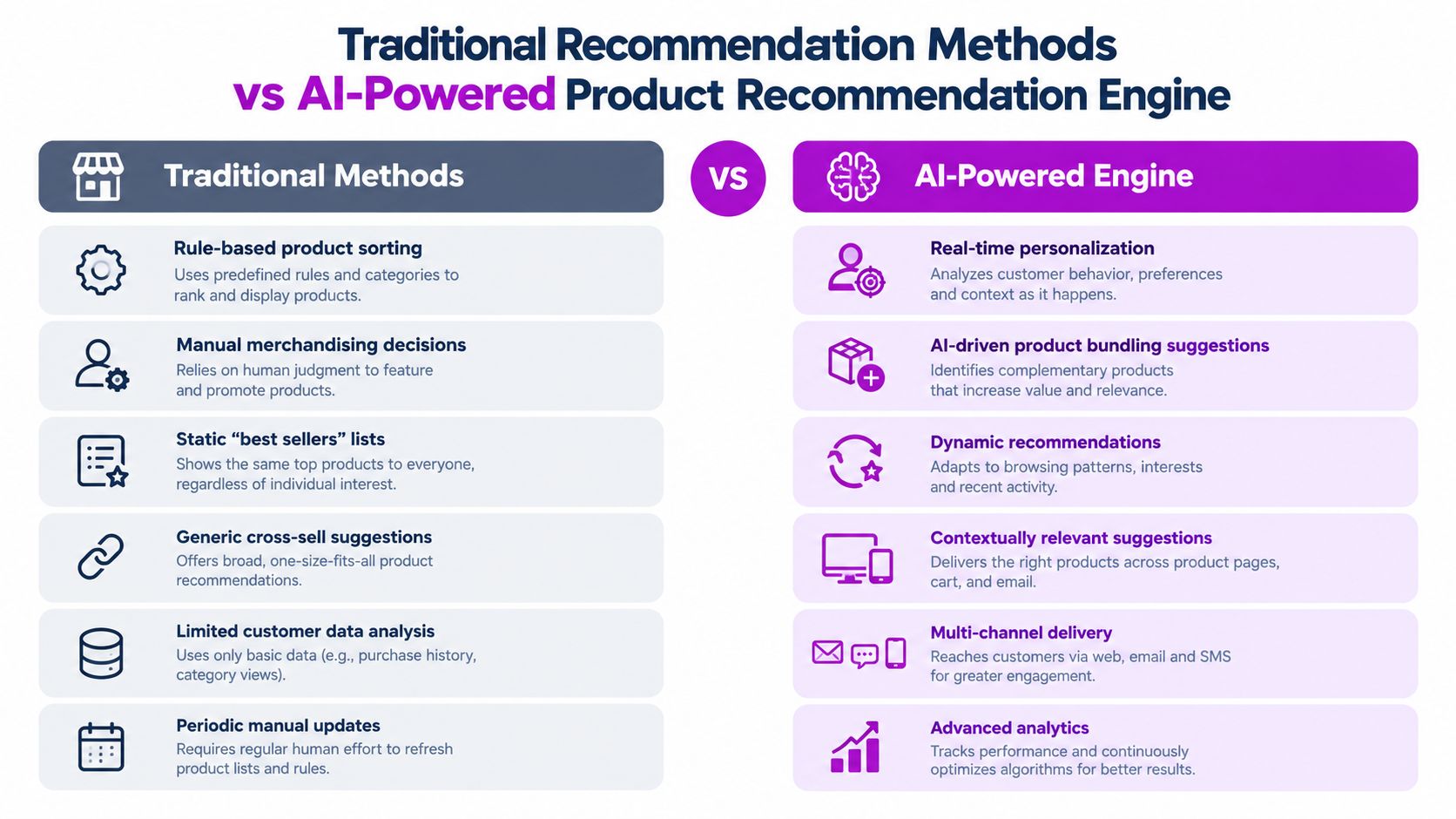
Personalized recommendations can be valuable, but “AI recommendations for every store” is too broad to position or build effectively. The better opportunity is a recommendation workflow for a specific merchant type, such as beauty brands managing routine-based products, fashion retailers coordinating complementary items, or subscription businesses trying to guide the next purchase.
The buyer is usually a merchandiser, ecommerce manager, or retention lead. Their problem isn't a lack of charts. They need recommendations that respect margin, stock availability, collection priorities, and brand rules, then allow a person to approve or adjust the result.
A focused first release could place recommendation blocks on product pages and in the cart. It should explain why an item was selected, exclude unavailable products, support manual overrides, and record which recommendation generated an interaction or order. Cross-channel email recommendations can come later.
- Core workflow: Import catalog and order data, generate recommendations, preview placements, and compare performance against a controlled baseline.
- Integrations: Shopify Admin GraphQL API, product and inventory data, Shopify events, email platforms, and customer data systems.
- Monetization: Charge by order volume, recommendation impressions, or the number of active storefronts. A tiered subscription makes sense only if merchants can understand the value they receive.
- MVP boundary: Start with one placement and one recommendation method. Don't build a general personalization suite before proving that merchants trust the output.
Clean product data matters more than a fashionable model. A merchant can't get useful recommendations from inconsistent product types, missing variants, or poorly maintained collections. For practical merchandising principles, see this guide to ecommerce product recommendations.
2. Advanced Conversion Rate Optimization Testing Platform
Most Shopify stores don't need a multivariate testing laboratory on day one. They need a safer way to test a product page headline, shipping message, offer structure, or cart intervention without asking developers to rebuild the theme for every experiment.
The strongest user is an ecommerce manager or CRO lead at a store with enough traffic to learn from controlled tests. The product should connect a hypothesis to a change, a selected audience, and a decision. A dashboard that reports clicks without helping the team decide what to ship won't retain serious users.
The MVP should focus on high-value storefront surfaces. Allow merchants to create a variant, define the audience, set guardrails, and monitor conversion events. Add a clear experiment log so teams can record the hypothesis, result, and follow-up action.
A credible workflow needs more than a visual editor:
- Testing controls: Support one-variable experiments first, with preview, rollback, and audience exclusions.
- Evidence layer: Show primary conversion events alongside revenue per session, add-to-cart activity, and checkout progression.
- Technical foundation: Use Shopify theme extensions, webhooks, event tracking, and privacy-conscious session data.
- Commercial model: A subscription based on active experiments or monthly visitor bands can align price with usage, but the app must communicate limits clearly.
Don't promise automatic conversion lifts. Merchants need reliable test design and clean attribution more than impressive claims. The product can later add heatmaps, recordings, and behavioral analysis, but those features shouldn't delay the first experiment.
For a Shopify-specific approach to experimentation, connect the product thesis with conversion rate optimization using AI.
3. Intelligent Inventory and Demand Forecasting
Inventory forecasting becomes a painful problem when a merchant sells across several channels, manages multiple locations, or relies on suppliers with uncertain lead times. The app opportunity isn't predicting demand. It's helping a specific operator make a reorder decision with enough context to trust it.
The primary user could be an operations manager at a growing brand with seasonal products, a purchasing lead managing wholesale commitments, or a founder still maintaining reorder points in spreadsheets. Each user needs a different starting workflow, so the product should choose one segment instead of serving every catalog.
A narrow MVP might cover one sales channel, one warehouse, and a selected group of products. It can ingest historical orders, identify recurring demand patterns, suggest reorder points, and let the user approve purchase recommendations. Supplier purchase orders and multi-location transfers can follow after the forecast earns trust.
Forecasting is only useful when it changes a purchasing decision before the stock problem arrives.
The technical risks are substantial. Missing historical data, promotional spikes, discontinued products, and supplier delays can all make a forecast misleading. The interface should show assumptions, data gaps, confidence ranges qualitatively, and the reason a recommendation changed.
- Integrations: Shopify orders and inventory, warehouse systems, supplier feeds, purchase orders, and fulfillment platforms.
- Monetization: Price by active SKUs, locations, or forecasted units. Avoid charging for a level of complexity the merchant hasn't adopted.
- Validation: Interview the person who approves replenishment, not only the person who reviews analytics.
- MVP boundary: Begin with recommendations and approval. Fully automatic ordering should wait until failure handling is proven.
4. Dynamic Pricing and Competitive Intelligence Tool
Dynamic pricing sounds attractive until a brand considers margin leakage, inconsistent prices between channels, and customer distrust. That tension creates a better product thesis: a pricing copilot that recommends controlled actions instead of changing every price without approval.
The ideal customer isn't every Shopify merchant. It might be a catalog-heavy retailer with frequent competitor movement, a brand managing seasonal markdowns, or a marketplace seller protecting margin across channels. The buyer needs to define rules for minimum margin, product exclusions, pricing windows, and approval rights before any automation runs.
A useful first workflow could monitor selected competitor products and alert the merchant when a meaningful change occurs. The app can combine that signal with inventory position and merchant-defined margin rules, then recommend an action. Automatic repricing is a later step, not the MVP.
- Data collection: Capture competitor observations with clear timestamps and product matching confidence.
- Merchant controls: Provide minimum margins, maximum change limits, protected products, and approval queues.
- Integrations: Shopify products and inventory, marketplaces, pricing feeds, analytics, and ERP systems.
- Monetization: Charge by monitored products or competitive sets. The value comes from a decision process, not from collecting more data.
- Validation: Ask who approves pricing changes and which products create the most manual work.
Avoid building a generic price-scraping dashboard. A merchant won't pay just to see that a competitor changed a price. They may pay for a reliable recommendation that explains the commercial trade-off and leaves control with the operator.
A strong vertical wedge could be seasonal markdown management or margin protection for a defined product category. That focus makes onboarding, data matching, and the sales message much easier.
5. Customer Data Platform and Unified Analytics
A customer data platform can become an expensive integration project if it starts with every possible data source. The more buildable opportunity is a single customer profile tied to one decision, such as identifying repeat-purchase segments, coordinating consent-aware campaigns, or reconciling customer activity across multiple storefronts.
The buyer may be a retention lead, marketing operations manager, or Shopify Plus administrator. They need trustworthy identity resolution and usable segments, not another disconnected report. The app should make it obvious which records were combined, which consent signals apply, and where a segment can be activated.
Start with core Shopify customer and order data. Add email, SMS, advertising, support, and mobile events only after the first use case works. Data governance belongs in the initial product because a platform that cannot explain how it stores, synchronizes, and deletes customer information creates adoption risk.
A practical initial architecture includes:
- Unified profiles: Combine customer, order, product, and event records with visible matching rules.
- Consent controls: Store permissions by channel and market, and make suppression behavior explicit.
- Activation: Send a validated segment to one marketing or support destination rather than promising every integration.
- Reliability: Include sync logs, replayable failures, deduplication, and a clear audit trail.
- Monetization: Use a subscription tied to active profiles, connected destinations, or data volume, with a simple entry plan.
Privacy and compliance aren't expansion features. The app should support configurable retention, role-based access, and merchant control over connected systems from its first release. A smaller, trustworthy data layer can beat a broader platform that takes months to configure.
6. Post-Purchase Experience and Customer Retention Engine
The order confirmation is not the end of the customer journey. It starts a period when shoppers want accurate delivery information, useful product guidance, and an easy path to a second purchase. The opportunity is a post-purchase workflow that connects those moments without flooding customers with messages.
The best initial customer may be a consumables brand, subscription retailer, or multi-product merchant with repeat-purchase potential. The user is often a retention manager who currently coordinates shipment updates, review requests, education, replenishment prompts, and loyalty campaigns across several tools.
An MVP should choose one post-purchase job. For example, it could combine order-status communication with a replenishment reminder based on the product purchased. It should suppress messages when an order is delayed, respect channel consent, and let the merchant edit every message before activation.
- Operational foundation: Sync fulfillment events, delivery status, returns, cancellations, and customer preferences.
- Customer experience: Provide branded tracking, useful product instructions, and clear support paths.
- Retention logic: Trigger replenishment or cross-sell messages from product and order context, not from a generic calendar.
- Integrations: Shopify orders, fulfillment partners, SMS and email providers, loyalty systems, and help desks.
- Monetization: Combine a platform subscription with usage-based messaging costs, while making provider charges transparent.
Don't lead with a large loyalty program. Rewards, tiers, and referrals can become distractions if the merchant still sends late or irrelevant order communication. Fix the operational sequence first, then add retention mechanics where the data supports them.
7. SEO and Technical Store Performance Auditing
A Shopify SEO audit app should do more than list warnings. Merchants need prioritization, ownership, and a clear path from issue to correction. A report containing hundreds of alerts can create work without improving the store.
The target user might be an ecommerce manager without an in-house technical SEO team, an agency managing several stores, or a developer responsible for theme quality. Their recurring problem is finding technical issues early and explaining which fixes matter to revenue, discoverability, accessibility, or user experience.
A focused MVP can monitor a defined set of store conditions: broken links, metadata completeness, canonical signals, structured product information, image weight, mobile rendering, and theme changes. Each issue should include affected URLs, severity, suggested action, and a way to mark ownership.
The product becomes more valuable when it tracks changes over time rather than producing a one-off scan.
- Workflow: Scan, prioritize, assign, fix, rescan, and document the result.
- Integrations: Shopify products and themes, Search Console, analytics, page-performance data, and issue-management tools.
- Monetization: Charge by monitored storefront, crawl depth, or active issue volume. Agencies may need workspace and client reporting features.
- MVP boundary: Focus on detection and remediation guidance before adding rank tracking or competitor intelligence.
- Technical caution: Don't recommend changes that can break theme logic, indexing, checkout behavior, or accessibility.
Merchants may already use Lighthouse and general SEO crawlers. A Shopify-specific product must earn its place by connecting findings to Shopify objects, theme files, collections, redirects, and publishing workflows. Agencies looking to support this work can also explore ecommerce SEO services.
8. SMS and Marketing Automation Orchestration Platform
Another email and SMS platform won't win because it has more triggers. It needs to coordinate a specific lifecycle problem better than the tools a merchant already owns. Good starting points include delivery communication, browse-to-purchase recovery, replenishment, or consent-aware post-purchase education.
The buyer is usually a lifecycle marketer who wants fewer manual campaigns and more consistent customer journeys. The app should unify events from Shopify with channel preferences, customer behavior, and product context. It also needs an explicit rule for what happens when a customer qualifies for conflicting campaigns.
A narrow MVP might orchestrate one journey across email and SMS. For example, a delayed-order flow could send an email with updated information, suppress promotional messages, and route support-risk cases to a help desk. This is more valuable than launching with a visual builder that supports every hypothetical journey.
- Consent layer: Capture, store, and honor channel permissions before sending.
- Journey controls: Add frequency caps, quiet periods, suppression rules, and timezone handling.
- Measurement: Attribute clicks, purchases, unsubscribes, and support contacts to the journey.
- Integrations: Shopify events, email and SMS providers, customer support, loyalty, and analytics systems.
- Monetization: A subscription plus transparent message usage can work, but merchants shouldn't pay twice for the same provider delivery cost.
Deliverability and trust belong in the MVP. A campaign that generates short-term engagement while increasing complaints or unsubscribes is not a successful workflow. For broader marketing operations context, see how to find top tech talent faster, then narrow the product back to one Shopify-owned customer journey.
9. Multi-Merchant and B2B Wholesale Platform
Multi-vendor commerce is attractive because it promises a larger marketplace, but the operational burden is substantial. Vendor onboarding, catalog approval, payouts, commissions, inventory synchronization, fulfillment responsibility, and customer support all need defined owners.
The best first customer is not a merchant casually testing a marketplace idea. It's an operator with a clear wholesale or multi-seller model, such as a manufacturer adding approved distributors, a retailer curating independent suppliers, or a brand running separate B2B and DTC purchasing paths.
The MVP should select one commercial model. A B2B wholesale app can begin with account-specific catalogs, price lists, quantity rules, quick ordering, and approval workflows. A marketplace app needs vendor onboarding, product moderation, commission records, and order routing. Combining both creates a large product before the team understands which workflow merchants will pay for.
- Buyer workflow: Support company accounts, purchasing permissions, order minimums, payment terms, and repeat ordering.
- Operator workflow: Provide vendor approval, catalog controls, commission logic, payout exports, and dispute records.
- Integrations: Shopify products and orders, inventory systems, payment providers, tax tools, fulfillment, and ERP platforms.
- Monetization: Charge the store operator a subscription, with optional usage or transaction pricing only when the value is clear.
- Risk control: Log every price, inventory, and payout change so the operator can resolve disputes.
A multi-merchant product succeeds on governance, not just storefront presentation. The app must make responsibility visible when a product is unavailable, an order ships late, or a vendor disputes a commission.
The category also faces established tools and concentrated adoption in mature Shopify environments, as documented in a 2026 Shopify app ecosystem analysis. That makes a vertical or workflow-specific entry point more defensible than a general marketplace builder.
10. Content Generation and Product Description AI Assistant
Content generation is the most obvious AI direction for Shopify, which is precisely why a generic writing app is difficult to differentiate. Shopify's 2025 AI trends guidance reports that 69% of surveyed store owners use AI for content generation, so a new product needs to solve the workflow around content, not merely produce more words.
A better buyer is a growing brand with a large catalog, multiple markets, or frequent product updates. The pain is usually inconsistent attributes, missing localization, slow approval, and repetitive editing across products and collections. The app should connect generation to structured product data and publishing governance.
The MVP can create drafts for product descriptions and metadata using approved attributes, brand rules, banned claims, and market-specific requirements. Every output should remain unpublished until a person reviews it. Version history, approval roles, and a clear record of the source data matter more than a long list of tone presets.
The valuable AI app may generate less content and provide more control over what gets published.
Build the workflow around quality:
- Input validation: Flag missing product attributes before asking AI to write.
- Brand controls: Apply approved terminology, tone rules, formatting, and restricted claims.
- Human review: Route drafts to merchandisers or marketers with comments and approval status.
- Localization: Support market-specific review rather than translating every field automatically.
- Monetization: Charge by active products, generated drafts, or team seats, with limits that are easy to understand.
A more defensible extension is AI governance for merchandising. The app could inventory connected AI tools, manage permissions, log prompts and outputs, flag unsupported claims, and preserve an audit trail across teams and vendors. That turns content generation into accountable commerce operations.
Top 10 Shopify App Ideas: Feature Comparison
| Solution | Implementation Complexity 🔄 | Resource Requirements ⚡ | Expected Outcomes ⭐📊 | Ideal Use Cases 💡 | Key Advantages ⭐ |
|---|---|---|---|---|---|
| AI-Powered Product Recommendation Engine | 🔄 High, data integration & model training | ⚡ Moderate–High, historical data, compute, analytics | ⭐ Significant AOV lift (15–30%); 📊 higher CLTV & engagement | Personalization for retail catalogs; fashion & beauty DTC | Real-time personalization, multi‑channel recommendations, analytics |
| Advanced CRO Testing Platform | 🔄 Medium, test setup & discipline | ⚡ Low–Medium, traffic, analyst time, tracking tools | ⭐ Measurable conversion gains (10–40%); 📊 clear optimization insights | High‑traffic pages, checkout & product page optimization | No‑code A/B & multivariate testing; statistical significance tools |
| Intelligent Inventory & Demand Forecasting | 🔄 High, data cleaning & supplier integrations | ⚡ High, historical sales, ERP/WMS integration, ops support | ⭐ Fewer stockouts/overstock; 📊 reduced carrying costs & better cash flow | Multi‑location retailers, inventory‑heavy or seasonal brands | Predictive forecasts, automated reorder points, multi‑channel sync |
| Dynamic Pricing & Competitive Intelligence Tool | 🔄 Medium–High, pricing rules & monitoring | ⚡ Medium, competitor feeds, margin configs, monitoring | ⭐ Revenue & margin optimization; 📊 responsive price signals | Competitive categories (electronics, fast‑turn SKUs) | Automated repricing, elasticity analysis, margin protection rules |
| Customer Data Platform (CDP) & Unified Analytics | 🔄 High, data strategy, privacy & integrations | ⚡ High, engineering, governance, analytics team | ⭐ Unified customer view; 📊 improved retention, personalization & attribution | Omnichannel enterprises, Shopify Plus, advanced personalization | Single source of truth, advanced segmentation, compliance tooling |
| Post-Purchase Experience & Customer Retention Engine | 🔄 Medium, multi‑channel config & loyalty setup | ⚡ Medium, comms channels, CX ops, loyalty management | ⭐ Increased CLTV & repeat purchases; 📊 fewer support inquiries | Subscription brands, D2C with repeat purchase models | Loyalty & replenishment automation, white‑label tracking, win‑backs |
| SEO & Technical Store Performance Auditing | 🔄 Medium, audit automation; fixes need dev work | ⚡ Low–Medium, SEO expertise + development resources | ⭐ Improved organic visibility over time; 📊 prioritized technical fixes | Brands pursuing organic growth, performance‑sensitive stores | Continuous audits, Core Web Vitals & schema recommendations |
| SMS & Marketing Automation Orchestration Platform | 🔄 Medium, workflow & compliance setup | ⚡ Medium, SMS costs, content ops, deliverability tools | ⭐ Higher engagement & recovered revenue; 📊 improved retention metrics | Time‑sensitive comms, engaged audiences, lifecycle marketing | Behavioral SMS/email automation, deliverability & testing tools |
| Multi‑Merchant & B2B Wholesale Platform | 🔄 High, vendor onboarding & payout complexity | ⚡ High, vendor ops, payment integration, inventory sync | ⭐ New B2B revenue streams; 📊 multi‑vendor performance visibility | Manufacturers, marketplaces, brands expanding to B2B | Vendor management, bulk ordering, commission & payout automation |
| Content Generation & Product Description AI Assistant | 🔄 Low–Medium, integration & prompt tuning | ⚡ Low–Medium, product data, editors for review | ⭐ Faster content production; 📊 improved SEO & discoverability | Large catalogs, brands scaling product listings | Bulk SEO‑optimized content, brand voice consistency, multi‑language support |
Choose the Smallest Shopify App Worth Paying For
These Shopify app ideas fall into distinct validation paths. Recommendations and CRO testing are growth experiments. They need a merchant who can define a baseline, approve a change, and evaluate a commercial outcome. The MVP should make one experiment easy to launch and interpret, not attempt to own the entire marketing stack.
Inventory forecasting and post-purchase workflows are operational systems. Their buyers care about reliability, exception handling, and whether the product fits existing fulfillment and support processes. Validate the workflow with the person who handles stock decisions or customer communication every day. A polished interface won't compensate for missing webhooks, unreliable synchronization, or poor recovery when an integration fails.
CDP, SEO auditing, SMS orchestration, and AI content governance are infrastructure products. Their value depends on data quality, permissions, consent, auditability, and integration depth. Start with one dependable data flow, one user role, and one activation destination. Expand only after merchants can explain what the app changed and why they trust it.
B2B wholesale and multi-merchant platforms require a different validation path. Interview operators about account structures, pricing rules, vendor responsibilities, payment terms, inventory ownership, and dispute resolution. A marketplace demo can look compelling while hiding the operational work that determines whether the business is viable.
The competitive context makes narrow positioning essential. Industry tracking recorded approximately 5,649 Shopify apps in 2021, 7,014 in 2022, and 10,557 in 2023, followed by a reported decline to about 9,701 in 2024 and a later report of 11,905 apps in the fourth quarter of 2024, according to this Shopify App Store ecosystem compilation. Those figures point to a market with strong developer interest and meaningful pressure on weak products. A broad clone needs a compelling technical or workflow advantage.
Use this sequence before committing to a full build:
- Interview the ideal merchant: Speak with the person who owns the recurring pain and ask what they do today.
- Confirm the costly workflow: Identify the spreadsheet, manual handoff, delayed decision, lost sale, or operational error behind the complaint.
- Define one measurable outcome: Choose a result the merchant can observe, such as faster activation, fewer manual updates, cleaner approvals, or more completed experiments.
- Prototype the narrowest integration: Connect only the Shopify data and destination required to complete that workflow.
- Test willingness to pay: Ask for a paid pilot, deposit, or signed commitment before adding a long feature backlog.
- Design for failure: Include permissions, logs, idempotent jobs, webhooks, retries, and recovery paths when the app touches revenue or customer data.
Monetization should match usage and value. A forecasting app may price by active SKUs or locations. A messaging app may combine a subscription with delivery usage. A governance tool may charge by connected tools or team seats. Avoid pricing that makes the merchant calculate your value every month.
Privacy, compliance, data quality, and Shopify-specific constraints belong in the MVP plan, not in a later compliance sprint. Larger stores may need granular scopes, bulk operations, audit logs, GraphQL Admin API support, and transparent attribution. Smaller merchants may need the opposite, fast setup, minimal configuration, and a first successful workflow in one session. The product should choose its primary segment and build around that reality.
Validate the merchant problem before building the full platform.
ECORN offers Shopify app development, API integrations, CRO, design, and Shopify Plus development for public apps and applications serving multiple stores. If you're assessing one of these Shopify app ideas, ECORN can help turn merchant research into a focused build and deployment plan.
ECORN helps brands validate and develop Shopify apps, integrate store data with operational systems, and improve storefront performance through Shopify development and CRO. Visit ECORN to discuss a narrow app MVP or a multi-store commerce project.


Conversion Rate Optimization for Landing Pages: The Playbook
Shopify Plus Automation: A Guide for 2026
10 Social Selling Platforms for Shopify Merchants

Shopify Website Design Examples: 7 Stores Worth Studying
7 Ecommerce Newsletter Examples for Shopify Brands
One Product Shopify Store: Build and Scale

Mobile Pop Up Strategy for Shopify Stores That Converts

Sitemap for Shopify: How to Find, Optimize, and Submit It

7 Single Product Websites Worth Emulating
Product Variants Shopify: The Complete 2026 Guide

Ecommerce Analytics Consulting for Growth
What Is AI Integration for eCommerce
How to Choose the Right eCommerce Website Development Firm
E Business Strategy Implementation
Conversion Tracking Setup for Shopify Stores
BigCommerce vs Shopify Plus Which Enterprise Wins in 2026
Shopify Theme Kit: Setup, Commands, and Migration Guide
Shopify Extension Development: A Practical 2026 Guide
Shopify Speed Score Explained and How to Improve It
Shopify Mobile Optimization: The 2026 Playbook

How to Add Subcategory in Shopify for Better UX
How to Implement Structured Data for Ecommerce in 2026

SEO App Mobile: Shopify Store Optimization Guide
Shopify Plus Support: What It Includes and How to Choose

Google Ads for Shopify: The Complete 2026 Playbook

Shopify New York: How to Find and Hire the Right Agency

Google Search Console for Shopify: The Complete Setup
First Party Data Collection for eCommerce Growth
FAQ Online Store Guide: Build and Measure It Right
Do FB Ads Work for eCommerce in 2026?
One Page Checkout for Shopify: Design and Implementation
Shopify GraphQL vs REST: The 2026 Developer Decision
Shopify Ecommerce Consulting: Strategy, Pricing &

Are Reddit Ads Worth It for eCommerce Brands
Shopify Title and Meta Description: A Practical 2026 Guide

Product Video Best Practices for Shopify Brands
Real-Time Inventory Management: A 2026 Guide
AI Chatbot Integration for Shopify Stores
Affiliate Program Management: A Shopify Guide
10 Best Performance Monitoring Tools for Shopify in 2026
Digital Asset Management for eCommerce Brands in 2026
Every Type of Facebook Ads Explained for eCommerce Growth
Product Information Management Explained for Shopify Brands
Support Ticket System: A Guide for Shopify Stores

10 Best Customer Service Tools for Shopify in 2026

Can I Start a Business with No Money? a 2026 Blueprint

What Sells Good on Etsy: Best Niches for 2026

Shopify Add to Cart Button: A Practical 2026 Guide

Customer Feedback Automation: A Practical eCommerce Guide
Critical Rendering Path: A Guide for Shopify Stores

How to Promote on TikTok for eCommerce in 2026

B2B eCommerce Consulting That Drives Real Revenue
10 Best Practices for Site Navigation in 2026
Return vs Refund for Shopify Stores: A Practical Guide
What Is Customer Lifetime Value and Why It Matters
What Is Voice of Customer Research for eCommerce

SMS Marketing for Ecommerce That Actually Converts

Master How to Improve Email Deliverability in 2026

Top 7 eCommerce Partners NYC for Shopify Brands in 2026

Machine Learning for Ecommerce: Boost Your Shopify Store

Beauty Market Research: Your 2026 Growth Guide

Shopify International Expansion: A 2026 Roadmap

What Does CRO Stand for in Business: Understanding CRO

Shopify Visual Merchandising: A Playbook for Higher Sales

Shopify Landing Page Design: Master Conversion in 2026
10 Best AI SEO Optimization Tools for Shopify in 2026

Agentic AI for Ecommerce: Boost Your Sales in 2026
Mastering Email Marketing Data for eCommerce Growth

Conversion Rate Optimisation Australia: Boost Your Sales
Conversion Rate Optimization AI: Your Shopify Store Guide

10 Product Bundling Strategies for Shopify in 2026
How to Increase Customer Lifetime Value: A Shopify Playbook
AI Customer Service Automation: Shopify Guide 2026

Clean Website Design: A Shopify Conversion Playbook

Omnichannel Retail Strategy: A Shopify Playbook
Product Data Enrichment: A Guide for Shopify Brands

Instagram Shopping Features a Guide for Shopify Stores
What Is Revenue Optimization: A Holistic RevOps Guide

Benefits of Conversion Rate Optimization: Boost Your
WordPress to Shopify Migration: Your 2026 Seamless Switch
Boost Sales: Ecommerce Payment Processing Guide 2026
Unified Commerce Platform: Benefits, KPIs & Shopify Guide

How to Reduce Bounce Rate eCommerce: Your 2026 Guide
Shopify API Integration: A Practical End-to-End Guide

How to Implement Data Governance: A 2026 Guide
Shopify Store Development Cost: A 2026 Breakdown
What Is Server Side Tracking: The Shopify Guide 2026
Marketing Automation Workflows: A Shopify Guide for 2026
Shopify: How to Reduce Technical Debt

Shopify UX Design Change: A Playbook for Growth
User Generated Content Strategy: Shopify Playbook
Shopify Pause and Build Plan Cost: A Complete 2026 Guide

Compare at Price on Shopify: A Complete Guide for 2026

Where Can I Sell My Prints? 10 Best Platforms for 2026
Shopify Order Management System: The Ultimate Guide 2026
What Is Marketing Attribution? an eCommerce Guide for 2026

10 Best Black Friday Sales Sheets for 2026

Discover the Top Social Media Marketing Agencies For
Consumer Confidence Definition for eCommerce in 2026

What Is Social Commerce? Your 2026 Guide to Boosting Sales


newsletter in your inbox