

Your sales are growing, but the Shopify theme that helped you launch is now creating problems. Product pages feel repetitive, mobile navigation takes too many taps, campaign changes require developer time, and the checkout experience gives you little visibility into where buyers hesitate. The store still works, but every design decision now carries a larger commercial cost.
That's the point at which a Shopify design agency becomes relevant. You're not hiring one only to make the storefront prettier. You're hiring a specialist to connect brand presentation, platform implementation, customer behavior, and measurable commercial outcomes. The right partner can improve the shopping journey without treating design as a collection of isolated screens.
The wrong partner will deliver polished mockups, add unnecessary complexity, and leave you with no reliable way to tell whether the investment worked. Here's how to separate the two, evaluate evidence, choose an engagement model, and ask the AI-discovery questions that increasingly belong in a Shopify brief.
Why Your Store Outgrew the DIY Approach
A founder usually notices the problem in small moments. A best-selling product needs a more persuasive landing page, but the theme only supports rigid sections. A promotion requires a new merchandising path, but the navigation has grown into an unwieldy list. Customers ask about shipping costs even though the information exists somewhere on the site. The team keeps adding apps, and the storefront becomes harder to maintain.
The original theme wasn't a mistake. It was appropriate for proving demand. The problem starts when a store's commercial complexity grows faster than its design system. More products, variants, markets, subscriptions, campaigns, and integrations create decisions that a generic theme can't always handle cleanly.
Practical rule: Hire an agency when storefront decisions affect revenue, operational effort, or customer confidence, not merely when the site looks dated.
A specialist should begin by identifying the business constraint. Is the issue weak product discovery, confusing merchandising, poor mobile usability, slow content production, an awkward cart, or a checkout that hides important costs? Different problems require different interventions. A full redesign may be the right answer, but it may also be an expensive way to avoid fixing one high-friction step.
The moment design becomes infrastructure
At an early stage, one person can choose a theme, write product copy, install an app, and publish a campaign. At a later stage, the store becomes a shared operating system for marketing, merchandising, customer service, and technology teams. A new component must work across product templates, collections, editorial pages, and mobile layouts. A discount must coexist with subscriptions, inventory rules, and accelerated payment methods.
That's why a Shopify design agency should be evaluated as a commercial and technical partner. You need people who can translate customer behavior into interface decisions, build within Shopify's constraints, and document what changed. You also need a measurement plan that distinguishes a useful improvement from a visually impressive release.
A good engagement leaves you with more than a refreshed theme. It leaves you with clearer priorities, a maintainable component system, a better-instrumented funnel, and a process for deciding what to improve next.
What a Shopify Design Agency Actually Does
Think of a capable agency as an architect plus contractor. The architect defines the structure, circulation, and priorities. The contractor turns those decisions into a functioning building. For ecommerce, the agency should also install the equivalent of sensors and maintenance routines, so your team can see how shoppers move through the store and keep improving it after launch.
Design starts with the shopping task
The design team maps how customers find, evaluate, compare, and purchase products. That work can include information architecture, navigation, collection layouts, product-page hierarchy, mobile interactions, merchandising modules, and a visual system that supports campaigns without forcing every page into the same template.
The useful question isn't “Does this look premium?” It's “Can the intended customer understand the offer, trust the product, and take the next step without unnecessary effort?” A design review should connect each major decision to a customer task or business requirement.
Development turns the system into a store
Shopify development covers theme architecture, custom sections, Liquid implementation, app integrations, responsive behavior, analytics events, and quality assurance. For more complex organizations, the work may include Shopify Plus capabilities, multiple storefronts, international requirements, B2B functionality, or a migration from another platform.
Platform specialization matters because a design can be attractive in Figma and still be impractical in Shopify. The team must understand what belongs in the theme, what belongs in an app, how integrations affect performance and maintenance, and how checkout customization differs from storefront customization.
CRO makes improvement continuous
Conversion rate optimization should not mean changing button colors without a hypothesis. A serious team reviews funnel events, device behavior, search usage, cart interactions, error states, and checkout progression. It then prioritizes changes by expected customer impact and implementation effort.
Consulting adds the operating layer. The agency helps decide whether to redesign, test, simplify, integrate, or leave a component alone. It may also advise on subscriptions, retention, campaign architecture, analytics governance, and the division of work between your internal team and external specialists.
Before hiring, ask the agency to map its services to outcomes. UX work should clarify customer journeys. Development should create reliable, maintainable functionality. CRO should produce testable hypotheses and clean measurement. Consulting should help your team make better prioritization decisions.
For a broader view of partner selection, compare the criteria in this guide to choosing a Shopify marketing agency. The same principle applies here: judge the partner by the business problem it can solve, not by the number of services listed on its website.
The Measurable Benefits of Hiring Specialists
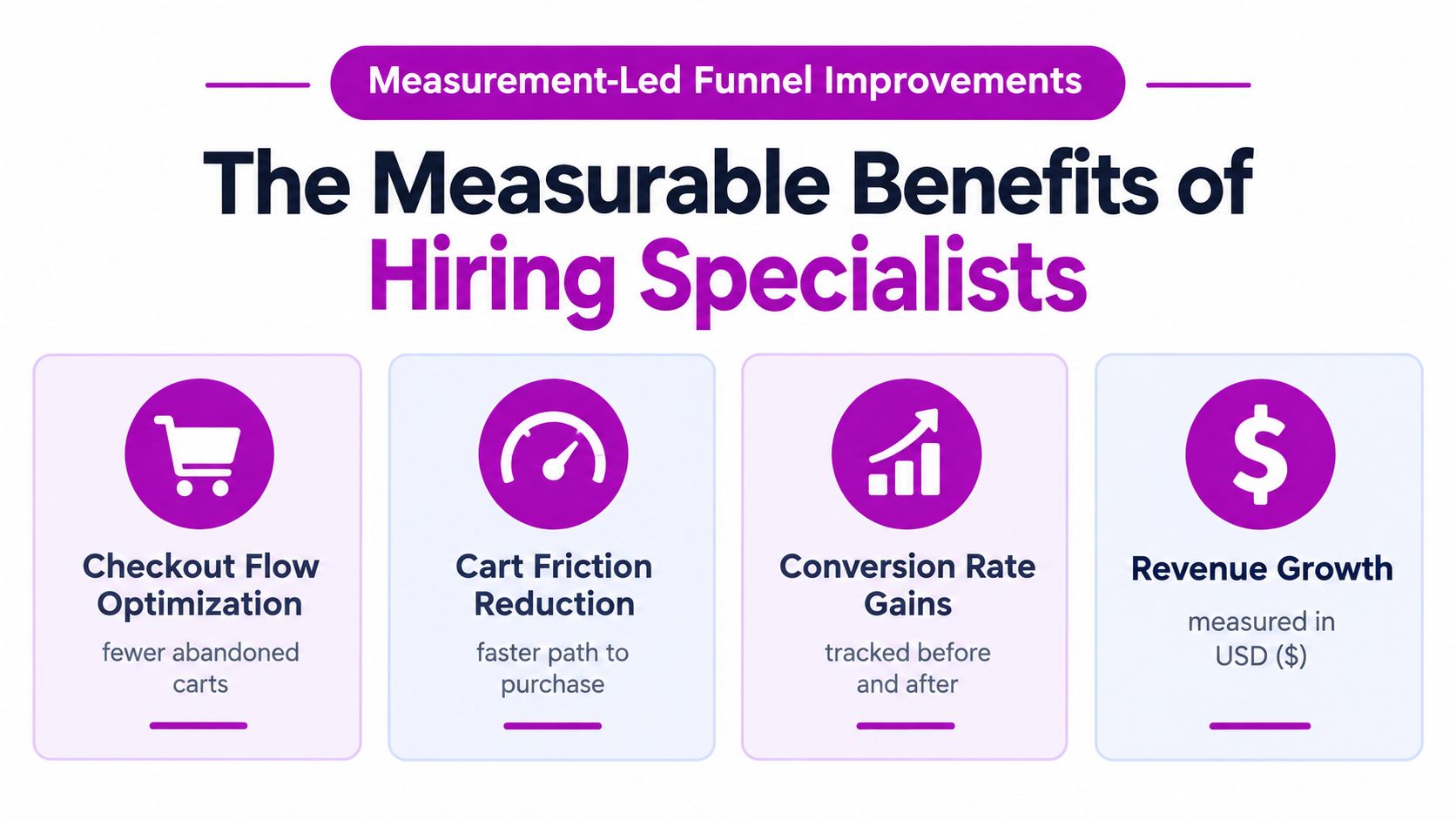
A specialist earns its fee by finding and fixing friction that a general design refresh can easily miss. Checkout is usually the clearest example. Baymard evaluated 344 leading US and European ecommerce sites, reviewing more than 30,000 checkout elements against over 110 usability guidelines. Its benchmark found 32 identifiable checkout improvements on the average site, and estimated that the average large ecommerce site could potentially increase conversion rate by approximately 35% through better checkout UX alone. Baymard's checkout usability research provides the evidence.
That doesn't mean an agency can promise a specific lift for your store. It means your checkout deserves structured investigation before anyone claims that a new visual style will improve performance. Baymard also reports that 65% of benchmarked sites have mediocre-or-worse checkout performance, while only 2% are rated good, which makes checkout quality a practical area for differentiation.
What the agency should investigate
A measurement-led team should instrument the funnel by device and step, then inspect where users encounter uncertainty or failure. Its recommendations should translate into concrete interface requirements:
- Guest checkout prominence: Don't force account creation before purchase unless there's a strong, tested reason.
- Form simplification: Remove fields that don't support fulfillment, compliance, payment, or a clear business need.
- Error recovery: Show precise, persistent messages and preserve entered information when a shopper makes a mistake.
- Delivery visibility: Explain shipping costs and timing before the final payment moment.
- Payment completion: Track whether shoppers reach, select, and complete available payment methods.
Cart architecture deserves the same attention. Baymard found that 23% of US online shoppers had abandoned an order in the previous quarter because the total order cost wasn't estimated upfront. The research also found that 58% of sites hinder comparison-oriented cart use, while 86% make quantity updates or item removal difficult. Those findings appear in Baymard's cart benchmark.
Requirements that follow from the evidence
Your agency should expose shipping, tax, and delivery estimates as early as the business rules allow. The cart should support immediate quantity changes, validation, removal, undo, and clear feedback when inventory, discounts, subscriptions, or accelerated payments alter the total.
Ask to track cost-estimate exposure, quantity-change failures, cart-edit completion, and checkout progression separately. Aggregate conversion rate can tell you that something changed, but these events help explain why. That distinction separates a specialist's diagnosis from a redesign justified by taste.
How to Evaluate an Agency's Portfolio and Process
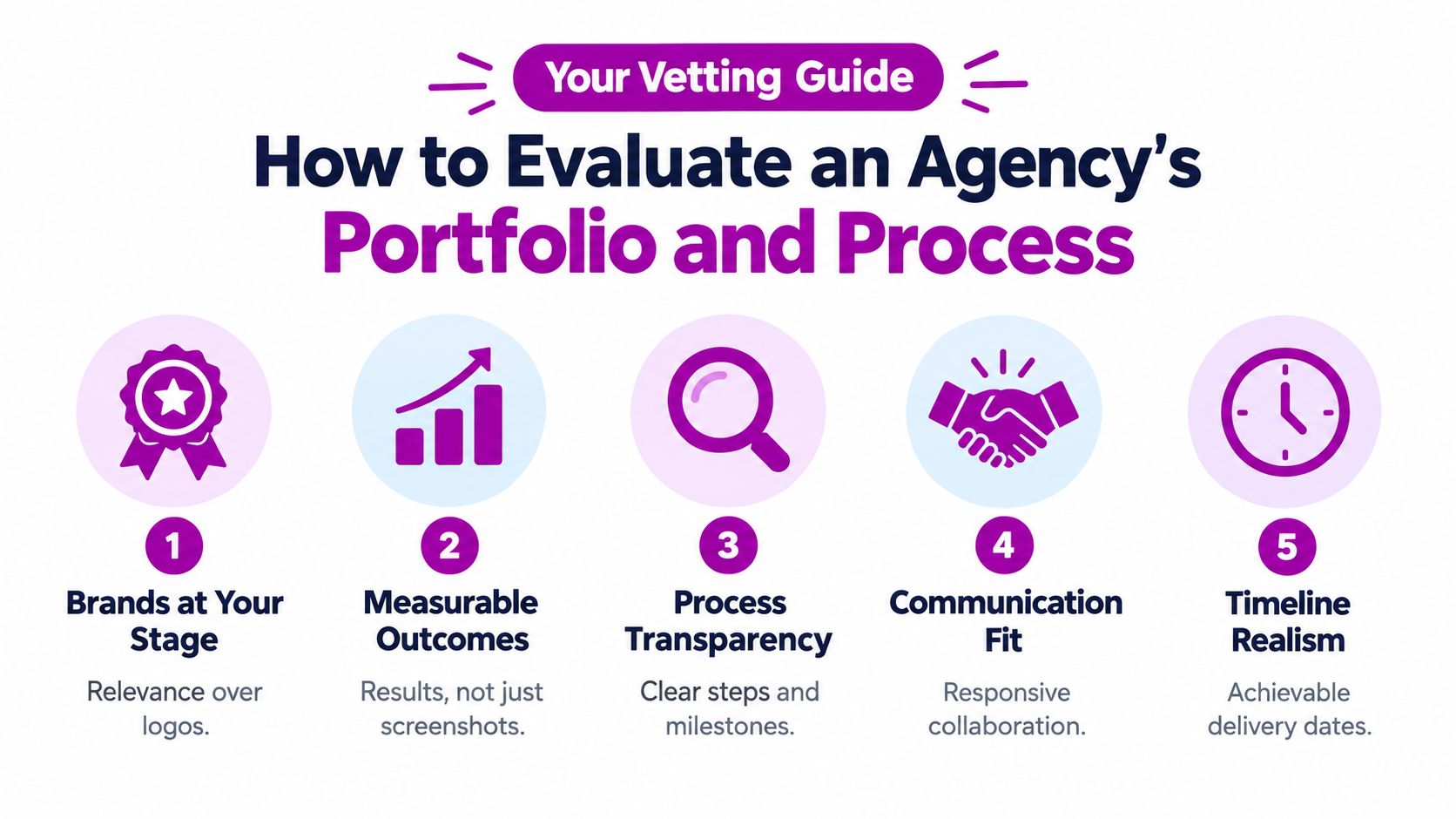
A polished portfolio can mislead you fast. Anyone can assemble attractive before-and-after screens. What matters is whether the agency can explain why the store changed, what constraints shaped the work, how success was measured, and who was responsible when the build hit real operational friction.
Start with the work that happened before any redesign concepts appeared. Strong Shopify teams describe the original problem in plain business terms: a weak product hierarchy, mobile navigation that buried key categories, checkout friction, migration limits, or a publishing workflow that slowed launches. They do not hide behind empty marketing adjectives that could describe any store.
Ask these questions on the first call, and listen for specific answers rather than polished talk tracks:
- What did you measure before proposing a solution?
- Which customer or business problem did the work target?
- How did you separate design impact from traffic, pricing, seasonality, or promotional changes?
- Which funnel events will you instrument before launch?
- Who owns theme development, QA, analytics, and post-launch fixes?
- What will my team be able to edit without developer support?
If the answers stay high level, keep pushing. A serious agency should be able to tell you which events matter at cart and checkout, how those events are segmented by device, and what they expect your team to monitor after launch. That is the difference between a redesign driven by taste and a redesign tied to evidence.
Use the portfolio to inspect process quality, not just visual style. Look for signs that the team can improve cart editing, cost-estimate visibility, and checkout progression. In 2026, add one more question: how will this build support AI-driven discovery, product understanding, and structured merchandising signals as search behavior keeps shifting beyond standard keyword visits. If the agency has no point of view on that, it is already behind.
Working arrangements matter too, but keep the discussion practical. A project works best when the problem is defined and the endpoint is clear. A subscription works best when the store needs ongoing design, development, testing, and maintenance capacity. A pilot can make sense if you need proof of collaboration before committing to a longer relationship. No single model is superior by default. Fit depends on the type of work you have.
Demand a process you can audit. That means a realistic discovery phase, written milestones, named owners, a definition of launch readiness, and a clear change-request path when priorities shift. Be careful with offers framed as unlimited support or full-service partnership. Those phrases sound reassuring, but they tell you nothing about available capacity, response times, escalation paths, or decision rights.
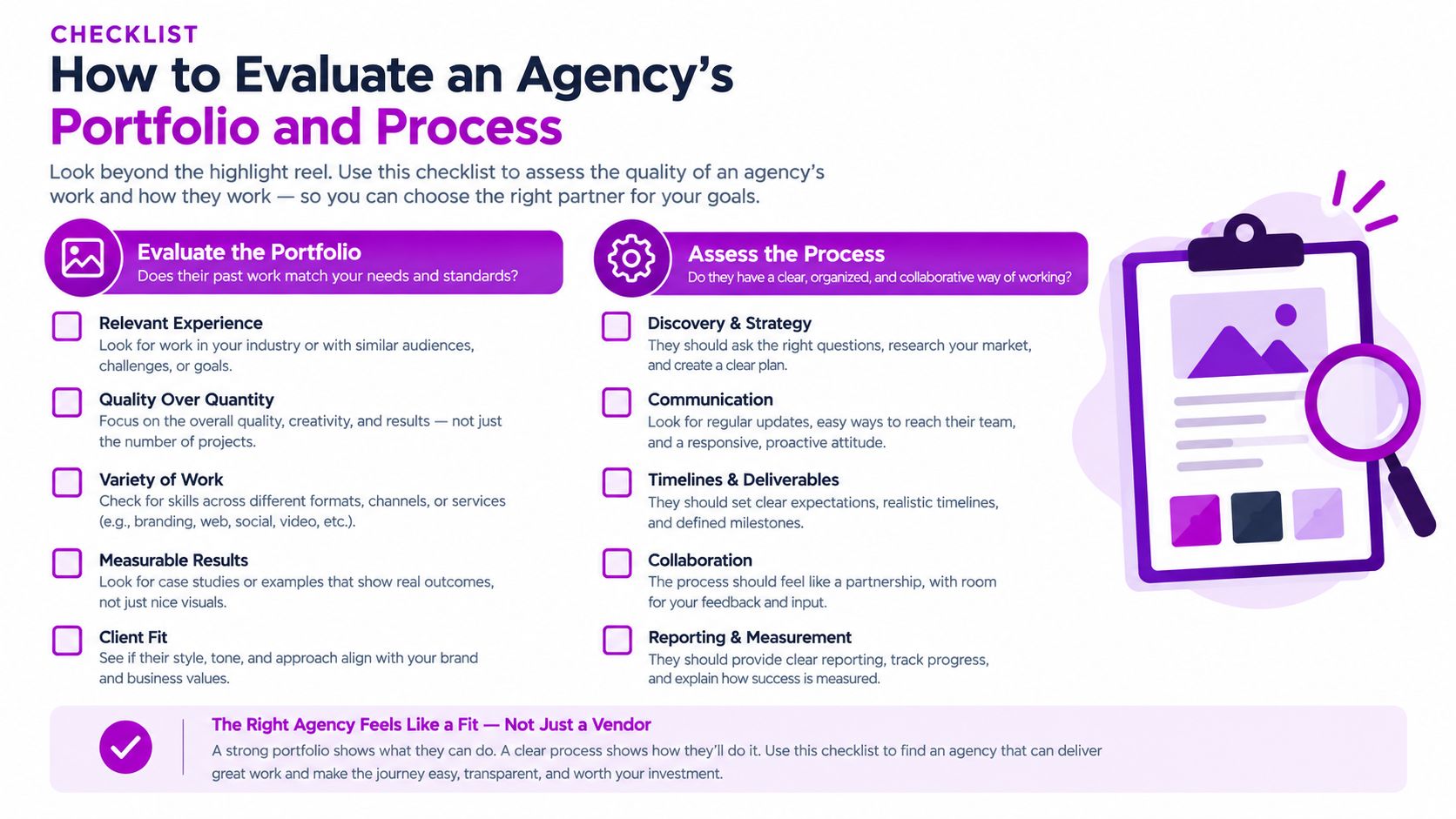
Use this checklist as a simple comparison tool while you vet agencies: A helpful checklist graphic for businesses to evaluate the portfolio and working process of a creative agency.
Comparing Project Pricing and Subscription Models
A low quote looks good until the real work starts. Then change requests pile up, launch dates move, and your team pays for every gap between the original scope and what the store actually needs. Pricing is not the decision. The fit between your operating model and the agency model is.
Use a project when the outcome is defined. That usually means a redesign, a migration, a new theme build, or a contained integration with clear owners on your side. Use a subscription when the work never really stops, because merchandising changes weekly, campaigns keep landing, tests need to ship, and post-launch issues need attention. If your roadmap changes every month, fixed scope will create friction.
Stage matters more than preference.
Emerging brands usually get the best value from a tightly scoped project. They need a dependable store foundation, cleaner UX, and a clear launch target, not an ongoing retainer that sits half-used. Growing brands with regular campaign calendars, active testing needs, and recurring design or development requests should lean toward a subscription, but only if the agency shows how work gets prioritized, how capacity is allocated, and how progress is reported. Established Shopify Plus merchants often need both. A major project may reset architecture or redesign checkout and cart flows, while ongoing capacity handles localization, experimentation, support, and iterative improvements.
Fair pricing is less about the label and more about the operating terms. You should see who is doing the work, what decisions require your input, which dependencies sit with your team, who owns analytics setup, and what happens after launch. If strategy, copy, photography, QA, app costs, or post-launch fixes are excluded, the proposal should say so plainly. If a subscription includes capacity limits, rollover rules, urgent requests, or work that falls outside the monthly scope, those rules should be explicit before you sign.
A pilot can be useful, but only for a specific reason. Use it to test communication quality, technical judgment, documentation, and measurement discipline on a contained assignment. Do not use it as a vague pre-sales exercise that delays real decisions.
One more point gets missed. In 2026, agency value is not only about shipping pages faster. Ask how the team measures checkout and cart UX changes, how it weighs project fees against subscription efficiency over time, and whether it is preparing your store content and structure for AI-driven discovery. If the answers are fuzzy, keep looking.
Review Shopify design and development services with that lens. Headline deliverables matter less than whether the engagement model matches the work your business will ask the agency to do.
Reading Case Studies Without Falling for Them
A beautiful case study proves that an agency can present a beautiful case study. It doesn't prove that the agency diagnosed the right problem or caused the reported result.

Read each example as an investigation. Look for the baseline, the change, the measurement window, the traffic context, and the agency's specific contribution. A result that follows a redesign may also reflect a new offer, a campaign, a pricing change, improved traffic quality, or seasonal demand. The case study should tell you how the team isolated those influences, or clearly admit that it couldn't.
A useful report might say that the team identified mobile product-page friction, introduced a clearer variant-selection pattern, instrumented the relevant interactions, and compared behavior against a defined baseline after launch. That's much more valuable than saying the brand received a “high-converting new experience.” If the agency can't explain what it measured, you can't judge the claim.
Subscription value looks different
A subscription-style agency shouldn't need one dramatic before-and-after story to justify its work. Its value should appear in the quality of the backlog, the speed of learning, the number of meaningful experiments completed, the reduction of recurring defects, and the clarity of monthly decisions.
Ask for a sample report. It should show completed work, findings, unresolved risks, next priorities, and a link between activity and business outcomes. More tickets aren't automatically better. A team that ships a smaller number of well-prioritized changes may be doing stronger work than one that produces a constant stream of decorative updates.
The emerging AI-referral conversation needs the same skepticism. Adobe reported that AI-source traffic to US retail websites grew 393% year over year in Q1 2026, and that AI-referred visitors converted 42% better than non-AI traffic in March 2026, as described in its analysis of AI traffic to retail sites. An independent analysis of 973 ecommerce websites and $20 billion in orders found that ChatGPT referrals represented less than 0.2% of ecommerce traffic and converted below organic search, affiliates, and paid search. Those findings come from different datasets and point in different directions.
The sensible conclusion isn't to buy an AI chatbot or promise autonomous checkout. Ask the agency how it will improve machine-readable product information, clear attributes, accessible content, consistent variant data, and structured policies, then how it will distinguish AI referrals from on-site AI interactions and prove incremental revenue.
Your Decision Framework and Next Steps
Start with your operating reality, not an agency's preferred package. An emerging brand with one storefront and a defined theme problem should begin with a focused project. A growing brand with continuous merchandising, campaign, and CRO demands should assess a subscription. A Shopify Plus organization with complex integrations or multiple storefronts should look for a partner that can combine architecture, implementation, governance, and ongoing optimization.
Shortlist two or three agencies. Give each the same context, including your current platform setup, primary commercial problem, internal capacity, key integrations, and measurement limitations. Ask them to recommend what they'd do first, what they'd leave alone, and how they'd prove the work mattered.
Use a pilot to reduce selection risk
A pilot should have a real business purpose, not a fake exercise designed only to compare presentations. Suitable pilots include a cart and checkout audit, a product-page redesign with instrumentation, a focused theme component build, or a measurement cleanup followed by one controlled improvement.
Your decision checklist is simple:
- Relevant experience: Has the agency solved problems at your stage and complexity?
- Platform depth: Can its developers explain theme, app, checkout, and Shopify Plus constraints?
- Behavioral evidence: Will it measure interactions by device and funnel step?
- Commercial clarity: Does the proposal define scope, ownership, capacity, and exclusions?
- Working fit: Can your team give feedback and make decisions at the required pace?
- AI readiness: Will it improve product-data clarity and test attributable impact instead of selling speculation?
Give the agency access to the data it needs, agree on a baseline before changes go live, and set a review point after implementation. Don't expect every redesign to produce an immediate commercial breakthrough. Expect a clearer customer journey, better instrumentation, fewer avoidable errors, and a prioritized sequence of improvements that your team can defend.
When evaluating an agency such as ECORN, assess its Shopify UI/UX design, custom theme development, CRO, consulting, flexible project options, and ongoing subscription capacity against those requirements. The right partner won't ask you to trust a portfolio. It'll show you how the work will be built, measured, and improved.
ECORN helps brands with Shopify design, custom theme development, Shopify Plus work, and conversion rate optimization through project-based and ongoing engagement options. Visit ECORN to discuss a focused store improvement or a longer-term optimization program grounded in measurable customer behavior.


Mastering Multi Store Management on Shopify
Scale Shopify Store
10 Shopify App Ideas Worth Building in 2026
Conversion Rate Optimization for Landing Pages: The Playbook
Shopify Plus Automation: A Guide for 2026
10 Social Selling Platforms for Shopify Merchants

Shopify Website Design Examples: 7 Stores Worth Studying
7 Ecommerce Newsletter Examples for Shopify Brands
One Product Shopify Store: Build and Scale

Mobile Pop Up Strategy for Shopify Stores That Converts
Sitemap for Shopify: How to Find, Optimize, and Submit It
7 Single Product Websites Worth Emulating
Product Variants Shopify: The Complete 2026 Guide
Ecommerce Analytics Consulting for Growth
What Is AI Integration for eCommerce
How to Choose the Right eCommerce Website Development Firm
E Business Strategy Implementation
Conversion Tracking Setup for Shopify Stores
BigCommerce vs Shopify Plus Which Enterprise Wins in 2026
Shopify Theme Kit: Setup, Commands, and Migration Guide
Shopify Extension Development: A Practical 2026 Guide
Shopify Speed Score Explained and How to Improve It
Shopify Mobile Optimization: The 2026 Playbook
How to Add Subcategory in Shopify for Better UX
How to Implement Structured Data for Ecommerce in 2026
SEO App Mobile: Shopify Store Optimization Guide
Shopify Plus Support: What It Includes and How to Choose

Google Ads for Shopify: The Complete 2026 Playbook

Shopify New York: How to Find and Hire the Right Agency
Google Search Console for Shopify: The Complete Setup
First Party Data Collection for eCommerce Growth
FAQ Online Store Guide: Build and Measure It Right
Do FB Ads Work for eCommerce in 2026?
One Page Checkout for Shopify: Design and Implementation
Shopify GraphQL vs REST: The 2026 Developer Decision
Shopify Ecommerce Consulting: Strategy, Pricing &

Are Reddit Ads Worth It for eCommerce Brands
Shopify Title and Meta Description: A Practical 2026 Guide

Product Video Best Practices for Shopify Brands
Real-Time Inventory Management: A 2026 Guide

AI Chatbot Integration for Shopify Stores
Affiliate Program Management: A Shopify Guide
10 Best Performance Monitoring Tools for Shopify in 2026
Digital Asset Management for eCommerce Brands in 2026
Every Type of Facebook Ads Explained for eCommerce Growth
Product Information Management Explained for Shopify Brands
Support Ticket System: A Guide for Shopify Stores

10 Best Customer Service Tools for Shopify in 2026

Can I Start a Business with No Money? a 2026 Blueprint

What Sells Good on Etsy: Best Niches for 2026

Shopify Add to Cart Button: A Practical 2026 Guide

Customer Feedback Automation: A Practical eCommerce Guide
Critical Rendering Path: A Guide for Shopify Stores

How to Promote on TikTok for eCommerce in 2026

B2B eCommerce Consulting That Drives Real Revenue
10 Best Practices for Site Navigation in 2026
Return vs Refund for Shopify Stores: A Practical Guide
What Is Customer Lifetime Value and Why It Matters
What Is Voice of Customer Research for eCommerce

SMS Marketing for Ecommerce That Actually Converts

Master How to Improve Email Deliverability in 2026

Top 7 eCommerce Partners NYC for Shopify Brands in 2026

Machine Learning for Ecommerce: Boost Your Shopify Store

Beauty Market Research: Your 2026 Growth Guide

Shopify International Expansion: A 2026 Roadmap

What Does CRO Stand for in Business: Understanding CRO

Shopify Visual Merchandising: A Playbook for Higher Sales
Shopify Landing Page Design: Master Conversion in 2026
10 Best AI SEO Optimization Tools for Shopify in 2026

Agentic AI for Ecommerce: Boost Your Sales in 2026
Mastering Email Marketing Data for eCommerce Growth

Conversion Rate Optimisation Australia: Boost Your Sales
Conversion Rate Optimization AI: Your Shopify Store Guide

10 Product Bundling Strategies for Shopify in 2026
How to Increase Customer Lifetime Value: A Shopify Playbook
AI Customer Service Automation: Shopify Guide 2026

Clean Website Design: A Shopify Conversion Playbook

Omnichannel Retail Strategy: A Shopify Playbook
Product Data Enrichment: A Guide for Shopify Brands

Instagram Shopping Features a Guide for Shopify Stores
What Is Revenue Optimization: A Holistic RevOps Guide

Benefits of Conversion Rate Optimization: Boost Your
WordPress to Shopify Migration: Your 2026 Seamless Switch
Boost Sales: Ecommerce Payment Processing Guide 2026
Unified Commerce Platform: Benefits, KPIs & Shopify Guide
How to Reduce Bounce Rate eCommerce: Your 2026 Guide
Shopify API Integration: A Practical End-to-End Guide
How to Implement Data Governance: A 2026 Guide
Shopify Store Development Cost: A 2026 Breakdown
What Is Server Side Tracking: The Shopify Guide 2026
Marketing Automation Workflows: A Shopify Guide for 2026
Shopify: How to Reduce Technical Debt

Shopify UX Design Change: A Playbook for Growth
User Generated Content Strategy: Shopify Playbook
Shopify Pause and Build Plan Cost: A Complete 2026 Guide
Compare at Price on Shopify: A Complete Guide for 2026
Where Can I Sell My Prints? 10 Best Platforms for 2026
Shopify Order Management System: The Ultimate Guide 2026
What Is Marketing Attribution? an eCommerce Guide for 2026

10 Best Black Friday Sales Sheets for 2026


newsletter in your inbox