
AI Integration Services for eCommerce Stores
Companies spent an estimated $37 billion on generative AI in 2025, up from $11.5 billion in 2024, according to Menlo Ventures' 2025 enterprise AI report. That figure is the clearest signal that buying has moved past the experiment stage. It also hides the awkward part. Most of that money bought copilots, licenses, and prototypes that sit beside the business rather than inside it.
A store can run a chat widget, a recommendation app, and an AI copy tool and still not have AI integration services in any meaningful sense. The difference shows up the first time a model has to answer with a live price, refuse a refund it isn't allowed to grant, or notice that a SKU is down to four units.
The binding constraint isn't which app you install. It's the operating conditions that must exist before a model may influence a live catalog, price, inventory, service reply, or merchandising decision. That's the argument worth having, and it's the one most vendor pages skip.
What AI Integration Services Actually Do
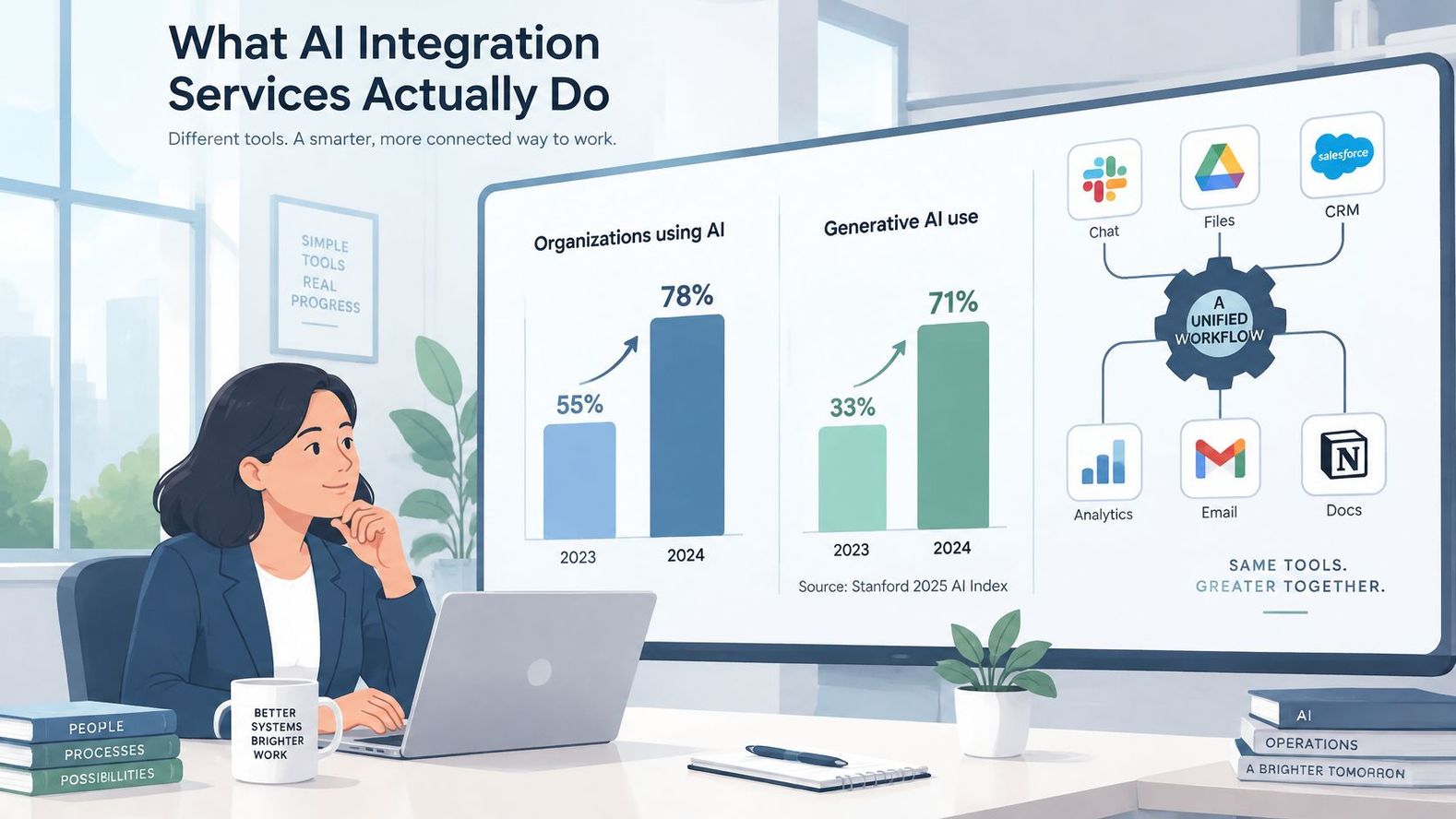
Stanford University's 2025 AI Index puts adoption well past the trial stage: 78% of surveyed organizations used AI in at least one business function in 2024, up from 55% in 2023, and generative AI use in at least one function more than doubled from 33% to 71% across the same two years, according to the 2025 AI Index report. Investment followed the same curve. Corporate AI investment reached $252.3 billion globally in 2024, with private generative AI investment at $33.9 billion, up 18.7% from 2023.
That is the market. Now look at the store.
The appliance and the wiring
A chatbot subscription is a new appliance on the counter. Integration is the wiring, the breaker panel, and the meter. Someone has to decide which circuit it draws from, what trips when it overloads, and how you read consumption at the end of the month. The appliance is what vendors compete on. The wiring is what decides whether the thing still runs on a Tuesday when the warehouse feed is late.
AI integration services are the work of connecting a model or an agent to the systems a store already runs, so the output can change a live decision and survive review. That means redesigning a workflow rather than bolting on a button, connecting Shopify to the ERP, CRM, helpdesk and marketing stack, deciding which record wins when two systems disagree, training the people who handle exceptions, and measuring the result in error rate, conversion, margin, and hours saved.
A model that can't see live stock is a content generator. A model wired to live stock, with permission to act only inside written limits, is a system you can put in front of customers.
Demos are allowed to be clever
Production isn't. A demo answers a friendly question in a sandbox with a clean catalog and a fixed shipping table. Production answers the same question while a price change is publishing, three SKUs are oversold, and the returns policy was edited last week by someone in legal.
The gap between those two situations isn't model quality. It's whether anyone built the conditions around the model: a permissioned source for price and availability, an evaluation set drawn from real customer questions, a named owner for the answers, and a way back when a release goes wrong. Judge a provider by whether they ask about those conditions before they show you a demo.
eCommerce Jobs These Services Take On
Five jobs absorb almost all the attention in a Shopify operation. They fail in different ways, and the systems behind them aren't interchangeable.
| Use case | Systems involved | What good looks like | Main failure if rushed |
|---|---|---|---|
| Product discovery and recommendations | Catalog, search, inventory | Rankings match live price, stock, and attributes | Stale or wrong items recommended |
| Customer service and order help | Helpdesk, orders, returns policy | Grounded replies; escalation on refunds and address changes | Unauthorized refunds or invented policy |
| On-site content and merchandising | CMS, metafields, PIM | Faster copy that stays accurate and on brand | Off-brand or unsupported claims |
| Inventory and operations | ERP such as NetSuite, Sage, or Dynamics | Forecasts and alerts tied to real stock movement | Decisions made on delayed or conflicting data |
| Marketing and lifecycle messages | CRM, email, analytics | Offers timed to behavior without exposing private data | Privacy leaks or irrelevant sends |
Where growing brands get stuck
Adoption is uneven in a way that explains why outside help gets hired. The OECD's work on AI adoption reports that 20.2% of firms across reporting OECD countries used AI in 2025, up from 14.2% in 2024 and 8.7% in 2023, while 39% of surveyed SMEs said they used an AI application in core business activities or products in 2025, up from 26% a year earlier. The OECD cautions that its SME sample isn't representative of all small firms, and the sector spread is wide regardless: 57.3% of information and communication technology firms used AI in 2025, against 36.8% of professional and scientific services firms.
Read those numbers as a resource statement. A brand doing real revenue on Shopify rarely has a data engineer, a search specialist, and someone who can write an evaluation suite sitting idle. The work in the table above needs all three at some point.
One row, chosen on purpose
No percentage tells you which row matters for your store. Your own operation does, and the choice is narrower than expected.
- Money this quarter: pick the row where a wrong answer costs cash now. Recommendations pushing sold-out items into paid traffic is a this-week problem. A copy assistant is a nice-to-have.
- Data you already trust: helpdesk macros and order history are cleaner than most merchandising spreadsheets, which makes order help an easier first target than catalog enrichment.
- A failure you can survive: an incorrect answer about fabric is annoying. An unapproved refund is a margin leak you'll be reconciling for weeks.
- One named owner: if nobody in the building will own the answers, the integration has nowhere to live after launch.
Support triage is the cheapest place most stores start, and a chatbot integration that only reads order status and policy text is a far smaller commitment than one with payment authority. Mark the single row that changes revenue or cost this quarter, and leave the other four alone until it holds in production.
What Production Ready Integration Requires
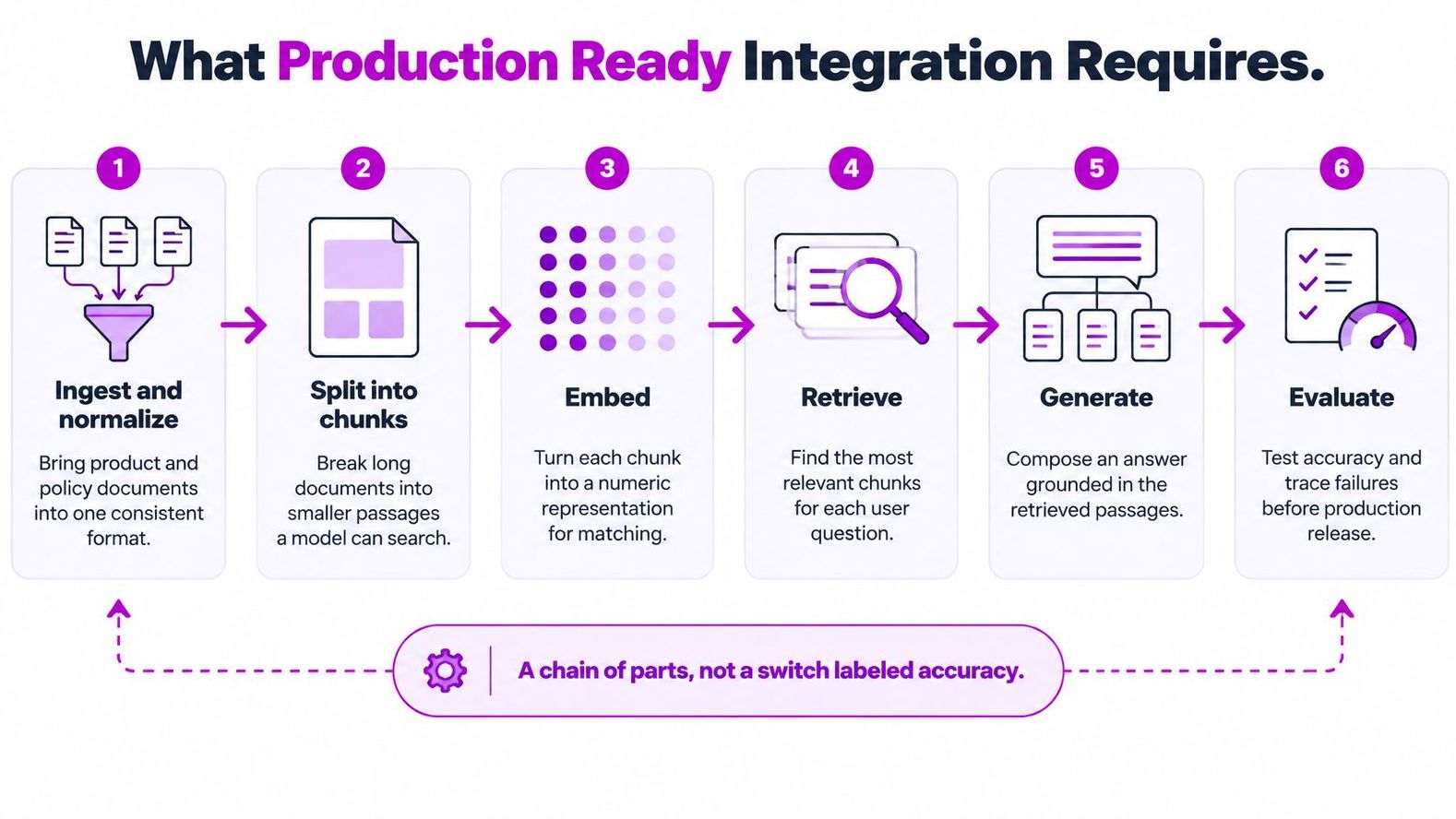
Retrieval-augmented generation is the architecture behind most store assistants you'll be quoted for, and it's a chain of parts, not a switch labeled accuracy, as these notes on LLM integration lay out. The pipeline runs in a fixed order, and every stage has its own way of being wrong.
Where it breaks first
Chunking is the earliest failure and the easiest to miss. Split a size chart away from the fit constraint that explains it and the assistant confidently recommends a size that doesn't exist, because the passage it retrieved said "runs small" and the table it needed landed in a different chunk. Embedding mismatch is quieter: the right SKU sits in the index, but its vector lands nearer a neighboring model, so recall drops and the answer comes from a similar product.
Reranking decides what reaches the prompt, and a reranker tuned for semantic similarity will happily promote a commercially wrong item, an accessory instead of the replacement part, because the language matches. Context bloat is the failure that shows up on the invoice: every extra chunk costs tokens and milliseconds, and past a point it makes answers worse rather than better.
| Stage | Store failure | Log to keep |
|---|---|---|
| Ingest and normalize | Stale price or policy enters the index | Source system and refresh time |
| Chunk | Size chart split from its constraint | Document and chunk IDs |
| Embed and search | Right SKU missed | Retrieval scores |
| Rerank | Similar but commercially wrong item promoted | Reranker choice |
| Prompt | Extra context raises token cost and latency | Prompt size, model version, latency |
| Answer check | Claim not supported by retrieved text | Supported-by-evidence flag |
Logs turn a mystery into a diff
Every stage needs a line in the log: document and chunk identifiers, retrieval scores, the reranker's decision, prompt size, model version, latency, and a flag for whether the final answer is backed by retrieved text. Without those fields, a bad answer is a mystery. With them, it's a diff.
Price, availability, promotions, and returns wording have to come from permissioned sources that refresh on a schedule, and a stale or conflicting record should trigger abstention or a handoff to a person rather than a confident guess. On Shopify, that means reading through a Shopify API integration that respects field-level access, not scraping rendered pages that a theme change can break.
Then gate releases. NIST's Generative AI Profile treats testing and evaluation, verification and validation, and production integration as deployment activities, and recommends monitoring third-party generative AI systems after deployment with benchmarks suited to the use case, covering accuracy, bias, security, privacy, and emergent behavior.
A short walkthrough of the wiring helps here, because the sequence matters more than the tooling.
In practice that means a versioned set of real catalog and service questions, rerun whenever prompts, indexes, models, or business rules change, measuring grounded-answer accuracy, refusal behavior, latency, cost per request, and sensitive-data leakage. Benchmark the model on that set rather than a public leaderboard. A change that lifts answer quality can still slow the storefront or surface an unsupported claim, so nothing ships on one metric.
How to Score Your Store Before You Buy
Retail's AI problem isn't experimentation. It's the second step. Cubeo's 2026 roundup of AI in eCommerce statistics reports that 71% of retailers have tried AI, yet fewer than 40% scale pilots across the enterprise, and a 2026 industry report cited there found 99% of organizations lack a mature framework for full AI integration, even though 92% plan to increase investment. Enterprise integration looks similar from another angle: an academic study of S&P 500 enterprises found 21% had AI integrated into business processes or used AI in production and service delivery in 2025.
Spending more on a vendor doesn't move those numbers. Conditions do. Score the store on six rows before you sign anything.
| Condition | Not ready | Ready to go live |
|---|---|---|
| Data | Price, stock, or policy disagree across Shopify and the ERP | One permissioned source of truth, refreshed on a schedule |
| Evaluation | Quality judged from a demo | Versioned catalog and service questions with accuracy, latency, and cost gates |
| Human control | Agent can refund, discount, or substitute alone | Approval required for irreversible actions |
| Monitoring | No owner after launch | Named owner, logs, and a rerun when prompts, indexes, or rules change |
| Rollback | No way to undo a bad release | Previous rules restored by a flag without a full redeploy |
| ROI | Only usage or demo feedback is tracked | Error rate, conversion, margin, escalations, and hours saved |
What a fail actually costs
Each left-hand column costs something specific. Disagreeing price and stock means every answer is a coin flip, and the support team loses trust in the tool within a fortnight. Judging quality from a demo means you learn about regressions from customers rather than from a test run.
No approval gate turns a prompt injection or a bad retrieval into a real refund. No owner after launch means the assistant keeps quoting a returns window you changed in March. No rollback path means the fix for a bad release is a second release, at whatever hour the problem appears.
Go/no-go: two rows on the left and you're not buying integration services yet. You're buying data cleanup, a question set, and a written approval rule.
A pilot that only drafts replies and logs its own mistakes is still a pilot. The moment it can change a price, promise a delivery date, or approve a refund, it's production, and production answers to the right-hand column. Withhold live catalog, pricing, and service authority until every row is green, then expand one workflow at a time.
Permissions That Keep Agents Inside the Rules
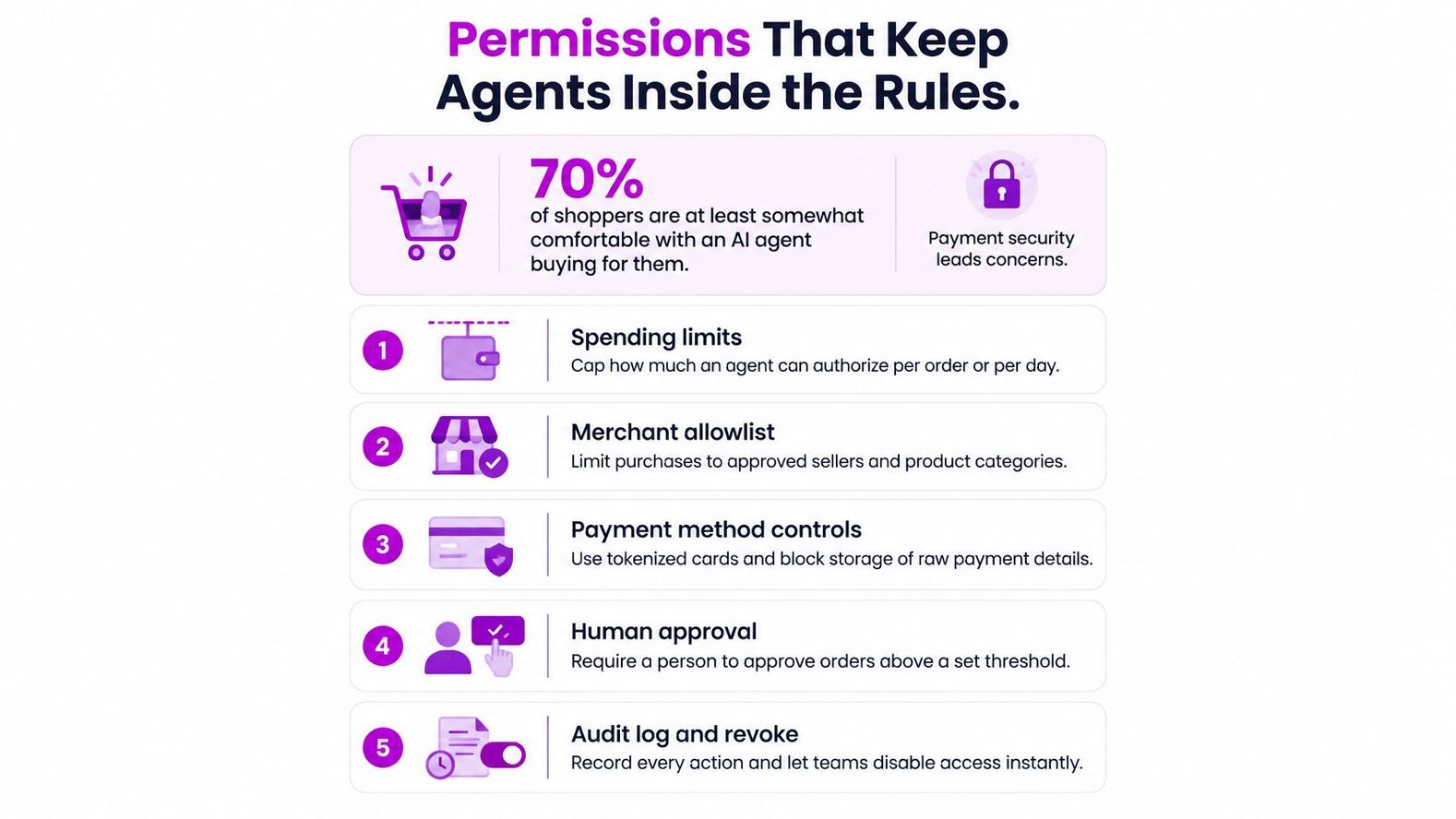
Shoppers are more ready than most merchants assume, and more worried than the conversion decks admit. In a global study of shoppers and AI shopping agents, 70% said they're at least somewhat comfortable with an AI agent purchasing on their behalf, while the leading concern was payment security at 32%, followed by privacy at 26%, mistakes at 18%, and loss of control at 17%. The same study reports that only 4% of companies have formal AI governance, while organizations reporting strong ROI were six times more likely to have thorough policies.
That last pair overturns the usual excuse. Governance isn't the tax you pay after growth. The companies with written policy were the ones reporting better commercial outcomes.
The permission list
Least privilege comes first. An agent reads the order fields it needs for the task at hand, not the full customer record, and not the payment table.
- Irreversible actions stop: refunds, discounts, address changes, and out-of-stock substitutions pause for a person unless a written rule permits a narrow, named case.
- Reconstruction beats reassurance: you should be able to say which data and which rule produced a recommendation or an action, months later.
- Retention and prompts: decide how long prompts and retrieved passages are kept, and put the vendor's incident notification duty in the contract rather than in a slide.
- Escalation path: a customer asking for a human gets one, without three rounds of deflection first.
- Recurring tests: accuracy and security checks run on a schedule, not once at launch.
One scene worth writing down
An agent may suggest a substitute SKU when the requested size is gone. It may not charge a different amount or ship to a new address without approval, because a substitution that changes the order value is a refund dispute waiting to happen.
Written rule: proposing is agent work. Changing what a customer pays is human work until the policy says otherwise.
None of this is exotic. It's the same access discipline you'd apply to a contractor with an admin login, applied to a system that can now act on its own. Write the allowed and forbidden list before any agent is connected to payments or customer records.
What a Connected Store Actually Runs
Finished integration looks like one flow, not a pile of AI apps. Say a shopper asks for a sold-out size in a running shoe your warehouse ran out of yesterday.
- The question names a size and a model, and search returns in-stock variants whose attributes still match the size chart and material constraints.
- The reply cites those specific fields plus the live availability timestamp, so the shopper sees why the suggestion fits.
- If the substitute changes the price or the delivery address, the action stops for a person under the permission rules already in place.
- The whole exchange is logged with the records it used, so a complaint three weeks later is a lookup rather than an argument.
That flow only works when price has one owner, stock has one owner, and policy has one owner. Price usually lives in the ERP or the commerce admin, and every channel reads that value rather than its own copy. Stock comes from the same system that fulfills orders, so a recommendation can't offer a unit the warehouse already allocated.
Policy text for returns, shipping windows, and promotions belongs in a versioned document the assistant retrieves, not in a chat note someone pasted last quarter. Metafields and PIM attributes hold those facts in a consistent shape, which is what lets retrieval cite them instead of scraping messy descriptions.
Who owns what
Sketch four boxes before you buy help. Which system owns price, which owns stock, which owns policy, and which gaps are still living in spreadsheets that nobody trusts. Payments, email, and analytics stay connected so the assistant isn't reasoning from a stale export.
We build this layer as custom development: API integrations, custom app development, and Headless CMS work, plus ERP connections for systems including NetSuite, Sage, and Dynamics. On BAGWORKSNY we integrated payments, shipping, analytics, and email marketing tools into the store, which is the same job in a smaller package.
A partner can wire Shopify to the ERP. The map is yours, and an agent still can't move money outside the allow-list you wrote.
Start With a Readiness Conversation
Walk into that conversation with the one use case you marked and the scorecard, not a shortlist of vendors. If two or more conditions are still on the left-hand side, the next spend is data work, a versioned question set, and a written approval rule, however unglamorous that sounds.
If those rows are green and the team still can't connect the storefront, the ERP, and the helpdesk, hire for that single workflow. Confirm three owners in the first session: price, stock, and policy, plus whoever approves refunds today.
Agree in the same meeting that success will be judged on error rate, conversion, margin, support escalations, and hours saved, not on how often the model gets opened. Usage is a vanity number that rises with confusion.
ECORN is an official Shopify Partner Agency, and we run Ask Me Anything and strategic consulting sessions with eCommerce experts where most of these decisions get made. If you need capacity after launch, our Shopify Expertise service provides an augmented team of Shopify specialists to maintain and enhance a project, because monitoring doesn't end at go-live.
Bound the start to one workflow on one storefront with a rollback flag, and add a second use case only after the first holds its gates. Write the allowed and forbidden actions down, book the readiness conversation, and keep the model away from live price, inventory, and customer orders until every row on the scorecard sits on the ready side.
ECORN plans and implements AI integrations for Shopify stores, from the data map and evaluation set through the permission rules that decide what an agent may touch. If you want to pressure-test a single use case before committing budget, bring your scorecard to an Ask Me Anything session or a strategic consulting call with our eCommerce experts. Start at ECORN and describe the one workflow you want production-ready first.
[Related Media]