7 Shopify Agency Los Angeles Options Compared for 2026
The most common advice about hiring a Shopify agency in Los Angeles is to chase the biggest name with the flashiest portfolio. That advice costs founders money. A Platinum-tier enterprise shop will happily quote a six-figure replatform to a store doing $20k a month, and you'll spend your entire year's margin on a build you can't yet feed with traffic. The reverse fails too: a two-person boutique can design a beautiful storefront, then stall the moment you need a second expansion store, an ERP integration, and someone accountable for checkout at 2am on Black Friday.
Fit beats reputation. So instead of ranking these seven agencies by prestige, I'm matching each one to a revenue stage, a store count, and the amount of technical capacity you already have in-house. Every pick gets judged on the same six things:
- Revenue stage: what monthly volume the agency's process is built for.
- Store count: one storefront, or several markets and B2B instances.
- Engagement model: fixed project, retainer, subscription, or fractional team.
- Pricing transparency: published rates versus quote-only.
- Proof: named clients and reviewable outcomes, not adjectives.
- Scope breadth: pure Shopify engineering, or marketing bundled in.
Each entry ends with a best-fit verdict and one red flag to test on the discovery call.
1. ECORN
ECORN fits a very specific buyer: a brand that already knows Shopify should stay Shopify, but wants specialist capacity without hiring a full internal team. It is an official Shopify Partner Agency, with services across Shopify development, Shopify apps, design, marketing, and conversion rate optimization. That makes the agency more useful for execution-heavy work than for founders looking for a broad digital retainer.

Platform depth matters because the work happens inside a live commerce system, where theme changes touch product data, checkout paths, apps, analytics, and store operations. Shopify's 2025 annual filing with the SEC reports $378.4 billion in gross merchandise volume, up from $292.3 billion in 2024. For a founder, the practical question is not whether Shopify is big enough. It is whether the agency can handle the specific store changes you need without turning every task into a discovery exercise.
Three ways to engage the team
ECORN's offer can be read as three practical engagement routes. Single-project work on Shopify and Shopify Plus costs $69 per hour, with no minimum or maximum project size. That is the cleanest option for a defined build, such as a custom theme, a set of app changes, or a focused CRO pass.
The Shopify pack is $6,400 per month for 160 hours of the eCommerce team. It includes front and back-end development, design, CRO, and support for multiple stores. It is best suited to scaling brands around $100k per month on Shopify Plus or brands running multiple storefronts. The trade-off is real: a monthly team only pays off if there is a steady backlog. If you have three small fixes and then nothing for six weeks, a single project is the better commercial fit.
ECORN also offers Shopify Expertise packages starting from 35 hours per month. Those work better when the store is already live and needs an augmented team to maintain and improve it. The service covers ongoing development and enhancement, not a one-off launch.
Practical rule: buy hours against a named backlog, not against a vague promise of "growth." If you can't list the first five tickets, you're not ready for a monthly pack.
Proof should be read at the level of use case, not vanity scale. ECORN's related cases include Sabina Bilenko, Bagworksny, Grace Floral London, Celtara, and other brands. On BAGWORKSNY, the team delivered a fully custom Shopify theme, with a project manager and Shopify developer on the work, plus payments, shipping, analytics, and email marketing tool integrations. It also added custom metafields and structured content so product and collection information could appear across the site. That is a useful signal for brands whose catalog needs more than default theme fields.
Best fit: brands from first custom theme through multi-store Plus operations that want one accountable Shopify team. Red flag to test: ask which package fits your monthly workload and why. If the answer is the largest pack without a backlog, push back.
2. SDG
Start with the market context, because it explains why an enterprise engineering shop exists here at all. U.S. Census Bureau figures in the Census QuickFacts profile for Los Angeles show Los Angeles County generated $213.93 billion in retail sales in 2022, at $22,010 per capita. That's a commercial ecosystem, not a local design scene.
SDG is headquartered in Los Angeles and holds Shopify Platinum Partner status. Here's their storefront.
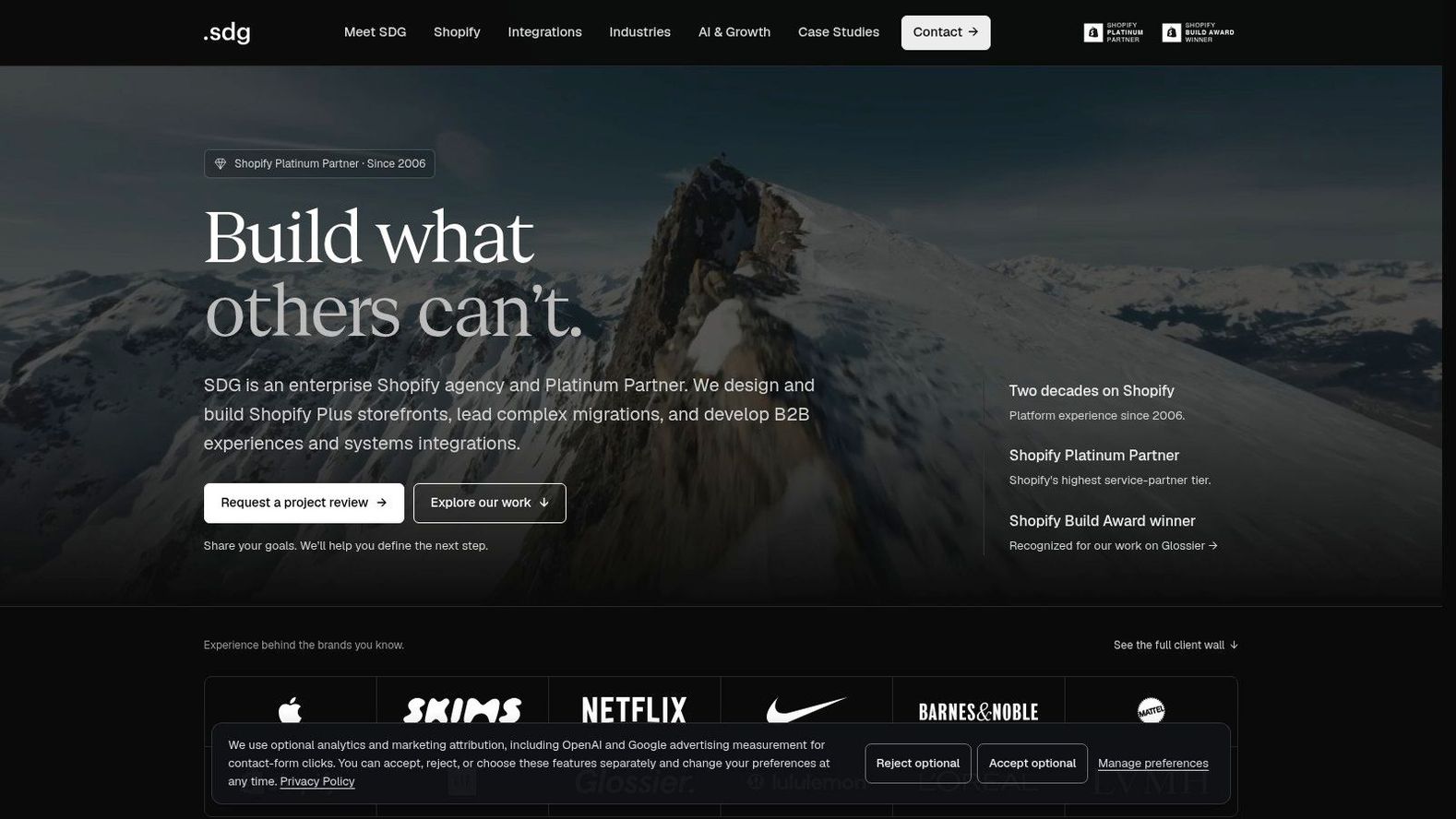
Their work centers on complexity: custom storefronts, headless commerce, custom apps, hard migrations, and systems integration, with strategy, performance, CRO and post-launch support wrapped around it. Named enterprise work includes Barnes & Noble and Netflix Shop.
The trade-off is straightforward. Enterprise process carries enterprise overhead: discovery phases, solution architecture, stakeholder reviews. If you're pre-product-market-fit, that machinery slows you down and you'll pay for documentation you never read. If you're migrating off Magento with an ERP, a WMS, and three international stores, that same machinery is what keeps launch weekend boring.
Local presence is a real advantage when you need a room. In-person working sessions beat a Figma comment thread for merchandising and checkout debates, which is worth weighing when you're comparing an eCommerce agency near you against remote-only options.
Ask who writes the code after the pitch team leaves the room.
Best fit: established high-volume brands and Plus merchants with multiple systems, markets, or a migration deadline. Red flag to test: request the named tech lead and their current allocation. Pricing is quote-based with no public rate card, so a proposal that arrives before anyone has read your analytics is a proposal built on assumptions.
3. Conspire Agency
Published pricing changes the negotiation. Conspire Agency posts project pricing and holds a 5.0 rating across 22 reviews on Shopify's Partner Directory, which gives you two things most agencies withhold: a number and a reviewable record.
Named work includes Zia Tile, Vital Proteins, and Cousins Maine Lobster. The offer is Los Angeles design and development for established brands: builds, redesigns, migrations, integrations, and ongoing development, plus fractional Shopify teams if you want continuing senior capacity without hiring.
That fractional model is the interesting part. Say you're a growing home goods brand with one marketer and no developer. A fractional team gives you a standing sprint cadence and someone who already knows your theme, instead of a new freelancer rediscovering your metafield logic every quarter.
Two cautions. Support plans are aimed at brands with established revenue, so a very small store will feel the minimum. And custom enterprise builds cost substantially more than a standard redesign, so read the scope line, not the headline price.
Use the discovery call to probe accessibility, which most LA agency pitches treat as a checklist. California's Unruh Civil Rights Act exposes businesses to statutory damages of at least $4,000 per violation, with $1,000 under the Disabled Persons Act, according to the Assembly Privacy and Consumer Protection Committee analysis of AB 2190. The same legislative text emphasizes both automated and manual testing by qualified users.
- Ask for evidence: keyboard and screen-reader test notes on product filters and checkout, not an overlay script.
- Ask about regressions: which app installs get retested, and who signs off.
Best fit: established brands wanting a redesign plus fractional senior support. Red flag: an accessibility answer that names a widget instead of a testing process.
4. Netalico Commerce
Netalico publishes the thing most agencies bury: who they're for. Netalico Commerce describes its target clients as brands with roughly $2 million to $50 million in GMV, served from a Los Angeles hub with a distributed Americas team working US business hours.
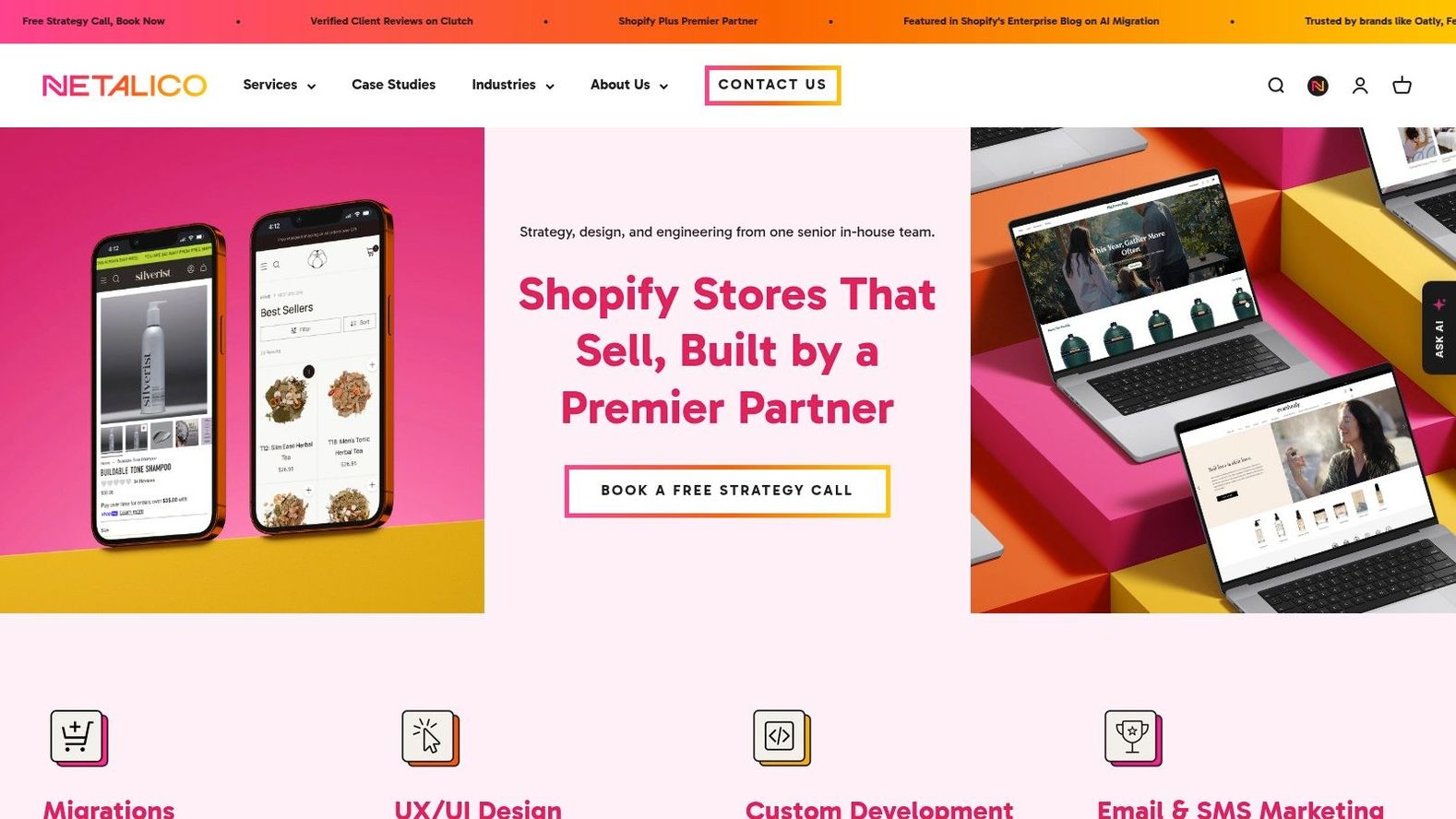
The pairing to notice is development plus research-led CRO: audits, UX changes, and testing running alongside Plus builds and migrations, on projects or monthly retainers. Clients include Big Green Egg, Oatly, and Getty Images.
That combination matters because checkout is where the money leaks. Baymard's checkout usability benchmark of 344 leading US and European eCommerce sites found 65% of checkout experiences were mediocre or worse, with only 2% rated good. An agency that can both diagnose that and ship the fix in Liquid is worth more than two vendors pointing at each other.
Distributed delivery is the honest trade-off. You get coverage and depth, but "LA agency" here means a hub, not necessarily a team you can visit weekly. If in-person merchandising sessions are core to how your founder works, confirm who's local before signing, a question worth putting to any Shopify development company in the USA.
A CRO retainer without a testing calendar is just a development retainer with a better name.
Best fit: mid-market DTC brands in the low eight figures that want build and optimization from one team. Red flag to test: ask for the last three experiments they ran, including the losers. If every test won, they're not testing, they're redecorating.
5. Alleyoop
Category focus is a real filter, not a marketing flourish. Alleyoop is a Los Angeles Shopify Plus agency built around fashion, luxury, and lifestyle brands, combining strategy, UX/UI, storefront development and migrations with CRO plus email and SMS retention.
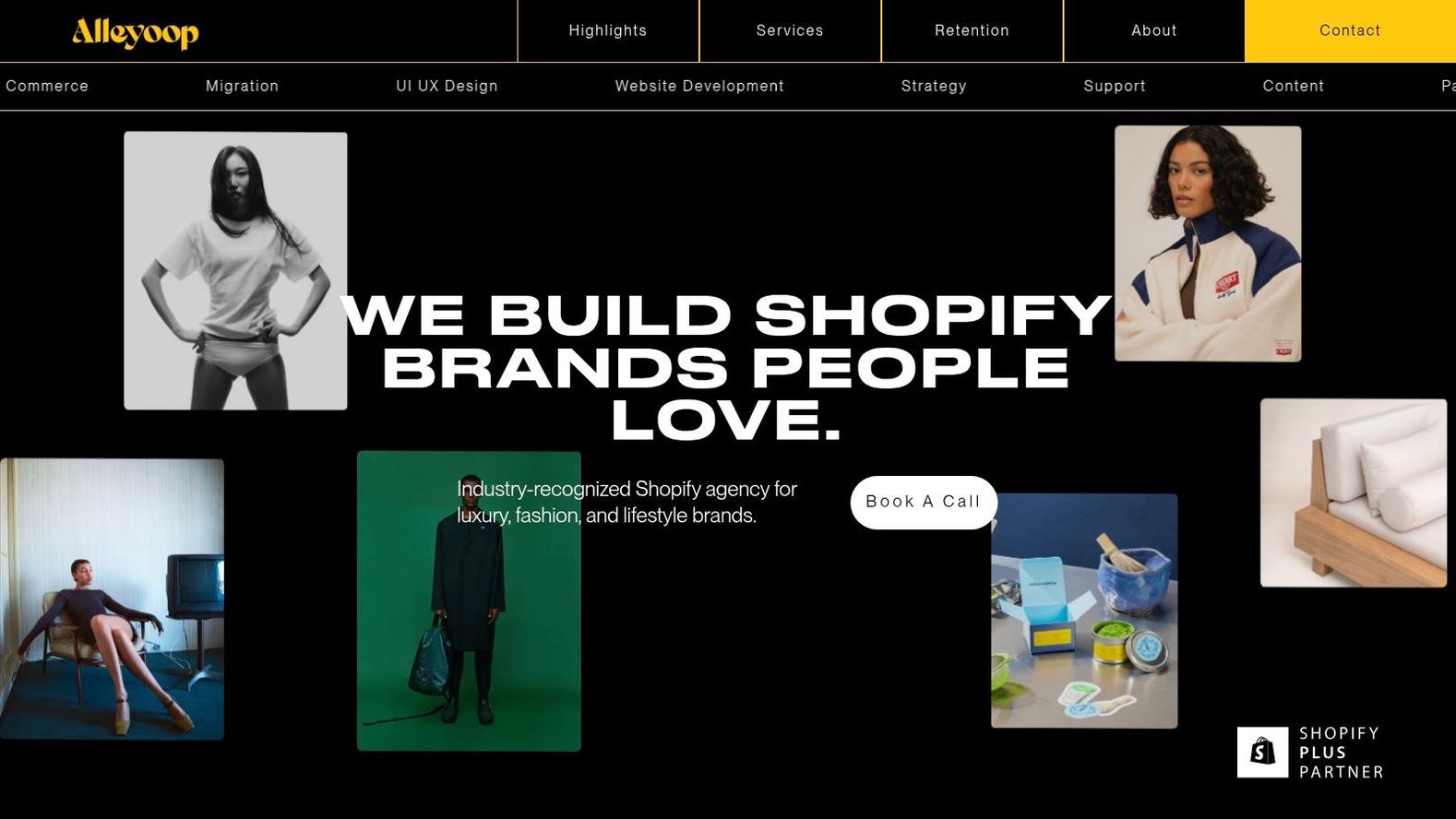
They build custom themes with reusable, editable sections and support B2B and internationalization. Shopify's Partner Directory lists their Los Angeles location.
Where the specialization pays, and where it doesn't
If your product sells on imagery, lookbooks, size guidance, and seasonal drops, an agency that already knows those patterns skips months of learning. Bundling email and SMS with storefront work also removes a classic handoff failure: the theme team builds a signup module the lifecycle team never gets to configure.
Outside fashion, luxury, and lifestyle, the premium buys you less. A B2B industrial parts catalog needs faceted search and quote logic more than editorial art direction.
Set expectations with real benchmarks. Statista's global conversion rate by industry and device data puts the average online conversion rate across selected global eCommerce sectors at just over 1.8% in the third quarter of 2024, with beauty and makeup highest at 2.3%. Anyone promising to triple your rate in a month is selling a story.
Two gaps to price in: the Partner Directory profile carries no reviews, so independent feedback there is thin, and pricing isn't public.
Best fit: fashion, luxury, and lifestyle brands on Plus that want storefront and retention under one roof. Red flag to test: ask for two references you can email directly. No directory reviews means references carry the whole verification load.
6. Propeller
Propeller is the pick when your problem isn't the storefront, it's everything pointing at it. The Santa Monica agency does Shopify and Shopify Plus design, development, and migrations alongside CRO, SEO, paid media, lifecycle marketing, and custom technology, with published case studies and a starting price for monthly partnerships.
Their model includes a defined 90-day planning step, which I like for a specific reason: it forces someone to write down what happens after launch instead of treating go-live as the finish line.
The commercial shape suits brands that want a growth partner. It suits a narrowly scoped task badly. If you need one checkout extension fixed, an ongoing partnership structure is the wrong container, and build or migration costs still require a separate quote.
Their CRO pitch is easy to justify with independent evidence. Baymard's eCommerce checkout usability report and benchmark reports an average cart-abandonment rate of 70.22% and an average of 19.9 form elements in checkout flows, where optimized implementations can drop to roughly 12. That's a testable hypothesis, not a redesign brief.
- Instrument the funnel: cart view, checkout initiation, contact info, shipping, payment, completion.
- Segment by device: mobile completion is where field reduction usually pays.
- Watch margin, not just rate: refunds and fraud can eat a "winning" variant.
Case-study outcomes on their site are agency-reported examples, not guarantees, and should be read that way.
Best fit: brands with product-market fit that want storefront plus paid, SEO, and lifecycle from one Santa Monica team. Red flag to test: ask what the 90-day plan commits to in writing. If it's a strategy deck with no shipped changes, you're buying meetings.
7. Coalition Technologies
Coalition is the breadth play. The Los Angeles-headquartered agency runs Shopify design and development next to SEO, paid media, email, and other digital marketing, with a large team of specialists. Shopify's Partner Directory lists Premier Partner status and a 4.8 rating.
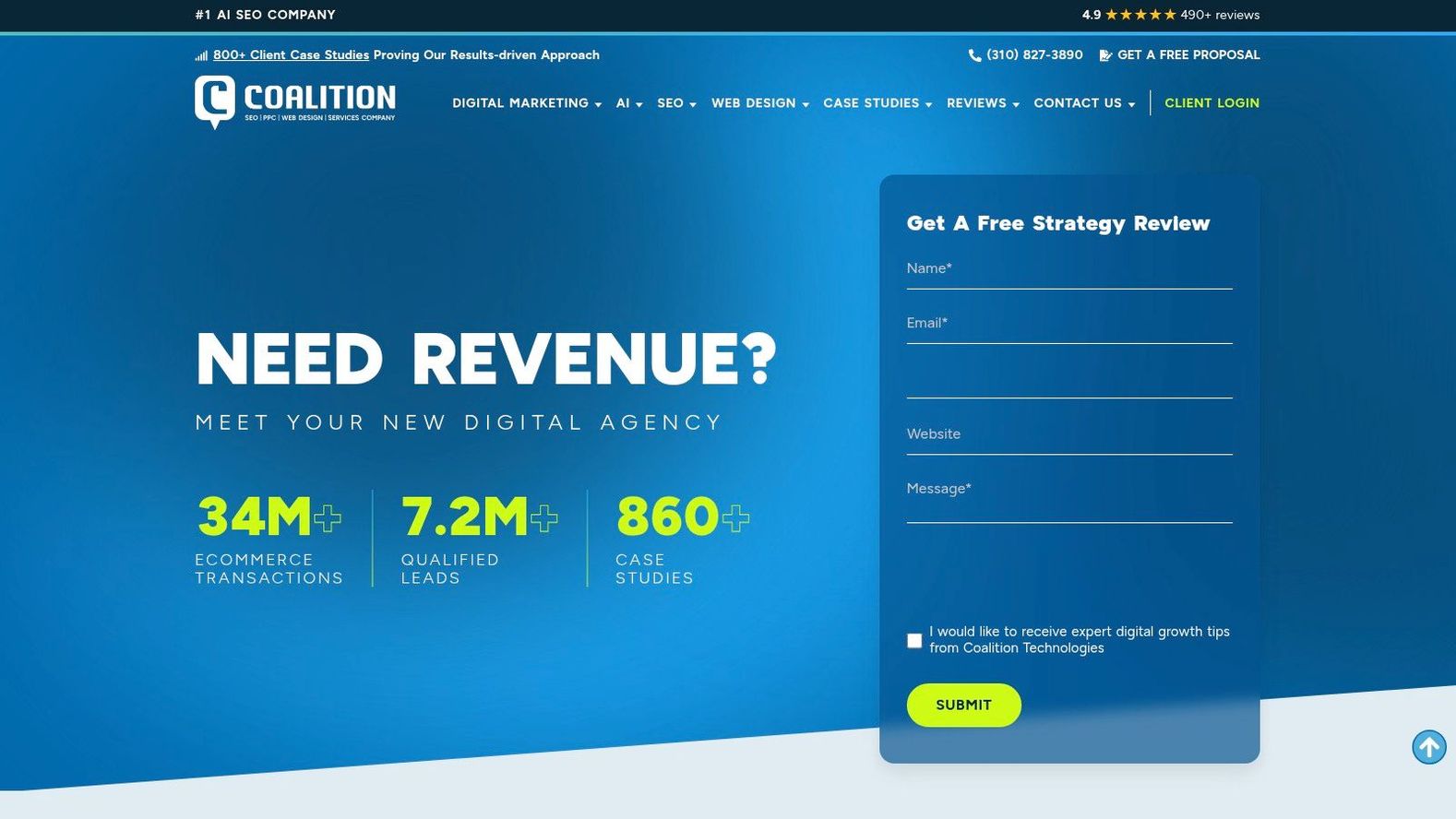
One vendor for development and marketing removes coordination cost, and that matters most for brands without in-house staff to brief and manage separate agencies. The trade-off is depth. A broad digital agency trades Shopify-only specialization for range, so the seniority of your assigned developer matters more than the logo. The listed price range is wide, and the distributed structure won't feel like a boutique.
A single storefront with modest traffic gets little from this much structure. A brand coordinating development plus several marketing channels is where consolidation pays.
The question worth burning the discovery call on is data plumbing. When one agency runs your ads, email, reviews, loyalty, and analytics, customer data spreads across all of it. California's privacy regulator, in its announcement on strengthened deletion rights, notes the Expanding Privacy Rights Act will require online-only businesses to offer an online submission method such as a webform for privacy requests, and identifies both the CCPA and the Delete Act as active enforcement frameworks.
A consent banner isn't a privacy architecture. Ask what happens downstream when a customer requests deletion.
Make them map it: which vendors receive customer data, how a deletion request propagates to email, reviews, loyalty and ad audiences, and where the audit evidence lives.
Best fit: brands consolidating development and multi-channel marketing into one accountable vendor. Red flag to test: ask who owns your ad accounts, pixel, and customer data if you leave. Hesitation there is a lock-in plan.
How the seven Los Angeles Shopify agencies differ by best fit, pricing signal, and standout strength
| Item | Best for | Pricing signal | Standout strength |
|---|---|---|---|
| ECORN | Brands seeking end-to-end Shopify growth and AI services | Rates published: $69/hour single projects, $6,400/month Shopify pack, Expertise packages from 35 hours/month | Combines Shopify expertise with AI-native delivery and flexible engagements |
| SDG | Enterprise brands with complex Shopify Plus needs | Quote-based; no public rate card | Handles headless commerce, integrations, and complex migrations |
| Conspire Agency | Established brands needing Shopify builds or ongoing support | Project pricing published | Offers one-off projects and fractional Shopify teams |
| Netalico Commerce | Mid-market and enterprise DTC brands focused on growth | Monthly pricing published; retainer fees may be a stretch for smaller stores | Pairs Shopify development with research-led CRO |
| Alleyoop | Fashion, luxury, and lifestyle brands | Pricing not publicly listed | Combines storefront work with CRO and email and SMS retention |
| Propeller | Brands seeking Shopify work alongside growth marketing | Monthly partnership starting price published; build costs quoted separately | Connects storefront development with marketing and optimization |
| Coalition Technologies | Businesses coordinating Shopify work with broader digital marketing | Wide listed price range; costs depend on scope | Offers Shopify services alongside SEO, paid media, email, and other marketing |
The standout column maps each shop's depth: engineering, CRO and retention, bundled marketing, or flexible engagement shape.
Turning the Shortlist Into a Signed Shopify Partner
Run the six criteria in order and the field narrows fast. Revenue stage eliminates most mismatches: enterprise engineering shops don't belong on a $20k/month shortlist, and boutique support plans don't belong on an enterprise merchant's shortlist. Store count decides whether you need multi-store and internationalization experience or a single clean theme. Engagement model decides whether you're buying a fixed deliverable, a fractional team, or a monthly block of hours.
Then check pricing transparency, proof from named clients, and in-house versus broader marketing needs. Published rates and directory reviews shorten diligence. Quote-only pricing isn't disqualifying, it just means you need references and a tightly written scope. And if your team already runs paid and lifecycle well, don't pay an agency to duplicate it.
Applied to these seven: enterprise complexity and migrations point to SDG. Established brands wanting a redesign plus fractional senior help point to Conspire. Mid-market DTC brands that want build and testing together point to Netalico. Fashion and luxury brands on Plus point to Alleyoop. Brands wanting storefront plus growth channels point to Propeller or Coalition, depending on how much marketing you want in the same contract. Brands that want one Shopify-native team from first custom theme through multi-store Plus operations, with AI and automation in the same stack, point to us.
Do this next: shortlist three, book a scoped discovery call with each, and buy one small project before any monthly commitment. We price single-project Shopify and Shopify Plus work at $69 per hour with no minimum size, and Expertise packages start at 35 hours per month, so a low-risk trial is available rather than theoretical.
Before you brief anyone, write down your integration and fulfillment assumptions so every agency prices the same scope. That means your shipping zones, carrier logic, how customers see Shopify store delivery quotes at checkout, which apps touch orders, and who owns fulfillment after launch. Two agencies quoting different assumptions will hand you numbers you can't compare.
This week, write one page: your monthly revenue, store count, the five tickets you'd hand over first, and your budget ceiling. Send that same page to all three. The quality of the questions you get back will tell you more than any portfolio.
We build and optimize Shopify and Shopify Plus stores end to end, from fully custom themes and metafield-driven content to CRO audits, A/B testing, and app development, with Core, Labs, and Agentique covering established brands, sprint-based development, and AI automation. If you're comparing Shopify agencies in Los Angeles and want to test fit before committing, start with a single project at $69 per hour or a 35-hour Expertise month. Visit ECORN to scope the first piece of work with our team.
[Related Media]