

Ecommerce link building is all about getting hyperlinks from other websites to point to your online store. Think of it as a vote of confidence that signals trust and authority to search engines like Google. It’s an essential piece of the puzzle for getting your store noticed in search results, driving qualified organic traffic, and, of course, making more sales. This is a foundational pillar of any serious ecommerce SEO strategy.
Why Link Building Drives Real Ecommerce Growth
Let's cut right to it. Paid ads get you instant visibility, but relying on them is like renting your traffic. The second you stop paying, the traffic fire hose shuts off. That creates a volatile, and often expensive, cycle. A smart ecommerce link building strategy, on the other hand, builds a durable, long-term asset for your business.
High-quality backlinks are endorsements from reputable sources across the web. When an established industry blog or a product review site links to one of your product pages, it’s a powerful signal to search engines that your store is a credible and valuable resource. That trust translates directly into higher rankings for your most important product and category pages.
Moving Beyond Paid Ads
The business case for link building gets even stronger when you look at the numbers. In the hyper-competitive world of ecommerce, a recent analysis found that a staggering 23.6% of all eCommerce orders come directly from organic traffic. Unlike paid ads that can chew through your budget with unpredictable costs, organic channels deliver sustainable results.
This is why building a solid backlink profile is non-negotiable for scaling your Shopify store. It’s not just about SEO; it’s about building a more resilient business.
A strong backlink profile isn't just an SEO metric; it's a competitive moat. It creates a sustainable traffic source that insulates your business from rising ad costs and algorithm shifts, turning your website into a more valuable asset over time.
The True Impact on Your Bottom Line
At the end of the day, the goal is to drive real ecommerce growth. That means doing more than just ranking—it includes tactics to improve ecommerce conversion rates and boost your overall sales. Every quality backlink you earn contributes to a powerful flywheel effect:
- Increased Authority: More backlinks from relevant sites lift your store's Domain Authority, making it easier for all of your pages to rank.
- Targeted Referral Traffic: A single link from a popular "best of" list or a gift guide can send high-intent shoppers—people already looking to buy—directly to your store.
- Enhanced Brand Credibility: When potential customers see your brand mentioned on websites they already trust, it builds powerful social proof and makes them far more likely to buy from you.
This isn't about chasing vanity metrics. It's a strategic investment that attracts qualified shoppers ready to buy, establishing a core pillar of your growth strategy that pays dividends for years to come.
Building Your Link Acquisition Foundation
Before you even think about sending that first outreach email, you need to lay the groundwork. Great ecommerce link building isn't a spray-and-pray game; it's a calculated effort that starts with some serious reconnaissance and a solid plan.
Skipping this part is like trying to build a house without a blueprint. It's messy, unstable, and pretty much guaranteed to fall apart.
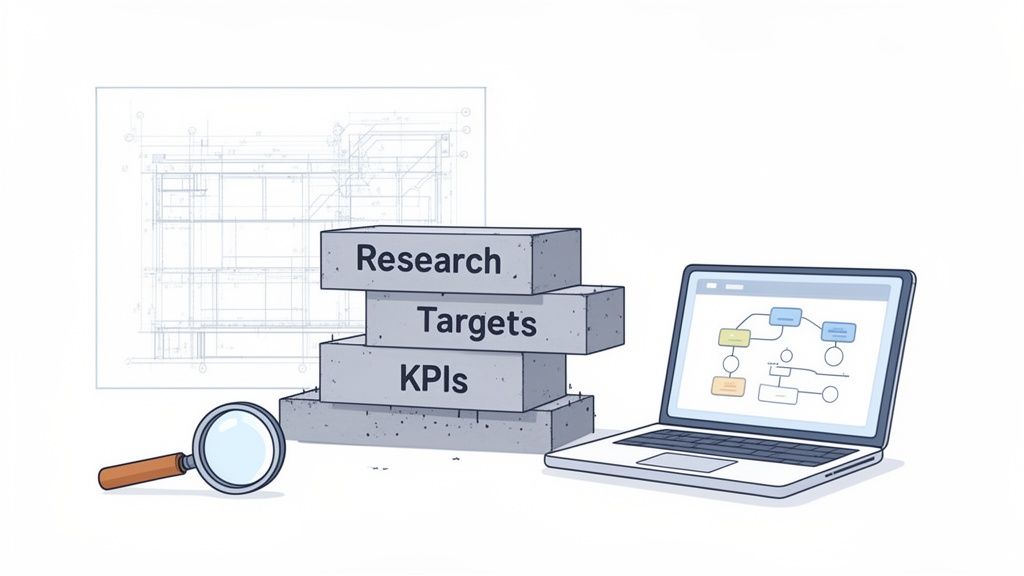
First up: understanding who you're up against. Your top competitors are already out there earning links, and their backlink profiles are a public playbook of what's working in your niche. Diving into their strategy gives you a ready-made roadmap of opportunities you can jump on.
Deconstructing Competitor Backlink Profiles
The goal here isn't to just copy what everyone else is doing. It's to reverse-engineer their success so you can build a smarter, more efficient strategy for your own store. Using a tool like Ahrefs or Semrush is non-negotiable for this.
Start by plugging in the domains of two or three of your biggest competitors. As you dig through their backlink data, you’re looking for answers to a few key questions:
- What kinds of sites link to them? Are they getting traction on niche blogs, major publications, product review sites, or forums? This tells you exactly what kind of content resonates in your industry.
- Which of their pages are magnets for links? You'll often find it’s not their homepage. Look closer, and you'll see links pointing to specific buying guides, data-heavy blog posts, or popular category pages. These are their "linkable assets."
- What's the context of the links? Check out the anchor text and the content around it. Are they cited as a resource in a how-to guide, featured in a "best of" list, or mentioned in a news story?
This analysis tells you where your audience is hanging out and what kind of content actually earns trust. If you see your main competitor has 10 links from "best hiking backpacks" roundups, you now have a crystal-clear target for your own outreach.
For a deeper dive into the mechanics, check out this excellent guide on how to get backlinks for SEO.
Defining Your Link Targets and KPIs
Armed with all that juicy competitor data, you can start building your own strategic framework. This is where you shift from reacting to their moves to proactively planning your own. Keep it simple but clear, outlining who you're going after and what success actually looks like.
First, define your ideal link targets. Based on your research, create a profile of the perfect website to land a link from. You'll want to consider things like:
- Thematic Relevance: Does their content vibe with your products? A link from a popular rock-climbing blog is gold for an outdoor gear store, while one from a generic news aggregator is... less so.
- Audience Overlap: Do they talk to the same people you want to reach? A link from a site with a highly engaged, relevant audience is your ticket to valuable referral traffic.
- Domain Authority (DA): While it's not a direct Google ranking factor, DA is a handy shorthand for a site's overall authority. Aim for sites with a DA that’s in the same ballpark as yours or higher.
Next, you need to set some realistic Key Performance Indicators (KPIs). Sure, the end goal is to boost your organic rankings, but that's a lagging indicator. To track your progress day-to-day, you need to focus on leading metrics you can actually influence.
A classic mistake is getting obsessed with the number of links you get. A much better approach is to set KPIs that measure the quality and impact of your work, like referral traffic from new links or keyword movement for target pages.
Your KPIs might include goals for referral traffic, the number of links acquired from sites above a certain DA, or ranking improvements for a specific set of keywords.
And a quick note for Shopify store owners: before you start any of this, make sure your technical SEO is locked down. Our comprehensive Shopify SEO checklist will help you cover all your bases. Getting this foundational work right ensures every link you build actually moves the needle for your business.
Creating Assets That Naturally Attract Links
Let's be honest: you can't build links to boring pages. It's tempting to throw all your effort into getting backlinks directly to your product and category pages, but that's a tough, uphill battle. Most high-quality websites simply don't link out to commercial pages unless it's a paid spot or part of an affiliate review.
The real secret to a scalable ecommerce link building strategy is creating genuine "linkable assets." These are valuable pieces of content that live on your site but do more than just sell. They solve problems, answer nagging questions, and offer up unique information that other sites actually want to reference. This completely flips the script—you're no longer asking for a favor, you're offering them a resource.
Power Up Your Content with In-Depth Buying Guides
One of the most effective linkable assets any ecommerce store can create is a seriously comprehensive buying guide. And I mean bigger than your average blog post. A great guide doesn't just list your products; it educates the shopper, helps them sort through complex options, and builds a massive amount of trust in your brand as the go-to expert.
Imagine a store that sells high-end coffee equipment. They could create something like "The Ultimate Guide to Brewing Espresso at Home." This isn't just a quick article; it's a deep-dive asset that could include:
- Detailed Comparisons: A visual breakdown of semi-automatic vs. fully automatic machines, complete with pros, cons, and who each type is best for.
- Expert How-Tos: Crystal-clear, step-by-step instructions (with great photos) on pulling the perfect shot, steaming milk like a pro, and keeping the machine in top shape.
- Jargon Busters: A simple glossary that demystifies terms like "portafilter," "tamping," and "grouphead" for the newbies.
A guide like this becomes an instant link magnet. Coffee hobbyist blogs, lifestyle magazines, and even home decor sites will want to reference it as an authoritative source, sending you hyper-relevant traffic and a powerful backlink. A well-executed guide is a cornerstone of any ecommerce content strategy built for serious link acquisition.
A truly great buying guide answers every question a potential customer might have before they even think to ask it. When you become the definitive resource on a topic, links naturally follow.
Capitalize on Timing with Gift Guides and Trend Reports
Another killer asset is timely and seasonal content. People are constantly searching for gift ideas, and journalists are always on the hunt for fresh content to feature around holidays and major events. By creating your own curated gift guides, you give them the perfect asset to pitch.
The key is to skip the generic lists and get specific. This helps you capture niche, long-tail traffic and appeal to very targeted publications.
- A pet supply store could create "The 15 Best Gifts for Anxious Dogs."
- A sustainable fashion brand could publish a "Holiday Gift Guide for the Eco-Conscious Shopper."
- A kitchenware retailer could release a "Summer Grilling Essentials" guide right as the weather warms up in May.
These assets are outreach gold because they are inherently helpful and perfectly timed. You can pitch them to bloggers who are putting together their own holiday roundups, offering your guide as a fantastic resource for their readers. This approach positions you as a helpful curator, not just another store trying to sell something.
Trend reports work in a similar way and can generate a ton of buzz. If you sell home decor, an annual "Top 10 Interior Design Trends for the New Year" report—packed with professional photos and expert quotes—can easily become a go-to resource for design bloggers and journalists all year.
Dominate Your Niche with Data-Driven Content
Without a doubt, the single most powerful type of linkable asset is data-driven content. This is where you publish original research, unique surveys, or exclusive insights that can't be found anywhere else. Journalists, bloggers, and industry analysts love citing data to back up their claims, and if you're the original source, they have to link back to you.
The stats speak for themselves. Original research and data-focused pages have been shown to attract 200% more links than typical blog content. Knowing that over half of businesses use competitor analysis to inform their link strategies, creating unique data that no one else has is a massive competitive advantage. You can dig into more of these stats in this link building research.
And you don't need a massive research budget to pull this off. Here are a few approachable ideas:
- Run a customer survey: Use a tool like SurveyMonkey to poll your email list about their habits or preferences related to your products. Then, publish the most surprising findings in a compelling report.
- Analyze your own sales data: Anonymize your internal data to reveal interesting trends. A fashion retailer could publish a report on the "Most Popular Sneaker Styles by State," creating a piece with huge regional appeal for local news sites.
- Compile public data: Gather data from multiple public sources (like government reports or academic studies) and pull it all together into one easy-to-digest resource with your own analysis and visuals.
Yes, these assets require more upfront effort. But the payoff can be immense. A single data-driven report can continue earning high-authority backlinks passively for years, cementing your site's authority and fueling long-term organic growth.
Linkable Asset Strategy Comparison
To help you decide where to start, here's a quick comparison of the different linkable asset strategies we've covered. Each has its own strengths and is suited for different goals and resources.
Choosing the right asset comes down to your team's bandwidth, your niche, and who you're trying to reach. A brand new store might start with gift guides to get some quick wins, while an established brand might invest in a data-driven report to become the definitive authority in their space.
Executing Outreach Campaigns That Get Replies
You've built your linkable assets, and now it's time to put them to work. This is where the rubber meets the road—shifting from planning to action. A killer ecommerce link building campaign lives and dies by smart prospecting and personalized outreach. This is how you get your amazing content in front of the right people: the bloggers, editors, and site owners who hold the keys to the backlinks you need.
Let's be clear: the days of blasting a generic template to thousands of contacts are over. They haven't worked for years. Today, success is all about prioritizing relevance over sheer volume. A small, hand-picked list of prospects who actually care about your niche is infinitely more valuable than a massive, spray-and-pray list of irrelevant sites.
When you get this right, a simple link request turns into a genuine partnership, laying the groundwork for relationships that can pay dividends for years to come.
Building Your Prospect List
Before you even think about writing an email, you need to know who you're writing to. Building a high-quality prospect list is arguably the most critical part of any outreach campaign. Your goal is to find websites that not only have solid authority but also share an audience with your own.
The easiest place to start? Go back to your competitor analysis. The sites linking to your direct competitors are the lowest-hanging fruit imaginable—they've already proven they're interested in your space.
From there, you can use targeted search queries to uncover new opportunities:
- For guest posting: Try searches like
"your niche" + "write for us"or"your industry" + "contributor guidelines". - For resource pages: Use queries like
"your product type" + "resources"or"helpful links" + "your niche". - For broken link building: Find older resource pages in your niche, then use a browser extension to find dead links pointing to content you can offer a replacement for.
As you build your list (a simple spreadsheet works fine), you have to vet every single prospect. Ask yourself: Does this site have a real, engaged audience? Is their content actually good? Would a link from them send relevant, high-intent traffic to my store?
The quality of your prospect list will directly determine the success of your outreach. A list of 50 highly relevant, hand-picked sites will always outperform a generic list of 5,000. Focus on relevance, not just numbers.
Personalizing Your Outreach Pitch
With your prospect list ready, it's time to craft your pitch. The secret to standing out in a perpetually crowded inbox is personalization. Your email needs to scream, "I've actually looked at your site," not "You're just another row on my spreadsheet."
Every great outreach email has three core ingredients:
- A Genuine Connection: Show them you know who they are. Reference a recent article they wrote, mention their activity on social media, or compliment their site's unique design. This small touch proves you're a real human who values their work.
- The Clear "Why": Get to the point. Explain why you're reaching out and how your content is a perfect fit for their audience. You have to connect the dots for them so they don't have to guess.
- The Simple Ask: Make it incredibly easy for them to say yes. Whether you're suggesting they replace a broken link or offering a guest post idea, be direct and crystal clear about what you'd like them to do next.
A great pitch is short, respects the recipient's time, and is framed entirely around the value you're providing them. It's not a favor to you; it's an opportunity to improve their content and help their readers.
The process flow below shows how different linkable assets become the foundation for these value-driven pitches.
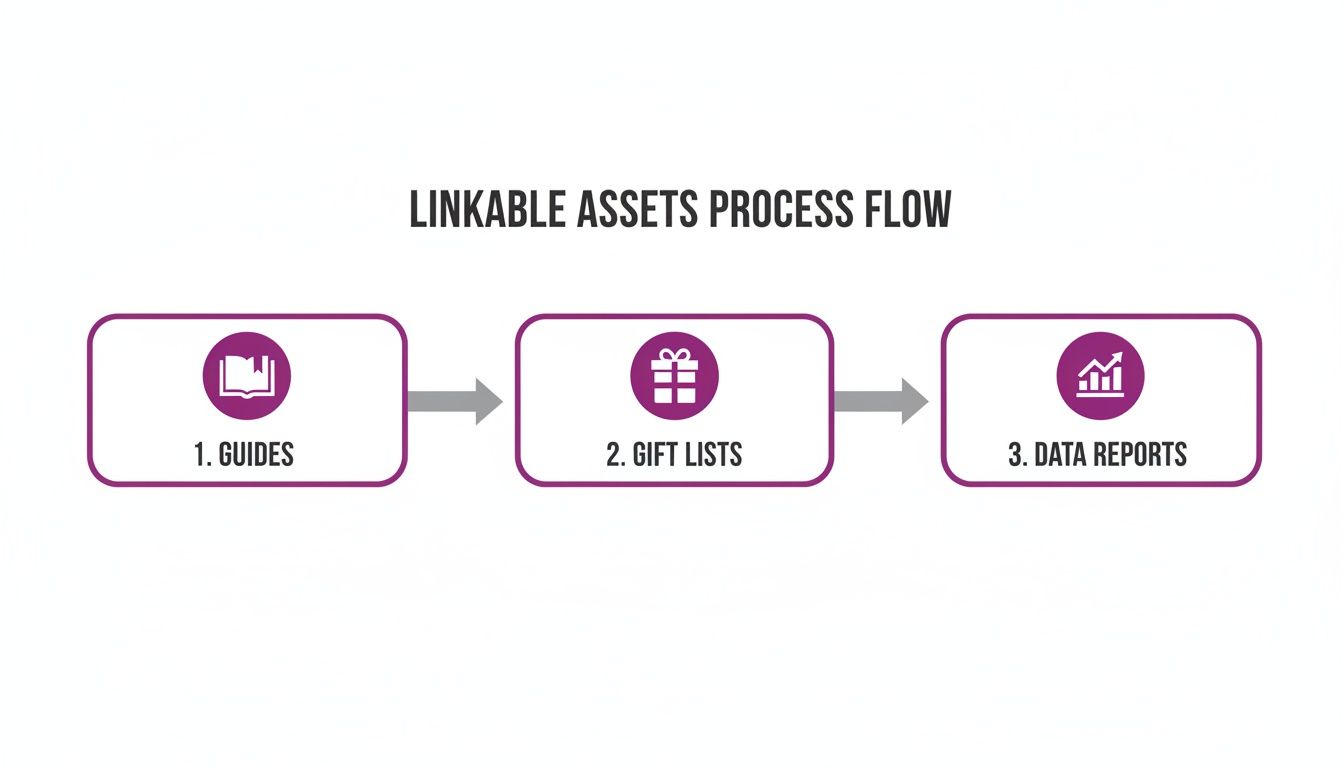
This visualizes how each asset—whether it's a guide, a gift list, or a data study—fuels a targeted and valuable outreach campaign.
The Art of the Follow-Up
Here's a stat that might surprise you: a single follow-up email can boost reply rates by more than 65%. I've found that many of my best links come not from the first email, but from the second or third. People are busy, inboxes are a disaster, and your initial message can easily get lost in the noise.
A gentle, polite follow-up isn't being pushy; it's being professional and persistent.
Here’s a simple workflow that works:
- Wait 3-5 business days: Give people a reasonable amount of time to respond before you nudge them.
- Keep it brief: Your follow-up should be even shorter than your first email. Just reply in the same thread and politely ask if they had a chance to see your original message.
- Know when to stop: Don't send more than two follow-ups. If you haven't heard back after three total attempts, it's time to move on.
This simple persistence shows you're serious and dramatically increases your chances of getting a reply. It’s often the one small step that turns a potential "no" into a fantastic backlink for your store.
How to Measure and Scale Your Link Building ROI
Link building isn’t just some abstract SEO task you check off a list; it’s a real financial investment in your store's future. Just like you'd scrutinize your ad spend, you need to hold your link building accountable. To justify the time and money you're pouring into ecommerce link building, you absolutely need a clear, no-fluff way to measure its return.
This means looking past the usual vanity metrics. A high Domain Authority (DA) score is great for your ego, but it doesn't directly pay the bills. The real goal is to track metrics that have a straight line to your bottom line—traffic, rankings, and, of course, revenue.
Identifying Metrics That Actually Matter
To get a true read on your link building ROI, you need to look at a mix of leading and lagging indicators. Leading indicators give you early signs of progress, which is great for morale and quick feedback. Lagging indicators come later, but they confirm the actual, long-term business impact.
Your focus should be on just a handful of key metrics that tell the whole story.
Here are the core numbers you should be watching:
- Organic Keyword Rankings: Keep a close eye on your search positions for the keywords your target pages are built around. Are your product and category pages climbing the SERPs for those valuable, high-intent terms?
- Referral Traffic: Jump into Google Analytics and see how much traffic your new backlinks are sending directly to your store. This is the most immediate payback you'll get from a newly acquired link.
- Organic Traffic Growth: As your rankings start to improve, you should see a lift in overall organic traffic to the pages you’re building links to. It's a simple cause-and-effect relationship.
- Conversion Rate from Referral Traffic: This is where you connect the dots to revenue. Analyze how well the traffic from your new links actually converts into sales. A link driving hundreds of clicks but zero sales is far less valuable than one sending ten clicks and two purchases.
By looking at these metrics together, you get a complete picture. You can see not only that your SEO is working but that it’s driving real, tangible business results.
Don't get lost in a sea of data. Your primary goal is to answer one question: "Is this activity leading to more qualified traffic and sales?" If a metric doesn't help answer that, it’s probably a distraction.
Building a Simple Performance Dashboard
You don't need some complex, enterprise-level system to track all this. A simple dashboard that pulls data from Google Analytics and your SEO tool of choice (like Ahrefs or Semrush) is all you need. This gives you one central place to see how your efforts are paying off.
Set up a custom report that pulls in the key metrics we just talked about. This could be a simple spreadsheet you update weekly or a more visual dashboard using a tool like Google Data Studio. The whole point is to spot trends over time and directly connect a spike in link acquisition to a rise in rankings and traffic. That visual connection is incredibly powerful for proving value and getting buy-in for more investment.
Scaling Your Link Building Efforts
Okay, so you have a process that works and a system for measuring its impact. What's next? The big challenge is scaling. How do you go from building a few links a month to creating a consistent, high-velocity link acquisition machine? The secret is in creating repeatable systems and centralizing your work.
One of the most powerful ways to scale is by creating a central content hub. Think of this as a dedicated section of your site—a blog, a resource center, a learning library—that houses all your best linkable assets. Instead of creating one-off guides for outreach, you build an entire library of valuable content that attracts links over and over again.
This approach creates a powerful flywheel effect that just keeps spinning:
- Create an Asset: You publish a monster guide on a core topic in your niche.
- Promote It: You use that guide for outreach, earning your first batch of backlinks.
- Gain Momentum: As that page gains authority from those initial links, it starts ranking on its own, attracting even more links passively.
- Internally Link: You then use this high-authority asset to pass "link equity" down to your most important product and category pages, lifting them all up.
By building out a hub like this, you create a sustainable engine for link acquisition that fuels your entire site's SEO. It's a systemized approach that allows you to scale your ecommerce link building predictably, ensuring you get consistent results and a clear, measurable return on your investment.
Got Questions About Ecommerce Link Building? We've Got Answers.
When you're deep in the weeds of running an ecommerce store, link building can feel like a whole other language. Founders and marketing managers often run into the same roadblocks and questions. What's a good link? How long does this actually take? Can I just do this myself?
Let's clear the air. Here are the straightforward, no-fluff answers to the questions we hear all the time.
How Long Until I See Results From Link Building?
This is the million-dollar question, isn't it? While you might spot some small keyword jumps or a tiny bit of referral traffic early on, real, tangible results don't happen overnight. Think of link building as a long-term investment in your store's authority, not a quick fix.
Generally, you can expect to see a noticeable impact on your organic rankings and traffic within 3 to 6 months of consistent, high-quality work. The key is momentum. Each quality backlink you earn is another brick in your foundation, building sustainable growth that pays dividends for years—a stark contrast to the fleeting boost you get from paid ads.
What Makes a Backlink Good or Bad for My Store?
Not all links are created equal. Far from it. Getting this right is critical, because a good backlink is a powerful vote of confidence, while a bad one can be a serious liability.
So, what does a good link look like?
- It's Relevant: The link comes from a site that's topically related to what you sell. A link from a popular rock-climbing blog to your outdoor gear store? That's gold.
- It Has Real Traffic and Authority: The site linking to you has its own established audience and is a respected voice in its space.
- It's Placed Naturally: The link fits seamlessly within high-quality content, adding real value for the person reading it.
On the flip side, a bad link usually comes from a spammy, low-quality site built purely for SEO manipulation, like a private blog network (PBN) or a sketchy, irrelevant directory. These can actively harm your rankings. Always, always prioritize the quality and relevance of a link over the sheer number you can get.
Should I Do Link Building Myself or Hire Help?
This really comes down to your two most valuable resources: time and expertise. You can absolutely get started on your own. Building genuine relationships with bloggers in your niche or hunting for broken link opportunities are fantastic starting points for any founder who's willing to get their hands dirty.
But let's be realistic—scaling a link building program is a massive time sink. The whole process of prospecting, creating content people want to link to, doing personalized outreach, and following up relentlessly is a full-time job. An experienced agency or consultant brings proven systems, expensive tools, and existing relationships to the table. That can seriously accelerate your results and, just as importantly, free you up to actually run your business.
For many growing stores, a hybrid approach is the sweet spot. You handle the in-house relationship building while outsourcing the more systematic, high-volume campaigns to a partner you trust.
Should I Get Links to My Homepage or Product Pages?
The best, most natural-looking backlink profile is a diverse one. You should have links pointing to various pages across your site—your homepage, category pages, and yes, even individual product pages. Focusing all your efforts on one type of page just looks weird to search engines.
Here's a powerful strategy we use all the time: build links primarily to your linkable assets. These are things like in-depth buying guides, unique data studies, or helpful tools. It's infinitely easier to get someone to link to a "Definitive Guide to Choosing a Hiking Backpack" than it is to your product page for the "TrekMaster 5000."
From there, you use strategic internal links within those assets to funnel that authority and "link equity" down to your most important product and category pages. It's a highly effective way to lift their rankings without having to beg for commercial links. While direct links to product pages are amazing when you can get them, the asset-based approach is almost always more efficient and scalable.
At ECORN, we specialize in turning Shopify stores into powerful growth engines. Our team of dedicated specialists can help you build an ecommerce link building strategy that drives real, measurable results. Start a project with us today and see how our expertise can scale your brand.


How to Add Subcategory in Shopify for Better UX
How to Implement Structured Data for Ecommerce in 2026
SEO App Mobile: Shopify Store Optimization Guide
Shopify Plus Support: What It Includes and How to Choose
Google Ads for Shopify: The Complete 2026 Playbook
Shopify New York: How to Find and Hire the Right Agency
Google Search Console for Shopify: The Complete Setup
First Party Data Collection for eCommerce Growth
FAQ Online Store Guide: Build and Measure It Right
Do FB Ads Work for eCommerce in 2026?
One Page Checkout for Shopify: Design and Implementation
Shopify GraphQL vs REST: The 2026 Developer Decision
Shopify Ecommerce Consulting: Strategy, Pricing &
Are Reddit Ads Worth It for eCommerce Brands
Shopify Title and Meta Description: A Practical 2026 Guide
Product Video Best Practices for Shopify Brands
Real-Time Inventory Management: A 2026 Guide
AI Chatbot Integration for Shopify Stores
Affiliate Program Management: A Shopify Guide
10 Best Performance Monitoring Tools for Shopify in 2026
Digital Asset Management for eCommerce Brands in 2026
Every Type of Facebook Ads Explained for eCommerce Growth
Product Information Management Explained for Shopify Brands
Support Ticket System: A Guide for Shopify Stores

10 Best Customer Service Tools for Shopify in 2026

Can I Start a Business with No Money? a 2026 Blueprint
What Sells Good on Etsy: Best Niches for 2026

Shopify Add to Cart Button: A Practical 2026 Guide

Customer Feedback Automation: A Practical eCommerce Guide
Critical Rendering Path: A Guide for Shopify Stores

How to Promote on TikTok for eCommerce in 2026

B2B eCommerce Consulting That Drives Real Revenue
10 Best Practices for Site Navigation in 2026
Return vs Refund for Shopify Stores: A Practical Guide
What Is Customer Lifetime Value and Why It Matters
What Is Voice of Customer Research for eCommerce

SMS Marketing for Ecommerce That Actually Converts

Master How to Improve Email Deliverability in 2026
Top 7 eCommerce Partners NYC for Shopify Brands in 2026
Machine Learning for Ecommerce: Boost Your Shopify Store

Beauty Market Research: Your 2026 Growth Guide

Shopify International Expansion: A 2026 Roadmap
What Does CRO Stand for in Business: Understanding CRO

Shopify Visual Merchandising: A Playbook for Higher Sales

Shopify Landing Page Design: Master Conversion in 2026
10 Best AI SEO Optimization Tools for Shopify in 2026

Agentic AI for Ecommerce: Boost Your Sales in 2026
Mastering Email Marketing Data for eCommerce Growth

Conversion Rate Optimisation Australia: Boost Your Sales
Conversion Rate Optimization AI: Your Shopify Store Guide

10 Product Bundling Strategies for Shopify in 2026
How to Increase Customer Lifetime Value: A Shopify Playbook
AI Customer Service Automation: Shopify Guide 2026
Clean Website Design: A Shopify Conversion Playbook

Omnichannel Retail Strategy: A Shopify Playbook
Product Data Enrichment: A Guide for Shopify Brands
Instagram Shopping Features a Guide for Shopify Stores
What Is Revenue Optimization: A Holistic RevOps Guide
Benefits of Conversion Rate Optimization: Boost Your
WordPress to Shopify Migration: Your 2026 Seamless Switch
Boost Sales: Ecommerce Payment Processing Guide 2026
Unified Commerce Platform: Benefits, KPIs & Shopify Guide
How to Reduce Bounce Rate eCommerce: Your 2026 Guide
Shopify API Integration: A Practical End-to-End Guide
How to Implement Data Governance: A 2026 Guide
Shopify Store Development Cost: A 2026 Breakdown
What Is Server Side Tracking: The Shopify Guide 2026
Marketing Automation Workflows: A Shopify Guide for 2026

Shopify: How to Reduce Technical Debt

Shopify UX Design Change: A Playbook for Growth
User Generated Content Strategy: Shopify Playbook

Shopify Pause and Build Plan Cost: A Complete 2026 Guide
Compare at Price on Shopify: A Complete Guide for 2026

Where Can I Sell My Prints? 10 Best Platforms for 2026
Shopify Order Management System: The Ultimate Guide 2026
What Is Marketing Attribution? an eCommerce Guide for 2026
10 Best Black Friday Sales Sheets for 2026

Discover the Top Social Media Marketing Agencies For
Consumer Confidence Definition for eCommerce in 2026
What Is Social Commerce? Your 2026 Guide to Boosting Sales
A Social Ad Campaign Playbook for eCommerce Growth
7 Best FAQ Page Examples for SaaS & eCommerce

Market Research in Fashion Industry: A Guide for Shopify
Shopify Migration Services: Expert Guide for 2026
Mastering FB Retargeting Ads for Shopify in 2026
What Is Omnichannel Ecommerce

Master Your Shopify Plus Migration: The 2026 Guide
Shopify Integration Services: A Merchant's 2026 Guide
Shopify Collection Description: A Guide to SEO & Sales
Shopify Plus Contact: Reach Sales & Support Effectively

Top Luxury Shopify Stores: Design & UX Strategies
How to Improve Customer Experience: A Shopify Roadmap
Creative Facebook Ads: 10 Examples for Shopify Brands

Remarketing with Facebook Ads: A Shopify Guide for 2026

SEO Linking Strategies for Shopify Stores
Top 7 Statistics YouTube Channels for eCommerce in 2026

Hiring Shopify Plus Designers: A Founder's Guide

Shopify Product Variation: Master Your Variants for 2026

Leverage Ai Solutions Brands: Your 2026 Shopify Growth Guide
Filters in Shopify: A Guide for Growing Brands


newsletter in your inbox