

The whole Shopify vs. Magento debate really boils down to one thing: do you want a ready-to-fly rocket ship or a powerful engine you can build a custom vehicle around? Shopify gives you the streamlined, ready-to-go eCommerce infrastructure, while Magento hands you the keys to an open-source framework for total, unlimited customization. It's a classic choice between operational simplicity and absolute control.
Choosing Your Enterprise eCommerce Foundation
Picking between Shopify and Magento is one of those foundational decisions that will shape everything—your team's technical workload, your budget, and how you scale. To make the right call, it helps to start by understanding Shopify and how its core philosophy differs from Magento's. Think of it as the ultimate trade-off: a managed, all-in-one solution versus a self-managed, infinitely flexible system.
Shopify Plus, their enterprise offering, is a Software-as-a-Service (SaaS) platform. In plain English, this means Shopify handles all the technical headaches—the hosting, security, server maintenance, and updates—all for a predictable monthly fee. This model is perfect for brands that want to pour their resources into what they do best: marketing, product development, and winning over customers, not managing infrastructure.
On the flip side, Magento (now known as Adobe Commerce) is an open-source platform. This gives you unparalleled freedom. You can dig into the source code, build completely custom integrations, and fine-tune every single pixel of the user experience. But, as they say, with great power comes great responsibility. You're on the hook for managing your own hosting, security patches, performance tuning, and development, which almost always means a much higher Total Cost of Ownership (TCO).
This fundamental difference in architecture is clear in their market share. Shopify absolutely dominates the overall market, powering around 4.8 million active stores across the globe. Its ease of use has made it the default choice for millions of businesses, especially in the United States.
To put this all into perspective, here's a quick look at how these two platforms stack up at a high level.
Shopify vs Magento At-a-Glance Decision Matrix
This table frames the core decision: predictability and ease versus power and control. Your choice will ultimately depend on your business's unique needs, resources, and long-term vision.
Platform Architecture and Technical Demands: What’s Under the Hood?
The biggest difference between Shopify and Magento isn't a feature—it’s the fundamental philosophy behind their architecture. This is where you’ll find the real fork in the road.
Shopify is a Software-as-a-Service (SaaS) platform. Think of it as leasing a fully serviced, high-performance retail space in a premium mall. Shopify owns and manages the entire building—they handle security, maintenance, updates, and make sure the lights stay on, even during the holiday rush. You just focus on what you sell and how you sell it.
This hands-off approach is a massive advantage for brands that want to pour their resources into marketing and operations, not server administration. Forget worrying about server loads during a flash sale or scrambling to apply a critical security patch. Shopify handles it all behind the scenes, making top-tier commerce accessible without needing a huge IT department on payroll.
On the other side of the spectrum, you have Magento, a self-hosted, open-source PHP platform. This is like owning the entire building and the land it sits on. You have the blueprints, the keys to every room, and the freedom to build, demolish, and rebuild anything you want. For businesses with deeply specific requirements—like intricate product configurators or custom integrations with old-school ERP systems—this absolute control is non-negotiable.
The Double-Edged Sword of Magento's Complexity
Magento’s power comes from its modular build and its Entity-Attribute-Value (EAV) database model. The EAV model is brilliant for flexibility, allowing you to create almost any product attribute imaginable. But it’s also notoriously complex. Without an experienced hand to manage and optimize it, the EAV database can quickly become a performance bottleneck, which is a classic headache for teams new to the platform.
Running Magento well is a serious technical commitment. You’re on the hook for everything:
- Performance Tuning: Constant optimization of server configurations, caching strategies, and database queries.
- Security Patching: You have to stay vigilant, applying every security update yourself to shield your store from threats.
- Custom Development: Any unique feature requires skilled PHP developers who know the Magento framework inside and out.
Magento’s architecture puts the full weight of performance, security, and uptime directly on your shoulders. It offers limitless power, but any mistake—a misconfigured server or a missed security patch—can hit your revenue and reputation hard.
How Architecture Shapes the Market
This core architectural split tells you everything you need to know about where each platform sits in the market. Magento, which has been around since 2004, has a smaller overall market share at just 1.49% of all eCommerce sites. But don't let that number fool you. It’s a beast in the enterprise world, powering roughly 20% of the top 1,000 U.S. retailers. You can find more details on Magento’s enterprise presence over at Simplior.com.
It’s All About Your Team’s DNA
So, how do you choose? It really boils down to your team’s internal strengths and what you want to focus on as a business.
If your company lives and breathes marketing, operational excellence, and would rather outsource the technical heavy lifting, Shopify Plus gives you an incredibly powerful and stable foundation to build on.
But if your business model demands unique functionality and you have a battle-tested in-house development team (or a trusted agency partner), Magento provides the raw, granular control to build something truly one-of-a-kind. It's less about which platform is "better" and more about which one aligns with your company’s DNA.
Calculating the True Total Cost of Ownership
When you’re comparing Shopify Plus and Magento, looking at the sticker price is like judging a car by its paint job—it tells you nothing about what it actually costs to keep it on the road. The Total Cost of Ownership (TCO) is what really matters. It pulls back the curtain on the complete financial picture, moving way beyond simple subscription fees to account for every single expense needed to run your store effectively.
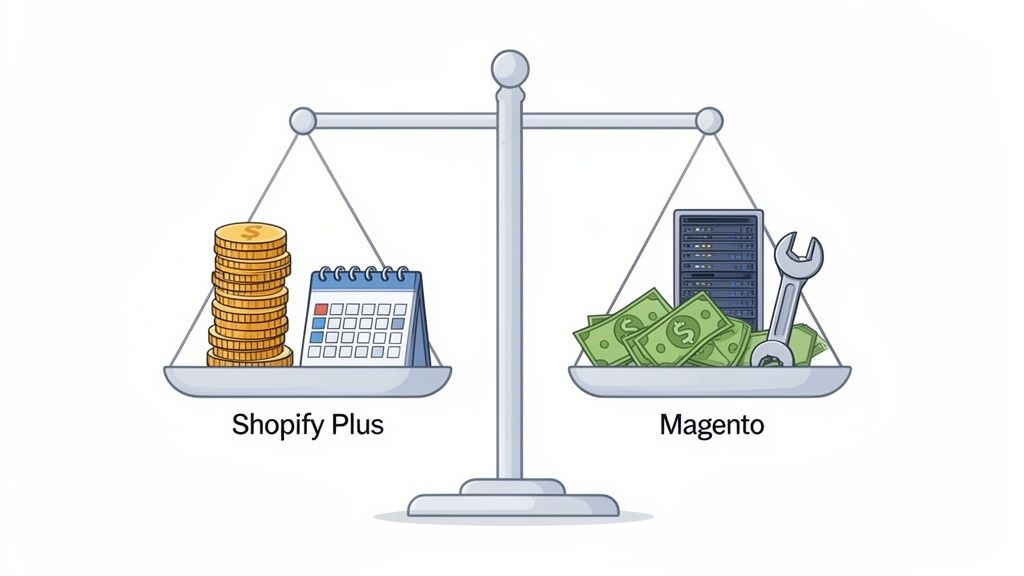
With Shopify Plus, the financial model is all about predictability. Because it's a SaaS platform, it bundles many of the variable costs that can plague open-source platforms into one recurring fee. This makes budgeting a whole lot simpler and frees up capital that would otherwise be tied up in managing technical overhead.
On the flip side, Magento’s open-source freedom comes with a much more complex and often unpredictable cost structure. Sure, the community edition software is free to download, but the ecosystem of necessary expenses can pile up fast, making it a much larger long-term investment.
The Predictable Costs of Shopify Plus
Shopify Plus consolidates your major operational expenses into a clear, recurring payment structure. This predictability is a huge advantage for financial planning, letting businesses forecast their platform costs with a high degree of accuracy.
The main costs you’ll see with a Shopify Plus store include:
- Monthly Subscription: This is your flat fee covering hosting, top-tier security, platform maintenance, and access to all the enterprise-level features.
- Transaction Fees: You'll see a small percentage per transaction if you don't use Shopify Payments. Even then, this fee is often lower than what standard payment processors charge.
- App Ecosystem Expenses: These are the monthly fees for any third-party apps you add to extend your store’s functionality, from loyalty programs to advanced analytics.
- Theme Development: This is typically a one-time or ongoing cost for custom theme design or modifications, though there are plenty of high-quality pre-built themes to choose from.
Getting a handle on these components is key. We actually put together a detailed breakdown you can read in our guide on the full cost of a Shopify store. That predictability isn't just a feature; it's a core part of its value proposition.
Dissecting Magento’s Complex Cost Structure
With Magento, the initial software cost is just the tip of the iceberg. The real TCO is a patchwork of numerous variable expenses that demand constant management and investment. It's not uncommon for these costs to spiral well beyond what was initially projected.
A realistic budget for a Magento store has to account for all of this:
- Licensing Fees: For Adobe Commerce, this is a hefty annual expense that scales with your store's revenue.
- Dedicated Hosting: High-performance, secure hosting isn't optional, and it can easily run you thousands of dollars per month.
- Developer Salaries or Retainers: You’ll need a skilled Magento developer or a dedicated agency on hand for updates, security patches, and any custom work. This is a significant, ongoing expense.
- Extension Purchases: While a vast marketplace exists, premium extensions often come with steep price tags and annual fees for support.
- Security and Compliance: PCI compliance, SSL certificates, and regular security audits? That’s all on you to manage and pay for.
The financial and operational costs reveal a stark difference between the two platforms. Shopify Plus offers a remarkably accessible starting point, with its plans kicking off at around $2,000 per month. In sharp contrast, Magento (Adobe Commerce) demands a much higher upfront investment, with licensing costs starting between $22,000 to $40,000 annually. And that figure doesn't even touch the additional expenses for hosting, development, and maintenance—which often push total implementation costs into the $30,000 to $100,000 range, or even higher.
Ultimately, while Magento gives you unparalleled control, that control comes at a premium. From a TCO perspective, the choice between Shopify and Magento boils down to one thing: do you prefer predictable operational expenses or a variable—but potentially much higher—investment for total customization?
Evaluating Customization and Ecosystem Flexibility
The choice between Shopify and Magento often comes down to one core philosophical question: how do you want to build out your store? This isn't just about adding a feature here or there; it’s about the fundamental approach you'll take to grow your platform, and it sits at the heart of the Shopify vs. Magento debate. The decision is a straight trade-off between guided efficiency and absolute control.
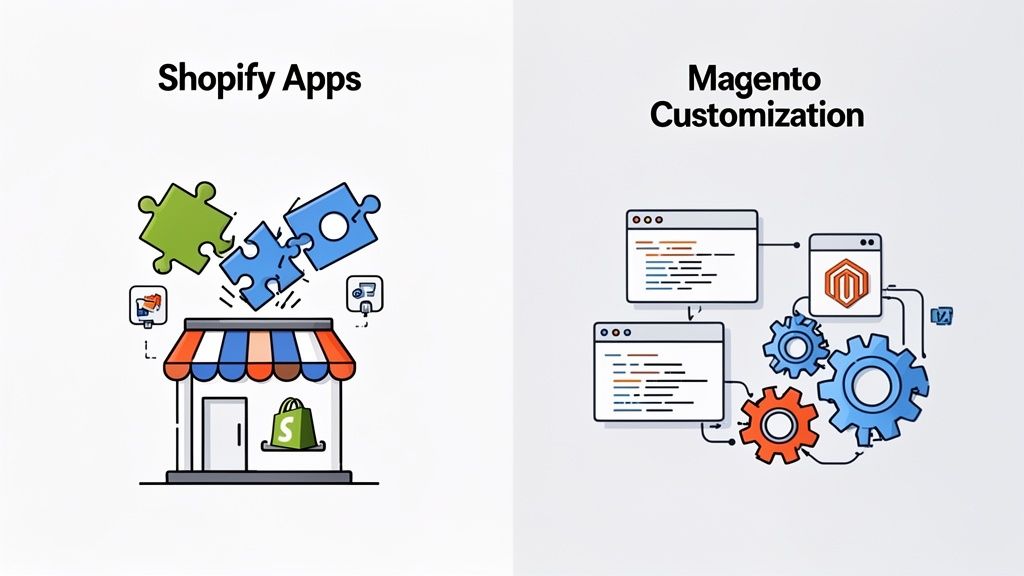
Shopify runs on a model of app-driven extensibility. Think of it as a meticulously curated garden where new functionality is added through pre-vetted, secure apps from the Shopify App Store. This approach lets merchants add powerful tools—like AI-powered personalization, subscription models, or loyalty programs—with just a few clicks. It sidesteps the need for complex, time-consuming custom development projects entirely.
A Shopify Plus merchant, for example, can roll out sophisticated features using Shopify Scripts for fine-tuned checkout customizations or by plugging in highly specialized apps. Tools like customer retention software for Shopify stores are built from the ground up to integrate seamlessly, ensuring your store remains stable and secure.
The Power of Code-Level Control in Magento
In sharp contrast, Magento is all about unrestricted, code-level modification. As an open-source platform, it hands developers the keys to the entire kingdom—complete access to the core code. This freedom is Magento's biggest superpower and, frankly, its biggest headache. It means you can build literally anything you can dream up, from a completely bespoke product configurator to a deep, two-way sync with a quirky legacy ERP system.
This level of control allows for truly unique user experiences and business logic that are simply off the table in Shopify’s more structured world. But here's the catch: every single customization is a development project. Each new feature needs to be scoped, coded, tested, and maintained by a skilled Magento developer, which has a direct impact on your timeline and budget.
Magento’s open-source DNA gives you limitless customization potential, but this power comes with the responsibility of managing code stability, security, and compatibility. Every modification is a direct trade-off between bespoke functionality and increased technical overhead.
This fundamental difference creates two wildly different paths for a store owner. A Shopify merchant can add a new feature over a cup of coffee. A Magento merchant might need weeks of development and testing to get a similar—albeit more tailored—result.
A Tale of Two Ecosystems
The difference is crystal clear when you look at their marketplaces. The Shopify App Store is a polished, user-friendly environment focused on plug-and-play solutions designed for merchants. The Magento Marketplace, while huge, feels more like a parts depot for developers, offering extensions that often need a technical hand to get them running correctly.
This table breaks down how each platform approaches expanding its functionality.
Functionality Expansion Approach Comparison
In the end, the right choice hinges entirely on your business needs and internal resources. If your priority is rapid growth fueled by proven, easy-to-implement solutions, Shopify’s ecosystem provides a stable and efficient path forward. But if your business model demands unique, deeply integrated features and you have the technical team to back it up, Magento offers the boundless freedom to build a platform that is truly one-of-a-kind.
Performance, Scaling, and the Headless Revolution
When you're choosing between Shopify and Magento, performance isn't just a line item on a feature list—it's a direct outcome of their fundamental architectures. How a platform handles a flood of traffic and scales with your brand is a make-or-break factor for keeping customers happy and revenue flowing, especially when Black Friday hits.
Shopify Plus is built for performance right out of the box. Its globally distributed, managed infrastructure is designed to absorb massive, unexpected traffic spikes without you lifting a finger. When your flash sale goes live, Shopify’s auto-scaling just works, ensuring your store stays snappy and responsive. That reliability is a huge part of its value proposition; it simply removes performance anxiety from the equation.
Magento, on the other hand, puts the performance keys directly in your hands. The potential for raw speed is immense, but it's entirely dependent on a highly optimized hosting environment managed by a sharp development team. Simple misconfigurations, clunky code, or an underpowered server can quickly lead to slow load times and, worse, a complete site crash under pressure.
While a perfectly tuned Magento store can be an absolute speed demon, Shopify Plus guarantees high performance and 99.99% uptime as part of the package. This makes Shopify the safer bet for brands that simply can't afford the risk of downtime or performance headaches.
Embracing Headless Commerce
The conversation has moved beyond traditional storefronts and into headless commerce. This modern approach splits your front-end customer experience from your back-end commerce engine. It gives brands the freedom to build completely unique, content-rich experiences across any channel you can imagine—from your website to mobile apps and even IoT devices.
Shopify has gone all-in on this with its Hydrogen and Oxygen stack. Hydrogen is a React-based framework built specifically for creating custom storefronts, while Oxygen is the globally distributed hosting solution designed to run them. This integrated toolkit makes it dramatically easier and faster for developers to spin up and deploy high-performance headless stores on the Shopify platform. If you're new to the idea, getting a handle on what headless commerce is can really highlight the competitive advantage this architecture offers.
Magento also brings powerful headless capabilities to the table with its PWA Studio and extensive APIs. PWA Studio gives developers the tools to build Progressive Web Apps, which create a slick, app-like experience right in a web browser. However, executing a headless build on Magento is a much heavier lift. It demands deep technical expertise to not only build the front-end experience but also to seamlessly wire it into the Magento back end.
The Developer Experience: A Tale of Two APIs
For a headless project, the developer experience is a massive differentiator. Shopify’s GraphQL API is almost universally praised for being clean, efficient, and easy to work with. It lets developers pull all the data they need in a single API call, which simplifies front-end work and boosts performance. This streamlined process can shave weeks or even months off a headless launch timeline.
Magento also offers both GraphQL and REST APIs, giving developers plenty of power. But the platform's architectural complexity often means that building and integrating a custom front end requires more intricate code and a much deeper understanding of Magento's data models. This almost always translates into longer development cycles and higher costs.
The choice really comes down to what your team values most:
- For Speed and Simplicity: Shopify’s integrated Hydrogen/Oxygen stack and its efficient GraphQL API offer a much faster, more direct route to launching a sophisticated headless storefront.
- For Absolute Control: Magento gives you the ultimate flexibility to build a completely custom headless architecture, but it requires a significant investment in specialized developers and ongoing maintenance.
At the end of the day, both platforms can power an incredible headless experience. Shopify gets you to the finish line faster and more efficiently, while Magento offers limitless customization for those with the technical firepower to pull it off.
Making the Right Decision for Your Business
Choosing between Shopify and Magento isn’t really about picking the "best" platform. It's about deciding on the right operational model for your business's DNA.
The whole debate boils down to a strategic choice: speed and agility versus deep, granular control. One platform lets you move fast and keep operations simple, while the other gives you limitless customization—but that comes with more complexity and higher overhead.
To make this decision easier, let's look at it through the lens of common business types. Each one has distinct needs that naturally line up with one platform's core strengths.
The Rapidly Scaling D2C Brand
This business is all about growth. They're marketing-obsessed, constantly checking conversion rates, and need to spin up campaigns and product drops on a whim. For them, getting bogged down in technical management is a distraction, not a core competency.
For this brand, Shopify Plus is the clear winner. Its SaaS model gets rid of the technical headaches, letting the team put all their energy into acquiring and retaining customers. The predictable costs and massive app ecosystem provide everything needed for aggressive scaling, minus the financial surprises or development bottlenecks you often hit with open-source solutions.
The Complex B2B Enterprise
This company’s operations are anything but simple. They need things like customer-specific pricing tiers, complicated quote-to-order workflows, and heavy integrations with legacy ERP or CRM systems that demand custom code. Here, control over the backend isn't just a nice-to-have; it's a must.
In this scenario, Magento (Adobe Commerce) is the superior choice. Its open-source framework provides the unrestricted access required to build bespoke solutions that fit their exact operational needs. While the TCO is definitely higher, the power to mold the platform around unique business processes gives them a long-term strategic advantage that Shopify’s more structured system just can't offer.
The decision ultimately hinges on your primary constraint. If your biggest bottleneck is development resources and time-to-market, choose Shopify. If your bottleneck is a rigid platform that can’t adapt to your unique business model, choose Magento.
The Multi-National Retailer
This brand is global, operating across multiple regions, languages, and currencies. They often have different product catalogs and legal requirements for each market. They need a system that can juggle all this complexity while keeping the brand experience consistent worldwide.
The choice here is more nuanced, but it often leans toward Shopify Plus. Its multi-store architecture and Markets features were built specifically to simplify international commerce. While Magento can certainly handle this, setting up and maintaining separate instances for each region requires a huge investment in development and infrastructure. That makes Shopify's centralized approach a more efficient and cost-effective route for global expansion.
This decision tree gives you a visual on the core scaling question: handling high traffic.
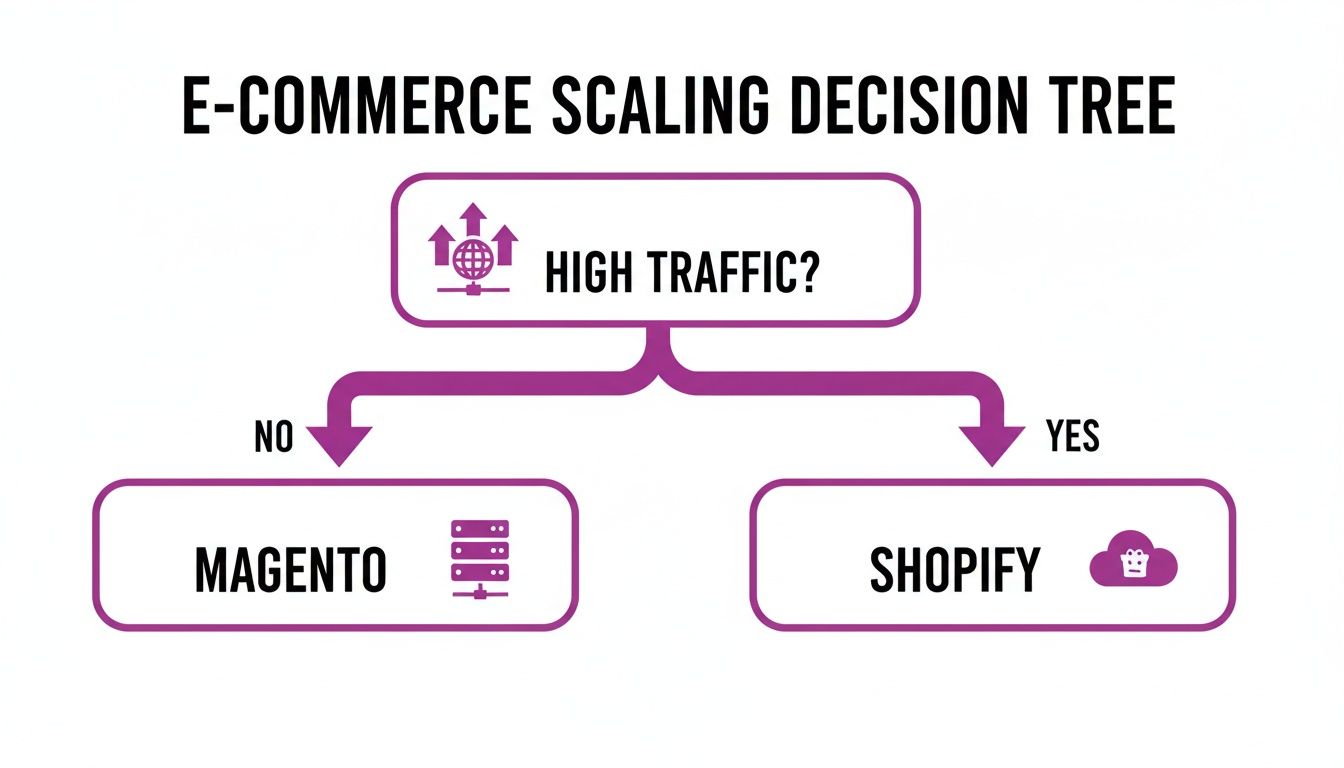
As the visual shows, if your priority is being ready for high traffic right out of the box, Shopify's cloud infrastructure is the way to go. Magento, on the other hand, requires dedicated server management to get to that same level of stability.
Frequently Asked Questions
Even after a side-by-side comparison, some specific questions always pop up when you're really weighing Shopify against Magento. Let's tackle the most common ones to give you that last bit of clarity before making a decision.
Is Magento More Secure Than Shopify?
This question gets right to a core difference in how these platforms are built. With Shopify, you're on a SaaS platform, meaning they handle security for you. Every single store gets the benefit of Level 1 PCI DSS compliance, constant monitoring, and security updates managed by Shopify's internal team. That responsibility is almost entirely off your plate.
Magento’s security, on the other hand, is completely merchant-managed. The core software is secure, sure, but you are responsible for keeping it that way. This means everything from choosing a secure hosting environment and applying security patches the moment they're released to vetting every single third-party extension you install. A properly maintained Magento store can be a fortress, but it demands constant technical oversight.
It really boils down to inherent security versus managed security. Shopify delivers security as part of the service, while Magento gives you the tools to build and maintain your own secure setup.
How Difficult Is Migrating From Magento To Shopify Plus?
Moving from Magento to Shopify Plus is a well-trodden path, but the difficulty is directly tied to how complex your current Magento store is. A standard migration—products, customers, and order history—is a fairly straightforward project that typically takes anywhere from a few weeks to a couple of months.
The real challenge comes from replicating custom-built Magento features. Any unique functionality you’ve developed over the years will need a new home on Shopify. This could mean:
- Finding an equivalent app in the Shopify App Store.
- Using Shopify Scripts to customize the checkout.
- Building a completely custom app for highly specialized logic.
While the data migration itself is manageable with modern tools, recreating years of custom code is where the heavy lifting happens. The payoff, of course, is a massive reduction in technical headaches and maintenance costs once you're on the other side.
Can Shopify Handle Complex B2B Requirements Like Magento?
Historically, Magento was the undisputed king of B2B eCommerce, thanks to its deep, native feature set. But Shopify has been pouring resources into its B2B offering, turning Shopify Plus into a serious competitor for a huge number of wholesale businesses.
Today, Shopify Plus comes with a powerful suite of B2B features built right in. You get company profiles, net payment terms, custom price lists, and even a password-protected B2B storefront. This setup lets you run both your wholesale and direct-to-consumer businesses from one clean, unified admin panel.
Magento still holds an edge for businesses that need deep, code-level customization for truly unique B2B workflows, like complex quote-to-order processes or integrations with older, legacy ERP systems. The choice depends on your operation. If your B2B needs fit within Shopify's streamlined (but powerful) feature set, it’s a much more efficient and user-friendly path. If your business runs on completely bespoke logic, Magento’s flexibility is hard to beat.
At ECORN, we live and breathe Shopify, helping ambitious brands unlock its true power. Whether you're planning a migration, looking to optimize for higher conversions, or need a custom solution built from the ground up, our team is here to help you scale smarter. Explore our Shopify development services to see how we can fuel your growth.


How to Build a Shopify Clothing Website That Converts

How to Launch a Box Subscription Business in 2026

Luxury Skincare Branding Playbook That Converters

10 Best Podcast Ecommerce Shows for Store Growth in 2026
Shopify Developer Hourly Rate: What to Pay in 2026
Critical Shopify Setup Errors That Are Secretly Sabotaging Your Store
Ecommerce Conversion Tracking: The Complete How-To Guide

Shopify Design Agency: How to Pick the Right Partner
Mastering Multi Store Management on Shopify
Scale Shopify Store

10 Shopify App Ideas Worth Building in 2026
Conversion Rate Optimization for Landing Pages: The Playbook
Shopify Plus Automation: A Guide for 2026
10 Social Selling Platforms for Shopify Merchants

Shopify Website Design Examples: 7 Stores Worth Studying
7 Ecommerce Newsletter Examples for Shopify Brands
One Product Shopify Store: Build and Scale

Mobile Pop Up Strategy for Shopify Stores That Converts

Sitemap for Shopify: How to Find, Optimize, and Submit It
7 Single Product Websites Worth Emulating

Product Variants Shopify: The Complete 2026 Guide
Ecommerce Analytics Consulting for Growth
What Is AI Integration for eCommerce
How to Choose the Right eCommerce Website Development Firm
E Business Strategy Implementation
Conversion Tracking Setup for Shopify Stores
BigCommerce vs Shopify Plus Which Enterprise Wins in 2026
Shopify Theme Kit: Setup, Commands, and Migration Guide
Shopify Extension Development: A Practical 2026 Guide

Shopify Speed Score Explained and How to Improve It

Shopify Mobile Optimization: The 2026 Playbook

How to Add Subcategory in Shopify for Better UX
How to Implement Structured Data for Ecommerce in 2026

SEO App Mobile: Shopify Store Optimization Guide

Shopify Plus Support: What It Includes and How to Choose

Google Ads for Shopify: The Complete 2026 Playbook

Shopify New York: How to Find and Hire the Right Agency

Google Search Console for Shopify: The Complete Setup
First Party Data Collection for eCommerce Growth
FAQ Online Store Guide: Build and Measure It Right

Do FB Ads Work for eCommerce in 2026?

One Page Checkout for Shopify: Design and Implementation
Shopify GraphQL vs REST: The 2026 Developer Decision
Shopify Ecommerce Consulting: Strategy, Pricing &

Are Reddit Ads Worth It for eCommerce Brands

Shopify Title and Meta Description: A Practical 2026 Guide

Product Video Best Practices for Shopify Brands

Real-Time Inventory Management: A 2026 Guide
AI Chatbot Integration for Shopify Stores

Affiliate Program Management: A Shopify Guide
10 Best Performance Monitoring Tools for Shopify in 2026

Digital Asset Management for eCommerce Brands in 2026

Every Type of Facebook Ads Explained for eCommerce Growth
Product Information Management Explained for Shopify Brands
Support Ticket System: A Guide for Shopify Stores

10 Best Customer Service Tools for Shopify in 2026

Can I Start a Business with No Money? a 2026 Blueprint

What Sells Good on Etsy: Best Niches for 2026

Shopify Add to Cart Button: A Practical 2026 Guide

Customer Feedback Automation: A Practical eCommerce Guide

Critical Rendering Path: A Guide for Shopify Stores

How to Promote on TikTok for eCommerce in 2026

B2B eCommerce Consulting That Drives Real Revenue

10 Best Practices for Site Navigation in 2026
Return vs Refund for Shopify Stores: A Practical Guide

What Is Customer Lifetime Value and Why It Matters

What Is Voice of Customer Research for eCommerce

SMS Marketing for Ecommerce That Actually Converts

Master How to Improve Email Deliverability in 2026

Top 8 eCommerce Partners NYC for Shopify Brands in 2026

Machine Learning for Ecommerce: Boost Your Shopify Store

Beauty Market Research: Your 2026 Growth Guide

Shopify International Expansion: A 2026 Roadmap
What Does CRO Stand for in Business: Understanding CRO

Shopify Visual Merchandising: A Playbook for Higher Sales

Shopify Landing Page Design: Master Conversion in 2026

10 Best AI SEO Optimization Tools for Shopify in 2026

Agentic AI for Ecommerce: Boost Your Sales in 2026
Mastering Email Marketing Data for eCommerce Growth

Conversion Rate Optimisation Australia: Boost Your Sales
Conversion Rate Optimization AI: Your Shopify Store Guide

10 Product Bundling Strategies for Shopify in 2026

How to Increase Customer Lifetime Value: A Shopify Playbook
AI Customer Service Automation: Shopify Guide 2026

Clean Website Design: A Shopify Conversion Playbook

Omnichannel Retail Strategy: A Shopify Playbook

Product Data Enrichment: A Guide for Shopify Brands

Instagram Shopping Features a Guide for Shopify Stores

What Is Revenue Optimization: A Holistic RevOps Guide

Benefits of Conversion Rate Optimization: Boost Your
WordPress to Shopify Migration: Your 2026 Seamless Switch
Boost Sales: Ecommerce Payment Processing Guide 2026
Unified Commerce Platform: Benefits, KPIs & Shopify Guide

How to Reduce Bounce Rate eCommerce: Your 2026 Guide
Shopify API Integration: A Practical End-to-End Guide

How to Implement Data Governance: A 2026 Guide
Shopify Store Development Cost: A 2026 Breakdown
What Is Server Side Tracking: The Shopify Guide 2026
Marketing Automation Workflows: A Shopify Guide for 2026

Shopify: How to Reduce Technical Debt


newsletter in your inbox