


Choosing between Magento or Shopify really boils down to one big question: Do you need limitless, deep customization, or do you crave agile, streamlined speed-to-market?
Think of Shopify as the all-in-one solution built for rapid scaling and quick pivots. Magento (now Adobe Commerce), on the other hand, is the absolute powerhouse for businesses with seriously complex technical demands and the resources to match.
Choosing Your eCommerce Platform Magento Or Shopify
Picking your platform is one of the most foundational decisions you'll make as a growing eCommerce brand. This guide is designed to go beyond the surface-level stuff to give you a strategic framework for that choice. We're going to dig into the nuanced differences that actually matter for your long-term growth, not just what you need today.
This decision impacts everything—from your total cost of ownership to your ability to innovate and react to market shifts. To get it right, you need an honest look at your internal team, your technical comfort level, and your ultimate business goals. It's also worth looking at broader guides on finding the right ecommerce platform to get a wider perspective before diving deep into this specific comparison.
Core Philosophies at a Glance
Shopify and Magento were built from two completely different schools of thought. Shopify provides a curated, user-friendly ecosystem where stability and ease of use are the top priorities. The whole point is to let brands focus on marketing and selling, not on managing technical infrastructure.
Magento is the polar opposite. As an open-source platform, it hands you the keys to the kingdom, offering unparalleled control and flexibility. It’s a blank canvas for businesses that need bespoke functionality, intricate integrations, or unique backend logic that you just can't get from an off-the-shelf solution. That freedom, however, comes with a whole lot more responsibility for development, security, and ongoing maintenance.
Analyzing the True Cost of Ownership
When you’re comparing Magento and Shopify, the sticker price is just the beginning of the story. To really understand the financial impact on your business, you need to look at the Total Cost of Ownership (TCO). This isn't just the monthly fee; it's every single direct and indirect cost you'll face over the life of your store.
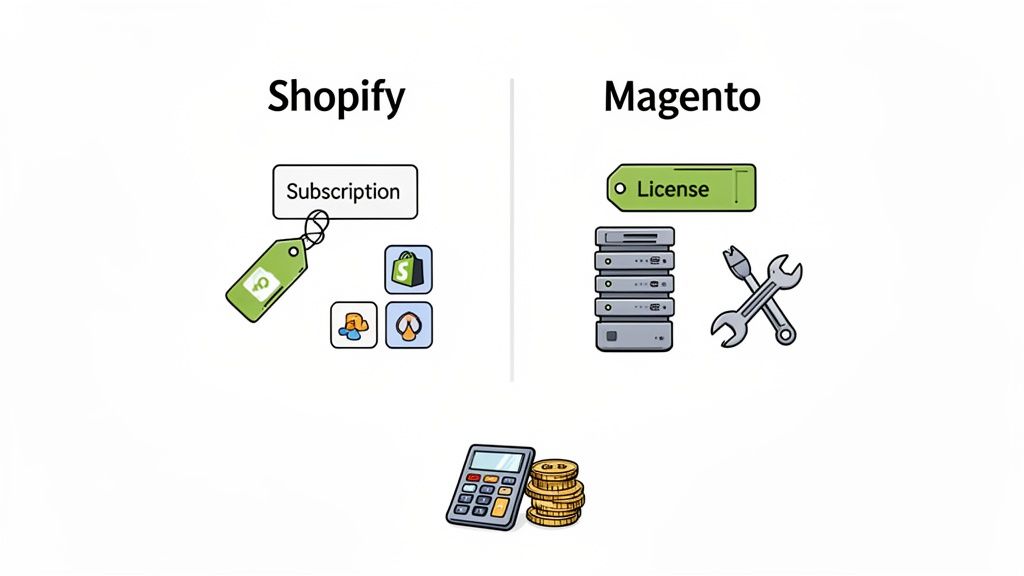
Shopify’s cost structure is built to be straightforward. As a SaaS (Software-as-a-Service) platform, it bundles hosting, security, and core maintenance into one predictable monthly subscription. This makes budgeting a whole lot simpler right from day one.
Unpacking Shopify and Shopify Plus Costs
Shopify’s pricing is tiered, so it can grow with you. It starts with basic plans for new businesses and scales all the way up to Shopify Plus for high-volume merchants. While the subscription is the main line item, a few other costs will pop up.
- Transaction Fees: If you opt out of Shopify Payments, you’ll pay a transaction fee on every sale. This ranges from 0.5% to 2.0%, depending on which plan you choose.
- App and Theme Costs: The Shopify App Store is where you'll find the tools to extend your store's functionality. Expect premium apps for subscriptions, loyalty programs, or advanced analytics to add another $100 to $500+ per month to your bill. A quality premium theme is typically a one-time purchase of $200 to $400.
Let's take a fast-growing D2C brand on Shopify Plus, which starts at $2,300 per month. Once you add in mission-critical apps and payment processing, a realistic monthly total often lands between $3,000 and $5,000.
The real power of Shopify’s model is its predictability. A growing brand can forecast its eCommerce budget with confidence, without the looming fear of a surprise server bill after a massive Black Friday sale.
Deconstructing the Complex Magento Cost Structure
With Magento (now Adobe Commerce), the financial picture is a lot more complicated. It’s open-source, which sounds free, but running a professional store is anything but. The core software might not cost anything (Magento Open Source), but you’re on the hook for everything else.
Adobe Commerce, the enterprise version, has some hefty licensing fees. These can start at $22,000 per year and climb based on your Gross Merchandise Volume (GMV). And that's just your ticket to get in the door.
- Hosting Expenses: Unlike Shopify, you have to find and pay for your own hosting. A reliable, scalable server setup for a Magento store will run you anywhere from $100 to over $2,000 a month, depending on your traffic and site complexity.
- Development and Customization: This is where the costs really balloon. Building a custom Magento store can easily require an initial investment of $25,000 to $100,000+. You’ll need specialized Magento developers for the initial build, customizations, and any integrations.
- Ongoing Maintenance: A Magento store is not a "set it and forget it" platform. It needs constant care. Think security patches, version updates, and performance tuning—these are non-negotiable. Plan on budgeting at least $500 to $5,000 per month for a maintenance retainer with an agency or developer.
A Practical Scenario Comparison
Let's put some real numbers to this to see how it plays out over a year.
Scenario 1: The High-Growth D2C Brand
A brand hitting $5 million in annual revenue opts for Shopify Plus.
- Shopify Plus Fee: ~$2,300/month
- Essential Apps: ~$500/month
- Payment Processing: Built into Shopify Payments
- Total Annual TCO: Roughly $33,600 (not including credit card rates)
Scenario 2: The Enterprise B2B Company
A company with the same $5 million revenue but needing complex integrations chooses Adobe Commerce.
- License Fee: ~$40,000/year
- Managed Hosting: ~$1,000/month ($12,000/year)
- Maintenance & Support Retainer: ~$3,000/month ($36,000/year)
- Total Annual TCO: Roughly $88,000 (and that’s before any new development projects)
The difference is stark. Shopify gives you predictable, all-in-one pricing, while Magento’s TCO is significantly higher and requires juggling multiple vendors for hosting, development, and security. The choice between Magento or Shopify isn't just about features—it's about understanding these long-term financial commitments from the very beginning.
Comparing Scalability and Peak Performance
When a marketing campaign goes viral or a Black Friday sale blows past all expectations, your platform's ability to handle the crush of traffic is everything. How each platform deals with this pressure is a massive point of difference in the magento or shopify debate. It’s the classic standoff: effortless reliability versus unlimited, but hands-on, power.
This is exactly the kind of scenario Shopify Plus was built for. It runs on a fully managed, global infrastructure that’s designed from the ground up to automatically soak up huge traffic surges. When your store is in the spotlight, you don't have to lift a finger. Shopify's systems manage the load balancing and resource allocation in the background, keeping your site fast, responsive, and open for business.
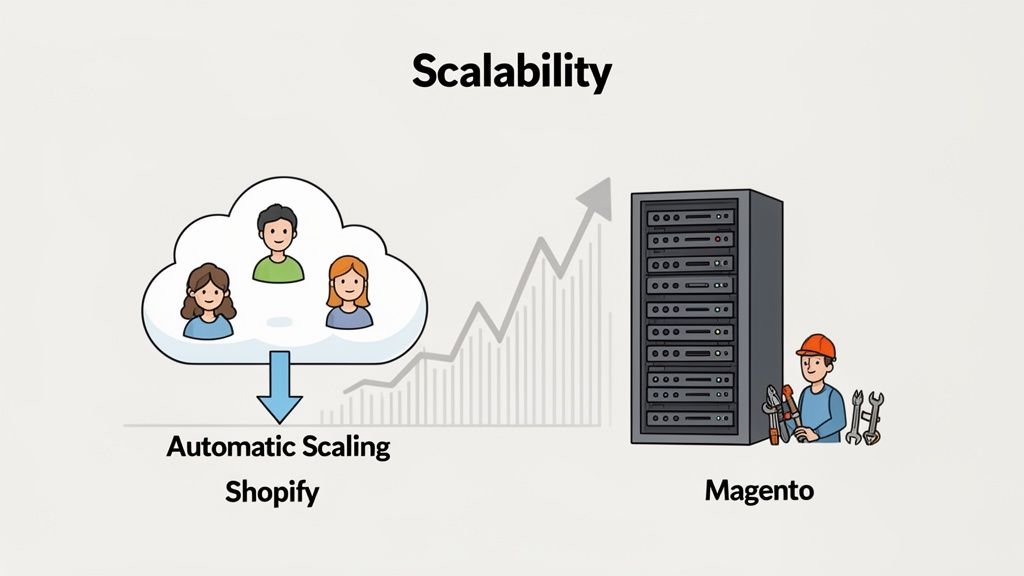
This completely hands-off approach is a game-changer for brands that would rather focus on marketing and running the business than managing servers. Your team can pour all its energy into the sales event, confident the tech will just work.
Shopify's Automated Scaling Model
Shopify’s architecture is a huge part of its success story. As a true SaaS platform, it takes all the guesswork and late-night panic out of performance management. For growing brands, the benefits are immediate and obvious.
- Guaranteed Uptime: Shopify Plus backs its performance with a 99.99% uptime guarantee. During peak season, every minute of downtime is lost cash, so this is a big deal.
- Unlimited Bandwidth: Merchants on Plus never have to think about hitting a bandwidth limit. The platform is engineered to handle an endless stream of visitors and transactions.
- Global CDN: Shopify uses a Content Delivery Network (CDN) to store your site's assets on servers all over the world. This means customers get lightning-fast load times whether they're in London, Los Angeles, or Lisbon.
For a high-growth D2C brand, Shopify Plus is like an insurance policy against your own success. You can launch your most ambitious campaigns without the fear of your own popularity taking down your website. That peace of mind is a major reason so many brands choose it.
The platform's sheer market leadership backs this up. Shopify is undeniably the top dog in eCommerce, holding 10.32% of the global market and an incredible 29% of the US market as of 2025. With 4.8 million live stores, its infrastructure has been proven at a massive scale, making it a dependable choice. You can dig into more stats on Shopify's market position at redstagfulfillment.com.
Magento's Manual and Powerful Scalability
Magento represents the other side of the coin entirely. Its scaling potential is, in theory, limitless—but that power comes with a whole lot of responsibility. Your Magento store’s performance is a direct reflection of your hosting setup and the skill of your tech team.
Where Shopify handles everything, Magento hands you the keys to the engine room. You're in charge of:
- Choosing and Configuring a Hosting Environment: You need to pick the right hosting provider and server setup for your traffic. This often means complex configurations involving load balancers, multiple web servers, and beefy database servers.
- Performance Tuning: It’s on your development team to constantly optimize the code, fine-tune database queries, and tweak server settings to keep things running smoothly.
- Proactive Monitoring: During a big sale, someone has to be watching the server monitors, ready to spin up more resources or troubleshoot issues on the fly.
This approach offers unparalleled control for businesses with very specific technical needs, like a global company needing to host data in a particular country for compliance reasons. But for most growing brands, this level of management is a huge operational headache and a serious financial drain. The choice between Magento or Shopify on this point couldn't be clearer: Do you want to manage performance, or simply rely on it?
Evaluating Customization and Development Needs
The choice between Magento or Shopify almost always boils down to one question: how much customization do you really need? This isn't just about tweaking colors or fonts. It's about the core architecture that dictates how you can innovate, integrate, and bend your store's functionality to fit your unique business model. The two platforms couldn't be more different in their approach.
Magento is the open-source blank canvas. It offers virtually unlimited freedom to build anything you can dream up. If your business hinges on a deeply complex ERP integration, custom B2B pricing logic, or a user experience so unique that no theme could ever capture it, Magento is built for that reality. That absolute control is its greatest strength.
But that freedom comes with a hefty price tag, both in time and money. You don't just "customize" Magento; you develop for it. This means you need a team of specialized Magento developers—who are not only expensive but also notoriously hard to find. Every new feature or tweak needs to be coded, tested, and maintained, which can seriously slow you down.
Shopify's Approach: Speed and Stability
Shopify plays by a different set of rules. It’s a controlled, curated ecosystem that puts stability, security, and speed first. Instead of handing over the source code, Shopify gives you powerful ways to customize through its mature App Store, flexible themes, and robust APIs.
This model is designed to get you moving fast. Why spend weeks coding a subscription feature from scratch when you can install a proven, well-supported app in minutes? This lets you react to market trends and customer demands on the fly, without getting bogged down in endless development cycles.
- App Store Ecosystem: With over 8,000 apps, the Shopify App Store can handle almost any feature you need, from loyalty programs to advanced search.
- Theme Customization: Modern Shopify themes give you a ton of control right from the editor, letting you make big visual changes without ever touching a line of code.
- API Flexibility: For more complex jobs, Shopify’s APIs let developers build custom connections to third-party systems or create unique frontend experiences.
The trade-off is clear. Shopify gives you guardrails to keep your store fast and secure, while Magento gives you the keys to the entire engine. For most growing brands, Shopify’s ecosystem offers more than enough power to build something truly special.
The Magento Reality: Deep Modifications
There's no denying Magento's power when it's in the right hands. Since its $1.68 billion acquisition by Adobe, it has cemented its spot as an enterprise titan, processing $155 billion in transactions every year. It’s the platform for global brands like Nike that need deep, systemic modifications to run their business. For teams that can handle its complexity, its open architecture can lead to 67% faster feature development, supported by over 3,890 extensions. You can see more on Magento's market impact at magecomp.com.
But you have to be brutally honest about your "needs" versus your "wants." It's easy to get seduced by the idea of limitless customization, only to realize you'll never actually use it. A common and very expensive mistake is over-investing in a complex Magento build when Shopify's ecosystem would have done the job just fine.
So, when weighing Magento or Shopify, ask yourself this: is that custom feature a genuine, revenue-driving necessity, or is it a "nice-to-have" that will burn through your budget and stall your growth? A realistic look at your development resources and true business needs will point you to the right answer.
To give you a clearer picture, let's break down the essential differences between the two platforms side-by-side.
Magento vs Shopify At-a-Glance Comparison
This table cuts through the noise and gives you a quick, scannable overview of where each platform shines. It's designed to help you see the core differences that matter most to a growing eCommerce brand.
Looking at them this way, the choice becomes less about which platform is "better" and more about which one is the right tool for the job you have today—and the one you plan to have tomorrow.
4. Platform Ecosystems and Future Readiness
An eCommerce platform is so much more than just its core software. It’s a living ecosystem of apps, developers, and forward-thinking technology. When you’re weighing Magento vs Shopify, you aren't just picking a tool for today—you're investing in the foundation for your future growth. The health of that ecosystem directly impacts how quickly you can innovate and adapt.
Shopify's biggest advantage is its massive, well-curated App Store. With thousands of options, it’s like a supercharged toolkit for merchants. You can bolt on new features—from loyalty programs and subscription models to advanced analytics—often with just a single click. This plug-and-play approach lets brands experiment with new strategies without getting bogged down in long development cycles. Honestly, a huge part of choosing a platform is knowing you have access to tools like the best Shopify apps that can give your revenue a real boost.
This diagram nails the fundamental difference in how each platform handles customization, which is a make-or-break factor in the Magento or Shopify decision.
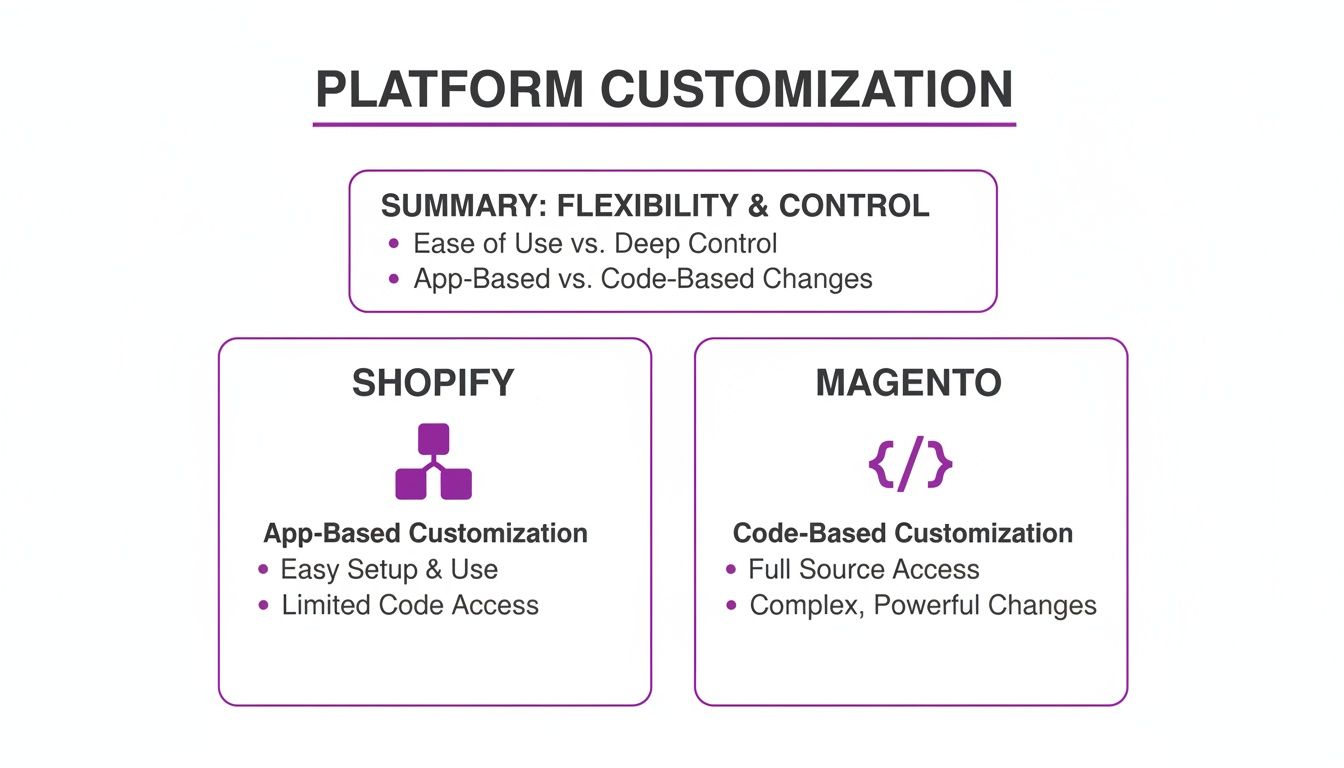
As you can see, Shopify’s world is built around user-friendly apps, while Magento customization almost always means diving into custom code.
Developer Communities and Finding Help
The Magento Marketplace, on the other hand, is built for powerful, enterprise-level extensions. These modules often provide much deeper functionality, but they almost always require a specialized developer to install, configure, and maintain them properly. This brings up a critical difference: finding the right help.
The Shopify developer community is enormous and easy to tap into. Finding a qualified Shopify expert or agency for theme tweaks or app setups is pretty straightforward and budget-friendly. Magento developers, however, are a different breed—highly specialized and, frankly, more expensive. Their expertise is non-negotiable for managing the platform's complexity, which creates a higher barrier to entry and can become a real bottleneck for smaller teams.
Shopify makes advanced features accessible to everyone through its app-driven ecosystem. Magento offers incredible depth, but you have to be ready to invest heavily in specialized technical talent to unlock its full potential.
Getting Ready for What's Next in Commerce
How well a platform keeps up with emerging trends is a massive consideration. Shopify’s centralized, SaaS model means it can roll out new features, like integrated AI tools, to every single merchant, fast. For example, tools like Shopify Magic for AI-powered product descriptions are built right into the dashboard. Advanced tech is put directly into your hands, no technical heavy lifting required.
This API-first mindset also makes Shopify a leader in headless commerce. Its Hydrogen framework and Oxygen hosting solution give you a complete toolkit for building lightning-fast, custom storefronts that plug into Shopify’s rock-solid backend. This is the perfect setup for brands that want to create truly unique, content-rich experiences on the web, in mobile apps, or anywhere else. If you're looking into this, it’s worth understanding what is headless commerce and how it gives you maximum creative freedom.
Headless and AI: A Tale of Two Philosophies
Magento also has a strong headless game with its PWA (Progressive Web App) Studio, letting developers build fast, app-like storefronts. It provides a robust foundation for a headless build, but in true Magento fashion, it demands more development resources and infrastructure management than Shopify’s all-in-one solution.
It's a similar story with AI. While you can certainly integrate AI into a Magento store, it’s going to be through third-party extensions or a custom development project. There’s no native, platform-wide AI feature set that compares to what Shopify is baking directly into its core product.
When it comes to future-proofing your brand, the choice boils down to this:
- Go with Shopify if you want to adopt new tech like AI and headless commerce quickly, with minimal technical headaches and a focus on getting to market fast.
- Go with Magento if you have a dedicated dev team and need a completely bespoke headless architecture or custom AI integrations built around your unique, complex business logic.
Ultimately, the choice between Magento or Shopify here depends on whether you prefer innovation delivered as a finished service or as a set of powerful tools you need to build with yourself.
Making the Right Choice for Your Business
So, after breaking down all the details, what’s the final verdict? It all comes down to being brutally honest about your brand's specific situation. The right platform isn't the one with the longest feature list; it’s the one that aligns with your team's skills, your actual budget, and where you want to be in a few years.
At its core, the magento or shopify decision boils down to your operational priorities. If your main goal is rapid growth, staying nimble with marketing, and creating a fantastic customer experience without hiring a team of developers, Shopify is almost always the answer. But, if your business model absolutely requires deep, complex customizations and you have the technical firepower in-house to manage a heavy infrastructure, Magento gives you that unparalleled control.
Situational Recommendations
Let's make this more concrete with a few real-world scenarios. Each one has a clear winner based on different business needs. See which one feels closer to home for you.
Choose Shopify Plus if: You're a high-growth D2C brand laser-focused on marketing agility and customer experience. Your priority is launching campaigns quickly and using the app ecosystem to boost conversions, not dealing with server management.
Consider Magento if: You're a global enterprise with complex B2B needs, multiple storefronts, and a dedicated in-house technical team. Your business relies on custom backend integrations or unique logic that a SaaS platform just can't handle.
A Decision-Making Checklist
Before you make the final call, run through these questions. Your answers will point you in the right direction.
Budget Reality: Have you really calculated the Total Cost of Ownership (TCO) for Magento, including hosting, development, and ongoing maintenance retainers? Or does Shopify’s predictable subscription give you more financial peace of mind?
Technical Resources: Do you have specialized Magento developers on speed dial? Or do you need a platform that lets your marketing team make changes without touching a line of code?
Scalability Needs: Is your main worry handling massive traffic spikes during flash sales with guaranteed uptime (Shopify)? Or do you need total control over a custom server environment for specific performance tuning (Magento)?
Customization Priorities: Can you get what you need from Shopify’s huge app store and flexible APIs? Or are your needs so fundamental that they require changing the source code itself, something only Magento allows?
Ultimately, your platform should be a growth engine, not an operational burden. Choosing between Magento or Shopify is a strategic move that defines how your team will spend its time and resources for years to come.
For many businesses still on Magento, the sheer operational overhead becomes a major bottleneck. The simplicity, rock-solid security, and lower TCO of Shopify often make a compelling case for switching. If that sounds familiar, your next step should be understanding the nuts and bolts of a Magento to Shopify migration. Making that move can unlock the agility you need to compete and let you focus on what actually matters—growing your business.
Your Top Questions Answered
When you're staring down the choice between Magento and Shopify, a handful of critical questions always seem to pop up. Let's tackle the ones we hear most often from founders and eCommerce managers weighing their options.
Which Platform Is Better For SEO?
Honestly, both can be SEO powerhouses, but they approach it from completely different angles.
Shopify is all about accessibility. It empowers marketing teams to handle the crucial on-page SEO tasks—like tweaking meta titles, writing product descriptions, and managing image alt text—without ever needing to call a developer. It’s built for speed and ease of use, which is a massive win for agile teams.
Magento, on the other hand, gives you deep, granular control over technical SEO. For an expert who knows exactly what they're doing, this is fantastic. The catch? You need that expertise. Misconfiguring something can do more harm than good, and it often requires a developer to get things just right, making it far less nimble.
Can I Migrate From Magento To Shopify?
Absolutely. We see brands making this move all the time. It's a well-trodden path for businesses wanting to slash operational costs, simplify their tech stack, and move faster.
But "possible" doesn't mean "easy." A migration is a complex project. You're moving the lifeblood of your business—products, customer data, and years of order history.
A botched migration can be catastrophic for your SEO and data integrity. This is one of those times where bringing in a specialized agency is non-negotiable. We manage the nitty-gritty technical details to ensure a seamless switch, protecting your search rankings and preventing any disruption to your business.
Is Magento Really More Expensive Than Shopify?
In almost every scenario we've modeled for growing businesses, yes. The trick is to stop looking at the sticker price and start thinking about Total Cost of Ownership (TCO).
With Magento, the licensing fee is just the beginning. You're on the hook for expensive hosting, constant developer support for security patches and updates, and a hefty ongoing maintenance budget. These costs are unpredictable and can quickly spiral.
Shopify Plus wraps most of these headaches into a clear, predictable subscription. For the vast majority of growing brands, this leads to a significantly lower and more manageable TCO.
Choosing the right platform is the bedrock of your brand's future growth. At ECORN, we live and breathe Shopify, helping businesses scale with top-tier design, development, and CRO strategies. Let's talk about building a platform that actually drives results.


7 Ecommerce Newsletter Examples for Shopify Brands
One Product Shopify Store: Build and Scale

Mobile Pop Up Strategy for Shopify Stores That Converts
Sitemap for Shopify: How to Find, Optimize, and Submit It
7 Single Product Websites Worth Emulating

Product Variants Shopify: The Complete 2026 Guide
Ecommerce Analytics Consulting for Growth
What Is AI Integration for eCommerce
How to Choose the Right eCommerce Website Development Firm
E Business Strategy Implementation
Conversion Tracking Setup for Shopify Stores
BigCommerce vs Shopify Plus Which Enterprise Wins in 2026
Shopify Theme Kit: Setup, Commands, and Migration Guide
Shopify Extension Development: A Practical 2026 Guide

Shopify Speed Score Explained and How to Improve It
Shopify Mobile Optimization: The 2026 Playbook
How to Add Subcategory in Shopify for Better UX
How to Implement Structured Data for Ecommerce in 2026

SEO App Mobile: Shopify Store Optimization Guide

Shopify Plus Support: What It Includes and How to Choose

Google Ads for Shopify: The Complete 2026 Playbook

Shopify New York: How to Find and Hire the Right Agency

Google Search Console for Shopify: The Complete Setup
First Party Data Collection for eCommerce Growth
FAQ Online Store Guide: Build and Measure It Right

Do FB Ads Work for eCommerce in 2026?

One Page Checkout for Shopify: Design and Implementation
Shopify GraphQL vs REST: The 2026 Developer Decision
Shopify Ecommerce Consulting: Strategy, Pricing &

Are Reddit Ads Worth It for eCommerce Brands

Shopify Title and Meta Description: A Practical 2026 Guide

Product Video Best Practices for Shopify Brands

Real-Time Inventory Management: A 2026 Guide
AI Chatbot Integration for Shopify Stores

Affiliate Program Management: A Shopify Guide
10 Best Performance Monitoring Tools for Shopify in 2026

Digital Asset Management for eCommerce Brands in 2026
Every Type of Facebook Ads Explained for eCommerce Growth
Product Information Management Explained for Shopify Brands
Support Ticket System: A Guide for Shopify Stores

10 Best Customer Service Tools for Shopify in 2026

Can I Start a Business with No Money? a 2026 Blueprint

What Sells Good on Etsy: Best Niches for 2026

Shopify Add to Cart Button: A Practical 2026 Guide

Customer Feedback Automation: A Practical eCommerce Guide
Critical Rendering Path: A Guide for Shopify Stores

How to Promote on TikTok for eCommerce in 2026

B2B eCommerce Consulting That Drives Real Revenue
10 Best Practices for Site Navigation in 2026
Return vs Refund for Shopify Stores: A Practical Guide

What Is Customer Lifetime Value and Why It Matters
What Is Voice of Customer Research for eCommerce

SMS Marketing for Ecommerce That Actually Converts

Master How to Improve Email Deliverability in 2026

Top 7 eCommerce Partners NYC for Shopify Brands in 2026

Machine Learning for Ecommerce: Boost Your Shopify Store

Beauty Market Research: Your 2026 Growth Guide

Shopify International Expansion: A 2026 Roadmap
What Does CRO Stand for in Business: Understanding CRO

Shopify Visual Merchandising: A Playbook for Higher Sales

Shopify Landing Page Design: Master Conversion in 2026
10 Best AI SEO Optimization Tools for Shopify in 2026

Agentic AI for Ecommerce: Boost Your Sales in 2026
Mastering Email Marketing Data for eCommerce Growth

Conversion Rate Optimisation Australia: Boost Your Sales
Conversion Rate Optimization AI: Your Shopify Store Guide

10 Product Bundling Strategies for Shopify in 2026

How to Increase Customer Lifetime Value: A Shopify Playbook
AI Customer Service Automation: Shopify Guide 2026
Clean Website Design: A Shopify Conversion Playbook

Omnichannel Retail Strategy: A Shopify Playbook

Product Data Enrichment: A Guide for Shopify Brands

Instagram Shopping Features a Guide for Shopify Stores
What Is Revenue Optimization: A Holistic RevOps Guide

Benefits of Conversion Rate Optimization: Boost Your
WordPress to Shopify Migration: Your 2026 Seamless Switch
Boost Sales: Ecommerce Payment Processing Guide 2026
Unified Commerce Platform: Benefits, KPIs & Shopify Guide

How to Reduce Bounce Rate eCommerce: Your 2026 Guide
Shopify API Integration: A Practical End-to-End Guide

How to Implement Data Governance: A 2026 Guide
Shopify Store Development Cost: A 2026 Breakdown
What Is Server Side Tracking: The Shopify Guide 2026
Marketing Automation Workflows: A Shopify Guide for 2026

Shopify: How to Reduce Technical Debt

Shopify UX Design Change: A Playbook for Growth

User Generated Content Strategy: Shopify Playbook

Shopify Pause and Build Plan Cost: A Complete 2026 Guide
Compare at Price on Shopify: A Complete Guide for 2026

Where Can I Sell My Prints? 10 Best Platforms for 2026
Shopify Order Management System: The Ultimate Guide 2026
What Is Marketing Attribution? an eCommerce Guide for 2026

10 Best Black Friday Sales Sheets for 2026

Discover the Top Social Media Marketing Agencies For
Consumer Confidence Definition for eCommerce in 2026

What Is Social Commerce? Your 2026 Guide to Boosting Sales

A Social Ad Campaign Playbook for eCommerce Growth

7 Best FAQ Page Examples for SaaS & eCommerce

Market Research in Fashion Industry: A Guide for Shopify
Shopify Migration Services: Expert Guide for 2026


newsletter in your inbox