


Writing a product description that actually sells is about so much more than just listing out features. It's about tapping into your customer's mindset, figuring out what makes them tick, and then showing them exactly how your product makes their life better. It’s a mix of psychology, empathy, and solid copywriting that builds trust and gets them to click "Add to Cart."
The Psychology Behind Persuasive Product Descriptions

Before you even think about writing a single word, you need to get inside your customer's head. The best product descriptions don't just describe; they position the product as the perfect answer to a nagging problem or the key to achieving a deep-seated desire. When you get this right, your product page transforms from a simple information sheet into a 24/7 sales machine for your Shopify store.
With everyone shopping online these days, the pressure is on for copy to do the heavy lifting. This shift is a big reason why the market for content writing services is expected to climb by about 5.5% each year between 2023 and 2030. Good copy is no longer a nice-to-have; it's a necessity.
Build a Practical Customer Persona
You can’t write for someone you don’t know. This is where a customer persona comes in, but let's be clear—this isn't some fluffy, academic exercise. A practical persona zeroes in on the details that actually drive a purchase.
Forget the generic demographics for a minute and ask the real questions:
- What are their day-to-day frustrations? I'm talking about the small, annoying problems that your product can solve.
- What do they aspire to? What's their vision of a better life, and how does your product fit into that picture?
- How do they talk? Dive into product reviews (especially your competitors'), forums, and social media comments to pick up on their exact language.
- What makes them hesitate before buying? Uncover their skepticism, budget worries, or fears from past bad experiences.
So, a persona for a brand selling ergonomic office chairs isn't just "Mark, a 35-year-old remote worker." It’s "Mark, who’s sick of his lower back aching after endless Zoom calls, worries about dropping a grand on a chair he can’t even test out, and just wants a home office that feels both legit and comfortable." That level of detail is copywriting gold.
Pinpoint Emotional Triggers and Pain Points
Here's the secret: people buy with their hearts and justify with their heads. Your product description needs to connect with those emotions first. Pain points aren't just practical issues; they're emotional burdens. Your customer doesn't just need a stain remover; they feel the hot-faced embarrassment of spilling red wine on their brand-new sofa during a party.
Key Takeaway: A feature is what your product has, but a benefit is what your customer gets. The benefit is the emotional payoff. Your job is to draw a straight line from the feature to that feeling of relief, joy, or newfound confidence.
At the end of the day, this all comes down to mastering some core business copywriting principles. Crafting words that genuinely move people to act is a skill, and it's essential for turning browsers into buyers.
Find Your Unique Brand Voice
Your brand voice is your store’s personality. It's what makes you sound like you and not like every other store on the block. Are you witty and a bit cheeky? Minimalist and sophisticated? Or maybe you're the trusted, authoritative expert?
A consistent voice is what builds that gut feeling of trust and attracts the right crowd. For example, a skincare brand targeting Gen Z might use a fun, emoji-heavy, "bestie" tone. But a company selling high-end audio gear? They'll sound precise, sophisticated, and deeply knowledgeable.
Your voice needs to feel authentic to who you are as a brand and, just as importantly, resonate with the persona you've so carefully built. It guides every word you choose and every sentence you write, making sure every product description reinforces what you stand for.
How to Structure Descriptions for Maximum Impact
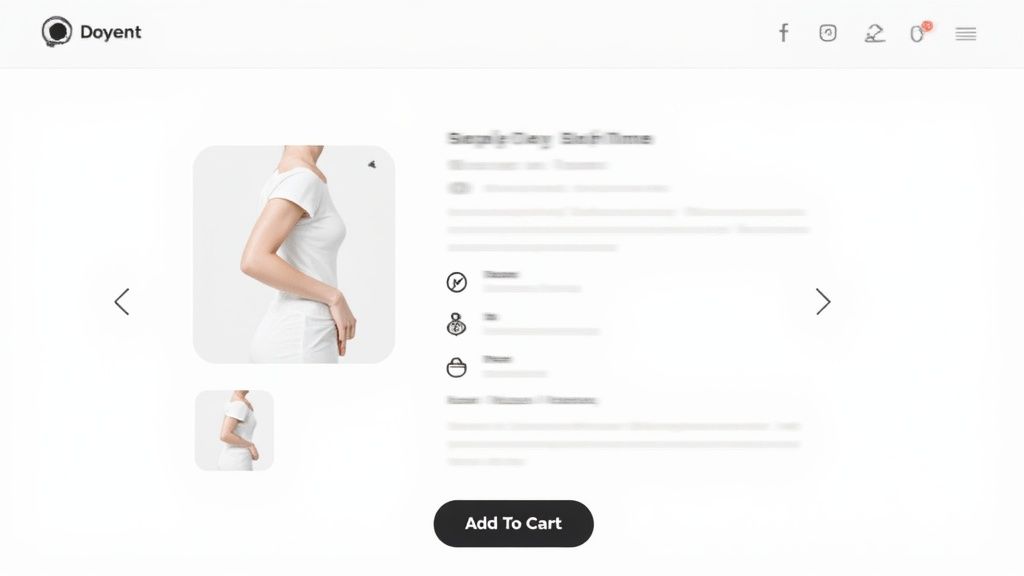
Let's get one thing straight: people don't read product descriptions; they scan them. While a staggering 87% of shoppers say product descriptions are a huge factor in their buying decision, they aren’t sitting down to read a novel. They're hunting for the specific details that matter to them.
This means the layout of your copy is just as important as the words you choose. A smartly structured description guides your customer's eye, making it dead simple for them to find what they need and feel confident enough to hit "Add to Cart."
Craft a Magnetic Headline
Your product title is your first impression. It's the first thing shoppers see on the page and in Google search results. It needs to be crystal clear, descriptive, and if you can swing it, a little bit intriguing. Your goal is to instantly tell someone they’re in the right place while dropping a hint about a key benefit.
So instead of a snoozer like "Performance T-Shirt," try something more benefit-focused: "The All-Day Comfort Tee: Stay Cool and Dry From Commute to Workout." See the difference? One is a label, the other is a solution.
Write an Engaging Opening Paragraph
Once the headline has their attention, you've got maybe one or two sentences to hook them. This is where you connect with the customer you've been picturing in your head. Speak directly to their biggest problem or desire and frame your product as the answer they've been looking for.
This isn't the time for a dry list of specs. Set the scene and make it personal. Think of it as the opening line of a mini-story where your customer gets to be the hero. For a pair of noise-canceling headphones, you might lead with, "Tired of the world interrupting your focus? Find your sanctuary in sound."
Pro Tip: Your opening paragraph is the perfect spot to naturally weave in your primary keyword. Search engines give more weight to content that appears higher on the page, so this gives your SEO a nice little nudge.
Use Scannable Bullet Points for Benefits
Okay, you’ve hooked them. Now it's time to deliver the goods in a format that's ridiculously easy to digest. Bullet points are non-negotiable here. They slice through walls of text and let shoppers absorb the key selling points in seconds.
But here’s the most important part: focus on benefits, not just features. For every technical detail, answer the customer’s unspoken question: "So what?"
Here’s how you can translate dry features into juicy, benefit-driven bullet points for a portable power bank:
- Try This: Charge Your Phone Up to 5 Times: Never stress about a dead battery on long travel days or during a power outage.
- Try This: Power Multiple Devices at Once: Keep your phone, tablet, and headphones all topped off at the same time.
- Try This: Slips Easily Into Your Pocket: Get massive power without the bulk. It’s the perfect travel companion.
This simple reframing makes the value of your product immediately obvious.
Tell a Mini-Story
Between your bullets and your final call to action, you have space for a short paragraph to inject some personality. This is your chance to paint a picture of the product in action, helping the customer visualize how much better their life will be with it.
Selling a high-end chef's knife? Describe the satisfying, effortless glide as it slices through a ripe tomato. A cozy wool blanket? Evoke the feeling of curling up on the sofa with a great book on a rainy afternoon. Storytelling turns a commodity into an experience, making it more memorable and far more desirable.
Using SEO to Help Customers Discover Your Products

You can write the most persuasive, emotionally resonant product description in the world, but if your ideal customer never sees it, it’s worthless. This is where search engine optimization (SEO) comes in. Think of it as the bridge connecting a shopper’s search query to your product page. It’s what makes your boots pop up when someone Googles "waterproof hiking boots for rocky trails."
Good SEO isn't about gaming the system. It's about making it dead simple for search engines like Google to understand what your product is and who it's for. When you align your copy with the actual words your customers are using, you’re doing more than just boosting visibility—you’re pulling in people who are already primed to buy.
And this isn't a small piece of the puzzle. The product description segment is on track to claim a massive 37.4% market share of the global content writing services market by 2025. This explosion is happening for one reason: brands now understand that optimized copy is a direct line to better search rankings, more organic traffic, and more sales. You can discover more insights about the content writing services market and its projected growth.
Uncovering Your Customer Keywords
Before you start tweaking anything, you need to know what you’re aiming for. Keyword research is just the fancy term for figuring out the exact phrases your target audience uses. The best way to start? Put yourself in their shoes. What would they type into that search bar?
Kick things off by brainstorming broad terms for your product, like "leather wallet." Now, drill down. Is it really just a "leather wallet," or is it a "slim bifold leather wallet" or maybe a "men's leather wallet with RFID blocking"?
You can use free tools like Google Keyword Planner or more powerful paid options like Ahrefs to check search volumes and, more importantly, discover related terms you hadn't even thought of.
Pro Tip: Don't get fixated on the big, high-volume keywords. Long-tail keywords (phrases of three or more words) are pure gold. They're less competitive and signal much higher buying intent. A search for "running shoes" is just browsing. A search for "lightweight trail running shoes for wide feet"? That person has their credit card out.
Where to Place Your Keywords for Maximum Effect
Okay, so you’ve got your primary keyword and a handful of secondary ones. Now, where do you put them? The goal is to sprinkle them strategically throughout your product page so they feel completely natural. Remember the golden rule: write for humans first, search engines second.
Here’s a quick checklist of the most important spots:
- Product Title (H1 Tag): This is prime real estate. Your main keyword absolutely has to be here, and it needs to be compelling.
- URL Slug: Keep your URL clean and descriptive. It should include the primary keyword, like
yourstore.com/products/slim-bifold-leather-wallet. - Meta Description: This is the little blurb that shows up under your title in Google’s search results. It doesn't directly impact rankings, but a keyword-rich, enticing description is what makes people click your link instead of your competitor's.
- Image Alt Text: Search engines can't see images. Alt text describes the image for them (and for visually impaired users). Describe your product photos accurately and weave in your keyword where it fits naturally.
Writing Unique Copy to Avoid Penalties
It’s so tempting, especially if you sell a t-shirt in ten different colors, to just copy and paste the same description for each one. Don’t do it. Search engines can actually penalize sites for duplicate content, which can drag down the rankings for all the pages involved.
Treat every single product page like its own unique piece of digital real estate. Even small tweaks can make a huge impact.
For those product variations, try these simple changes:
- Rewrite the Headline: Focus on what makes this one different. "The Classic Tee in Ocean Blue" is miles better than just "The Classic Tee."
- Adjust the Opening: Describe the specific color or material. "The deep Ocean Blue shade evokes calm, coastal vibes, making it the perfect partner for sunny days."
- Shuffle the Bullets: Reorder your benefit-led bullet points or rephrase a couple of them. This simple change can create a completely different flow.
By putting in that little bit of extra effort, you’re signaling to search engines that your site is full of distinct, valuable content. This not only keeps you out of the penalty box but also massively improves the customer experience, guiding them to the exact product they were looking for.
Working with AI to Write Better Descriptions Faster
Artificial intelligence has completely changed how we create content. For Shopify brands, AI tools aren't just a gimmick anymore—they're a serious asset for churning out product descriptions at scale. But here's the catch: you have to treat AI like a creative partner, not a magic button that does all the work.
Think of it this way: AI is the super-fast intern who can get a solid first draft on paper in seconds. You're the editor-in-chief. Your brand knowledge, your deep understanding of your customer, and your strategic vision are things AI simply can't replicate. You provide the direction, the refinement, and that critical human touch that turns generic text into copy that actually sells.
Engineering the Right AI Prompts
The output you get from any AI tool is a direct reflection of the prompt you feed it. Garbage in, garbage out. If you give it vague instructions, you'll get vague, uninspired copy back. To get compelling content, you need to provide specific, context-rich prompts that give the AI clear guardrails.
Don't just say, "Write a product description for a coffee mug." That's way too broad. You need to get specific and give the AI all the raw materials it needs to succeed.
Here’s an example of a prompt that actually works:
"Act as an expert ecommerce copywriter for a brand named 'Morning Ritual.' Our brand voice is warm, encouraging, and slightly minimalist. Write a 150-word product description for our new ceramic coffee mug called 'The Sunrise Mug.'
- Target Audience: Busy professionals who cherish their morning coffee as a moment of peace before a hectic day.
- Key Features: Hand-glazed ceramic, 14 oz capacity, ergonomic handle, microwave and dishwasher safe.
- Benefits to Highlight: The mug's weight feels substantial and comforting, the handle is designed for a perfect grip, and the glaze has a unique, subtle shimmer like a sunrise.
- Goal: Make the customer feel that this mug will elevate their morning coffee from a routine to a cherished ritual."
See the difference? This detailed input gives the AI everything—a persona, tone of voice, features, benefits, and the core emotional angle. The result is a much, much stronger starting point.
From First Draft to Final Polish
Once the AI spits out its initial draft, your real work begins. This is where your expertise truly shines. AI often fumbles the nuances and can produce text that sounds correct but feels hollow and lacks any real emotional connection.
Your editing process should zero in on a few key areas:
- Injecting Personality: Does this copy sound like your brand? Tweak words and phrases to match your unique voice. AI can mimic a tone, but it can't fake authentic personality.
- Verifying Facts: This is non-negotiable. Always double-check every feature, dimension, and material the AI lists. It can confidently make things up, and one wrong detail can completely shatter a customer's trust.
- Enhancing Sensory Details: AI-generated text is often sterile. It's your job to add the sensory words that help a customer imagine themselves holding and using the product. Describe the texture, the weight, the sound, the smell—bring it to life.
Key Takeaway: Treat the AI output as raw clay. It’s your job to sculpt it, refine it, and breathe life into it. The final product description should be a perfect blend of AI’s speed and your human empathy.
Beyond just writing copy, there are tons of AI applications in ecommerce that can help you work smarter. And if you’re looking to use AI for more sales-focused content like affiliate marketing, you'll find some great strategies in a modern guide to AI affiliate writing.
Ultimately, using AI for product descriptions isn't about being lazy; it's about being efficient. It beats the dreaded blank page, speeds up the brainstorming process, and frees you up to focus on the high-level creative and strategic work that actually moves the needle and drives sales.
Testing and Optimizing for Continuous Improvement
Think your job is done once the product description is live? Think again. Your product page isn't a static document you can just "set and forget." The top-performing Shopify brands I've worked with treat their product pages like a constant work-in-progress, always looking for another edge.
This is the heart of Conversion Rate Optimization (CRO)—a disciplined approach to improving your site so more visitors actually buy something. It’s about shifting from guesswork to data-backed decisions. Instead of wondering what your customers want, you use real numbers to discover what actually gets them to click "buy."
The industry is catching on. The global market for content writing services is projected to balloon to nearly USD 38.6 billion by 2033, as detailed in this analysis of the content writing market. That’s a massive signal that businesses are pouring money into copy that’s proven to sell, not just describe.
Setting Up Your First A/B Test
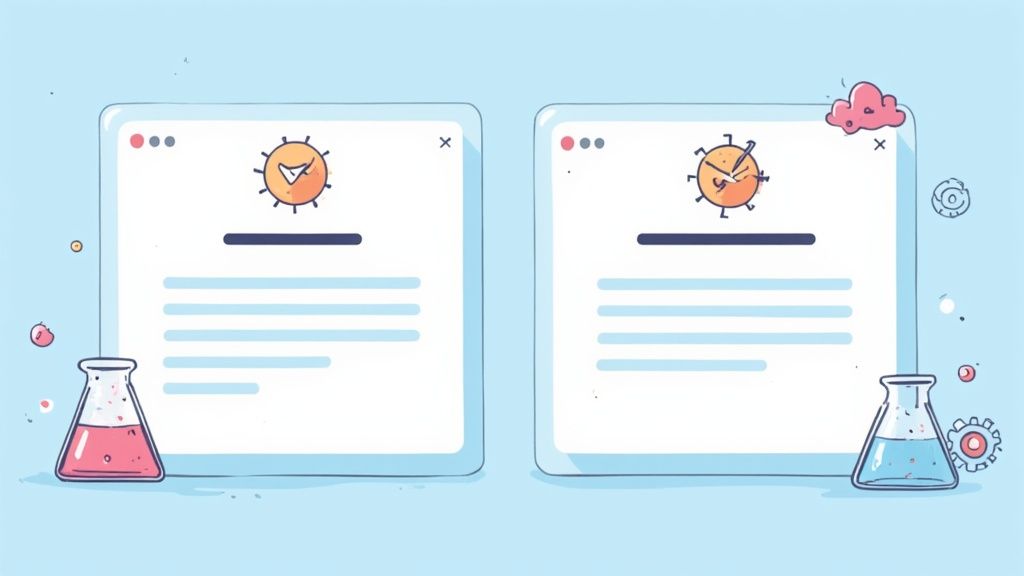
The go-to method for testing is the classic A/B test (or split test). It’s pretty straightforward: you show two different versions of your product description to two random groups of shoppers at the same time. Version A is your original copy—the "control"—and Version B is your new take with one specific change—the "variant."
From there, you just measure which version gets more people to take the action you want. The absolute golden rule here is to only change one element at a time. If you rewrite the headline, tweak the CTA, and change the bullet points all at once, you’ll have no clue which change actually made a difference.
Here are a few simple but powerful elements to test in your product descriptions:
- Headlines: Pit a benefit-driven headline against one that just states a feature.
- Calls-to-Action (CTAs): Does "Add to Cart" work better than "Buy Now"? What about something more creative like "Get Yours Today"?
- Bullet Points: Try reordering your benefits. You might be surprised to find that what you thought was the top selling point is actually number three in your customers' minds.
- Description Length: For some products, short and punchy wins. For others, more detail builds trust. Test it out.
Key Insight: Don’t start with your obscure, low-traffic products. Kick off your testing on your bestsellers. More eyeballs mean you’ll get statistically significant results much faster, letting you roll out your wins across the rest of your store.
Tracking the Metrics That Matter
It’s easy to drown in data when you start testing. To keep your head above water, zero in on the key performance indicators (KPIs) that tell you if your copy is actually working. Don't just glance at total sales; get granular with the metrics your description directly influences.
These are the three you can’t ignore:
- Add-to-Cart Rate: This is the percentage of people who hit the button after reading your page. It’s a direct measure of how persuasive your description is.
- Conversion Rate: The big one. This is the percentage of visitors who actually complete a purchase. A lift here is money in the bank.
- Bounce Rate: This tells you how many people land on your product page and leave without clicking anything else. If it's high, your copy probably isn't grabbing their attention.
Figuring out what the numbers mean is where the real skill comes in. Let’s say your add-to-cart rate shoots up, but your overall conversion rate stays flat. The problem isn't your product description anymore—it's likely something in your checkout flow. These insights are pure gold.
If you’re just getting started, brushing up on some A/B testing best practices will save you a ton of headaches and help you get reliable results.
By constantly testing your copy and making choices based on hard data, you create a powerful feedback loop. Every test teaches you something new about your customers, helping you sharpen your message and systematically grow your store’s revenue.
Common Questions About Writing Product Descriptions
Even with the best strategy in hand, a few tricky questions always seem to pop up the moment you sit down to write. Nailing these details is often what separates a product page that converts from one that just sits there.
Let's walk through some of the most common hurdles I see Shopify owners face. Think of these as the quick-and-dirty answers to get you unstuck and back to writing copy that sells.
How Long Should a Product Description Be?
There’s no magic number here. The right length comes down to your product's complexity and what your customer actually needs to know to feel confident hitting "Add to Cart." The goal is always to be concise but complete.
For something simple like a classic t-shirt, 50-100 words and a few snappy bullet points will probably do the trick. But if you're selling a high-end espresso machine, you're going to need more runway—likely over 300 words to break down the technical specs, different uses, and why it's a worthy investment.
The Golden Rule: Your description is long enough when it has answered every single question a potential customer might have. Don't be afraid of length; just use smart formatting like bullet points and bold text to keep it scannable.
What Are the Biggest Mistakes to Avoid?
Time and time again, I see brands making the same handful of conversion-killing mistakes. The good news? They're incredibly easy to fix once you know what to look for. Just steering clear of these common pitfalls will put you way ahead of the competition.
Here are the top offenders:
- Listing Features, Not Benefits: This is mistake #1, hands down. You have to translate what your product is into what it does for the customer. "Stainless steel construction" is a feature; "Rust-proof and built to last a lifetime" is a benefit.
- Using Empty Buzzwords: Fluff like "high-quality" or "innovative" means nothing on its own. Instead of telling people your product is great, show them. Talk about the specific materials, the unique design process, or the thoughtful details that prove it.
- Writing Robotic, Keyword-Stuffed Copy: Shoving keywords where they don't belong makes your copy sound clunky and untrustworthy. Always, always write for your human reader first. Google is smart enough to figure it out.
- A Mismatched Tone: If you’re a luxury brand, a playful, meme-filled description will feel jarring. Likewise, a super formal tone will fall flat with a younger, trend-focused audience. Make sure your voice actually sounds like your brand.
When in doubt, put yourself in your customer's shoes. It’s the fastest way to avoid these traps.
Should I Use the Same Description for Similar Products?
Definitely not. I know it's tempting to take this shortcut, but copying and pasting descriptions across similar products is a huge mistake for your store's performance.
From an SEO perspective, search engines like Google see this as duplicate content, which can tank your rankings and make it harder for shoppers to find any of your products. Even for simple variations—like the same sneaker in ten different colors—each page needs its own unique copy.
This doesn't mean you have to start from scratch every time. You can easily create unique descriptions by:
- Writing a distinct headline that calls out the specific color or style.
- Tweaking the opening paragraph to highlight what's unique about that particular version.
- Rephrasing or reordering your bullet points.
It’s a small amount of effort that signals to search engines that every page provides unique value, which helps both your discoverability and the customer's on-site experience.
At ECORN, we specialize in transforming Shopify stores with expert development and conversion rate optimization that turns browsers into buyers. Our flexible subscription plans are designed to scale with your brand's ambitions.
Discover how our dedicated Shopify specialists can elevate your eCommerce project.


How to Cross Sell on Shopify Without Friction
Best Shopify Theme for Custom Products Compared
Multi Store Inventory Management: A Practical Guide

SEO Consulting for Ecommerce: A Practical Guide
Shopify Theme Updater App: A Safe Update Playbook

Shopify Git Integration: A Developer's Guide to 2026
Headless Ecommerce Development Services Explained

How to Build a Shopify Clothing Website That Converts
How to Launch a Box Subscription Business in 2026

Luxury Skincare Branding Playbook That Converters
10 Best Podcast Ecommerce Shows for Store Growth in 2026

Shopify Developer Hourly Rate: What to Pay in 2026
Critical Shopify Setup Errors That Are Secretly Sabotaging Your Store
Ecommerce Conversion Tracking: The Complete How-To Guide
Shopify Design Agency: How to Pick the Right Partner
Mastering Multi Store Management on Shopify
Scale Shopify Store
10 Shopify App Ideas Worth Building in 2026
Conversion Rate Optimization for Landing Pages: The Playbook
Shopify Plus Automation: A Guide for 2026
10 Social Selling Platforms for Shopify Merchants
Shopify Website Design Examples: 7 Stores Worth Studying
7 Ecommerce Newsletter Examples for Shopify Brands
One Product Shopify Store: Build and Scale
Mobile Pop Up Strategy for Shopify Stores That Converts
Sitemap for Shopify: How to Find, Optimize, and Submit It
7 Single Product Websites Worth Emulating
Product Variants Shopify: The Complete 2026 Guide
Ecommerce Analytics Consulting for Growth
What Is AI Integration for eCommerce
How to Choose the Right eCommerce Website Development Firm
E Business Strategy Implementation
Conversion Tracking Setup for Shopify Stores
BigCommerce vs Shopify Plus Which Enterprise Wins in 2026
Shopify Theme Kit: Setup, Commands, and Migration Guide
Shopify Extension Development: A Practical 2026 Guide
Shopify Speed Score Explained and How to Improve It
Shopify Mobile Optimization: The 2026 Playbook
How to Add Subcategory in Shopify for Better UX
How to Implement Structured Data for Ecommerce in 2026

SEO App Mobile: Shopify Store Optimization Guide
Shopify Plus Support: What It Includes and How to Choose
Google Ads for Shopify: The Complete 2026 Playbook
Shopify New York: How to Find and Hire the Right Agency
Google Search Console for Shopify: The Complete Setup
First Party Data Collection for eCommerce Growth
FAQ Online Store Guide: Build and Measure It Right
Do FB Ads Work for eCommerce in 2026?
One Page Checkout for Shopify: Design and Implementation
Shopify GraphQL vs REST: The 2026 Developer Decision
Shopify Ecommerce Consulting: Strategy, Pricing &

Are Reddit Ads Worth It for eCommerce Brands
Shopify Title and Meta Description: A Practical 2026 Guide
Product Video Best Practices for Shopify Brands
Real-Time Inventory Management: A 2026 Guide

AI Chatbot Integration for Shopify Stores
Affiliate Program Management: A Shopify Guide
10 Best Performance Monitoring Tools for Shopify in 2026

Digital Asset Management for eCommerce Brands in 2026
Every Type of Facebook Ads Explained for eCommerce Growth
Product Information Management Explained for Shopify Brands
Support Ticket System: A Guide for Shopify Stores

10 Best Customer Service Tools for Shopify in 2026

Can I Start a Business with No Money? a 2026 Blueprint
What Sells Good on Etsy: Best Niches for 2026

Shopify Add to Cart Button: A Practical 2026 Guide

Customer Feedback Automation: A Practical eCommerce Guide
Critical Rendering Path: A Guide for Shopify Stores

How to Promote on TikTok for eCommerce in 2026

B2B eCommerce Consulting That Drives Real Revenue
10 Best Practices for Site Navigation in 2026
Return vs Refund for Shopify Stores: A Practical Guide
What Is Customer Lifetime Value and Why It Matters
What Is Voice of Customer Research for eCommerce

SMS Marketing for Ecommerce That Actually Converts

Master How to Improve Email Deliverability in 2026

Top 8 eCommerce Partners NYC for Shopify Brands in 2026
Machine Learning for Ecommerce: Boost Your Shopify Store
Beauty Market Research: Your 2026 Growth Guide

Shopify International Expansion: A 2026 Roadmap
What Does CRO Stand for in Business: Understanding CRO

Shopify Visual Merchandising: A Playbook for Higher Sales

Shopify Landing Page Design: Master Conversion in 2026

10 Best AI SEO Optimization Tools for Shopify in 2026

Agentic AI for Ecommerce: Boost Your Sales in 2026
Mastering Email Marketing Data for eCommerce Growth
Conversion Rate Optimisation Australia: Boost Your Sales
Conversion Rate Optimization AI: Your Shopify Store Guide

10 Product Bundling Strategies for Shopify in 2026
How to Increase Customer Lifetime Value: A Shopify Playbook
AI Customer Service Automation: Shopify Guide 2026
Clean Website Design: A Shopify Conversion Playbook

Omnichannel Retail Strategy: A Shopify Playbook
Product Data Enrichment: A Guide for Shopify Brands
Instagram Shopping Features a Guide for Shopify Stores
What Is Revenue Optimization: A Holistic RevOps Guide

Benefits of Conversion Rate Optimization: Boost Your
WordPress to Shopify Migration: Your 2026 Seamless Switch
Boost Sales: Ecommerce Payment Processing Guide 2026
Unified Commerce Platform: Benefits, KPIs & Shopify Guide


newsletter in your inbox