

Let's ditch the textbook definition of a content calendar. For a Shopify brand, it's not just a fancy spreadsheet for scheduling posts. Think of it as the central command center for your entire marketing operation. It’s what separates the brands that scramble for last-minute ideas from those that build strategic momentum and drive predictable revenue.
Without a solid plan, you’re always playing catch-up—chasing trends, rushing creative, and pushing out content that feels totally disconnected from your actual sales goals. This constant state of reaction doesn't just burn out your team; it creates a confusing, disjointed experience for your audience. A well-built calendar is your antidote to that chaos.
It helps you weave a cohesive brand story where every email, social media post, and blog article works in harmony, guiding customers from that first "hello" all the way to checkout.
Why a Content Calendar Is Your Shopify Growth Engine
A strategic content calendar does more than just plug holes in your schedule. It forces you to align every single piece of content with a specific business goal. For any eCommerce brand looking to grow, that shift is everything.
Turning Strategy into Action
So, how does this play out in the real world?
- Orchestrate Launches and Promotions: You can map out entire content arcs that build genuine excitement before a new product drops. Think behind-the-scenes teasers, feature highlights in the weeks leading up, and post-launch customer spotlights to keep the buzz going.
- Prevent Content Fatigue: We've all seen brands that do nothing but shout "BUY NOW!" A calendar helps you visualize your content mix, making sure you balance those promotional pushes with valuable, engaging material that actually builds a loyal community.
- Maintain Brand Consistency: From your Shopify blog to your latest TikTok, a calendar ensures your brand voice, visual style, and core messages are locked in and consistent across every single channel.
The 80/20 Rule for eCommerce Content
The most successful eCommerce marketing teams I've worked with live by a simple but incredibly powerful principle: the 80/20 rule.
The idea is that 80% of your content should provide genuine value—whether that's through education, inspiration, or pure entertainment. The remaining 20% is where you go for the direct sale. For Shopify stores, this balance is non-negotiable. Constant promotion just tunes people out, but value-driven content builds the trust that ultimately fuels conversions. You can find more practical advice on building a calendar that works in these in-depth industry guides.
A content calendar isn't about filling empty slots. It's about intentionally creating touchpoints that guide a customer through their journey with your brand, from their first impression to their tenth purchase.
When you have this kind of plan, your content stops being a guessing game and starts being a reliable growth engine. You can track key metrics like click-through rates, follower growth, and website traffic to see what’s resonating and double down on what works. By moving from random acts of content to a structured, strategic plan, you’re laying the foundation for scalable, sustainable growth for your Shopify store.
Building Your Calendar and Content Pillars
Okay, with the high-level strategy sorted, it's time to get our hands dirty and build the actual framework for your content calendar. The right tool can make a world of difference, but don't fall into the trap of thinking you need a pricey, complex platform right out of the gate. I've seen incredibly successful Shopify brands run their entire content machine from a souped-up Google Sheet. Others might prefer the drag-and-drop goodness of tools like Trello or Asana for team collaboration.
Honestly, the software itself isn't the magic bullet—it's how you structure it. A simple spreadsheet becomes a powerhouse when it's built for the realities of eCommerce. Your calendar needs to track way more than a publish date. Think of it as your mission control, detailing the campaign it's tied to, the specific audience segment you're targeting, the channel it's for, and the KPIs you'll use to measure its success.
Defining Your Core Content Pillars
Before you start plugging in ideas and dates, you need to lay the foundation. This means defining your content pillars: the core themes or topics your brand will own and talk about consistently. This is the bedrock of your entire strategy, making sure every single thing you create is relevant to your audience and pushing you toward your business goals.
Think of your pillars as the main sections of a magazine you're creating just for your customers. They aren't just your product categories. They are value-driven topics that your ideal customer is genuinely curious about. And before you go too far, it's a huge help to have already gone through the process of creating effective brand guidelines to nail down your voice and visual style.
Here are a few examples of content pillars that work wonders for Shopify brands:
- Product Styling Guides: This goes way beyond listing product features. It’s about showing customers how your products fit into their actual lives, giving them inspiration and real-world tips that provide genuine value.
- Behind-the-Brand Stories: People connect with people, not just faceless brands. This pillar is your chance to share your mission, put a face to the names on your team, and highlight the incredible craftsmanship that goes into what you make. It's a massive trust-builder.
- Customer Success Spotlights: Let's be real—user-generated content and testimonials are pure gold. This pillar is all about celebrating your customers, which provides powerful social proof and fosters a true sense of community around your brand.
The journey from your big-picture goals to a concrete plan is a simple, repeatable flow.
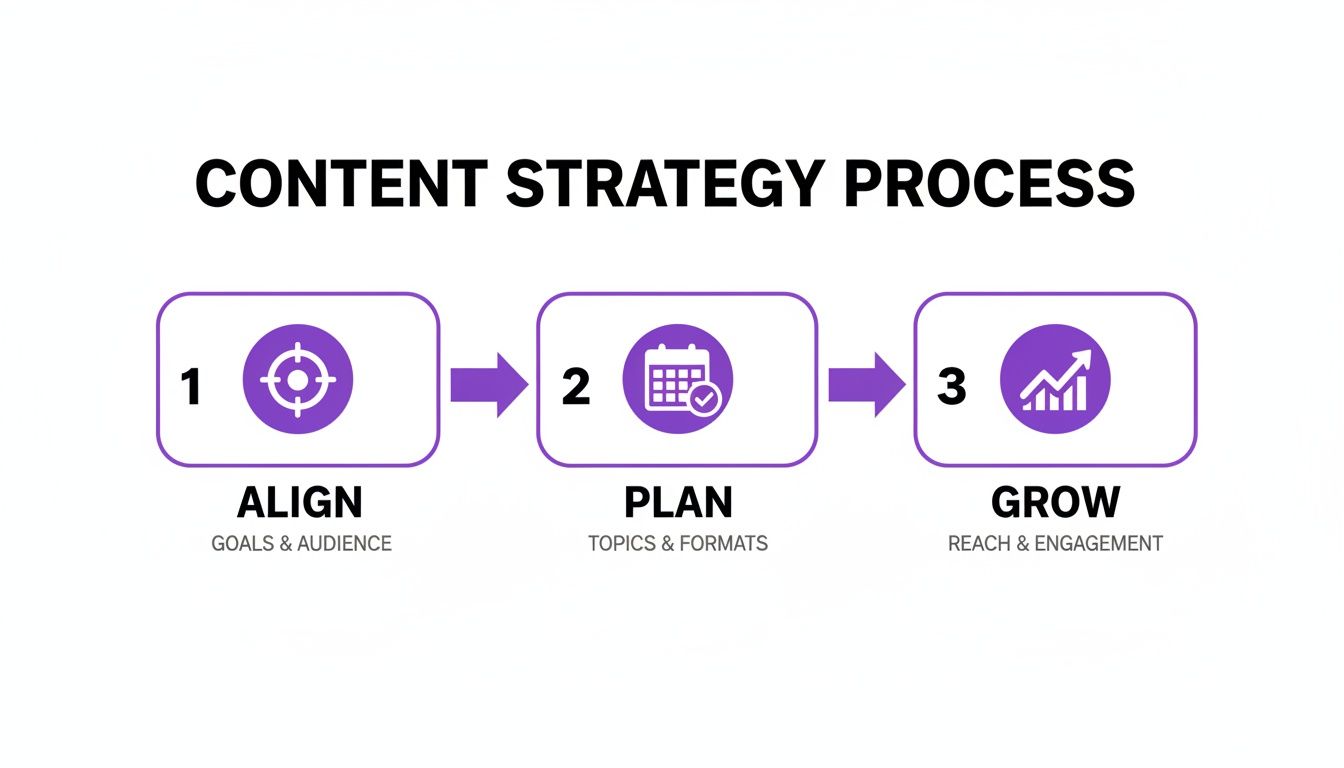
This visual breaks it down perfectly. You align your goals, plan your topics, and grow your reach. It's a cycle that feeds itself. The key takeaway? That planning phase is the critical bridge connecting what your brand stands for with the impact it makes in the market.
Aligning Pillars with Your Audience
The most powerful content pillars live at the intersection of what your brand sells and what your audience is dying to know. If you sell sustainable home goods, for instance, your pillars might be "Eco-Friendly Living Tips," "Minimalist Home Organization," and "Meet Our Artisans." See how each one supports your products while giving your target customer information they're already searching for?
A fantastic way to unearth these pillars is to listen to the questions your customers are already asking. What are their top Google searches? What are the most common tickets your support team answers? These questions are a goldmine of content ideas you already know people want. Building a solid ecommerce content strategy around these pillars ensures your marketing actually connects.
Your content pillars aren’t carved in stone. Revisit them every quarter. Do they still line up with what your audience cares about and where your business is headed? A pillar that crushed it last year might need a refresh or to be retired completely.
Once you have 3-5 strong content pillars, filling your calendar suddenly becomes a whole lot easier. You stop staring at a blank page asking, "What should we post today?" Instead, you ask a much more powerful question: "What's a great piece of content we can create for our 'Product Styling Guides' pillar this week?"
That simple shift transforms a chaotic creative scramble into a manageable, strategic process. It guarantees that every post, video, and blog article has a purpose, building a cohesive brand story that drives real engagement and—most importantly—sales.
Mapping Out Your Annual Sales and Marketing Beats
A great content calendar does more than just schedule posts; it tells a story that naturally leads to sales. This is where we zoom out from individual content pillars and start painting the big picture for your entire year. The aim here is to build a strategic rhythm for your marketing that feels intentional to you and exciting for your customers.
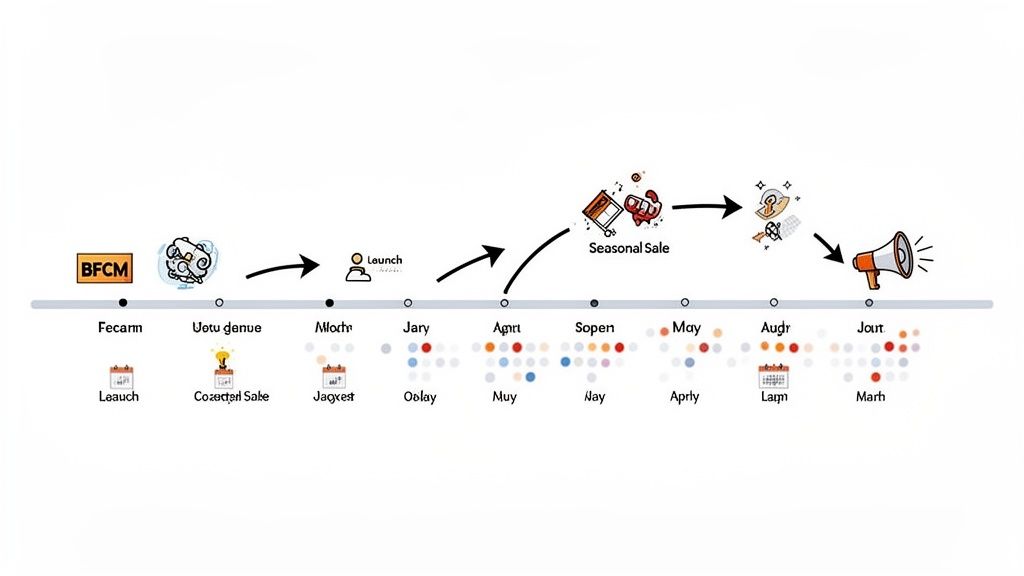
The first step is plotting the "big rocks" on your timeline. These are your non-negotiable, high-impact events that anchor everything else. Once they're locked in, you can build your smaller campaigns and daily content around them.
Start with Major Tentpole Events
Grab a yearly calendar and start marking down all the major retail holidays and seasonal moments that make sense for your brand. Think of these as the foundational beats of your marketing drum.
- Retail Holidays: BFCM (Black Friday/Cyber Monday) is the obvious giant, but don't overlook others. Valentine's Day, Mother's Day, or the Back-to-School rush can be huge if they align with what you sell.
- Seasonal Changes: Go beyond just "summer" and "winter." A fashion brand might map out "Sweater Weather" content for early fall or a "Vacation Shop" push in late spring. For a wellness brand, January is all about "New Year, New You."
- Industry Events: Are you heading to a major trade show or conference? Get those dates on the calendar. They're perfect opportunities for behind-the-scenes content or even exclusive promotions for attendees.
These events are predictable, which is their superpower. They give you a reliable framework, letting you plan campaigns months in advance and dodge that last-minute scramble so many brands fall into.
Layer in Your Store’s Unique Rhythm
With the big rocks in place, it’s time to add the events that are unique to your Shopify store. This is what turns a generic marketing calendar into your marketing calendar.
Think about your internal business cycle and start plotting:
- New Product Launches: When are you dropping new collections? Mark these dates in bold. Remember, a product launch isn't just one day; it's a campaign that can span several weeks.
- Flash Sales and Promotions: Plan your key sales that fall outside of the major holidays. Maybe you run a semi-annual sale or a special discount for your founder's birthday. Get them on the calendar now.
- Influencer and Partner Campaigns: If you're working with influencers, map out those timelines. Include everything from when you send out products to their scheduled post dates.
Laying all this out lets you see where your marketing energy needs to be focused throughout the year. You’ll immediately spot potential conflicts—like a flash sale accidentally overlapping with a partner campaign—and can adjust your timing for maximum impact.
Don't just plan what you'll post; plan the story you'll tell. A product launch isn't just an announcement. It's a narrative that unfolds over time, building anticipation and desire.
Create Compelling Content Arcs
This is where your calendar goes from a simple schedule to a powerful storytelling machine. Instead of thinking in one-off posts, you create content arcs—a series of connected content pieces that build momentum toward a specific goal.
Let's say you run a Shopify store launching a new line of natural skincare. Your content arc for the launch could look something like this:
- Pre-Launch (3 weeks out): Kick things off with "ingredient spotlight" posts. Educate your audience on the benefits of the key botanicals in your new formula.
- Pre-Launch (1 week out): Share behind-the-scenes videos of the product being made. Announce the official launch date and start a countdown on Instagram Stories.
- Launch Day: Go live! Host an Instagram Live with your founder to unbox the product, answer questions in real-time, and offer a limited launch-day discount.
- Post-Launch (1-2 weeks after): Roll out a user-generated content (UGC) contest. Encourage customers to share their results for a chance to win, then repost the best submissions as powerful social proof.
This arc takes your audience on a journey, making them feel like they're part of the launch. Each piece of content builds on the last, creating a wave of excitement that a single "it's here!" post could never achieve. That’s the real magic of a well-mapped calendar.
Using AI for Smarter Content Ideation
Once you've mapped out the big marketing beats for the year, the real work begins: filling all those empty calendar slots with content that actually performs. This is where you can get a serious leg up on the competition.
Instead of seeing AI as a threat to creativity, think of it as a tireless, data-driven assistant that can supercharge your entire workflow. It’s not about replacing your team; it's about making them faster and smarter.
The numbers don't lie. Recent data shows 89% of marketers are already using generative AI in some capacity, with 62% tapping into it specifically for brainstorming new topics. The result? Teams using AI publish 42% more content than those who don't. For a busy Shopify brand, that kind of efficiency is a massive competitive advantage. You can find more details on this approach over at storychief.io.
Brainstorming Blog Topics That Answer Real Questions
One of the fastest ways to build authority and drive organic traffic is to directly answer the questions your customers are punching into Google. AI is brilliant at digging these up. The trick is to move beyond generic prompts like "blog ideas."
You need to get specific. Try a prompt structured like this:
"Act as an SEO strategist for a Shopify brand that sells handmade leather bags. Our target audience is young professionals who value craftsmanship and durability. Generate 10 blog post titles in the format of a question that this audience would ask about caring for, styling, or choosing a leather bag."
A detailed prompt like this transforms AI from a basic idea generator into a strategic partner. It forces the tool to consider your exact audience and their problems, giving you topics like "How Can I Protect My Leather Tote from Rain?" or "What's the Best Way to Organize My Work Bag?" This is content that solves real problems and climbs search rankings.
AI’s real magic in content ideation isn't about giving you the final, polished piece. It's about rapidly generating a hundred possibilities that your human experts can then refine, combine, and elevate into something truly original.
Generating High-Converting Product and Social Copy
AI can also be a game-changer for your product pages and social media. Let’s say you’re launching a new product on your Shopify store. You can feed the AI its core features and target customer, then ask for multiple versions of a product description, each with a unique angle.
- Emotional Angle: "The confidence of a bag that holds your whole day."
- Technical Angle: "Crafted from full-grain leather with solid brass hardware."
- Storytelling Angle: "Designed on a trip to Florence, built for your daily commute."
You can A/B test these descriptions on your product page to see what resonates most with your shoppers. The same principle applies to social media. Take a single product and ask the AI to generate a month's worth of hooks—from questions and polls to snappy video captions—all designed to drive traffic back to that product. If you want to dive deeper, check out our guide on the top AI tools for eCommerce.
Uncovering Competitor Content Gaps
Finally, AI is phenomenal at lightning-fast competitor analysis. Give it the blog URLs of your top three competitors and ask it to find what they're not talking about.
Your prompt might look something like this:
"Analyze the blog content of [Competitor A URL], [Competitor B URL], and [Competitor C URL]. Identify five high-intent topics related to sustainable fashion that they haven't covered in-depth. Frame these topics as article ideas for our Shopify store, which specializes in organic cotton apparel."
In just a few minutes, you'll have a strategic list of content opportunities your competition is ignoring. This data-driven approach lets you fill those gaps, capture valuable niche traffic, and position your brand as the leading voice in your market.
Building a Sustainable Publishing Workflow
A beautifully planned content calendar is one thing, but it’s only as good as your ability to actually execute it. Week in, week out. The real challenge isn’t just mapping out your campaigns; it’s building a workflow that your team can stick to without hitting burnout. This is where your strategy becomes a reliable, day-to-day operational rhythm.
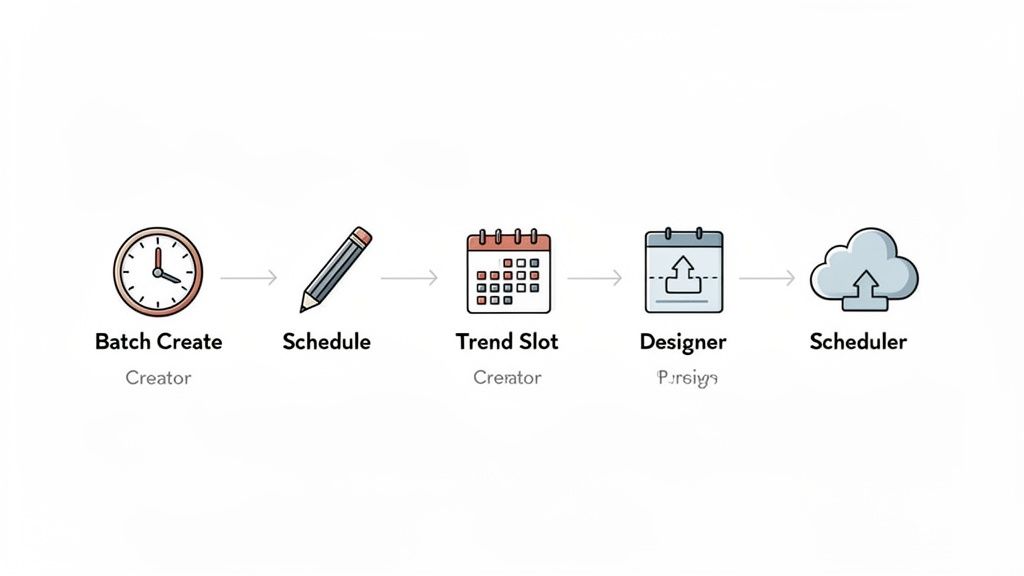
I see so many eCommerce brands fall into one of two traps. Either they're so rigid with their schedule that they miss out on timely trends, or they're completely reactive, constantly scrambling to create content on the fly. Neither approach works long-term. The secret is finding a balance that gives you both structure and flexibility.
Embracing the Hybrid Scheduling Model
The most effective system I've seen in action is the hybrid scheduling model. This approach is brilliant because it combines the efficiency of long-term planning with the agility you need for real-time marketing. Instead of trying to plan every single post for the month, you batch-create your core, evergreen content while intentionally leaving gaps in your calendar.
This structure allows you to get ahead on foundational content—like your product tutorials, brand stories, and educational guides—while keeping capacity open for those spontaneous, trend-driven posts that can really capture audience attention. Let's be honest, social media scheduling can be a massive time-suck for eCommerce brands. This hybrid approach is the solution.
The goal is to schedule 60-70% of your posts in advance and save the remaining 30-40% for those timely opportunities. One creator I know who adopted this method saw her posting consistency jump from 62% to 94%, which led to a 67% increase in engagement. For any Shopify brand, that mix of consistency and relevance is a powerful formula for growth. You can dig into more data on effective social media scheduling for brands on influenceflow.io.
Defining Roles for Seamless Execution
Even if you're a team of one, defining "roles" is a game-changer for staying organized and accountable. When you’re wearing all the hats, it's incredibly easy for things to slip through the cracks. By mentally assigning tasks to different roles, you create a structured process that ensures nothing gets missed.
Here’s a simple way to break down the responsibilities:
- Content Creator: This is the person actually writing, filming, or designing the content. They take the ideas from the calendar and bring them to life.
- Visual Designer: This role is all about aesthetics. They create graphics, edit photos, and make sure every visual is on-brand and optimized for its platform.
- Scheduler/Publisher: Think of this as the logistics manager. Their job is to get the finished content scheduled in your chosen tool for the right date and time, complete with captions, tags, and links.
- Community Manager: Once content goes live, this person jumps in to engage with your audience—replying to comments, answering DMs, and sparking conversation.
On a small team, one person might handle all these roles, but separating the tasks makes the workflow much more manageable. You can dedicate specific blocks of time to each function. Maybe Monday is for creation, Tuesday is for design, and so on.
Your workflow should serve your strategy, not the other way around. If a process is causing friction or burnout, it's not the right process for your team. Be willing to adjust and simplify until it feels smooth and sustainable.
Organizing Assets and Automating Your Posts
A messy asset library is a workflow killer. Nothing slows you down faster than digging through folders to find the right product photo or video clip.
Set up a simple, intuitive folder structure in a cloud drive like Google Drive or Dropbox. Organize your folders by campaign, product collection, or content pillar—whatever makes the most sense for you—so you can find what you need in seconds.
Finally, put your publishing on autopilot with scheduling tools. Platforms like Buffer, Later, or Hootsuite are non-negotiable for any serious eCommerce brand. They free you from the daily grind of manual posting, letting you batch-schedule weeks of content at once. This automation is what truly buys back your time, allowing you to focus on high-impact work like analyzing performance and engaging directly with your customers.
Measuring Performance to Refine Your Strategy
A content calendar shouldn't be a set of rules carved in stone. It's a living, breathing guide for your brand. But without tracking performance, your content plan is just a shot in the dark. You need to build a feedback loop that turns your content from a line item on the budget into a real, measurable asset for your Shopify store.
This means looking past the vanity metrics. Sure, likes and shares feel good and can signal that you've grabbed someone's attention, but they don't tell you if your content is actually moving the needle on sales. You have to focus on the numbers that hit your bottom line.
Tracking eCommerce KPIs That Matter
To get a real sense of your content's value, you have to connect it directly to customer actions. When you sit down for your monthly review, these are the kinds of metrics that should be front and center.
Here's what I'd be looking at:
- Click-Through Rate (CTR) to Product Pages: How many people who engaged with your content actually clicked through to check out a product? This is a crucial first step.
- Add-to-Cart Conversions: Did that new blog post or Instagram Reel directly lead to people adding products to their cart? Most analytics tools can help you trace this.
- Traffic Source Analysis: Jump into your Shopify analytics. Pinpoint which content channels are sending the most qualified traffic—the kind that converts—to your store.
A monthly content audit is your secret weapon. For your best and worst-performing pieces of content, ask yourself three simple questions: What worked? What didn't? And most importantly, why?
Getting into the habit of answering these questions gives you a massive advantage. You start refining your strategy based on hard evidence, not just what you think your audience wants. These insights are pure gold, telling you exactly where to double down on what’s working and how to constantly fine-tune your content calendar for better results.
Got Questions? We’ve Got Answers.
When you're building your first content calendar, a few common questions always pop up. Let's tackle them head-on, so you can move from planning to executing with confidence.
How Far in Advance Should a Shopify Store Plan Content?
Finding that perfect balance between long-range strategy and nimble execution is everything. From what we've seen, a quarterly roadmap for your big campaigns paired with a detailed monthly plan is the sweet spot for most eCommerce brands.
Start by sketching out your major promotions, product drops, and key seasonal moments three months ahead. This gives you a bird's-eye view of your marketing rhythm. Then, get into the nitty-gritty one month at a time—actually writing the social posts, drafting the blog articles, and designing the emails. This keeps you strategically aligned but leaves room to jump on a trend or react to what's happening right now.
What Is the Best Tool for an Ecommerce Content Calendar?
Honestly, the best tool is the one your team will actually use. There’s no magic bullet here; it’s all about what fits your current workflow and team size.
- For solo founders or tiny teams: Don't overcomplicate it. A well-organized Google Sheet or a visual Trello board is more than enough. They’re free, flexible, and surprisingly powerful for managing a solid content schedule.
- For growing teams: Once you have more people in the mix, tools like Asana or Notion are game-changers. Their collaboration features, like assigning tasks and creating approval workflows, really start to shine.
- For established brands: If you're running a larger operation, dedicated platforms like CoSchedule might be worth the investment. They bring advanced analytics and deeply integrated workflows to the table.
The tool is just the vessel. What truly matters is the system you build around it. The goal is clarity and consistency, whether you find that in a simple spreadsheet or a sophisticated software suite.
How Often Should My Shopify Brand Post Content?
Let's clear this up right now: consistency beats frequency, every single time.
Showing up with three high-value, on-brand posts every week is worlds more effective than dumping seven mediocre ones whenever you have a spare moment. An erratic schedule doesn’t just confuse your audience; it can also hurt your visibility with platform algorithms that favor reliable creators.
For a visual-heavy platform like Instagram, aiming for 3-5 quality feed posts a week is a great starting point. On the blog side, one or two deeply researched, SEO-driven articles a month can become long-term traffic magnets. Start with a pace that feels genuinely sustainable for your team. You can always ramp things up once you've hit your stride.
Ready to build a content engine that drives real growth? ECORN specializes in creating scalable marketing and development solutions for ambitious Shopify brands. See how we can elevate your strategy at https://www.ecorn.agency/.


Luxury Skincare Branding Playbook That Converters
10 Best Podcast Ecommerce Shows for Store Growth in 2026
Shopify Developer Hourly Rate: What to Pay in 2026
Critical Shopify Setup Errors That Are Secretly Sabotaging Your Store
Ecommerce Conversion Tracking: The Complete How-To Guide

Shopify Design Agency: How to Pick the Right Partner
Mastering Multi Store Management on Shopify
Scale Shopify Store
10 Shopify App Ideas Worth Building in 2026
Conversion Rate Optimization for Landing Pages: The Playbook
Shopify Plus Automation: A Guide for 2026
10 Social Selling Platforms for Shopify Merchants

Shopify Website Design Examples: 7 Stores Worth Studying
7 Ecommerce Newsletter Examples for Shopify Brands
One Product Shopify Store: Build and Scale
Mobile Pop Up Strategy for Shopify Stores That Converts

Sitemap for Shopify: How to Find, Optimize, and Submit It
7 Single Product Websites Worth Emulating
Product Variants Shopify: The Complete 2026 Guide
Ecommerce Analytics Consulting for Growth
What Is AI Integration for eCommerce
How to Choose the Right eCommerce Website Development Firm
E Business Strategy Implementation
Conversion Tracking Setup for Shopify Stores
BigCommerce vs Shopify Plus Which Enterprise Wins in 2026
Shopify Theme Kit: Setup, Commands, and Migration Guide
Shopify Extension Development: A Practical 2026 Guide
Shopify Speed Score Explained and How to Improve It
Shopify Mobile Optimization: The 2026 Playbook
How to Add Subcategory in Shopify for Better UX
How to Implement Structured Data for Ecommerce in 2026
SEO App Mobile: Shopify Store Optimization Guide
Shopify Plus Support: What It Includes and How to Choose
Google Ads for Shopify: The Complete 2026 Playbook

Shopify New York: How to Find and Hire the Right Agency

Google Search Console for Shopify: The Complete Setup
First Party Data Collection for eCommerce Growth
FAQ Online Store Guide: Build and Measure It Right
Do FB Ads Work for eCommerce in 2026?
One Page Checkout for Shopify: Design and Implementation
Shopify GraphQL vs REST: The 2026 Developer Decision
Shopify Ecommerce Consulting: Strategy, Pricing &

Are Reddit Ads Worth It for eCommerce Brands
Shopify Title and Meta Description: A Practical 2026 Guide

Product Video Best Practices for Shopify Brands
Real-Time Inventory Management: A 2026 Guide
AI Chatbot Integration for Shopify Stores
Affiliate Program Management: A Shopify Guide
10 Best Performance Monitoring Tools for Shopify in 2026
Digital Asset Management for eCommerce Brands in 2026
Every Type of Facebook Ads Explained for eCommerce Growth
Product Information Management Explained for Shopify Brands
Support Ticket System: A Guide for Shopify Stores

10 Best Customer Service Tools for Shopify in 2026

Can I Start a Business with No Money? a 2026 Blueprint
What Sells Good on Etsy: Best Niches for 2026

Shopify Add to Cart Button: A Practical 2026 Guide

Customer Feedback Automation: A Practical eCommerce Guide
Critical Rendering Path: A Guide for Shopify Stores

How to Promote on TikTok for eCommerce in 2026

B2B eCommerce Consulting That Drives Real Revenue
10 Best Practices for Site Navigation in 2026
Return vs Refund for Shopify Stores: A Practical Guide
What Is Customer Lifetime Value and Why It Matters
What Is Voice of Customer Research for eCommerce

SMS Marketing for Ecommerce That Actually Converts

Master How to Improve Email Deliverability in 2026

Top 8 eCommerce Partners NYC for Shopify Brands in 2026
Machine Learning for Ecommerce: Boost Your Shopify Store

Beauty Market Research: Your 2026 Growth Guide

Shopify International Expansion: A 2026 Roadmap
What Does CRO Stand for in Business: Understanding CRO

Shopify Visual Merchandising: A Playbook for Higher Sales

Shopify Landing Page Design: Master Conversion in 2026
10 Best AI SEO Optimization Tools for Shopify in 2026

Agentic AI for Ecommerce: Boost Your Sales in 2026
Mastering Email Marketing Data for eCommerce Growth

Conversion Rate Optimisation Australia: Boost Your Sales
Conversion Rate Optimization AI: Your Shopify Store Guide

10 Product Bundling Strategies for Shopify in 2026
How to Increase Customer Lifetime Value: A Shopify Playbook
AI Customer Service Automation: Shopify Guide 2026

Clean Website Design: A Shopify Conversion Playbook

Omnichannel Retail Strategy: A Shopify Playbook
Product Data Enrichment: A Guide for Shopify Brands

Instagram Shopping Features a Guide for Shopify Stores
What Is Revenue Optimization: A Holistic RevOps Guide

Benefits of Conversion Rate Optimization: Boost Your
WordPress to Shopify Migration: Your 2026 Seamless Switch
Boost Sales: Ecommerce Payment Processing Guide 2026
Unified Commerce Platform: Benefits, KPIs & Shopify Guide

How to Reduce Bounce Rate eCommerce: Your 2026 Guide
Shopify API Integration: A Practical End-to-End Guide
How to Implement Data Governance: A 2026 Guide
Shopify Store Development Cost: A 2026 Breakdown
What Is Server Side Tracking: The Shopify Guide 2026
Marketing Automation Workflows: A Shopify Guide for 2026

Shopify: How to Reduce Technical Debt

Shopify UX Design Change: A Playbook for Growth
User Generated Content Strategy: Shopify Playbook


newsletter in your inbox