


Let's start with a simple analogy. Think of your ecommerce platform as a pre-built house. It's perfectly livable, but you can't just knock down a wall or pop in a state-of-the-art kitchen without a massive, costly renovation.
Now, imagine building with a sophisticated LEGO set instead. This is composable commerce. Each brick is a specialized tool—your shopping cart, your search function, your payment system—that you hand-pick and snap together. You're not just buying a house; you're designing your dream home, piece by piece.
Moving Beyond One-Size-Fits-All Ecommerce
For a long time, the go-to for online retail was the monolithic platform. This was your all-in-one system, handling everything from the product catalog to the final checkout click. It was simple, sure. But for ambitious brands trying to carve out a unique space, "simple" quickly became "limiting."
This rigid, one-size-fits-all structure means you're often boxed in by the vendor's roadmap, their features, and their tech. When a new social channel blows up or a slicker payment gateway hits the market, integrating it can be painfully slow, expensive, or flat-out impossible. You end up bending your business to fit the platform, not the other way around—a classic growth killer.
The Shift to Modular Flexibility
This is exactly why composable commerce has become such a game-changer. It’s a total shift in thinking, moving away from that rigid, pre-built model. Instead of getting every single function from one vendor, you get to choose the absolute best tool for each job and "compose" them into a custom tech stack that works for you.
This approach puts you firmly in the driver's seat. You can pair the most powerful search engine with the most flexible content management system (CMS) and the most efficient checkout provider on the market. Everything is connected seamlessly through APIs (Application Programming Interfaces), which act as the universal adapters between your different "LEGO" bricks.
Composable commerce is all about freedom and future-proofing. It lets brands build truly unique customer experiences by assembling a tailored stack of best-of-breed technologies, rather than being stuck within the walls of a single, restrictive platform.
Solving Today’s Biggest Ecommerce Challenges
This move toward modular systems is a direct answer to the growing pains of modern retail. Data shows that by 2025, composable commerce will be the key to tackling the industry's biggest headaches. Right now, 50% of retailers are flagging high customer acquisition costs and 52% are struggling with multi-channel integration. It's no surprise that 70% of retailers see composable as a top priority.
Monolithic platforms often make these problems worse with their slow innovation and vendor lock-in. Composable allows you to build an agile storefront that can scale one component at a time, directly addressing these issues. You can dive deeper into these trends in the full report on composable commerce in 2025%20(1).pdf).
Ultimately, this strategy is about building a business that's more resilient, adaptable, and powerful. It empowers you to innovate faster, react to market shifts, and create customer journeys that your competitors, stuck on their one-size-fits-all platforms, simply can't match.
Understanding The Composable Commerce Architecture
To really get what composable commerce is all about, we need to pop the hood and look at the architecture. Ditch the idea of a rigid, all-in-one box you get with traditional platforms. Instead, imagine building with a set of high-performance, specialized LEGO bricks. A composable system is built on this very idea of flexibility, clear communication, and independent power.
At the very heart of this model are Application Programming Interfaces (APIs). You can think of APIs as universal translators or super-smart adapters. They let completely different software applications—built by different companies, using different tech—talk to each other flawlessly and swap data in real time. This seamless communication is the magic that holds the entire composable ecosystem together.
These individual software applications are what we call Packaged Business Capabilities (PBCs). A PBC is essentially a self-contained, functional piece of your business. It's a "best-of-breed" tool that is an expert at doing one specific thing incredibly well.
A few common examples of PBCs you might recognize are:
- A lightning-fast search engine like Algolia
- A flexible content management system (CMS) like Contentful
- A robust payment gateway like Stripe
- A dedicated customer loyalty program like LoyaltyLion
You handpick these PBCs one by one and then connect them using APIs to assemble a custom tech stack that's perfectly sculpted to your unique business needs. This visual really drives home the difference between the pre-built, one-size-fits-all house of a monolithic platform and the custom-built, brick-by-brick approach of a composable one.
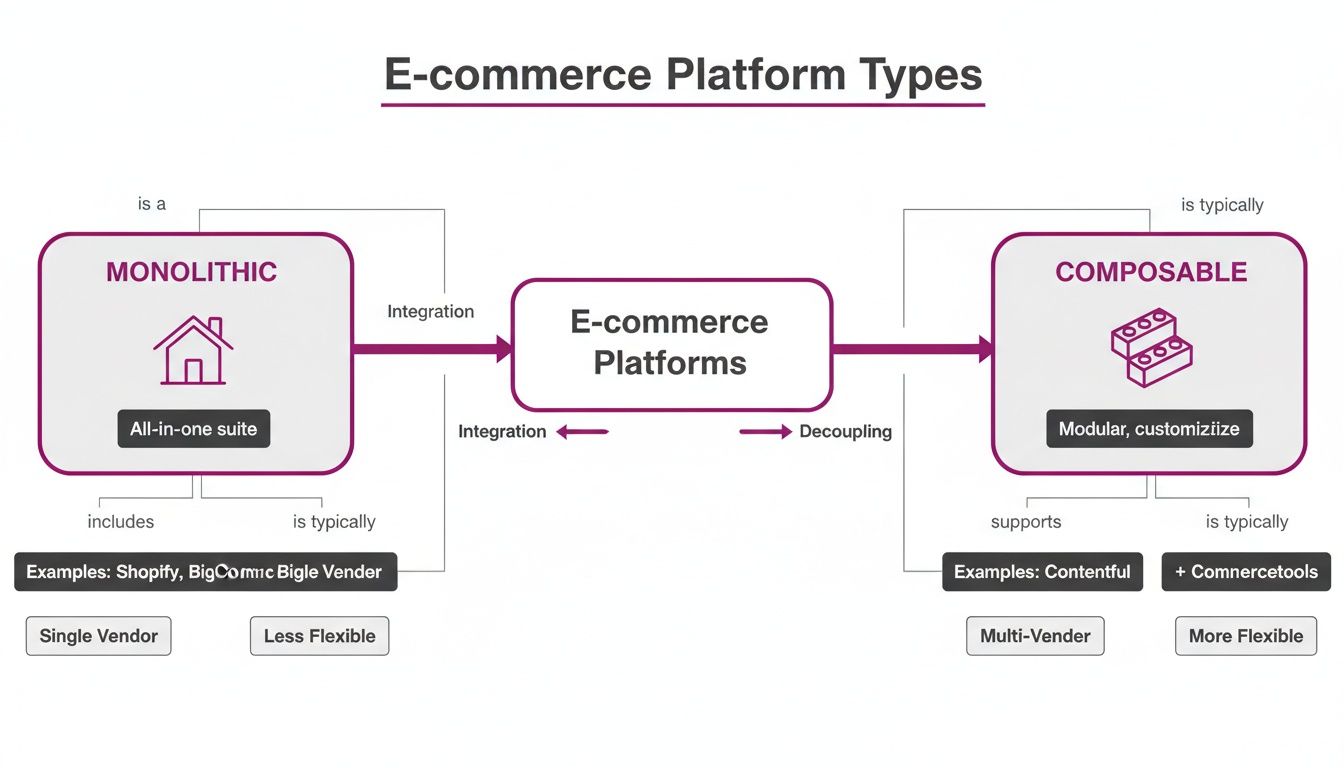
As you can see, a monolithic approach can feel like being locked into a single vendor's world, limiting your options. A composable strategy, on the other hand, gives you the freedom to assemble the absolute best tools for every job.
This table breaks down the core differences at a glance:
Monolithic vs Composable Architecture At a Glance
Ultimately, the choice comes down to control. Monolithic offers simplicity out of the box, while composable provides the ultimate control and future-proofing for ambitious brands.
The MACH Principles Powering Composable
This entire architectural style isn’t just a random assortment of ideas; it’s guided by a set of core principles known as MACH architecture. MACH is an acronym that stands for the four technological pillars that make this whole composable thing work.
MACH stands for Microservices, API-first, Cloud-native, and Headless. Each one of these principles contributes to building a system that is more agile, scalable, and ready for whatever comes next compared to its monolithic predecessors.
Let’s break down what each of these really means for your business.
Microservices
Instead of one massive, tangled application where everything depends on everything else, a microservices architecture breaks down functionality into small, independent services. Your search, your shopping cart, and your inventory management each run as their own mini-application. If your search service needs an update or, heaven forbid, fails, it doesn’t take your entire store down with it.
API-First
This principle dictates that all communication and interaction between your microservices must happen through APIs. A crucial part of composable commerce is relying on custom API development services to weave together all these best-of-breed components seamlessly. This ensures every part of your system can talk to every other part, giving you a fast, reliable path to scale.
Cloud-Native
Your entire infrastructure is designed from the ground up to live on the cloud. This is a game-changer for scalability, allowing you to handle enormous traffic spikes during a Black Friday sale without your site even breaking a sweat. It also means you’re not bogged down managing physical servers, which cuts down on overhead and boosts reliability.
Headless
Finally, headless architecture decouples your front-end customer experience (the "head") from your back-end business logic and data. This separation is the key to unlocking true creative freedom. You can build totally unique, blazing-fast storefronts on any channel you can dream of—a website, a mobile app, a smart mirror, you name it. To really dig into this idea, check out our guide on what is headless commerce and how it fits into this modern e-commerce stack. This is the freedom that lets brands innovate on the customer journey without being held back by their back-end systems.
Why Ambitious Shopify Brands Need a Composable Strategy
The technical diagrams for composable commerce are impressive, sure. But the real magic is what this approach unlocks for ambitious Shopify brands. This isn't just about swapping out technology for the sake of it; it's a strategic shift that creates real competitive advantages and drives bottom-line growth. For founders and marketers obsessed with agility and ROI, this is where the theory hits the pavement.
The biggest promise here is unparalleled flexibility. Let's be honest, even with a ton of apps, a standard Shopify theme keeps you inside a predefined box. It can be a real struggle to create a customer journey that’s genuinely unique to your brand. Before you know it, you and your competitors start to look and feel the same, forced to compete on price or ad spend alone.
A composable strategy completely shatters those walls. It lets you design and build customer experiences that are simply impossible with off-the-shelf solutions. You can craft a custom front-end that’s not just beautiful but also engineered for blistering speed, which has a direct, measurable impact on your conversion rates.
Future-Proofing Your Business for Tomorrow’s Tech
The world of retail moves at a dizzying pace. New tech emerges, customer habits change overnight, and what works today might be a dinosaur tomorrow. A monolithic platform can feel like a dead weight, holding you back as nimbler competitors race ahead with newer, better tools.
Composable commerce is built for this exact chaos. It makes your business inherently adaptable. When a mind-blowing new AI personalization engine hits the market, you can plug it in without a full-scale, heart-stopping re-platform. If a new social channel suddenly becomes the place to sell, you can spin up a unique shopping experience for it in no time.
This ability to adopt and test new tech on your own terms is the very definition of future-proofing. You’re no longer stuck waiting for your platform provider to add a feature to their roadmap. Instead, you get to innovate whenever you want, keeping your brand ahead of the curve.
By decoupling your systems, you empower your team to act on new opportunities instantly. A composable strategy transforms your tech stack from a potential bottleneck into a powerful engine for continuous innovation and growth.
Achieving Faster Speed-to-Market
In ecommerce, speed is everything. Launching new products, running flash sales, or rolling out entire campaigns faster than the competition gives you a massive advantage. With a composable setup, your teams can work on different parts of the system at the same time, without stepping on each other's toes.
- Marketing can update content on the fly through a headless CMS, no developer needed.
- Developers can launch a new feature for your mobile app without touching the main website.
- New regional storefronts can be deployed in a fraction of the time by connecting a new front-end to your existing backend.
This modular approach absolutely crushes traditional development cycles. Forget massive, high-risk deployments. You can now push small, incremental changes quickly and safely, letting you respond to market feedback in days instead of months.
There's a reason the retail and eCommerce sector is buzzing about this. Projections show an 18.9% CAGR in composable applications through 2034. This growth is fueled by modern retail needs like Buy Online, Pick Up in Store (BOPIS), which exploded by over 200% in 2021. With 77% of executives laser-focused on improving conversion rates, the agility of a composable setup is the perfect answer. You can dig into the full analysis on the composable applications market growth.
Optimizing Your Tech Spend for Maximum ROI
Finally, let’s talk money. A composable strategy leads to a much smarter way of spending it. With a monolithic platform, you're often paying for a bloated bundle of features, many of which you’ll probably never touch. That's wasted budget and unnecessary complexity.
Composable commerce flips that model completely. You move to a "pay-for-what-you-need" approach, investing only in the best-in-class tools that solve your specific problems. This not only tightens up your tech spend but also guarantees that every single component in your stack is a high-performer that directly contributes to your bottom line.
Building Your Ideal Ecommerce Experience
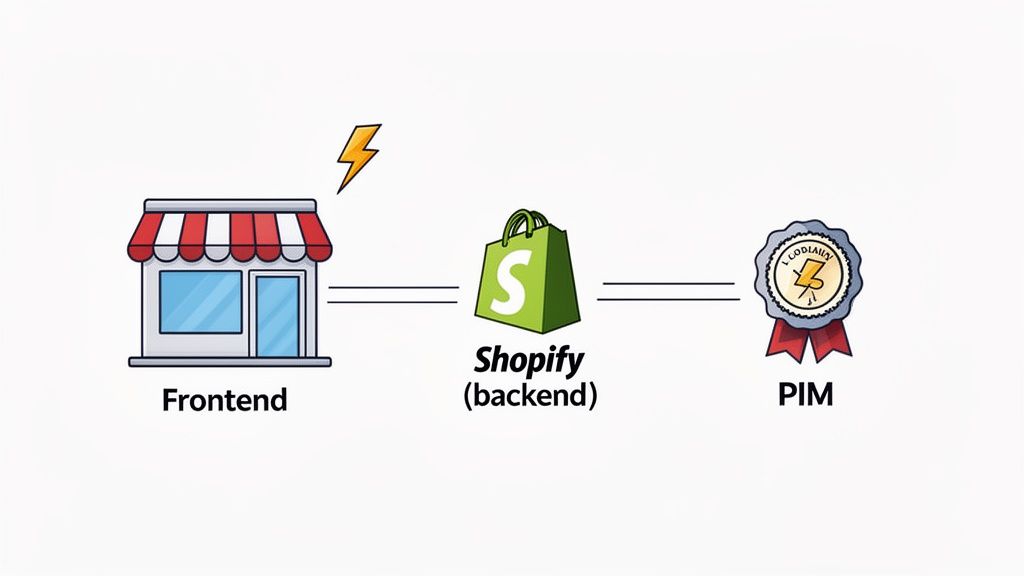
This diagram is a fantastic way to see how best-in-class, independent services can plug into each other to create one cohesive system. It’s the perfect snapshot of taking composable commerce from a lofty idea to a real-world setup that actually works for your business.
But understanding the architecture is just the first step. The real "aha!" moment comes when you see how this approach solves actual business problems.
Let's walk through a few real-life scenarios. These mini-stories show how ambitious brands are using a composable strategy to build their dream customer experiences, piece by piece, and might just spark some ideas for your own challenges.
Of course, a slick tech stack is only part of the puzzle. You also need to turn all those new visitors into loyal customers. Once your site is flexible and fast, check out these ecommerce conversion rate optimisation tips to make sure you're maximizing sales.
Use Case 1: The Need for Speed and Design Freedom
Picture a fashion brand on Shopify Plus. They've got great products and a solid customer base, but their standard theme just feels… slow. Worse, it's generic. Page load times are killing their conversion rates, and the theme’s rigid structure makes it impossible to create the immersive, editorial-style shopping experience they’ve been dreaming of.
So, they decide to go headless.
By shifting to a composable setup, they keep Shopify Plus as their powerful, reliable backend for handling orders, inventory, and payments. But they completely detach the frontend, building a custom storefront from the ground up using a modern framework like Next.js.
- The Result: Their site speed is now lightning-fast, giving them an immediate lift in conversions and a much lower bounce rate.
- The Freedom: The design team finally has total creative control. They can now build a unique, content-rich experience that makes competitors on standard templates look outdated.
This is a classic example of using a composable strategy to fix a specific, high-impact problem without having to replatform the entire business.
Use Case 2: Taming a Complex International Catalog
Now, let's think about a B2B distributor selling highly technical parts across a dozen different countries. Their product catalog is a beast—we're talking thousands of SKUs, complex specs, and unique pricing and availability for each region. Trying to manage all that data inside their core ecommerce platform has turned into a nightmare of spreadsheets and manual updates, leading to constant errors and unhappy customers.
Their solution? Integrate a specialized tool.
They "compose" a best-in-class Product Information Manager (PIM) into their existing stack. The PIM becomes the single source of truth for all product data, handling everything from technical specs and localized marketing copy to regional pricing rules. It then feeds this clean, organized data to their Shopify storefront, their sales team's mobile app, and even their print catalogs—all through APIs.
This brand didn't need to rip out their entire ecommerce engine. They just identified their biggest operational headache—product data management—and plugged in a specialized solution that does that one job perfectly.
Use Case 3: Boosting Retention with a Best-in-Class Loyalty Program
Finally, imagine a direct-to-consumer wellness brand. Customer acquisition costs are through the roof, so they know that increasing customer lifetime value through retention is the key to long-term survival. The built-in loyalty features of their ecommerce platform are pretty basic and don't offer the kind of personalized, tiered rewards they want to create.
They choose to compose a dedicated loyalty and retention platform.
By integrating a specialized service, they can build a much more sophisticated loyalty program with features like:
- Tiered rewards based on how much customers spend.
- Points for non-purchase activities like social media follows and product reviews.
- Personalized reward recommendations based on buying history.
This powerful new tool plugs right into their existing customer data and checkout flow, making the experience totally seamless. It's a targeted approach that lets them build a powerful system for increasing repeat purchases and engagement—a core piece of any modern ecommerce tech stack.
Making a Smart Transition to Composable Commerce
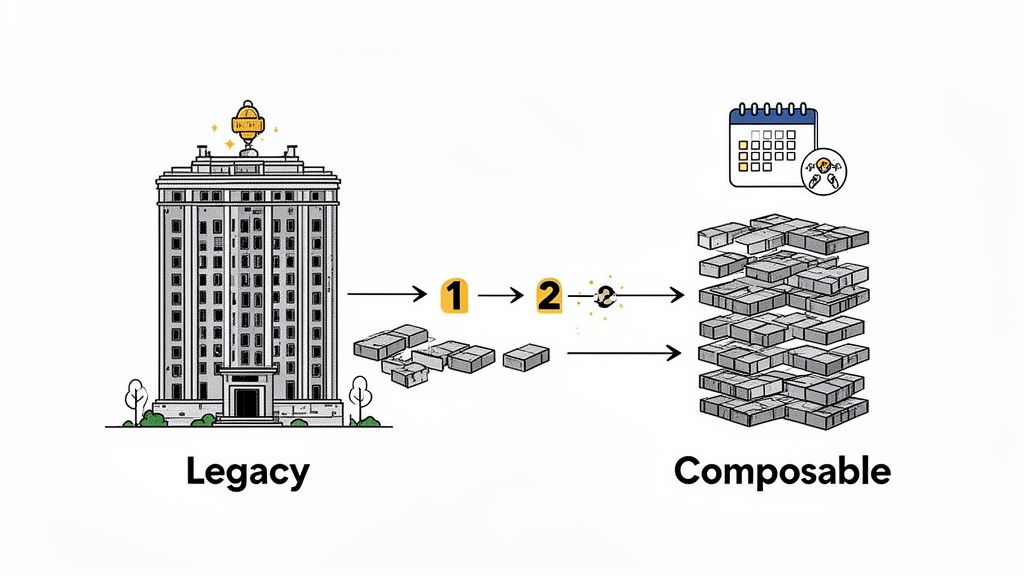
The idea of building a completely custom ecommerce stack sounds incredible, but the thought of a massive, all-at-once migration is enough to give anyone pause. It's a high-stakes move, and frankly, it can be pretty daunting.
But here’s the good news: going composable doesn’t mean you have to flip a switch overnight. A smart transition isn’t about a risky "big bang" relaunch. It’s a strategic, phased approach that starts delivering value almost immediately while keeping disruptions to a minimum.
Many brands hesitate, and for good reason. They worry about the initial complexity or finding the right developers to juggle multiple integrations. The most successful projects, however, tackle these challenges by starting small and building momentum. Instead of ripping everything out at once, you can incrementally swap out pieces of your existing platform, one by one.
This gradual method gives you a clear, manageable path forward, turning a huge project into a series of smaller, achievable wins.
Adopting the Strangler Pattern
One of the most effective strategies for this kind of phased migration is called the strangler pattern. The name sounds a bit intense, but the idea behind it is brilliantly simple.
Picture an old brick wall being slowly overtaken by a new, vibrant vine. Over time, the vine grows stronger and thicker, eventually covering the wall entirely until it becomes the new structure. That’s exactly how this approach works for your tech stack.
You start by picking the single biggest pain point in your current system. Is it your clunky, slow-loading blog? Your rigid product search? An outdated promotions engine that drives your marketing team crazy? Whatever it is, you build or integrate a new, modern microservice to replace just that one piece of functionality.
Then you do it again. And again. Over time, you systematically replace old components with new, best-in-class ones. Each new service is another building block in your modern, composable architecture. Eventually, the old monolithic system is "strangled" out, completely replaced by a flexible, powerful network of tools you chose.
The strangler pattern is about evolution, not revolution. It allows you to deliver immediate business value and prove the ROI of composable commerce with each small step, all while keeping your core business running smoothly.
Key Steps for a Phased Migration
A successful move to composable is built on careful planning, not just diving headfirst into a rebuild. A structured approach ensures each phase is a win, allowing your team to learn and adapt as you go.
Here’s a practical roadmap for putting the strangler pattern into action:
- Audit and Identify Pain Points: First things first, take a hard look at your current system. Find the areas causing the most friction, whether that’s for your customers or your internal teams. This could be anything from slow page loads to a CMS that’s impossible to manage.
- Prioritize for Impact: Rank those pain points. You're looking for the sweet spot between high business impact and low technical risk. A great first project is often something like replacing your blog’s CMS—it’s valuable but contained.
- Build and Integrate: Now, go find the best-in-class solution for that component. The critical part is making sure it integrates cleanly with your existing system through APIs. For your customers, the transition should feel completely seamless.
- Measure and Iterate: Once the new piece is live, track its performance obsessively. Are site speeds up? Are conversion rates improving? Is your team working more efficiently? Use these insights to prove the concept and decide what to tackle next.
This cycle de-risks the entire process, turning a massive project into a series of controlled, manageable steps that continuously improve your ecommerce experience. And honestly, having an experienced partner to help guide this strategy can make all the difference.
Building a Future-Proof Ecommerce Business
Throughout this guide, we've looked at composable commerce as more than just a tech upgrade—it's a fundamental business strategy. It's the difference between being trapped by your technology and being set free by it. When you step away from a rigid, one-size-fits-all platform, you build a foundation designed for agility, innovation, and real growth in a market that doesn't wait for anyone.
This modular approach gives your teams the power to move fast. Instead of getting stuck waiting on a slow-moving platform roadmap, they can plug in best-in-class tools to solve specific problems, whether that's building a lightning-fast storefront or launching a deeply personal marketing campaign. It’s about creating an ecommerce ecosystem that adapts to the market, instead of getting run over by it.
Embracing a New Era of Ecommerce
The shift to this flexible model is picking up serious steam. The global market for composable commerce is expected to jump from $4.2 billion in 2024 to an incredible $18.7 billion by 2033, growing at a powerful 17.8% CAGR. Retailers are already on board, with 85% agreeing it leads to a better customer experience and 70% making composable storefronts a priority for more meaningful personalization. This isn't just about features; it's about cutting tech debt by up to 50% and becoming more adaptable than ever. You can see the full breakdown of these numbers and what's driving the growth of composable commerce here.
This is more than a trend; it's a core change in how winning brands will operate. The ability to assemble your perfect tech stack means you can jump on new opportunities without tearing down your entire system. You're finally free to innovate on your own terms.
By building a flexible foundation, you create a business that is not just ready for today's challenges but is prepared for whatever comes next. It’s about owning your technology, not being owned by it.
This is the path to the kind of innovation and personalization that will set you apart. At the end of the day, a smart composable strategy, guided by an experienced partner like ECORN, is how you unlock what your ecommerce business is truly capable of. You get the freedom to build amazing customer experiences, fine-tune your operations, and create a resilient business that's ready to scale.
Your Composable Commerce Questions, Answered
As brands start looking beyond their traditional commerce systems, a few key questions always pop up. Let's break down the most common ones with clear, straightforward answers to help you figure out what a move to composable really means for your business.
How Is Composable Commerce Different From Headless Commerce?
This is a fantastic question and a common point of confusion. The simplest way to put it is that headless commerce is a key ingredient, but composable commerce is the entire recipe.
Headless commerce is all about decoupling your frontend presentation layer—the "head"—from your backend. This gives you total design freedom over the customer experience, but you're often still stuck with the same old monolithic backend powering everything.
Composable commerce is the bigger picture. It’s a full-blown strategy where you assemble your entire tech stack from a handpicked selection of best-in-class, independent services. Think of it as connecting your headless frontend, CMS, search, payments, and loyalty programs together with APIs, creating a system that’s perfectly tailored to your needs.
Is Composable Commerce Only for Large Enterprise Brands?
Not at all. While the big enterprise players were the first to jump on board—mostly because they were the ones hitting the ceiling of monolithic platforms first—the modular nature of composable actually makes it incredibly accessible for growing brands. Frankly, it can be a much smarter financial move.
The pay-for-what-you-need model is a core benefit here. You can start small. Is your CMS inflexible? Is your site search letting you down? Just replace that one piece. This is often way more cost-effective than shelling out for bloated monolithic platform tiers loaded with features you'll never touch.
A composable approach lets you point your budget directly at your most pressing business challenges. You invest in the specific tools that will drive the most growth, instead of paying for a bundled package that doesn't quite fit.
This ability to adopt new tech incrementally makes composable commerce a powerful and totally viable option for any business serious about scaling.
What Are the First Steps to Adopting a Composable Approach?
Starting your composable journey doesn't have to be a massive, all-at-once project. The best way to begin is by taking a hard look at your current tech stack. A simple audit will give you a clear roadmap based on what your business actually needs.
Here’s how to get started on the right foot:
- Identify Your Biggest Pain Point: What's the single biggest point of friction in your business right now? Is it a clunky content editor slowing down your marketing team? Terrible search functionality frustrating customers? Pinpoint the one issue that, if solved, would deliver the most immediate value.
- Define a Pilot Project: Once you have your target, scope out a small project to replace just that one component. For example, you could integrate a best-in-class search provider like Algolia to improve product discovery without overhauling your entire site.
- Prove the Value and Learn: This smaller, focused project lets you test the waters with minimal risk. You can prove the value of the approach to stakeholders, get your team comfortable with the integration process, and build momentum before committing to a larger transformation.
This methodical, step-by-step process turns what could be a daunting transition into a series of manageable, high-impact wins.
Ready to build a more flexible, future-proof ecommerce business? The team of Shopify specialists at ECORN is here to help you navigate your transition to a composable architecture with expert guidance and development. Explore our scalable solutions and see how we can help you grow.


Conversion Tracking Setup for Shopify Stores
BigCommerce vs Shopify Plus Which Enterprise Wins in 2026
Shopify Theme Kit: Setup, Commands, and Migration Guide
Shopify Extension Development: A Practical 2026 Guide
Shopify Speed Score Explained and How to Improve It
Shopify Mobile Optimization: The 2026 Playbook
How to Add Subcategory in Shopify for Better UX
How to Implement Structured Data for Ecommerce in 2026

SEO App Mobile: Shopify Store Optimization Guide

Shopify Plus Support: What It Includes and How to Choose

Google Ads for Shopify: The Complete 2026 Playbook

Shopify New York: How to Find and Hire the Right Agency

Google Search Console for Shopify: The Complete Setup
First Party Data Collection for eCommerce Growth
FAQ Online Store Guide: Build and Measure It Right
Do FB Ads Work for eCommerce in 2026?
One Page Checkout for Shopify: Design and Implementation
Shopify GraphQL vs REST: The 2026 Developer Decision
Shopify Ecommerce Consulting: Strategy, Pricing &

Are Reddit Ads Worth It for eCommerce Brands

Shopify Title and Meta Description: A Practical 2026 Guide

Product Video Best Practices for Shopify Brands
Real-Time Inventory Management: A 2026 Guide
AI Chatbot Integration for Shopify Stores
Affiliate Program Management: A Shopify Guide
10 Best Performance Monitoring Tools for Shopify in 2026
Digital Asset Management for eCommerce Brands in 2026
Every Type of Facebook Ads Explained for eCommerce Growth
Product Information Management Explained for Shopify Brands
Support Ticket System: A Guide for Shopify Stores

10 Best Customer Service Tools for Shopify in 2026

Can I Start a Business with No Money? a 2026 Blueprint

What Sells Good on Etsy: Best Niches for 2026

Shopify Add to Cart Button: A Practical 2026 Guide

Customer Feedback Automation: A Practical eCommerce Guide
Critical Rendering Path: A Guide for Shopify Stores

How to Promote on TikTok for eCommerce in 2026

B2B eCommerce Consulting That Drives Real Revenue
10 Best Practices for Site Navigation in 2026
Return vs Refund for Shopify Stores: A Practical Guide

What Is Customer Lifetime Value and Why It Matters
What Is Voice of Customer Research for eCommerce

SMS Marketing for Ecommerce That Actually Converts

Master How to Improve Email Deliverability in 2026

Top 7 eCommerce Partners NYC for Shopify Brands in 2026

Machine Learning for Ecommerce: Boost Your Shopify Store

Beauty Market Research: Your 2026 Growth Guide
Shopify International Expansion: A 2026 Roadmap

What Does CRO Stand for in Business: Understanding CRO

Shopify Visual Merchandising: A Playbook for Higher Sales

Shopify Landing Page Design: Master Conversion in 2026
10 Best AI SEO Optimization Tools for Shopify in 2026

Agentic AI for Ecommerce: Boost Your Sales in 2026
Mastering Email Marketing Data for eCommerce Growth
Conversion Rate Optimisation Australia: Boost Your Sales
Conversion Rate Optimization AI: Your Shopify Store Guide

10 Product Bundling Strategies for Shopify in 2026
How to Increase Customer Lifetime Value: A Shopify Playbook
AI Customer Service Automation: Shopify Guide 2026

Clean Website Design: A Shopify Conversion Playbook

Omnichannel Retail Strategy: A Shopify Playbook
Product Data Enrichment: A Guide for Shopify Brands

Instagram Shopping Features a Guide for Shopify Stores
What Is Revenue Optimization: A Holistic RevOps Guide

Benefits of Conversion Rate Optimization: Boost Your
WordPress to Shopify Migration: Your 2026 Seamless Switch
Boost Sales: Ecommerce Payment Processing Guide 2026
Unified Commerce Platform: Benefits, KPIs & Shopify Guide
How to Reduce Bounce Rate eCommerce: Your 2026 Guide
Shopify API Integration: A Practical End-to-End Guide

How to Implement Data Governance: A 2026 Guide
Shopify Store Development Cost: A 2026 Breakdown
What Is Server Side Tracking: The Shopify Guide 2026
Marketing Automation Workflows: A Shopify Guide for 2026
Shopify: How to Reduce Technical Debt

Shopify UX Design Change: A Playbook for Growth
User Generated Content Strategy: Shopify Playbook

Shopify Pause and Build Plan Cost: A Complete 2026 Guide
Compare at Price on Shopify: A Complete Guide for 2026

Where Can I Sell My Prints? 10 Best Platforms for 2026
Shopify Order Management System: The Ultimate Guide 2026
What Is Marketing Attribution? an eCommerce Guide for 2026

10 Best Black Friday Sales Sheets for 2026

Discover the Top Social Media Marketing Agencies For
Consumer Confidence Definition for eCommerce in 2026

What Is Social Commerce? Your 2026 Guide to Boosting Sales
A Social Ad Campaign Playbook for eCommerce Growth

7 Best FAQ Page Examples for SaaS & eCommerce

Market Research in Fashion Industry: A Guide for Shopify
Shopify Migration Services: Expert Guide for 2026

Mastering FB Retargeting Ads for Shopify in 2026
What Is Omnichannel Ecommerce

Master Your Shopify Plus Migration: The 2026 Guide
Shopify Integration Services: A Merchant's 2026 Guide

Shopify Collection Description: A Guide to SEO & Sales

Shopify Plus Contact: Reach Sales & Support Effectively

Top Luxury Shopify Stores: Design & UX Strategies
How to Improve Customer Experience: A Shopify Roadmap

Creative Facebook Ads: 10 Examples for Shopify Brands

Remarketing with Facebook Ads: A Shopify Guide for 2026


newsletter in your inbox