

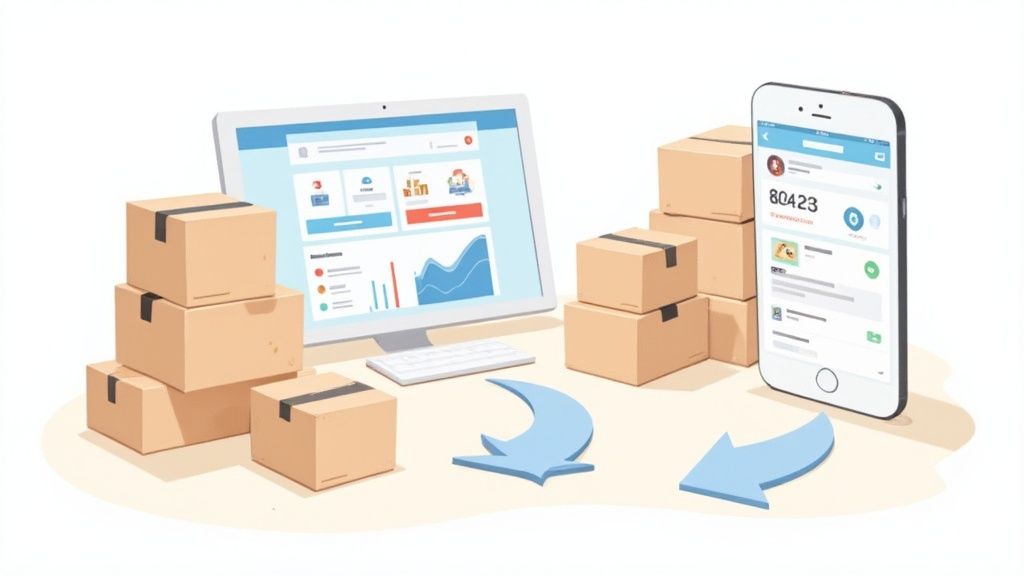
Shipping apps for Shopify are specialized tools designed to plug into your store and completely overhaul your fulfillment process. Think of them as a massive upgrade to Shopify's native shipping features, built to save you time, slash costs, and get rid of manual errors once your order volume really starts to climb.
Why Your Store Needs a Dedicated Shopify Shipping App

Ever find yourself staring at a mountain of new orders, wondering how you’ll get them out the door without losing your mind or your margins? You’re not alone. While Shopify's built-in shipping tools are a great starting point for new stores, their limitations become painfully obvious as your business starts to scale.
A dedicated shipping app is the secret weapon for any growing store. It’s like graduating from a manual spreadsheet to powerful accounting software; you’re automating complexity to unlock some serious efficiency. These tools can turn shipping from a costly, time-sucking chore into a real competitive advantage.
Automating Tedious Tasks and Eliminating Errors
Manually copying and pasting addresses, comparing carrier rates, and printing labels one by one isn't just slow—it's a recipe for expensive mistakes. A single typo in an address can lead to a lost package, an unhappy customer, and a one-star review that lives on your site forever. Shipping apps for Shopify fix this by:
- Batch Printing Labels: Generate hundreds of shipping labels in a single click. This alone can save you countless hours.
- Automating Address Verification: Instantly flag and prompt you to correct invalid addresses before a package ever leaves your warehouse.
- Creating Shipping Rules: Set up rules to automatically assign the cheapest or fastest carrier based on package weight, destination, or even the type of product being shipped.
The right shipping app doesn’t just make you faster; it makes your entire fulfillment operation smarter and more reliable. That has a direct impact on customer satisfaction and your bottom line.
Unlocking Deeper Discounts and Boosting Profitability
One of the biggest wins here is gaining access to much better shipping rates. Many apps come with pre-negotiated discounts with major carriers like USPS, UPS, and DHL—rates that are often significantly better than what you get through Shopify Shipping alone. This is a direct path to learning how to reduce shipping costs and protect your profit margins on every single order you send out.
Just look at the Shopify App Store ecosystem, and you'll see the demand. As of 2025, it hosts over 11,905 apps, a massive jump from 5,649 in 2021. The fulfillment category alone has more than 1,026 dedicated solutions, which proves just how critical these tools have become for modern ecommerce.
To help you see the difference, here’s a quick breakdown of what you get out-of-the-box versus what an app can do.
Shopify Native Shipping vs Dedicated Shipping Apps
FeatureShopify Native ShippingDedicated Shipping AppsLabel PrintingBasic, single-label printing.Advanced batch printing and automation.Carrier RatesStandard Shopify Shipping discounts.Access to deeper, pre-negotiated commercial rates.AutomationLimited to basic shipping profiles.Complex rule-based automation (e.g., by weight, location).Address VerificationNo built-in validation.Automatic address verification and correction flags.Multi-Carrier SupportLimited to carriers in the Shopify network.Extensive integrations with dozens of global carriers.CustomizationMinimal options for packing slips or labels.Fully customizable branding on labels and documents.International ShippingBasic customs form generation.Advanced automation for international paperwork.
While Shopify gives you a solid foundation, a dedicated app builds a skyscraper on top of it, giving you the tools you need to scale efficiently.
Of course, before you jump into these powerful third-party tools, it helps to have a solid grasp of the basics. Understanding how to set up shipping on Shopify will ensure you can truly appreciate the extra efficiency and control a dedicated app brings to the table, helping you build a logistics strategy that actually supports your brand's growth.
Finding the Right Type of Shipping App for Your Store

Diving into the world of shipping apps for Shopify feels a bit like walking into a massive hardware store when all you need is a single screw. You know you need something, but the sheer number of options is overwhelming. The trick is to realize that not all shipping apps do the same thing. They’re specialized tools, each designed to solve a very specific piece of the fulfillment puzzle.
Instead of getting bogged down by brand names, it's smarter to first understand the main categories of apps. Think of it like building a proper toolkit; you need to know if the job calls for a hammer, a wrench, or a power drill. By figuring out the primary function you need to fix or improve, you can cut through the noise and find the perfect tool for your store’s unique challenges.
Let’s break down the main types.
Rate Shoppers and Label Printers
This is the bread and butter of shipping apps, the most common and essential category for most merchants. Their mission is straightforward: save you time and money on the fundamental task of getting a package out the door and to your customer. These apps essentially become the command center for your entire shipping operation.
They plug into multiple carriers (like USPS, UPS, FedEx, and DHL) and pull all their rates into one clean interface. When an order lands, you can see every available shipping option and its cost, letting you pick the cheapest or fastest one in a snap. But their biggest gift is bulk label printing, which lets you process hundreds of orders in minutes instead of grinding through them one by one.
- Who they're for: Pretty much any merchant shipping physical goods from their own space, whether you’re a startup in a garage or a growing business with a dedicated warehouse.
- Core function: Comparing carrier rates in real-time and printing shipping labels in large batches.
Checkout Optimizers
This group of apps shifts the focus to the customer-facing side of shipping—that critical moment when a buyer hits your checkout page. Their entire purpose is to kill surprises and slash cart abandonment by showing accurate, real-time shipping rates directly in the shopping cart.
These apps take a customer’s address, what’s in their cart, and your package dimensions to calculate the exact shipping cost from your connected carriers. This stops you from overcharging customers (and scaring them off) or undercharging (and eating the cost yourself). Many also let you build sophisticated shipping rules, like offering free shipping over $50 or showing calculated rates only for certain product types.
By providing total transparency at checkout, these apps build trust and directly combat cart abandonment. Shoppers are far more likely to complete a purchase when shipping costs are clear and reasonable.
Freight and LTL Solutions
What happens when you sell furniture, exercise equipment, or wholesale pallets of your product? Your standard parcel carriers won’t touch it. That’s where Freight and Less-Than-Truckload (LTL) shipping apps come into play. LTL shipping is for anything too big or heavy for the usual guys but not big enough to require a full truck.
These highly specialized shipping apps for Shopify connect your store to a network of freight carriers. They provide real-time freight quotes at checkout, a complex calculation that standard apps just can’t handle. They also help you manage all the required paperwork, like the Bill of Lading (BOL), and coordinate the actual shipment pickups.
- Who they're for: Merchants selling large, heavy, or oversized items that demand specialized freight services.
- Core function: Calculating complex freight quotes and managing the entire freight booking process.
Returns Management Platforms
Finally, we have the apps built to tackle reverse logistics—the often-dreaded returns process. These platforms can transform returns from a customer service nightmare into a smooth, self-service experience that actually builds loyalty.
Instead of a customer having to email your support team and wait, they can visit a branded portal on your website, punch in their order details, and print a return label automatically. You get to set the rules, controlling which items are eligible for return, offering instant exchanges, or providing store credit. This doesn't just lighten your support team's load; it creates a positive post-purchase experience that makes customers more likely to come back and shop with you again.
Must-Have Features in a Winning Shipping App
Sifting through the hundreds of shipping apps for Shopify can feel like a chore, but the choice gets a lot easier once you know exactly what to look for. What separates a decent app from a game-changing one? It's the features that actually solve problems, save you money, and give you back your most valuable asset—time.
Let's cut through the marketing fluff and get down to the essential, non-negotiable features that deliver a real return. Think of this as your practical checklist for evaluating solutions like a seasoned pro, helping you pick an app that will become a cornerstone of your operations.
Multi-Carrier Integration
Picture this: you have separate browser tabs open for every single carrier you use. It's a logistical headache and makes comparing rates on the fly nearly impossible. This is precisely why multi-carrier integration is the absolute bedrock of any serious shipping app.
A great app serves as your central command center, pulling all your carrier accounts—USPS, UPS, FedEx, DHL, you name it—into one clean, unified dashboard. This lets you see every available shipping option for an order on a single screen, so you can instantly pick the best rate without juggling websites. It's the key to unlocking true flexibility in your shipping strategy.
And speaking of carriers, you need an app that supports the services your customers actually use. As of 2025, USPS is the top dog for Shopify merchants, with 127,190 stores using its services globally. UPS follows with 71,893 stores, and FedEx with 44,273, showing a clear preference for major North American players. You can dig into more Shopify shipping trends over at meetanshi.com to see how your carrier mix compares.
Rule-Based Automation
This is where the real magic happens. Rule-based automation is what turns a simple shipping tool into an intelligent assistant. It lets you create "if-this-then-that" scenarios that automatically handle shipping decisions for you, wiping out repetitive manual tasks and expensive human errors.
It’s like programming your own shipping expert directly into your workflow. You can set up rules to automatically:
- Select the Cheapest Carrier: For any domestic order under 2 lbs, automatically choose USPS Ground Advantage. No second-guessing.
- Upgrade High-Value Orders: If an order total exceeds $150, automatically bump the shipping to a faster, insured service like UPS 2nd Day Air.
- Assign Specific Packaging: For fragile items, automatically assign them to your "Box A with extra padding" package preset.
- Route International Shipments: Automatically select DHL Express for all orders headed to Europe to ensure a smooth customs process.
For a growing store, this feature is a massive time-saver, ensuring every order is shipped consistently and cost-effectively without you having to micromanage.
Live Rate Calculation at Checkout
Nothing kills a conversion faster than sticker shock from an unexpected shipping cost at checkout. That’s where live rate calculation becomes an essential tool for protecting both your sales and your profit margins.
Instead of guessing with inaccurate flat rates, an app with this feature connects directly to your carriers in real time. It pulls the actual shipping cost based on the customer's cart and their specific address, creating instant trust through transparency.
Live rates ensure you neither overcharge your customers (which leads to cart abandonment) nor undercharge them (forcing you to eat the cost). It’s all about creating a fair, transparent experience that works for everyone.
For merchants who want to really nail this part of their store, we've put together a comprehensive resource. Check out our guide on how to choose the right Shopify shipping calculator for a deeper dive into making your checkout seamless.
Bulk Label Printing and Processing
When you're handling five orders a day, printing labels one by one is no big deal. But when that number jumps to 50 or 500, the same process becomes an operational nightmare. Bulk label printing is the feature that lets you scale your fulfillment without having to hire a massive team.
In just a single click, you can select hundreds of orders and generate all the shipping labels, packing slips, and customs forms you need. This feature alone can turn hours of tedious work into a few minutes, freeing you up to focus on growing your business instead of getting stuck in it.
Branded Tracking and Returns Portals
The customer experience doesn't end when the payment goes through. A winning shipping app extends your brand's presence deep into the post-purchase journey. Branded tracking pages replace those generic carrier links with a custom page featuring your logo, brand colors, and even marketing messages or links to other products.
On top of that, a customer-facing returns portal can transform a notoriously painful process into a smooth, self-service experience. Instead of emailing your support team, customers can initiate a return, select a reason, and print their own label from a branded portal right on your site. This is a game-changer for reducing support tickets and building loyalty by making returns painless.
How to Choose the Right Shipping App for Your Business
With hundreds of shipping apps for Shopify, it’s easy to get lost. But picking the right one boils down to a quick, honest look at your own business. It's not about the flashiest features; it's about what fits your operation right now and has the legs to grow with you.
Think of it like taking a "business snapshot." Before you even peek at an app's feature list, you need a clear picture of your own needs. A startup shipping 50 orders a month from a garage has a completely different set of problems to solve than a brand juggling 5,000 orders through a 3PL.
Assess Your Current Order Volume
Your monthly order volume is the single most telling metric. It directly impacts the level of automation you need and what pricing tier actually makes financial sense.
- Low Volume (0-100 orders/month): Simplicity and cost are king. All you really need is a straightforward app that gives you discounted shipping rates and lets you print labels without a fuss. Complex automation can wait.
- Growing Volume (100-2,000 orders/month): This is the make-or-break stage where manual work starts to fall apart. Efficiency is everything. You'll need an app with solid batch processing, automation rules, and key integrations to slash fulfillment time and cut down on errors.
- High Volume (2,000+ orders/month): Now you're in the big leagues. Your focus shifts to optimization. You'll be looking for advanced tools like multi-warehouse support, detailed shipping analytics, and maybe even API access to fine-tune every single step of your fulfillment workflow.
Shipping App Feature Matrix by Business Size
To make this crystal clear, here’s a breakdown of which features matter most at each stage of your business growth. It's a simple way to see what's a "nice-to-have" versus a "must-have" based on your order count.
FeatureStartup (0-100 orders/mo)Growth (100-2000 orders/mo)Enterprise (2000+ orders/mo)Discounted RatesEssentialEssentialEssentialSingle Label PrintingEssentialNice-to-HaveNot a PriorityBatch Label PrintingNice-to-HaveEssentialEssentialAutomation RulesNot a PriorityEssentialEssential (Advanced)Branded TrackingNice-to-HaveHighly RecommendedEssentialReturns PortalNot a PriorityHighly RecommendedEssentialMulti-Warehouse SyncNot ApplicableNice-to-HaveEssentialAdvanced AnalyticsNot a PriorityNice-to-HaveEssentialAPI AccessNot ApplicableNot a PriorityHighly RecommendedDedicated SupportNot a PriorityHighly RecommendedEssential
As you can see, the core need for discounted postage never goes away, but the tools required to manage the process efficiently scale dramatically with your order volume. Startups can get by with the basics, but growing businesses quickly need automation and returns management to keep customers happy and operations sane.
Factor in Your Fulfillment Strategy
How you actually get products into your customers' hands is a huge fork in the road. Are you taping up boxes yourself, or is someone else doing the heavy lifting?
If you fulfill in-house, you need an app that’s a rockstar at rate shopping and batch label printing. Your main goal is to streamline the physical process of getting packages out the door as fast and as cheap as possible.
On the other hand, if you partner with a 3PL provider, your priorities shift. They handle the shipping, so you need an app that excels at order routing—automatically sending orders to the right warehouse based on stock levels or customer location. You’ll also want a slick, customer-facing returns portal to manage reverse logistics without ever touching a box.
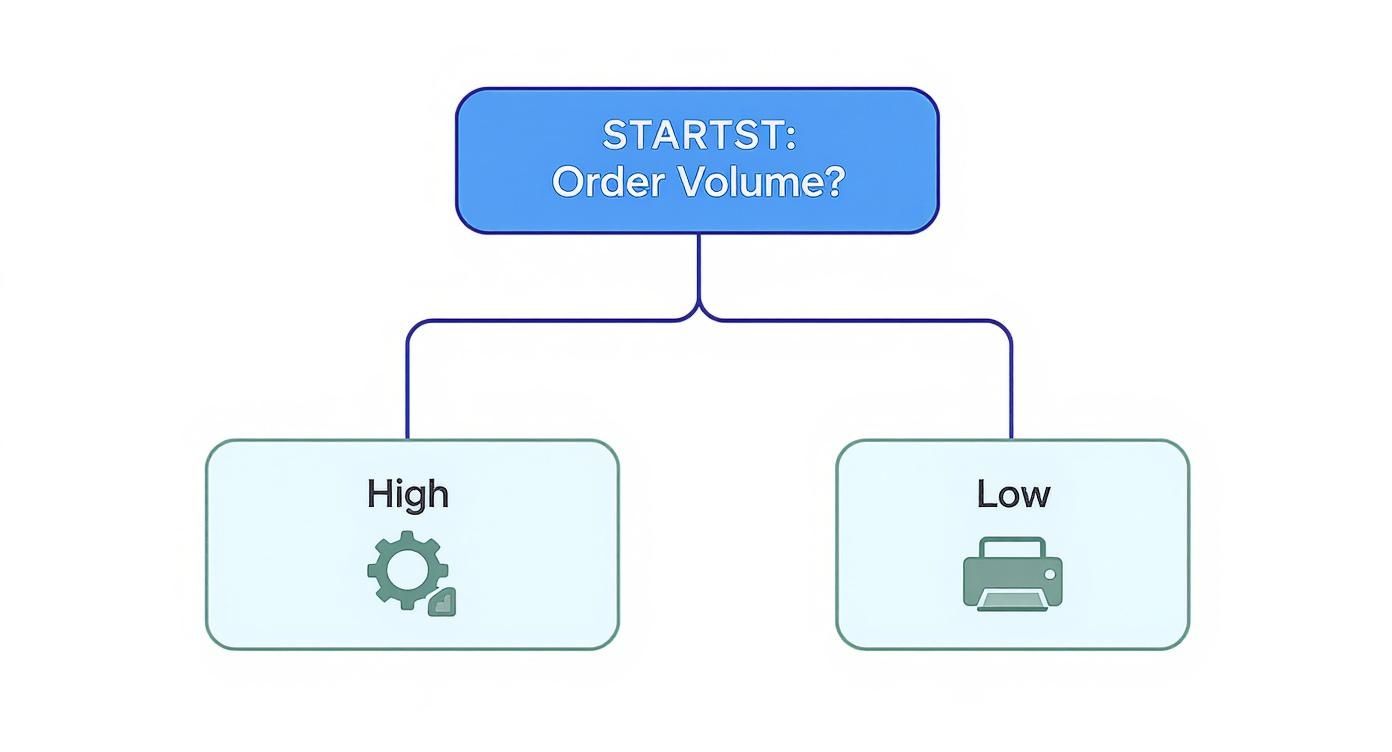
This flowchart nails the core concept: as your business scales, intelligent automation goes from a luxury to a non-negotiable part of your tech stack.
Consider Your Product Mix and Destinations
The what and where of your business adds another layer of complexity. If you're selling oversized furniture, you can’t use an app built only for small parcels. You'll need one that supports freight and LTL (Less Than Truckload) shipments.
Shipping internationally is a whole other beast. If global sales are a big part of your strategy, prioritize an app that automates customs forms (like the CN22 or commercial invoices) and helps you navigate duties and taxes. A solid international shipping app is the difference between a smooth global expansion and a logistical nightmare of packages marooned in customs.
Before you can pick the right app, you need a baseline understanding of your options. Getting a handle on understanding the best shipping methods for Shopify stores provides that foundational knowledge, making your app choice much clearer.
Choosing a shipping app is a strategic decision, not just a technical one. The right tool should feel like a natural extension of your business, solving today’s problems while preparing you for tomorrow's growth.
Align the App with Your Budget
Finally, let’s talk money. Most shipping apps price their plans based on monthly shipment volume, with higher tiers unlocking more powerful features. Don't get upsold on an enterprise plan when you're just starting out.
Look for a plan that fits your current order count but offers a clear and painless upgrade path. Many apps have free or low-cost starting tiers, which is perfect for testing the waters. This lets you confirm it’s the right fit before you commit more budget as your business grows. The goal is simple: find an app where the monthly fee is easily paid for by what you save in postage and time.
Measuring the ROI of Your Shipping Strategy

Putting one of the many shipping apps for Shopify in place is really just step one. The tool itself isn't where the magic happens; the real value comes from using its data to constantly fine-tune your operations. Think of your new app like the dashboard in a race car—it gives you the critical feedback needed to go faster and more efficiently.
This is the point where you shift from just using an app to strategically managing your entire fulfillment process. By keeping an eye on the right metrics, you can turn a mountain of shipping data into a treasure map that leads directly to bigger profits and happier customers.
Identifying Your Core Shipping KPIs
To measure success, you first have to define what it looks like. Key Performance Indicators (KPIs) are the vital signs of your shipping health. While your app’s dashboard might throw a ton of data at you, focusing on a few core metrics will give you the most useful insights without getting lost in the numbers.
Here are the essential KPIs you should be tracking from day one:
- Cost Per Shipment: This is your most important financial metric, hands down. It's the total you spend on postage, supplies, and labor, divided by the number of orders you ship. The goal is to consistently push this number down.
- Average Time-in-Transit: How long does it actually take for a package to get from your warehouse to a customer's doorstep? This number has a direct line to customer satisfaction.
- Order Accuracy Rate: This tells you the percentage of orders shipped without any mistakes (like the wrong item or address). A high accuracy rate means fewer expensive returns and frustrated customers.
- On-Time Shipping Rate: What percentage of your orders are packed and handed to the carrier within your promised timeframe (e.g., within 24 hours)?
These figures tell a story. They reveal just how efficient and cost-effective your entire shipping strategy really is.
Turning Data Into Smarter Decisions
Once you start tracking these KPIs, you can use them to make data-driven improvements instead of just guessing. Your app’s analytics section is no longer just a report; it’s a decision-making engine.
For instance, maybe you notice your Average Time-in-Transit to the West Coast is creeping over seven days, and customer complaints are ticking up. That data is a clear signal. It tells you that your current carrier is dropping the ball in that region, giving you a reason to explore a new carrier or service that’s more reliable for those routes.
By regularly reviewing your shipping analytics, you transform logistics from a reactive cost center into a proactive, data-driven profit center. Every piece of data is an opportunity to optimize.
This kind of proactive management also builds incredible customer trust. In fact, research shows that clear delivery timelines influence the purchase decisions of 84% of customers. It's a direct link between the tracking capabilities of your app and consumer confidence. You can dig into more Shopify statistics about consumer behavior to better understand these trends.
Connecting Shipping Performance to Business Goals
At the end of the day, the ROI of your shipping strategy isn't just about shaving a few cents off postage. It’s about how those savings and efficiencies fuel your bigger business goals. The data from your shipping app for Shopify draws a straight line between the two.
Think about these connections:
- Lowering Cart Abandonment: When you use your app to offer more competitive and accurate shipping rates at checkout, you can directly reduce how many shoppers bail without buying.
- Increasing Customer Lifetime Value (CLV): Faster transit times and accurate, on-time deliveries create a fantastic customer experience. That encourages repeat business, which directly boosts your CLV.
- Improving Profit Margins: Every dollar you save through smarter rate shopping or fewer shipping errors goes straight to your bottom line, making your entire business more profitable.
By measuring these outcomes, you prove that your investment in a quality shipping app isn't just another expense—it's a high-return investment in your company's growth.
Frequently Asked Questions
When you start digging into the world of Shopify shipping apps, a few common questions always seem to pop up. Let's get you some straight, no-fluff answers so you can make your decision with confidence.
Can I Use My Own Negotiated Carrier Rates with These Apps?
Yes, absolutely. In fact, this is one of the biggest reasons merchants graduate from Shopify's built-in shipping tools. The best shipping platforms are designed specifically to connect with your own carrier accounts, whether that’s UPS, FedEx, DHL, or another major player.
This feature is often called "Bring Your Own Carrier," and it's a game-changer. It means the app can pull in the exact discounted rates you’ve worked out with your carrier reps. This lets you see your unique pricing right alongside other options, all in one place, and print labels using your own account.
For anyone shipping in high volume, this is non-negotiable. The discounts you've negotiated are almost always significantly better than standard rates, which translates into massive savings on every single package that leaves your warehouse.
How Do Shipping Apps Handle International Orders and Customs Forms?
This is where a great shipping app for Shopify really earns its keep. They take an incredibly tedious and error-prone process and automate it. As soon as an international order comes in, the app flags it and walks you through getting the right customs info attached.
Most of these apps let you save key product details like item descriptions, value, weight, and those all-important Harmonized System (HS) codes. You enter the data once, and you're done. From that point on, the app automatically generates and sends the necessary forms—like a CN22, CN23, or Commercial Invoice—electronically to the carrier.
This automation is huge because it slashes the human errors that cause packages to get stuck or outright rejected at customs. Some of the more advanced platforms even help you pre-calculate duties and taxes, giving you the power to offer a "Delivered Duty Paid" (DDP) option at checkout. That kind of transparency is a massive win for international customers and can seriously lift your conversion rates abroad.
What Is the Typical Cost of a Shipping App and How Are They Priced?
Pricing for shipping apps is all over the map, so you really need to find a model that fits your monthly order volume without breaking the bank. You'll generally run into three main structures:
- Free Plans: These are perfect for new stores. They're usually supported by a tiny per-label fee or through the app's partnerships with carriers, making it a low-risk way to get started.
- Tiered Monthly Subscriptions: This is the most common setup. You pay a flat monthly rate based on how many shipments you send out (e.g., plans for up to 50, 500, or 2,000 shipments a month). Moving up the tiers usually unlocks more powerful automation features and lets you add more users.
- Per-Label Fees: Some platforms are pure pay-as-you-go. You'll be charged a small fee, maybe $0.05, for every label you print, on top of the postage itself. This is a great fit for businesses with unpredictable or highly seasonal sales cycles.
When you're comparing costs, be on the lookout for hidden fees for things like carrier setup or extra user seats. The right plan should feel predictable and scale with you as you grow, not penalize you for it.
Do I Need a Shipping App if I Use a 3PL Provider?
That's a great question, and it really hinges on how tightly integrated your 3PL is. But for most stores, the answer is a firm yes—a shipping app is still incredibly valuable. Even with your Third-Party Logistics (3PL) partner handling the boxes and tape, a good app acts as the strategic "brain" for your whole fulfillment operation.
Think of it this way: you can use the app to create smart shipping rules that your 3PL has to follow. For instance, you could set up a rule to automatically route orders from California to your West Coast warehouse, or to always use a specific express service for items over $500. It gives you a layer of control and oversight on top of your outsourced fulfillment.
Plus, the app becomes your central dashboard for analytics, giving you a single, unified view of shipping costs and delivery times across all your 3PL partners. It also makes managing returns way smoother by offering customers a self-service portal to generate their own return labels, which can be a clunky process when dealing directly with a 3PL.
Optimizing your shipping is a critical step in scaling your Shopify store, but it's just one piece of the puzzle. At ECORN, we specialize in comprehensive eCommerce solutions, from development and design to conversion rate optimization. If you're ready to build a more efficient and profitable online business, let's connect and discuss your goals.


How to Build a Shopify Clothing Website That Converts

How to Launch a Box Subscription Business in 2026

Luxury Skincare Branding Playbook That Converters
10 Best Podcast Ecommerce Shows for Store Growth in 2026

Shopify Developer Hourly Rate: What to Pay in 2026
Critical Shopify Setup Errors That Are Secretly Sabotaging Your Store
Ecommerce Conversion Tracking: The Complete How-To Guide

Shopify Design Agency: How to Pick the Right Partner
Mastering Multi Store Management on Shopify
Scale Shopify Store
10 Shopify App Ideas Worth Building in 2026
Conversion Rate Optimization for Landing Pages: The Playbook
Shopify Plus Automation: A Guide for 2026
10 Social Selling Platforms for Shopify Merchants

Shopify Website Design Examples: 7 Stores Worth Studying
7 Ecommerce Newsletter Examples for Shopify Brands
One Product Shopify Store: Build and Scale
Mobile Pop Up Strategy for Shopify Stores That Converts
Sitemap for Shopify: How to Find, Optimize, and Submit It

7 Single Product Websites Worth Emulating
Product Variants Shopify: The Complete 2026 Guide
Ecommerce Analytics Consulting for Growth
What Is AI Integration for eCommerce
How to Choose the Right eCommerce Website Development Firm
E Business Strategy Implementation
Conversion Tracking Setup for Shopify Stores
BigCommerce vs Shopify Plus Which Enterprise Wins in 2026
Shopify Theme Kit: Setup, Commands, and Migration Guide

Shopify Extension Development: A Practical 2026 Guide

Shopify Speed Score Explained and How to Improve It
Shopify Mobile Optimization: The 2026 Playbook

How to Add Subcategory in Shopify for Better UX
How to Implement Structured Data for Ecommerce in 2026
SEO App Mobile: Shopify Store Optimization Guide

Shopify Plus Support: What It Includes and How to Choose

Google Ads for Shopify: The Complete 2026 Playbook

Shopify New York: How to Find and Hire the Right Agency

Google Search Console for Shopify: The Complete Setup
First Party Data Collection for eCommerce Growth
FAQ Online Store Guide: Build and Measure It Right
Do FB Ads Work for eCommerce in 2026?

One Page Checkout for Shopify: Design and Implementation

Shopify GraphQL vs REST: The 2026 Developer Decision
Shopify Ecommerce Consulting: Strategy, Pricing &

Are Reddit Ads Worth It for eCommerce Brands

Shopify Title and Meta Description: A Practical 2026 Guide

Product Video Best Practices for Shopify Brands
Real-Time Inventory Management: A 2026 Guide
AI Chatbot Integration for Shopify Stores

Affiliate Program Management: A Shopify Guide
10 Best Performance Monitoring Tools for Shopify in 2026
Digital Asset Management for eCommerce Brands in 2026
Every Type of Facebook Ads Explained for eCommerce Growth
Product Information Management Explained for Shopify Brands
Support Ticket System: A Guide for Shopify Stores

10 Best Customer Service Tools for Shopify in 2026

Can I Start a Business with No Money? a 2026 Blueprint

What Sells Good on Etsy: Best Niches for 2026

Shopify Add to Cart Button: A Practical 2026 Guide

Customer Feedback Automation: A Practical eCommerce Guide
Critical Rendering Path: A Guide for Shopify Stores

How to Promote on TikTok for eCommerce in 2026

B2B eCommerce Consulting That Drives Real Revenue

10 Best Practices for Site Navigation in 2026
Return vs Refund for Shopify Stores: A Practical Guide

What Is Customer Lifetime Value and Why It Matters
What Is Voice of Customer Research for eCommerce

SMS Marketing for Ecommerce That Actually Converts

Master How to Improve Email Deliverability in 2026

Top 8 eCommerce Partners NYC for Shopify Brands in 2026
Machine Learning for Ecommerce: Boost Your Shopify Store

Beauty Market Research: Your 2026 Growth Guide

Shopify International Expansion: A 2026 Roadmap

What Does CRO Stand for in Business: Understanding CRO

Shopify Visual Merchandising: A Playbook for Higher Sales

Shopify Landing Page Design: Master Conversion in 2026

10 Best AI SEO Optimization Tools for Shopify in 2026

Agentic AI for Ecommerce: Boost Your Sales in 2026
Mastering Email Marketing Data for eCommerce Growth

Conversion Rate Optimisation Australia: Boost Your Sales
Conversion Rate Optimization AI: Your Shopify Store Guide

10 Product Bundling Strategies for Shopify in 2026

How to Increase Customer Lifetime Value: A Shopify Playbook
AI Customer Service Automation: Shopify Guide 2026

Clean Website Design: A Shopify Conversion Playbook

Omnichannel Retail Strategy: A Shopify Playbook

Product Data Enrichment: A Guide for Shopify Brands
Instagram Shopping Features a Guide for Shopify Stores

What Is Revenue Optimization: A Holistic RevOps Guide

Benefits of Conversion Rate Optimization: Boost Your
WordPress to Shopify Migration: Your 2026 Seamless Switch
Boost Sales: Ecommerce Payment Processing Guide 2026
Unified Commerce Platform: Benefits, KPIs & Shopify Guide

How to Reduce Bounce Rate eCommerce: Your 2026 Guide
Shopify API Integration: A Practical End-to-End Guide

How to Implement Data Governance: A 2026 Guide
Shopify Store Development Cost: A 2026 Breakdown
What Is Server Side Tracking: The Shopify Guide 2026
Marketing Automation Workflows: A Shopify Guide for 2026

Shopify: How to Reduce Technical Debt


newsletter in your inbox