

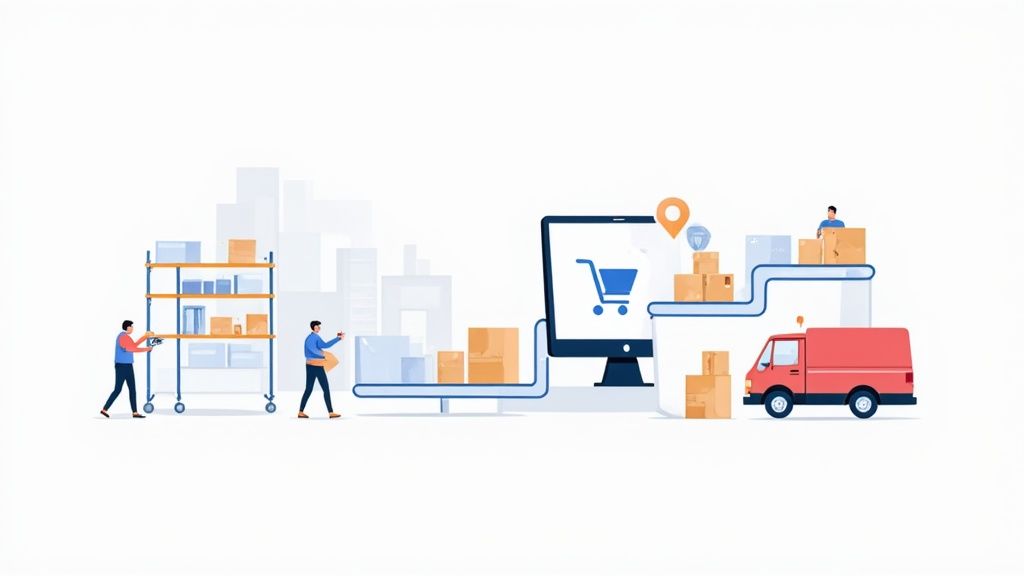
Ecommerce fulfillment is, quite simply, the entire process of getting an online order into your customer's hands. Think of it as the whole backstage operation that kicks off the second a customer clicks 'buy' and doesn't end until that package is safely delivered. It’s everything from storing your products and packing orders to shipping them out the door.
The Journey of an Online Order
Picture your online store as a restaurant. The website is your menu where customers place their orders. Your ecommerce fulfillment solution? That's the entire kitchen and delivery service rolled into one. It’s the well-oiled machine that grabs an order ticket, prepares the meal perfectly, boxes it up securely, and makes sure it arrives hot and fresh at the customer's door. A beautiful menu is useless without a great kitchen to back it up.
In the same way, your fulfillment process is your business's central nervous system. It's the critical link between your digital storefront and the physical world, turning all those clicks into actual products on doorsteps. This journey is made up of several key steps that absolutely have to work in harmony.
Breaking Down the Core Fulfillment Steps
Every successful delivery is built on a sequence of well-executed tasks. While the tiny details might change from one business to another, the basic workflow is the backbone of any ecommerce fulfillment operation.
- Receiving and Storing: This is where it all starts. Your inventory arrives from your supplier at a warehouse or fulfillment center. It gets inspected, counted, logged into an inventory system, and then put away in its designated spot, whether that's a bin, a pallet, or a shelf.
- Picking and Packing: A customer places an order, and a "picking list" is instantly generated. A warehouse team member then goes out, finds the right items on the shelves, and brings them to a packing station. Here, they're prepped for shipment using the right-sized boxes, mailers, and protective filler.
- Shipping and Delivery: The packed order gets a shipping label, and a carrier is chosen. Once the package is handed off, tracking info is fired off to the customer so they can follow its journey right to their home.
The goal of any fulfillment strategy is to make this entire process as fast, accurate, and cost-effective as possible. A single mistake, like a mis-picked item or a delayed shipment, can directly impact customer satisfaction and your brand's reputation.
Why Mastering Fulfillment Is Non-Negotiable
Getting fulfillment right is about so much more than just logistics; it’s a powerful way to build a brand that can scale and earn respect. When customers get their orders quickly and accurately, you build trust and encourage them to come back for more. For new brands, especially in unique spaces like crowdfunding, being able to nail the process of successfully fulfilling crowdfunding backer rewards is make-or-break for establishing credibility.
The demand for solid ecommerce fulfillment is absolutely exploding. The global market was valued at an estimated $123.7 billion in 2024 and is on track to more than double by 2030. This incredible growth just goes to show how central logistics have become. For a deeper dive into the tech that drives all this, you might find our guide on what an order management system is and how it functions helpful.
Ultimately, great fulfillment isn't just an operational box to tick. It’s a real strategic advantage that fuels growth, racks up positive reviews, and creates loyal customers for life.
Choosing Your Fulfillment Model
Picking a fulfillment model is one of those pivotal decisions that will shape the future of your ecommerce business. It’s about so much more than just who puts products in boxes. This choice directly impacts your operational costs, how much control you have over your customer experience, and your sheer ability to grow.
There’s no single “best” answer here. What works for a small-batch artisan crafting custom jewelry is worlds away from what a fast-growing apparel brand shipping thousands of orders a month needs. Let’s break down the three main options to see how they stack up in the real world.
In-House Fulfillment
In-house fulfillment, sometimes called self-fulfillment, is exactly what it sounds like: you handle everything yourself. You store inventory in your own space—be it a garage, a spare room, or a small rented warehouse. You pick and pack the orders, you print the labels, and you drop them off for shipping.
This is the natural starting point for most new businesses. Picture a boutique candle maker who pours, packs, and ships every single order from their home studio. This model gives them ultimate control. They can slip in a handwritten thank-you note, use beautifully branded packaging, and personally inspect every item for quality.
The big win here is low initial cost, since you aren't paying monthly management fees to a partner. The trade-off, however, is your time. As order volume creeps up, many founders find they're spending more hours tangled in packing tape than they are on marketing, product development, or actually growing the business.
Third-Party Logistics (3PL)
When you've outgrown the garage, outsourcing to a third-party logistics (3PL) provider is the logical next step. A 3PL is essentially a partner company that takes over all the physical parts of fulfillment for you—receiving your inventory, storing it professionally, and then picking, packing, and shipping orders as they come in.
Imagine a supplement brand that’s taking off, and their monthly orders suddenly jump from 500 to 5,000. Trying to pack that many orders in-house would bring the entire business to a screeching halt. Instead, they can partner with a 3PL and ship their inventory to a dedicated fulfillment center. When an order hits their Shopify store, it’s automatically routed to the 3PL, whose team handles the rest.
This model is built for scale. 3PLs give you access to a professional workforce, sophisticated warehouse tech, and—crucially—much better shipping rates.
A major advantage of using a 3PL is distributing inventory across multiple warehouses. This can slash shipping times from a week to just 1-2 days for many customers, which is a huge factor in winning sales and keeping people coming back.
While you do hand over some direct control, a good 3PL acts like an extension of your own team. The main costs you’ll see are fees for receiving inventory, monthly storage, and a per-order fee for the pick-and-pack service.
Dropshipping
Dropshipping is a completely different beast. In this model, you don't hold any inventory at all. When a customer places an order on your store, you turn around and purchase that item from a third-party supplier, who then ships it directly to your customer.
Think of an entrepreneur who wants to sell niche kitchen gadgets. Instead of shelling out thousands for inventory upfront, they can list products from a dropshipping supplier. Their job is marketing, managing the website, and handling customer service, but they never actually touch the physical product. This makes for an incredibly low barrier to entry.
The catch? Margins and control. Since you're buying products one at a time, your cost per item is higher, which means lower profit margins. You also have very little say over the customer experience—you can’t control the packaging, shipping speed, or even the product quality. If your supplier messes up, your brand takes the hit. It's a fantastic way to test product ideas, but it can be tough to build a sustainable, long-term brand around it.
Comparison of Ecommerce Fulfillment Models
To make the choice clearer, let's put these three models side-by-side. Each one shines in different scenarios, and seeing them compared on key factors like cost and scalability can help you pinpoint the right fit for your business right now.
FactorIn-House FulfillmentThird-Party Logistics (3PL)DropshippingInitial CostLow (cost of space & supplies)Medium to High (setup, receiving fees)Very Low (no inventory costs)Operational ControlComplete control over branding & qualityPartial control (partner-dependent)Very little control over shipping & packagingScalabilityLimited; becomes difficult with volumeHigh; designed for growthModerate; dependent on supplier capacityBest For...Startups, hobbyists, custom productsGrowing SMBs & enterprise brandsNew entrepreneurs, market testing
Ultimately, the model you choose will depend on your order volume, capital, and how much hands-on control you want over the final package that lands on your customer's doorstep.
This decision tree gives you a simple visual for that first big choice: keeping fulfillment in your own hands or outsourcing it to a partner.
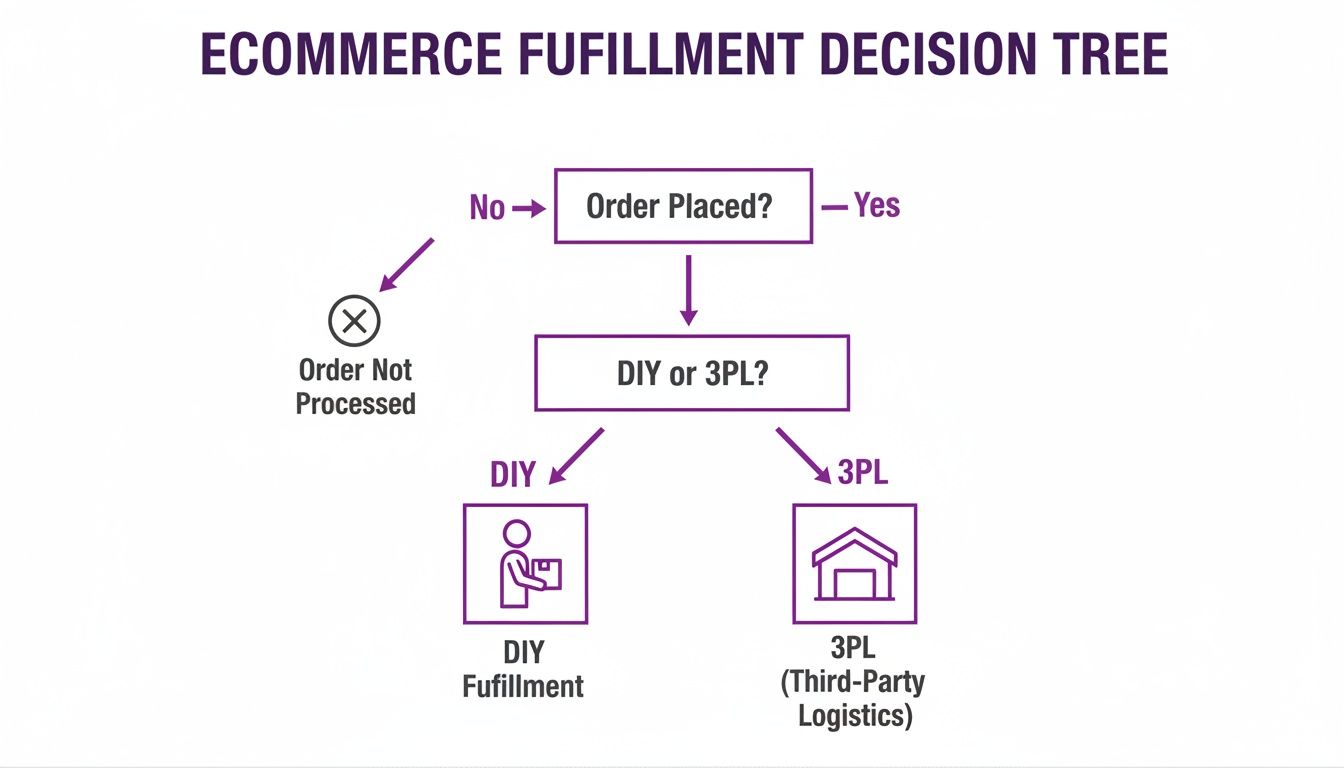
This really boils down the core dilemma for a growing brand. It highlights that critical fork in the road where you have to decide between maintaining direct control (DIY) or prioritizing scale and efficiency by bringing on a partner (3PL).
Finding the Right Fulfillment Partner
Choosing a fulfillment partner isn't like hiring a vendor; it's more like a business marriage. This is the company that will touch your products and interact with your customers every single day, making them a direct extension of your brand. Get it right, and they can pour fuel on your growth. Get it wrong, and you're staring down the barrel of operational nightmares and a damaged reputation.
This decision has to go way beyond a simple price sheet. A cheap rate card can quickly get swallowed up by hidden fees, poor accuracy, or painfully slow shipping. To find the right fit, you need a playbook for vetting providers on the things that actually matter: their tech, their network, how transparent their pricing is, and if they can actually grow with you.
Evaluating Technology and Integration Capabilities
In today's e-commerce world, a fulfillment partner's tech stack is just as critical as its physical warehouses. The seamless flow of information between your store and their system is the backbone of an efficient operation. Without it, you’re stuck with manual order entry, guesswork on inventory levels, and a whole lot of unhappy customers.
Their integration capabilities should be at the top of your list, especially if you're running on a platform like Shopify. A solid, reliable integration automates the entire process from the moment a customer clicks "buy."
Here are the key questions you need to be asking about their tech:
- Integration Quality: How does their system talk to your e-commerce platform? Is it a pre-built, one-click app, or does it need a bunch of custom development work? You're looking for a robust, real-time sync.
- System Visibility: What kind of access do you get to their software? Can you log in and see live inventory levels, track order statuses, and pull your own performance reports?
- Automation Rules: Can you set up rules to manage orders automatically? Things like using specific packaging for certain products or flagging orders for a manual review.
A partner with a strong technology platform gives you the visibility and control you need to manage your logistics like a pro, even from hundreds of miles away.
The Importance of the Warehouse Network
A fulfillment partner’s physical footprint is a huge lever for both shipping speed and cost. Where their warehouses are located directly impacts how quickly—and affordably—you can get packages into your customers' hands. A partner with one warehouse in California might offer low storage fees, but you'll be paying a fortune in shipping costs and transit times for every order headed to New York.
Distributing your inventory across a network of strategically located warehouses is one of the most effective ways to lower shipping costs and compete with the 2-day shipping expectations set by major retailers.
By placing your products closer to where your customers live, you can drastically cut down on expensive air freight and use cheaper ground shipping services instead. It’s a strategy that saves you money and gives your customers the fast delivery they’ve come to expect.
Analyzing Pricing Structures and Hidden Fees
Let's be honest: fulfillment pricing can be a minefield. To avoid nasty surprises on your first invoice, you need to understand every single potential charge and how it’s calculated. A transparent partner will happily walk you through a clear, detailed rate card that breaks down all their fees.
Make sure you get crystal-clear answers on these common costs:
- Receiving: This is a one-time fee for taking in and stowing your inventory. It's often charged per pallet, per carton, or by the hour.
- Storage: A recurring monthly fee for the space your products occupy, usually calculated by the pallet, shelf, or cubic foot.
- Pick and Pack: A fee charged for every order they process. Sometimes this includes an extra fee for each individual item in the order.
- Shipping: The actual postage cost paid to the carrier (like UPS or FedEx) to deliver the package to the customer's door.
- Account Management: Some providers roll in a monthly fee for general support and access to their software.
Ask any potential partner for a sample invoice or a detailed cost projection based on your average monthly order volume. This simple exercise helps you sniff out any hidden fees and make a true apples-to-apples comparison, ensuring the ecommerce fulfillment solutions you choose truly align with your budget.
Integrating Fulfillment with Your Shopify Store
A great fulfillment partner is only as good as its connection to your Shopify store. Think of this integration as the digital handshake between your sales channel and your warehouse. If that handshake is weak or slow, orders get dropped, inventory counts go haywire, and your entire operation can grind to a halt.
A solid connection automates the whole information pipeline, making your fulfillment process fast, accurate, and ready to scale. When an order comes in, the integration should instantly fire it off to the fulfillment center without anyone lifting a finger. It also needs to sync inventory in real-time, which is how you stop selling products you don't actually have. This automation is the secret to killing costly human errors and freeing you up to actually grow your business.
The Power of Direct Integration
The most straightforward way to link your Shopify store to various ecommerce fulfillment solutions is right through the Shopify App Store. Most of the big-name 3PLs offer their own apps that you can install with just a click or two. This path is all about simplicity and speed, getting you connected and running in minutes.
The Shopify App Store is packed with options for shipping and fulfillment, so you can usually find a pre-built solution that fits what you need.
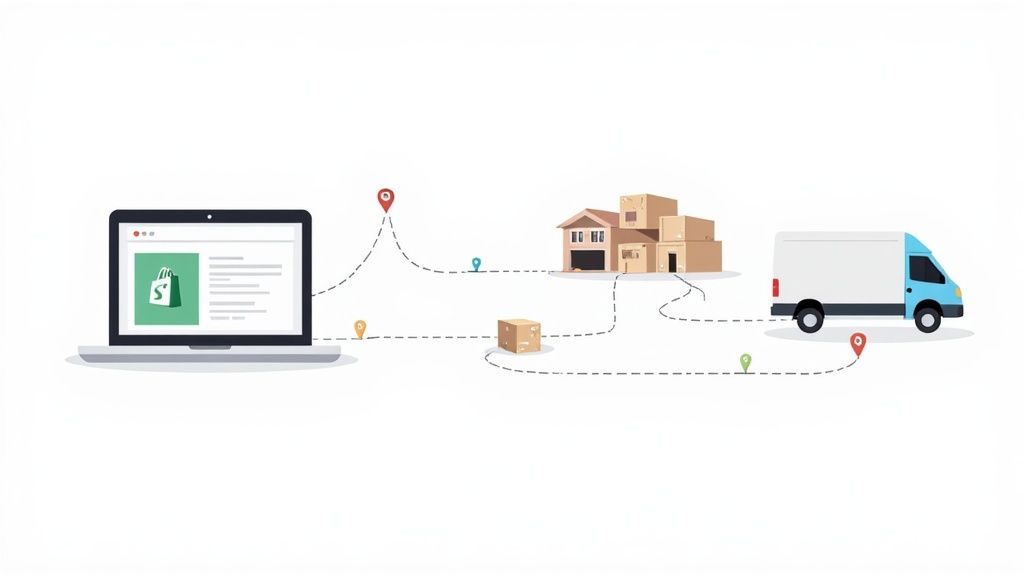
This just goes to show how many partners have invested in creating plug-and-play connections. It’s a clear signal of how critical a smooth integration is for any serious Shopify merchant.
An app-based integration handles all the essentials automatically:
- Order Syncing: As soon as an order is placed, it’s sent to your fulfillment partner. No delays.
- Inventory Updates: Stock levels in your Shopify admin adjust the second an item is sold or restocked at the warehouse.
- Shipping Confirmations: Tracking numbers are automatically sent back to Shopify, triggering the shipping notification email to your customer.
This hands-off system is the foundation for efficient operations, making sure data flows exactly where it needs to, when it needs to.
Understanding API Connections
What if your business has more complex needs? Or maybe you're using a custom-built system? This is where a custom integration using an Application Programming Interface (API) comes into play. An API is basically a bridge that lets two completely different software systems talk to each other by following a strict set of rules.
Think of it like having a universal translator. Your Shopify store speaks one language, and your partner's warehouse management system (WMS) speaks another. The API translates the messages—orders, inventory levels, shipping updates—so nothing gets lost in translation.
A well-built API integration gives you ultimate flexibility. You can customize workflows, sync unique product data, and build processes that are perfectly tailored to your business model.
While it’s way more powerful, this route requires technical know-how (and budget) to build and maintain. It's usually the go-to for larger brands or businesses with unique operational quirks that a standard app just can't handle.
Key Integration Functions to Look For
Whether you go with an app or a custom API, a successful integration must nail a few core tasks without fail. When you're vetting a fulfillment partner, make sure their system can handle these functions flawlessly. Nailing these technical details is just as vital as the physical packing and shipping of the box.
For a deeper dive into how this all fits together, check out our guide on setting up shipping on Shopify.
Your chosen solution absolutely must deliver on:
- Real-Time Order Routing: Orders should be sent to the right fulfillment center the moment they're placed, based on stock availability and the customer's location.
- Accurate Inventory Sync: Stock levels need to update across every sales channel in real-time. This is non-negotiable for preventing overselling.
- Automated Tracking Updates: The second an order ships, that tracking number must sync back to Shopify to trigger the customer notification. No manual updates needed.
Unlocking Growth with Advanced Fulfillment Strategies
Once you’ve got your basic fulfillment process humming along, it's time to start thinking bigger. Logistics shouldn't just be another expense on your balance sheet; it can be a powerful engine for growth and a serious competitive advantage. The world's top brands don't just put products in boxes—they use sophisticated ecommerce fulfillment solutions to build incredible customer experiences and open up entirely new markets.
These advanced strategies are all about flipping the script, turning your fulfillment operations from a reactive necessity into a proactive tool for scaling your business. When you move beyond a single warehouse and adopt a more dynamic approach, you can start delighting customers with faster delivery, untangle operational knots, and get your brand ready for the global stage.
Distributing Your Inventory for Speed and Savings
One of the most powerful moves you can make is implementing distributed inventory. Instead of shipping every order from one central location, you strategically place your products in multiple fulfillment centers across the country, or even the world. This one change creates a massive ripple effect, impacting everything from your costs to your customer satisfaction.
Think about it: a customer in New York orders from your brand, but your only warehouse is in California. That package is in for a long, expensive cross-country trip. But with distributed inventory, that same order could ship from a fulfillment center right in New Jersey. It arrives in just a day or two, and you've paid a fraction of the shipping cost.
By placing your inventory closer to your customers, you can drastically reduce shipping zones, cut postage costs, and consistently meet the 2-day delivery expectation that modern shoppers demand. It's a fundamental shift that improves your bottom line while boosting conversion rates.
This approach transforms shipping from a potential deal-breaker into one of your best selling points.
Multiple warehouses alone won't shorten transit times; placement will. ShipBob operates 50+ fulfillment centers with real-time inventory visibility, so the right SKUs sit in the right regions before demand spikes. Get placement right and shipping stops eating your margin.
Simplifying Multi-Channel and B2B Fulfillment
As your brand grows, so does its complexity. You might start out selling direct-to-consumer (DTC) on your website, but soon you're on marketplaces like Amazon and even supplying products to major retail partners (B2B). Trying to manage these different channels with separate inventory pools and processes is an operational nightmare waiting to happen.
This is where advanced fulfillment partners come in, offering omnichannel fulfillment all under one roof. They can handle your DTC website orders, marketplace shipments, and large B2B retail orders from a single, unified pool of inventory. This streamlines your operations in a huge way.
- No More Siloed Inventory: Your stock becomes fungible, meaning it can fulfill an order from any channel. This prevents frustrating stockouts on one platform while another has excess product just sitting there.
- Retail Compliance Handled: Your partner manages all the complex requirements for retail shipments, like specialized labeling and palletizing, ensuring you avoid those costly chargebacks.
- Unified Reporting: You finally get a single, clear view of all your sales and inventory data across every single channel you sell on.
Enabling Seamless International Expansion
Taking your brand global is a massive milestone, but international logistics can be incredibly intimidating. Dealing with customs, duties, taxes, and painfully long shipping times can stop expansion plans dead in their tracks. A capable fulfillment partner with a global network makes this process not just manageable, but efficient.
International expansion is a clear priority for growing brands. Recent data shows that 36% of brands plan to ship to new countries in 2025, while 25% are setting up physical fulfillment in new markets. The growth potential is huge, with 78% of brands now selling across two or more channels.
As a real-world example, one brand used a UK-based fulfillment center to slash its EU delivery times from 25 days down to just 3—that's an 88% reduction. You can learn more about how brands are using fulfillment to scale by checking out these insights on the ecommerce fulfillment market.
This kind of global reach turns a complex logistical headache into a straightforward operational task, letting you enter new markets with speed and confidence.
Common Questions About Ecommerce Fulfillment
Diving into the world of outsourced logistics naturally brings up a lot of practical questions. How much does this actually cost? What do I need to do to get ready? It’s easy to get bogged down in the details.
This quick-reference guide is designed to give you direct answers to the most common concerns we hear about ecommerce fulfillment solutions. Getting clear on these points from the start is the key to a smooth partnership and avoiding nasty surprises down the road.
What Is the Typical Cost Structure for a 3PL Service?
One of the first things to understand is that a 3PL’s invoice isn't a single line item. It’s not like a simple subscription; think of it more like a pay-for-what-you-use utility bill where each part of the fulfillment journey has its own cost.
You can almost always expect to see charges for these core activities:
- Receiving: This is a one-time fee for when your inventory first arrives at the warehouse and they check it in and stow it.
- Storage: A recurring monthly fee that covers the physical shelf space your products occupy.
- Pick-and-Pack: A per-order fee for the labor involved in pulling items off the shelves and boxing them up.
- Shipping: The direct cost paid to the carrier (like UPS or FedEx) to get the package to your customer's door.
On top of that, many providers have a one-time setup fee or a small monthly account management cost. Always, always ask for a detailed rate card upfront so you can see every single potential charge before you sign anything.
How Do I Prepare My Business for a Fulfillment Partner?
A smooth handover is all about preparation. When you hand over your inventory, you're also handing over your data and processes. You need to give them a perfect blueprint to work from.
First, get your product data in pristine order. This means every single SKU, product dimension, and weight needs to be 100% accurate in your system. Any errors here will cascade into shipping and storage problems. Next, pull together an initial inventory forecast to help them allocate the right amount of warehouse space. Finally, document every detail about your packing and branding requirements so nothing is left to guesswork.
Can Fulfillment Solutions Handle Customer Returns?
Absolutely. In fact, this is a huge part of what they do. The official term for it is reverse logistics, and any modern fulfillment partner worth their salt is equipped to manage products coming back just as efficiently as they send them out. If you want to really get this part right, it's worth exploring strategies for optimizing multichannel fulfillment with integrations to make the whole process seamless.
A well-managed returns process is one of the biggest drivers of customer loyalty. When a return is easy and painless, it reinforces a customer's trust in your brand, making them far more likely to come back and buy again.
Here's how it works: your partner receives the returned item, inspects it according to your rules, and then takes action. They can restock products that are in perfect condition, set aside damaged goods, or even trigger automated refunds and exchanges directly through your store’s integration. It turns a potential negative experience into a positive one.
Navigating the complexities of Shopify and ecommerce fulfillment can be challenging, but you don't have to do it alone. The team at ECORN specializes in providing scalable solutions to help your brand grow. Learn how our Shopify expertise can optimize your operations today!


Shopify Plus Ecommerce Agency: How to Pick the Right One
Shopify Themes Retina: How to Serve 2x Images

How to Cross Sell on Shopify Without Friction
Best Shopify Theme for Custom Products Compared
Multi Store Inventory Management: A Practical Guide

SEO Consulting for Ecommerce: A Practical Guide
Shopify Theme Updater App: A Safe Update Playbook
Shopify Git Integration: A Developer's Guide to 2026
Headless Ecommerce Development Services Explained

How to Build a Shopify Clothing Website That Converts
How to Launch a Box Subscription Business in 2026

Luxury Skincare Branding Playbook That Converters
10 Best Podcast Ecommerce Shows for Store Growth in 2026
Shopify Developer Hourly Rate: What to Pay in 2026
Critical Shopify Setup Errors That Are Secretly Sabotaging Your Store
Ecommerce Conversion Tracking: The Complete How-To Guide
Shopify Design Agency: How to Pick the Right Partner
Mastering Multi Store Management on Shopify
Scale Shopify Store
10 Shopify App Ideas Worth Building in 2026
Conversion Rate Optimization for Landing Pages: The Playbook
Shopify Plus Automation: A Guide for 2026
10 Social Selling Platforms for Shopify Merchants
Shopify Website Design Examples: 7 Stores Worth Studying
7 Ecommerce Newsletter Examples for Shopify Brands
One Product Shopify Store: Build and Scale
Mobile Pop Up Strategy for Shopify Stores That Converts
Sitemap for Shopify: How to Find, Optimize, and Submit It
7 Single Product Websites Worth Emulating
Product Variants Shopify: The Complete 2026 Guide
Ecommerce Analytics Consulting for Growth
What Is AI Integration for eCommerce
How to Choose the Right eCommerce Website Development Firm
E Business Strategy Implementation
Conversion Tracking Setup for Shopify Stores
BigCommerce vs Shopify Plus Which Enterprise Wins in 2026
Shopify Theme Kit: Setup, Commands, and Migration Guide
Shopify Extension Development: A Practical 2026 Guide
Shopify Speed Score Explained and How to Improve It
Shopify Mobile Optimization: The 2026 Playbook
How to Add Subcategory in Shopify for Better UX
How to Implement Structured Data for Ecommerce in 2026
SEO App Mobile: Shopify Store Optimization Guide
Shopify Plus Support: What It Includes and How to Choose
Google Ads for Shopify: The Complete 2026 Playbook

Shopify New York: How to Find and Hire the Right Agency
Google Search Console for Shopify: The Complete Setup
First Party Data Collection for eCommerce Growth
FAQ Online Store Guide: Build and Measure It Right
Do FB Ads Work for eCommerce in 2026?
One Page Checkout for Shopify: Design and Implementation
Shopify GraphQL vs REST: The 2026 Developer Decision
Shopify Ecommerce Consulting: Strategy, Pricing &
Are Reddit Ads Worth It for eCommerce Brands
Shopify Title and Meta Description: A Practical 2026 Guide

Product Video Best Practices for Shopify Brands
Real-Time Inventory Management: A 2026 Guide
AI Chatbot Integration for Shopify Stores
Affiliate Program Management: A Shopify Guide
10 Best Performance Monitoring Tools for Shopify in 2026
Digital Asset Management for eCommerce Brands in 2026
Every Type of Facebook Ads Explained for eCommerce Growth
Product Information Management Explained for Shopify Brands
Support Ticket System: A Guide for Shopify Stores

10 Best Customer Service Tools for Shopify in 2026

Can I Start a Business with No Money? a 2026 Blueprint
What Sells Good on Etsy: Best Niches for 2026

Shopify Add to Cart Button: A Practical 2026 Guide

Customer Feedback Automation: A Practical eCommerce Guide
Critical Rendering Path: A Guide for Shopify Stores

How to Promote on TikTok for eCommerce in 2026

B2B eCommerce Consulting That Drives Real Revenue
10 Best Practices for Site Navigation in 2026
Return vs Refund for Shopify Stores: A Practical Guide
What Is Customer Lifetime Value and Why It Matters
What Is Voice of Customer Research for eCommerce

SMS Marketing for Ecommerce That Actually Converts

Master How to Improve Email Deliverability in 2026
Top 8 eCommerce Partners NYC for Shopify Brands in 2026
Machine Learning for Ecommerce: Boost Your Shopify Store

Beauty Market Research: Your 2026 Growth Guide
Shopify International Expansion: A 2026 Roadmap
What Does CRO Stand for in Business: Understanding CRO

Shopify Visual Merchandising: A Playbook for Higher Sales
Shopify Landing Page Design: Master Conversion in 2026
10 Best AI SEO Optimization Tools for Shopify in 2026

Agentic AI for Ecommerce: Boost Your Sales in 2026
Mastering Email Marketing Data for eCommerce Growth
Conversion Rate Optimisation Australia: Boost Your Sales
Conversion Rate Optimization AI: Your Shopify Store Guide

10 Product Bundling Strategies for Shopify in 2026
How to Increase Customer Lifetime Value: A Shopify Playbook
AI Customer Service Automation: Shopify Guide 2026
Clean Website Design: A Shopify Conversion Playbook

Omnichannel Retail Strategy: A Shopify Playbook
Product Data Enrichment: A Guide for Shopify Brands
Instagram Shopping Features a Guide for Shopify Stores
What Is Revenue Optimization: A Holistic RevOps Guide
Benefits of Conversion Rate Optimization: Boost Your
WordPress to Shopify Migration: Your 2026 Seamless Switch


newsletter in your inbox