

At its core, the difference between Shopify and Shopify Plus comes down to one thing: scale. Standard Shopify is a fantastic engine for startups and growing businesses, while Shopify Plus is the enterprise-level solution built for high-volume merchants who need serious customization, automation, and performance without hitting a ceiling.
The choice isn't about which one is "better," but which platform truly fits your brand's current reality and future ambitions.
Shopify vs Shopify Plus A High-Level Overview
Deciding between standard Shopify and Shopify Plus is a defining moment for any e-commerce brand. It’s the leap from running a successful online store to engineering an enterprise-grade commerce machine. Standard Shopify, particularly the Advanced plan, gives the vast majority of businesses everything they need to manage products, market effectively, and sell online.
But as brands grow, they inevitably run into ceilings that Shopify Plus was specifically designed to smash through. These growing pains usually pop up in a few key areas, which we'll dive into throughout this guide:
- Checkout Customization: The need for a fully branded, frictionless checkout experience that converts.
- Automation Capabilities: The demand to automate repetitive back-office tasks and complex marketing workflows.
- API Access: The requirement for deeper, more robust integrations with crucial business systems like ERPs and CRMs.
- Global Operations: The complexity of managing multiple stores for different countries, languages, or currencies.
Of course, a powerful platform is only half the battle. To get the most out of your investment, you also need to focus on constantly improving e-commerce conversion rates. A high-performance platform combined with an optimized customer journey is the recipe for success.
At a Glance Key Differences Between Shopify and Shopify Plus
For a quick summary, this table boils down the fundamental differences between a top-tier standard plan and the Shopify Plus enterprise solution. It looks beyond simple feature lists to highlight the strategic advantages that really define the Plus experience.
This table gives you a clear sense of where the lines are drawn. Standard Shopify equips you to build a great business; Shopify Plus gives you the infrastructure to run an empire.
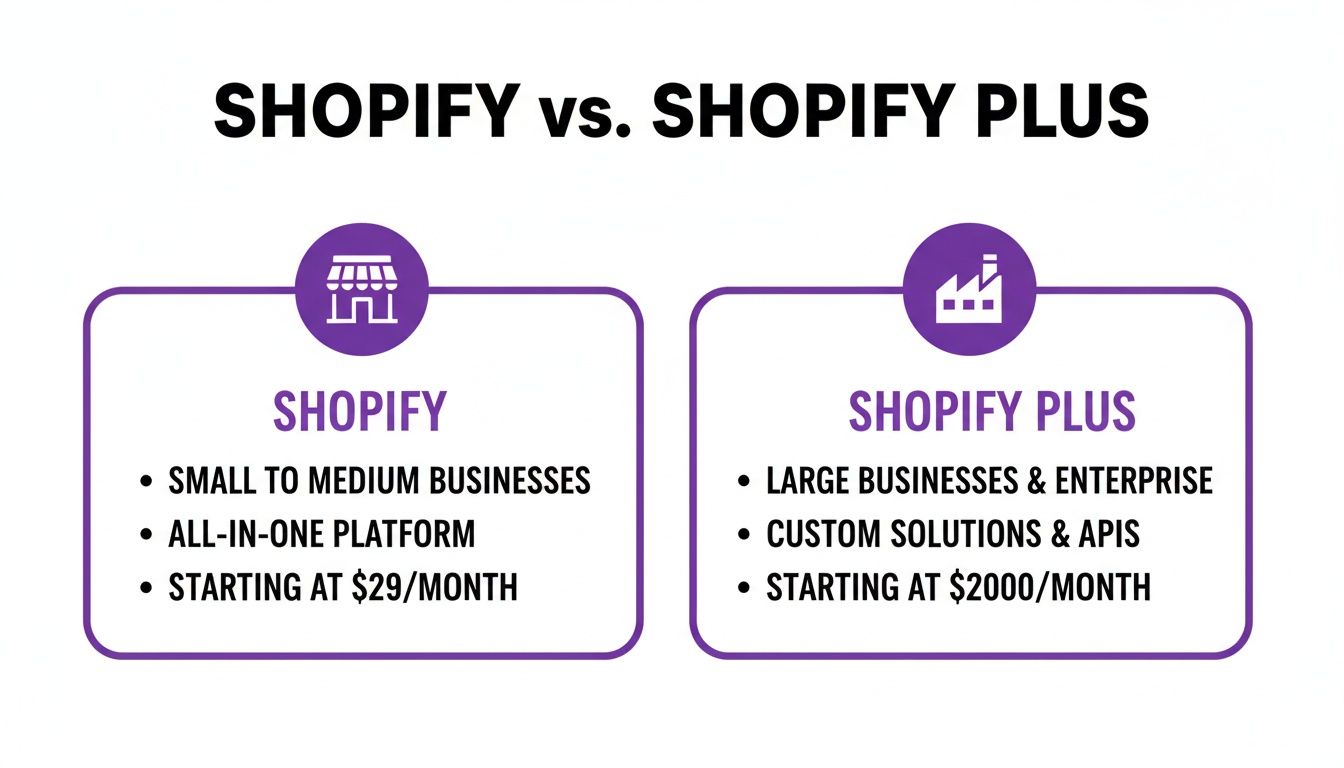
As you can see, Shopify Plus isn't just a simple upgrade—it's an entirely different class of platform, engineered from the ground up to handle enterprise-level complexity and scale.
Comparing Scalability, Performance, and Core Features
While the standard Shopify plans are incredibly capable, they're built with certain operational ceilings. As your business scales, what once felt like a high ceiling can start to feel like a pretty tight crawlspace. The real heart of the Shopify vs. Shopify Plus debate boils down to performance and the raw technical capacity needed to support a high-volume operation without hitting a wall.
For a fast-growing brand, even seemingly small limitations can cause major friction. Take the Advanced Shopify plan, for example. It caps you at 15 staff accounts. That might sound like plenty for a mid-sized team, but for a larger organization with dedicated roles for marketing, merchandising, customer service, and development, it gets restrictive, fast.
Shopify Plus blows that limitation away with unlimited staff accounts. This isn't just about cramming more people in; it's about enabling granular control. With Plus, you can create specific roles and permissions, ensuring a content manager only has access to the blog, while your finance lead only sees financial reports. Standard plans just don't offer that level of role-based security.
Unlocking Enterprise-Grade Performance
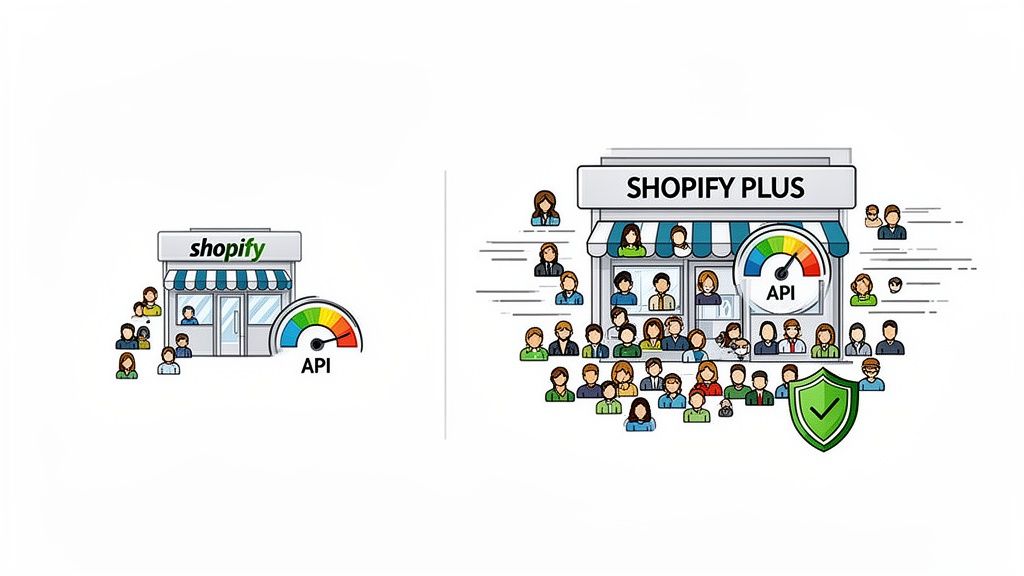
Performance is where Shopify Plus really flexes its muscles. All Shopify plans benefit from a solid infrastructure, but Plus is engineered for the extreme demands of enterprise commerce—especially during make-or-break moments like flash sales or a massive product launch.
And this isn't just marketing fluff; it's backed by serious guarantees. Shopify Plus delivers 99.98-99.99% uptime, making sure your store is standing strong during a critical Black Friday surge. It’s built to handle over 10,000 checkouts per minute with unlimited bandwidth, a capability that prevents the costly crashes and slowdowns that can cripple a standard platform during a viral sales event. These performance boosts are a big reason top Plus stores hit conversion rates of 4-5%, well above the industry average. For a deeper look, check out these powerful statistics behind Shopify's performance.
Key Takeaway: The value of Shopify Plus isn't just in its features, but in its ability to deliver consistent, high-speed performance when the stakes are highest. This reliability protects revenue and brand reputation during peak sales periods.
The Power of Exclusive Plus Features
Beyond raw horsepower, Shopify Plus hands you a toolkit of exclusive features designed to solve complex, enterprise-level challenges. These tools give you a degree of customization and control that's simply off-limits on standard plans.
- Checkout Customization: Standard Shopify has a secure, reliable checkout, but it's largely a locked box. Shopify Plus unlocks the
checkout.liquidfile and introduces Checkout Blocks, giving you full control. This means you can add custom fields, one-click upsells, loyalty program info, or unique branding directly into the payment experience, which can have a massive impact on conversions. - Shopify Functions: This is a game-changer for developers. It lets you write custom backend logic for things like unique discount combinations ("buy one, get one, and get a free gift if you're a VIP member"), complex shipping rules, or tiered pricing structures that run directly on Shopify’s servers for maximum speed and security.
- B2B on Shopify: If you have a wholesale arm, Plus includes a dedicated B2B suite. This lets you manage your wholesale and direct-to-consumer businesses from a single dashboard, with features like custom price lists, net payment terms, and a password-protected storefront for your wholesale buyers.
API Limits and Integration Potential
One of the most critical, yet often overlooked, technical differentiators is API access. The Application Programming Interface (API) is the digital glue that connects your Shopify store to other essential business systems, like your ERP, CRM, or 3PL partner.
Standard Shopify plans have API rate limits that are perfectly fine for basic app integrations. But a fast-growing business running complex, real-time data syncs will slam into those limits in no time, causing delays and operational headaches.
Shopify Plus gives you a 500% higher API call limit. This massive increase is absolutely essential for enterprise merchants who depend on seamless, high-frequency data exchange between Shopify and their core business infrastructure. It unlocks a level of operational automation and system integration that's just not possible on a standard plan, turning your store from a standalone sales channel into the central hub of your entire commerce ecosystem.
Analyzing Pricing and Total Cost of Ownership
When you start comparing Shopify and Shopify Plus, the conversation always lands on price. It's a natural starting point. But framing it as just a simple cost comparison misses the whole story.
While standard Shopify plans have those straightforward monthly fees we all know, Shopify Plus shifts the entire financial equation. You're not just paying a subscription anymore; you're making a strategic investment in your core commerce infrastructure, and that requires a different way of thinking.
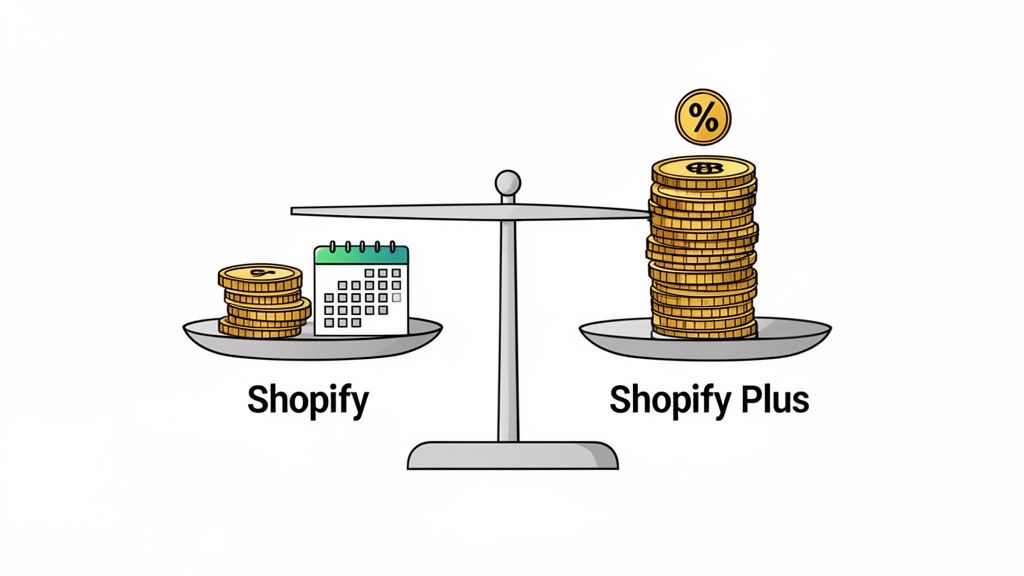
The initial sticker shock is real. The Advanced Shopify plan runs $399 per month, while Shopify Plus starts at $2,300 per month (usually with a three-year term). But if your analysis stops there, you're missing the bigger picture—the Total Cost of Ownership (TCO), where transaction fees and bundled value completely change the math.
The Transaction Fee Break-Even Point
This is the single most important calculation to make when you're thinking about upgrading. Every standard Shopify plan charges a percentage on sales made through third-party payment gateways. On the Advanced plan, that fee is 0.5%. It might sound small, but it adds up fast.
Shopify Plus slashes this fee. If you're using a third-party gateway, it drops to just 0.2%. That 0.3% difference becomes a massive number as your revenue scales into the seven figures.
Key Insight: The main financial trigger for upgrading to Shopify Plus is when your savings on transaction fees alone are enough to cover the higher subscription cost. For most brands, this tipping point happens when you're processing well over $1 million annually.
Let's run a quick scenario for a store using a third-party gateway:
- Business A (Advanced Shopify): On $100,000 in monthly sales, they pay $500 in Shopify transaction fees (
$100,000 * 0.5%). - Business B (Shopify Plus): On $100,000 in monthly sales, they pay only $200 in Shopify transaction fees (
$100,000 * 0.2%).
While Business B saves $300 on fees, it's not quite enough to justify the higher monthly cost... yet. But as that monthly revenue climbs to $200k, $300k, and beyond, the math flips completely. Once you get this calculation, you can dig deeper into the nuances of Shopify Plus pricing and its value.
Uncovering the Hidden Value in TCO
The financial case for Plus goes way beyond just transaction fees. The platform bundles in several powerful enterprise tools that would otherwise require expensive app subscriptions, which drives your TCO down even further.
- Shopify Flow: This is a serious automation engine for building complex workflows. A comparable tool like Zapier or Make at enterprise scale could easily cost you hundreds of dollars every month.
- Launchpad: A fantastic tool for scheduling and automating flash sales, product drops, and theme changes. Without it, you’re often looking at custom development or a patchwork of specialized apps.
- Nine Expansion Stores: This is a huge one. Your Plus license includes nine extra storefronts, which is a game-changer for international expansion or running separate B2B and B2C sites. Spinning up nine separate Advanced Shopify stores would cost you nearly $3,600 a month in subscriptions alone.
This bundled value is at the very core of the Shopify Plus proposition. It’s a platform built for explosive growth. In fact, merchants on Plus grow at an average clip of 126% year-over-year, powered by a 36% better TCO than competing enterprise platforms.
Once you factor in the savings from bundled apps, the cost of running multiple storefronts, and that dramatic cut in transaction fees, the TCO for high-volume brands often ends up being lower on Shopify Plus. The decision stops being about cost and becomes a clear, value-driven investment in your brand's future scalability and operational muscle.
Unlocking Advanced Customization and Automation
While the standard Shopify plans offer a seriously solid foundation, Shopify Plus is where you get the architectural freedom to build a truly unique, high-converting customer journey. This is the point where the platform stops being just a store builder and becomes a full-fledged commerce engine. The difference isn't just about unlocking more features; it's about getting granular control over the most critical parts of your business.
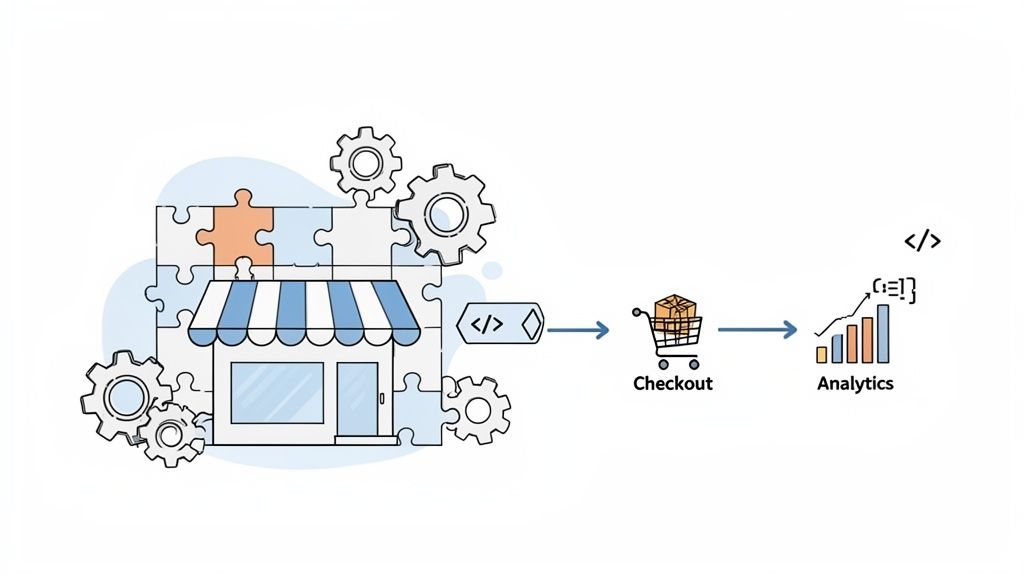
The single biggest area of control comes at the checkout. With standard Shopify, the checkout is secure and efficient, but it's largely a locked-down experience. Shopify Plus, on the other hand, gives you access to Checkout Blocks, letting you inject custom content, strategic upsells, loyalty information, or branded elements directly into the payment flow. This turns a generic transaction into a powerful conversion and branding moment.
Driving Efficiency with Exclusive Automation Tools
Beyond the checkout, Shopify Plus introduces a suite of powerful automation tools built to eliminate manual work and streamline complex operations. These aren't just simple "if-this-then-that" recipes; they are robust systems designed to automate core business processes.
The real star of the show here is Shopify Flow. This is an exclusive visual workflow builder that lets you automate tasks across your store and any integrated apps. For instance, you could quickly build a flow that automatically:
- Tags high-value customers who spend over a certain amount.
- Pings your fraud team on Slack for any high-risk orders.
- Hides low-stock products from your storefront to prevent overselling.
This level of native automation saves countless hours and cuts down on the risk of human error. Another key tool is Launchpad, which acts as a command center for major events like flash sales or product drops. You can schedule a whole series of actions—publishing new products, changing theme elements, and adjusting pricing—to all trigger at once. No more needing a team on standby at midnight for a big launch.
Key Difference: Standard Shopify leans on third-party apps for automation, which can get expensive and feel disjointed. Shopify Plus builds this muscle directly into the platform with tools like Flow and Launchpad, creating a much more cohesive and powerful system.
Embracing Headless Commerce and API Freedom
For enterprise-level brands pushing the boundaries of what a digital experience can be, Shopify Plus opens the door to headless commerce. This approach decouples the frontend presentation layer (the "head," or what your customer actually sees) from the backend commerce engine.
So, what does that mean in practice? It means you can use Shopify's rock-solid backend to manage all your products, inventory, and orders while building a completely custom storefront using modern frameworks like React or Vue.js. This gives you unparalleled creative freedom to design truly immersive shopping experiences.
This is all made possible by the significantly expanded API access that comes with Plus. With 500% higher API call limits compared to standard plans, brands can build complex, real-time integrations with their ERPs, CRMs, and other business-critical systems. This robust API infrastructure is also essential for extending commerce into new channels, such as:
- Mobile Apps: Powering a native shopping experience on both iOS and Android.
- IoT Devices: Enabling purchases through things like smart mirrors or voice assistants.
- Content Platforms: Integrating "buy" buttons directly into digital magazines or interactive lookbooks.
Pulling off this level of advanced customization, especially with Shopify Plus, often requires the expertise of dedicated Shopify development companies. Their experience ensures that the powerful tools available on Plus are actually used effectively to drive growth and create a brand experience that sets a merchant apart. This strategic freedom is a core differentiator in the Shopify vs. Shopify Plus comparison.
Managing Global Expansion and Multiple Storefronts
For brands with their sights set on more than a single market, the whole Shopify vs. Shopify Plus debate shifts gears. It becomes less about features and more about your entire operational architecture. Standard Shopify plans are fantastic for a single, primary storefront, but they start to feel clunky and expensive when you need to run separate sites for different regions, languages, or business models.
This is where Shopify Plus changes the game entirely. It introduces a fundamentally more powerful way to think about growth. The platform is built from the ground up for multi-store enterprises, and a core piece of that is the inclusion of up to nine free expansion stores under one Shopify Plus license.
This isn't just about saving a few bucks on subscriptions; it's a massive strategic advantage that simplifies global commerce. Instead of juggling separate accounts, billing cycles, and scattered data, a parent company can manage a whole ecosystem of storefronts from a single, unified dashboard. It’s the only way to manage distinct operations with any real precision.
Architecting a Global Commerce Ecosystem
Let's say a fashion brand is blowing up in Europe. On a standard Shopify plan, launching a localized store for Germany means firing up a totally new, separate account with its own subscription fee. Want to add a French store? That's another one. It quickly spirals into an administrative mess.
With Shopify Plus, this kind of expansion is already baked in. The brand can spin up new expansion stores to create perfectly tailored experiences for each market:
- Regional Storefronts: You could have a North American store with USD pricing and a UK store priced in GBP, each running its own culturally relevant marketing campaigns.
- Language-Specific Stores: Offer fully translated content and localized customer support, making shoppers feel right at home.
- B2B and D2C Operations: Run your public-facing, direct-to-consumer store right alongside a password-protected wholesale portal complete with custom pricing and net terms.
Key Advantage: The multi-store model lets you centralize backend operations (like your core product catalog) while decentralizing the frontend execution (like regional merchandising and marketing). This creates a system that is both incredibly efficient and flexible enough to meet local market demands. For a deeper look, check out our guide on managing multiple storefronts with Shopify.
From Multi-Store to Global Commerce Operations
Shopify Plus is the engine behind a powerful ecosystem designed for high-growth brands. Globally, there are approximately 67,507 live stores running on the platform. The United States alone is home to 41,137 of these stores, followed by 5,534 in the UK, which shows just how dominant it is in major markets. The Apparel category leads the pack, making up 26.7% of all Plus stores, proving its mettle in industries that demand both scale and style. This spread shows how Plus merchants, who often manage huge product catalogs, handle a level of complexity that standard Shopify simply wasn't designed for. You can see more data on the global distribution of Shopify Plus stores on storeleads.app.
This multi-store strategy gets another major boost from tools like Shopify Markets Pro. While your expansion stores handle the localization of content and currency, Markets Pro takes on the messy logistics of selling across borders. It simplifies calculating duties and import taxes, locks in foreign exchange rates, and helps you stay compliant with international regulations.
When you combine the multi-store architecture of Plus with the logistical firepower of Markets Pro, you get a seamless global commerce operation. It's an integrated system that lets brands march into new international markets with speed, confidence, and a much lower operational headache than trying to duct-tape a solution together on a standard Shopify plan. This is the key differentiator that makes Shopify Plus the obvious choice for any ambitious global brand.
When to Upgrade: An Actionable Decision Checklist
Making the jump from a standard Shopify plan to Shopify Plus is a big strategic move. It’s more than just paying for extra features; it’s a commitment to a new level of scale and operational muscle. To make this call with confidence, you have to get real about the friction points you're hitting in your business right now.
This checklist is designed to pinpoint the exact business triggers that scream, "we've outgrown our current plan." If you find yourself nodding along to a few of these points, the Shopify vs. Shopify Plus debate is no longer a "what if" for your brand—it’s time for a serious conversation.
You're Hitting Technical Ceilings
One of the clearest signs you need to upgrade is when your growth is literally bumping up against the platform’s limits. These aren't just small headaches; they're hard stops that can stall your operations and frustrate your team.
Keep an eye out for these technical red flags:
- API Rate Limits: Are your integrations with your ERP, CRM, or 3PL constantly failing or getting delayed? If your systems can't sync data in real-time because you’re maxing out your API calls, you’re flying blind. Shopify Plus gives you a 500% increase in API capacity, which solves this problem overnight.
- Staff Account Caps: Have you already hit your 15 staff accounts on the Advanced plan? When you can't give new hires or agency partners the access they need, both security and efficiency start to break down. Plus offers unlimited accounts with fine-tuned permissions.
- Performance Under Pressure: Did your site slow to a crawl or crash during your last big sale? Plus is built to handle over 10,000 checkouts per minute, giving you the rock-solid stability that high-volume brands depend on.
Your Revenue Justifies the Cost Savings
The financial case for Shopify Plus becomes a no-brainer once you hit a certain revenue milestone. The platform’s lower transaction fees are specifically designed to make it more economical for high-volume stores, eventually turning the upgrade into a cost-saving move.
The tipping point often hits when a brand is processing over $1 million in annual revenue. At that scale, the savings from the reduced transaction fee (down from 0.5% on Advanced to just 0.2% on Plus for third-party gateways) can easily be enough to cover the higher monthly cost.
Run the numbers for your own business. Figure out what you're currently paying in Shopify transaction fees each year and stack it up against what you’d pay on Plus. If the savings are substantial, the financial argument for upgrading is already made. This is a critical data point in any Shopify vs. Shopify Plus analysis.
Your Ambitions Require Advanced Tools
Finally, the decision to upgrade often comes down to pure ambition. You might not be hitting hard limits today, but you know your roadmap demands tools and capabilities that only Shopify Plus can deliver.
Ask yourself if your future plans involve any of these:
- Deep Checkout Customization: Do you need to add custom fields, loyalty program logic, or unique upsells right on the checkout page to squeeze every last drop out of your conversion rate? Only Plus unlocks that level of control.
- Serious B2B/Wholesale Operations: Are you looking to launch or scale a wholesale channel? The dedicated B2B on Shopify suite that comes with Plus gives you the tools you need for custom pricing, net terms, and a separate storefront experience.
- Complex Automation: Is your team getting buried in manual tasks like order tagging, fraud analysis, or inventory management? Shopify Flow, a Plus-exclusive tool, can automate these workflows and free up hundreds of hours.
- Multi-Store International Expansion: Planning to launch localized storefronts for different countries or regions? The nine included expansion stores in a Plus license make this a much simpler and more cost-effective process.
If your strategic roadmap is full of these kinds of initiatives, waiting to upgrade just means delaying your own growth. Making the move to Plus becomes a proactive investment in your future. Partnering with a specialized agency like ECORN can ensure a smooth migration, helping you get the most out of these advanced capabilities from day one and turn your platform into a real competitive advantage.
Common Questions Answered
When you're weighing Shopify against Shopify Plus, a few key questions almost always come up. Let's get straight to the practical answers that merchants like you need when figuring out the next step for your brand.
Can I Get Granular Staff Permissions Without Shopify Plus?
Not really. Standard Shopify plans, even the Advanced one, give you pretty broad permission sets. For example, if you want someone to manage your blog posts, you also have to give them permission to edit all of your website pages. For many teams, that’s just too much access for one role.
True granular control—like letting a staff member only touch the blog—is a feature you only get with Shopify Plus. This is a huge deal for larger teams. It lets you create super-specific roles, which tightens up security and makes your operations much smoother by making sure people only have access to what they absolutely need. Without Plus, you're stuck with clunky workarounds or paying for third-party apps to try and patch the gap.
Is Shopify Plus Necessary for Wholesale or B2B?
You can run a B2B operation on a standard Shopify plan with apps, but it often feels like you're holding things together with tape. The apps can get expensive, and they don’t always play nice with your direct-to-consumer store, which can lead to some serious headaches with inventory and data syncing.
Shopify Plus changes the game here with its dedicated B2B on Shopify suite. This is native functionality, not a bolt-on. It lets you manage both your wholesale and retail customers from a single backend. You get essential B2B features right out of the box, like custom price lists, net payment terms, and a password-protected storefront just for your wholesale clients. If you're serious about scaling your wholesale channel, Plus offers a much cleaner and more powerful solution.
The Big Picture: The move to Plus isn't usually about just one feature. It's about needing a powerful, unified ecosystem that can handle everything you throw at it. Shopify Plus brings B2B, international sales, and high-volume retail under one roof, so you're not juggling a complex web of apps to make it all work.
Ready to scale your e-commerce operations with a platform built for growth? The team at ECORN specializes in seamless migrations and Shopify Plus development, ensuring you leverage every advanced feature to maximize your ROI. Start your Shopify Plus journey with us today.


Multi Store Inventory Management: A Practical Guide

SEO Consulting for Ecommerce: A Practical Guide
Shopify Theme Updater App: A Safe Update Playbook
Shopify Git Integration: A Developer's Guide to 2026
Headless Ecommerce Development Services Explained

How to Build a Shopify Clothing Website That Converts
How to Launch a Box Subscription Business in 2026

Luxury Skincare Branding Playbook That Converters
10 Best Podcast Ecommerce Shows for Store Growth in 2026
Shopify Developer Hourly Rate: What to Pay in 2026
Critical Shopify Setup Errors That Are Secretly Sabotaging Your Store
Ecommerce Conversion Tracking: The Complete How-To Guide
Shopify Design Agency: How to Pick the Right Partner
Mastering Multi Store Management on Shopify
Scale Shopify Store
10 Shopify App Ideas Worth Building in 2026
Conversion Rate Optimization for Landing Pages: The Playbook
Shopify Plus Automation: A Guide for 2026
10 Social Selling Platforms for Shopify Merchants
Shopify Website Design Examples: 7 Stores Worth Studying
7 Ecommerce Newsletter Examples for Shopify Brands
One Product Shopify Store: Build and Scale
Mobile Pop Up Strategy for Shopify Stores That Converts
Sitemap for Shopify: How to Find, Optimize, and Submit It
7 Single Product Websites Worth Emulating
Product Variants Shopify: The Complete 2026 Guide
Ecommerce Analytics Consulting for Growth
What Is AI Integration for eCommerce
How to Choose the Right eCommerce Website Development Firm
E Business Strategy Implementation
Conversion Tracking Setup for Shopify Stores
BigCommerce vs Shopify Plus Which Enterprise Wins in 2026
Shopify Theme Kit: Setup, Commands, and Migration Guide
Shopify Extension Development: A Practical 2026 Guide
Shopify Speed Score Explained and How to Improve It
Shopify Mobile Optimization: The 2026 Playbook
How to Add Subcategory in Shopify for Better UX
How to Implement Structured Data for Ecommerce in 2026
SEO App Mobile: Shopify Store Optimization Guide
Shopify Plus Support: What It Includes and How to Choose
Google Ads for Shopify: The Complete 2026 Playbook

Shopify New York: How to Find and Hire the Right Agency
Google Search Console for Shopify: The Complete Setup
First Party Data Collection for eCommerce Growth
FAQ Online Store Guide: Build and Measure It Right
Do FB Ads Work for eCommerce in 2026?
One Page Checkout for Shopify: Design and Implementation
Shopify GraphQL vs REST: The 2026 Developer Decision
Shopify Ecommerce Consulting: Strategy, Pricing &
Are Reddit Ads Worth It for eCommerce Brands

Shopify Title and Meta Description: A Practical 2026 Guide

Product Video Best Practices for Shopify Brands
Real-Time Inventory Management: A 2026 Guide
AI Chatbot Integration for Shopify Stores
Affiliate Program Management: A Shopify Guide
10 Best Performance Monitoring Tools for Shopify in 2026
Digital Asset Management for eCommerce Brands in 2026
Every Type of Facebook Ads Explained for eCommerce Growth
Product Information Management Explained for Shopify Brands
Support Ticket System: A Guide for Shopify Stores

10 Best Customer Service Tools for Shopify in 2026

Can I Start a Business with No Money? a 2026 Blueprint

What Sells Good on Etsy: Best Niches for 2026

Shopify Add to Cart Button: A Practical 2026 Guide

Customer Feedback Automation: A Practical eCommerce Guide
Critical Rendering Path: A Guide for Shopify Stores

How to Promote on TikTok for eCommerce in 2026

B2B eCommerce Consulting That Drives Real Revenue
10 Best Practices for Site Navigation in 2026
Return vs Refund for Shopify Stores: A Practical Guide
What Is Customer Lifetime Value and Why It Matters
What Is Voice of Customer Research for eCommerce

SMS Marketing for Ecommerce That Actually Converts

Master How to Improve Email Deliverability in 2026

Top 8 eCommerce Partners NYC for Shopify Brands in 2026
Machine Learning for Ecommerce: Boost Your Shopify Store

Beauty Market Research: Your 2026 Growth Guide
Shopify International Expansion: A 2026 Roadmap
What Does CRO Stand for in Business: Understanding CRO

Shopify Visual Merchandising: A Playbook for Higher Sales

Shopify Landing Page Design: Master Conversion in 2026
10 Best AI SEO Optimization Tools for Shopify in 2026

Agentic AI for Ecommerce: Boost Your Sales in 2026
Mastering Email Marketing Data for eCommerce Growth
Conversion Rate Optimisation Australia: Boost Your Sales
Conversion Rate Optimization AI: Your Shopify Store Guide

10 Product Bundling Strategies for Shopify in 2026
How to Increase Customer Lifetime Value: A Shopify Playbook
AI Customer Service Automation: Shopify Guide 2026
Clean Website Design: A Shopify Conversion Playbook

Omnichannel Retail Strategy: A Shopify Playbook
Product Data Enrichment: A Guide for Shopify Brands
Instagram Shopping Features a Guide for Shopify Stores
What Is Revenue Optimization: A Holistic RevOps Guide
Benefits of Conversion Rate Optimization: Boost Your
WordPress to Shopify Migration: Your 2026 Seamless Switch
Boost Sales: Ecommerce Payment Processing Guide 2026
Unified Commerce Platform: Benefits, KPIs & Shopify Guide
How to Reduce Bounce Rate eCommerce: Your 2026 Guide
Shopify API Integration: A Practical End-to-End Guide


newsletter in your inbox