

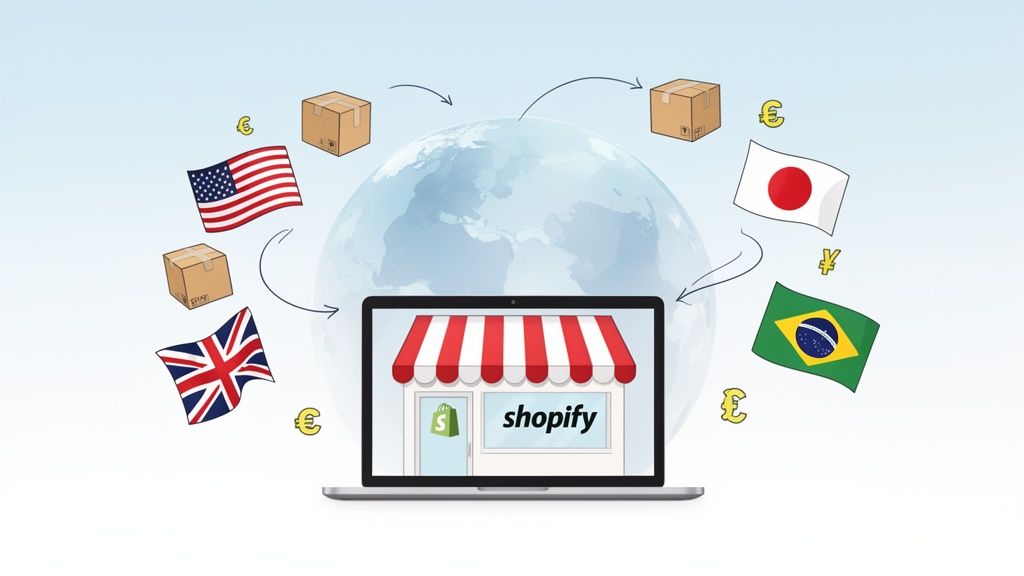
So, what exactly is cross-border e-commerce? Simply put, it’s selling your products online to customers in another country. For Shopify brands, it's the single biggest lever you can pull to grow beyond your home turf and turn a local success story into a global one.
Your Gateway to Global Growth
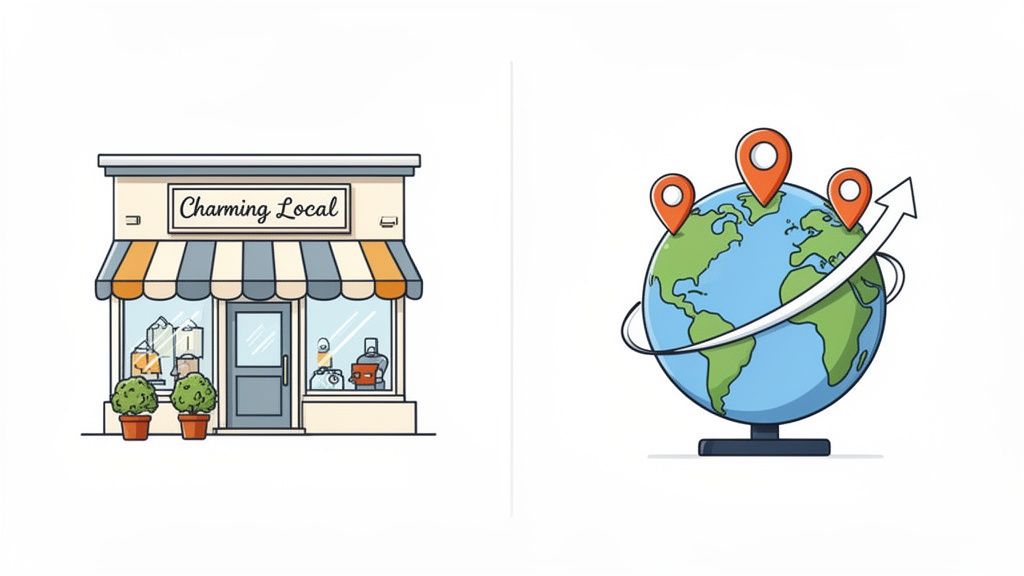
If your Shopify store is only selling in one country right now, think of it like a beloved local shop. It's got a loyal following, but your audience is ultimately limited by geography. Going cross-border is like taking that shop and opening a new location on every major high street in the world, making your products available to billions of new customers. It's about knocking down those geographical walls to find your next wave of growth.
This guide is your roadmap for that expansion. We're cutting through the theory to give you a step-by-step playbook built for ambitious Shopify founders. We’ll walk through how to nail the essentials of a smart international strategy.
You'll get the hang of the core pillars:
- Strategic Market Selection: How to find and validate new countries where people are actually looking for what you sell.
- True Localization: Creating a shopping experience that feels native, builds trust, and gets people to click "buy."
- Simplified Logistics: Solving the puzzle of international shipping, duties, and returns without the usual headaches.
The Can't-Miss Opportunity
The sheer scale of the global market is staggering, and it's not slowing down. Cross-border selling is fundamentally changing retail—a massive 52% of online shoppers are already buying from international brands. This trend, pushed along by easier global shipping, is on track to hit $3.5 trillion in sales. You can discover more insights about these digital commerce statistics and see what they mean for the future of retail.
This is exactly what Shopify Markets was built for. It gives you a single dashboard to manage every international market you operate in.
From one place, you can set up custom domains, currencies, languages, and pricing for each region you sell into, making global operations feel surprisingly simple.
Tapping into this global demand isn't just about finding new customers; it's about future-proofing your business. When you have a diversified customer base spread across different economies, you build a much more resilient and sustainable company, shielding you from the inevitable ups and downs of any single market. Let's get started.
How to Identify and Validate Your Next Market
Expanding your brand across borders is an exciting step, but success isn’t about throwing a dart at a world map and hoping for the best. It’s about making smart, calculated decisions based on real data. Forget the guesswork—the best place to start looking for your next big market is right inside your own analytics.
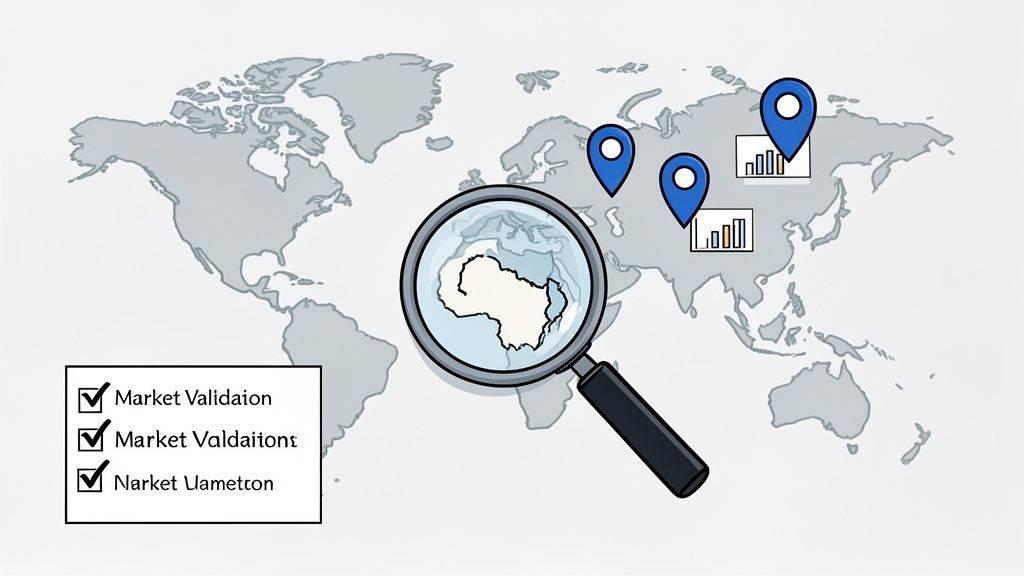
Think of your current store traffic as a treasure map. You might be a US-based brand seeing a surprising number of visitors from Germany, or an Australian company noticing a spike in traffic from Canada. This isn't just random noise; it's a clear signal of organic interest and a hint that you already have product-market fit, all before you’ve spent a single dollar on international marketing.
Uncover Clues in Your Analytics
First things first: dive into your Shopify Analytics or Google Analytics. Find the "Sessions by location" report to see exactly which countries are sending you traffic. But don't just stop at the raw numbers. Look deeper at metrics like session duration, add-to-cart rates, and initiated checkouts from these international visitors.
A high volume of traffic from a country with zero conversions might point to a payment or shipping barrier you can fix. On the other hand, a lower-traffic country with surprisingly high engagement could be your hidden gem. These patterns are your first clues, helping you build an initial list of potential markets to explore.
Conduct Structured Market Research
Once you have a handful of promising countries, it's time to do some real digging to see if the opportunity is legit. The goal here is to get the complete picture—not just if customers exist, but if you can actually serve them profitably.
Your research should zero in on a few key areas:
- Product-Market Fit: Is there a genuine need or desire for what you sell? Dig into cultural nuances, local holidays, and seasonal trends that might affect demand. A winter coat brand won't do well in a tropical climate.
- Competitive Landscape: Who are the local players? Check out their pricing, marketing tactics, and what their customers are saying in reviews. This will help you spot gaps in the market you can fill.
- Consumer Behavior: How do people in this market actually shop? Find out their preferred payment methods (is it all credit cards, or do digital wallets like Alipay or Klarna rule?), which social media platforms they live on, and what they expect when it comes to shipping times.
Tools like Google Market Finder are fantastic for this stage. It gives you hard data on things like local search volume for your product category, average household income, and internet usage rates, giving you a much clearer view of whether a market is truly viable.
To help you get started, here's a look at some of the top international markets and what makes them tick. This isn't an exhaustive list, but it gives you a sense of the key metrics to look for as you build your own comparison.
Top Cross Border E-commerce Market Comparison
A comparative look at key metrics for high-potential international markets to help brands prioritize their expansion efforts.
This kind of comparison helps you move from a long list of possibilities to a focused shortlist. It’s not just about market size; it's about finding the market that aligns best with your brand, products, and operational capabilities.
Your goal is to narrow your options down to a shortlist of 3-5 high-potential markets. Trying to launch in ten countries at once spreads your resources too thin and is a recipe for disaster. Focus is your greatest advantage here.
Validate Your Shortlist with Low-Cost Tests
With your shortlist in hand, it's time for the final step before a full-scale launch: validation. This is where you run small, low-cost experiments to see if your research holds up in the real world. Think of it as dipping your toe in the water before diving in.
A powerful way to do this is with targeted ad campaigns on platforms like Meta or Google. Create a simple ad campaign for one of your target countries. Use translated ad copy and point the traffic to a basic landing page that gauges interest by collecting email sign-ups for a future launch announcement.
This approach gives you concrete data on click-through rates, cost per acquisition, and sign-up conversions for that specific audience. If a test campaign in Spain generates hundreds of sign-ups at a low cost, you've got strong validation. If a similar campaign in Japan gets almost no traction, you’ve just saved yourself a massive amount of time and money on a market that isn't quite ready for your brand.
Winning Customer Trust Starts with Mastering Localization
Jumping into a new market is like being a guest in someone's home. If you show up with a generic, one-size-fits-all gift, it’s not going to land well. The same goes for your online store. A generic approach is the fastest way to make a new audience feel like you don't get them. True localization isn't about just swapping out a few words; it's about fundamentally reshaping your entire shopping experience to feel familiar, intuitive, and trustworthy to a local.
Think about it. A direct, word-for-word translation often creates awkward phrasing that immediately screams "outsider." A truly localized site, on the other hand, speaks the local dialect, gets the cultural references right, and maybe even cracks a local joke. It's the difference between a website that just functions in a new country and one that actually connects and converts. This obsession with detail is what separates the winners in cross-border e-commerce from the brands that never gain traction.
Go Way Beyond Basic Translation
Effective localization means fine-tuning every single customer touchpoint to meet local expectations. Doing this creates a seamless experience, removes friction, and builds the confidence someone needs to buy from a brand they've never heard of before.
Start by zeroing in on these core elements:
- Language Nuances: Don't just translate, transcreate. Work with native speakers or professional services to nail local idioms and phrasing. A single clumsy slogan or product description can instantly shatter your brand's credibility.
- Currency and Pricing: This is non-negotiable. You must automatically show prices in the local currency. To take it a step further, adopt local pricing conventions, like rounding to .99, to make your prices feel completely natural.
- Imagery and Creative: The models, settings, and styles in your photos need to resonate. What connects with an audience in Los Angeles might fall completely flat in Tokyo.
True localization is an act of empathy. It’s about showing your international customers that you see them, understand their culture, and have made a genuine effort to meet them where they are. This is how you build the trust required to turn a first-time visitor into a loyal customer.
Payments and Taxes are Make-or-Break
The checkout is where so many international sales fall apart. If a customer gets to the payment step and doesn't see an option they recognize and trust, you've likely lost them. The global market proves this point, with the cross-border e-commerce consumer market valued at an impressive $1.21 trillion. Tapping into this massive opportunity means meeting local expectations head-on, especially since 53% of transactions now use digital or mobile wallets. You can discover more cross-border online shopping statistics to get a better handle on these trends.
Beyond language, offering the right local payment methods is absolutely critical for building trust. For a deep dive into navigating global payment processing, it's worth exploring resources from expert payment solutions. This covers everything from bank transfers in Germany to the "buy now, pay later" services that are huge in Australia.
Equally important is being upfront about costs. Nothing kills a sale faster than sticker shock from unexpected taxes and duties when the package arrives. This is a top reason for cart abandonment and angry customer support tickets.
Actionable Tip: Always show the full landed cost at checkout. This means the total price including the product, shipping, duties, and taxes. Use a Shopify app that calculates this automatically. It removes all the guesswork for your customers and prevents those nasty post-purchase surprises.
Nail Your International SEO
Localization doesn't stop at your storefront; it extends to how search engines find you in the first place. If you want to show up in local Google results, you have to get your international SEO right. This technical setup is what tells search engines which version of your site to serve to users in different countries.
The key here is the hreflang tag. It’s a small piece of code that signals a page's language and geographic target. In simple terms, it tells Google, "Hey, this is the German version of the page for users in Germany, and this other one is the English version for folks in the UK."
You also need to think about your domain strategy:
- Country-Code Top-Level Domains (ccTLDs): Using a domain like
yourbrand.defor Germany sends the strongest possible signal for local targeting. - Subdomains: A setup like
de.yourbrand.comis another highly effective way to separate and target different regions. - Subdirectories: Using
yourbrand.com/deis a common approach that can be managed easily with tools like Shopify Markets.
Getting your technical SEO dialed in ensures that all your hard work on localization actually pays off by driving relevant, high-intent organic traffic from the markets you want to win.
Architecting Your Global Shopify Storefront
Deciding on the technical foundation for your international expansion is one of the most critical calls you'll make. This choice sets the stage for everything that follows—how you'll manage day-to-day operations, how authentically you can localize the shopping experience, and how far you can ultimately scale. For Shopify brands, this usually comes down to two main paths.
Here's a simple way to think about it: your first option is like renting a large, beautiful house. You can decorate each room to suit different guests, but you’re still working within the original floor plan. The second option is like owning a portfolio of custom-built homes, one in each neighborhood, giving you complete architectural control over every single property.
These two approaches perfectly mirror the core choices on Shopify: using a single store supercharged with tools like Shopify Markets, or going all-in with a multi-store setup using separate instances—a strategy usually reserved for Shopify Plus merchants. Each has its place, and the right one for you depends entirely on where you are in your growth journey.
The Single Store Approach with Shopify Markets
For most brands just dipping their toes into global sales, a single Shopify store enhanced with Shopify Markets is the smartest way to start. It keeps all your products, inventory, and orders centralized in one dashboard you already know and love, making daily management a breeze. From this single backend, you can manage multiple countries—or "markets."
This setup lets you roll out localized experiences that make a real difference, like:
- Multiple Currencies: Letting shoppers see prices in their own currency.
- Translated Content: Displaying your site in local languages.
- International Domains: Using subdomains (
fr.yourstore.com) or subdirectories (yourstore.com/fr) for a local feel. - Calculated Duties: Showing estimated taxes and duties right at checkout to eliminate surprises and build trust.
It's a cost-effective and efficient way to test the waters in new markets without the massive overhead of running entirely separate stores. The decision tree below visualizes the basic localization steps that tools like Shopify Markets help you put into practice.
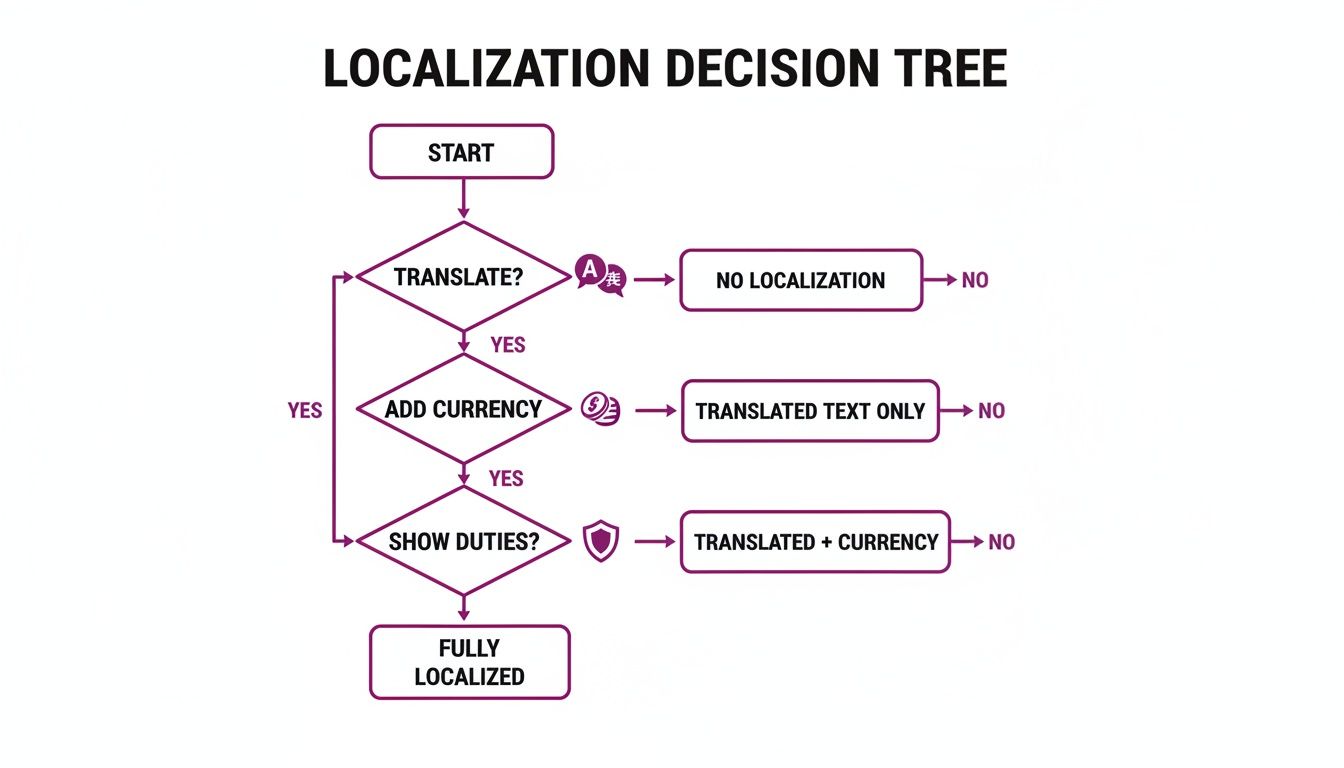
This flowchart shows how each layer of localization builds on the last, creating an experience that feels increasingly native to the customer.
The Multi-Store Approach with Shopify Plus
Once your international sales start to really take off, you might find yourself bumping up against the limitations of a single store. That's the signal it's time to graduate to a multi-store architecture using Shopify Plus. This means spinning up completely separate Shopify stores for each of your key regions (e.g., yourbrand.co.uk, yourbrand.de).
A multi-store setup is the final frontier of control and customization. It lets you create a truly distinct storefront for each market, complete with different product catalogs, unique marketing campaigns, and operational workflows built from the ground up for local shoppers.
Sure, this path comes with higher costs and more management complexity, but for brands operating at scale, the payoff is huge. You can run entirely separate marketing campaigns, offer region-exclusive products that nobody else sees, and even set up dedicated fulfillment and support teams for each store. To really get into the weeds on this, check out our strategic guide to managing multiple currencies on Shopify. This is the kind of deep localization you need to go head-to-head with established local players and win.
Solving the International Logistics Puzzle
Alright, let's talk about the final frontier of e-commerce: getting your product into your customer's hands, wherever they are in the world. For a lot of brands, the thought of international shipping, customs, and returns is enough to cause a headache. It feels like an intimidating maze.
But here’s the thing: with the right game plan, you can turn this puzzle into a smooth operation that builds massive customer confidence and keeps them coming back.
The first big decision you'll face is how to handle duties and taxes. This choice directly shapes your customer's experience and can honestly make or break a sale at checkout. You’ve got two main ways to play this.
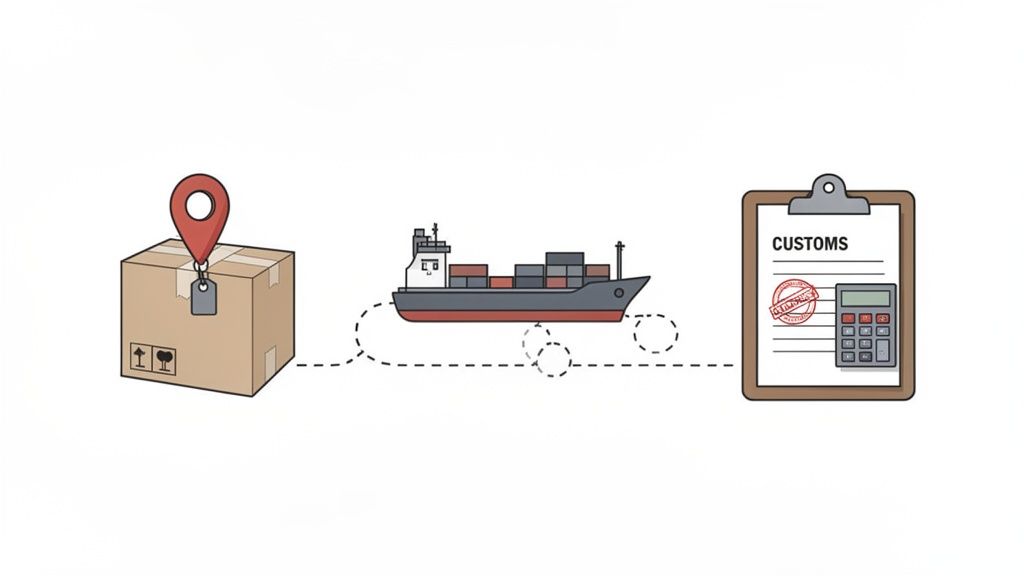
Understanding DDP vs DDU Shipping
Think of it like choosing who pays the tollbooth operator on an international highway. Your call here determines whether your customer has a smooth, happy ride or gets hit with an unexpected bill at their front door.
DDU (Delivered Duty Unpaid): This is the old-school way. You charge the customer for the product and shipping, and that's it. They’re on the hook for paying any import duties, taxes, or customs fees when the package arrives. It's simpler on your end, but it creates a terrible customer experience, often leading to refused packages and angry support tickets. Avoid this.
DDP (Delivered Duty Paid): This is the gold standard for modern cross-border e-commerce. You calculate and collect all duties and taxes right at checkout, giving the customer one clear, final price. This landed cost approach gets rid of any nasty surprises and guarantees a seamless delivery, which does wonders for customer satisfaction.
For any Shopify brand serious about going global, shipping DDP is non-negotiable. The transparency builds incredible trust and is a powerful conversion driver. Customers who know the final, all-in cost upfront are far more likely to click "buy."
Demystifying Customs and Landed Cost
Calculating that landed cost means you have to get cozy with customs compliance. The centerpiece of this is correctly classifying your products using Harmonized System (HS) codes. An HS code is just a universal number that tells customs officials everywhere exactly what you're shipping.
Getting this wrong is a super common—and costly—mistake.
Incorrect HS codes can leave packages stuck at the border for weeks, trigger the wrong duty calculations, and even earn you fines. While 91% of businesses now sell cross-border, a shocking 75% struggle with HS codes, and 38% have been hit with fines from tariff errors. This is where automation becomes your best friend.
Shopify apps like Zonos and Easyship plug right into your checkout. They use AI to assign the correct HS codes and calculate the precise landed cost in real-time. A massive compliance headache? Solved, automatically.
Smart Fulfillment and Returns Strategies
As your international sales start to climb, shipping everything from a single warehouse becomes painfully slow and expensive. This is the moment a Third-Party Logistics (3PL) partner with a global network becomes a game-changer.
By storing inventory in warehouses closer to your international customers, you can offer faster, cheaper shipping that actually competes with local brands in that market. (We dive deeper into this in our guide on ecommerce fulfillment solutions).
Just as critical is your returns strategy. Nothing kills a sale faster than a complicated or expensive international returns process. A clear, simple, and customer-first policy is one of your best tools for building confidence with shoppers who are on the fence.
Here are a few winning ideas:
- Consolidated Returns: Work with a service that gives you local return addresses. Customers can send items to a domestic hub, which then ships them back to you in bulk. Easy for them, cheaper for you.
- Pre-Paid Labels: Make it completely frictionless. Include a return label in the box or have an online portal where they can print one in seconds.
- Store Credit Options: Gently encourage customers to take store credit or make an exchange. This helps you hold onto the revenue and gives them another chance to find something they love.
When you solve these logistical challenges, you’re not just shipping boxes. You’re removing the biggest barriers to international conversion and creating a shopping experience that feels just as easy as buying from a store down the street.
Scaling Your Global Sales with Smart Optimization
Getting your international storefronts live is a huge step, but it’s really just the starting line. The true path to profitable cross-border e-commerce is paved with continuous, data-driven improvement. This is where Conversion Rate Optimization (CRO) becomes your most important tool for growth.
Think of your new international sites like freshly planted gardens. They need constant attention—weeding, watering, and testing—to truly flourish. Just letting them sit there isn’t a strategy. You have to actively test, learn, and adapt to the unique quirks of each market.
Applying CRO Principles to Global Stores
What convinces a customer in New York might completely fall flat in Berlin. Smart optimization means treating each market as its own ecosystem. This involves a systematic process of testing different parts of your localized storefronts to figure out what genuinely connects with local shoppers.
Start by setting up A/B tests on your most critical pages and user flows. A few high-impact areas to get you started include:
- Localized Messaging: Try out different headlines, product descriptions, and calls-to-action that use local slang or tap into cultural nuances.
- Promotional Offers: Does a 20% Off discount outperform a "Buy One, Get One Free" deal in the UK? Run tests on regional promotions to see what moves the needle.
- Checkout Flow: Experiment with the order of fields, how you display payment options, and which trust badges you show to reduce friction for specific audiences.
Beyond just getting more traffic, learning how to improve ecommerce conversion rate is the key to driving actual sales and building a sustainable global business. Every test gives you another piece of the puzzle, helping you refine your approach one market at a time.
Supercharging Optimization with AI
This is where Artificial Intelligence (AI) can give you a massive advantage. AI tools can chew through enormous amounts of data way faster than any human ever could, spotting hidden patterns in customer behavior and automating complex optimization tasks. It’s the difference between making educated guesses and making data-backed decisions at scale.
AI acts as a force multiplier for your CRO efforts. Instead of manually testing every single hypothesis, AI-powered tools can personalize experiences for thousands of shoppers at once, making sure every visitor sees the most relevant content for their location and behavior.
Picture a shopper from Australia landing on your site. AI can instantly tailor their experience by showing them summer-appropriate clothing, displaying prices in AUD, and highlighting products that are trending in their region. Pulling this off manually across multiple markets is next to impossible.
Integrating AI can transform several key parts of your global operations:
- AI-Powered Personalization: Showcase product recommendations based on a user's location, browsing history, and what’s currently popular in their country. This makes your store feel like it was built just for them.
- Dynamic Pricing: AI algorithms can adjust prices on the fly based on competitor pricing, local demand, and even inventory levels, helping you squeeze the most margin out of every single market.
- Predictive Inventory Management: AI can analyze sales data to forecast demand in different regions. This ensures you stock the right products in the right international warehouses, which means fewer stockouts and shorter shipping times.
By combining foundational CRO principles with the raw power of AI, you can move beyond simply being "live" in a new country. You can start building a highly profitable, self-improving sales engine that constantly adapts to win over customers all around the world.
Your Cross Border E-commerce Questions Answered
Stepping into global e-commerce always brings up a few questions, from the nitty-gritty of daily operations to your long-term strategy. Let's tackle these head-on. Getting these concerns out of the way helps demystify the process, turning what feel like roadblocks into clear, actionable steps.
Below, I've answered some of the most common questions we hear from Shopify brands gearing up to expand their footprint. Think of this as your quick-reference guide for clearing those final hurdles before you launch.
How Do I Handle Customer Support for Different Time Zones and Languages?
Offering great international customer support doesn't mean you need a huge, 24/7 team from day one. It’s all about a smart, tiered approach that lets you deliver an excellent experience without breaking the bank.
Start with an AI-powered chatbot. Modern tools can be trained in multiple languages to give instant answers to common questions about order status, shipping, and product details. This first line of defense automatically handles a huge chunk of your inquiries around the clock.
For the more complex stuff that needs a human touch, you can:
- Hire Remote Agents: Bring on part-time support agents who are actually located in your key international regions.
- Use a BPO Service: Outsource to a specialized Business Process Outsourcing (BPO) company that offers multilingual support.
- Leverage Integrated Tools: Apps like Gorgias or Zendesk plug right into Shopify. They help you manage tickets, translate conversations on the fly, and build out a solid multilingual knowledge base for self-service.
This mix ensures your customers get quick, helpful answers, no matter where they are or what language they speak.
What Is the Best Way to Manage International Pricing and Currency?
The golden rule here is simple: eliminate friction for the customer. That means always displaying prices in their local currency. It's a non-negotiable step for building trust and getting those conversion rates where you need them to be.
Shopify Markets is your command center for this. It lets you use automatic, real-time currency conversion or, if you want more control, set fixed prices for specific countries. For a more advanced strategy, you can even create pricing rules that factor in local market conditions and landed costs to make sure your margins are protected.
Always be transparent with your pricing. Use Shopify apps that automatically round converted prices to familiar local numbers—like €19.99 instead of a clunky €19.47. This makes your store feel truly native and boosts shopper confidence right when they're about to make a decision.
Which Shopify Apps Are Essential for Cross Border E-commerce?
While Shopify Markets gives you a powerful foundation, a few key apps can take your international store from functional to exceptional. Think of them as specialized tools that perfect specific parts of the cross-border journey.
- For Advanced Translation: Shopify's built-in tools are great, but apps like Weglot or Langify give you much more granular control over your translations and international SEO.
- For Duties and Taxes: Zonos and Easyship are industry leaders for a reason. They provide hyper-accurate landed cost calculations at checkout, so there are no nasty surprises for your customers.
- For Global Fulfillment: If you're using a 3PL, an integration app like ShipBob or Flexport can connect your warehouses directly to Shopify for seamless international logistics.
- For Geolocation: A reliable geolocation and redirect app is critical. It makes sure visitors automatically land on the correct, localized version of your store from their very first click, creating a smooth experience from the start.
Ready to build a global Shopify experience that converts? The team at ECORN specializes in designing and developing scalable international storefronts. From CRO to Shopify Plus development, we provide the expertise to help you expand with confidence. Start your project with us today.


How to Implement Structured Data for Ecommerce in 2026
SEO App Mobile: Shopify Store Optimization Guide

Shopify Plus Support: What It Includes and How to Choose

Google Ads for Shopify: The Complete 2026 Playbook

Shopify New York: How to Find and Hire the Right Agency
Google Search Console for Shopify: The Complete Setup
First Party Data Collection for eCommerce Growth
FAQ Online Store Guide: Build and Measure It Right
Do FB Ads Work for eCommerce in 2026?
One Page Checkout for Shopify: Design and Implementation

Shopify GraphQL vs REST: The 2026 Developer Decision
Shopify Ecommerce Consulting: Strategy, Pricing &

Are Reddit Ads Worth It for eCommerce Brands
Shopify Title and Meta Description: A Practical 2026 Guide

Product Video Best Practices for Shopify Brands
Real-Time Inventory Management: A 2026 Guide
AI Chatbot Integration for Shopify Stores
Affiliate Program Management: A Shopify Guide
10 Best Performance Monitoring Tools for Shopify in 2026
Digital Asset Management for eCommerce Brands in 2026
Every Type of Facebook Ads Explained for eCommerce Growth
Product Information Management Explained for Shopify Brands
Support Ticket System: A Guide for Shopify Stores

10 Best Customer Service Tools for Shopify in 2026

Can I Start a Business with No Money? a 2026 Blueprint

What Sells Good on Etsy: Best Niches for 2026

Shopify Add to Cart Button: A Practical 2026 Guide

Customer Feedback Automation: A Practical eCommerce Guide
Critical Rendering Path: A Guide for Shopify Stores

How to Promote on TikTok for eCommerce in 2026

B2B eCommerce Consulting That Drives Real Revenue
10 Best Practices for Site Navigation in 2026
Return vs Refund for Shopify Stores: A Practical Guide

What Is Customer Lifetime Value and Why It Matters
What Is Voice of Customer Research for eCommerce

SMS Marketing for Ecommerce That Actually Converts

Master How to Improve Email Deliverability in 2026

Top 7 eCommerce Partners NYC for Shopify Brands in 2026
Machine Learning for Ecommerce: Boost Your Shopify Store

Beauty Market Research: Your 2026 Growth Guide
Shopify International Expansion: A 2026 Roadmap

What Does CRO Stand for in Business: Understanding CRO

Shopify Visual Merchandising: A Playbook for Higher Sales

Shopify Landing Page Design: Master Conversion in 2026
10 Best AI SEO Optimization Tools for Shopify in 2026

Agentic AI for Ecommerce: Boost Your Sales in 2026
Mastering Email Marketing Data for eCommerce Growth

Conversion Rate Optimisation Australia: Boost Your Sales
Conversion Rate Optimization AI: Your Shopify Store Guide

10 Product Bundling Strategies for Shopify in 2026

How to Increase Customer Lifetime Value: A Shopify Playbook
AI Customer Service Automation: Shopify Guide 2026

Clean Website Design: A Shopify Conversion Playbook

Omnichannel Retail Strategy: A Shopify Playbook

Product Data Enrichment: A Guide for Shopify Brands

Instagram Shopping Features a Guide for Shopify Stores

What Is Revenue Optimization: A Holistic RevOps Guide

Benefits of Conversion Rate Optimization: Boost Your
WordPress to Shopify Migration: Your 2026 Seamless Switch
Boost Sales: Ecommerce Payment Processing Guide 2026
Unified Commerce Platform: Benefits, KPIs & Shopify Guide
How to Reduce Bounce Rate eCommerce: Your 2026 Guide
Shopify API Integration: A Practical End-to-End Guide

How to Implement Data Governance: A 2026 Guide
Shopify Store Development Cost: A 2026 Breakdown
What Is Server Side Tracking: The Shopify Guide 2026
Marketing Automation Workflows: A Shopify Guide for 2026

Shopify: How to Reduce Technical Debt

Shopify UX Design Change: A Playbook for Growth
User Generated Content Strategy: Shopify Playbook

Shopify Pause and Build Plan Cost: A Complete 2026 Guide
Compare at Price on Shopify: A Complete Guide for 2026
Where Can I Sell My Prints? 10 Best Platforms for 2026
Shopify Order Management System: The Ultimate Guide 2026
What Is Marketing Attribution? an eCommerce Guide for 2026

10 Best Black Friday Sales Sheets for 2026

Discover the Top Social Media Marketing Agencies For
Consumer Confidence Definition for eCommerce in 2026
What Is Social Commerce? Your 2026 Guide to Boosting Sales

A Social Ad Campaign Playbook for eCommerce Growth

7 Best FAQ Page Examples for SaaS & eCommerce

Market Research in Fashion Industry: A Guide for Shopify
Shopify Migration Services: Expert Guide for 2026

Mastering FB Retargeting Ads for Shopify in 2026
What Is Omnichannel Ecommerce

Master Your Shopify Plus Migration: The 2026 Guide
Shopify Integration Services: A Merchant's 2026 Guide
Shopify Collection Description: A Guide to SEO & Sales

Shopify Plus Contact: Reach Sales & Support Effectively

Top Luxury Shopify Stores: Design & UX Strategies
How to Improve Customer Experience: A Shopify Roadmap

Creative Facebook Ads: 10 Examples for Shopify Brands

Remarketing with Facebook Ads: A Shopify Guide for 2026

SEO Linking Strategies for Shopify Stores
Top 7 Statistics YouTube Channels for eCommerce in 2026

Hiring Shopify Plus Designers: A Founder's Guide

Shopify Product Variation: Master Your Variants for 2026

Leverage Ai Solutions Brands: Your 2026 Shopify Growth Guide

Filters in Shopify: A Guide for Growing Brands

Shopify Plus Developer: A Guide for Growing Brands


newsletter in your inbox