

The real difference boils down to one core question: do you crave unlimited flexibility and total control, or do you need a powerful, all-in-one system built for simplicity and speed? With WordPress and WooCommerce, you're the architect. With Shopify, you're moving into a high-end, fully managed property. Your choice really depends on whether you value creative freedom over operational efficiency.
Framing The WordPress vs Shopify Decision
Choosing between WordPress and Shopify is one of those foundational decisions that will shape your entire online business. This isn't just about picking a tool; it's a strategic move that dictates your budget, marketing agility, and what your day-to-day work looks like. Understanding the broader world of ecommerce helps put this critical choice into perspective.
Instead of just rattling off feature lists, this guide is designed to give you a clear framework for making the right call. We’re going to dissect each platform based on the factors that actually matter for scaling your business in the long run.
For a bit of market context, WordPress is a giant, powering an incredible 43% of all websites. It’s the undisputed king of content management. But when you zoom in on ecommerce, Shopify’s dedicated, laser-focused approach tells a much more competitive story.
Quick Decision Matrix WordPress vs Shopify
To get started, here's a high-level table to quickly point you in the right direction. Think of this as a gut check—a way to see which platform aligns with your immediate needs and comfort level before we get into the nitty-gritty details.
For a deeper exploration of what goes into this choice, you can also check out our guide on how to choose an ecommerce platform.
This table sets the stage perfectly. Now, let’s dive into the specifics of cost, features, and the long-term impact each platform could have on your business.
Hosted vs. Self-Hosted: The Fundamental Choice
At the heart of the WordPress or Shopify debate is one simple, yet critical, distinction: hosted vs. self-hosted. This isn’t just some tech jargon; it’s the single most important factor that will shape your costs, responsibilities, and how you actually run your store day-to-day. Getting this right from the start is the key to making a decision you won't regret later.
Shopify's Hosted "All-in-One" Approach
Shopify operates on a hosted model, which you'll often hear called Software-as-a-Service (SaaS). Think of it like leasing a prime spot in a high-end, fully-serviced shopping mall. The mall management—that's Shopify—takes care of everything behind the scenes. They handle the building's security, maintenance, utilities, and structural integrity. Your job is just to show up, set up your products, and start selling.
With this model, Shopify is on the hook for all the heavy lifting:
- Web Hosting: Your store runs on their powerful, globally optimized servers.
- Security: They manage your SSL certificate, PCI compliance for payments, and shield you from cyber threats.
- Performance: They make sure your site stays fast and responsive, even when you get a huge surge of traffic on Black Friday.
- Software Updates: Every platform improvement and bug fix happens automatically, without you needing to lift a finger.
You're essentially trading a degree of architectural control for incredible convenience and peace of mind. It lets you focus on being a merchant, not a system administrator.
The Self-Hosted Path with WordPress
WordPress paired with WooCommerce is the complete opposite—it’s the self-hosted route. Sticking with our real estate analogy, this is like buying your own plot of land and building your store from the ground up. You have absolute freedom to design the layout, pick the building materials, and install any custom feature you can possibly imagine. But with that freedom comes total responsibility.
When you own the property, you're the one in charge of everything:
- Finding a Host: It's up to you to research and buy a hosting plan from a provider like Kinsta, WP Engine, or SiteGround.
- Implementing Security: You have to install an SSL certificate, configure firewalls, and keep security plugins up to date.
- Managing Updates: You are responsible for manually updating the WordPress core, your theme, and every single plugin you use.
- Optimizing Performance: How fast your site loads is entirely on you, depending on your hosting plan and the optimization techniques you implement.
The hands-on nature of WordPress gives you unparalleled flexibility. If you can dream it, you can build it. But that power is balanced by the very real responsibility of maintaining your store’s entire technical foundation.
What This Really Means for Your Business
The choice between hosted and self-hosted boils down to a classic trade-off: convenience vs. control.
With a Shopify store, you can get to market fast, scale with predictable costs, and sleep soundly knowing the technical side is handled. With a WordPress store, you have limitless potential for customization, but it requires a much bigger investment of your time, technical skill, or budget to hire a developer to manage it all.
The right answer to the "WordPress or Shopify" question depends entirely on which of those resources—time, technical know-how, or budget for total control—is the most valuable asset for your business right now.
A Detailed Comparison of Key eCommerce Features
Choosing between WordPress and Shopify means getting beyond the simple hosted vs. self-hosted argument. You need to dig into the practical, day-to-day features that will actually define what your store can and can’t do. This is where we break down how each platform handles the nuts and bolts of an eCommerce business, from the first setup steps to the ecosystems that will support your growth. The best choice always comes down to these operational differences.
First, let's get some market context. While WordPress dominates the web as a whole, Shopify has become an absolute juggernaut in the eCommerce world, claiming a massive 26.2% market share of all eCommerce sites globally. That puts it well ahead of WooCommerce’s 20.1% in a head-to-head matchup, proving just how effective its specialized model has become.
True Cost of Ownership
One of the biggest divides between the two is how you pay for them, and this directly shapes your financial planning.
With Shopify, you get predictable, tiered pricing. The subscription model neatly bundles hosting, security, and core features into one clear monthly bill. You know exactly what’s coming, with the only extra costs being transaction fees (if you don't use Shopify Payments) and any premium apps you decide to install. It’s perfect for businesses that thrive on stable, forecastable expenses.
WordPress with WooCommerce has a far more variable cost structure. The core software is free, but that's just the starting line. You have to budget for a handful of separate costs that can easily fluctuate and add up over time:
- Performance Hosting: A cheap shared hosting plan won't cut it. You’ll need managed WordPress or WooCommerce hosting, which can run anywhere from $30 to over $200 per month.
- Premium Plugins: While free plugins are abundant, essential features like advanced shipping rules, subscriptions, or complex booking systems often demand paid extensions. Each of these can cost between $50 to $300 annually.
- Developer Fees: Any custom coding, serious troubleshooting, or tricky integrations will almost certainly require hiring a developer, introducing a significant and often unpredictable expense.
Key Insight: Think of Shopify's cost as an all-inclusive operational expense, like your monthly rent. WooCommerce's cost is a collection of individual expenses that you have to track, manage, and add up on your own.
Ease of Use and Setup
The experience of getting a store off the ground couldn't be more different on these two platforms.
Shopify is built from the ground up for simplicity. Its guided setup is incredibly intuitive, walking you through everything from adding your first product to configuring payments and picking a theme. The dashboard is clean and designed for people with zero technical experience. You could genuinely launch a professional-looking store in a weekend.
WordPress and WooCommerce, on the other hand, have a much steeper learning curve. The process is broken into several distinct steps: buying a domain and hosting, installing WordPress itself, finding and setting up a theme, and then finally installing and configuring the WooCommerce plugin. While it’s incredibly powerful, the WordPress dashboard can feel like a cockpit to a beginner—it’s a general CMS first, an eCommerce platform second. This multi-step process requires more technical patience and a willingness to learn.
The table below gives you a clear visual breakdown of the core differences between a managed solution like Shopify and a self-hosted platform like WordPress.
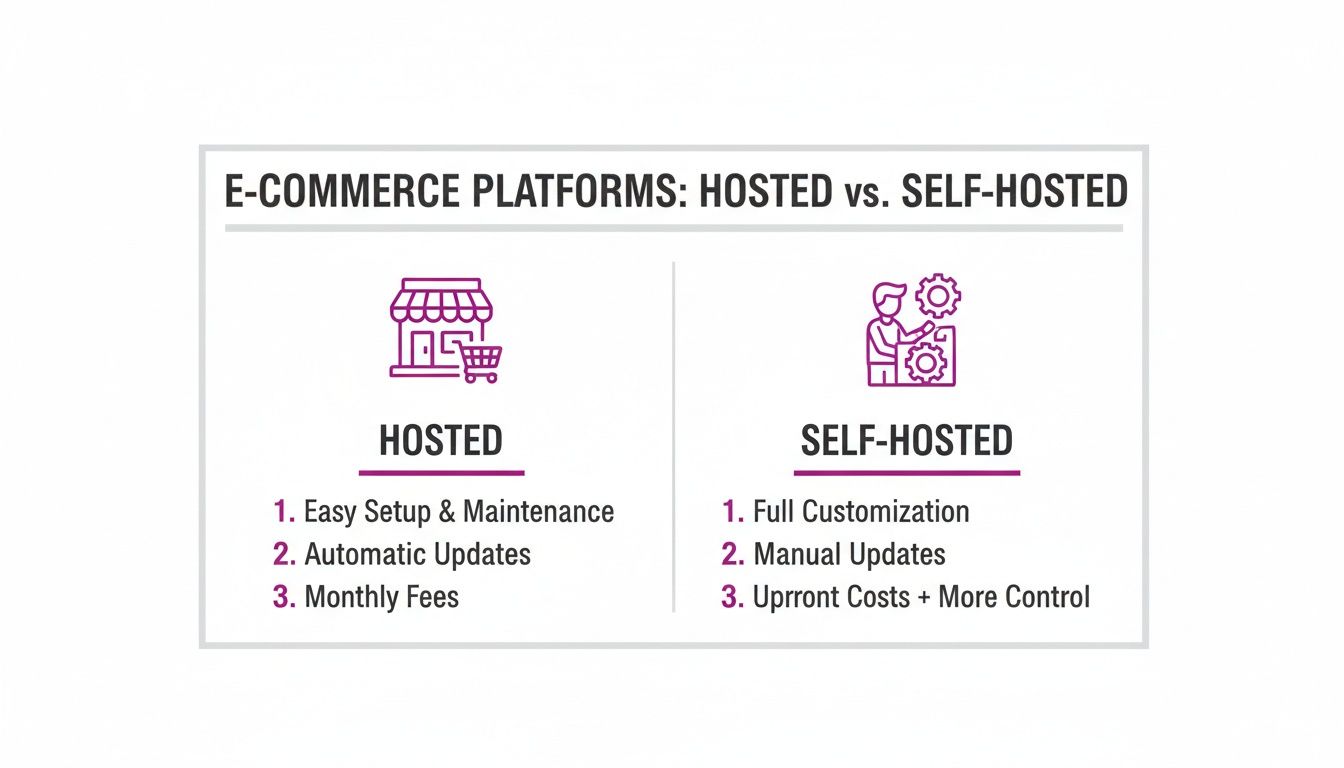
This really brings the fundamental trade-off into focus: Shopify gives you a streamlined, all-in-one package designed for ease, while WordPress provides a powerful foundation that you have to build on yourself, demanding much more hands-on involvement.
Feature Breakdown WordPress (WooCommerce) vs Shopify
To get a clearer picture of how these platforms stack up in day-to-day operations, here’s a detailed, feature-by-feature look at what each one brings to the table.
This table highlights the core trade-off: WooCommerce offers unparalleled freedom and control at the cost of complexity and responsibility. Shopify, in contrast, provides a powerful, reliable, and user-friendly ecosystem but with more structured boundaries.
Design and Customization
How your store looks is non-negotiable, and each platform approaches design from a completely different angle.
Shopify offers curated creative control. It features a marketplace full of polished, mobile-responsive, and conversion-optimized themes. The built-in theme editor lets you make significant changes—colors, fonts, layouts—but it all happens within a secure framework. This is great because it stops you from accidentally "breaking" your site and ensures everything just works.
WordPress delivers limitless creative freedom. With thousands of themes available and powerful page builders like Elementor or Divi, you can build literally any design you can dream up. This is a huge win for brands with a very specific vision or complex content layouts. The catch? This freedom comes with responsibility. The wrong plugin or a bit of bad custom code can easily lead to slow performance or security holes. For a deeper dive, our Shopify vs WordPress expert comparison guide offers more detailed insights.
App and Plugin Ecosystems
Both platforms depend on third-party extensions to add new features, but their ecosystems couldn't be more different.
The Shopify App Store is a tightly curated and vetted marketplace. Before any app is listed, it has to meet strict standards for performance and security. This creates a really safe and reliable environment where you can add features like loyalty programs or advanced analytics with confidence. While many of the best apps have a monthly fee, you're paying for quality, support, and peace of mind.
The WordPress plugin library is a sprawling, open-source world with over 60,000 free and premium plugins. This massive selection is one of its biggest strengths—there's a plugin for just about anything you can imagine. The open-source model means you can find tons of free tools, but it also comes with risks. The quality of plugins varies dramatically, and poorly coded or outdated ones are a leading cause of security breaches and slow sites.
For stores needing tricky shipping rules, for example, knowing the best shipping restriction plugins for WooCommerce is essential. This is a perfect example of how WordPress leans on its massive plugin ecosystem to handle very specific, advanced needs.
SEO and Marketing Tools
For many online stores, SEO is everything. Both platforms can get you to the top of Google, but they take different paths to get there.
Shopify has solid SEO fundamentals baked right in. It automatically generates sitemaps, manages canonical URLs correctly, and bundles SSL certificates with every plan. Its themes are also built for speed and mobile performance. You have less direct control over technical things like the URL structure for blog posts or collections, but its built-in reliability helps you avoid common SEO blunders.
WordPress gives you total SEO control. With a plugin like Yoast SEO or Rank Math, you can fine-tune every single aspect of your on-page and technical SEO. You can customize URL slugs, perfect your breadcrumbs, and implement advanced schema markup without breaking a sweat. This power is a double-edged sword: it allows experts to squeeze out every last drop of performance, but it also gives beginners enough rope to hang themselves with the wrong settings.
Comparing Performance, Security, and Scalability
Let’s get real for a second. For any serious eCommerce brand, the technical foundation of your store isn't just a feature—it's the very bedrock of your business. When you're weighing WordPress against Shopify, you have to look past the shiny storefronts and dig into how each platform handles the intense demands of performance, security, and scalability. These three pillars will ultimately decide your store's reliability and its ability to grow without collapsing under its own success.
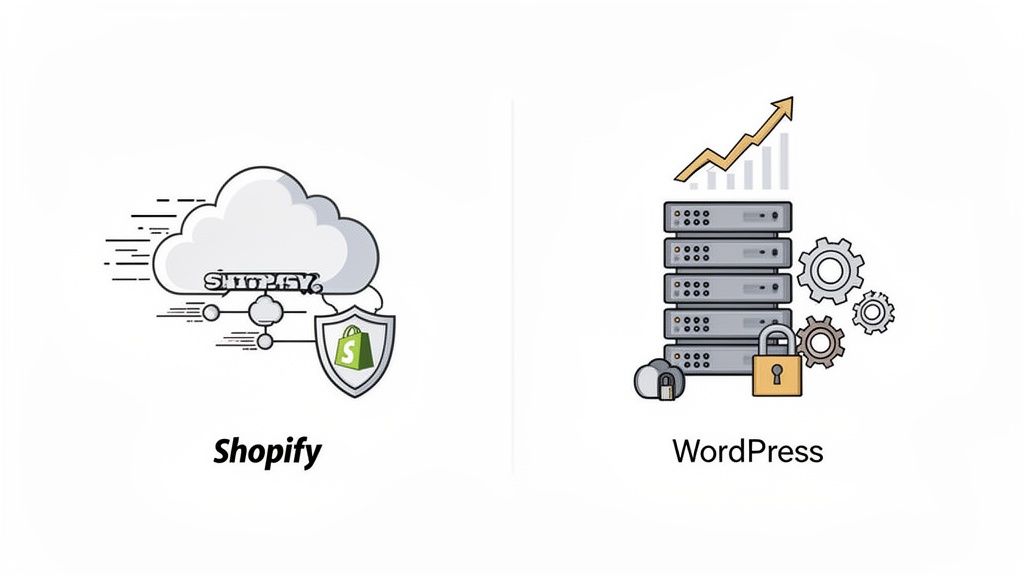
Shopify tackles these challenges with a managed, all-in-one philosophy. In stark contrast, WordPress with WooCommerce places the responsibility squarely on your shoulders.
Performance Under Pressure
How your site holds up during a massive traffic spike can make or break a major sales event. A slow-loading page is one of the quickest ways to lose a customer. In fact, studies consistently show that even a one-second delay in page response can lead to a 7% drop in conversions. That’s a lot of lost revenue.
Shopify is built for high-stakes retail from the ground up. Its entire global infrastructure is battle-tested to handle enormous, simultaneous traffic surges—think Black Friday chaos or a viral product launch. Because Shopify hosts every store on its own powerful servers, it handles all the heavy lifting for you: caching, content delivery networks (CDNs), and server health are all part of the package.
WordPress performance, on the other hand, is a direct reflection of your own efforts and investment. A WooCommerce store's speed is entirely dependent on your hosting plan, the quality of your theme, the number of plugins you’re running, and your diligence in optimization. You can absolutely achieve incredible speed with a high-end managed host and careful tuning, but a poorly configured site on cheap hosting will crumble under the first sign of pressure.
Key Takeaway: With Shopify, high performance is a built-in feature of the service. With WordPress, high performance is a result you must actively build and maintain.
The Security Divide
In eCommerce, security isn't just a nice-to-have; it's a fundamental requirement for earning customer trust and processing payments. The way each platform approaches this responsibility is a critical differentiator.
Shopify bakes robust security measures into its core offering. Every single Shopify store comes with a free SSL certificate and is automatically Level 1 PCI DSS compliant—the gold standard for payment security. Shopify's dedicated security team works around the clock monitoring threats and patching vulnerabilities across the entire platform. This means you don't have to lose sleep over server-side attacks or data breaches.
WordPress demands a hands-on, self-managed approach to security. While the core software itself is secure, you are responsible for literally everything else. This includes:
- Installing an SSL Certificate: This is non-negotiable for any online store to encrypt customer data.
- Configuring Security Plugins: Tools like Wordfence or Sucuri are essential for firewalls and malware scanning.
- Regular Updates: You must stay on top of updating the WordPress core, all themes, and every single plugin to patch vulnerabilities as soon as they're discovered.
- Choosing a Secure Host: Your hosting provider plays a huge role in protecting your server from threats.
This DIY model offers incredible flexibility, but it also introduces significant risk if not handled by someone with technical expertise. A single outdated plugin can become an open door for attackers.
Scalability From Launch to Enterprise
As your business grows, your platform needs to be able to grow right alongside you. The path to scaling on WordPress versus Shopify is fundamentally different, involving distinct technical and financial hurdles.
Shopify is engineered for seamless scaling. You can start on a basic plan and effortlessly move up to Shopify Plus as your order volume and operational complexity increase. Shopify Plus is their enterprise-level solution, offering dedicated support, higher API limits, and advanced features for multi-store management. The real magic is that the underlying infrastructure scales automatically; you never have to think about migrating servers or optimizing databases.
Scaling a WooCommerce store is a much more hands-on, technical project. As your traffic grows, you'll need to upgrade your hosting from shared plans to a VPS or even a dedicated server, which requires significant technical oversight. You’ll likely need to bring in developers to optimize your database, implement advanced caching solutions, and ensure your custom code can handle the increased load. While this allows for infinite customization, it also makes scaling a complex and often expensive undertaking rather than a simple plan upgrade.
Which Platform Is Right for Your Business Stage
There's no single "best" answer to the WordPress vs. Shopify debate. The right choice is completely situational, hinging on your business model, how comfortable you are with technology, and where you want to go long-term. Instead of a one-size-fits-all answer, let's look at the ideal choice for four distinct business stages.
This breakdown will help you move beyond the feature lists and make a smart, strategic decision for your brand.
The New Entrepreneur Validating an Idea
When you're just starting out, speed is everything. You need to get your idea out into the world, test the market, and start making sales with as little friction as possible. For this stage, Shopify is the clear winner.
Its all-in-one platform cuts out nearly all the technical headaches. You won't burn weeks figuring out server configurations or dealing with plugin conflicts. All that time and energy can go straight into what actually matters: marketing, talking to customers, and refining your product. Plus, Shopify's predictable monthly costs make budgeting a breeze when every dollar counts.
The Content-First Brand
What if your entire strategy is built around killer blog posts, in-depth guides, and an SEO machine that drives your sales? This is where the choice gets more interesting. For content-centric brands, WordPress with WooCommerce is often the stronger play.
Let's be clear: WordPress is the most powerful content management system on the planet, period. Its block editor, custom post types, and legendary SEO plugins like Yoast give you total command over your content strategy. This setup lets you build a powerful marketing engine that feeds organic traffic directly to your products, all under one roof.
That said, a hybrid model is becoming popular. Some brands run their storefront on Shopify for its commerce power and host a WordPress blog on a subdomain. For those who want the best of both worlds without splitting their site, apps like Post Bridge can pull a WordPress blog into a Shopify subfolder, consolidating your SEO authority.
Key Insight: Don’t just think about how you'll sell products; think about how you'll attract customers. If your answer is "through world-class content," WordPress has a serious edge.
The Growing Business with Increasing Complexity
As your business takes off, the challenges change. You're suddenly dealing with a bigger product catalog, much higher order volumes, and complicated fulfillment logistics. At this point, Shopify often provides a smoother, more stable path for growth.
Because Shopify manages the infrastructure, you never have to lose sleep about your site crashing during a Black Friday sale. The curated App Store is full of reliable, vetted solutions for everything from inventory management to sophisticated analytics. You can add new features and capabilities without worrying you'll break something. That "it just works" reliability frees up your team to focus on growing the business, not on technical firefighting.
While a WooCommerce store can absolutely scale to this level, it demands a serious investment in high-performance hosting and, often, a dedicated developer to wrangle the growing technical complexity.
The Established Enterprise with Custom Needs
For large-scale enterprises with truly unique operational needs, complex back-end integrations, or the desire for a completely bespoke brand experience, WordPress with WooCommerce offers unmatched flexibility.
The open-source nature of WordPress means you can get under the hood and modify anything. This is a game-changer for businesses that need to build custom inventory workflows, integrate with a proprietary ERP system, or create a digital experience that's one-of-a-kind. You have the freedom to mold the platform to your exact business processes, rather than forcing your processes to fit the platform. Shopify Plus is a formidable enterprise solution, but for true, ground-up customization, WordPress is still king.
Got Questions About WordPress vs. Shopify? We’ve Got Answers.
Choosing between WordPress and Shopify always brings up a few last-minute, crucial questions. Let’s tackle the most common ones head-on so you can move forward with confidence. We'll get into the real talk on SEO, long-term costs, and what it actually takes to switch platforms.
Think of this as the final checklist to clear up any lingering doubts about your eCommerce strategy.
Which Platform Is Better for SEO, WordPress or Shopify?
Both platforms can get you to the top of Google, but they approach SEO from completely different angles. WordPress, with plugins like Yoast SEO, gives you ultimate, granular control. For an SEO expert, this is a dream—you can tweak every last technical detail. But for a novice, that same control can quickly turn into a liability if you mess something up.
Shopify takes a more guided, "it just works" approach. It comes packed with strong, built-in SEO fundamentals like automatic SSL certificates, blazing-fast load times, and clean sitemaps. You give up a tiny bit of that deep technical control, but what you get in return is a rock-solid, stable foundation that’s optimized right out of the box.
For the vast majority of businesses, Shopify's built-in SEO is more than enough to rank at the top without the headache of managing technical configurations. WordPress is the better fit for teams with in-house SEO expertise who need to control every single variable.
What Are the True Long-Term Costs?
When you look at the long-term costs of WordPress vs. Shopify, you’re really looking at a classic "predictable vs. variable" situation.
Shopify’s pricing is refreshingly transparent. You have a monthly subscription fee, app costs, and transaction fees that are easy to forecast. As your business grows, your costs scale in a predictable way, which makes budgeting a whole lot simpler.
WooCommerce has a seductive $0 price tag for the software itself, but the real costs are hiding just beneath the surface. Over time, these variable expenses add up and can easily surpass Shopify’s fees. You have to budget for:
- Premium Hosting: Cheap hosting won't cut it. You'll need a powerful, secure server.
- Paid Plugins: Advanced features like subscriptions, bookings, or complex shipping rules all require premium extensions.
- Security Services: A good firewall and malware scanner aren't optional—they're essential.
- Developer Fees: Something will inevitably break, or you'll need a custom feature. That means paying a developer.
When you factor everything in, a high-traffic WooCommerce store often ends up costing more in both time and money than a comparable Shopify plan.
How Difficult Is Migrating from WordPress to Shopify?
Moving from WooCommerce to Shopify is a well-trodden path, but it's one that demands careful planning to avoid wrecking your SEO and losing customer data. While migration apps can handle the basics—transferring products, customers, and orders—a successful switch is about much more than just copying data.
The single most critical piece of the puzzle is implementing a flawless 301 redirect strategy. This is non-negotiable. You have to map every single old URL to its new home on Shopify to preserve the search engine rankings you’ve worked so hard to earn.
For any established brand, trying to DIY this is a huge risk. The safest bet is to partner with an experienced agency. They can manage the technical details, ensure zero downtime, and make sure your organic traffic doesn't take a nosedive. It transforms a high-stakes project into a smooth, seamless transition.
Ready to build a high-performance eCommerce store without the technical headaches? The team of dedicated specialists at ECORN is prepared to elevate your project with efficiency and expertise. Whether you need world-class design, conversion rate optimization, or Shopify Plus development, we offer flexible solutions to help your brand scale. Explore our Shopify services and see how we can help you grow.


Shopify Plus Ecommerce Agency: How to Pick the Right One

Shopify Themes Retina: How to Serve 2x Images

How to Cross Sell on Shopify Without Friction

Best Shopify Theme for Custom Products Compared
Multi Store Inventory Management: A Practical Guide

SEO Consulting for Ecommerce: A Practical Guide

Shopify Theme Updater App: A Safe Update Playbook
Shopify Git Integration: A Developer's Guide to 2026
Headless Ecommerce Development Services Explained

How to Build a Shopify Clothing Website That Converts

How to Launch a Box Subscription Business in 2026

Luxury Skincare Branding Playbook That Converters
10 Best Podcast Ecommerce Shows for Store Growth in 2026
Shopify Developer Hourly Rate: What to Pay in 2026
Critical Shopify Setup Errors That Are Secretly Sabotaging Your Store
Ecommerce Conversion Tracking: The Complete How-To Guide

Shopify Design Agency: How to Pick the Right Partner
Mastering Multi Store Management on Shopify
Scale Shopify Store
10 Shopify App Ideas Worth Building in 2026
Conversion Rate Optimization for Landing Pages: The Playbook
Shopify Plus Automation: A Guide for 2026
10 Social Selling Platforms for Shopify Merchants
Shopify Website Design Examples: 7 Stores Worth Studying
7 Ecommerce Newsletter Examples for Shopify Brands
One Product Shopify Store: Build and Scale
Mobile Pop Up Strategy for Shopify Stores That Converts
Sitemap for Shopify: How to Find, Optimize, and Submit It
7 Single Product Websites Worth Emulating
Product Variants Shopify: The Complete 2026 Guide
Ecommerce Analytics Consulting for Growth
What Is AI Integration for eCommerce
How to Choose the Right eCommerce Website Development Firm
E Business Strategy Implementation
Conversion Tracking Setup for Shopify Stores
BigCommerce vs Shopify Plus Which Enterprise Wins in 2026
Shopify Theme Kit: Setup, Commands, and Migration Guide
Shopify Extension Development: A Practical 2026 Guide
Shopify Speed Score Explained and How to Improve It
Shopify Mobile Optimization: The 2026 Playbook
How to Add Subcategory in Shopify for Better UX
How to Implement Structured Data for Ecommerce in 2026
SEO App Mobile: Shopify Store Optimization Guide
Shopify Plus Support: What It Includes and How to Choose
Google Ads for Shopify: The Complete 2026 Playbook

Shopify New York: How to Find and Hire the Right Agency
Google Search Console for Shopify: The Complete Setup
First Party Data Collection for eCommerce Growth
FAQ Online Store Guide: Build and Measure It Right
Do FB Ads Work for eCommerce in 2026?
One Page Checkout for Shopify: Design and Implementation
Shopify GraphQL vs REST: The 2026 Developer Decision
Shopify Ecommerce Consulting: Strategy, Pricing &

Are Reddit Ads Worth It for eCommerce Brands

Shopify Title and Meta Description: A Practical 2026 Guide

Product Video Best Practices for Shopify Brands

Real-Time Inventory Management: A 2026 Guide
AI Chatbot Integration for Shopify Stores

Affiliate Program Management: A Shopify Guide
10 Best Performance Monitoring Tools for Shopify in 2026

Digital Asset Management for eCommerce Brands in 2026
Every Type of Facebook Ads Explained for eCommerce Growth
Product Information Management Explained for Shopify Brands
Support Ticket System: A Guide for Shopify Stores

10 Best Customer Service Tools for Shopify in 2026

Can I Start a Business with No Money? a 2026 Blueprint

What Sells Good on Etsy: Best Niches for 2026

Shopify Add to Cart Button: A Practical 2026 Guide

Customer Feedback Automation: A Practical eCommerce Guide
Critical Rendering Path: A Guide for Shopify Stores

How to Promote on TikTok for eCommerce in 2026

B2B eCommerce Consulting That Drives Real Revenue

10 Best Practices for Site Navigation in 2026
Return vs Refund for Shopify Stores: A Practical Guide

What Is Customer Lifetime Value and Why It Matters
What Is Voice of Customer Research for eCommerce

SMS Marketing for Ecommerce That Actually Converts

Master How to Improve Email Deliverability in 2026

Top 8 eCommerce Partners NYC for Shopify Brands in 2026

Machine Learning for Ecommerce: Boost Your Shopify Store

Beauty Market Research: Your 2026 Growth Guide

Shopify International Expansion: A 2026 Roadmap
What Does CRO Stand for in Business: Understanding CRO

Shopify Visual Merchandising: A Playbook for Higher Sales

Shopify Landing Page Design: Master Conversion in 2026
10 Best AI SEO Optimization Tools for Shopify in 2026

Agentic AI for Ecommerce: Boost Your Sales in 2026
Mastering Email Marketing Data for eCommerce Growth
Conversion Rate Optimisation Australia: Boost Your Sales
Conversion Rate Optimization AI: Your Shopify Store Guide

10 Product Bundling Strategies for Shopify in 2026
How to Increase Customer Lifetime Value: A Shopify Playbook
AI Customer Service Automation: Shopify Guide 2026
Clean Website Design: A Shopify Conversion Playbook

Omnichannel Retail Strategy: A Shopify Playbook

Product Data Enrichment: A Guide for Shopify Brands

Instagram Shopping Features a Guide for Shopify Stores
What Is Revenue Optimization: A Holistic RevOps Guide
Benefits of Conversion Rate Optimization: Boost Your
WordPress to Shopify Migration: Your 2026 Seamless Switch


newsletter in your inbox