

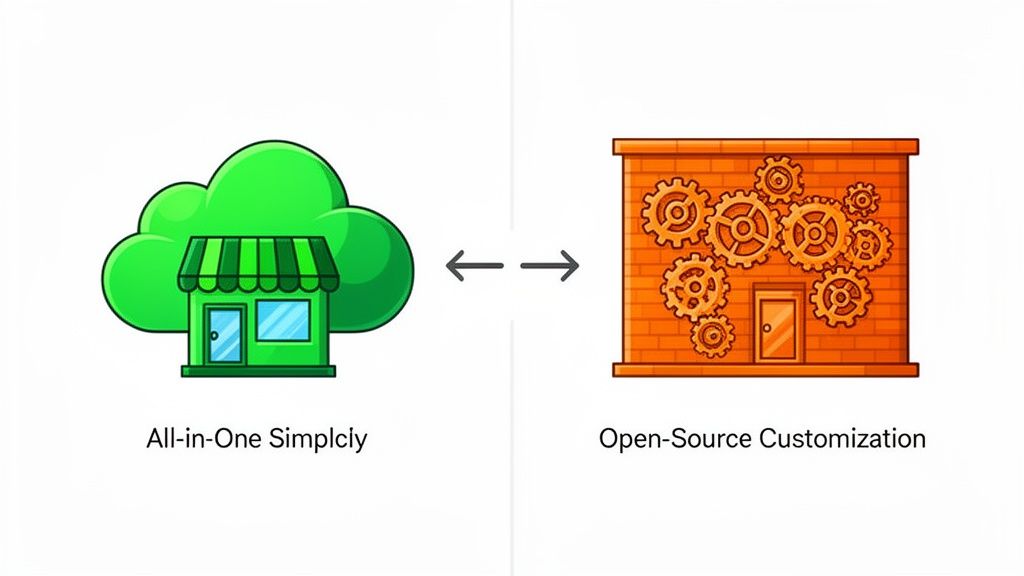
When you boil it down, the choice between Shopify or Magento comes down to a simple trade-off: speed and simplicity versus power and control. Shopify is the all-in-one solution for brands that want to get to market fast and focus on selling. On the other hand, Magento (now Adobe Commerce) is the open-source powerhouse for established businesses that need deep, custom functionality.
Your decision hinges entirely on your technical resources, budget, and long-term vision.
Shopify vs Magento: The Core Differences for Ambitious Brands
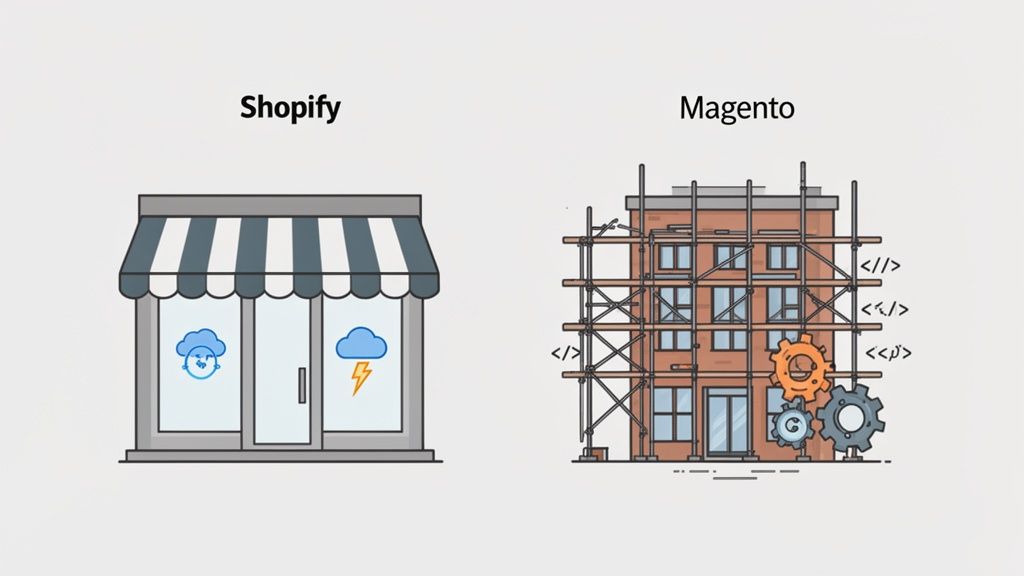
Choosing an eCommerce platform is one of those foundational decisions that will define your brand’s operational agility and growth potential for years. The whole “Shopify or Magento” debate isn’t about which one is universally better, but which one is the right tool for your specific job.
Shopify is engineered for rapid deployment and ease of use. It’s a Software-as-a-Service (SaaS) platform, which is just a fancy way of saying it handles all the technical heavy lifting—hosting, security, and maintenance—so you can concentrate on what you do best: selling. This makes it the undisputed champion for direct-to-consumer brands that prioritize speed to market.
In sharp contrast, Magento (now under the Adobe Commerce umbrella) is an open-source framework. Think of it less like a ready-to-drive car and more like a high-performance engine that requires a skilled team to build the rest of the vehicle around it. This approach gives you unparalleled freedom to customize every single aspect of the shopping experience, from complex product configurators to deep integrations with legacy enterprise systems.
A Head-to-Head Overview
Market data paints a pretty clear picture of who uses which platform. Shopify’s broad appeal is obvious, holding 26.2% of the global market share and powering over six million live sites. Its predictable costs and proven scalability make it a safe bet for growing brands.
Meanwhile, Magento's smaller footprint is highly concentrated among enterprise giants like Nike and Hermès—brands that absolutely require its deep customization capabilities. For more profitability insights on this matchup, you can check out resources like platter.com.
Key Takeaway: Shopify lets you build on top of its platform with apps and themes. Magento lets you rebuild the platform itself to fit your exact business logic.
To really frame this comparison, let's break down the fundamental differences that will shape your decision.
Comparing Total Cost of Ownership Beyond The Sticker Price
When you're weighing Shopify against Magento, looking just at the monthly subscription fee is like judging an iceberg by its tip. The real financial picture is painted by the Total Cost of Ownership (TCO), which covers every hidden and ongoing expense needed to run and grow your store.
Shopify’s pricing is all about predictability. It’s a SaaS model, so hosting, security, and basic maintenance are all bundled into one straightforward monthly fee. Even when you graduate to Shopify Plus, which kicks off around $2,000 per month, you’re still working within a relatively fixed cost structure. But that sticker price is just the beginning.
The costs that make a store truly functional add up fast. A great-looking premium theme will set you back $200-$400 right out of the gate. Then there’s the Shopify App Store. While it's an incredible resource, it's built on subscriptions. A solid tech stack with apps for loyalty programs, subscriptions, and advanced reviews can easily tack on another $500 to $1,500+ to your monthly bill. We break all this down in our complete guide on the cost of a Shopify store.
Magento: The Variable Cost Powerhouse
Magento plays by a completely different set of financial rules. With Magento Open Source, the core software is free, but you're on the hook for everything else. This is where the costs get really variable—and often, quite significant.
Here's a quick look at where the money goes with a Magento build:
- Performance Hosting: You can't skimp here. Expect to pay anywhere from $100 to $600+ per month for managed hosting that can handle Magento’s heavy resource demands.
- Developer Retainers: You absolutely need a skilled Magento developer or agency in your corner. Retainers for maintenance, critical security patches, and updates can run from $2,000 to $10,000+ per month.
- Paid Extensions: The Magento Marketplace is full of extensions, but the premium ones that handle critical functions like advanced search or complex B2B features can cost $500 to $5,000 apiece.
- Security and Compliance: This is all on you. PCI compliance and proactive security aren't optional, and they often require specialized services to manage properly.
For the big players, Adobe Commerce (the licensed version) comes with hefty annual fees, often starting at $22,000 per year and climbing with your revenue.
Magento’s cost is a direct reflection of its flexibility. You are not just paying for a platform; you are funding a custom-built eCommerce engine tailored precisely to your operational needs.
TCO Scenarios: A Practical Comparison
So how do these costs actually play out for different-sized businesses? Shopify might seem like the budget-friendly choice for startups, but as businesses scale and complexity ramps up, the lines start to blur. For enterprises with truly unique needs, Magento's initial investment can pay off in spades.
Let's put some numbers to it. The table below gives a ballpark estimate of what you might expect to spend in your first year on each platform, depending on your business size.
Estimated First-Year Total Cost of Ownership Comparison
This table illustrates the potential first-year investment for different business sizes on both Shopify and Magento, factoring in platform fees, development, apps/extensions, and maintenance.
As you can see, the initial setup for a serious Magento store, typically running $30,000-$100,000, is significantly higher than Shopify's $5,000-$15,000. But for the right business, that investment unlocks a level of customization that Shopify can't match.
It’s also crucial to factor in operational expenses like content creation when looking at TCO. Innovations in areas like cutting e-commerce costs with AI product photography can make a huge difference to your overall budget, no matter which platform you’re on.
Ultimately, the choice between Shopify and Magento comes down to a fundamental trade-off: Do you want the predictable, streamlined ease of Shopify, or are you ready to make a long-term investment in the limitless customization that Magento offers?
Development Complexity and Speed to Market
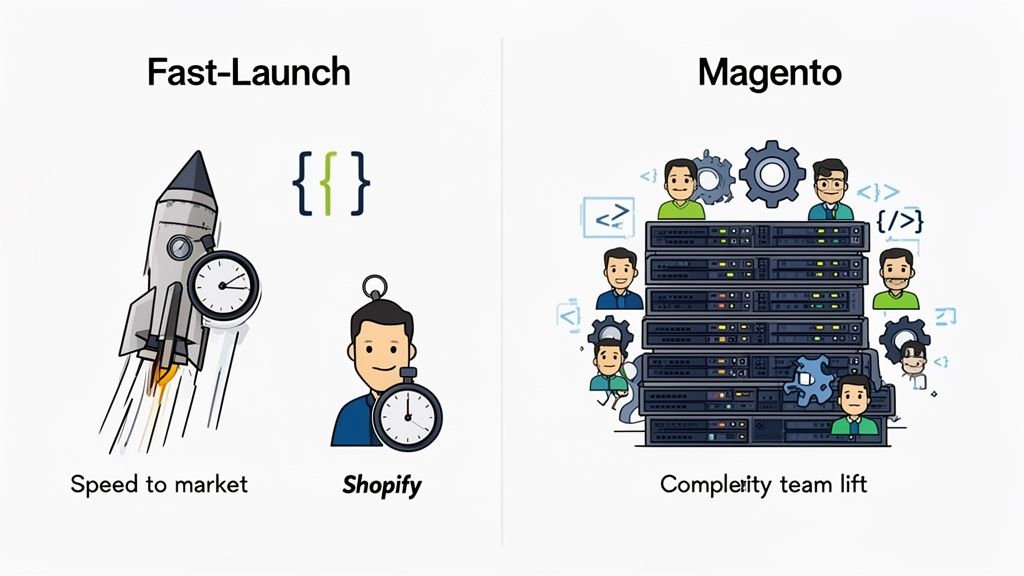
The journey from a business idea to your first sale looks wildly different on Shopify versus Magento (now Adobe Commerce). Your choice here is a fundamental one, setting the pace for your launch, defining the technical skills you'll need on hand, and determining the daily effort required to just keep the lights on.
Think of it this way: one platform is engineered for speed, the other for total architectural control.
Shopify’s entire philosophy is built around velocity and simplicity. As a fully-hosted SaaS platform, it handles the messy, technical backend stuff so you don't have to. Server configurations, security patches, database maintenance—it's all managed for you. This frees you up to concentrate on what actually grows the business: merchandising, marketing, and creating a great customer experience.
For most brands, this means a professional, secure, and fully optimized store can be up and running in a matter of weeks, not the months (or longer) a complex build can take. The process is straightforward, focusing on configuring settings, tweaking a theme with Shopify's Liquid templating language, and plugging in apps from its massive ecosystem.
Shopify: The Path of Rapid Deployment
On Shopify, the development cycle is clear and accessible. The required skillset is heavily weighted toward the front-end, mixing good design sense with an understanding of Shopify's theme structure. A single talented Shopify developer or a small, nimble team can get an incredible amount done in a very short time.
Let's imagine you want to launch a custom product builder. On Shopify, the project might look like this:
- Theme Customization: A front-end developer jumps into the product page template, using Liquid, HTML, and CSS to craft the user interface.
- App Integration: They'll likely find a proven product options app from the Shopify App Store to handle the complex logic and data behind the scenes.
- Shopify Scripts (Plus only): If you have tricky pricing rules based on customer selections, a developer can write a fairly simple Ruby-based script to manage it.
The key takeaway is that the core platform is a rock-solid foundation you build on top of, not something you have to manage yourself. This model dramatically cuts down the team size and timeline needed for new features.
Julian Klenda, CEO of Maine Lobster Now, saw this difference firsthand after moving from Magento. He shared that tasks that "used to be so difficult" on Magento became "turnkey" on Shopify. This shift allowed them to build their new store for about 90% less than what their previous Magento site cost.
Magento: The Commitment to Custom Engineering
Magento, on the other hand, operates on a different principle. It accepts complexity as the price for absolute control. Being open-source means every line of code is accessible, but this power comes with a whole lot of responsibility. Developing on Magento isn't a one-person job; it's a multi-disciplinary engineering effort that requires serious technical depth.
The codebase is notoriously intricate. You need senior developers who are experts in PHP, familiar with the Zend Framework, and have a deep understanding of Magento's unique architecture. And it doesn't stop with coding. You also need people to handle server administration, database tuning, and deployment pipelines. You're not just running a store; you're maintaining a sophisticated piece of enterprise software.
Let's look at that same custom product builder scenario, but this time on Magento:
- Backend Development: A PHP developer needs to create a custom module from scratch to manage the logic, database tables, and pricing rules. This alone is a major project.
- DevOps and Server Admin: A DevOps engineer must ensure the server is properly configured to handle the performance demands of the new module without slowing down the entire site.
- Front-End Integration: A separate front-end developer has to wire the new backend module into the user-facing theme, which often involves complex JavaScript and templating.
- Project Management: A dedicated project manager is almost always necessary to coordinate these different specialists and keep everything from going off the rails.
This heavy operational burden is precisely why brands like LAKOR moved away from Magento. They described a "sinking feeling that at any moment, you might need to open your laptop and fix something that broke." The difference in development complexity between Shopify and Magento isn't just a slight variation—it's a fundamental split in philosophy, cost, and the demands it places on your team.
Scalability, Performance, and Security Under Pressure
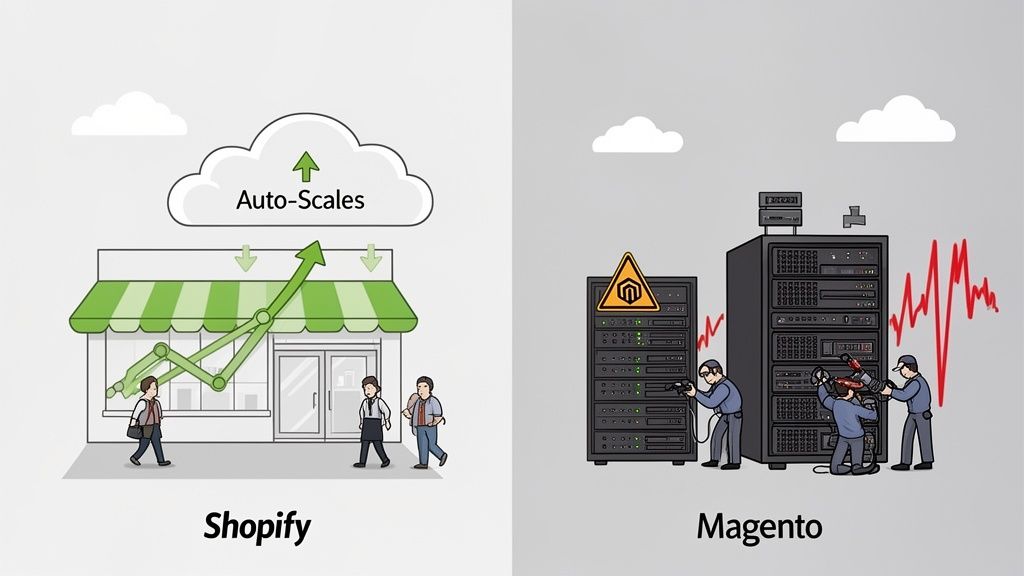
You only discover an eCommerce platform's true strength when it's under pressure. How it handles a massive traffic surge during a Black Friday sale or defends against a new security threat is what separates a reliable growth partner from a constant operational headache.
This is where the core difference between Shopify (SaaS) and Magento (open-source) becomes incredibly clear. One is built for peace of mind; the other is built for total control.
Shopify and Shopify Plus are designed so you don't have to think about infrastructure. That's their biggest selling point. You never worry about server capacity, uptime, or load balancing because Shopify’s global team is managing it all, 24/7. This includes a built-in Content Delivery Network (CDN) for fast load times worldwide and rock-solid, out-of-the-box security.
Magento, on the other hand, can scale to incredible heights, but its performance is entirely on you. The platform’s power is directly tied to the quality of your hosting and the expertise of your technical team. You get ultimate control, but you also carry the full weight of performance tuning, caching strategies, and security patching.
The Black Friday Stress Test
Let’s imagine your Black Friday campaign goes viral. Your site traffic spikes by 1,000% in an hour.
With Shopify, this is basically a non-event from an infrastructure perspective. The platform is engineered for these exact moments, automatically scaling resources to handle the flood of visitors without you lifting a finger. With a stellar average uptime of 99.98%, your store stays fast and stable. You can focus on shipping orders, not fighting server fires.
For a Magento store, this same scenario is a high-stakes exam for your team. Your site's survival hinges on meticulous preparation. Did you provision enough server power? Is your caching dialed in perfectly? Are all the latest security patches applied? One small oversight can crash your site at the most important moment of the year.
Key Differentiator: With Shopify, you're buying into a shared, battle-hardened infrastructure built to handle the combined peak traffic of millions of stores. With Magento, you're building your own private infrastructure, which is only as strong as your team and your budget.
Security and Compliance: A Shared vs. Sole Responsibility
Security isn't optional in eCommerce, and this is another area where the two platforms sit on opposite ends of the spectrum.
Shopify includes Level 1 PCI DSS compliance right out of the box. This is the highest level of compliance for handling credit card information, and Shopify takes on the massive complexity and cost of maintaining it for you. This built-in security is a huge relief, letting you focus on your business knowing customer data is protected. If you want to dive deeper, we have an in-depth look at how Shopify keeps your store safe.
With Magento, achieving and maintaining PCI compliance is 100% your responsibility. You have to make sure your hosting environment, custom code, and any third-party extensions all meet strict security rules. This means constant vigilance, regular security audits, and a team ready to apply security patches the minute they’re released. It gives you granular control, but it also introduces huge risks if not managed perfectly.
It's no surprise that Shopify has captured 10.32% of the global market by removing these technical hurdles. The platform’s average server response time of just 380ms is crucial for keeping customers engaged, potentially saving the 17% of sales that are often lost to slow-loading sites. This kind of reliability is why so many ambitious brands trust specialists for their development—they can grow without hitting technical walls. You can read more about Shopify's market share and performance metrics on redstagfulfillment.com.
Ultimately, the choice comes down to your risk tolerance and operational capacity. Shopify offers predictable performance and managed security. Magento gives you limitless power, but you have to know how to wield it and protect it yourself.
Ecosystem Extensibility and Customization Potential
An eCommerce platform's real power isn’t just what it does out of the box, but how it adapts and grows with your business. This flexibility comes down to its ecosystem—the collection of apps, extensions, and APIs that let you bolt on new features or completely rework the user experience. The Shopify vs. Magento debate is perfectly captured by their wildly different approaches here.
Shopify’s biggest draw is its curated, user-friendly App Store. Think of it as a massive, vibrant marketplace packed with thousands of plug-and-play solutions. The whole ecosystem is built for speed and simplicity, letting merchants add seriously sophisticated functionality without touching a single line of code.
You can have advanced loyalty programs, subscription services, or detailed analytics dashboards up and running in minutes. This "app-first" approach is perfect for brands that need to stay nimble and react to market trends without getting bogged down by developers.
Shopify: Adding Features to a Strong Foundation
The Shopify model is all about building on top of a solid, secure core. When your needs get more advanced, its powerful APIs become the gateway to headless commerce builds or fully custom applications. This allows for massive customization without ever modifying the underlying platform code, so you never have to worry about compromising stability or security.
Let's imagine a fashion brand wants to launch a "Shop the Look" feature.
- The Shopify Approach: The merchant heads to the App Store and finds a handful of pre-built solutions. They install one, tweak the settings, and push it live in an afternoon.
- The Outcome: This rapid deployment means they can immediately shift focus to marketing the new feature and measuring its impact, instead of getting stuck in a long, expensive development cycle.
Magento: The Power to Rebuild the Core
Magento, on the other hand, offers the ultimate in deep, core-level customization thanks to its open-source nature. It's not about adding features on top of a platform; it’s about having the total freedom to fundamentally change the platform itself to fit unique and complex business logic. This is where Magento really pulls ahead and justifies its higher development costs.
This kind of control is non-negotiable for businesses with highly specific operational needs that an off-the-shelf app could never handle. When a business process is so unique that it dictates how the technology must behave, Magento is often the only real choice.
Shopify lets you build on top of its platform; Magento lets you rebuild the platform itself. This is the most critical distinction when evaluating which platform’s customization potential aligns with your long-term vision.
Consider a B2B distributor with a multi-layered pricing engine. Prices change dynamically based on customer group, order volume, and real-time inventory pulled from a legacy ERP system. This isn't just a feature—it's the core of their business.
- The Magento Approach: A development team builds a custom module that integrates directly with the ERP. They modify Magento’s core pricing and checkout logic to fetch and apply these complex rules on the fly.
- The Outcome: The business gets an eCommerce platform that perfectly mirrors its complex offline operations. The upfront investment is steep, but the long-term gains in operational efficiency and accuracy are massive.
Ultimately, your choice comes down to the nature of your needs. If your goal is to add powerful, market-tested features quickly to a bulletproof platform, Shopify's ecosystem is second to none. But if your business model demands the ability to fundamentally rewrite how an eCommerce platform calculates, processes, or integrates data at its very core, then the limitless potential of Magento is the clear winner.
Making the Right Choice: A Decision Framework for Your Brand
Choosing between Shopify and Magento (Adobe Commerce) goes way beyond a simple feature list. It’s about matching a platform’s entire philosophy to your brand’s DNA. You’re not just picking software; you’re deciding how your business will operate and grow for years to come.
This framework is designed to cut through the noise and help you make that call with confidence. It all comes down to asking the right questions, starting with your big-picture goals and drilling down to your day-to-day reality.
The Core Decision Checklist
Before you sign on any dotted line, get your team in a room and get honest answers to these questions. Your responses will almost always point you decisively toward one platform or the other.
- What’s our real in-house technical muscle? Do you have a bench of experienced PHP developers and server admins ready to go, or is your team made up of marketers and merchants? Be brutally honest about your capacity to tame a complex, open-source beast.
- What's our realistic timeline to launch? Is getting to market fast a top priority to start bringing in revenue? A typical Shopify build is a matter of weeks, while a Magento project is often a multi-month marathon.
- How deep does our product complexity go? Do you just need to add features with pre-built apps, or do you need to fundamentally rewrite the platform’s core logic for things like bespoke B2B pricing or a one-of-a-kind inventory system?
- What’s our tolerance for surprise costs? Can your budget absorb variable monthly expenses for developer retainers and emergency fixes? Or do you need the financial guardrails of a predictable, fixed SaaS subscription?
The Litmus Test: If your world revolves around marketing, merchandising, and growing fast with predictable costs, Shopify is your platform. If your entire business is defined by deep operational complexity that demands rebuilding core code—and you have the technical team to back it up—Magento is the tool for the job.
Situational Recommendations for Ambitious Brands
Let's make this even clearer by mapping these questions to specific types of businesses. The Shopify vs. Magento choice gets a lot simpler when you see it through the lens of your business stage and specific needs.
Choose Shopify or Shopify Plus if:
- You’re a direct-to-consumer (DTC) brand focused on building a powerful brand and moving fast.
- Your business model thrives on agility and reacting quickly to market trends.
- You want to empower your non-technical team to manage the store every single day without calling a developer.
- You prefer a massive ecosystem of plug-and-play apps over custom-coded features.
- Predictable Total Cost of Ownership (TCO) and managed security are non-negotiable for your financial planning.
Consider Magento (Adobe Commerce) if:
- You are an established enterprise with complex B2B needs, like tiered pricing, customer-specific catalogs, and intricate quoting workflows.
- Your operations require deep, custom integrations with legacy ERP or PIM systems that off-the-shelf apps just can't handle.
- You have a dedicated, in-house development team and a budget earmarked for ongoing maintenance, security patching, and hosting.
- Your competitive edge comes from truly unique, custom-built functionalities that simply don't exist in any app marketplace.
Ultimately, this choice sets the course for your operational future. Shopify gives you a powerful, streamlined path to scale, freeing you up to focus on what you do best: growing your brand. Magento provides an unparalleled toolkit for engineering a completely bespoke eCommerce machine, but only if you have the resources to build and maintain it.
Frequently Asked Questions
When you're deep in the weeds comparing Shopify and Magento, the same questions always seem to pop up. Let's tackle some of the most common ones we hear from brands trying to make this exact decision.
Before diving into the specifics, it's always helpful to zoom out and understand the broader landscape of e-commerce platforms. Seeing where each one fits helps clarify which is truly the right long-term partner for your business goals.
Ultimately, the choice often boils down to a simple trade-off: do you need to get to market fast, or do you need absolute control over every line of code?
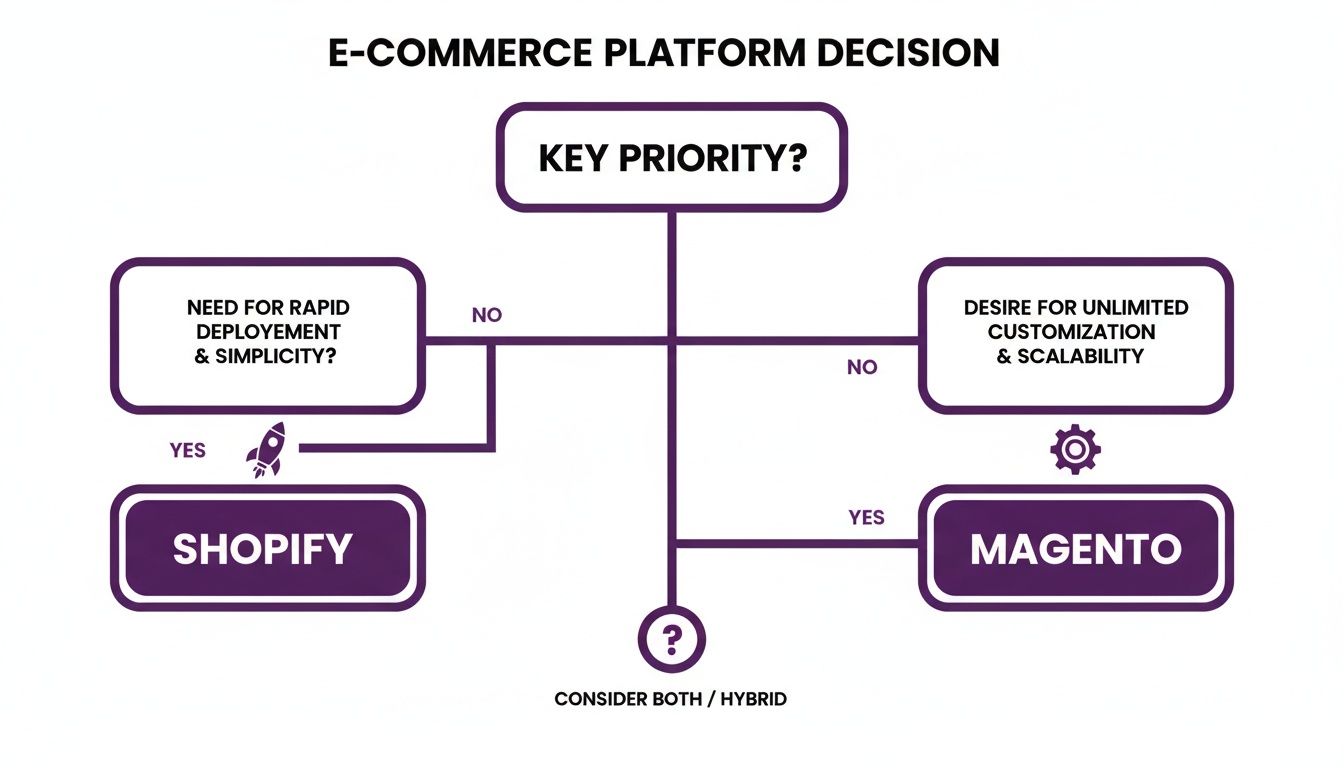
This decision tree really drives the point home. If your priority is a quick launch with straightforward operations, Shopify is your path. If your business model demands deep, foundational custom work, then Magento is the framework built for that.
Which Platform Is Better for B2B eCommerce?
For years, Magento was the undisputed king of B2B, thanks to native features like customer-specific catalogs and tiered pricing. But that's changed. Shopify Plus has significantly closed this gap with its own powerful B2B functionalities, a solid API, and its massive app ecosystem.
Honestly, for most growing B2B brands today, Shopify Plus offers a more agile and cost-effective path forward. Magento only really makes sense for huge enterprises with incredibly unique B2B logic that has to be hard-coded into the platform's core.
For businesses with straightforward wholesale needs, Shopify Plus delivers 80% of the required B2B functionality right out of the box. You get there faster and with a much lower total cost of ownership.
How Difficult Is Migrating From Magento to Shopify?
Moving from Magento to Shopify is a well-trodden path, but don't underestimate the complexity. It all comes down to your data. The main headache is mapping Magento’s notoriously complex data structures to Shopify’s much simpler model.
While migration tools can automate a lot of the grunt work, you'll almost certainly need a developer to properly handle the tricky parts:
- Customer data and order history
- Complex product attributes and configurations
- Redirecting SEO equity to preserve your search rankings
It's a significant project, but the payoff usually comes in the form of lower long-term maintenance costs and the freedom to move much faster.


What Is AI Integration for eCommerce
How to Choose the Right eCommerce Website Development Firm
E Business Strategy Implementation
Conversion Tracking Setup for Shopify Stores
BigCommerce vs Shopify Plus Which Enterprise Wins in 2026
Shopify Theme Kit: Setup, Commands, and Migration Guide
Shopify Extension Development: A Practical 2026 Guide

Shopify Speed Score Explained and How to Improve It

Shopify Mobile Optimization: The 2026 Playbook
How to Add Subcategory in Shopify for Better UX
How to Implement Structured Data for Ecommerce in 2026

SEO App Mobile: Shopify Store Optimization Guide

Shopify Plus Support: What It Includes and How to Choose

Google Ads for Shopify: The Complete 2026 Playbook

Shopify New York: How to Find and Hire the Right Agency

Google Search Console for Shopify: The Complete Setup
First Party Data Collection for eCommerce Growth
FAQ Online Store Guide: Build and Measure It Right

Do FB Ads Work for eCommerce in 2026?

One Page Checkout for Shopify: Design and Implementation
Shopify GraphQL vs REST: The 2026 Developer Decision
Shopify Ecommerce Consulting: Strategy, Pricing &

Are Reddit Ads Worth It for eCommerce Brands

Shopify Title and Meta Description: A Practical 2026 Guide

Product Video Best Practices for Shopify Brands

Real-Time Inventory Management: A 2026 Guide
AI Chatbot Integration for Shopify Stores

Affiliate Program Management: A Shopify Guide
10 Best Performance Monitoring Tools for Shopify in 2026

Digital Asset Management for eCommerce Brands in 2026
Every Type of Facebook Ads Explained for eCommerce Growth
Product Information Management Explained for Shopify Brands
Support Ticket System: A Guide for Shopify Stores

10 Best Customer Service Tools for Shopify in 2026

Can I Start a Business with No Money? a 2026 Blueprint

What Sells Good on Etsy: Best Niches for 2026

Shopify Add to Cart Button: A Practical 2026 Guide

Customer Feedback Automation: A Practical eCommerce Guide

Critical Rendering Path: A Guide for Shopify Stores

How to Promote on TikTok for eCommerce in 2026

B2B eCommerce Consulting That Drives Real Revenue

10 Best Practices for Site Navigation in 2026
Return vs Refund for Shopify Stores: A Practical Guide

What Is Customer Lifetime Value and Why It Matters

What Is Voice of Customer Research for eCommerce

SMS Marketing for Ecommerce That Actually Converts

Master How to Improve Email Deliverability in 2026

Top 7 eCommerce Partners NYC for Shopify Brands in 2026

Machine Learning for Ecommerce: Boost Your Shopify Store

Beauty Market Research: Your 2026 Growth Guide

Shopify International Expansion: A 2026 Roadmap
What Does CRO Stand for in Business: Understanding CRO

Shopify Visual Merchandising: A Playbook for Higher Sales

Shopify Landing Page Design: Master Conversion in 2026
10 Best AI SEO Optimization Tools for Shopify in 2026

Agentic AI for Ecommerce: Boost Your Sales in 2026
Mastering Email Marketing Data for eCommerce Growth

Conversion Rate Optimisation Australia: Boost Your Sales
Conversion Rate Optimization AI: Your Shopify Store Guide

10 Product Bundling Strategies for Shopify in 2026

How to Increase Customer Lifetime Value: A Shopify Playbook
AI Customer Service Automation: Shopify Guide 2026

Clean Website Design: A Shopify Conversion Playbook

Omnichannel Retail Strategy: A Shopify Playbook

Product Data Enrichment: A Guide for Shopify Brands

Instagram Shopping Features a Guide for Shopify Stores
What Is Revenue Optimization: A Holistic RevOps Guide

Benefits of Conversion Rate Optimization: Boost Your
WordPress to Shopify Migration: Your 2026 Seamless Switch
Boost Sales: Ecommerce Payment Processing Guide 2026
Unified Commerce Platform: Benefits, KPIs & Shopify Guide

How to Reduce Bounce Rate eCommerce: Your 2026 Guide
Shopify API Integration: A Practical End-to-End Guide

How to Implement Data Governance: A 2026 Guide
Shopify Store Development Cost: A 2026 Breakdown
What Is Server Side Tracking: The Shopify Guide 2026
Marketing Automation Workflows: A Shopify Guide for 2026

Shopify: How to Reduce Technical Debt

Shopify UX Design Change: A Playbook for Growth

User Generated Content Strategy: Shopify Playbook

Shopify Pause and Build Plan Cost: A Complete 2026 Guide
Compare at Price on Shopify: A Complete Guide for 2026

Where Can I Sell My Prints? 10 Best Platforms for 2026
Shopify Order Management System: The Ultimate Guide 2026
What Is Marketing Attribution? an eCommerce Guide for 2026

10 Best Black Friday Sales Sheets for 2026

Discover the Top Social Media Marketing Agencies For

Consumer Confidence Definition for eCommerce in 2026

What Is Social Commerce? Your 2026 Guide to Boosting Sales

A Social Ad Campaign Playbook for eCommerce Growth

7 Best FAQ Page Examples for SaaS & eCommerce

Market Research in Fashion Industry: A Guide for Shopify
Shopify Migration Services: Expert Guide for 2026

Mastering FB Retargeting Ads for Shopify in 2026
What Is Omnichannel Ecommerce

Master Your Shopify Plus Migration: The 2026 Guide
Shopify Integration Services: A Merchant's 2026 Guide
Shopify Collection Description: A Guide to SEO & Sales

Shopify Plus Contact: Reach Sales & Support Effectively

Top Luxury Shopify Stores: Design & UX Strategies


newsletter in your inbox