

Effective ecommerce marketing is really a mix of different strategies, all working together to attract new customers, convert them into buyers, and then keep them coming back. The goal isn't just to run a few disconnected campaigns; it's to build a complete growth engine that turns your online store into a reliable, revenue-generating machine.
Building Your Foundation for Sustainable Growth
Welcome to the playbook for scaling your online store. We're going to move beyond simple tactics and focus on building a cohesive system that drives real, sustainable growth.
Think of your ecommerce brand as a high-performance car. To win the race, you need a powerful engine, the right kind of fuel, and a clear map to the finish line. This guide is your blueprint for all three.
Great marketing isn’t about picking one channel and hoping for the best. It's about creating a flywheel where different strategies feed into each other. Each technique has a specific job, from grabbing a visitor's attention to encouraging that all-important second purchase, creating a cycle of continuous growth.
The Three Pillars of Ecommerce Marketing
To build this growth engine, you need to organize your efforts around three core functions. These pillars guide the entire customer journey, from the moment they first hear about you to when they become a vocal advocate for your brand.
Attract: This is the top of your funnel. It's all about generating awareness and driving traffic to your store. Techniques like Search Engine Optimization (SEO), content marketing, and social media ads are your bread and butter here, helping you capture the attention of people actively looking for what you sell.
Convert: Once someone lands on your site, the game changes. Now, the focus is on turning that initial interest into a sale. This is where Conversion Rate Optimization (CRO) comes in—refining product pages, making the checkout process dead simple, and using compelling visuals to nudge shoppers toward that "Buy Now" button.
Retain: Getting a new customer is almost always more expensive than keeping an existing one. That’s why retention marketing, powered by email, SMS, and loyalty programs, is so crucial. The aim here is to build lasting relationships and turn one-time buyers into loyal fans who purchase from you again and again.
This concept map shows how these three pillars—attract, convert, and retain—are not separate tasks but a continuous loop at the heart of your marketing.
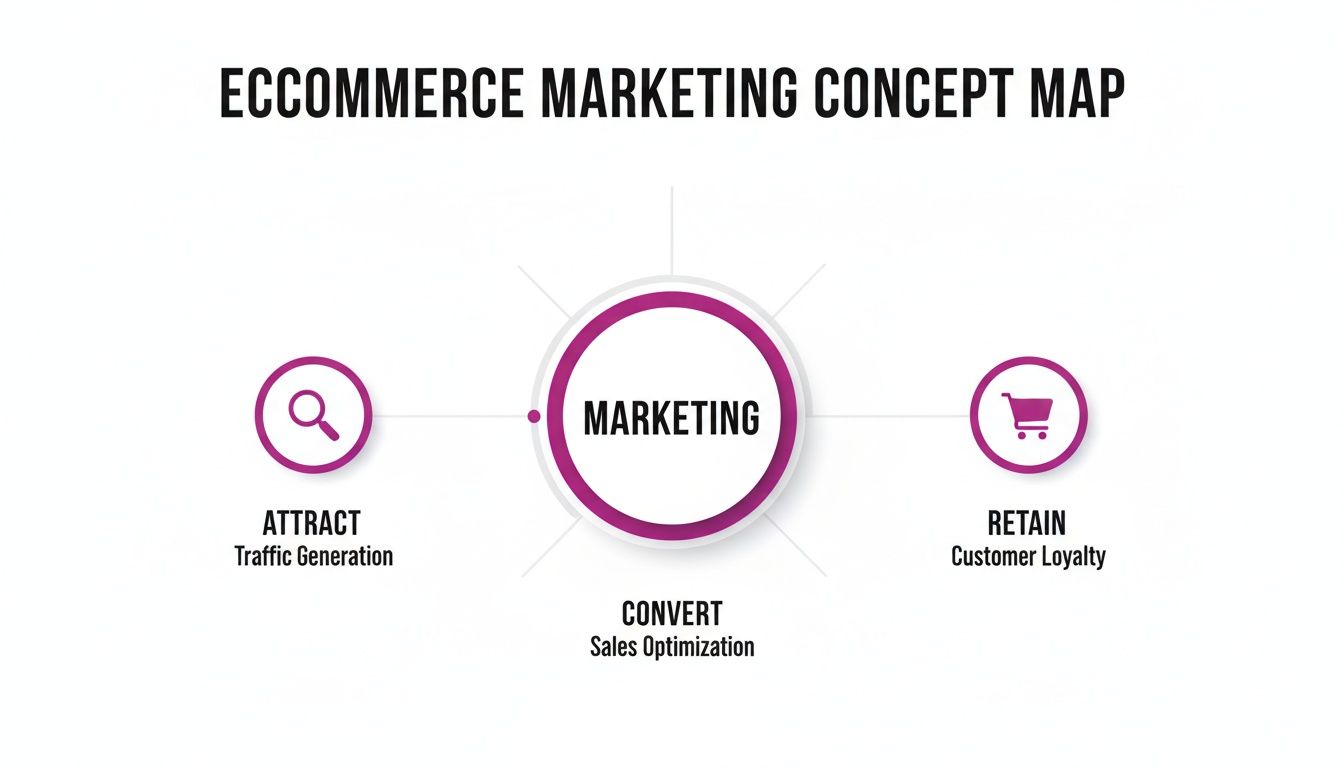
The key takeaway is that these functions are deeply connected. Happy, retained customers make attracting new ones easier through word-of-mouth. A smooth conversion process makes your attraction strategies that much more effective. This integrated approach is the framework for building a resilient, high-growth brand.
To give you a clearer picture, here's a quick breakdown of the core techniques we'll be diving into.
Core Ecommerce Marketing Techniques at a Glance
This table offers a snapshot of the essential marketing pillars, their main purpose, and how you can measure their impact. Think of it as your cheat sheet for understanding the ecommerce marketing landscape.
With this foundational understanding, you're ready to explore each of these techniques in detail. The following sections will provide a deep dive into the strategies, tools, and playbooks you need to succeed.
Driving Organic Traffic with SEO and Content
Imagine a steady stream of motivated customers finding your store every day—without you paying for every single click. That’s not a pipe dream; it’s the direct result of smart ecommerce Search Engine Optimization (SEO). It's all about transforming your online store into a magnet for search engines like Google.
The whole process boils down to optimizing what your customers see (on-page SEO) and the behind-the-scenes mechanics that make your site run smoothly (technical SEO). The goal is simple: make it ridiculously easy for search engines to find, understand, and rank your product pages for the exact terms your customers are typing into that search bar.
On-Page SEO: The Foundations of Visibility
On-page SEO covers all the optimizations you make directly on your website. Think of each product page as a tiny, highly targeted billboard that you want Google to show to the right person at the right time. For any ecommerce store, especially those built on Shopify, this is the lowest-hanging fruit.
Getting your on-page SEO right means nailing a few key elements:
- Keyword-Rich Title Tags: This is the blue, clickable link people see in search results. It needs to include your main keyword and product name, like "Women's All-Weather Running Shoes | Your Brand Name."
- Compelling Meta Descriptions: This is the short snippet of text under the title. It’s not a direct ranking factor, but a great description acts like ad copy, tempting people to click on your link instead of a competitor's.
- Descriptive Product Details: Ditch the generic manufacturer descriptions. Write unique, genuinely helpful product descriptions that answer customer questions and naturally weave in relevant keywords. Duplicate content can actually hurt your rankings, so this step is critical.
- Optimized Image Alt Text: Search engines can't "see" your beautiful product photos. Alt text describes the image, which helps with accessibility and gives you a chance to rank in image searches.
These foundational tasks are absolutely crucial. When you get them right, you're sending clear signals to search engines about what your pages are about, making it much more likely they'll show up when it matters.
"When done well, SEO is an extremely cost-effective way to attract visitors who are actively looking to buy what you're selling."
This is precisely why you should focus on the basics first. You’re building a solid base that all your other marketing efforts can stand on. To really dig in and start seeing results, you'll want to implement current ecommerce SEO best practices.
Technical SEO: Keeping Your Store Healthy
While on-page SEO is what the user interacts with, technical SEO is all about your website's infrastructure. If your store were a brick-and-mortar shop, technical SEO would be its foundation, electrical wiring, and plumbing. It has to be rock-solid for everything else to work.
For an ecommerce site, this means your store must be fast, secure, and easy for search engine crawlers to navigate. Key components include:
- Site Speed: A slow-loading site is a conversion killer, plain and simple. Studies have shown 73% of mobile users have bailed on a site that took too long to load. Compressing your images and using a fast Shopify theme are non-negotiable.
- Mobile-Friendliness: The vast majority of online shopping now happens on a phone. Your site absolutely must provide a seamless experience on a smaller screen, from browsing all the way to checkout.
- Clean URL Structure: Simple, logical URLs (e.g.,
yourstore.com/collections/running-shoes) are far better than messy, auto-generated ones. They're easier for both humans and search engines to understand at a glance.
Content Marketing That Solves Problems
SEO gets people to your door, but great content invites them in and convinces them to stay. For ecommerce brands, content marketing isn't just about churning out blog posts; it's about becoming a trusted resource for your audience. You're not just selling a product—you're selling a solution.
Think beyond your product pages. Let’s say you sell high-end kitchen knives. You could create content like:
- A blog post on "How to Properly Sharpen Your Chef's Knife"
- A downloadable guide covering "The 5 Essential Knives Every Home Cook Needs"
- A quick video tutorial showing different cutting techniques
This kind of content attracts potential customers while they're still in the research phase, establishing your brand as an expert. By helping them solve a problem, you build a level of trust that naturally leads them to your products when they're ready to buy. To take this a step further, check out our guide on building an ecommerce content strategy that turns visitors into loyal customers.
Maximizing Sales with CRO and AI Personalization
Getting a flood of visitors to your store is a great start, but it’s only half the battle. The real magic happens when those visitors become paying customers. That's where Conversion Rate Optimization (CRO) comes in.
Think of CRO as the art of refining your digital storefront. It’s all about making the path from "just browsing" to "just bought" as smooth and compelling as possible.
The best way to start is to put yourself in your customer's shoes and take a "digital walkthrough" of your own store. Where do they get stuck? What makes them hesitate or, even worse, bounce from your site completely? Every little point of friction—a confusing menu, a slow-loading image, or a clunky checkout form—is an opportunity to do better.
The Science of Small Improvements
At its core, CRO isn't about guesswork; it’s a data-driven discipline. Instead of guessing what might work, you test changes and let your customers' behavior tell you what’s best. This is where A/B testing (or split testing) becomes your most powerful tool. You simply show two different versions of a page to different groups of visitors to see which one performs better.
You can test almost anything, but here are some high-impact areas to get you started:
- Product Page Layouts: Does a gallery of images on the left convert better than one big hero image at the top? There’s only one way to find out.
- Call-to-Action (CTA) Buttons: Play around with the color, size, and text of your "Add to Cart" or "Buy Now" buttons. A simple tweak from "Buy" to "Get Yours Now" can sometimes make a surprising difference.
- Checkout Process: Can you cut down the number of steps or fields needed to make a purchase? A streamlined, one-page checkout often blows a multi-step process out of the water.
Even tiny improvements in your conversion rate can lead to massive revenue gains over time. To dive deeper into finding and fixing these friction points, check out our in-depth guide to ecommerce conversion rate optimisation.
Powering Conversions with AI Personalization
If CRO provides the framework for optimization, then Artificial Intelligence (AI) adds a layer of dynamic, real-time personalization that can seriously supercharge your results. Imagine having a personal shopper for every single visitor—one who knows their tastes and can instantly point them to products they'll love. That’s the power of AI in ecommerce.
AI algorithms analyze a user's browsing history, past purchases, and even on-site behavior (like where they move their mouse) to create a completely unique shopping experience. This is where we move beyond basic CRO into a world where your store actually adapts to each individual.
AI personalization is no longer some futuristic concept for retail giants. It's an accessible and essential tool for creating shopping experiences that feel uniquely relevant to every single customer.
That relevance is exactly what modern shoppers expect. The impact is undeniable: by 2025, the AI-enabled ecommerce market is projected to hit $8.65 billion. We also know that 91% of shoppers are more likely to buy from brands that offer personalized recommendations. This is the same approach that allows giants like Amazon to drive over 35% of their sales from recommendations alone.
Practical AI Applications for Your Store
Here’s the good news: you don't need a team of data scientists to get started. For Shopify store owners, there's a whole ecosystem of powerful apps that can integrate this technology seamlessly, helping you boost both conversion rates and Average Order Value (AOV).
Here are a few ways you can put AI to work right now:
- AI-Powered Product Recommendations: Go beyond the generic "You might also like" section. AI can display hyper-relevant suggestions based on what a user has viewed, added to their cart, or bought in the past. It's a cross-selling and upselling machine.
- Dynamic Content and Offers: Personalize the content on your homepage, pop-ups, and banners. An AI tool could show a "Free Shipping" banner to a first-time visitor while showing a "10% Off for Loyal Customers" message to a repeat buyer.
- Predictive Search: The moment a visitor starts typing in your search bar, AI can predict what they’re looking for and show relevant product suggestions, making product discovery incredibly fast.
- Personalized Email and SMS: Connect AI with your email and SMS marketing to send messages with product recommendations tailored to each subscriber's browsing history. It's a huge step up from generic newsletters.
By combining the methodical testing of CRO with the intelligent automation of AI, you create a powerful system for growth. You’re not just making your website better in general; you’re making it better for every single person who visits.
Putting Your Foot on the Gas with Paid Ads and Social Media
While SEO and content marketing are busy laying a strong, long-term organic foundation, paid advertising and social media are the rocket fuel for your growth engine. These are the ecommerce marketing techniques you use for immediate, targeted traffic, letting you jump right in front of the right people at the exact moment they’re thinking about buying.
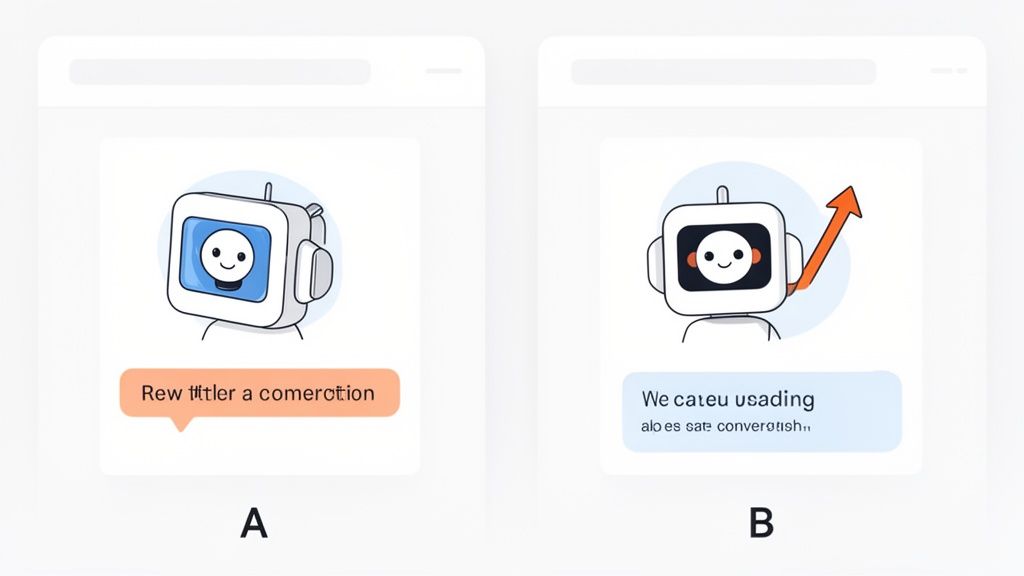
Think of paid media as paying for a pop-up shop in the busiest digital intersection in the world. Instead of waiting for shoppers to wander into your store, you’re setting up right in their path, turning casual browsers into paying customers. The whole game is about picking the right spots and building campaigns that actually connect, making sure every dollar you put in comes back with friends.
Choosing Your Paid Advertising Platforms
Here’s the thing: not all platforms are created equal. Spreading your budget too thin across every channel out there is a classic rookie mistake and a surefire way to burn through cash. Your first move is to get smart and pick the channels where your ideal customers already hang out. This decision comes down to your product and who you're trying to sell it to.
For instance, if you're selling anything visual—apparel, home decor, cosmetics—you need to be on platforms like Instagram and Pinterest. The right image or video can literally stop someone mid-scroll. On the other hand, if your product solves a very specific problem, Google Ads is your best friend. It lets you capture people with high buying intent who are actively typing your solution into a search bar.
A common pitfall is trying to be everywhere at once. Don't. Instead, become a master of one or two key platforms where you know your audience lives. Once you're getting solid results and have good data, then you can start branching out.
This focused approach means you'll actually learn the quirks of each platform's ad tools, get better at optimizing your campaigns, and stop wasting money on channels that just aren't a good fit.
The Power of Social Media Marketing
Social media is so much more than just a billboard for your ads. It's where you build a real community and show people there are humans behind the brand. A winning strategy mixes organic, relationship-building content with paid promotion to create a one-two punch that drives both engagement and sales.
Organic social content is all about building that know, like, and trust factor. This includes stuff like:
- Behind-the-scenes glimpses of how your products are made or what your team is up to.
- User-generated content (UGC) showing off real customers loving your products.
- Educational posts that are genuinely helpful and solve problems for your audience.
This is the content that builds loyalty and keeps people coming back. Then, paid social ads act as a megaphone, blasting your best organic posts or specific offers out to a much bigger, laser-targeted audience. You can do incredibly powerful things like retargeting people who visited your site but didn't buy, or creating lookalike audiences based on the traits of your absolute best customers.
Crafting Campaigns That Actually Convert
A great ad doesn't just show a product; it tells a mini-story and solves a problem. Your ad creative—the image or video—and your copy have to team up to grab attention and quickly explain why someone should care. You want the viewer to feel like you "get" them and their problem, and that you have the perfect solution.
Here are the three essential pillars of a high-converting ad:
- A Compelling Hook: You have about three seconds. Maybe less. Start with a sharp question, a surprising stat, or a visual that’s impossible to ignore to stop the scroll.
- A Clear Benefit: Skip the feature list. Tell them how your product is going to make their life better, easier, or more fun. Focus on the outcome.
- A Strong Call-to-Action (CTA): Be direct. Tell people exactly what you want them to do next. "Shop Now," "Learn More," or "Get 20% Off Today" are clear and effective.
At the end of the day, the goal of paid media isn't just to spend money—it's to get a positive Return on Ad Spend (ROAS). When you carefully pick your platforms, blend your organic and paid social efforts, and create ads that truly connect, you can turn your ad budget into a predictable, scalable revenue machine. This is how you grow, fast.
Creating Lifetime Value Through Retention Marketing
The most profitable ecommerce brands know a secret: getting a new customer is just the opening act. While traffic and first-time buyers are great, the real, lasting growth comes from turning those shoppers into loyal fans who come back again and again. This is the heart of retention marketing—a playbook of techniques designed to build genuine, long-term customer relationships.
Think of your owned marketing channels, mainly email and SMS, as your direct hotline to your customers. Unlike the rented space of social media or paid ads, you're in complete control of the conversation here. This lets you personally guide customers through their journey with your brand, creating automated, yet deeply personal, dialogues that keep you top of mind and drive that next sale.
Essential Automated Email Flows
Email marketing is still an absolute powerhouse for ecommerce, pulling in a stunning ROI of around $36 for every $1 spent. But the secret to tapping into that potential isn't blasting out newsletters—it's automation. By setting up smart, strategic email flows, you can engage every customer with the perfect message at the perfect time, all without lifting a finger.
These automated sequences are like having a 24/7 sales and support team working for you. Here are the three non-negotiable flows every online store needs to have running:
- The Welcome Series: This is your big first impression after someone subscribes. Don't just send a single "welcome" email. Craft a 3-5 part series that tells your brand's story, shows off your bestsellers, and maybe offers a small hook to encourage their first purchase.
- Abandoned Cart Recovery: A huge number of shopping carts are left behind at the last minute. This automated flow is your single best tool for winning back that lost revenue. A simple reminder, followed by an email that tackles common worries (like shipping costs) or creates a little urgency, can bring a huge chunk of those almost-customers back to finish the job.
- Post-Purchase Follow-Ups: The conversation can't stop at the "thank you" page. A solid post-purchase series should include order confirmations, shipping updates, and—crucially—a follow-up asking for a review. This keeps customers in the loop and shows you care about their experience, not just their money.
The Power of Audience Segmentation
Sending the same generic email to your entire list is a one-way ticket to low open rates and a flood of unsubscribes. The real magic of modern email marketing is segmentation. This just means slicing your audience into smaller, more specific groups so you can send them messages that actually feel relevant.
A personalized email isn't a "nice-to-have" anymore; it's what customers expect. They are far more likely to open, click, and buy from brands that send them relevant offers based on what they've done before.
For instance, you could create segments based on:
- Purchase History: Target customers who bought a specific product with offers for items that go perfectly with it.
- Purchase Frequency: Roll out the red carpet for your VIPs (your frequent shoppers) with early access or exclusive deals. For customers who've gone quiet, send a special "we miss you" offer to win them back.
- Location: Send out promotions tied to regional holidays or let people know about a local pop-up shop.
When you tailor your messaging this way, you make customers feel seen and understood. Your marketing shifts from a generic broadcast to what feels like a one-on-one chat. To truly master this and keep customers coming back, you need solid strategies to improve customer retention and build that unwavering loyalty.
High-Impact Communication with SMS Marketing
While email is your go-to for building relationships over time, SMS marketing is your tool for instant, high-impact messages. With open rates that often soar past 90%, a text message is almost guaranteed to be seen right away.
But with great power comes great responsibility. Because texting is such a personal channel, you have to use it wisely. This isn't for your weekly newsletter; it's for can't-miss announcements that demand immediate action.
Reserve SMS marketing for things like:
- Flash Sales and Limited-Time Offers: Nothing creates urgency like a text about a sale that ends in 24 hours.
- New Product Drops: Let your biggest fans get first dibs when a hot item is back in stock or a new collection finally arrives.
- Order and Shipping Confirmations: These are high-value, real-time updates that genuinely improve the customer experience and build trust.
By combining the patient, relationship-building power of email with the immediate punch of SMS, you create a truly powerful retention machine. This dynamic duo turns one-time buyers into genuine brand advocates who provide the predictable, long-term revenue that your store’s success is built on.
It’s a Mobile World, Your Store Just Lives In It
Let's face it: your customers are living on their phones. That’s where the modern shopping journey starts, stalls, and finishes. Having a “mobile-friendly” site isn't some competitive advantage anymore—it’s the absolute bare minimum, the price of admission.
To really get ahead, you have to think mobile-first from the ground up. This means designing the whole experience—from the first tap to the final thank you page—for a small screen and a distracted user. Picture it like this: you're building an intimate, easy-to-browse boutique, not a sprawling, messy warehouse. Everything needs to feel intuitive, quick, and frankly, a little bit delightful.
The Undeniable Power of M-Commerce
The sheer scale of mobile commerce (or m-commerce) is staggering, and it's not slowing down. This isn't just a trend; it's a seismic shift. M-commerce now drives 44% of all US ecommerce sales, and experts predict that number will rocket to $710 billion by 2025. On a global scale, it's already a whopping 60%. The message is loud and clear: if your store isn’t built for mobile, you're shutting the door on the majority of your potential customers. You can dive deeper into these trends with these ecommerce statistics on elementor.com.
And this mobile-first reality bleeds into everything, especially how people discover your brand. Social commerce—a huge part of the mobile experience—is on track to become a $2.9 trillion market by 2026. This means those shoppable Instagram posts aren't just for getting likes; they're becoming primary sales channels.
Optimizing for mobile isn't just a technical to-do list; it's a strategic imperative. It's about meeting your customers exactly where they are and removing every single frustrating roadblock between them and the "buy" button.
By making this your priority, you’re not just chasing a trend. You're aligning your business with the undeniable reality of consumer behavior and setting yourself up to win in a mobile-dominated future.
Key Pillars of a Mobile-First Strategy
To build a mobile experience that actually converts, you need to laser-focus on three critical areas. Get these right, and your site won't just be accessible on a phone—it will be genuinely great to use.
Lightning-Fast Page Loads: Mobile shoppers have zero patience. We're talking none. Research shows that a staggering 73% of users will bounce if a mobile site takes more than three seconds to load. Every second you shave off your load time is money in your pocket. Compressing your images, using browser caching, and picking a speedy Shopify theme aren't just suggestions; they're non-negotiable.
Thumb-Friendly Navigation: Remember, you're designing for thumbs, not mouse cursors. This means big, obvious, easy-to-tap buttons are your best friends. Your "Add to Cart" and "Checkout" buttons should be impossible to miss and right where a thumb can comfortably reach them. Keep your menus clean and simple, so finding a product doesn't feel like a scavenger hunt.
A Simplified Checkout Process: A clunky, complicated checkout is where countless mobile sales go to die. Your job is to make it ridiculously easy to give you money. Slash the number of form fields down to the absolute essentials. More importantly, integrate one-tap payment options like Apple Pay, Google Pay, and Shop Pay. This turns a tedious chore into a seamless, satisfying transaction.
Answering Your Top Ecommerce Marketing Questions
Stepping into the world of ecommerce marketing can feel like drinking from a firehose. There's so much advice out there, and it's tough to know where to start. We get it. Founders and marketers ask us the same questions all the time, so we’ve put together some straight-to-the-point answers.
Our goal is to cut through the noise and give you a clear path forward. Let’s jump into the practical stuff you can use right away.
What Are the Most Important Techniques for a New Store?
When your store is brand new, the key is to focus. Don't try to boil the ocean by being on every platform and running every type of campaign. Instead, pour your energy into a few foundational, cost-effective strategies. Build a solid base before you even think about scaling up with paid ads.
Here's your short list:
- On-Page SEO: Get the basics right on your product and category pages. That means writing unique, keyword-rich descriptions and titles that clearly tell search engines what you're selling. This is your digital storefront—make it easy for people to find.
- Essential Email Automations: You need a simple welcome series to greet new subscribers and an abandoned cart flow to bring back lost sales. Think of these two automations as your 24/7 sales team, working for you even when you're asleep.
- Core Social Presence: Pick just one or two social media platforms where you know your ideal customers hang out. Your job is to build a real community there with content that's genuinely engaging and helpful, not just a constant sales pitch.
The goal for a new store isn't to be everywhere, but to be truly effective where it counts. Nail these fundamentals, and you'll have a sturdy launchpad for everything that comes next.
How Should I Prioritize Marketing Channels?
Deciding where to put your time and money is one of the most critical decisions you'll make. The right answer depends entirely on your specific audience, your budget, and where your business is right now. You have to be a bit of a detective—your first job is to figure out where your ideal customers actually spend their time online.
If you're selling highly visual products, for example, platforms like Instagram and Pinterest are a natural fit. But if you’ve got a product that solves a very specific, searchable problem, then SEO and Google Ads are likely where you'll find your goldmine.
The smartest approach? Test a few promising channels with a small, controlled budget. Keep a close eye on your Customer Acquisition Cost (CAC) for each one. As soon as you spot the channels bringing in the most profitable customers, you can double down with confidence. This data-driven method takes the guesswork out of the equation and replaces it with smart, strategic decisions.
Ready to put these advanced ecommerce marketing techniques into action and start seeing real growth? The team of Shopify specialists at ECORN is here to help you design, develop, and optimize your store for peak performance. Explore our scalable solutions and see how we can help your brand thrive.


Best Shopify Theme for Custom Products Compared
Multi Store Inventory Management: A Practical Guide

SEO Consulting for Ecommerce: A Practical Guide
Shopify Theme Updater App: A Safe Update Playbook
Shopify Git Integration: A Developer's Guide to 2026
Headless Ecommerce Development Services Explained

How to Build a Shopify Clothing Website That Converts
How to Launch a Box Subscription Business in 2026

Luxury Skincare Branding Playbook That Converters
10 Best Podcast Ecommerce Shows for Store Growth in 2026
Shopify Developer Hourly Rate: What to Pay in 2026
Critical Shopify Setup Errors That Are Secretly Sabotaging Your Store
Ecommerce Conversion Tracking: The Complete How-To Guide
Shopify Design Agency: How to Pick the Right Partner
Mastering Multi Store Management on Shopify
Scale Shopify Store
10 Shopify App Ideas Worth Building in 2026
Conversion Rate Optimization for Landing Pages: The Playbook
Shopify Plus Automation: A Guide for 2026
10 Social Selling Platforms for Shopify Merchants

Shopify Website Design Examples: 7 Stores Worth Studying
7 Ecommerce Newsletter Examples for Shopify Brands
One Product Shopify Store: Build and Scale
Mobile Pop Up Strategy for Shopify Stores That Converts
Sitemap for Shopify: How to Find, Optimize, and Submit It
7 Single Product Websites Worth Emulating
Product Variants Shopify: The Complete 2026 Guide
Ecommerce Analytics Consulting for Growth
What Is AI Integration for eCommerce
How to Choose the Right eCommerce Website Development Firm
E Business Strategy Implementation
Conversion Tracking Setup for Shopify Stores
BigCommerce vs Shopify Plus Which Enterprise Wins in 2026
Shopify Theme Kit: Setup, Commands, and Migration Guide
Shopify Extension Development: A Practical 2026 Guide
Shopify Speed Score Explained and How to Improve It
Shopify Mobile Optimization: The 2026 Playbook
How to Add Subcategory in Shopify for Better UX
How to Implement Structured Data for Ecommerce in 2026
SEO App Mobile: Shopify Store Optimization Guide
Shopify Plus Support: What It Includes and How to Choose
Google Ads for Shopify: The Complete 2026 Playbook
Shopify New York: How to Find and Hire the Right Agency
Google Search Console for Shopify: The Complete Setup
First Party Data Collection for eCommerce Growth
FAQ Online Store Guide: Build and Measure It Right
Do FB Ads Work for eCommerce in 2026?
One Page Checkout for Shopify: Design and Implementation
Shopify GraphQL vs REST: The 2026 Developer Decision
Shopify Ecommerce Consulting: Strategy, Pricing &
Are Reddit Ads Worth It for eCommerce Brands
Shopify Title and Meta Description: A Practical 2026 Guide
Product Video Best Practices for Shopify Brands
Real-Time Inventory Management: A 2026 Guide
AI Chatbot Integration for Shopify Stores
Affiliate Program Management: A Shopify Guide
10 Best Performance Monitoring Tools for Shopify in 2026
Digital Asset Management for eCommerce Brands in 2026
Every Type of Facebook Ads Explained for eCommerce Growth
Product Information Management Explained for Shopify Brands
Support Ticket System: A Guide for Shopify Stores

10 Best Customer Service Tools for Shopify in 2026

Can I Start a Business with No Money? a 2026 Blueprint
What Sells Good on Etsy: Best Niches for 2026

Shopify Add to Cart Button: A Practical 2026 Guide

Customer Feedback Automation: A Practical eCommerce Guide
Critical Rendering Path: A Guide for Shopify Stores

How to Promote on TikTok for eCommerce in 2026

B2B eCommerce Consulting That Drives Real Revenue
10 Best Practices for Site Navigation in 2026
Return vs Refund for Shopify Stores: A Practical Guide
What Is Customer Lifetime Value and Why It Matters
What Is Voice of Customer Research for eCommerce

SMS Marketing for Ecommerce That Actually Converts

Master How to Improve Email Deliverability in 2026

Top 8 eCommerce Partners NYC for Shopify Brands in 2026
Machine Learning for Ecommerce: Boost Your Shopify Store
Beauty Market Research: Your 2026 Growth Guide

Shopify International Expansion: A 2026 Roadmap
What Does CRO Stand for in Business: Understanding CRO

Shopify Visual Merchandising: A Playbook for Higher Sales

Shopify Landing Page Design: Master Conversion in 2026
10 Best AI SEO Optimization Tools for Shopify in 2026

Agentic AI for Ecommerce: Boost Your Sales in 2026
Mastering Email Marketing Data for eCommerce Growth
Conversion Rate Optimisation Australia: Boost Your Sales
Conversion Rate Optimization AI: Your Shopify Store Guide

10 Product Bundling Strategies for Shopify in 2026
How to Increase Customer Lifetime Value: A Shopify Playbook
AI Customer Service Automation: Shopify Guide 2026
Clean Website Design: A Shopify Conversion Playbook

Omnichannel Retail Strategy: A Shopify Playbook
Product Data Enrichment: A Guide for Shopify Brands
Instagram Shopping Features a Guide for Shopify Stores
What Is Revenue Optimization: A Holistic RevOps Guide
Benefits of Conversion Rate Optimization: Boost Your
WordPress to Shopify Migration: Your 2026 Seamless Switch
Boost Sales: Ecommerce Payment Processing Guide 2026
Unified Commerce Platform: Benefits, KPIs & Shopify Guide
How to Reduce Bounce Rate eCommerce: Your 2026 Guide


newsletter in your inbox