


In the competitive world of ecommerce, a reactive approach to security is a recipe for lost revenue and damaged customer trust. As fraudulent tactics become more sophisticated, growing brands, particularly on platforms like Shopify, must adopt a multi-layered defense. Simply relying on basic gateway checks is no longer sufficient to protect your profit margins from the ever-present threat of chargebacks and unauthorized transactions.
This guide moves beyond generic advice, offering a prioritized, actionable roundup of the most critical ecommerce fraud prevention best practices. We'll dissect the essential controls and operational workflows that form a comprehensive security framework. You will gain a clear understanding of how to implement and optimize key strategies, transforming your fraud management from a costly, reactive process into a proactive, strategic advantage.
We will cover a range of specific, high-impact tactics, including:
- Detection Controls: Leveraging tools like 3D Secure, device fingerprinting, and AVS/CVV checks.
- Operational Workflows: Building efficient manual review queues and effective chargeback dispute processes.
- Performance Monitoring: Establishing KPIs to measure success and identify emerging threats.
- Automation and Integration: Guidance for implementing these practices within the Shopify ecosystem.
Each practice is broken down into actionable steps, providing a clear roadmap to not only protect your bottom line but also create a secure and seamless shopping experience for your legitimate customers. This article provides the blueprint for building a resilient fraud prevention strategy that supports your brand's growth and safeguards your success. Let's begin fortifying your digital storefront.
1. Master 3D Secure (3DS) Authentication for Ironclad Transactions
One of the most powerful ecommerce fraud prevention best practices is leveraging 3D Secure (3DS). This protocol acts as an additional security layer for card transactions, requiring customers to authenticate themselves directly with their issuing bank. While older versions sometimes created clunky user experiences, the modern iteration, 3DS 2.0, is far more sophisticated.
How 3DS 2.0 Works
3DS 2.0 uses over 100 data points to conduct a silent, real-time risk assessment in the background. Legitimate, low-risk transactions pass through a "frictionless flow" with no extra steps for the customer. However, if the transaction is flagged as high-risk, the customer is prompted with a "challenge flow" to verify their identity via a one-time code, biometrics, or a password.
The primary benefit for merchants is the liability shift. For transactions that are successfully authenticated through 3DS, the liability for any resulting fraudulent chargebacks shifts from you to the card-issuing bank. This directly protects your revenue and your merchant account health.
Key Takeaway: Implementing 3DS 2.0 isn't just about blocking fraud; it's a strategic move to transfer financial risk away from your business for authenticated transactions.
Actionable Implementation Tips
- Apply Risk-Based Rules: Don't enable 3DS for every single transaction. Work with your payment gateway (like Shopify Payments) to trigger it only for high-risk scenarios. For example, you might enable it for all international orders over $500 or for first-time customers using a new shipping address.
- Communicate Clearly at Checkout: Add a small note on your checkout page explaining the extra security step. A simple message like, "For your security, your bank may ask you to verify this purchase," can manage expectations and reduce cart abandonment.
- Monitor Performance: After implementation, keep a close eye on your conversion and cart abandonment rates. If you see a negative impact, you may need to adjust your 3DS rules to be less aggressive.
- Understand Regional Mandates: For businesses operating in Europe, understanding Strong Customer Authentication (SCA) requirements is mandatory. An insightful PSD2 integration guide can help you navigate these complex regulatory frameworks, which often rely on 3DS for compliance.
2. Leverage Machine Learning and AI for Predictive Fraud Detection
Beyond static rules, one of the most proactive ecommerce fraud prevention best practices involves harnessing the power of machine learning (ML) and artificial intelligence (AI). These systems analyze vast datasets in real-time to identify complex patterns and predict fraudulent activity with a level of precision that manual reviews and simple rules cannot match.

How AI-Powered Fraud Detection Works
Unlike a fixed rule (e.g., "decline all orders over $1,000 from X country"), a machine learning model learns from thousands of data points from both historical fraudulent and legitimate transactions. It identifies subtle correlations and anomalies related to device information, user behavior, transaction velocity, and network data. As it processes more orders, the model continuously refines its understanding of what constitutes a "good" versus a "bad" transaction, adapting to new fraud tactics automatically.
This is the technology powering industry-leading tools like Stripe Radar and Shopify Flow, which assess risk scores for every transaction. The core benefit is speed and scalability. AI models can make highly accurate decisions in milliseconds, allowing your business to approve more legitimate orders instantly and block sophisticated fraud without human intervention.
Key Takeaway: Implementing an AI-driven fraud solution allows your business to move from a reactive to a predictive stance, stopping fraud before it happens while minimizing friction for genuine customers.
Actionable Implementation Tips
- Combine AI with Human Oversight: Use the AI model to score and flag transactions, but route the high-risk, borderline cases to a manual review queue. This "human-in-the-loop" approach trains the model and catches nuances the AI might miss.
- Establish a Feedback Loop: Ensure your system learns from your decisions. When you manually approve a transaction the AI flagged (or vice-versa), that data should be fed back into the model to improve its future accuracy.
- Tune Your Risk Thresholds: Don't just turn the system on and walk away. Monitor your approval rates and false positive rates. If you're declining too many legitimate orders, you may need to adjust the risk score threshold that triggers a block or a review.
- Explore Broader Applications: AI's role in ecommerce extends far beyond just fraud detection. Understanding the full scope of AI applications in ecommerce can reveal new opportunities for personalization, operational efficiency, and customer service.
3. Utilize Address Verification System (AVS) Checks
Another foundational ecommerce fraud prevention best practice is to fully utilize the Address Verification System (AVS). This is a simple yet effective tool provided by card networks (Visa, Mastercard, etc.) that cross-references the billing address entered by a customer with the address the card-issuing bank has on file for that cardholder.
How AVS Works
During a transaction, your payment processor sends the numeric portions of the customer's billing street address and their ZIP code to the issuing bank. The bank responds with a simple AVS code indicating the level of match: full match, partial match (e.g., ZIP code matches but street address does not), or no match. This check happens almost instantly and provides an immediate signal of potential risk.
For example, a fraudster with a stolen credit card number and CVV code is unlikely to know the cardholder's exact billing address. An AVS mismatch is a classic red flag that the person making the purchase is not the legitimate card owner. This simple check acts as a crucial first line of defense against common card-not-present fraud.
Key Takeaway: AVS is a fundamental, low-friction fraud check that verifies a key piece of information that only the legitimate cardholder should know, making it a powerful tool for stopping basic fraud attempts.
Actionable Implementation Tips
- Configure AVS Rules in Your Gateway: Most payment gateways like Shopify Payments or Stripe allow you to set rules based on AVS responses. You can automatically decline transactions with a "No Match" (AVS code 'N') or flag transactions with a "Partial Match" for manual review.
- Don't Rely on It Exclusively: AVS is powerful but not foolproof. It can produce false positives, such as a customer who recently moved or a data entry typo. Use it in conjunction with other signals like CVV verification and IP geolocation for a more accurate risk assessment.
- Understand Its Limitations: AVS is primarily supported in the US, Canada, and the UK. For international transactions from other regions, AVS checks may not be available or reliable, so you should weigh other risk factors more heavily for those orders.
- Educate Customers on Mismatches: If a transaction is declined due to an AVS mismatch, provide a clear, helpful error message. A message like, "The billing address you entered does not match the address on file with your bank. Please review and try again," can help legitimate customers correct their information and complete the purchase.
4. Always Require Card Verification Value (CVV) Checks
A foundational yet critical component of ecommerce fraud prevention best practices is mandating Card Verification Value (CVV) checks for every transaction. This simple three or four-digit code, which is never stored on the card's magnetic stripe or chip, serves as proof that the customer physically possesses the card at the time of purchase.
How CVV Verification Works
When a customer enters their card details, your payment gateway sends the CVV along with the other information to the issuing bank for authorization. The bank checks if the submitted CVV matches the code on file for that card. A mismatch results in a declined transaction, effectively stopping fraudsters who may have acquired stolen card numbers from a database breach but lack the physical card itself.
This check provides a crucial layer of defense against card-not-present (CNP) fraud. While not a foolproof solution on its own, it acts as an essential first line of defense that filters out a significant volume of low-effort fraud attempts before they can even reach more advanced security checks.
Key Takeaway: Requiring a CVV is a non-negotiable, baseline security measure. It confirms physical card possession and acts as a simple, powerful deterrent against fraudsters using lists of stolen card numbers.
Actionable Implementation Tips
- Never Store CVV Data: This is a strict requirement for PCI DSS compliance. Storing CVV codes, even temporarily, creates a massive security risk and can lead to severe penalties. Ensure your payment processor handles this data securely without it ever touching your servers.
- Decline on Mismatch: Configure your payment gateway to automatically decline any transaction where the CVV check fails. This is a clear signal of potential fraud and should not be overridden without further investigation.
- Monitor Failed Attempts: Keep an eye on analytics for multiple failed CVV attempts from the same IP address or user account. This behavior can indicate a fraudster attempting to guess the code and should trigger a higher risk score or even a temporary block.
- Use in Combination: CVV checks are most effective when used alongside other fraud prevention tools like AVS (Address Verification System), 3D Secure, and device fingerprinting. Each tool covers a different potential vulnerability, creating a more comprehensive security net.
5. Implement Velocity Checks to Thwart High-Speed Attacks
One of the most effective ecommerce fraud prevention best practices for catching automated attacks is implementing velocity checks. This technique analyzes the frequency of actions within a specific timeframe, allowing you to spot and block behavior that is too fast or repetitive to be human. Fraudsters often use bots to test stolen credit card numbers or create multiple fraudulent accounts in rapid succession, and velocity checks are your primary defense.
How Velocity Checking Works
Velocity rules track how many times a specific event occurs from a single data point, like an IP address, email, or credit card number, over a set period. For example, you can monitor how many orders are placed from one IP address in an hour, or how many different credit cards are used with the same shipping address in a day. When these counts exceed a predefined threshold that deviates from normal customer behavior, the system can automatically block the action.
The core benefit is its ability to stop automated fraud at the source. By identifying and blocking bot-driven attacks like "card testing," where fraudsters make small, rapid purchases to verify stolen card details, you prevent a cascade of fraudulent orders and chargebacks before they even happen. This is crucial for protecting your payment processor relationship and avoiding hefty fees.
Key Takeaway: Velocity checking isn't just about single transactions; it's about recognizing suspicious patterns over time to shut down large-scale, automated fraud campaigns before they can damage your business.
Actionable Implementation Tips
- Establish a Baseline: Analyze your historical order data to understand what normal customer behavior looks like. How many orders does a typical customer place in a day or week? This data will help you set realistic and effective thresholds that don't block legitimate shoppers.
- Monitor Failed Attempts: Don't just track successful orders. A fraudster testing stolen cards will generate many failed payment attempts. Set a velocity rule to flag or temporarily block an IP address after five failed payment attempts in 15 minutes.
- Layer Your Rules: Combine velocity checks with other data points for greater accuracy. For example, create a rule that triggers for "more than three orders from a new customer account using different credit cards within one hour."
- Apply Different Rulesets: Your rules for new customers should be stricter than for established, trusted customers. A loyal VIP customer making multiple purchases during a flash sale is different from a brand-new account doing the same. Segment your rules to reduce false positives.
6. Embrace Digital Wallets and Tokenization for Safer Payments
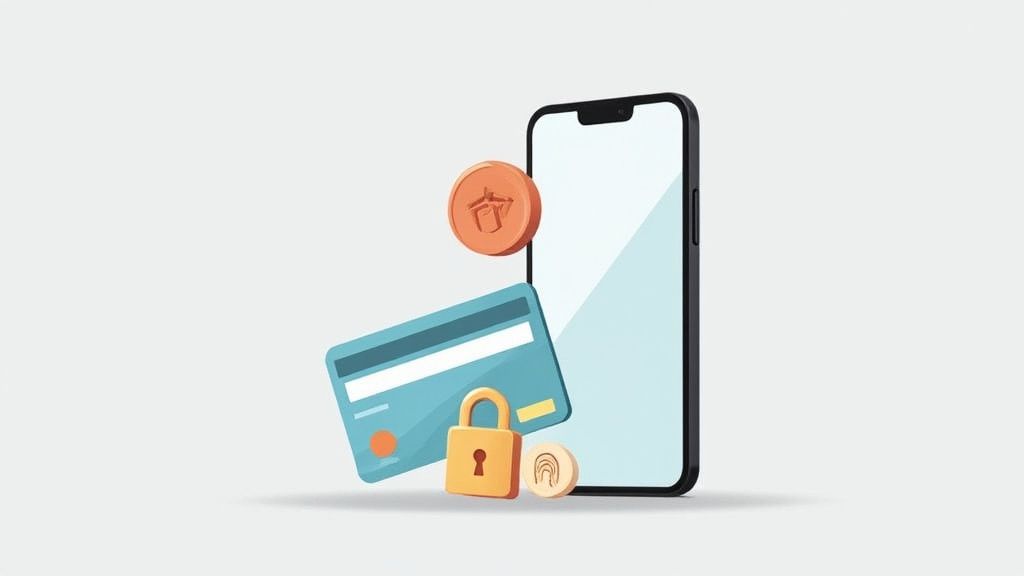
Another cornerstone of modern ecommerce fraud prevention best practices is the adoption of digital wallets and tokenization. This technology replaces a customer's sensitive card details, like the 16-digit Primary Account Number (PAN), with a unique, non-sensitive equivalent known as a "token." This token is useless to fraudsters if intercepted, as it holds no value outside of the specific transaction it was created for.
How Tokenization Secures Transactions
When a customer pays with a digital wallet like Apple Pay, Google Pay, or Shopify's own Shop Pay, the actual card data is never transmitted to or stored on your servers. Instead, a unique token is generated for that specific purchase. This process is often layered with biometric authentication (fingerprint or face ID) on the customer's device, adding a powerful, nearly foolproof layer of identity verification.
The primary benefit is a drastic reduction in your data breach risk. Since you are not handling raw credit card information, you significantly lower your PCI DSS compliance burden and protect your customers' data. For example, transactions via Apple Pay and Google Pay are inherently more secure, leading to significantly lower fraud rates compared to manually entered card details.
Key Takeaway: By championing digital wallets, you are not just offering convenience; you are outsourcing a significant portion of payment security to major tech platforms that specialize in it, drastically reducing your own fraud exposure.
Actionable Implementation Tips
- Prominently Display Wallet Options: Don't hide Apple Pay or Google Pay buttons at the bottom of the checkout page. Feature them clearly and early in the process, even on product pages, to encourage their use and speed up checkout.
- Integrate Multiple Wallet Providers: Cater to a wider audience by offering several popular digital wallet options. Ensure they are seamlessly integrated into your checkout flow for a frictionless user experience. Proper integration is key, and an effective payment gateway integration guide can provide clarity on this process.
- Educate Your Customers: Use a small banner or note during checkout to highlight the security benefits of using a digital wallet. A simple message like, "Pay faster and more securely with Apple Pay," can boost adoption.
- Monitor Adoption Trends: Keep an eye on the percentage of transactions coming through digital wallets. A high adoption rate is a positive indicator for your fraud prevention efforts and can inform future security strategy decisions.
7. Strengthen Trust with KYC (Know Your Customer) and Customer Verification
While often associated with financial services, Know Your Customer (KYC) is a powerful ecommerce fraud prevention best practice for businesses handling high-value goods or services. It is the process of verifying a customer's identity to prevent fraud, money laundering, and account takeovers before they can complete sensitive transactions.
How KYC Works in Ecommerce
In an ecommerce context, KYC involves collecting and verifying personal information, which can range from a simple email and phone number verification to requiring government-issued identification documents. This process creates a significant barrier for fraudsters attempting to use stolen identities or payment information, as they typically cannot produce the required documentation. For example, a luxury watch retailer might require ID verification for any purchase over $10,000, ensuring the person buying is who they claim to be.
The core benefit is creating a trusted environment for legitimate customers while making it exceptionally difficult for sophisticated fraudsters to operate. This is especially critical for industries dealing with digital goods, high-ticket items, or services susceptible to large-scale, organized fraud.
Key Takeaway: Implementing KYC isn't about adding friction; it's about building a fortress around your most valuable transactions and customer accounts, ensuring only legitimate users gain access.
Actionable Implementation Tips
- Implement Risk-Based KYC: You don't need to verify every customer. Trigger KYC checks only for specific high-risk scenarios, such as first-time orders over a high threshold ($2,000+), transactions from high-risk countries, or when a customer attempts to change critical account details.
- Automate Document Verification: Use third-party identity verification (IDV) services that use AI to quickly and accurately verify documents. This reduces the manual workload on your team and provides a near-instant decision for the customer.
- Optimize the User Experience: Ensure your document upload process is mobile-friendly and seamless. Clearly communicate why you are asking for this information, emphasizing that it's for their protection and security.
- Screen Against Fraud Lists: Integrate systems that screen customer details against known fraud databases and government sanctions lists during the verification process. This adds another layer of proactive defense to your ecommerce fraud prevention strategy.
8. Utilize Geolocation and Device Fingerprinting to Uncover Hidden Risks
Going beyond simple address verification, geolocation and device fingerprinting are essential ecommerce fraud prevention best practices that analyze the context of a transaction. Geolocation identifies a customer's physical location via their IP address, while device fingerprinting creates a unique ID for their computer or phone based on dozens of attributes like operating system, browser version, and screen resolution.

How Geolocation and Device Fingerprinting Work
These technologies work together to spot inconsistencies that signal fraud. For instance, a fraudster might use a stolen credit card with a billing address in New York, but their IP address places them in Vietnam. This "impossible travel" scenario, where a transaction occurs thousands of miles from the cardholder's registered location, is a massive red flag.
Device fingerprinting adds another layer by identifying when multiple fraudulent orders originate from the same device, even if different names, emails, and credit cards are used. This helps shut down prolific fraudsters before they can cause significant damage. For example, if your system flags five different accounts all using a unique but consistent device fingerprint, you can block that device ID from making future purchases.
Key Takeaway: Analyzing where a transaction is coming from (geolocation) and what device is being used (fingerprinting) provides powerful context that a simple AVS check can't offer, exposing sophisticated fraud attempts.
Actionable Implementation Tips
- Flag IP and Shipping Mismatches: Set up an automated rule in your fraud prevention app (like Shopify Flow with Signifyd or ClearSale) to flag any order where the IP address location is in a different country than the shipping address. This is a classic indicator of potential fraud.
- Monitor for Proxy and VPN Usage: Fraudsters often use proxies or VPNs to hide their true location. Many advanced fraud tools can detect this anonymizing technology. Configure your system to assign a higher risk score to transactions originating from known proxies.
- Analyze Device Velocity: Track how many unique accounts or credit cards are used from a single device fingerprint within a short period. A single device attempting transactions with three or more different cards in 24 hours should be immediately sent for manual review.
- Create Trusted Device Lists: For repeat customers, allow them to create a list of "trusted devices." When they log in or purchase from a recognized device, you can streamline their checkout experience. If a login attempt occurs from a new, unrecognized device, trigger a secondary verification step like an email confirmation.
9. Implement a Dynamic Fraud Rules Engine for Granular Control
A fraud rules engine is a core component of any sophisticated ecommerce fraud prevention best practices stack. This system allows you to create and apply a specific set of "if-then" conditions to automatically evaluate incoming transactions in real-time. Instead of relying solely on a third-party's black-box algorithm, you gain granular control to target fraud patterns unique to your business.
How a Fraud Rules Engine Works
A rules engine assesses transactions against your custom criteria. For example, a rule could be: "IF the transaction amount is over $1,000 AND the shipping address is different from the billing address, THEN flag for manual review." You can create rules based on countless data points, including IP address location, AVS/CVV mismatches, customer purchase history, product type, and more.
The primary benefit is precision and adaptability. As fraudsters change tactics, you can instantly create and deploy new rules to counter their efforts without waiting for a software update. Platforms like Shopify Flow (for Shopify Plus merchants) or dedicated fraud tools like Signifyd and Kount provide powerful, user-friendly interfaces for managing these business rules.
Key Takeaway: A fraud rules engine empowers you to move from a reactive to a proactive fraud prevention stance, letting you codify your team's expertise into an automated, real-time defense system.
Actionable Implementation Tips
- Start Simple and Iterate: Begin with a few high-confidence rules based on clear past fraud incidents. For instance, block all orders where the billing country is the US but the IP address originates from a high-risk country. Monitor the performance and add more nuanced rules over time.
- Layer Rules for Accuracy: Combine multiple conditions to reduce false positives. A rule that flags orders over $500 is good, but one that flags orders over $500 and placed by a first-time customer between 1-4 AM local time is far more precise.
- Create Rule "Scores": Instead of a simple pass/fail, assign a risk score to each rule trigger. A transaction that triggers multiple rules can accumulate a higher score, allowing you to prioritize your manual review queue by focusing on the highest-risk orders first.
- Document and Version Your Rules: Maintain a clear record of every rule, its purpose, and its performance. Use a versioning system to track changes so you can easily identify what works and roll back any rule that negatively impacts conversions.
10. Implement Proactive Chargeback Monitoring and Management
While preventing fraud is the goal, managing the chargebacks that do occur is an equally critical ecommerce fraud prevention best practice. A chargeback happens when a customer disputes a transaction with their card issuer. Proactive management involves not just fighting disputes, but analyzing their root causes to prevent future occurrences and protect your merchant account health.
How Chargeback Management Works
Effective chargeback management is a two-part process: reactive and proactive. The reactive part involves responding to active disputes by gathering and submitting compelling evidence (like order details, shipping confirmation, and customer communications) to the issuing bank. This process, known as representment, aims to reverse the chargeback.
The proactive part involves analyzing chargeback data to identify patterns. Are chargebacks coming from a specific region? Are they tied to a particular product? Is the reason code consistently "Product Not Received"? Answering these questions helps you identify and fix underlying issues in your operations, customer service, or fraud filters. Payment processors like Stripe and Shopify provide built-in dashboards to track these metrics, while card networks like Visa and Mastercard enforce strict thresholds (often below 1%) that merchants must stay under.
Key Takeaway: Viewing chargebacks solely as a financial loss is a mistake. Each dispute is a data point that can reveal vulnerabilities in your customer experience or fraud detection systems.
Actionable Implementation Tips
- Respond to Every Dispute: Never ignore a chargeback, even for small amounts. Responding to every case with strong evidence demonstrates diligence to payment processors and can help you recover revenue. Keep meticulous records of orders, tracking information, and customer service interactions.
- Clarify Your Billing Descriptor: Ensure your billing descriptor (the name that appears on a customer's credit card statement) is easily recognizable. A vague descriptor like "SP *12345" can lead to "friendly fraud" from customers who simply don't recognize the charge.
- Analyze Root Cause by Reason Code: Categorize chargebacks by their reason codes (e.g., "Fraud," "Product Not Received," "Not as Described"). A high number of "Product Not Received" disputes may signal issues with your shipping carrier or fulfillment process, not necessarily criminal fraud.
- Improve Customer Service Accessibility: Make it easy for customers to contact you with issues. Prominent contact information, live chat, and a clear return policy can help resolve problems directly with customers before they escalate to a chargeback.
Top 10 Ecommerce Fraud Prevention Practices Comparison
Building a Resilient, Growth-Oriented Security Strategy
Navigating the landscape of ecommerce fraud prevention can feel like a high-stakes balancing act. However, the journey from reactive damage control to a proactive, growth-oriented security posture is entirely achievable. The ten best practices detailed in this guide, from fundamental checks like AVS and CVV to advanced systems like AI-powered detection and device fingerprinting, are not isolated tactics. They are interconnected layers of a dynamic, intelligent defense system designed to protect your revenue and your brand's reputation.
The core principle is not to build an impenetrable digital fortress that frustrates legitimate customers. Instead, the objective is to create a smart, flexible framework that introduces targeted friction for suspicious actors while maintaining a seamless, trust-building experience for everyone else. This strategic approach turns security from a cost center into a competitive advantage, fostering the kind of customer loyalty that fuels sustainable growth.
Synthesizing Your Defense: From Tactics to Strategy
For growing brands, especially those leveraging the Shopify ecosystem, the path forward is one of progressive enhancement. You don't need to implement every advanced solution overnight. The key is to build a solid foundation and then layer on sophistication as your transaction volume and risk profile evolve.
Your initial focus should be on mastering the essentials:
- Non-negotiable Verifications: Ensure AVS and CVV checks are correctly configured and that your payment gateway’s responses are integrated into your risk assessment rules. These are your first line of defense.
- Human Intelligence: Establish clear, documented playbooks for your manual review queue. Empower your team to spot nuanced red flags that automated systems might miss, turning a potential loss into a saved sale.
- Chargeback Discipline: Develop a rigorous chargeback management process. Meticulously track your dispute win rate and analyze lost chargebacks to identify patterns and weaknesses in your current fraud detection setup.
Once these foundational pillars are in place, you can strategically integrate more advanced technologies. Layering in a sophisticated rules engine, adopting 3D Secure 2.0 for high-risk segments, and leveraging AI-driven analytics will elevate your defenses from good to great. This layered security model is one of the most effective ecommerce fraud prevention best practices because it creates multiple hurdles for fraudsters, forcing them to abandon their attempts and seek easier targets.
The Future-Proof Imperative: Adaptability and Innovation
The world of digital commerce is in constant flux, with new payment methods and fraud vectors emerging continuously. A truly resilient security strategy must be adaptable. This involves not only monitoring your key performance indicators, like chargeback rates and manual review queue volumes, but also staying informed about industry trends. As e-commerce platforms evolve, a critical aspect of a resilient security strategy involves the secure integration of diverse payment options. For insights into emerging digital currency integrations, consider how to integrate USDC into your e-commerce platform as a forward-looking example of this evolution.
Ultimately, mastering ecommerce fraud prevention is about protecting the future of your business. It’s about ensuring that as you scale, your profits are not eroded by preventable losses. It’s about building a brand that customers trust implicitly with their sensitive information. By thoughtfully implementing the practices outlined here, you are not just stopping fraud; you are building a more robust, efficient, and profitable enterprise poised for long-term success.
Ready to transform your fraud prevention strategy from a defensive necessity into a powerful growth engine? The Shopify Plus experts at ECORN specialize in designing and implementing bespoke security frameworks that protect your revenue without sacrificing customer experience. Contact ECORN today to build a resilient fraud defense tailored to your brand's unique needs.



How to Launch a Box Subscription Business in 2026

Luxury Skincare Branding Playbook That Converters

10 Best Podcast Ecommerce Shows for Store Growth in 2026

Shopify Developer Hourly Rate: What to Pay in 2026
Critical Shopify Setup Errors That Are Secretly Sabotaging Your Store
Ecommerce Conversion Tracking: The Complete How-To Guide

Shopify Design Agency: How to Pick the Right Partner
Mastering Multi Store Management on Shopify

Scale Shopify Store

10 Shopify App Ideas Worth Building in 2026

Conversion Rate Optimization for Landing Pages: The Playbook
Shopify Plus Automation: A Guide for 2026

10 Social Selling Platforms for Shopify Merchants

Shopify Website Design Examples: 7 Stores Worth Studying

7 Ecommerce Newsletter Examples for Shopify Brands

One Product Shopify Store: Build and Scale

Mobile Pop Up Strategy for Shopify Stores That Converts

Sitemap for Shopify: How to Find, Optimize, and Submit It

7 Single Product Websites Worth Emulating

Product Variants Shopify: The Complete 2026 Guide

Ecommerce Analytics Consulting for Growth
What Is AI Integration for eCommerce

How to Choose the Right eCommerce Website Development Firm

E Business Strategy Implementation
Conversion Tracking Setup for Shopify Stores

BigCommerce vs Shopify Plus Which Enterprise Wins in 2026
Shopify Theme Kit: Setup, Commands, and Migration Guide

Shopify Extension Development: A Practical 2026 Guide

Shopify Speed Score Explained and How to Improve It

Shopify Mobile Optimization: The 2026 Playbook

How to Add Subcategory in Shopify for Better UX
How to Implement Structured Data for Ecommerce in 2026

SEO App Mobile: Shopify Store Optimization Guide

Shopify Plus Support: What It Includes and How to Choose

Google Ads for Shopify: The Complete 2026 Playbook

Shopify New York: How to Find and Hire the Right Agency

Google Search Console for Shopify: The Complete Setup

First Party Data Collection for eCommerce Growth
FAQ Online Store Guide: Build and Measure It Right
Do FB Ads Work for eCommerce in 2026?

One Page Checkout for Shopify: Design and Implementation

Shopify GraphQL vs REST: The 2026 Developer Decision
Shopify Ecommerce Consulting: Strategy, Pricing &

Are Reddit Ads Worth It for eCommerce Brands

Shopify Title and Meta Description: A Practical 2026 Guide

Product Video Best Practices for Shopify Brands

Real-Time Inventory Management: A 2026 Guide

AI Chatbot Integration for Shopify Stores

Affiliate Program Management: A Shopify Guide
10 Best Performance Monitoring Tools for Shopify in 2026

Digital Asset Management for eCommerce Brands in 2026

Every Type of Facebook Ads Explained for eCommerce Growth
Product Information Management Explained for Shopify Brands
Support Ticket System: A Guide for Shopify Stores

10 Best Customer Service Tools for Shopify in 2026

Can I Start a Business with No Money? a 2026 Blueprint

What Sells Good on Etsy: Best Niches for 2026

Shopify Add to Cart Button: A Practical 2026 Guide

Customer Feedback Automation: A Practical eCommerce Guide

Critical Rendering Path: A Guide for Shopify Stores

How to Promote on TikTok for eCommerce in 2026

B2B eCommerce Consulting That Drives Real Revenue

10 Best Practices for Site Navigation in 2026

Return vs Refund for Shopify Stores: A Practical Guide

What Is Customer Lifetime Value and Why It Matters

What Is Voice of Customer Research for eCommerce

SMS Marketing for Ecommerce That Actually Converts

Master How to Improve Email Deliverability in 2026

Top 8 eCommerce Partners NYC for Shopify Brands in 2026

Machine Learning for Ecommerce: Boost Your Shopify Store

Beauty Market Research: Your 2026 Growth Guide

Shopify International Expansion: A 2026 Roadmap

What Does CRO Stand for in Business: Understanding CRO

Shopify Visual Merchandising: A Playbook for Higher Sales

Shopify Landing Page Design: Master Conversion in 2026

10 Best AI SEO Optimization Tools for Shopify in 2026

Agentic AI for Ecommerce: Boost Your Sales in 2026
Mastering Email Marketing Data for eCommerce Growth

Conversion Rate Optimisation Australia: Boost Your Sales

Conversion Rate Optimization AI: Your Shopify Store Guide

10 Product Bundling Strategies for Shopify in 2026

How to Increase Customer Lifetime Value: A Shopify Playbook
AI Customer Service Automation: Shopify Guide 2026

Clean Website Design: A Shopify Conversion Playbook

Omnichannel Retail Strategy: A Shopify Playbook

Product Data Enrichment: A Guide for Shopify Brands

Instagram Shopping Features a Guide for Shopify Stores

What Is Revenue Optimization: A Holistic RevOps Guide

Benefits of Conversion Rate Optimization: Boost Your
WordPress to Shopify Migration: Your 2026 Seamless Switch
Boost Sales: Ecommerce Payment Processing Guide 2026

Unified Commerce Platform: Benefits, KPIs & Shopify Guide

How to Reduce Bounce Rate eCommerce: Your 2026 Guide
Shopify API Integration: A Practical End-to-End Guide
How to Implement Data Governance: A 2026 Guide

Shopify Store Development Cost: A 2026 Breakdown
What Is Server Side Tracking: The Shopify Guide 2026

Marketing Automation Workflows: A Shopify Guide for 2026

Shopify: How to Reduce Technical Debt

Shopify UX Design Change: A Playbook for Growth


newsletter in your inbox