


Forget mass-market tactics. A winning marketing strategy for a niche market is all about laser-focusing on a specific audience with very specific needs. It's how you build intense customer loyalty and, frankly, make more money.
You’re essentially choosing to become the absolute go-to expert for a small, passionate group instead of shouting into the void. This approach flips the script, turning scarcity into a massive strength and building a brand that feels indispensable to the right people.
Why Niche Marketing Is Your Unfair Advantage
Winning in today's jam-packed eCommerce world isn't about having the biggest megaphone. It’s about whispering to the right people. For niche brands, a focused marketing strategy isn't just a good idea—it's a complete shift away from generic tactics and toward authentic conversations that build a protective moat around your business.
This precision-guided approach also just makes better financial sense. Hyper-focused brands don't just collect email addresses; they build communities. That deep connection pays dividends in stronger brand loyalty, more word-of-mouth referrals, and a much higher customer lifetime value (LTV).
Better Economics and Stronger Loyalty
The data backs this up. Time and again, research shows that companies targeting niche markets see significantly higher revenue growth and more efficient customer acquisition than their broad-market competitors. This comes down to a much tighter product-market fit and customers who are willing to pay more for products that truly get them.
Take the niche perfume market, for example. It's projected to hit around $5.4 billion by 2025. Buyers in these spaces often pay a premium and stick around longer, which means lower customer acquisition costs (CAC) and a much healthier LTV for the brand. You can find more stats on the niche perfume market on freeyourself.com.
It really boils down to a simple idea: It's far more profitable to be a big fish in a small pond than a small fish in a vast ocean. Your goal is to be everything to someone, rather than something to everyone.
This guide is your playbook for doing just that. We're going to walk through the core pillars you need to master to build a niche brand that doesn't just survive, but thrives:
- Pinpointing a Profitable Niche: Moving beyond guesswork to data-backed validation.
- Creating an Irresistible Brand Promise: Crafting a unique value proposition that makes you the only logical choice.
- Designing a High-Converting Customer Journey: Building a marketing and sales funnel that feels personal and actually drives action.
By concentrating your efforts, you create a powerful magnetic pull that attracts your ideal customers and keeps them coming back for more. This isn't just another strategy; it's the most sustainable path for emerging brands to compete and win.
Finding and Validating Your Profitable Niche
A winning marketing strategy doesn’t start with ad copy or a fancy website. It starts way earlier, with finding a group of people who share a specific, underserved passion. This isn't about generic brainstorming; it's more like being a digital detective, sniffing out opportunities the big brands are too clumsy to see.
The whole point is to get way more specific than "pet products" or "outdoor gear." Real profit margins and die-hard customer loyalty live in the details. Your mission is to carve out a defensible corner of the market where you can become the only logical choice for a very specific customer.
Uncovering Niche Opportunities
The best ideas are almost always hiding in plain sight, usually buried in online conversations. So, your first job is to just listen. Pay close attention to what people are already talking about, complaining about, and asking for.
Platforms like Reddit are absolute goldmines for this. Dive into subreddits related to a broad interest—think r/ultralight for serious hikers or r/skincareaddiction for beauty fanatics. You're looking for recurring frustrations with products on the market or clever DIY solutions people have cobbled together. Those are massive flashing signs of an unmet need.
Another killer tool is Google Trends. It helps you see the difference between a fleeting fad and a genuine, sustainable trend. You can, for instance, compare the search interest for "keto snacks" versus "vegan protein bars" over the last five years. A steady upward climb or consistently high interest signals long-term potential.
This entire process is about finding your advantage before you even build a product.
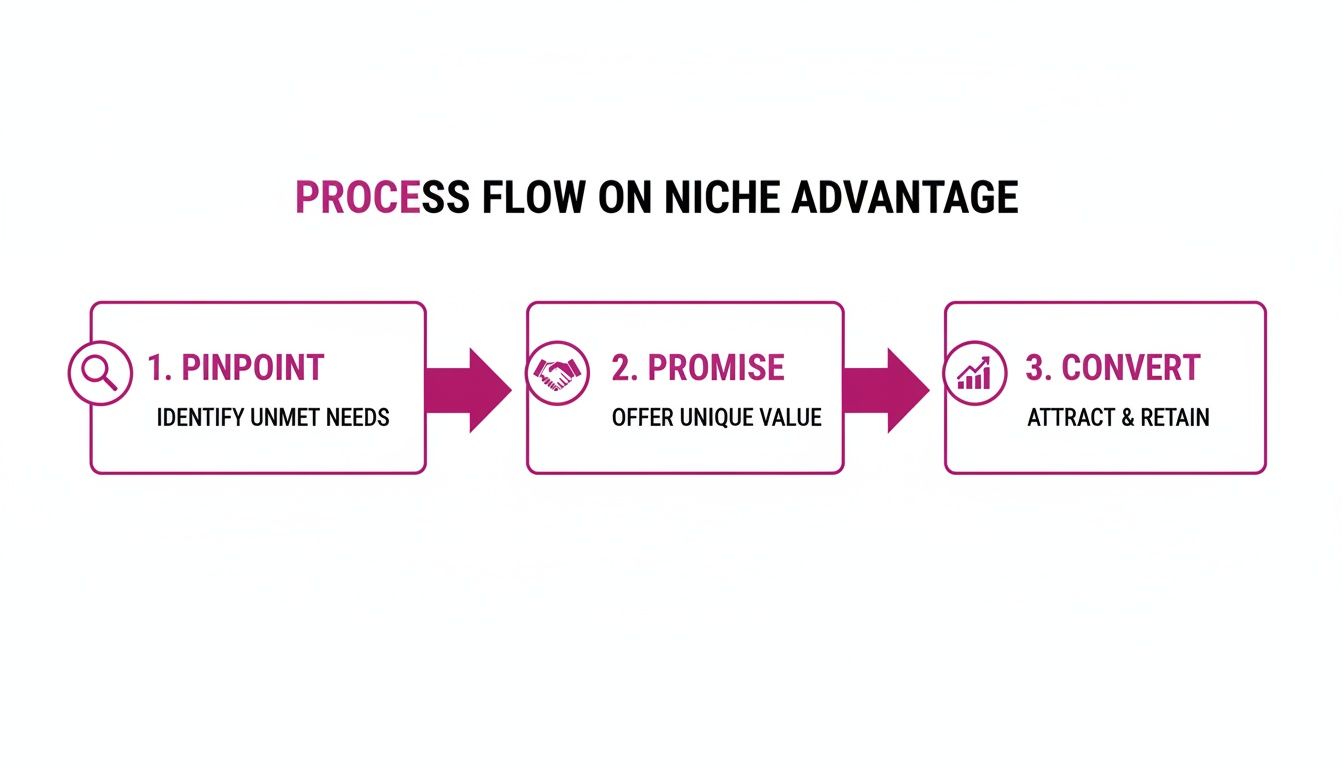
It’s this flow—from pinpointing that hyper-specific audience to delivering on a unique promise—that unlocks much higher conversion rates than you'd ever see in a crowded, generic market.
A Practical Validation Framework
An idea is just an idea until you pressure-test it. Before you sink a dollar or an hour into development, you need to run your potential niche through a simple but critical framework. A truly profitable niche has three things in spades: passion, problems, and purchasing power.
- Audience Passion: Niche communities are built on pure enthusiasm. Is there an active, engaged group of people who just love this topic? Look for dedicated forums, popular hashtags, and a vibrant micro-influencer scene. An audience that willingly geeks out over something is an audience ready to buy specialized products.
- Inherent Problems: The best products don't create demand; they solve a real problem. For example, instead of just "pet products," you might discover that owners of small, short-haired dogs can't find hiking gear that fits properly without chafing. That’s a real problem you can solve.
- Purchasing Power: Passion is great, but your audience has to be willing and able to spend money. Do some digging. What are they buying now, and how much are they spending? Are they investing in high-end equipment or constantly hunting for budget alternatives? This tells you everything about their price sensitivity.
A strong niche isn’t just a small market; it’s a focused market with a distinct identity and a shared set of challenges. If you can't clearly articulate the problem your product solves for a specific person, your niche isn't defined enough.
From Broad Idea to Defensible Niche
Let's walk through how this looks in the real world. Say you start with a broad idea like "eco-friendly products."
- Initial Research: You jump on Reddit and Google Trends and quickly notice a growing buzz around zero-waste travel and cutting down on plastic use during outdoor adventures.
- Narrowing Down: You dig deeper into hiking and camping communities and find a consistent thread of complaints about single-use plastics and gear that isn’t biodegradable. The frustration is palpable.
- Identifying the Persona: Suddenly, you spot a specific sub-group: small dog owners who love to hike but are fed up with the lack of sustainable, durable gear for their pets. They complain that most 'eco-friendly' pet gear is flimsy and falls apart.
- Validation: You've hit the jackpot. The community is passionate (constantly sharing trail photos and tips), they have a clear problem (no durable, eco-friendly gear for their small dogs), and they demonstrate purchasing power (they're already buying high-quality hiking gear for themselves).
Just like that, you've gone from the vague "eco-friendly products" to the ultra-specific and defensible niche of "biodegradable, rugged hiking gear for small dog owners." That’s a business.
Once you’ve locked in a promising niche, the next step involves developing a robust go-to-market strategy to launch with impact. This validation process is non-negotiable, and if you need to go deeper, our team can help with comprehensive eCommerce market research to make sure your brand is built on a rock-solid, data-backed foundation.
Crafting Your Unmistakable Brand Promise
Once you've validated your niche, the game changes entirely. It’s no longer about finding just any audience; it's about becoming so essential to your audience that they can't imagine going anywhere else. This is where you forge your Unique Value Proposition (UVP)—a clear, powerful promise that answers one simple question for your customer: "Why should I buy from you?"
A weak brand promise is the fastest way to get lost in the noise. It’s the difference between a forgettable tagline and a magnetic statement that pulls your ideal customer in. For a niche business, a generic UVP is a death sentence.
Analyzing Competitor Messaging
Your journey to an unforgettable UVP starts with a little snooping on your competitors. The goal isn't to copy them, but to find the empty space—the promise they aren't making. Spend some real time on their websites, read their product descriptions, and scroll through their social media feeds.
What are they hammering on about?
- Price: Are they all racing to the bottom, positioning themselves as the budget option?
- Quality: Do they talk endlessly about premium materials or old-world craftsmanship?
- Features: Is their messaging all about a specific technical advantage or a long list of specs?
Pay close attention to what they aren't saying. If every competitor is screaming about low prices, there’s a massive opportunity for a brand that promises unparalleled customer service, lightning-fast shipping, or a radically transparent sourcing story. That gap in the market? That's where your niche marketing strategy can really shine.
For example, in the ridiculously crowded coffee market, just saying "we sell high-quality coffee" makes you invisible. But what if all your competitors focus on complex flavor profiles and you notice nobody is talking about speed and freshness for the busy professional who needs a great cup now? That's your opening.
Identifying True Customer Pain Points
The most powerful brand promises are born from genuine customer problems. Your niche has specific frustrations, desires, and unmet needs that the mass-market players are happy to ignore. Your UVP has to speak directly to solving one of these core pain points.
Go back to those Reddit threads, forums, and customer reviews you dug through during your research. What are the recurring complaints? What weird workarounds are people using because the perfect solution just doesn't exist yet?
Your brand promise isn't about what you sell; it's about the problem you solve. People don't buy a drill—they buy a hole in the wall. Focus on the outcome, not just the product.
This process requires real empathy. You need to get inside your customer's head and articulate their problem even better than they can. When a customer reads your UVP and has that "Wow, they really get me" moment, you've built a connection that goes way beyond a simple transaction.
Articulating Your Unique Solution
Alright, time to connect the dots. You’ve found the gap in the market. You've identified the core customer pain point. Your UVP is the bridge between the two, clearly articulating how your unique solution is the only real answer.
Here’s a simple but effective template to start drafting your positioning statement:
For [Your Target Niche], who [Struggle with a Specific Problem], our [Product/Brand Name] is the only [Product Category] that provides [Your Unique Solution/Benefit].
Let's put this into practice. See the difference between a generic statement that gets ignored and a powerful, niche-focused UVP that commands attention.
Generic Statement (Weak)Niche UVP (Magnetic)We sell high-quality coffee beans.For coffee lovers with adventurous palates, we offer single-origin, ethically sourced beans roasted and shipped within 48 hours of your order.We offer eco-friendly pet gear.For small dog owners who hike, our gear is the only biodegradable and rugged solution that prevents chafing on long trails.We make custom keyboards.For competitive gamers who demand zero latency, our keyboards offer hot-swappable optical switches for instant response time and complete customization.
See how hyper-specific the magnetic examples are? They name the audience, pinpoint the exact frustration, and deliver a concrete promise that no generic competitor can touch. This kind of clarity makes your brand unforgettable and transforms your marketing from a hopeful shout into a confident conversation with exactly the right person.
Building Your Niche Content and Channel Strategy
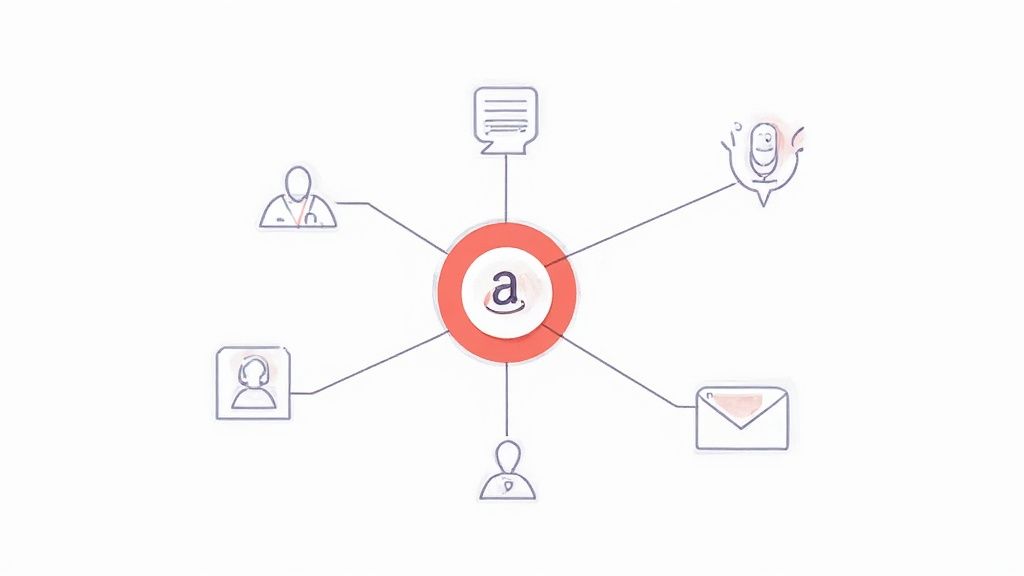
A killer brand promise is completely wasted if it never reaches the right people. This is where a laser-focused channel and content strategy comes in, turning your marketing from a hopeful shout into a targeted, welcome conversation.
The biggest mistake I see brands make is trying to be everywhere at once. They stretch their time and money thin across huge platforms like Facebook or Instagram, hoping something sticks. That's a losing game in a niche market.
Your job is to go where your audience already lives. Niche communities don't just browse; they congregate. They’ve built their digital homes in specialized forums, active subreddits, private Slack groups, and around specific micro-influencers who genuinely speak their language. Finding these digital watering holes is the key to building a strategy that feels authentic, not intrusive.
Identifying Your Core Channels
Forget the idea that you need a massive social media presence on every platform. For niche brands, depth beats breadth every single time. Instead of guessing, let your buyer persona research be your guide.
Where do they actually go for information and recommendations? It might not be Google. It could be a dedicated subreddit like r/ultralight for minimalist hikers or a specific TikTok hashtag where woodworkers share their latest projects.
Think about these potential hubs for your audience:
- Specialized Forums: These are often the original online communities for hobbies and interests. They are absolute goldmines for understanding customer pain points and building real authority by just being helpful.
- Subreddits: Reddit is a universe of thousands of hyper-focused communities. Engaging here means becoming part of the conversation, not just dropping an ad and running.
- Discord or Slack Communities: These real-time chat platforms host incredibly passionate groups dedicated to specific topics, from competitive gaming to sustainable fashion.
- Micro-Influencers: Find creators with smaller but fiercely engaged followings. They're seen as trusted peers within your niche. A single post from the right micro-influencer can be worlds more powerful than a dozen from a generic macro-influencer.
Choosing the right channels isn't about chasing the largest user numbers. It's about finding the highest concentration of your ideal customers and earning their attention through value, not volume.
Niche Marketing Channel ROI Comparison
Deciding where to invest your time and money can be tough. Not all channels are created equal, especially when you're targeting a very specific group. Below is a quick comparison of how common channels typically perform for niche marketing, helping you see where you might get the most bang for your buck.
ChannelPrimary Use Case for NichesTypical ROIKey MetricsCommunity Forums/RedditBuilding authority, direct customer research, organic trafficHigh (long-term)Engagement rate, referral traffic, brand mentionsMicro-Influencer MarketingBuilding trust, generating authentic UGC, driving targeted salesVery HighConversion rate from links, engagement per post, CPENiche SEO/ContentAnswering specific questions, capturing high-intent trafficHigh (long-term)Organic rankings for long-tail keywords, time on pagePaid Social (Targeted)Reaching lookalike audiences, testing messaging quicklyMedium to HighCost Per Acquisition (CPA), Return on Ad Spend (ROAS)Email MarketingNurturing leads, driving repeat purchases, building loyaltyVery HighOpen rate, click-through rate, customer lifetime value (CLV)Broad Paid Search/DisplayGeneral brand awareness (less effective for niches)Low to MediumImpressions, click-through rate (CTR), cost per click (CPC)
This table highlights a clear pattern: channels that foster trust and direct engagement, like communities and micro-influencers, often deliver a much stronger return in a niche market than broad, impersonal advertising.
Prioritizing Content That Builds Trust
Once you know where to find your people, you have to figure out what to say. In a niche market, the hard sell is a quick way to get ignored. Your content absolutely has to educate, entertain, or solve a problem. This is how you build the authority and trust needed to turn a lurker into a loyal customer.
A well-planned eCommerce content strategy is non-negotiable here. Your content should revolve around demonstrating your expertise and genuine passion for the world you serve.
Actionable Content Ideas for Niche Markets:
- Ultimate Guides and How-To Tutorials: Create the single most comprehensive resource on a topic your audience obsesses over. For instance, if you sell specialized baking tools, create the definitive guide to sourdough starters, complete with troubleshooting tips and videos.
- Behind-the-Scenes Stories: Niche audiences love seeing how the sausage is made. Show your product development process, introduce your team, and share the "why" behind your brand. It builds a powerful human connection.
- Customer Spotlights and Case Studies: Feature your actual customers using your products in the real world. This is powerful social proof and makes your community feel seen and valued.
- Problem-Solving Checklists or Tools: Create a free, valuable resource that directly tackles a common frustration. A brand selling organization products could offer a downloadable "Ultimate Spring Cleaning Checklist."
Allocating Your Budget for Maximum Impact
Your channel and content choices will tell you exactly where your money should go. For most early-stage niche brands, a content-first approach delivers a much higher return than pouring money into broad ad campaigns that miss the mark.
Data from marketer surveys backs this up. Targeted content and community-driven channels consistently produce a superior ROI for niche brands. In fact, conversion rates from community referrals and creator promotions often beat generic paid search by 2–4×, and the average order value (AOV) can be 20–60% higher.
This points to a clear budget mix: allocate a significant chunk—think 30–40%—to long-form storytelling, creator collaborations, and genuine community engagement. This strategic allocation ensures your marketing dollars are working to build a loyal community, not just chase fleeting clicks.
As you build out your strategy, exploring dedicated marketing blogs can provide fantastic case studies and actionable advice. Discover more marketing and content strategies on the Branditok Blog. These resources often provide frameworks and real-world examples that can spark your next great campaign idea.
Optimizing Your Store for Niche Conversions
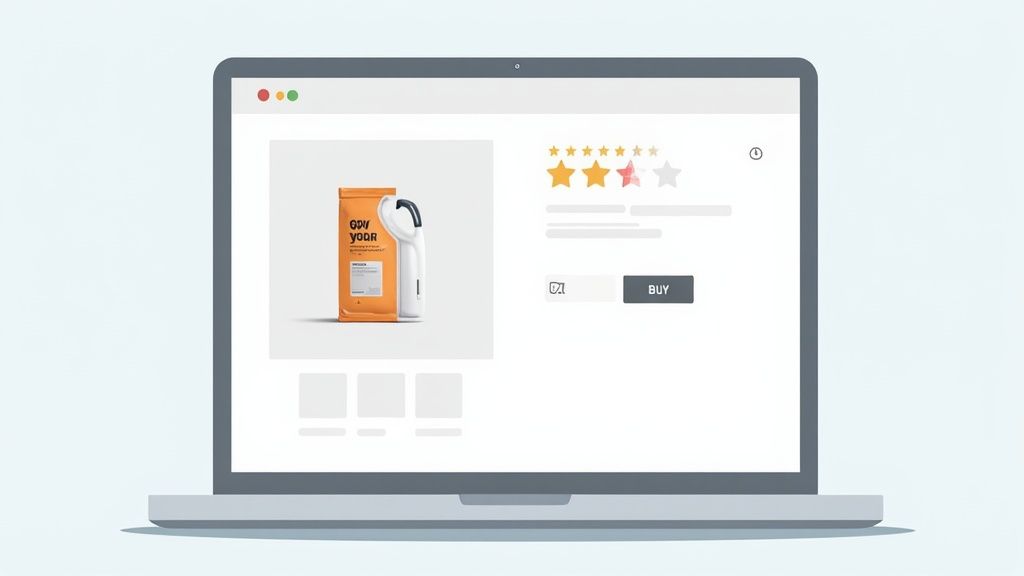
Getting highly qualified traffic to your store is a huge win, but it’s only half the battle. The real magic happens when you turn that targeted interest into actual revenue. This is where Conversion Rate Optimization (CRO) becomes the most critical part of your marketing strategy for a niche market.
Forget generic CRO advice. For a niche audience, your entire store experience—from the first click to the final thank you page—has to scream, "This was made for you."
Designing Product Pages That Speak Their Language
Think of your product page as your digital salesperson. In a niche market, it needs to be an expert, not a generalist. It has to do more than just list features; it has to validate your customer’s passion and solve their very specific problem.
That means going way beyond standard stock photos. Use high-resolution imagery and video that shows your product in the exact context your niche audience would use it. Selling rugged, biodegradable hiking gear for small dogs? Your photos better feature a beagle on a real trail, not posing in a sterile studio.
Your product descriptions are just as critical. You need to use the language, jargon, and terminology your audience uses every day. Speak directly to their unique desires and frustrations, proving you truly understand their world.
Here’s how to craft a high-converting product page for a niche audience:
- Emphasize Niche-Specific Benefits: Don't just say a dog harness is "durable." Say it's "designed with reinforced stitching to withstand snags on dense underbrush." See the difference?
- Showcase Hyper-Relevant Social Proof: Feature reviews and user-generated content from people who are clearly part of the community. A testimonial from "Jane D., Ultralight Hiker & Beagle Owner" is infinitely more powerful than one from just "Jane D."
- Use Detailed Specs That Matter: Provide the technical details your audience obsesses over. For a niche coffee brand, this means calling out the elevation, processing method, and specific tasting notes—not just "rich flavor."
Building Unbreakable Trust with Your Audience
Niche customers are often discerning and wary of mass-market brands trying to cash in on their passion. Building trust isn't optional; it's everything. And it happens through a series of small, intentional details across your site.
A frictionless checkout process is paramount. Every extra step or unnecessary field you ask for is another chance for them to abandon their cart. Keep it simple, fast, and mobile-friendly.
Niche buyers are looking for reasons to trust you. Make it easy for them. Displaying secure payment badges, offering clear shipping information, and having a transparent return policy aren't just best practices—they're essential signals that you're a legitimate, expert-run business.
This trust extends to the entire purchase journey. Your site must be secure (with HTTPS), load quickly, and be completely free of broken links or confusing navigation. These aren't just technical details; they're promises to your customer.
The Untapped Power of Localization
If your niche has a global presence, localization can be one of your most powerful conversion levers. This is about more than just translating text; it’s about creating a native shopping experience.
When a customer from another country lands on your site, simple things can make a huge difference. Offering local currencies and familiar payment options is a massive trust signal. It removes friction and shows respect for the customer's context.
This single change can have a dramatic effect on your bottom line. In fact, companies that localize their product pages and payment options for international niche markets often see conversion rate improvements between 20–50%. Budget for localization early and A/B test the impact to quantify the uplift. You can dig into more global niche strategies on crystalhues.com.
A continuous cycle of testing and refinement is what separates good eCommerce stores from great ones. By optimizing your site for the unique psychology of your niche audience, you create an experience that doesn't just sell a product—it builds a loyal customer for life.
Measuring What Matters and Scaling Your Strategy
Launching your niche marketing strategy is a massive win, but the work isn't over. How do you know if it's actually working? This is where the real magic happens—turning your hard-earned data into a roadmap for growth.
We have to move past the feel-good metrics like likes and shares. While they might offer a quick ego boost, they don't pay the bills. The brands that truly dominate their niches are the ones that are religious about tracking the numbers that directly impact their bottom line. It's about understanding the simple math that drives your business forward.
Tracking Your Core Niche KPIs
For any niche eCommerce store, the entire story of your business's health can be told through just a few key performance indicators (KPIs). Nail these, and you'll know exactly when to push the accelerator and when to pump the brakes.
Don't worry, you don't need a degree in data science. It boils down to three core metrics.
- Customer Acquisition Cost (CAC): This one's simple. How much are you spending, on average, to get a new customer? The formula is straightforward: Total Marketing Spend ÷ Number of New Customers Acquired.
- Customer Lifetime Value (LTV): This is the total amount of money you can expect to make from a single customer over their entire relationship with your brand. It’s the long-term view of your customer's worth.
- CAC-to-LTV Ratio: This is it. The single most important health check for your niche business. It directly compares what you spend to acquire a customer against what they're worth to you over time.
So, what’s a good number? A healthy niche brand should be aiming for an LTV that's at least 3x its CAC.
Think of it this way: if your LTV is $300, and your CAC is $100, you’ve got a fantastic, profitable model ready to scale. But if your CAC creeps up to $150, you’re in the danger zone, spending too much for each new customer. Time to re-evaluate your channels or creative.
Your data isn't just a report card; it's your command center. It tells you which channels are printing money, which ads are duds, and when it’s time to adjust your pricing. It’s the closest thing you’ll get to a crystal ball for making smarter decisions.
Building Your Performance Dashboard
You don’t need to splash out on fancy, expensive software to get started. A powerful, actionable dashboard can be built right inside the tools you’re likely already using, like Google Analytics 4 and your native Shopify analytics.
Here’s what you absolutely need to track:
- Channel Performance Breakdown: Know your CAC, conversion rate, and Return on Ad Spend (ROAS) for every single channel—paid social, email, SEO, you name it. This immediately shows you where your best customers are coming from.
- LTV by Cohort: Group your customers by the month they made their first purchase. Then, track how much each group spends over time. This is how you see if you're getting better at retaining customers and increasing their value.
- Funnel Conversion Rates: You need to see exactly where people are dropping off. Track the conversion rate from landing page visit to adding to cart, to initiating checkout, and finally, to making a purchase.
This data-first mindset is what fuels sustainable scaling. When you spot a channel with a low CAC and a high LTV, that's a bright green light to double down and invest more. It takes the guesswork out of growth and gives you the confidence to expand—maybe even into adjacent niches—when the time is right.
Even with the best-laid plans, a few nagging questions always pop up. When you're carving out a niche, you're bound to wonder about the practical stuff—like your budget, how to handle the big fish, and when it’s time to grow. Let's tackle those head-on so you can move forward without second-guessing.
How Much Should I Actually Spend?
This is the big one, right? There's no magic number, but you can get pretty strategic about it. A solid starting point is to think in terms of a 60/40 split.
Dedicate 60% of your budget to the long game: killer content and genuine community building. This is your foundation. The other 40%? Use that for targeted paid ads. This isn't about blanketing the internet; it's about getting quick traffic, testing your messaging, and learning what resonates fast.
What if a Huge Competitor Enters My Niche?
It happens. You've spent months, maybe years, cultivating this perfect little corner of the internet, and suddenly a massive, well-funded brand decides they want in. Your first instinct might be to panic. Don't.
Your biggest strength is something they can't easily buy: agility and a real connection to your audience. While they're spending a fortune on broad campaigns, you can go deeper. Double down on hyper-relevant content, personalized customer service, and authentic engagement. You know these customers inside and out. Use that insider knowledge.
A large competitor can buy reach, but they can't fake the trust you've built. Be the authentic, go-to voice in your space, and you'll always have an edge.
When Is the Right Time to Expand?
Eventually, you’ll hit a point where you need to decide what’s next. Growing beyond your initial niche is a natural step, but the timing is everything. Keep an eye out for these signals:
- You're Hitting a Ceiling: You’ve captured a huge chunk of your initial market, and growth is starting to slow down. It’s not a bad thing; it just means you’ve done your job well.
- Your Customers Are Asking for More: Listen to what your audience wants. Are they constantly asking for products or solutions that are just outside what you currently offer? That's a huge green light.
- The Numbers Make Sense: You have consistent, profitable revenue. This financial stability means you can explore an adjacent market without putting your core business at risk.
Ready to build a niche marketing strategy that actually converts? The team at ECORN specializes in Shopify development and CRO to help eCommerce brands scale the smart way. Learn how we can help your brand grow.



Shopify Website Design Packages: What You Actually Get

How to Choose a Shopify Plus Web Design Agency in 2026
Shopify Plus Ecommerce Agency: How to Pick the Right One
Shopify Themes Retina: How to Serve 2x Images

How to Cross Sell on Shopify Without Friction
Best Shopify Theme for Custom Products Compared
Multi Store Inventory Management: A Practical Guide

SEO Consulting for Ecommerce: A Practical Guide
Shopify Theme Updater App: A Safe Update Playbook
Shopify Git Integration: A Developer's Guide to 2026
Headless Ecommerce Development Services Explained

How to Build a Shopify Clothing Website That Converts
How to Launch a Box Subscription Business in 2026

Luxury Skincare Branding Playbook That Converters
10 Best Podcast Ecommerce Shows for Store Growth in 2026
Shopify Developer Hourly Rate: What to Pay in 2026
Critical Shopify Setup Errors That Are Secretly Sabotaging Your Store
Ecommerce Conversion Tracking: The Complete How-To Guide
Shopify Design Agency: How to Pick the Right Partner
Mastering Multi Store Management on Shopify
Scale Shopify Store
10 Shopify App Ideas Worth Building in 2026
Conversion Rate Optimization for Landing Pages: The Playbook
Shopify Plus Automation: A Guide for 2026
10 Social Selling Platforms for Shopify Merchants

Shopify Website Design Examples: 7 Stores Worth Studying
7 Ecommerce Newsletter Examples for Shopify Brands
One Product Shopify Store: Build and Scale
Mobile Pop Up Strategy for Shopify Stores That Converts
Sitemap for Shopify: How to Find, Optimize, and Submit It
7 Single Product Websites Worth Emulating
Product Variants Shopify: The Complete 2026 Guide
Ecommerce Analytics Consulting for Growth
What Is AI Integration for eCommerce
How to Choose the Right eCommerce Website Development Firm
E Business Strategy Implementation
Conversion Tracking Setup for Shopify Stores
BigCommerce vs Shopify Plus Which Enterprise Wins in 2026
Shopify Theme Kit: Setup, Commands, and Migration Guide
Shopify Extension Development: A Practical 2026 Guide
Shopify Speed Score Explained and How to Improve It
Shopify Mobile Optimization: The 2026 Playbook
How to Add Subcategory in Shopify for Better UX
How to Implement Structured Data for Ecommerce in 2026
SEO App Mobile: Shopify Store Optimization Guide
Shopify Plus Support: What It Includes and How to Choose
Google Ads for Shopify: The Complete 2026 Playbook

Shopify New York: How to Find and Hire the Right Agency
Google Search Console for Shopify: The Complete Setup
First Party Data Collection for eCommerce Growth
FAQ Online Store Guide: Build and Measure It Right
Do FB Ads Work for eCommerce in 2026?
One Page Checkout for Shopify: Design and Implementation
Shopify GraphQL vs REST: The 2026 Developer Decision
Shopify Ecommerce Consulting: Strategy, Pricing &
Are Reddit Ads Worth It for eCommerce Brands
Shopify Title and Meta Description: A Practical 2026 Guide

Product Video Best Practices for Shopify Brands
Real-Time Inventory Management: A 2026 Guide
AI Chatbot Integration for Shopify Stores
Affiliate Program Management: A Shopify Guide
10 Best Performance Monitoring Tools for Shopify in 2026
Digital Asset Management for eCommerce Brands in 2026
Every Type of Facebook Ads Explained for eCommerce Growth
Product Information Management Explained for Shopify Brands
Support Ticket System: A Guide for Shopify Stores

10 Best Customer Service Tools for Shopify in 2026

Can I Start a Business with No Money? a 2026 Blueprint
What Sells Good on Etsy: Best Niches for 2026

Shopify Add to Cart Button: A Practical 2026 Guide

Customer Feedback Automation: A Practical eCommerce Guide
Critical Rendering Path: A Guide for Shopify Stores

How to Promote on TikTok for eCommerce in 2026

B2B eCommerce Consulting That Drives Real Revenue
10 Best Practices for Site Navigation in 2026
Return vs Refund for Shopify Stores: A Practical Guide
What Is Customer Lifetime Value and Why It Matters
What Is Voice of Customer Research for eCommerce

SMS Marketing for Ecommerce That Actually Converts

Master How to Improve Email Deliverability in 2026

Top 8 eCommerce Partners NYC for Shopify Brands in 2026
Machine Learning for Ecommerce: Boost Your Shopify Store

Beauty Market Research: Your 2026 Growth Guide

Shopify International Expansion: A 2026 Roadmap
What Does CRO Stand for in Business: Understanding CRO

Shopify Visual Merchandising: A Playbook for Higher Sales

Shopify Landing Page Design: Master Conversion in 2026
10 Best AI SEO Optimization Tools for Shopify in 2026

Agentic AI for Ecommerce: Boost Your Sales in 2026
Mastering Email Marketing Data for eCommerce Growth

Conversion Rate Optimisation Australia: Boost Your Sales
Conversion Rate Optimization AI: Your Shopify Store Guide

10 Product Bundling Strategies for Shopify in 2026
How to Increase Customer Lifetime Value: A Shopify Playbook
AI Customer Service Automation: Shopify Guide 2026
Clean Website Design: A Shopify Conversion Playbook

Omnichannel Retail Strategy: A Shopify Playbook
Product Data Enrichment: A Guide for Shopify Brands
Instagram Shopping Features a Guide for Shopify Stores
What Is Revenue Optimization: A Holistic RevOps Guide


newsletter in your inbox