

Walk into any of your favorite stores. What’s the first thing you see? Probably a slick display of new arrivals, styled perfectly. Best-sellers are right there at eye level, easy to grab. And there's always that one discount rack in the back that just pulls you in.
That whole experience—the layout, where products are placed, the promotions—is the handiwork of a retail merchandiser.
Ecommerce merchandising is just that, but for your online store. It's the strategy behind how you present, organize, and promote products on your website to turn a simple visit into an actual shopping journey. It's about moving beyond just listing items for sale and, instead, creating a story that guides a visitor from your homepage all the way to checkout.
It's More Than Just a Product Grid
At its heart, merchandising is about gently influencing customer behavior to boost sales. It’s what separates a cluttered, confusing online store from one that feels intuitive, exciting, and easy to shop.
This involves a few key moves:
- Curating Your Products: Grouping items into collections that just make sense, like "Summer Essentials" or "Top-Rated Gadgets."
- Nailing Your Site Navigation: Building clear menus and categories so shoppers can find what they want without getting frustrated.
- Polishing Your Visuals: Using high-quality images, videos, and genuinely helpful product descriptions to make your items shine.
- Driving a Smart Promotional Strategy: Highlighting sales, new arrivals, and special offers to create a little urgency and grab attention.
This strategic thinking is a massive driver behind the explosive growth in online retail. Global ecommerce sales are on track to hit $6.86 trillion in 2025, making up 21% of all retail purchases. With 2.77 billion people shopping online, smart merchandising isn’t just a "nice-to-have" for brands on platforms like Shopify; it's how you grab a piece of that pie. You can dive deeper into these numbers with these current ecommerce trends on sellerscommerce.com.
Good merchandising isn't about tricking people into buying things. It's about anticipating what they need and making it dead simple for them to discover products they'll actually love. Think of it as building desire while clearing the path to purchase.
Ultimately, great ecommerce merchandising acts as your store's silent salesperson. It works around the clock to create an experience that doesn't just look good but actually converts browsers into loyal customers, which is what really moves the needle for your business.
Key Components Of Ecommerce Merchandising
To really get a grip on this, it helps to see how the classic, in-store merchandising tactics translate to the digital world. The core ideas are the same; it's just the tools and environment that have changed.
This table breaks down the main components, showing you what they look like in an online store and what the end goal is for your business.
Seeing it laid out like this makes it clear: every decision, from your homepage layout to your product photos, is a merchandising choice. Getting them right is how you build a store that people want to come back to again and again.
The Core Pillars Of A Winning Merchandising Strategy
Think of a winning eCommerce merchandising strategy like building a house. It’s not just one thing; it’s a set of core pillars that all have to work together. Get these right, and they support each other to create a shopping experience that feels intuitive, looks great, and converts visitors into customers.
Mastering these five components is how you turn a basic product grid into a genuine sales engine.
To see how it all connects, this map shows how merchandising decisions drive everything from the initial display and layout of your store right through to the final checkout process.
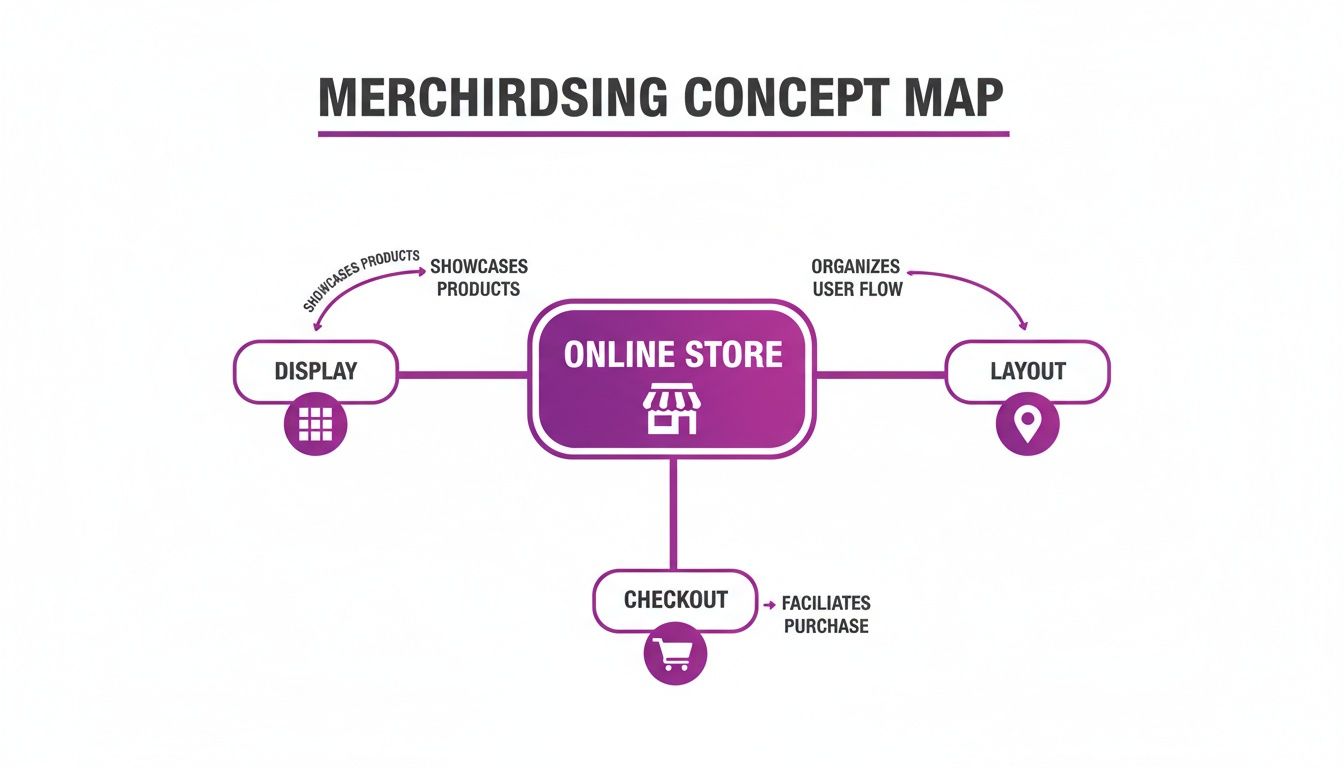
This really brings home the point that every single customer touchpoint is a merchandising opportunity. It all matters.
1. Product Curation And Assortment
Everything starts here, with the products you actually sell and how you group them. Product curation is the art of organizing your items into logical collections that tell a story and make shopping a breeze. Instead of making customers dig through hundreds of SKUs, you guide them.
Get creative and think beyond basic product types. You could build collections around:
- A specific use case: "Work From Home Essentials" or "Weekend Getaway Gear."
- A theme or season: "Holiday Gift Guide" or "Summer Beach Collection."
- A customer segment: "Gifts for Dad" or "Beginner-Friendly Kits."
This isn't just about tidying up your store. It's about inspiring people and helping them discover products they never would have found on their own. Of course, a huge part of this is Mastering Ecommerce Product Catalog Management to make sure your products are presented perfectly.
2. On-Site Experience And Navigation
Once your product collections are sorted, the next pillar is making sure people can actually find them. The on-site experience is all about cutting out the friction. Think of this as the architecture of your digital store—the aisles, the signs, and the overall floor plan.
Key elements here are intuitive navigation with clear menus, a powerful on-site search that can handle typos and synonyms, and smart filtering on category pages. If someone wants a "blue cotton t-shirt in size medium," they should find it in a few clicks, not after a marathon scrolling session. A bad on-site experience is just like walking into a messy, disorganized shop—it’s a massive reason for high bounce rates.
3. Visual Merchandising
In eCommerce, your product imagery does all the heavy lifting. Customers can't touch or feel the products, so visual merchandising is your most powerful way to show off quality, features, and value. This means going way beyond those simple, white-background product shots.
A killer visual strategy needs to include:
- High-Resolution Photography: Multiple angles, detailed close-ups, and zoom features are table stakes now.
- Lifestyle Images: Show your products in real-world contexts so customers can picture themselves using them.
- Product Videos: Demonstrate how a product works, show how a piece of clothing fits, or give a sense of scale.
- User-Generated Content (UGC): Nothing builds trust and social proof like photos from real customers.
Powerful visuals bridge the gap between the digital and physical worlds. They answer questions, build desire, and give customers the confidence they need to click "add to cart."
4. Pricing And Promotions
How you price your products and frame your offers is a make-or-break merchandising pillar. Strategic pricing and promotions are about more than just slashing prices; it's about creating a sense of value and urgency that drives action without cheapening your brand.
Effective tactics include things like product bundling (think a "skincare starter kit" at a slight discount) or tiered offers ("buy 2, get 1 free"). You can also lean on visual cues like countdown timers for flash sales or "low stock" alerts to create urgency. These techniques guide buying decisions and can give your Average Order Value (AOV) a serious boost. For more ideas, you can dive deeper into various ecommerce merchandising strategies.
5. Personalization And The Customer Journey
The final, and most advanced, pillar is personalization. This is where you use customer data to create a shopping experience tailored to each individual. Instead of showing every visitor the same homepage and the same product suggestions, you create a unique path for everyone.
This is the engine behind projections of $7.5 trillion in global eCommerce sales by 2025, as algorithm-fueled product journeys become the standard. With 85% of consumers shopping online, personalized recommendations are proven to boost sales by 20-30% in major markets. The power of this pillar is immense.
Personalization can be as simple as a "Recently Viewed" widget or as complex as an AI-driven engine that suggests products based on browsing history, past purchases, and even real-time clicks. For example, showing a customer who just bought a camera a selection of compatible lenses and memory cards is a smart, personalized merchandising move that makes their life easier and grows your revenue.
How Smart Merchandising Impacts Your Bottom Line
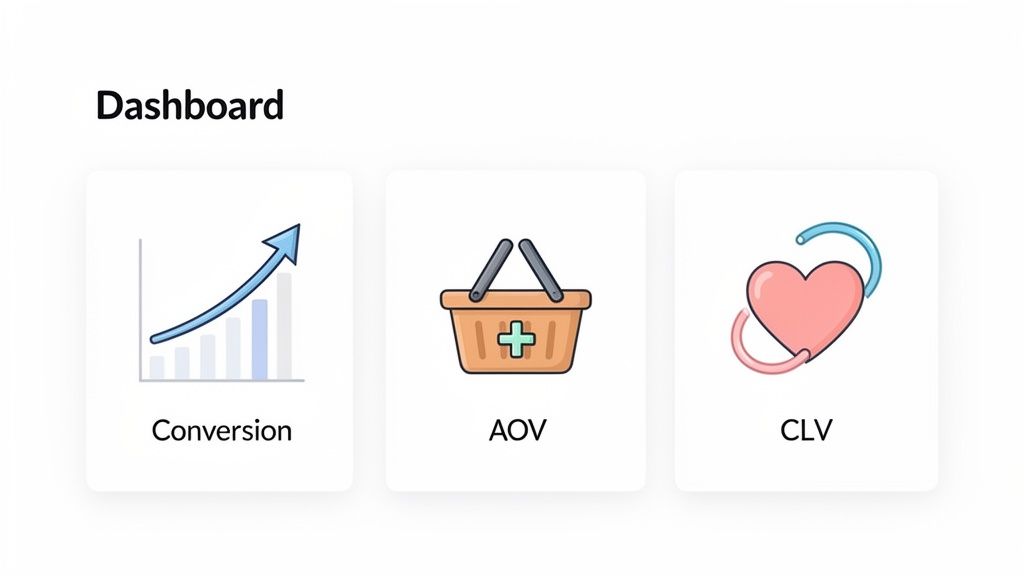
Let’s be clear: effective eCommerce merchandising isn’t just about making your store look pretty. It's a direct, powerful driver of the metrics that actually matter to your business. When you stop just listing products and start strategically guiding the customer journey, you see real financial results.
Think of it as the difference between a cluttered flea market and a high-end boutique. Both sell things, but the boutique's thoughtful layout, curated displays, and helpful guidance—your merchandising—lead to more sales and happier customers who come back again and again.
Every merchandising decision, from how you organize a category to the product recommendations you show, has a measurable impact on your bottom line. Let’s break down exactly how this translates to the key performance indicators (KPIs) that define success in eCommerce.
Boosting Your Conversion Rate
The number one goal of any online store is turning visitors into customers, and this is where merchandising really shines. A high conversion rate is proof that your website is doing its job of persuading people to buy. Smart merchandising makes that decision easy by removing friction and building confidence.
Great merchandising is a strategic play to improve e-commerce conversion rates by creating a shopping experience that just works. When a shopper can easily find what they’re looking for through intuitive navigation and clear filters, their frustration disappears, and their likelihood of buying skyrockets.
Here’s how merchandising directly pumps up your conversion rate:
- High-Quality Visuals: Amazing product photos and videos answer questions before a customer even has to ask. This builds the trust they need to click "Add to Cart."
- Social Proof: Displaying customer reviews and user-generated content acts as a powerful validator, giving new shoppers the confidence to make a purchase.
- Clear Calls-to-Action (CTAs): Well-placed and visually obvious buttons are like a friendly guide, leading the user smoothly all the way through checkout.
Increasing Average Order Value
Getting a customer to buy is a huge win. But getting them to spend more in that same transaction? That’s how you really ramp up profitability. Your Average Order Value (AOV) is a direct reflection of how well your merchandising strategy introduces customers to more products they'll love.
This all comes down to intelligent upselling and cross-selling.
An upsell nudges a customer toward a more premium version of a product. A cross-sell suggests complementary items that make their original purchase even better. Both are core merchandising techniques designed to increase the total cart value.
For example, if someone adds a new camera to their cart, your site should immediately suggest a compatible memory card, a camera bag, and an extended warranty. These aren't just random pop-ups; they're genuinely helpful recommendations that improve the customer's experience while boosting your AOV. Product bundling is another fantastic tool here—offering a small discount for a curated set of items is often too good to pass up.
Enhancing Customer Lifetime Value
Finally, exceptional merchandising builds loyalty, turning one-time buyers into lifelong fans. Customer Lifetime Value (CLV) measures the total revenue you can expect from a single customer over time. A high CLV is the signature of a healthy, sustainable business, and it’s built entirely on positive experiences.
Personalization is the engine that drives CLV. When your store remembers a customer’s preferences and shows them relevant new arrivals or personalized recommendations, it creates a powerful feeling of being understood.
This tailored experience makes shoppers feel seen and valued, giving them a compelling reason to return. By consistently delivering a seamless and relevant journey, you build a relationship that goes far beyond a single transaction. This loyalty not only fuels repeat purchases but also creates your best brand advocates.
See It In Action With Real-World Examples
Theory is one thing, but seeing how the best brands pull it all together is where the lightbulbs really start to go off. When you deconstruct the choices these companies make, you can start to reverse-engineer their success and find killer tactics for your own store.
Let’s ditch the abstract concepts and look at how a couple of leading brands are absolutely crushing it with brilliant eCommerce merchandising.
Gymshark: The Master of Visual and Community Merchandising
Gymshark, the fitness apparel giant, didn't just build a clothing brand; they built an empire by selling an aspirational lifestyle. Their whole merchandising strategy is a masterclass in using powerful visuals to create a community and fuel desire.
The second you land on their homepage, you’re pulled into their world. You won't find boring, static product shots on a white background. Instead, you're hit with high-energy images and videos of athletes and fitness influencers actually sweating in the gear. This isn’t just about showing you what a pair of leggings looks like; it’s about showing you what you can become in them.
Take a look at how they structure their category pages to guide the shopping experience.
The layout is all about bold, clean visuals and super clear product collections. It makes it dead simple for shoppers to find exactly what they’re looking for, whether it's hoodies, shorts, or the latest drop.
This works so well because it combines powerful visual merchandising with a heavy dose of social proof. The models are often well-known fitness personalities, which adds an immediate layer of credibility and makes you feel like you're part of the club.
By focusing on the feeling and the outcome of using their products, Gymshark turns a simple shopping trip into an inspirational experience. Their merchandising tells a story where you, the customer, are the hero.
They also nail the on-site experience on their product pages, loading them with:
- Multiple lifestyle and studio shots that show off the fit, fabric, and function from every conceivable angle.
- Detailed product descriptions that call out performance features like sweat-wicking tech and seamless construction.
- Customer reviews and photos (UGC) that build trust and help shoppers figure out their sizing.
Sephora: The Architect of Personalized Journeys
Now let's switch gears to the beauty world, where Sephora reigns supreme in creating deeply personal shopping experiences. Their entire merchandising strategy is designed to guide customers through a frankly massive product catalog to find the perfect items for their unique needs.
One of their most powerful merchandising tools is their lineup of quizzes, like the "Fragrance Finder" or "Skincare Quiz." These aren't just fun gimmicks; they’re sophisticated selling machines. They ask smart, targeted questions about your preferences, skin type, or scent profile, and then—voila—they serve up a curated collection of products just for you.
This clever approach hits several goals at once:
- It Kills Choice Paralysis: With thousands of foundations, finding the right one is overwhelming. The quiz cuts through the noise.
- It Gathers Valuable Data: Every answer helps Sephora build a richer customer profile for even better personalization down the road.
- It Makes You Feel Seen: The curated results feel less like a sales pitch and more like a personal consultation with an expert.
Sephora's product pages are also a treasure trove of merchandising tactics. They feature user-generated content right at the forefront, showcasing customer photos and reviews so you can see how a lipstick looks on different skin tones. They also use smart cross-selling ("Complete Your Routine"), which is a huge driver for bumping up their average order value.
By seamlessly blending guidance, social proof, and data, Sephora makes beauty shopping feel both personal and incredibly effective.
Putting Your Merchandising Strategy To Work On Shopify
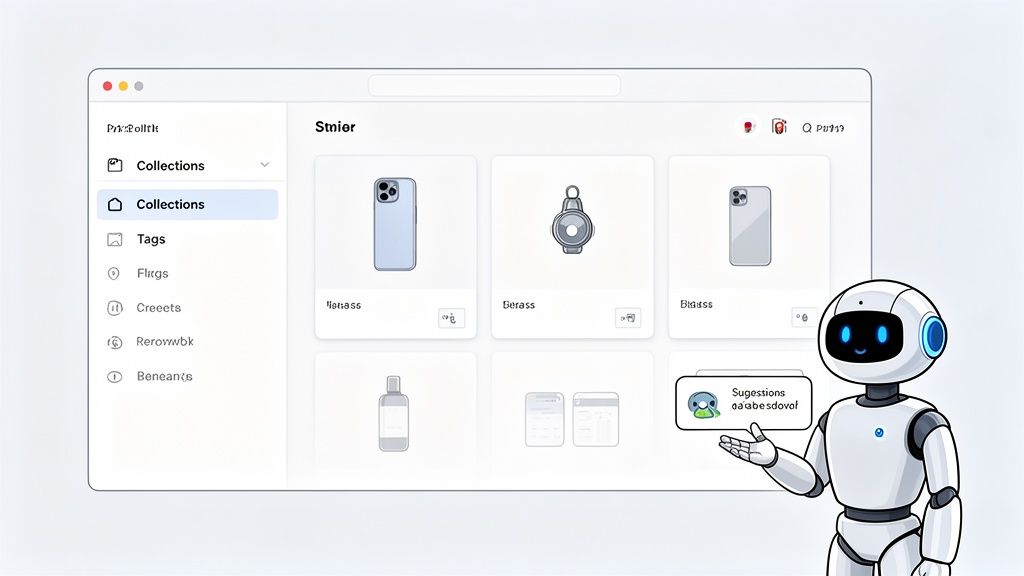
Turning merchandising theory into real-world results can feel like a huge leap, but Shopify is packed with powerful, user-friendly tools to make it happen. By getting the most out of its built-in features and layering in the right apps, you can create a slick system that guides customers right where you want them and boosts sales.
This is your no-nonsense roadmap to implementing a killer merchandising strategy on your own Shopify store. We'll start with the tools you already have. Think of Shopify’s core features as the foundation—the load-bearing walls of your digital storefront.
Mastering Shopify's Native Merchandising Tools
Before you even think about the app store, you need to squeeze every last drop of value out of what Shopify offers right out of the box. These native features are surprisingly powerful and form the backbone of any clear, intuitive shopping experience. A well-organized store is ground zero for great merchandising.
Get started by dialing in these three core areas:
- Collections: This is your main tool for curating products. Don't just stop at basic categories like "Shirts" or "Pants." Get creative. Think "Weekend Getaway Essentials," "Top Rated," or "Gifts Under $50." You can also set up automated collections to group items by tags, price, or vendor, which is a massive time-saver.
- Product Tags: Tags are your secret weapon for organizing and filtering with precision. Use them to label products with key attributes—color, material, style, specific features, you name it. This data is what fuels the filtering options on your collection pages, letting shoppers zero in on exactly what they want in seconds.
- Navigation Menus: Your main menu and footer are the road signs for your store. Design them with the customer in mind. Your most popular collections should be front and center, with logical dropdowns that don't overwhelm people. A clean, simple navigation setup is your best defense against high bounce rates.
Nail these native features first. You'll build a rock-solid foundation that makes your store easier for customers to shop and for you to manage.
Supercharging Your Strategy With Essential Shopify Apps
Once your foundation is solid, Shopify apps are how you take your merchandising to the next level. The app store is full of specialized tools that automate tricky tasks and unlock advanced features, especially when it comes to personalization and social proof.
Look into these app categories to really supercharge your efforts:
- Advanced Search & Filtering: Apps like Searchanise or Product Filter & Search beef up Shopify's native search. They add features like visual search, typo correction, and more complex filtering logic that help customers find what they're looking for way faster.
- Personalization & Recommendations: To create that "just for you" shopping experience, you need to show the right products to the right person at the right time. For a deep dive, check out our guide on personalization apps and techniques for Shopify stores. These tools often use AI to power "You Might Also Like" carousels and other smart recommendations.
- Customer Reviews & UGC: Tools like Yotpo or Loox make it dead simple to collect and showcase customer reviews, photos, and even videos. This user-generated content (UGC) is pure gold—it builds trust and acts as authentic, free visual merchandising.
Your Shopify app ecosystem should be a direct extension of your merchandising goals. Don't just pile on apps for the sake of it. Choose tools that solve a specific problem, whether that's improving product discovery or building customer confidence.
The Growing Role Of AI In Shopify Merchandising
Artificial intelligence isn't some far-off concept anymore; it's a practical tool that can automate and optimize huge chunks of your merchandising work. AI-powered apps can handle complex logic that would be a nightmare to manage by hand, especially as your catalog grows.
The most obvious impact of AI is in automated product sorting. Instead of you manually dragging and dropping products in a collection, AI can reorder them on the fly based on real-time data. It can push best-sellers, high-margin items, or trending products to the top, ensuring your most important products are always getting the most eyeballs.
This kind of smart technology is a huge reason why digital retail is exploding. By 2025, online sales are projected to hit nearly $7.4 trillion, accounting for almost a quarter of every retail dollar spent. This growth is fueled by smarter product discovery—an area where top Shopify specialists excel by using quick, AI-driven merchandising tweaks to drive conversions. Discover more insights about these online retail trends on invespcro.com.
When you combine Shopify's native tools with a few strategic apps and a sprinkle of AI, you get a powerful, responsive merchandising system that adapts to your customers and drives your bottom line.
Got Questions? Let's Talk Merchandising.
Once you start digging into ecommerce merchandising, a lot of practical questions pop up. It’s only natural. This section is designed to tackle the most common ones we hear from store owners, giving you clear, straightforward answers to help you get moving and build your strategy with confidence.
Think of it as a quick chat with an expert, meant to clear up any confusion.
How Is Ecommerce Merchandising Different From Marketing?
This is a classic, and the difference is absolutely critical. Here’s the simplest way to think about it: marketing is what gets people to your front door, and merchandising is what happens once they’re inside.
Marketing covers all the stuff you do to drive traffic—your SEO efforts, social media ads, influencer shout-outs, and email campaigns. These are the invitations you send out for your party.
Merchandising, on the other hand, is the party. It’s the layout of your digital store, the way products are arranged on the "shelves," the overall vibe, and the entire experience that convinces visitors to stick around, browse, and actually buy something.
They're two sides of the same coin and have to work together perfectly. For example, a marketing campaign hyping up your new spring collection is only going to land if your on-site merchandising is on point—showcasing those products beautifully on the homepage, in curated collections, and with killer visuals. One just doesn't work without the other.
What Are The Most Important Merchandising KPIs To Track?
While every business has its own specific goals, there are a handful of key performance indicators (KPIs) that tell you almost everything you need to know about your merchandising efforts. Don't drown in data; start with these.
- Conversion Rate: This is your north star. It’s the percentage of visitors who make a purchase, and it's the ultimate test of how compelling and easy your on-site experience really is.
- Average Order Value (AOV): Is your upselling and cross-selling working? This metric tells you. A climbing AOV means customers are adding more to their carts, which is a great sign that your recommendations and bundles are hitting the mark.
- Add-to-Cart Rate: This one shows how many visitors are actually putting items in their cart. It’s a huge signal of purchase intent and proves that your product pages and visuals are convincing enough for them to take that next step.
- Product Views Per Session: This KPI helps you figure out if customers are discovering your products. If this number is stubbornly low, it might be a red flag for issues with your site navigation or product recommendations.
- Bounce Rate (on key pages): Pay close attention to the bounce rate on your homepage, category pages, and top product pages. A high bounce rate screams friction—it means there's a disconnect between what a customer expected and what they actually found.
How Often Should I Update My Merchandising Strategy?
Your merchandising should never be a "set it and forget it" task. How often you make updates really depends on your industry and how quickly your catalog changes, but the real key is to stay nimble.
If you're in a fast-paced world like fashion or consumer electronics, you might need to make tweaks weekly or even daily to feature new arrivals, push best-sellers, or jump on a new trend. For stores with a more stable product line, a monthly or quarterly check-in is a good starting point.
The best way to approach this is to let data and events be your triggers. Don't just update on a random schedule; update with a purpose. Let a new product launch, a holiday, a big marketing campaign, or a dip in a key metric be the reason you refresh your strategy.
This is where a structured Conversion Rate Optimization (CRO) program really shines. By constantly A/B testing things like product sorting, promotional banners, and recommendation placements, you ensure your store is always getting better based on how real customers behave, not just on a hunch.
Can A Small Business Do Effective Merchandising On A Budget?
Absolutely. Great merchandising isn't about having the most expensive AI tools. It's about nailing the fundamentals with the resources you have. Many of the highest-impact tactics cost you more in time and creativity than they do in cash.
Focus your budget-friendly efforts right here:
- Invest in Your Visuals: You don't need a Hollywood studio. A modern smartphone, some decent lighting, and a clean background can produce fantastic product photos. Spend your time creating high-quality images and writing product descriptions that focus on benefits, not just features.
- Leverage Native Shopify Features: Get really good at creating intuitive collections. Use your product tags like a pro to power your filters and search. Manually curate "Related Products" for your best-sellers to create simple, effective cross-sells.
- Harness the Power of Your Customers: Actively ask for and collect customer reviews and photos. This user-generated content (UGC) is one of the most powerful types of social proof you can get, and it's completely free. Feature it proudly on your product pages.
These foundational strategies build trust, answer your customers' questions before they have to ask, and create a more professional shopping experience—all without draining your bank account.
Ready to transform your Shopify store into a high-performance sales machine? At ECORN, our team of dedicated Shopify specialists lives and breathes ecommerce merchandising. We combine expert design, development, and CRO strategies to help brands like yours scale efficiently. Explore our flexible subscription packages and let's build an online experience that truly converts.



Shopify Website Design Examples: 7 Stores Worth Studying
7 Ecommerce Newsletter Examples for Shopify Brands
One Product Shopify Store: Build and Scale
Mobile Pop Up Strategy for Shopify Stores That Converts
Sitemap for Shopify: How to Find, Optimize, and Submit It

7 Single Product Websites Worth Emulating
Product Variants Shopify: The Complete 2026 Guide
Ecommerce Analytics Consulting for Growth
What Is AI Integration for eCommerce
How to Choose the Right eCommerce Website Development Firm
E Business Strategy Implementation
Conversion Tracking Setup for Shopify Stores
BigCommerce vs Shopify Plus Which Enterprise Wins in 2026
Shopify Theme Kit: Setup, Commands, and Migration Guide
Shopify Extension Development: A Practical 2026 Guide
Shopify Speed Score Explained and How to Improve It
Shopify Mobile Optimization: The 2026 Playbook
How to Add Subcategory in Shopify for Better UX
How to Implement Structured Data for Ecommerce in 2026
SEO App Mobile: Shopify Store Optimization Guide
Shopify Plus Support: What It Includes and How to Choose
Google Ads for Shopify: The Complete 2026 Playbook
Shopify New York: How to Find and Hire the Right Agency
Google Search Console for Shopify: The Complete Setup
First Party Data Collection for eCommerce Growth
FAQ Online Store Guide: Build and Measure It Right
Do FB Ads Work for eCommerce in 2026?
One Page Checkout for Shopify: Design and Implementation
Shopify GraphQL vs REST: The 2026 Developer Decision
Shopify Ecommerce Consulting: Strategy, Pricing &
Are Reddit Ads Worth It for eCommerce Brands
Shopify Title and Meta Description: A Practical 2026 Guide

Product Video Best Practices for Shopify Brands
Real-Time Inventory Management: A 2026 Guide

AI Chatbot Integration for Shopify Stores
Affiliate Program Management: A Shopify Guide
10 Best Performance Monitoring Tools for Shopify in 2026
Digital Asset Management for eCommerce Brands in 2026
Every Type of Facebook Ads Explained for eCommerce Growth
Product Information Management Explained for Shopify Brands
Support Ticket System: A Guide for Shopify Stores

10 Best Customer Service Tools for Shopify in 2026

Can I Start a Business with No Money? a 2026 Blueprint
What Sells Good on Etsy: Best Niches for 2026

Shopify Add to Cart Button: A Practical 2026 Guide

Customer Feedback Automation: A Practical eCommerce Guide
Critical Rendering Path: A Guide for Shopify Stores

How to Promote on TikTok for eCommerce in 2026

B2B eCommerce Consulting That Drives Real Revenue

10 Best Practices for Site Navigation in 2026
Return vs Refund for Shopify Stores: A Practical Guide
What Is Customer Lifetime Value and Why It Matters
What Is Voice of Customer Research for eCommerce

SMS Marketing for Ecommerce That Actually Converts

Master How to Improve Email Deliverability in 2026

Top 7 eCommerce Partners NYC for Shopify Brands in 2026
Machine Learning for Ecommerce: Boost Your Shopify Store
Beauty Market Research: Your 2026 Growth Guide

Shopify International Expansion: A 2026 Roadmap
What Does CRO Stand for in Business: Understanding CRO
Shopify Visual Merchandising: A Playbook for Higher Sales

Shopify Landing Page Design: Master Conversion in 2026

10 Best AI SEO Optimization Tools for Shopify in 2026

Agentic AI for Ecommerce: Boost Your Sales in 2026
Mastering Email Marketing Data for eCommerce Growth
Conversion Rate Optimisation Australia: Boost Your Sales
Conversion Rate Optimization AI: Your Shopify Store Guide

10 Product Bundling Strategies for Shopify in 2026
How to Increase Customer Lifetime Value: A Shopify Playbook
AI Customer Service Automation: Shopify Guide 2026
Clean Website Design: A Shopify Conversion Playbook

Omnichannel Retail Strategy: A Shopify Playbook
Product Data Enrichment: A Guide for Shopify Brands
Instagram Shopping Features a Guide for Shopify Stores

What Is Revenue Optimization: A Holistic RevOps Guide
Benefits of Conversion Rate Optimization: Boost Your
WordPress to Shopify Migration: Your 2026 Seamless Switch
Boost Sales: Ecommerce Payment Processing Guide 2026
Unified Commerce Platform: Benefits, KPIs & Shopify Guide
How to Reduce Bounce Rate eCommerce: Your 2026 Guide
Shopify API Integration: A Practical End-to-End Guide

How to Implement Data Governance: A 2026 Guide
Shopify Store Development Cost: A 2026 Breakdown
What Is Server Side Tracking: The Shopify Guide 2026
Marketing Automation Workflows: A Shopify Guide for 2026
Shopify: How to Reduce Technical Debt

Shopify UX Design Change: A Playbook for Growth
User Generated Content Strategy: Shopify Playbook
Shopify Pause and Build Plan Cost: A Complete 2026 Guide
Compare at Price on Shopify: A Complete Guide for 2026
Where Can I Sell My Prints? 10 Best Platforms for 2026
Shopify Order Management System: The Ultimate Guide 2026
What Is Marketing Attribution? an eCommerce Guide for 2026
10 Best Black Friday Sales Sheets for 2026

Discover the Top Social Media Marketing Agencies For
Consumer Confidence Definition for eCommerce in 2026
What Is Social Commerce? Your 2026 Guide to Boosting Sales
A Social Ad Campaign Playbook for eCommerce Growth

7 Best FAQ Page Examples for SaaS & eCommerce

Market Research in Fashion Industry: A Guide for Shopify


newsletter in your inbox