


Choosing between Magento and Shopify really boils down to one fundamental question: do you need ultimate power and control, or do you crave speed and simplicity?
It's a classic trade-off we see all the time. Shopify is typically the perfect fit for direct-to-consumer brands that need to launch fast, value ease of use, and want to plug into a powerful marketing ecosystem right out of the box. On the other hand, Magento (now officially Adobe Commerce) is an absolute beast built for complex enterprises that demand deep, granular customization, intricate multi-store setups, and total operational control.
Making The Right Platform Choice: A Quick Guide
Picking an eCommerce platform is one of the most foundational decisions you'll make for your business. It directly impacts your ability to scale, your day-to-day operational costs, and how quickly you can get your products to market. The Magento vs. Shopify debate isn't about which one is "better" in a vacuum; it’s about finding the platform that truly aligns with your specific business model, your team's technical skills, and your long-term vision for growth.
Think of it this way: Shopify operates on a Software-as-a-Service (SaaS) model. This means they handle all the technical heavy lifting—hosting, security, patches, and maintenance—for a predictable monthly fee. This frees you up to focus almost entirely on what you do best: marketing and selling.
Magento is the polar opposite. As an open-source platform, it hands you the keys to the entire codebase. You can build whatever you can imagine, but that freedom comes with responsibility. You're on the hook for sourcing your own hosting, managing security, and handling all the ongoing developer maintenance.
Key Differentiators at a Glance
Let's look at the numbers to see how this plays out in the real world. While Shopify now powers a staggering 30% of all online stores, Magento maintains a serious foothold where it counts, powering 12% of enterprise-level businesses and 20% of the top 1000 U.S. retailers.
This data paints a very clear picture: Shopify dominates the broader market with its accessibility, while Magento is the trusted choice for highly specialized, custom-built environments. The costs reflect this reality, too. A typical Magento build can easily run from $30,000 to $100,000+ just to get started, whereas a brand can get a beautiful Shopify store off the ground for a more modest $5,000 to $15,000.
To make things even clearer, here’s a quick-glance table to help you see where your business might fit.
Magento vs Shopify At a Glance
This table breaks down the core philosophies and practical differences between the two platforms, helping you quickly map your business needs to the right solution.
Ultimately, this comparison highlights that your choice depends on your priorities. Are you looking for a reliable, scalable, and fast-to-market solution, or do you require a platform that can be molded into a completely unique, complex digital operation?
This decision tree gives you a simple visual guide for the core choice between Shopify's launch speed and Magento's deep customization capabilities.
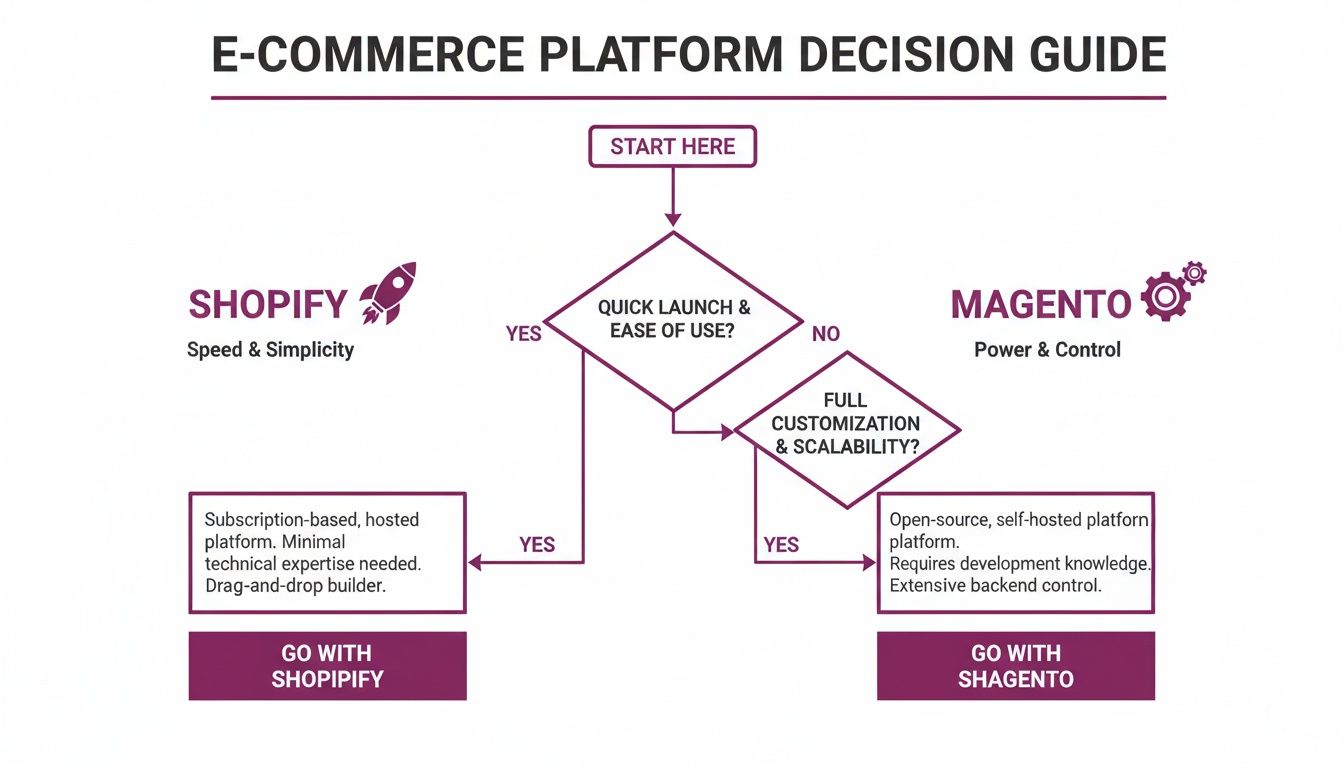
As the chart shows, if your priority is getting to market quickly and efficiently, Shopify is your path. If building a completely bespoke digital experience from the ground up is the goal, Magento has the power you need.
For an even more detailed breakdown, check out our full guide on how to choose an eCommerce platform.
Decoding Market Share and Global Footprints
When you're weighing Magento against Shopify, looking at market share is about more than just seeing who’s more popular. It's a practical look into the reality of each platform’s ecosystem—something that directly impacts who you can hire, what apps are available, and how much community support you can lean on. A platform's dominance in a certain region also means it’s more likely to have seamless integrations with local payment gateways and shipping carriers, which is a massive deal if you're planning to sell internationally.
There's no denying it: Shopify’s presence is enormous. They’ve absolutely cornered a huge slice of the direct-to-consumer (D2C) pie, especially in North America, and that widespread adoption has created a self-sustaining ecosystem that’s a huge plus for merchants.
Think about it this way: the sheer volume of Shopify stores has created a massive pool of developers and agencies who live and breathe the platform. That competition makes it far easier—and often cheaper—to find an expert for anything from a quick theme tweak to a complex custom app.
The Power of a Dominant Ecosystem
Shopify's incredible reach has also spawned a gigantic app marketplace. With over 8,000 apps on tap, you can find a pre-built solution for pretty much anything you can dream up, whether it's a sophisticated loyalty program or a tricky subscription model. This plug-and-play approach dramatically cuts down the time and money it would take to build new features from the ground up.
The bottom line is simple: Shopify's market leadership has created a virtuous cycle of support and innovation. More merchants bring in more developers, who build more apps, which makes the platform even more appealing to new businesses.
This vibrant ecosystem is a game-changer for businesses that need to move fast, stay agile, and access a wide array of ready-made tools. It lets them pounce on market trends without getting stuck in long, expensive custom development cycles.

Magento's Strategic European Stronghold
Magento tells a different market share story—one focused on depth, not breadth. While its overall numbers are smaller, Magento (now Adobe Commerce) has cemented its position as the go-to for large, complex enterprises, especially in Europe. Its open-source nature and powerful architecture are a perfect match for the complex multi-language, multi-currency setups common across the continent.
This European focus means that if you're operating in markets like Germany, the UK, or France, you'll find a deep bench of Magento agencies who are experts in local regulations, tax laws, and payment preferences. That kind of specialized knowledge is invaluable when you’re navigating the maze of cross-border European commerce.
The numbers tell the story perfectly. Globally, Shopify is the clear leader with a 10.32% share of all eCommerce sites, powering roughly 4.8 million stores. It's especially dominant in the United States, commanding 29% of the market. Magento’s footprint is more concentrated. It holds a 1.49% global share but has a strong 20% adoption rate among the top 1000 US retailers and an impressive 45.58% market share in Europe, proving its mettle in high-stakes, high-revenue environments. You can dig into more Shopify market share data to see the full picture.
So, how do you choose based on their global footprint? It comes down to aligning your goals with their strengths:
- Go with Shopify if: Your main markets are North America, the UK, or Australia. You'll have access to the biggest talent pool and a massive library of off-the-shelf apps to get you moving quickly.
- Stick with Magento if: Your business is heavily focused on Europe, you need robust multi-store and multi-language features for different regions, or your business model requires a level of deep customization that Shopify’s ecosystem just can't handle.
Calculating the True Total Cost of Ownership
When you’re weighing Magento vs. Shopify, you have to look way beyond the sticker price. A platform's real Total Cost of Ownership (TCO) is the full story—it covers everything from the initial build and monthly software fees to the sneaky costs like developer retainers and transaction penalties. Getting this complete financial picture is crucial. It’s the only way to pick a platform that isn’t just powerful, but actually sustainable for your business.
At first glance, Shopify’s pricing seems refreshingly simple, with its clear monthly subscription tiers. The costs, however, start to stack up as you grow. The biggest variables are the transaction fees and the ever-growing bill for essential apps from the Shopify App Store.
For instance, while Shopify Payments has competitive rates, if you need to use a third-party gateway like Stripe or PayPal, Shopify adds its own transaction fee on top. This ranges from 2% on the Basic plan down to 0.6% on Advanced Shopify. That's a fee you pay in addition to what the payment provider charges, effectively a double-dip that can seriously chip away at your margins, especially if you're doing high volume.

Unpacking Shopify's App Ecosystem Costs
The Shopify App Store is one of the platform's biggest draws, but its costs are very easy to underestimate. A brand-new store might get by with a handful of free apps, but a scaling business quickly finds itself paying for multiple subscriptions to handle key functions:
- Advanced subscriptions: Apps like ReCharge or Bold Subscriptions can run into hundreds of dollars per month.
- Complex product options: You'll need an app to get past Shopify's built-in 100-variant limit.
- Loyalty and rewards programs: These are essential for retention, and most come with a monthly fee tied to your number of customers.
These app fees can easily tack on $200 to $2,000+ per month to your operating costs. To keep these ongoing expenses in check, many Shopify users even bring on a virtual personal assistant specifically for Shopify sellers to manage daily store tasks. For a deep dive into what this looks like at the enterprise level, our ultimate guide to Shopify Plus pricing breaks down every possible line item.
Here's the core financial trade-off with Shopify: you get predictability, but you give up some control. You’re paying for a managed ecosystem, but you’re also paying for every single piece of functionality you need to scale beyond its out-of-the-box features.
Demystifying Magento's Hidden Expenses
Magento's cost structure is the complete opposite of Shopify's. While Magento Open Source is technically "free" to download, the real money goes into the infrastructure and the talent needed to run it properly. These aren't just nice-to-haves; they are fundamental for a secure, fast-loading store.
The biggest expenses you'll face with a Magento store are:
- High-Performance Hosting: Magento is a beast that needs specialized hosting. This can cost anywhere from $100 to over $1,000 a month.
- Adobe Commerce Licensing: If you go for the enterprise version, the license fees kick off at $22,000 a year and climb based on your Gross Merchandise Value (GMV).
- Developer Retainers: You absolutely need a dedicated developer or agency for the initial setup, customization, security patching, and day-to-day maintenance. These retainers usually start at $2,000 to $10,000+ per month.
- Security and Compliance: Unlike Shopify, you're on the hook for maintaining PCI compliance and applying security patches yourself, which means constant developer oversight.
A mid-sized business running on Magento Open Source can realistically expect to spend $25,000 to $60,000 per year just on hosting, development, and maintenance—and that's before any licensing fees. For big players on Adobe Commerce, the TCO can easily blow past $100,000 annually.
So, when it comes to the Magento vs. Shopify cost debate, the choice becomes pretty clear. Shopify offers a much lower barrier to entry with predictable monthly costs that grow as you do. Magento, on the other hand, demands a heavy upfront and ongoing investment in technical resources but gives you a platform with virtually no limits. Your budget and your team's tech skills will ultimately decide which TCO model makes sense for you.
Unlocking Customization and Technical Control
The real heart of the Magento vs. Shopify debate isn't just a list of features; it's a clash of philosophies. Shopify gives you a guided, efficient experience inside a well-manicured garden. Magento hands you the keys to an open field and a tractor, letting you build whatever you can imagine. This choice fundamentally defines what your business can achieve, pitting speed against total control.
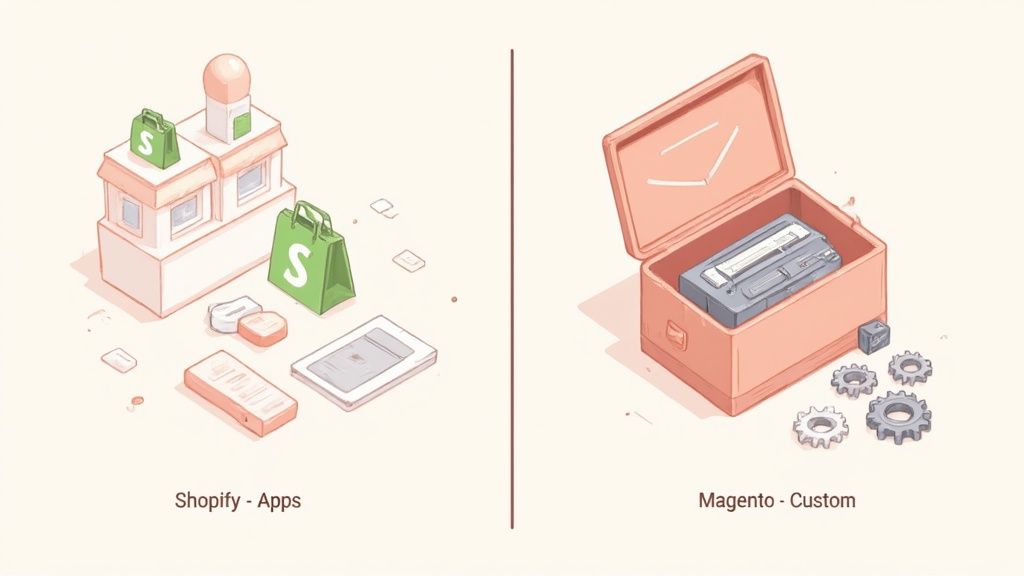
Shopify's entire approach to customization is built for speed and efficiency. For most store owners, this starts with the theme editor and the Liquid templating language. It's a powerful setup that lets you make significant visual changes—tweaking layouts, colors, and fonts—without needing a developer on standby. When you need more complex features, the first stop is always the Shopify App Store.
But for brands with bigger ambitions, Shopify's headless capabilities are where the real magic happens. Using tools like Hydrogen, Shopify's own React-based framework, developers can build completely custom, lightning-fast storefronts that plug into Shopify's rock-solid backend via APIs. This unlocks unique user experiences, but it definitely requires a skilled development team.
Where Shopify's Convenience Meets Its Limits
While Shopify's ecosystem is massive, it has clear boundaries. You can't just dive in and modify the core checkout process (unless you're on Shopify Plus, which offers some limited access). Your ability to create deeply integrated, non-standard business workflows is ultimately capped by what the available APIs and apps allow.
This is where you might hit a wall. For instance, imagine you need a product configurator for custom furniture, where customers choose from hundreds of components with interdependent pricing rules. While an app might get you close, it may not integrate perfectly with your inventory or ERP system in the exact way your operations demand.
The strategic trade-off with Shopify is clear: you exchange a degree of foundational control for unparalleled speed-to-market, security, and a lower technical maintenance burden. For most D2C brands, this is an excellent deal.
Magento's Framework for Absolute Control
Magento (now Adobe Commerce) works on a completely different principle. It's open-source, which means you get the keys to the entire kingdom. If you can code it, you can build it. This unmatched flexibility is precisely why Magento remains the platform of choice for businesses with truly unique operational needs.
This level of control is non-negotiable for enterprises with complex backend processes. Think about a B2B portal where different customer groups see entirely different product catalogs, get negotiated contract pricing, and place bulk orders through a custom interface that talks directly to a legacy ERP system. This is Magento’s home turf.
Another powerful example is building a sophisticated multi-warehouse inventory system. With Magento, you can develop native logic that routes orders to the nearest warehouse based on a customer's location, checks stock levels in real-time across all locations, and handles split shipments—all within the core platform.
While Shopify leads the market with 14.5% of top eCommerce platforms, Magento's 9.2% share demonstrates its dominance among businesses requiring premium, custom solutions. Its strong presence in Europe (45.58%) and the US (38.56%) makes it a go-to for multinationals that need unlimited multi-site architecture, an area where it easily surpasses Shopify's expansion store limits. You can dig into more eCommerce platform rankings here.
Defining the Breaking Point
So, when does Magento become the necessary choice over Shopify? The decision usually boils down to one of these critical business needs:
- Bespoke B2B Functionality: You need complex quote-to-order workflows, customer-specific pricing tiers, or purchase order systems that are deeply woven into your business logic.
- Complex Product Customization: Your products have thousands of variations, dependencies, and dynamic pricing rules that go far beyond Shopify's variant limits or existing apps.
- Deep Legacy System Integration: You must create a two-way sync with an older, proprietary ERP, CRM, or PIM system that doesn't have modern API support.
- Unique Checkout Modifications: Your business model demands a fundamentally different checkout flow, like a multi-step approval process or unconventional payment logic.
Ultimately, the choice hinges on your business's complexity. Shopify provides a powerful, fast, and secure path for the vast majority of eCommerce brands. Magento is the industrial-strength solution for when "out-of-the-box" just won't cut it.
Evaluating Performance, Scalability, and Security
When you're running a growing e-commerce business, site performance isn't just a nice-to-have; it's the very foundation of your customer experience. Comparing Magento and Shopify on performance, scalability, and security reveals a fundamental split in their operational philosophies. The path you choose here will directly dictate your site's speed, its resilience during traffic spikes, and ultimately, who’s on the hook for keeping it all safe.
As a fully-managed SaaS platform, Shopify essentially takes the entire infrastructure headache off your plate. They handle the hosting, server setups, and performance tuning. For a merchant, that means you get reliable, consistent speed without needing a dedicated technical team just to manage servers.
Magento, on the other hand, is a self-hosted or PaaS (Platform-as-a-Service) solution, which puts performance squarely in your hands. The speed and stability of your store are a direct reflection of your investment in top-tier hosting and the skill of your development team. While this gives you an incredible amount of control, it also means you’re responsible for everything from server caching to database optimization.
Handling High-Traffic Events
The real stress test for any platform is a high-stakes event like Black Friday or a viral marketing campaign. This is where the architectural differences between Shopify and Magento truly come into focus. After all, a platform's ability to help you improve e-commerce conversion rate is directly tied to a fast, reliable user experience when traffic is off the charts.
Shopify Plus is engineered to handle massive, concurrent traffic loads without breaking a sweat. Its globally distributed infrastructure is built for enterprise-level events, giving merchants peace of mind with guaranteed uptime and performance that scales automatically. You don't have to spin up extra servers for a flash sale; the platform just absorbs the traffic.
With Magento, your ability to scale is entirely dependent on the infrastructure you’ve built. To prep for a major sales event, your team has to proactively scale server resources, run load tests, and double-check that your hosting environment can handle the surge. It allows for precise, fine-tuned control, but it also introduces a massive risk if it isn't managed by experts.
Key Takeaway: Shopify Plus delivers "performance as a service," offering effortless scalability for big moments. Magento offers "performance as a project," demanding a significant investment of time and technical expertise to achieve that same reliability.
The Security Responsibility Divide
Security is another area where the two platforms couldn't be more different. Your choice here really comes down to your team's in-house capabilities and your business's appetite for risk.
With Shopify, security is a core feature of the service itself. They manage all server-level security, monitor for threats, and ensure the entire platform is PCI DSS Level 1 compliant. This means the critical task of protecting customer payment data is handled for you, which dramatically reduces your compliance burden. You're still responsible for your own store's admin security, of course, but the foundational infrastructure is locked down by Shopify.
In the Magento world, security is a shared—and often heavy—responsibility. You and your development team are accountable for:
- Applying Security Patches: Adobe regularly releases critical security patches, and it's on you to apply them immediately to shield your store from known vulnerabilities.
- Server Hardening: This involves configuring your server environment to protect against common threats and prevent unauthorized access.
- PCI Compliance: You have to ensure your entire tech stack, from the server to your payment gateway integration, meets strict PCI standards.
The table below breaks down this division of labor for critical operational tasks.
Scalability and Security Responsibility Model
The operational models of Shopify and Magento create a clear divide in who manages key responsibilities. A SaaS platform like Shopify bundles these services, whereas a self-hosted solution like Magento requires you to manage them or hire experts.
This clear distinction is crucial for long-term planning. It helps you anticipate the true cost and resource allocation needed to run your store effectively.
Ultimately, your decision comes down to a strategic trade-off. Shopify offers a lower-risk, hands-off model where world-class performance and security are part of the package. Magento provides ultimate control but demands a significant, ongoing investment in technical resources to manage these critical functions effectively.
So, Which Platform is Right for You?
After digging into the details of Magento and Shopify, the final call comes down to the DNA of your business. This isn't just a feature-for-feature comparison; it's about picking a platform philosophy that will either supercharge your growth or bog you down with operational headaches. Your long-term goals, technical firepower, and market strategy have to be the deciding factors.
The platforms are built for two very different, yet equally ambitious, types of businesses. One is all about marketing speed and agility, while the other demands complete control over complex, deeply woven systems. Get this choice right, and you'll empower your team with the tools they need to win.
The Ideal Shopify Plus Merchant
Shopify Plus is the undisputed king for ambitious, direct-to-consumer (D2C) brands that move at the speed of social media. If your game plan is all about rapid-fire product launches, aggressive marketing campaigns, and quick-turn international expansion, this is your home. It’s built for teams that need to move fast without getting stuck in the weeds of technical maintenance.
These merchants value a hands-off operational model where hosting, security, and performance are someone else's problem. Their focus is locked on acquiring and keeping customers, tapping into Shopify’s massive app ecosystem to quickly spin up loyalty programs, subscription models, and slick marketing automations.
Shopify Plus is for the brand that wants to pour 100% of its energy into growth and the customer experience, trusting the platform to handle the heavy lifting. It's a direct investment in speed and operational simplicity.
The Ideal Adobe Commerce (Magento) Enterprise
Adobe Commerce, the powerhouse formerly known as Magento, is still the go-to for large enterprises with seriously complex needs. This is the platform for businesses navigating intricate B2B sales cycles with customer-specific pricing, quoting tools, and detailed account hierarchies. If your business is built around a deeply integrated, legacy ERP system, Magento’s open-source flexibility isn't just a nice-to-have—it's a necessity.
It's also the clear winner for multi-brand giants that need to run completely separate storefronts—each with its own catalog, branding, and rules—from a single, unified backend. This kind of business has a strong in-house dev team or a dedicated agency partner and sees their eCommerce platform as the custom-built core of their entire digital operation.
Choosing between these two is a major strategic move. An expert partner like ECORN can offer the critical guidance you need, ensuring your decision is perfectly aligned with where your business is headed. From managing a smooth migration to delivering ongoing CRO and optimization, the right support makes sure your platform becomes a powerful engine for real, sustained growth.
Got Questions? We’ve Got Answers.
When you're weighing two heavy-hitters like Magento and Shopify, a few critical questions always come up. Getting clear, practical answers on the tricky stuff—migration, B2B features, and product complexity—is what separates a good decision from a great one. Let's tackle the most common ones head-on.
Is It a Nightmare to Migrate from Magento to Shopify Plus?
Let’s be honest: the difficulty of moving from Magento to Shopify Plus depends entirely on how custom your current site is. If you're running a relatively standard Magento setup, the process can be pretty straightforward. But for a site layered with years of custom code, it's a project that demands careful planning.
The migration itself is about more than just moving data. You're mapping customer histories, order data, and product catalogs over to a new structure. You'll also need a new theme built for Shopify's Liquid framework and will have to find Shopify Apps (or build custom ones) to replace any unique features you had on Magento.
The real challenge isn't moving products; it's translating years of custom business logic from Magento's open-source playground into Shopify’s more streamlined ecosystem. For many brands, though, the upfront effort is a small price to pay for the long-term gains in performance, lower maintenance costs, and reduced technical headaches.
Which Platform Is Actually Better for B2B?
For a long time, this wasn't even a contest. Magento was the undisputed king of B2B, with deeply integrated, native features for things like customer-specific pricing, complex quote management, and detailed corporate account structures. If your entire business model is built on these kinds of intricate B2B workflows, Magento remains an incredibly powerful, out-of-the-box solution.
But Shopify Plus has aggressively closed the gap. Its B2B suite is no longer an afterthought; it’s a seriously robust offering with dedicated wholesale channels, company profiles that support net payment terms, and a far more intuitive B2B checkout. For brands that want a modern, easy-to-manage B2B portal without the constant development overhead of Magento, Shopify Plus has become the go-to choice.
Can Shopify Really Handle Complex Product Catalogs Like Magento Can?
Magento's strength has always been its native ability to handle product complexity. It was built to manage massive catalogs with intricate product types—like grouped, bundled, and highly configurable products—right from the start. Its attribute system is undeniably more powerful out of the box, making it a natural fit for businesses with hundreds of thousands of SKUs.
Shopify's famous 100-variant limit can seem like a dealbreaker at first glance. But in practice, it’s a hurdle that’s easily cleared. Most merchants solve this with powerful third-party apps from the Shopify App Store or by integrating a dedicated Product Information Management (PIM) system for total control. For the vast majority of businesses, this approach works beautifully.
So, who wins? For businesses needing granular, native control over an exceptionally complex catalog, Magento still has an edge. For everyone else, Shopify, combined with its incredible app ecosystem, gets the job done just as well—often with a lot less fuss.
Ready to build a powerful eCommerce store that’s actually built for growth? The team at ECORN are experts in Shopify Plus development, migration, and conversion rate optimization. We’re here to help you get the most out of your platform. Book a consultation today and let's talk about your project.


How to Implement Structured Data for Ecommerce in 2026

SEO App Mobile: Shopify Store Optimization Guide

Shopify Plus Support: What It Includes and How to Choose

Google Ads for Shopify: The Complete 2026 Playbook

Shopify New York: How to Find and Hire the Right Agency

Google Search Console for Shopify: The Complete Setup
First Party Data Collection for eCommerce Growth
FAQ Online Store Guide: Build and Measure It Right

Do FB Ads Work for eCommerce in 2026?
One Page Checkout for Shopify: Design and Implementation
Shopify GraphQL vs REST: The 2026 Developer Decision
Shopify Ecommerce Consulting: Strategy, Pricing &

Are Reddit Ads Worth It for eCommerce Brands

Shopify Title and Meta Description: A Practical 2026 Guide

Product Video Best Practices for Shopify Brands

Real-Time Inventory Management: A 2026 Guide
AI Chatbot Integration for Shopify Stores

Affiliate Program Management: A Shopify Guide
10 Best Performance Monitoring Tools for Shopify in 2026

Digital Asset Management for eCommerce Brands in 2026
Every Type of Facebook Ads Explained for eCommerce Growth
Product Information Management Explained for Shopify Brands
Support Ticket System: A Guide for Shopify Stores

10 Best Customer Service Tools for Shopify in 2026

Can I Start a Business with No Money? a 2026 Blueprint

What Sells Good on Etsy: Best Niches for 2026

Shopify Add to Cart Button: A Practical 2026 Guide

Customer Feedback Automation: A Practical eCommerce Guide

Critical Rendering Path: A Guide for Shopify Stores

How to Promote on TikTok for eCommerce in 2026

B2B eCommerce Consulting That Drives Real Revenue
10 Best Practices for Site Navigation in 2026
Return vs Refund for Shopify Stores: A Practical Guide

What Is Customer Lifetime Value and Why It Matters
What Is Voice of Customer Research for eCommerce

SMS Marketing for Ecommerce That Actually Converts

Master How to Improve Email Deliverability in 2026

Top 7 eCommerce Partners NYC for Shopify Brands in 2026

Machine Learning for Ecommerce: Boost Your Shopify Store

Beauty Market Research: Your 2026 Growth Guide

Shopify International Expansion: A 2026 Roadmap

What Does CRO Stand for in Business: Understanding CRO

Shopify Visual Merchandising: A Playbook for Higher Sales

Shopify Landing Page Design: Master Conversion in 2026
10 Best AI SEO Optimization Tools for Shopify in 2026

Agentic AI for Ecommerce: Boost Your Sales in 2026
Mastering Email Marketing Data for eCommerce Growth

Conversion Rate Optimisation Australia: Boost Your Sales
Conversion Rate Optimization AI: Your Shopify Store Guide

10 Product Bundling Strategies for Shopify in 2026

How to Increase Customer Lifetime Value: A Shopify Playbook
AI Customer Service Automation: Shopify Guide 2026
Clean Website Design: A Shopify Conversion Playbook

Omnichannel Retail Strategy: A Shopify Playbook

Product Data Enrichment: A Guide for Shopify Brands

Instagram Shopping Features a Guide for Shopify Stores
What Is Revenue Optimization: A Holistic RevOps Guide

Benefits of Conversion Rate Optimization: Boost Your
WordPress to Shopify Migration: Your 2026 Seamless Switch
Boost Sales: Ecommerce Payment Processing Guide 2026
Unified Commerce Platform: Benefits, KPIs & Shopify Guide

How to Reduce Bounce Rate eCommerce: Your 2026 Guide
Shopify API Integration: A Practical End-to-End Guide

How to Implement Data Governance: A 2026 Guide
Shopify Store Development Cost: A 2026 Breakdown
What Is Server Side Tracking: The Shopify Guide 2026
Marketing Automation Workflows: A Shopify Guide for 2026

Shopify: How to Reduce Technical Debt

Shopify UX Design Change: A Playbook for Growth

User Generated Content Strategy: Shopify Playbook

Shopify Pause and Build Plan Cost: A Complete 2026 Guide
Compare at Price on Shopify: A Complete Guide for 2026
Where Can I Sell My Prints? 10 Best Platforms for 2026
Shopify Order Management System: The Ultimate Guide 2026
What Is Marketing Attribution? an eCommerce Guide for 2026

10 Best Black Friday Sales Sheets for 2026

Discover the Top Social Media Marketing Agencies For
Consumer Confidence Definition for eCommerce in 2026

What Is Social Commerce? Your 2026 Guide to Boosting Sales

A Social Ad Campaign Playbook for eCommerce Growth

7 Best FAQ Page Examples for SaaS & eCommerce

Market Research in Fashion Industry: A Guide for Shopify
Shopify Migration Services: Expert Guide for 2026

Mastering FB Retargeting Ads for Shopify in 2026
What Is Omnichannel Ecommerce

Master Your Shopify Plus Migration: The 2026 Guide
Shopify Integration Services: A Merchant's 2026 Guide
Shopify Collection Description: A Guide to SEO & Sales

Shopify Plus Contact: Reach Sales & Support Effectively

Top Luxury Shopify Stores: Design & UX Strategies
How to Improve Customer Experience: A Shopify Roadmap

Creative Facebook Ads: 10 Examples for Shopify Brands

Remarketing with Facebook Ads: A Shopify Guide for 2026

SEO Linking Strategies for Shopify Stores
Top 7 Statistics YouTube Channels for eCommerce in 2026

Hiring Shopify Plus Designers: A Founder's Guide

Shopify Product Variation: Master Your Variants for 2026

Leverage Ai Solutions Brands: Your 2026 Shopify Growth Guide

Filters in Shopify: A Guide for Growing Brands

Shopify Plus Developer: A Guide for Growing Brands


newsletter in your inbox