

If you're running a Shopify store, recurring payments are your ticket to transforming it from a simple sales machine into a predictable, automated revenue engine. The whole idea is to offer products on a subscription basis, which lets you charge customers automatically at regular intervals. Instead of constantly chasing the next sale, you build a solid foundation of Monthly Recurring Revenue (MRR).
Why Recurring Payments Are Your Shopify Store's Superpower
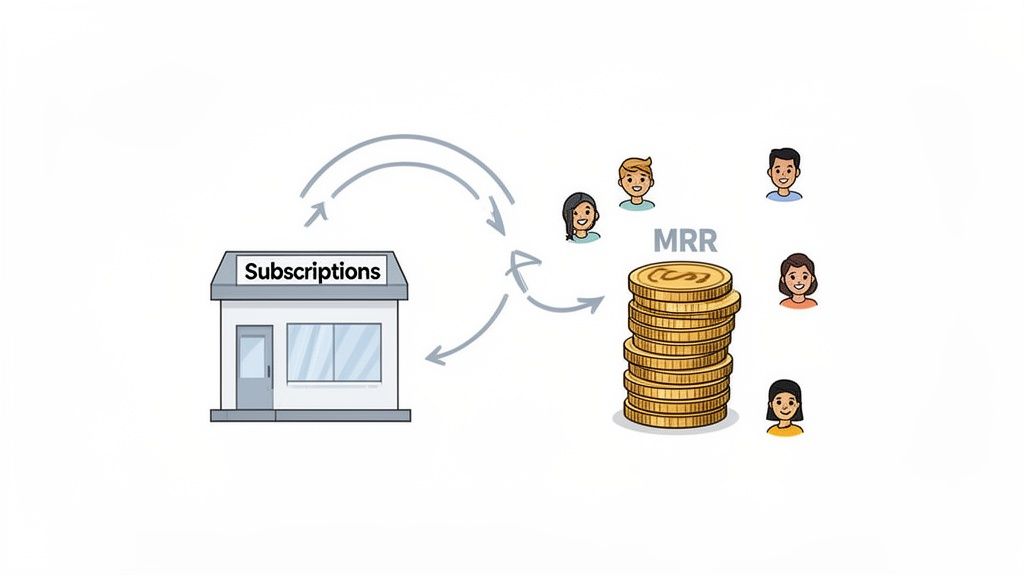
Moving to a subscription model is about more than just reliable billing—it fundamentally changes your business's financial DNA. The biggest win? You get to step off the rollercoaster of unpredictable, one-off purchases. Instead of starting from zero every month, you kick things off with a baseline of guaranteed income. That makes financial planning, inventory management, and reinvesting in growth so much easier.
This stability all comes down to a metric that subscription businesses live and die by: Monthly Recurring Revenue (MRR). Think about a coffee brand with 500 subscribers each paying $20 a month. That’s a predictable MRR of $10,000. It’s money they can count on, simplifying everything from marketing budgets to stock orders.
The Real Business Impact of Subscriptions
The perks go way beyond better cash flow. When you bring recurring payments to your Shopify store, you'll see key performance indicators improve across the board. You're turning what would have been a single transaction into a long-term customer relationship, and that has a massive ripple effect.
Let's look at the data to see just how much of a game-changer subscriptions can be.
The Subscription Impact At A Glance
This table just scratches the surface. The shift from a transactional to a relational model strengthens nearly every aspect of your operation.
The success of this model is undeniable. Shopify's own subscription solutions have become a true powerhouse for merchants. As of March 31, 2024, MRR from subscriptions hit a staggering $151 million—a 32% jump from the previous year. This boom shows just how vital recurring payments are for growth, with Shopify Plus merchants alone contributing $48 million to that total. You can dive deeper into these Shopify subscription growth trends to see the full picture.
The greatest advantage of a subscription model is predictability. When you know what's coming in, you can stop reacting and start planning. It's the difference between navigating with a map versus navigating in a fog.
Choosing Your Implementation Path
Ready to unlock these benefits? You’ve got two main routes for setting up recurring payments on Shopify.
Your first option is to go with Shopify’s own native tools, like the Shopify Subscriptions app or their APIs. These are usually the simplest to get started with and integrate seamlessly right into your existing setup.
The second path involves tapping into powerful third-party apps from the Shopify App Store. These often bring more advanced features to the table, with greater customization and robust tools for managing things like customer churn and retention. We'll explore both routes in detail throughout this guide, so you can pick the right strategy for your brand.
Choosing Your Subscription Platform: Native Tools vs. Third-Party Apps
When you decide to offer recurring payments on Shopify, your first big fork in the road is picking the engine that will run everything. You’ve really got two main paths: stick with Shopify’s own native tools or bring in a specialized third-party app from the Shopify App Store. This isn't just a technical decision—it’s a strategic one that will shape your customer experience, how you scale, and ultimately, your long-term revenue.
The right choice really comes down to where your business is today and where you want it to be tomorrow. There’s no single “best” answer here, just the one that fits your specific needs. Let's dig into the practical differences to help you figure that out.
The Case for Shopify's Native Tools
Shopify's own subscription tools, including their free Shopify Subscriptions app, are built for one thing above all else: simplicity. Because Shopify built them, they slot perfectly into Shopify Payments and the native checkout experience. This makes them a fantastic starting point for brands just dipping their toes into the subscription world.
Imagine a new pet food company testing the waters. Their entire goal is to offer a simple "subscribe and save 10%" on their most popular bag of dog food. For them, the native tools are a perfect match.
- Zero Additional Cost: The app is free to install, which is a massive plus for businesses keeping a close eye on their budget.
- Effortless Setup: You can get a subscription plan live on a product directly from your Shopify admin in a matter of minutes.
- Perfect Integration: It just works. It syncs with your theme and checkout right away, giving customers a consistent brand experience without you having to mess with complex settings.
This path is ideal for straightforward replenishment models where the product and delivery schedule don't change much. If you want to get a better handle on the payment side of this setup, check out our comprehensive guide to Shopify's payment gateways.
When to Look at Third-Party Apps
While Shopify's tools are great for getting off the ground, many businesses eventually hit a ceiling as their subscription program gets more ambitious. This is exactly where third-party apps come in, offering a much deeper feature set built specifically for retention and advanced customization.
These apps were created to solve the complex problems that pop up as you grow. There's a reason the market for these solutions is booming. In fact, the massive growth in Shopify's Subscription Solutions revenue, which hit $562 million in early 2024—a 27% jump year-over-year—shows just how many merchants are successfully using these advanced tools to manage recurring billing. You can find more on this and other Shopify growth statistics on Red Stag Fulfillment.
Let's go back to our pet food company. Six months in, business is great. Now, they want to give their customers more flexibility:
- Let them build a custom box with different treats and food bags.
- Give subscribers an easy way to skip a delivery or swap products through a self-service portal.
- Set up an automated system (dunning management) to retry failed payments and send reminders.
These are the kinds of features where the native tools start to struggle, but specialized apps are built to handle them with ease.
The moment your subscription strategy shifts from a simple 'set it and forget it' model to a flexible, customer-first experience, it's time to upgrade. Your platform shouldn't be what holds your growth back.
Third-party solutions provide the sophisticated logic needed for curated boxes, personalized bundles, and powerful analytics. They come with robust customer portals that cut down on support tickets and empower your subscribers, which has a direct impact on lowering your churn rate. Yes, they come with a monthly fee, but for growing brands, the ROI from better retention and higher average order values almost always makes it worth the cost.
The takeaway? Start with what you need right now, but always keep an eye on where you're headed. A simple, native solution might be perfect today, but be ready to make the switch to a more powerful platform as your vision for recurring payments on Shopify grows.
Your Blueprint For Setting Up Recurring Payments
This is where the theory hits the road. Setting up recurring payments on Shopify isn't just about flipping a switch; it's about architecting a scalable system that works for your brand and your customers right from the get-go. Let’s walk through what you actually need to do, from configuring your products to managing the backend processes that keep your subscription engine humming.
Whether you're using Shopify's built-in tools or a powerful third-party app, the foundational principles don't change. You have to define what you're selling, make it dead simple for customers to subscribe, and make sure the backend can handle the complexities of automated billing. Nailing this is non-negotiable for long-term success.
This flow chart nails the core journey: a customer finds your subscription on your storefront, makes a decision, and puts your business on the path to predictable growth.
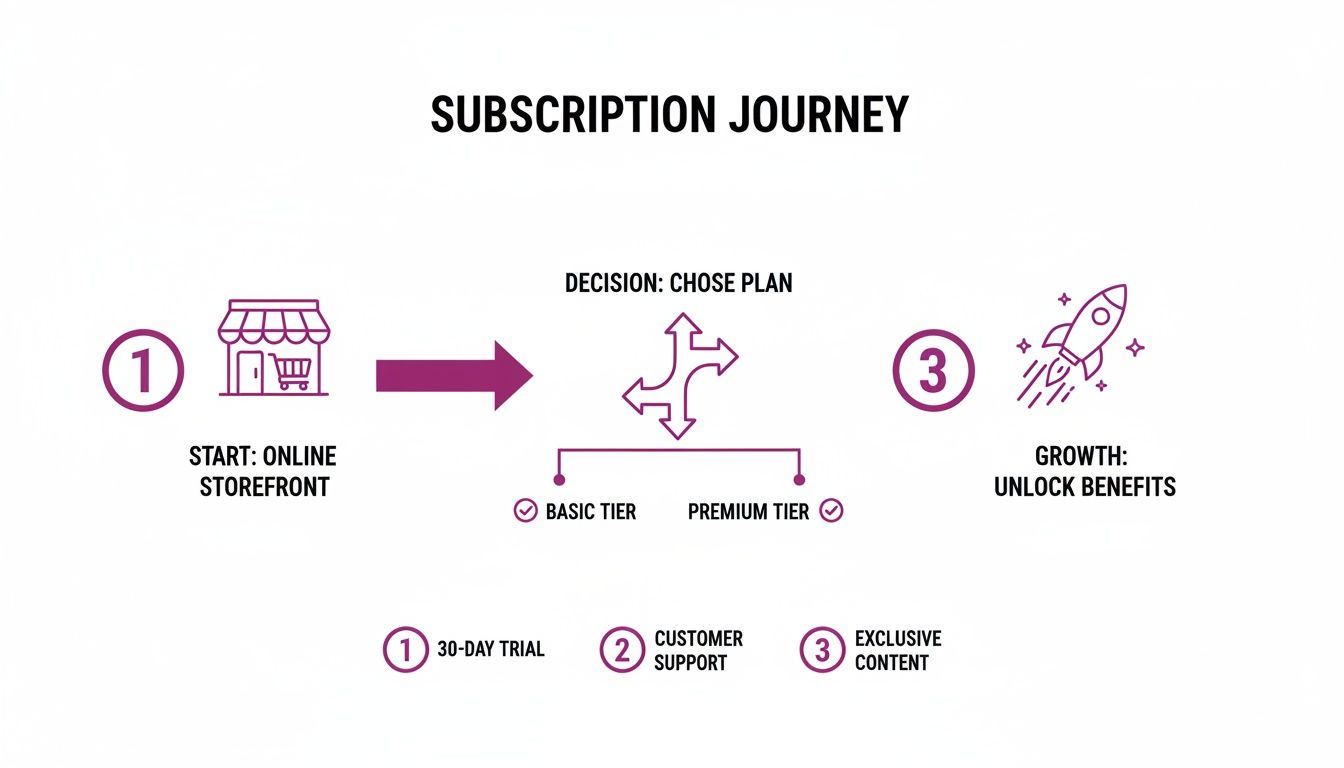
That path from initial interest to a long-term subscription is a critical conversion funnel you'll want to obsess over.
Creating Your First Subscription Plan
Before anyone can subscribe, you need to define what they’re subscribing to. In the Shopify ecosystem, this is handled through "selling plans." Think of a selling plan as the rulebook for your subscription, dictating everything from billing frequency to the discount a subscriber gets.
A selling plan is essentially a reusable template. For instance, you could create a "Monthly Restock" plan offering a 15% discount for deliveries every 30 days. Once that's set up, you can apply this plan to any product in your catalog—coffee beans, skincare serums, you name it—without reinventing the wheel each time.
It's a surprisingly efficient system. You can then assign this plan to specific products right inside your Shopify admin, giving you the choice to make an item available for subscription-only or as a one-time purchase, too.
Designing The Storefront Experience
Once your plans are ready, it's time to make them visible and compelling on your product pages. This is where the subscription widget enters the picture. This small but mighty interface element is what lets customers choose between a one-time purchase and a subscription.
Most modern Shopify themes and subscription apps make this incredibly easy with "app embed blocks." You can often just drag and drop the subscription widget into your product page template, usually slotting it in right above the "Add to Cart" button.
Your subscription widget isn't just a button; it's your primary sales pitch. Use it to clearly communicate the value of subscribing, like "Subscribe & Save 15%" or "Never Run Out Again."
The goal is to make the choice feel natural and obviously beneficial. The numbers don't lie: recurring payments are a golden ticket for merchant loyalty and growth on Shopify. Gross Payment Volume (GPV) through Shopify Payments is projected to hit $45.9 billion in Q2 2025—a massive jump from $34.2 billion in Q2 2024, accounting for 60% of processed GMV. With around 1.85 to 1.96 million merchants relying on Shopify Payments for smooth transactions, it’s clear that subscriptions are simplifying operations for eCom founders everywhere. You can dig into more data on Shopify's financial ecosystem and its growth.
Mastering The Backend Automation
A successful subscription program runs on smart automation. Two of the most critical backend processes you’ll need to get right are dunning management and webhooks. They might sound technical, but they solve very real, practical business problems.
Dunning Management (Payment Retries)
What happens when a subscriber's credit card expires or gets declined? Without an automated system, that revenue just vanishes. Dunning is the process of automatically retrying failed payments and notifying customers to update their details.
Most subscription apps let you configure a dunning schedule. For example, you could set it to:
- Retry the payment 3 days after the initial failure.
- Send an email to the customer letting them know about the issue.
- Retry again 5 days later, with a final notification before cancellation.
A solid dunning strategy can recover a huge percentage of otherwise lost revenue, directly protecting your MRR. It’s a must-have.
Webhooks for Data Syncing
Webhooks are automated messages sent from your subscription app to other systems when a specific event happens. They're the glue connecting your subscription data to the rest of your tech stack.
For example, you could set up a webhook to work like this:
- Trigger Event: A customer cancels their subscription.
- Action: The webhook sends a message to your CRM (like Klaviyo or HubSpot).
- Result: The customer is automatically added to a "win-back" email campaign.
This ensures your data is always in sync, enabling powerful, automated marketing and customer service workflows without anyone lifting a finger. Setting up these systems from day one ensures your subscription model is built to scale.
How To Optimize The Subscriber Experience And Reduce Churn
Getting a new subscriber is a huge win, but let's be honest—the real work starts right after that first checkout. Sustainable, long-term growth isn't built on a constant churn-and-burn of new customers; it’s forged by keeping the ones you have. For any Shopify store with a subscription model, your focus has to shift from just making the sale to actively preventing cancellations.
The battle against churn is won or lost in the post-purchase experience. If managing a subscription is a headache, customers will reach for the cancel button without a second thought. The best defense is to make the entire process so easy and empowering that leaving feels like a genuine downgrade.
Empower Customers Through The Customer Portal
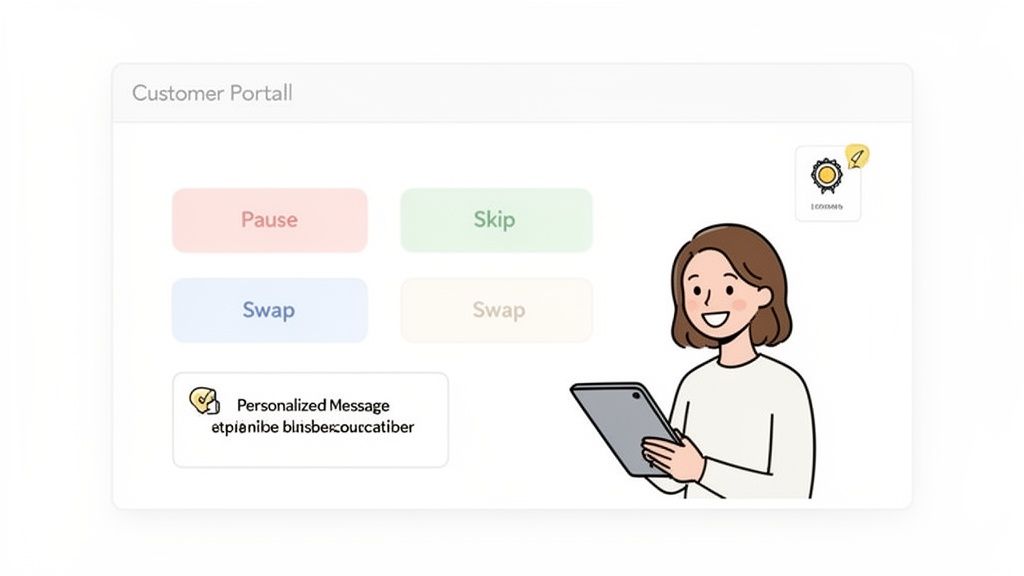
Your single most powerful tool in the fight for retention is the customer portal. This self-service hub is where subscribers should be able to manage every single aspect of their recurring order without ever having to email your support team. The moment a customer has to contact you just to skip a delivery, you're already halfway to losing them.
Friction is the enemy of loyalty. A well-designed portal eliminates it entirely, turning what could have been a cancellation into a simple, temporary adjustment.
Think about a coffee subscription that lets a customer pause their deliveries for a month while they're on vacation. Or a beauty brand that allows a subscriber to easily swap their foundation shade as they get a tan in the summer. These small conveniences are absolutely massive for retention.
Your customer portal needs to make these actions effortless:
- Skip a Delivery: This is the most common request by far. A customer might have too much product and just needs a quick break.
- Swap a Product: Give them the freedom to try something new without the hassle of cancelling and starting a new subscription.
- Change Delivery Frequency: Let them switch from a 30-day to a 60-day cycle if their needs change.
- Update Payment and Address Details: This is a basic but critical function. It prevents involuntary churn from expired cards or moves.
The goal of a customer portal isn't just to list a few options; it's to give your subscribers a real sense of control. When customers feel empowered, they are far less likely to churn.
Proactive Communication Builds Lasting Loyalty
Beyond a slick portal, your communication strategy is what makes subscribers feel valued, not just billed. Automated, impersonal transaction emails just don't cut it anymore. You have to build a relationship that constantly reinforces the value they're getting.
Start with personalized pre-renewal notifications. Instead of a generic "Your order is shipping soon," try something more engaging. Remind them what's coming and give them a direct link to their portal to make any last-minute tweaks. This proactive approach prevents surprise charges and shows you respect their time and money.
Here are a few communication tactics that make a real difference:
- Pre-Renewal Reminders: Send an email 3-5 days before their card is charged. This simple courtesy can slash chargebacks from customers who simply forgot.
- Subscriber-Exclusive Content: Treat your subscribers like VIPs. Give them early access to new products, exclusive discounts on one-off purchases, or helpful content related to their subscription.
- Personalized Check-ins: Use your data to send smart, targeted messages. If a customer hits their six-month anniversary, send an automated email thanking them for their loyalty—maybe with a small gift or discount code.
Ultimately, optimizing the subscriber experience comes down to a simple idea: treat your subscribers better than your one-time buyers. By giving them control through a robust portal and making them feel appreciated with thoughtful communication, you turn a transactional relationship into a loyal partnership. If you're looking for more ways to keep your hard-earned customers, our guide on how to reduce customer churn offers even more actionable strategies. These efforts are what protect your recurring revenue and build a more resilient business.
Analyzing Subscription Data To Fuel Your Growth
Getting your subscription program live is a massive win, but let's be honest—it's just the starting line. The real magic behind recurring payments on Shopify isn't just the predictable revenue; it's the treasure trove of data that comes with it.
This isn’t just about looking at sales figures. It’s about digging into subscriber behavior to make genuinely smart decisions that drive sustainable growth. When you stop obsessing over top-line revenue and start focusing on specific subscription KPIs, you can truly understand the health of your business, forecast future income, and pinpoint exactly where your retention efforts need to go.
The Core Metrics You Absolutely Need to Track
To get started, there are a few numbers you need to live and breathe. These metrics tell the real story of how your subscription program is performing and are the foundation for any meaningful analysis. Forget vanity metrics; these are the KPIs that directly impact your bottom line.
- Monthly Recurring Revenue (MRR): This is the heartbeat of your subscription business. It’s the predictable revenue you can count on from all active subscribers each month. You get this number by multiplying your total subscriber count by the average revenue per subscriber.
- Customer Lifetime Value (LTV): LTV gives you a window into the future, forecasting the total revenue you can expect from a single subscriber over their entire relationship with your brand. Seeing your LTV climb is one of the clearest signs your retention strategy is hitting the mark.
- Churn Rate: This is the one that can keep you up at night. It's the percentage of subscribers who cancel in a given period (usually a month). A high churn rate is a blaring alarm that something in your customer experience isn't working.
- Average Revenue Per User (ARPU): Simply put, this is your MRR divided by your number of active subscribers. ARPU shows you the average revenue each subscriber brings in. It's a fantastic metric for seeing if your upselling and cross-selling efforts are paying off.
These numbers don't exist in a vacuum; they work together to paint a complete picture of your business. For any store using recurring payments, the ability to analyze sales data for real growth is what separates the brands that coast from the ones that dominate.
Turning Data Into Actionable Insights
Collecting data is the easy part. The hard part—and the most valuable—is knowing what to do with it. The secret is to look for patterns and constantly ask why things are happening. This is where you graduate from just reporting numbers to making real, impactful changes.
For example, do you see a big spike in your churn rate right after the first renewal? That’s not just a statistic; it’s a direct message from your customers. It almost certainly points to a problem with your onboarding or a mismatch between their expectations and their first delivery. That one insight should immediately have you reviewing your welcome emails, product instructions, and initial support interactions.
Your data is a roadmap pointing directly to your biggest opportunities and most urgent problems. A high first-month churn isn't just a number; it's your customers telling you that their initial experience didn't live up to the promise.
Here's a quick look at how to decode the health of your subscription program using these critical metrics.
Decoding Your Subscription Health
The table below breaks down the most critical KPIs for a Shopify subscription business, helping you understand not just what to track, but why it matters.
By keeping a close eye on these KPIs, you can spot trends before they become problems and react proactively. A dip in ARPU might signal it's time to promote your higher-value subscription boxes, while a steadily increasing LTV validates every dollar you've invested in customer loyalty. This data-first approach transforms recurring payments from a simple billing feature into your most powerful growth engine.
Common Questions About Shopify Recurring Payments
Even with the best game plan, you're bound to run into some practical questions when you get into the weeds of managing recurring payments. Let's tackle the most common ones I hear from merchants so you can navigate the day-to-day realities of running a subscription program.
Can I Offer Both One-Time And Subscription Options For The Same Product?
Absolutely, and you really should. This hybrid approach is a fantastic way to appeal to every type of shopper who lands on your product page.
You can set it up to give customers a clear choice between a "one-time purchase" and a "subscribe & save" option, usually with a nice discount highlighted for the subscription. Most subscription apps add a widget that handles this for you automatically. It’s the perfect setup—you don’t lose the customers who aren't ready to commit, but you still make a strong case for the long-term value of subscribing.
What Happens If A Recurring Payment Fails?
Payment failures are inevitable, but a good system handles them gracefully. When a charge doesn't go through, an automated process called dunning immediately kicks in. This is a core feature of both Shopify's own subscription tools and any third-party app worth its salt.
The system will typically try to charge the card again several times over a few days, following a schedule you can customize. At the same time, it sends out automated emails letting the customer know there's an issue and giving them a direct link to update their payment details. A solid dunning strategy is non-negotiable for minimizing involuntary churn and protecting your hard-earned monthly recurring revenue.
How Does Shipping Work For Subscription Orders?
This is simpler than it sounds. Subscription orders are generated automatically in your Shopify admin every time a customer's billing cycle comes around. From your end, they look and behave just like any other standard order.
You can fulfill them using your normal process, whether that’s with Shopify Shipping, a 3PL partner, or your own in-house team. One of the best perks you can offer is special shipping rates for subscribers, like free or flat-rate shipping—it can be a surprisingly powerful incentive to get people to sign up.
Ready to scale your Shopify store with a powerful subscription strategy? The team at ECORN specializes in Shopify development and conversion rate optimization to build predictable revenue streams. Let's build your subscription engine together.


Shopify Plus Ecommerce Agency: How to Pick the Right One
Shopify Themes Retina: How to Serve 2x Images

How to Cross Sell on Shopify Without Friction
Best Shopify Theme for Custom Products Compared
Multi Store Inventory Management: A Practical Guide

SEO Consulting for Ecommerce: A Practical Guide
Shopify Theme Updater App: A Safe Update Playbook
Shopify Git Integration: A Developer's Guide to 2026
Headless Ecommerce Development Services Explained

How to Build a Shopify Clothing Website That Converts
How to Launch a Box Subscription Business in 2026

Luxury Skincare Branding Playbook That Converters
10 Best Podcast Ecommerce Shows for Store Growth in 2026
Shopify Developer Hourly Rate: What to Pay in 2026
Critical Shopify Setup Errors That Are Secretly Sabotaging Your Store
Ecommerce Conversion Tracking: The Complete How-To Guide
Shopify Design Agency: How to Pick the Right Partner
Mastering Multi Store Management on Shopify
Scale Shopify Store
10 Shopify App Ideas Worth Building in 2026
Conversion Rate Optimization for Landing Pages: The Playbook
Shopify Plus Automation: A Guide for 2026
10 Social Selling Platforms for Shopify Merchants

Shopify Website Design Examples: 7 Stores Worth Studying
7 Ecommerce Newsletter Examples for Shopify Brands
One Product Shopify Store: Build and Scale
Mobile Pop Up Strategy for Shopify Stores That Converts
Sitemap for Shopify: How to Find, Optimize, and Submit It
7 Single Product Websites Worth Emulating
Product Variants Shopify: The Complete 2026 Guide
Ecommerce Analytics Consulting for Growth
What Is AI Integration for eCommerce
How to Choose the Right eCommerce Website Development Firm
E Business Strategy Implementation
Conversion Tracking Setup for Shopify Stores
BigCommerce vs Shopify Plus Which Enterprise Wins in 2026
Shopify Theme Kit: Setup, Commands, and Migration Guide
Shopify Extension Development: A Practical 2026 Guide
Shopify Speed Score Explained and How to Improve It
Shopify Mobile Optimization: The 2026 Playbook
How to Add Subcategory in Shopify for Better UX
How to Implement Structured Data for Ecommerce in 2026
SEO App Mobile: Shopify Store Optimization Guide
Shopify Plus Support: What It Includes and How to Choose

Google Ads for Shopify: The Complete 2026 Playbook

Shopify New York: How to Find and Hire the Right Agency

Google Search Console for Shopify: The Complete Setup
First Party Data Collection for eCommerce Growth
FAQ Online Store Guide: Build and Measure It Right
Do FB Ads Work for eCommerce in 2026?
One Page Checkout for Shopify: Design and Implementation
Shopify GraphQL vs REST: The 2026 Developer Decision
Shopify Ecommerce Consulting: Strategy, Pricing &

Are Reddit Ads Worth It for eCommerce Brands
Shopify Title and Meta Description: A Practical 2026 Guide

Product Video Best Practices for Shopify Brands
Real-Time Inventory Management: A 2026 Guide
AI Chatbot Integration for Shopify Stores
Affiliate Program Management: A Shopify Guide
10 Best Performance Monitoring Tools for Shopify in 2026
Digital Asset Management for eCommerce Brands in 2026
Every Type of Facebook Ads Explained for eCommerce Growth
Product Information Management Explained for Shopify Brands
Support Ticket System: A Guide for Shopify Stores

10 Best Customer Service Tools for Shopify in 2026

Can I Start a Business with No Money? a 2026 Blueprint

What Sells Good on Etsy: Best Niches for 2026

Shopify Add to Cart Button: A Practical 2026 Guide

Customer Feedback Automation: A Practical eCommerce Guide
Critical Rendering Path: A Guide for Shopify Stores

How to Promote on TikTok for eCommerce in 2026

B2B eCommerce Consulting That Drives Real Revenue
10 Best Practices for Site Navigation in 2026
Return vs Refund for Shopify Stores: A Practical Guide
What Is Customer Lifetime Value and Why It Matters
What Is Voice of Customer Research for eCommerce

SMS Marketing for Ecommerce That Actually Converts

Master How to Improve Email Deliverability in 2026

Top 8 eCommerce Partners NYC for Shopify Brands in 2026
Machine Learning for Ecommerce: Boost Your Shopify Store

Beauty Market Research: Your 2026 Growth Guide

Shopify International Expansion: A 2026 Roadmap

What Does CRO Stand for in Business: Understanding CRO

Shopify Visual Merchandising: A Playbook for Higher Sales

Shopify Landing Page Design: Master Conversion in 2026

10 Best AI SEO Optimization Tools for Shopify in 2026

Agentic AI for Ecommerce: Boost Your Sales in 2026
Mastering Email Marketing Data for eCommerce Growth
Conversion Rate Optimisation Australia: Boost Your Sales
Conversion Rate Optimization AI: Your Shopify Store Guide

10 Product Bundling Strategies for Shopify in 2026
How to Increase Customer Lifetime Value: A Shopify Playbook
AI Customer Service Automation: Shopify Guide 2026

Clean Website Design: A Shopify Conversion Playbook

Omnichannel Retail Strategy: A Shopify Playbook
Product Data Enrichment: A Guide for Shopify Brands
Instagram Shopping Features a Guide for Shopify Stores
What Is Revenue Optimization: A Holistic RevOps Guide
Benefits of Conversion Rate Optimization: Boost Your
WordPress to Shopify Migration: Your 2026 Seamless Switch


newsletter in your inbox