


A customer acquisition cost calculator is a straightforward tool, but its power lies in its honesty. At its core, it tells you how much your business is spending to land a new customer. You get this number by dividing your total sales and marketing costs by the number of new customers you brought in over a specific period. This metric, often called CAC, is a vital sign for the health of any eCommerce business.
Decoding Your Customer Acquisition Cost
Before you can even think about optimizing your marketing spend, you have to get crystal clear on what it actually costs to win a new customer. This isn't just about your ad budget—it’s about accounting for every single dollar that plays a role in getting someone to convert.
The basic formula for Customer Acquisition Cost (CAC) is simple: Total Sales & Marketing Costs / New Customers Acquired. The real work, however, is in digging up all those costs.
So many businesses fall into the trap of only counting their direct ad spend. This gives you an artificially low CAC that paints a dangerously rosy picture of profitability when the reality might be very different. A true, actionable calculation goes much deeper.
Uncovering Your True Marketing and Sales Expenses
To get a number you can trust, you need to audit every single expense tied to customer acquisition. Think beyond the obvious and hunt down the hidden costs that keep your growth engine running. A thorough audit is the first step toward building a reliable cost per customer acquisition calculator that actually reflects your business's performance.
Your total investment is way more than just what you pay Google or Meta. Make sure your list includes:
- Team Salaries: The pay for your marketing managers, sales reps, content creators, and anyone else directly involved in bringing in new customers.
- Software Subscriptions: The fees for your CRM, email marketing platform, analytics tools, SEO software, and every other piece of tech in your marketing stack.
- Agency and Freelancer Fees: Any cash going out to external partners like digital marketing agencies, SEO consultants, copywriters, or graphic designers.
- Creative Production Costs: The budget for photoshoots, video production, and creating all those ad assets.
- Promotional Costs: The hit you take on discounts, new-customer offers, or referral program payouts.
By capturing every related expense, you transform CAC from a vanity metric into a serious business intelligence tool. An accurate CAC empowers you to make smarter calls on budget allocation, channel focus, and your entire growth strategy.
Getting this number right is foundational. Without a clear picture of your real acquisition costs, you're flying blind. You can't know which marketing channels are truly profitable and which ones are quietly draining your bank account. This detailed approach ensures your CAC is a true reflection of your financial health, paving the way for sustainable growth.
Your Interactive Customer Acquisition Calculator
Getting your head around the theory of customer acquisition cost is one thing. Actually putting that knowledge to work for your own business is where the magic happens. To make this as straightforward as possible, we’ve built a simple, interactive cost per customer acquisition calculator right on this page.
This isn't about getting lost in a monster spreadsheet just to find a baseline. The goal here is immediate clarity. You only need two numbers to get started.
First, pull together all your sales and marketing expenses for a specific period—say, the last month or quarter. Then, grab the total number of brand new customers you brought in during that same window. Pop those numbers into the fields below, and you'll get an instant, clear picture of your overall CAC.
Using The On-Page Calculator
Think of our on-page tool as a quick health check for your marketing. It’s perfect for getting a snapshot of your performance without any fuss.
Here's what you'll need:
- Total Sales & Marketing Costs: Enter the combined total of all your relevant expenses. This should include everything from ad spend and team salaries to the software fees and agency costs we covered earlier.
- New Customers Acquired: Drop in the exact number of new paying customers you gained in the period your costs cover.
Once you enter these values, the calculator does the rest and gives you your blended CAC. This single number is a powerful first indicator of how efficiently your marketing engine is running.
(Note to Developer: Insert interactive calculator widget here)
Download Your Free CAC Tracking Template
While an instant calculation is great for a spot-check, the real power comes from tracking this metric over time. A single CAC number is just a point in time; it lacks context. Is your cost to acquire a customer going up or down? How do new campaigns affect it? To answer those questions, you need to track it consistently.
To help you monitor your performance and start digging into channel-specific data, we've put together a free Google Sheets template. This is a resource designed to grow with you.
A one-time CAC calculation tells you where you are today. Tracking it over time in a spreadsheet tells you where you're going and gives you the power to actually steer the ship.
Our template is set up so you can:
- Log Monthly Expenses: Easily itemize and sum up your costs each month.
- Track Customer Growth: Keep a running tally of new customers acquired month over month.
- Visualize Trends: The sheet automatically calculates your CAC and can be used to create simple graphs that show you performance trends at a glance.
This simple tool moves you from a static, one-off calculation to a dynamic financial dashboard. Go ahead and download the ECORN CAC Tracking Template and make a copy for your own use. Start plugging in your data to build a historical record of your acquisition efficiency. It’s a simple habit, but it's absolutely fundamental to making the kind of smart, data-driven decisions that fuel sustainable growth.
How To Calculate CAC With Real-World Examples
A single, blended Customer Acquisition Cost (CAC) can be dangerously misleading. It often masks expensive, underperforming marketing channels behind your successful ones, which can lead to some really poor budget decisions down the line.
To get a true grip on your marketing performance, you have to move beyond that blended average and start analyzing each channel on its own.
Let’s walk through a practical example to see how this works in the real world. We'll use a fictional Shopify store, "Artisan Mugs," to bring these calculations to life.
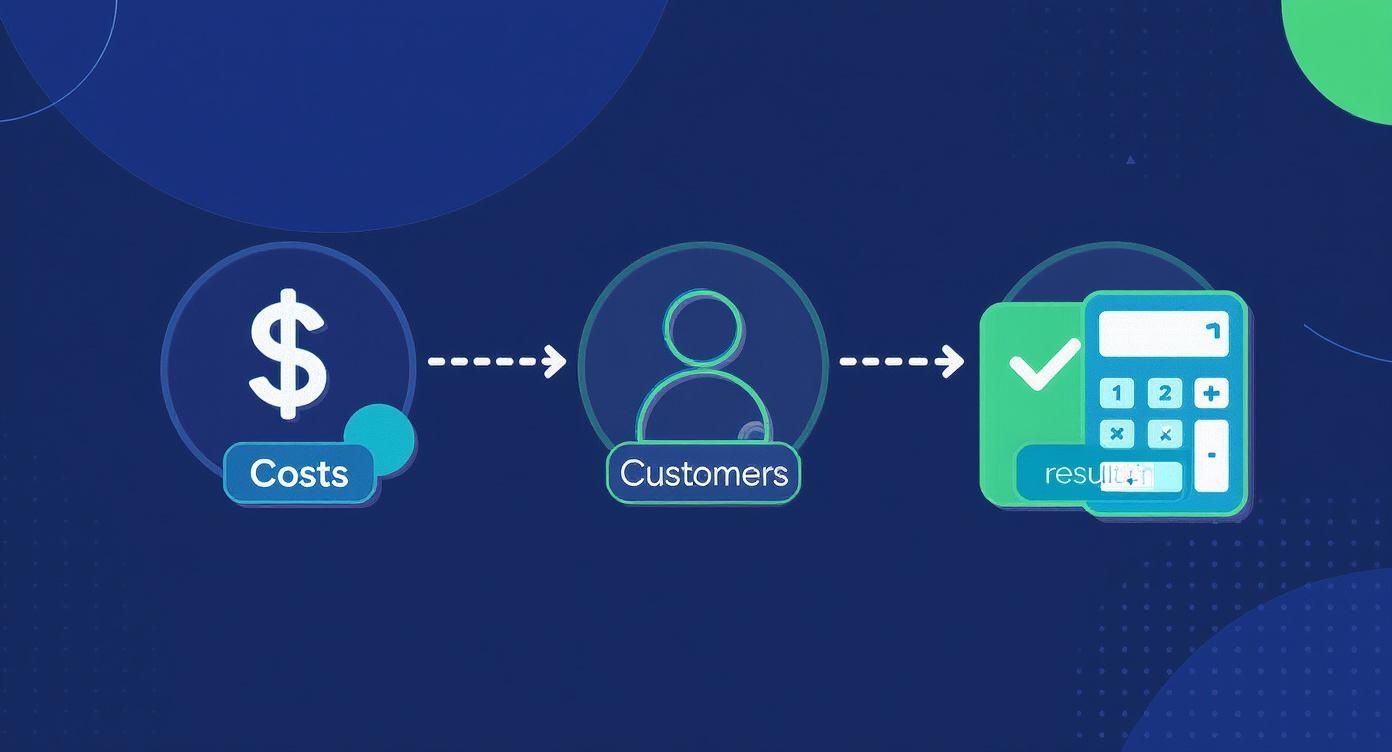
This visual breaks down the simple flow: you take your total costs, divide them by your new customers, and get your CAC.
While the concept is straightforward, the real magic happens when you apply this formula at different levels of your marketing strategy.
Calculating The Overall Blended CAC
First up, let's figure out the overall or "blended" CAC for Artisan Mugs for the month of May. This gives us that 30,000-foot view of our marketing efficiency.
To get there, we need to round up all the sales and marketing costs for the month:
- Google Ads Spend: $5,000
- TikTok Ads Spend: $3,000
- Email Marketing Platform (Klaviyo): $500
- Marketing Manager Salary (Portion): $2,500 (Assuming 50% of their time is on acquisition)
The total marketing cost for May comes to $11,000.
During that same month, Artisan Mugs brought in a total of 400 new customers from all their efforts.
Now, we just plug those numbers into the CAC formula:
Total Costs / New Customers = Blended CAC
$11,000 / 400 = $27.50
So, the blended CAC for Artisan Mugs is $27.50. On the surface, that might not sound too bad. But it definitely doesn't tell the whole story.
Digging Deeper With Channel-Specific CAC
A blended CAC averages out your high performers and your money pits. To make smart decisions, you absolutely must break down the costs and acquisitions by channel. This is how you find out which channels are true growth drivers and which are just draining your budget.
Let's say we’ve tracked where our 400 new customers actually came from:
- Google Ads: 250 new customers
- TikTok Ads: 100 new customers
- Email Marketing: 50 new customers
Now we can calculate the CAC for each one. To keep it simple, we’ll just look at the direct ad spend for the paid channels to gauge platform efficiency. In a more advanced setup, you might allocate salary and software costs proportionally, but this approach gives us a clean, actionable starting point.
Google Ads CAC
- Cost: $5,000
- New Customers: 250
- CAC: $5,000 / 250 = $20.00
TikTok Ads CAC
- Cost: $3,000
- New Customers: 100
- CAC: $3,000 / 100 = $30.00
Email Marketing CAC
- Cost: $500 (Klaviyo subscription)
- New Customers: 50
- CAC: $500 / 50 = $10.00
This channel-specific breakdown is where the lightbulb moments happen. Here’s a quick table to visualize the difference.
Sample CAC Calculation Blended vs Channel-Specific
This comparison shows how a blended CAC can hide inefficiencies that a channel-specific breakdown reveals.
The blended CAC of $27.50 was hiding the fact that TikTok is 50% more expensive than Google Ads and a whopping 300% more expensive than email marketing for acquiring a customer.
This granular view immediately raises critical questions. Is the higher cost on TikTok justified by higher-value customers? Or is the campaign under-optimized?
By moving beyond that single, blended number, you gain the clarity needed to really start steering the ship. You can now confidently decide whether to scale up Google and email, troubleshoot the TikTok campaign, or reallocate that budget to a more efficient channel.
So, you've done the math. You have your Customer Acquisition Cost. Whether you used a quick online calculator or a detailed spreadsheet, you know what you’re spending to get a new customer in the door.
But what does that number actually mean?
The truth is, a "good" Customer Acquisition Cost (CAC) is completely relative. Context is everything.
A $50 CAC might be a fantastic result for a brand selling high-end furniture with healthy profit margins. But that same $50 could be a death sentence for a t-shirt store where the average first purchase is only $65. The number itself is just data; the real magic happens when you compare it to the right things.
This is where a lot of founders get stuck. They go hunting for a single "industry average" to measure up against, but that's often a dead end. Your CAC is a unique fingerprint, influenced by everything from your brand's age to your specific sales cycle.
Why Industry Benchmarks Are Just a Starting Point
Looking at industry averages can give you a rough idea of where you stand, but it should never be your ultimate source of truth. The cost to acquire a customer varies wildly from one sector to another, driven by things like product complexity, the level of competition, and how long it takes for a customer to decide to buy.
Take B2B, for example. Companies in that space often face much higher acquisition costs because the sales cycle is longer and the stakes are higher. In fact, some B2B SaaS companies report average CACs around $1,200 per customer.
On the flip side, B2C brands generally enjoy lower costs. The food and beverage space averages about $53 per customer, while beauty brands are seeing something closer to $61.
This data highlights a critical point: you're not just competing within an industry, but within a specific business model.
Several key factors will always influence your CAC:
- Product Price Point: Higher-priced items can justify a higher CAC because the immediate return is so much greater.
- Purchase Frequency: A subscription box company can afford a higher initial CAC than a business selling one-off products because they’re banking on that recurring revenue.
- Sales Cycle Length: Brands selling things that require a lot of thought, like custom engagement rings, will naturally have higher acquisition costs than those selling impulse-buy products.
- Market Maturity: If you're breaking into a new, untapped market, you'll have to spend more upfront on education and brand building, which temporarily inflates your CAC.
The most important benchmark isn't what your competitors are spending. It's the relationship between what you spend to get a customer and what that customer is worth to your business over time.
This simple shift changes the question from "Is my CAC good?" to a much more powerful one: "Is my CAC profitable and sustainable for my business?"
The Ultimate Benchmark: Your LTV to CAC Ratio
The single most important metric for judging your CAC is Customer Lifetime Value (LTV). LTV is the total revenue you can reasonably expect from a single customer throughout their entire relationship with your brand.
When you put your LTV next to your CAC, you get a crystal-clear picture of your business's health.
Think about it. A business could have a sky-high CAC of $300, but if their average customer spends $1,500 over their lifetime, that's an incredibly successful acquisition strategy.
On the other hand, a business with a seemingly "low" CAC of $20 could be in deep trouble if their average customer only ever makes a single $25 purchase and never comes back. This is why focusing only on lowering your acquisition cost can be a shortsighted move.
The goal isn't just to get cheap customers; it's to acquire profitable customers. This LTV:CAC ratio is the true measure of your marketing's return on investment and the ultimate indicator of your business's long-term viability. Before you can know if your acquisition cost is "good," you first have to figure out what a customer is actually worth.
Balancing CPA with LTV for Sustainable Growth
Chasing a lower Customer Acquisition Cost (CPA) is one of the most common—and dangerous—traps in eCommerce. It feels productive, but it completely misses the point. The real key to long-term profitability isn't just about spending less; it's about the relationship between what you spend and what a customer is actually worth to your business.
This is where the LTV:CPA ratio comes into play. It’s a simple but powerful formula that pits your Customer Lifetime Value (LTV)—the total profit you expect from a customer over their entire relationship with you—against the cost you paid to acquire them.
A brand with a high CPA of $150 might seem unhealthy on the surface. But if their average customer has an LTV of $900, they've actually built an incredible growth engine. On the flip side, a business celebrating a low $20 CPA could be on the verge of collapse if their customers only ever make one $30 purchase.
Understanding Customer Lifetime Value
Calculating LTV can get complex, but you don't need a data science degree to get a solid estimate. At its core, LTV measures the total revenue a customer will generate before they churn.
A simple LTV estimation uses a few key metrics:
- Average Order Value (AOV): The average amount a customer spends in a single transaction.
- Purchase Frequency (F): How often the average customer buys from you in a specific period, like a year.
- Customer Lifespan (T): The average length of time someone continues to buy from your store.
Getting a hyper-precise figure requires a deep dive, but even a back-of-the-napkin estimate provides immense strategic value. For those ready to go deeper, you can calculate customer lifetime value with our detailed data-driven guide, which breaks down the different models and formulas.
The goal isn't just to acquire cheap customers; it's to invest strategically in acquiring profitable customers who will drive sustainable growth for years to come.
This shifts your perspective from pure cost-cutting to value creation. Instead of asking, "How can we make ads cheaper?" you start asking, "How can we attract customers who will love our brand and keep coming back for more?"
The Ideal LTV to CPA Ratio
Once you have both your LTV and CPA, you can calculate your ratio. Think of this number as the ultimate health score for your marketing efforts and business model.
While every business is unique, a widely accepted benchmark for a healthy, scalable business is an LTV:CPA ratio of 3:1 or higher.
Let’s break down what the different ratios really mean for your store:
Understanding this balance completely changes how you view your CPA. It's no longer just an expense to be minimized. Instead, it becomes one side of a powerful equation that dictates your company's future, giving you the confidence to spend what's necessary to acquire high-value customers, knowing the long-term payoff is there.
Practical Strategies to Lower Your Acquisition Cost

So, you've crunched the numbers and can see exactly how each channel is performing. Now for the fun part: taking action.
Lowering your Customer Acquisition Cost (CAC) isn’t about making blind budget cuts. It’s about getting smarter and more efficient. The real goal here is to squeeze more value out of every single dollar you're already spending.
The best place to start is with the traffic you already have. Before you even think about pouring more money into ads, you need to make sure your store is a well-oiled conversion machine. This is where Conversion Rate Optimization (CRO) comes in.
Maximize Your Existing Traffic with CRO
Think of Conversion Rate Optimization as plugging the holes in your bucket before adding more water. It’s a methodical way of improving your website to convince a higher percentage of visitors to actually buy something.
Even tiny improvements in your conversion rate can slash your CAC. Why? Because you're getting more customers from the exact same amount of traffic and ad spend.
Start by walking through your user journey and spotting the friction points.
- Simplify Your Checkout Process: Is checkout a marathon of forms and questions? A long, clunky process is one of the biggest reasons people abandon their carts.
- Improve Site Speed: Seconds matter. A slow-loading site is frustrating and sends potential customers bouncing before they even see your products.
- Enhance Product Pages: Are you using killer photos, compelling copy, and obvious calls-to-action? These are the elements that build trust and nudge visitors toward the "Add to Cart" button.
Focusing on CRO first is just common sense. Spending more on ads to drive traffic to a site that doesn't convert well is like trying to fill that leaky bucket—it's incredibly inefficient and a massive waste of money.
Refine Your Ad Targeting and Creative
Once your site is primed to convert, it's time to work on the quality of traffic you're sending its way. This is all about showing the right ads to the right people.
Dive deep into the audience data within your ad platforms. Look for common threads among your best customers and use those insights to build sharper lookalike audiences. Stop wasting your budget on broad targeting that hits people who will never buy from you.
At the same time, you need to be constantly refreshing your ad creative. The ad that crushed it three months ago has probably gone stale.
- Test Different Hooks: Lead with a customer's pain point. Highlight a unique benefit. Start with a surprising fact. See what grabs attention.
- Vary Your Formats: Don't just stick to static images. Mix in video, user-generated content (UGC), and carousels to keep things fresh.
- Refresh Your CTAs: Sometimes, a simple tweak from "Shop Now" to "Learn More" can make a world of difference, depending on where the user is in their journey.
For a deeper dive, our guide on https://www.ecorn.agency/blog/reduce-customer-acquisition-cost gives you a full playbook for optimizing your entire funnel.
Embrace Technology and AI
Let's face it, customer acquisition is getting more expensive. Rising costs are a huge headache for marketers, but technology—especially AI—is giving us new tools to fight back. For anyone managing user acquisition, leveraging AI for ads, particularly for user acquisition, is becoming a non-negotiable for automating creative optimization and personalizing campaigns at scale.
The data doesn't lie: companies that use AI-driven marketing platforms can cut their CAC by as much as 50%. That's a massive advantage, especially when you learn that the average CAC has skyrocketed by over 220% in the last eight years alone. By putting smart, data-backed strategies into practice, you can get your costs under control and build a much more profitable, sustainable business.
Common Questions About Customer Acquisition Cost
Even after crunching the numbers with a customer acquisition calculator, a few questions always seem to pop up. Let's tackle the ones we hear most often from fellow eCommerce store owners.
What’s The Real Difference Between CPA And CAC?
This is a big one, and you’ll often see these two terms used interchangeably. But there’s a small, yet important, distinction to be made.
Customer Acquisition Cost (CAC) almost always refers to the total cost to bring in a brand new paying customer. Someone who has never bought from you before.
Cost Per Acquisition (CPA), on the other hand, can be a bit more flexible. Technically, it could be the cost to get any action—like a lead, an email signup, or a free trial. For most of us in the eCommerce world, though, we use both terms to mean the exact same thing: the cost to get a new sale.
How Often Should I Actually Calculate This?
Like any useful metric, the key is consistency. Sticking to a schedule turns numbers on a screen into actionable insights for your business.
Here’s a rhythm that works well for most brands:
- Your Blended CAC: Pull this number at least monthly. This gives you a great high-level report card on your overall marketing efficiency and business health over time.
- Channel-Specific CPA: You need to be more granular here. For active campaigns on platforms like Google Ads or Meta, check your CPA weekly, if not daily. This is how you react quickly—shifting budget to what’s working and cutting what’s not before you burn through your cash.
What Expenses Should I Be Including In The Calculation?
This is where people often trip up. If you want a CAC number that’s actually useful for making business decisions, you have to include everything. Cherry-picking just your ad spend will give you a dangerously low and misleading figure.
An honest CAC calculation must account for every single dollar you spend on acquisition. That means direct ad spend, your marketing team's salaries, software subscriptions, creative production costs, and any agency or freelancer fees. An incomplete picture is worse than no picture at all.


Multi Store Inventory Management: A Practical Guide

SEO Consulting for Ecommerce: A Practical Guide

Shopify Theme Updater App: A Safe Update Playbook

Shopify Git Integration: A Developer's Guide to 2026
Headless Ecommerce Development Services Explained

How to Build a Shopify Clothing Website That Converts
How to Launch a Box Subscription Business in 2026

Luxury Skincare Branding Playbook That Converters
10 Best Podcast Ecommerce Shows for Store Growth in 2026

Shopify Developer Hourly Rate: What to Pay in 2026
Critical Shopify Setup Errors That Are Secretly Sabotaging Your Store
Ecommerce Conversion Tracking: The Complete How-To Guide
Shopify Design Agency: How to Pick the Right Partner
Mastering Multi Store Management on Shopify
Scale Shopify Store
10 Shopify App Ideas Worth Building in 2026
Conversion Rate Optimization for Landing Pages: The Playbook
Shopify Plus Automation: A Guide for 2026
10 Social Selling Platforms for Shopify Merchants

Shopify Website Design Examples: 7 Stores Worth Studying
7 Ecommerce Newsletter Examples for Shopify Brands
One Product Shopify Store: Build and Scale
Mobile Pop Up Strategy for Shopify Stores That Converts
Sitemap for Shopify: How to Find, Optimize, and Submit It
7 Single Product Websites Worth Emulating
Product Variants Shopify: The Complete 2026 Guide
Ecommerce Analytics Consulting for Growth
What Is AI Integration for eCommerce
How to Choose the Right eCommerce Website Development Firm
E Business Strategy Implementation
Conversion Tracking Setup for Shopify Stores
BigCommerce vs Shopify Plus Which Enterprise Wins in 2026
Shopify Theme Kit: Setup, Commands, and Migration Guide

Shopify Extension Development: A Practical 2026 Guide
Shopify Speed Score Explained and How to Improve It
Shopify Mobile Optimization: The 2026 Playbook
How to Add Subcategory in Shopify for Better UX
How to Implement Structured Data for Ecommerce in 2026
SEO App Mobile: Shopify Store Optimization Guide
Shopify Plus Support: What It Includes and How to Choose
Google Ads for Shopify: The Complete 2026 Playbook

Shopify New York: How to Find and Hire the Right Agency
Google Search Console for Shopify: The Complete Setup
First Party Data Collection for eCommerce Growth
FAQ Online Store Guide: Build and Measure It Right
Do FB Ads Work for eCommerce in 2026?
One Page Checkout for Shopify: Design and Implementation

Shopify GraphQL vs REST: The 2026 Developer Decision
Shopify Ecommerce Consulting: Strategy, Pricing &
Are Reddit Ads Worth It for eCommerce Brands

Shopify Title and Meta Description: A Practical 2026 Guide

Product Video Best Practices for Shopify Brands
Real-Time Inventory Management: A 2026 Guide

AI Chatbot Integration for Shopify Stores
Affiliate Program Management: A Shopify Guide
10 Best Performance Monitoring Tools for Shopify in 2026
Digital Asset Management for eCommerce Brands in 2026
Every Type of Facebook Ads Explained for eCommerce Growth
Product Information Management Explained for Shopify Brands
Support Ticket System: A Guide for Shopify Stores

10 Best Customer Service Tools for Shopify in 2026

Can I Start a Business with No Money? a 2026 Blueprint

What Sells Good on Etsy: Best Niches for 2026

Shopify Add to Cart Button: A Practical 2026 Guide

Customer Feedback Automation: A Practical eCommerce Guide
Critical Rendering Path: A Guide for Shopify Stores

How to Promote on TikTok for eCommerce in 2026

B2B eCommerce Consulting That Drives Real Revenue
10 Best Practices for Site Navigation in 2026
Return vs Refund for Shopify Stores: A Practical Guide
What Is Customer Lifetime Value and Why It Matters
What Is Voice of Customer Research for eCommerce

SMS Marketing for Ecommerce That Actually Converts

Master How to Improve Email Deliverability in 2026

Top 8 eCommerce Partners NYC for Shopify Brands in 2026
Machine Learning for Ecommerce: Boost Your Shopify Store

Beauty Market Research: Your 2026 Growth Guide

Shopify International Expansion: A 2026 Roadmap
What Does CRO Stand for in Business: Understanding CRO

Shopify Visual Merchandising: A Playbook for Higher Sales

Shopify Landing Page Design: Master Conversion in 2026
10 Best AI SEO Optimization Tools for Shopify in 2026

Agentic AI for Ecommerce: Boost Your Sales in 2026
Mastering Email Marketing Data for eCommerce Growth
Conversion Rate Optimisation Australia: Boost Your Sales
Conversion Rate Optimization AI: Your Shopify Store Guide

10 Product Bundling Strategies for Shopify in 2026
How to Increase Customer Lifetime Value: A Shopify Playbook
AI Customer Service Automation: Shopify Guide 2026

Clean Website Design: A Shopify Conversion Playbook

Omnichannel Retail Strategy: A Shopify Playbook
Product Data Enrichment: A Guide for Shopify Brands

Instagram Shopping Features a Guide for Shopify Stores
What Is Revenue Optimization: A Holistic RevOps Guide
Benefits of Conversion Rate Optimization: Boost Your
WordPress to Shopify Migration: Your 2026 Seamless Switch
Boost Sales: Ecommerce Payment Processing Guide 2026
Unified Commerce Platform: Benefits, KPIs & Shopify Guide
How to Reduce Bounce Rate eCommerce: Your 2026 Guide
Shopify API Integration: A Practical End-to-End Guide


newsletter in your inbox