

The fundamental difference between WordPress and Shopify boils down to a simple trade-off: WordPress gives you total flexibility and content ownership on an open-source platform, while Shopify delivers a streamlined, all-in-one commerce ecosystem designed for simplicity and rock-solid reliability.
There’s no single "best" platform here. The right move depends entirely on your business model, your team's technical comfort level, and where you plan to take your brand in the next few years.
WordPress and Shopify An Executive Summary
Choosing between WordPress and Shopify is one of the most critical strategic decisions an eCommerce leader can make. It's the classic showdown between an open-source content management system (CMS) that can be adapted for commerce versus a dedicated, software-as-a-service (SaaS) platform built from the ground up to sell.
Think of it this way: WordPress is like building a custom home from scratch. You own the land, you pick the architect, and every single detail is up to you. Shopify is like leasing a premium, move-in-ready retail space in a high-end mall—the landlord handles security, maintenance, and infrastructure, so you can focus purely on selling.
This choice will shape everything from your day-to-day operations to your long-term ability to scale. To get it right, you need to weigh them against a few key questions:
- Ownership and Control: Do you need complete control over your code, data, and hosting environment? Or would you rather have a managed service handle all the technical heavy lifting?
- Customization vs. Convenience: Is your brand built on a one-of-a-kind user experience that requires deep customization? Or is getting to market quickly with a high-performing, dependable storefront the top priority?
- Cost Structure: Are you prepared for the variable costs of hosting, security plugins, and developer maintenance that come with WordPress? Or does Shopify’s predictable monthly subscription better align with your budget?
The market data tells a really interesting story. WordPress powers a massive 43.4% of all websites, but its strength lies in general web infrastructure. When you zoom in on the world of eCommerce, Shopify has become an absolute juggernaut, capturing around 29% of the U.S. eCommerce software market as of 2025.
This trend, highlighted in recent WordPress vs Shopify reports, shows that while WordPress runs more of the web, a huge chunk of serious online stores are choosing Shopify's focused approach.
To help frame your thinking, here's a quick, high-level look at how the two platforms stack up.
WordPress (WooCommerce) vs Shopify At a Glance
The table below breaks down the core philosophies of each platform, helping you see where your business might fit best.
Ultimately, this comparison isn't about which platform has more features on a checklist. It's about which operational model aligns with your business goals and internal resources.
Comparing The Core Architectural Differences
To really get to the bottom of the WordPress vs. Shopify debate, you have to look past the feature lists and dig into how they’re fundamentally built. The biggest difference is this: WordPress is open-source and self-hosted, while Shopify is a Software-as-a-Service (SaaS) platform. This isn't just geeky jargon; it dictates everything from your responsibilities and costs to your creative freedom.
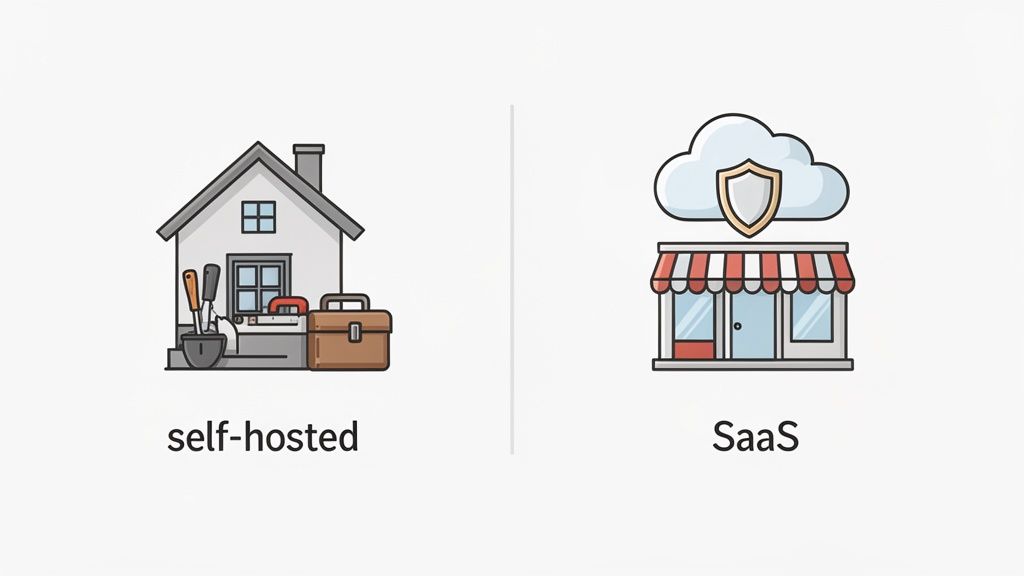
Think of WordPress, combined with the WooCommerce plugin, as building a custom house. You own the land (your hosting) and the blueprints (the open-source code). This gives you the absolute freedom to build whatever you can dream up, from a simple shop to a massive, multi-faceted digital storefront.
But that ownership comes with a whole lot of responsibility. You’re the general contractor, and you're on the hook for everything.
- Hosting Management: It's on you to pick, pay for, and set up your own web hosting.
- Security: You're in charge of setting up firewalls, SSL certificates, and keeping malware at bay.
- Performance: Site speed is a direct result of your hosting plan, caching plugins, and how well you optimize everything.
- Maintenance: You have to manually manage all software updates for WordPress itself, plus every theme and plugin you install.
This hands-on model gives you incredible control, but you'll need some technical know-how or the budget to hire someone who does.
The WordPress Model Unpacked
Because WordPress is self-hosted, your store’s performance is completely tied to the infrastructure it runs on. A critical piece of that puzzle is your hosting. Making the right call when choosing the right VPS hosting for WordPress can make or break your site's speed, security, and ability to handle traffic surges. It’s a level of decision-making Shopify users simply never have to think about.
Shopify's Turnkey Approach
Shopify, on the other hand, is like leasing a high-end retail space in a secure, bustling mall. The platform is a fully-hosted, closed system. Shopify handles all the servers, security, and performance tuning for you, so your store is fast, reliable, and secure right from day one.
This turnkey approach hides all the technical complexity, freeing you up to focus on what really matters: your products, marketing, and customers. You never have to lose sleep over a server patch or a plugin conflict taking your site down during a flash sale. The trade-off? You have to play by the landlord's rules. You can decorate your shop beautifully, but you can't knock down walls or change the building's core structure.
Key Takeaway: The choice between WordPress and Shopify really boils down to total control with total responsibility (WordPress) versus streamlined convenience with built-in limitations (Shopify).
It's also interesting to see how their histories shaped what they are today. WordPress started as a blogging platform and grew into the web’s go-to toolkit, now boasting over 65,000 plugins. Shopify, however, was built for commerce from the ground up. This laser focus is how it captured nearly 29% of the U.S. eCommerce software market—by creating a finely tuned machine specifically for selling online. This history explains why one feels like a versatile box of tools and the other a purpose-built engine.
Comparing Design Customization and App Ecosystems
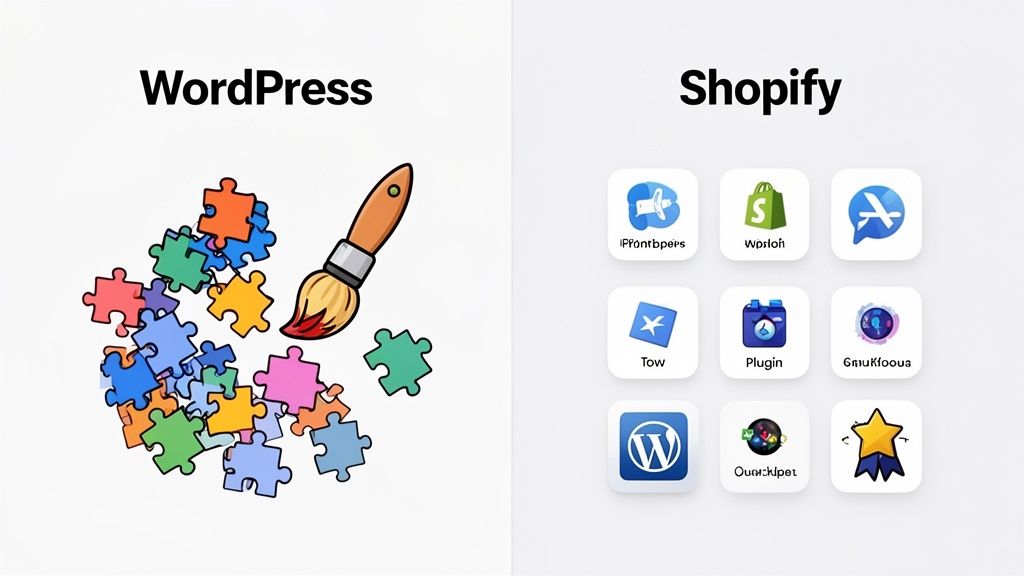
The look, feel, and functionality of your online store really come down to its design templates and third-party apps. This is where the core philosophies of WordPress and Shopify diverge, creating two wildly different experiences for a store owner. One platform gives you total creative freedom (along with all its potential headaches), while the other provides a stable, curated world with very clear guardrails.
WordPress is practically synonymous with unlimited design flexibility. With thousands of themes available across countless marketplaces and from independent developers, you can find a starting point for just about any niche or aesthetic you can dream up. If you can't find one you love, you can just build a completely custom theme from the ground up or tweak an existing one without any restrictions holding you back.
This open-ended approach means your brand’s visual identity is limited only by your imagination and your team's technical chops. It allows for pixel-perfect layouts, one-of-a-kind animations, and bespoke user experiences that are just not possible within a more structured system.
The Power of the WordPress Plugin Directory
The real muscle behind WordPress is its legendary plugin ecosystem. With over 59,000 free plugins in the official directory alone—not to mention thousands more premium options—you can bolt on nearly any feature imaginable. We're talking everything from sophisticated SEO toolkits and caching systems to specialized inventory management and full-blown membership portals.
This incredible variety gives you fine-grained control over every aspect of your store’s functionality. But with great power comes great responsibility—and a significant management burden.
- Plugin Conflicts: When you mix and match plugins from different developers, you're bound to run into compatibility issues that can break parts of your site.
- Security Vulnerabilities: Outdated or poorly coded plugins are the number one way hackers get in, which means you have to be vigilant about updates.
- Performance Drag: Piling on too many plugins is a surefire way to slow your site to a crawl, which hurts both your user experience and your SEO rankings.
Essentially, the WordPress ecosystem lets you build anything you want, but it also makes you the sole quality assurance manager for your entire tech stack.
Shopify’s Curated Theme and App Stores
Shopify takes a completely different path, prioritizing quality control and reliability above all else. The Shopify Theme Store offers a much smaller, curated selection of premium themes, but every single one has been vetted to meet strict performance and usability standards. You might have fewer choices, but you’re guaranteed a high-quality, mobile-responsive foundation for your store right from the start.
The Shopify App Store operates on the same principle. It's a carefully managed marketplace where every app has to pass a rigorous review process before it gets listed. This ensures that any app you install will integrate smoothly, is secure, and won't crash your store. This whole model is designed to shield merchants from the technical nightmares that are all too common in the WordPress world.
The core difference is crystal clear: WordPress offers a universe of plugins where you are the quality control department. Shopify provides a vetted ecosystem where reliability is the priority, but this stability often comes with higher, recurring monthly app subscriptions.
This trade-off has real-world business implications. A WordPress store might seem cheaper upfront, with its free or one-time-purchase plugins. In contrast, a Shopify store's monthly app fees can easily add up, but that cost is often offset by the reduced need for developer maintenance and the simple peace of mind that comes from a stable, secure platform.
Ultimately, choosing between WordPress and Shopify boils down to this fundamental balance. If your business absolutely needs a unique design or a niche feature that just doesn't exist in the Shopify App Store, WordPress gives you the unparalleled flexibility to build it. But if your main priority is a reliable, high-performing, and secure store that lets you focus on selling, Shopify’s curated ecosystem is a powerful, commerce-first toolkit.
SEO and Content Marketing: A Tale of Two Philosophies
When organic traffic is your lifeblood, the platform you choose isn't just a technical detail—it's a cornerstone of your entire marketing strategy. This is where the fundamental differences between WordPress and Shopify really come to light, and where the wrong choice can hamstring your growth for years.
There's a reason WordPress is legendary in SEO circles. It was born as a blogging platform, so content is in its DNA. This gives you an incredible amount of granular control over every single SEO element you can think of, from crafting the perfect URL structure to mapping out complex internal linking webs.
This power is supercharged by a massive ecosystem of specialized SEO plugins. Tools like Yoast SEO or Rank Math are like having an SEO consultant looking over your shoulder, giving you real-time advice, managing sitemaps, and handling tricky technical tasks like schema markup with ease.
The WordPress Content Engine
One of WordPress’s killer features is its ability to handle sophisticated content architectures. If your game plan involves building massive resource hubs, creating unique post types for things like case studies, or developing intricate blog category systems, WordPress has the flexibility to make it happen without hitting a wall.
For any business where the blog is the main engine for customer acquisition, the open-source nature of WordPress is a massive advantage. It lets you build a completely custom content machine that's fine-tuned to your specific SEO goals.
This flexibility is what lets you execute a truly advanced ecommerce content strategy. You can seamlessly weave together in-depth informational content with your commercial product pages, creating a natural user journey that educates prospects before asking for the sale.
Shopify’s Commerce-First Approach to SEO
Let's be clear: Shopify has come a long way with its SEO features. For the vast majority of product-focused businesses, it's more than capable of helping you dominate the search results. Shopify handles a lot of the technical basics for you right out of the box—like generating canonical tags and XML sitemaps—which is a huge plus for teams that don't have deep technical expertise.
But that streamlined, commerce-first approach comes with a few trade-offs. The most talked-about limitation is its rigid URL structure. Your product pages will always live under a /products/ folder, and your blog posts will always be under /blogs/news/. You can't change it. For brands that want highly customized, keyword-rich URL paths, this can be a real sticking point.
Still, you can't ignore Shopify's rock-solid SEO foundation. Core performance metrics like site speed, mobile-friendliness, and security are huge ranking factors, and Shopify's managed infrastructure delivers on all three without you having to lift a finger.
Let Your Marketing Model Be Your Guide
So, which one is right for you? It really comes down to what drives your business.
If your brand leans heavily on long-form guides, tutorials, and elaborate content funnels to attract customers, you'll probably feel more at home with WordPress. Its flexibility is built for creating the kind of complex, content-rich experiences that are central to that growth model.
On the other hand, if you're a DTC brand focused on product-led growth, paid ads, and social commerce, you can absolutely crush it with Shopify's SEO. The platform's native features are strong, and its app store is full of powerful tools to fill any gaps. To really make the most of it, diving into an Ultimate Guide to E-commerce Marketing Automation for Shopify can show you how to leverage that ecosystem for maximum impact.
Ultimately, the WordPress vs. Shopify SEO debate isn't about which one is "better." It's about which one is a better fit for how you acquire customers.
Evaluating True Cost of Ownership and Scalability
Looking past the sticker price on the monthly plan is the first real step in understanding what it actually costs to run a store on WordPress versus Shopify. That initial fee rarely tells the whole story, especially once your business starts growing and you need more complex tools. The real expenses are hiding in the layers of hosting, apps, maintenance, and transaction fees.
With Shopify, the cost structure is built to be predictable. You have a clear monthly subscription that covers your hosting, security, and all the platform maintenance. But that's just your starting point. As you start adding functionality through the Shopify App Store, that monthly bill will creep up. A few must-have apps for things like marketing, customer reviews, or subscriptions can easily tack on $100-$300 or more every month.
On top of that, you have to watch Shopify's transaction fees. If you use Shopify Payments, you’re in the clear. But if you bring in a third-party gateway like PayPal or Stripe, Shopify will take an additional slice of 0.5% to 2.0% from every single sale—that’s on top of what the payment processor is already charging you. For a brand that’s starting to scale, that can become a serious line item on your P&L. We break this down even further in our guide to the true cost of a Shopify store.
Budgeting for a WordPress Store
On the surface, WordPress and WooCommerce look like the cheaper option because the core software is free. The catch? You’re responsible for building out and maintaining the entire infrastructure yourself, which brings its own set of variable—and often unpredictable—costs. A realistic budget for a WordPress store has to account for all the things Shopify bundles into its subscription.
- Managed Hosting: This is non-negotiable if you're serious. Plan on spending anywhere from $30/month for a basic plan up to $500+/month for high-performance hosting that can handle enterprise-level traffic without breaking a sweat.
- Premium Themes and Plugins: Sure, there are plenty of free options, but professional stores almost always invest in premium tools for design, security, caching, and backups. This can easily run you $500-$1000+ in initial or annual costs.
- Developer Support: Unless you’re a developer yourself, you will eventually need technical help. Whether it’s for updates, fixing plugin conflicts, or custom tweaks, budgeting for a freelancer or an agency is just smart planning.
The fundamental difference in cost is this: Shopify’s expenses are predictable and scale with app usage and sales volume. WordPress costs are more fragmented and tied to infrastructure performance and maintenance needs.
To help visualize this, we've put together some estimated monthly costs based on where a business is in its growth journey. These are just projections, of course, as your specific app and plugin choices will make a big difference.
Projected Monthly Cost Comparison by Business Stage
This table shows a clear pattern: while WordPress might start cheaper, the costs for robust hosting and expert support can make it just as, if not more, expensive than a comparable Shopify plan as you scale. The key is understanding where your money is going—into Shopify's managed ecosystem or into building and maintaining your own.
Comparing Scalability and Growth Potential
Scalability isn’t just about handling more traffic. It’s about how gracefully a platform supports your business as it gets more complex.
Shopify’s entire architecture is built for this from the get-go. Moving from a basic plan up to Shopify Plus is a seamless switch that unlocks an enterprise-grade solution with higher API limits, dedicated support, and powerful tools like Shopify Flow for automation. This kind of managed scalability is a huge part of Shopify's appeal—they handle the heavy lifting so you can focus on growth.
WordPress, on the other hand, can scale infinitely... but that scalability is 100% on you. As your store grows, you have to proactively manage and upgrade your hosting environment, moving from shared hosting to a VPS, and eventually to a dedicated server or cloud setup. This demands serious technical oversight to manage performance, security, and uptime during big traffic spikes—a massive responsibility that Shopify Plus handles for its merchants automatically.
How to Choose the Right Platform for Your Business
Okay, let's cut through the noise. Reading endless feature comparisons is one thing, but making the final call comes down to your actual business model. The best platform isn't the one with the longest feature list; it's the one that feels like a natural extension of your goals, your team's skills, and your vision for the future.
Your choice between WordPress and Shopify should be a gut-level decision, rooted in the DNA of your business.
To make things a bit more concrete, we've put together a straightforward decision tree. It maps out the choice based on your single biggest priority right now.
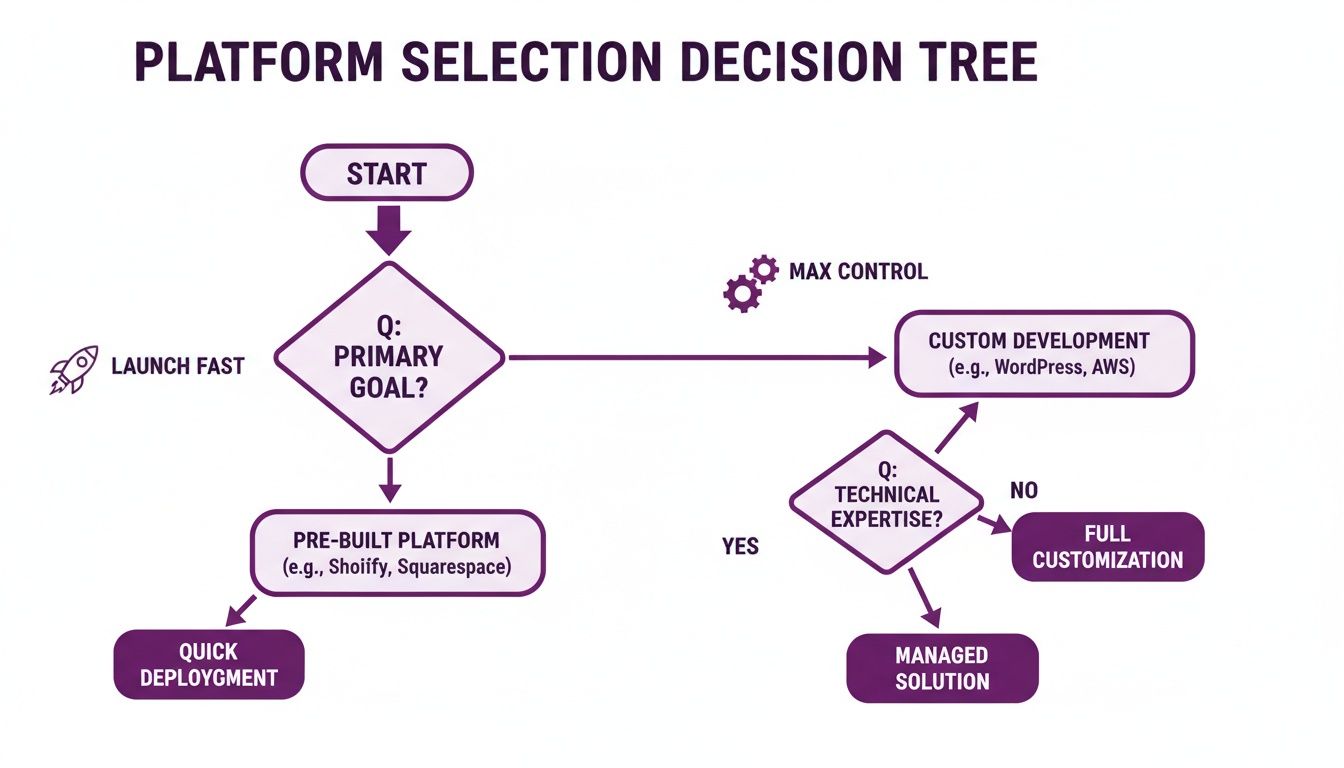
As you can see, if you need to get to market yesterday, Shopify is your fast track. If you crave total, uncompromising control over every pixel and line of code, WordPress is where you'll feel at home. The right platform doesn't just host your store; it actively accelerates your business model.
Find Your Fit: Scenarios to Guide Your Decision
Let's look at four common business profiles. See which one sounds the most like you.
1. The Startup Founder Who Needs Speed
Your main goal is to get your product out there, test the market, and start making sales—fast. You simply don't have the time for a long, drawn-out development project or the budget for a full-time developer.
- Recommendation: Shopify. Its all-in-one setup lets you launch a secure, fast, and good-looking store in a single weekend. It removes all the technical roadblocks, so you can pour 100% of your energy into what really matters at this stage: marketing and selling.
2. The Content-Driven Brand
Your business lives and breathes content. Organic search is your primary growth engine, fueled by detailed blog posts, resource centers, and a sophisticated SEO strategy that brings customers to you.
- Recommendation: WordPress with WooCommerce. You need the unparalleled CMS power that WordPress offers. It gives you the granular control necessary to execute a world-class content and SEO plan—from custom URL structures to advanced schema markups via plugins. It's an engine built for organic growth.
The WordPress vs. Shopify debate often boils down to this: Is your content there to support your products, or are your products there to support your content? Your answer will point you to the right platform.
3. The Multichannel Retailer
You’re not just online. You're selling at pop-up shops, weekend markets, and maybe even a small brick-and-mortar location. You need one brain to run the whole operation—inventory, sales, and customer data all have to be perfectly in sync.
- Recommendation: Shopify. Its native Point of Sale (POS) system is a game-changer. It’s built right into the platform, creating a unified commerce solution that WordPress just can't replicate without patching together a clunky system of third-party plugins.
4. The Innovator with a Unique Vision
Your business idea breaks the mold. You need a completely custom feature, a one-of-a-kind user journey, or a niche integration that you'll never find in an app store. You need to get your hands on the source code and build it yourself.
- Recommendation: WordPress with WooCommerce. This is where the open-source nature of WordPress shines. It gives you the ultimate freedom to build anything you can dream up. You can tear down the checkout process and rebuild it, invent new core functionalities—whatever it takes. The platform bends to your business, not the other way around.
Still Have Questions? Let's Clear Things Up
Even with a detailed breakdown, you probably still have a few specific questions bouncing around. That's completely normal. Let's tackle some of the most common ones we hear from merchants trying to decide between WordPress and Shopify.
Can I Move From WordPress to Shopify (or Vice Versa)?
Absolutely. Migrating between platforms is a well-trodden path, but it’s not something you should rush into. While automated tools can get your core data—products, customers, orders—across the finish line, that's only half the battle.
Your theme, any custom features, and most importantly, your SEO rankings, need a hands-on, strategic approach. Setting up proper 301 redirects is non-negotiable if you want to protect the search authority you've worked so hard to build.
Which Platform Is Better for Dropshipping?
For most people starting out, Shopify is the hands-down winner for dropshipping. Its user-friendly setup and seamless integrations with apps like DSers let you get a store up and running with incredible speed.
You can dropship on WordPress using WooCommerce and various plugins, but it's a much more technical lift. If speed to market and simplicity are your top priorities, Shopify is the way to go.
What's Headless Commerce?
Think of it as separating the "face" of your website (what customers see) from the "brain" (the backend commerce engine). This lets you use the best tool for each job—like using WordPress for its amazing content capabilities and Shopify for its rock-solid checkout.
What Is Headless Commerce and How Does It Fit In?
Headless commerce is a more advanced setup where your frontend (the "head") is detached from your backend. A common hybrid approach is using WordPress and Shopify together.
In this model, WordPress handles the beautiful, content-rich frontend experience, while Shopify’s powerful backend processes all the transactions. It's a "best of both worlds" solution, but it's technically demanding and really only makes sense for established brands with access to development resources.
Does Shopify Charge Extra Transaction Fees?
This is a big one. If you use Shopify Payments, their built-in payment processor, you just pay the standard credit card processing fees. Simple.
However, if you choose to use an external gateway like Stripe or PayPal, Shopify will add its own transaction fee on top. This fee ranges from 2.0% down to 0.5%, depending on which Shopify plan you're on. This is a critical cost difference compared to WooCommerce, which never adds its own transaction fees.
Trying to navigate a complex migration, integration, or simply figure out which platform is right for you can be a lot to handle. At ECORN, we specialize in this stuff. Our team can help you build a high-performing eCommerce store that's perfectly aligned with your business goals.
Explore our Shopify development services and see how we can help you scale.



Shopify Design Agency: How to Pick the Right Partner
Mastering Multi Store Management on Shopify
Scale Shopify Store
10 Shopify App Ideas Worth Building in 2026
Conversion Rate Optimization for Landing Pages: The Playbook
Shopify Plus Automation: A Guide for 2026
10 Social Selling Platforms for Shopify Merchants
Shopify Website Design Examples: 7 Stores Worth Studying
7 Ecommerce Newsletter Examples for Shopify Brands
One Product Shopify Store: Build and Scale
Mobile Pop Up Strategy for Shopify Stores That Converts
Sitemap for Shopify: How to Find, Optimize, and Submit It
7 Single Product Websites Worth Emulating
Product Variants Shopify: The Complete 2026 Guide
Ecommerce Analytics Consulting for Growth
What Is AI Integration for eCommerce
How to Choose the Right eCommerce Website Development Firm
E Business Strategy Implementation
Conversion Tracking Setup for Shopify Stores
BigCommerce vs Shopify Plus Which Enterprise Wins in 2026
Shopify Theme Kit: Setup, Commands, and Migration Guide
Shopify Extension Development: A Practical 2026 Guide
Shopify Speed Score Explained and How to Improve It
Shopify Mobile Optimization: The 2026 Playbook
How to Add Subcategory in Shopify for Better UX
How to Implement Structured Data for Ecommerce in 2026
SEO App Mobile: Shopify Store Optimization Guide
Shopify Plus Support: What It Includes and How to Choose
Google Ads for Shopify: The Complete 2026 Playbook

Shopify New York: How to Find and Hire the Right Agency
Google Search Console for Shopify: The Complete Setup
First Party Data Collection for eCommerce Growth
FAQ Online Store Guide: Build and Measure It Right
Do FB Ads Work for eCommerce in 2026?
One Page Checkout for Shopify: Design and Implementation
Shopify GraphQL vs REST: The 2026 Developer Decision
Shopify Ecommerce Consulting: Strategy, Pricing &

Are Reddit Ads Worth It for eCommerce Brands

Shopify Title and Meta Description: A Practical 2026 Guide

Product Video Best Practices for Shopify Brands

Real-Time Inventory Management: A 2026 Guide
AI Chatbot Integration for Shopify Stores

Affiliate Program Management: A Shopify Guide
10 Best Performance Monitoring Tools for Shopify in 2026

Digital Asset Management for eCommerce Brands in 2026
Every Type of Facebook Ads Explained for eCommerce Growth
Product Information Management Explained for Shopify Brands
Support Ticket System: A Guide for Shopify Stores

10 Best Customer Service Tools for Shopify in 2026

Can I Start a Business with No Money? a 2026 Blueprint

What Sells Good on Etsy: Best Niches for 2026

Shopify Add to Cart Button: A Practical 2026 Guide

Customer Feedback Automation: A Practical eCommerce Guide
Critical Rendering Path: A Guide for Shopify Stores

How to Promote on TikTok for eCommerce in 2026

B2B eCommerce Consulting That Drives Real Revenue

10 Best Practices for Site Navigation in 2026
Return vs Refund for Shopify Stores: A Practical Guide
What Is Customer Lifetime Value and Why It Matters
What Is Voice of Customer Research for eCommerce

SMS Marketing for Ecommerce That Actually Converts

Master How to Improve Email Deliverability in 2026

Top 7 eCommerce Partners NYC for Shopify Brands in 2026
Machine Learning for Ecommerce: Boost Your Shopify Store

Beauty Market Research: Your 2026 Growth Guide

Shopify International Expansion: A 2026 Roadmap
What Does CRO Stand for in Business: Understanding CRO

Shopify Visual Merchandising: A Playbook for Higher Sales

Shopify Landing Page Design: Master Conversion in 2026
10 Best AI SEO Optimization Tools for Shopify in 2026

Agentic AI for Ecommerce: Boost Your Sales in 2026
Mastering Email Marketing Data for eCommerce Growth
Conversion Rate Optimisation Australia: Boost Your Sales
Conversion Rate Optimization AI: Your Shopify Store Guide

10 Product Bundling Strategies for Shopify in 2026
How to Increase Customer Lifetime Value: A Shopify Playbook
AI Customer Service Automation: Shopify Guide 2026
Clean Website Design: A Shopify Conversion Playbook

Omnichannel Retail Strategy: A Shopify Playbook

Product Data Enrichment: A Guide for Shopify Brands

Instagram Shopping Features a Guide for Shopify Stores
What Is Revenue Optimization: A Holistic RevOps Guide
Benefits of Conversion Rate Optimization: Boost Your
WordPress to Shopify Migration: Your 2026 Seamless Switch
Boost Sales: Ecommerce Payment Processing Guide 2026
Unified Commerce Platform: Benefits, KPIs & Shopify Guide

How to Reduce Bounce Rate eCommerce: Your 2026 Guide
Shopify API Integration: A Practical End-to-End Guide

How to Implement Data Governance: A 2026 Guide
Shopify Store Development Cost: A 2026 Breakdown
What Is Server Side Tracking: The Shopify Guide 2026
Marketing Automation Workflows: A Shopify Guide for 2026

Shopify: How to Reduce Technical Debt

Shopify UX Design Change: A Playbook for Growth

User Generated Content Strategy: Shopify Playbook

Shopify Pause and Build Plan Cost: A Complete 2026 Guide
Compare at Price on Shopify: A Complete Guide for 2026
Where Can I Sell My Prints? 10 Best Platforms for 2026
Shopify Order Management System: The Ultimate Guide 2026
What Is Marketing Attribution? an eCommerce Guide for 2026


newsletter in your inbox