


Picking between Shopify and BigCommerce often boils down to a fundamental choice: do you want simplicity backed by a massive app store, or an all-in-one platform with more features built-in from the get-go?
Shopify has mastered ease-of-use, making it the go-to for direct-to-consumer (DTC) brands and startups that need to get to market quickly and flexibly. On the flip side, BigCommerce packs more muscle into its core platform, particularly for businesses with complex product catalogs or B2B ambitions, aiming to keep your reliance on third-party apps to a minimum.
Shopify vs BigCommerce A Head-To-Head Overview
Choosing an ecommerce platform is one of those foundational decisions that will echo through every part of your business. It's not just about how your store looks; it dictates how you operate, how you scale, and ultimately, how well you turn browsers into buyers. The Shopify versus BigCommerce debate sits right at the heart of this decision. Both are titans in the SaaS (Software-as-a-Service) space, but they were built with different philosophies in mind.
Shopify's approach is all about providing a clean, intuitive core and then letting you customize it to your heart's content through its legendary app marketplace. This "app-first" model gives you incredible freedom. BigCommerce takes the opposite route, baking advanced functionality like complex product options and native B2B tools directly into its platform. For stores with those specific needs, this can mean a much simpler tech stack from day one.
Understanding Market Dominance
You can't ignore the sheer gravity of each platform's market presence. Shopify is a giant, commanding 26-30% of the global ecommerce platform market, while BigCommerce holds a more modest 1-3%. With over 4.8 million active merchants, Shopify's ecosystem is simply massive. It's no surprise that it powers 73% of the top 800 DTC brands—a testament to its dominance among high-growth companies. For a deeper dive, check out the full analysis of Shopify’s market position and statistics on thehubcontent.com.
The image below perfectly captures the clean, user-friendly interface that has become Shopify's signature.
This design philosophy is all about accessibility. It empowers merchants to launch and grow their business without needing a computer science degree.
Key Differentiators at a Glance
If you're short on time, this table cuts right to the chase, highlighting the core differences between the two platforms.
This quick comparison should give you a solid starting point for figuring out which platform’s philosophy aligns better with your business goals and operational style.
Comparing Pricing Models and Total Cost of Ownership
When you're trying to choose between Shopify and BigCommerce, looking at the monthly plan price is just scratching the surface. The real number you need to care about is the Total Cost of Ownership (TCO), which is a much bigger puzzle involving transaction fees, app subscriptions, and sometimes, forced upgrades. Getting this right from the start can save you from some nasty financial surprises later on.
On the face of it, their pricing pages look pretty similar, but the philosophies behind them are worlds apart. Shopify really pushes you to use its own payment gateway, Shopify Payments, by waving its own transaction fees if you do. But if you want to use a third-party gateway like PayPal or Stripe, Shopify will slap on an extra fee anywhere from 0.6% to 2%, on top of what your payment processor is already taking.
This is a huge deal for merchants who already have great rates with another provider or are in a country where Shopify Payments isn’t an option. Those little percentages add up fast and can start to seriously eat into your margins, especially as you scale.
The Hidden Costs in Shopify's App-Centric Model
Shopify’s biggest strength—its massive app ecosystem—is also its biggest potential money pit. The core platform is clean and simple, but getting it to do anything more advanced usually means adding a bunch of paid apps. Need better product options, subscriptions, or a decent loyalty program? Yep, each of those is likely another monthly bill.
For a growing store, these app costs can stack up quickly, turning that "affordable" base plan into a hefty monthly expense. It's a pay-as-you-go approach to features. That gives you flexibility, but you have to watch your budget like a hawk. For a deep dive into what this can look like, check out our full guide on how much Shopify costs per month.
BigCommerce and Its Revenue-Based Tiers
BigCommerce comes at it from a different angle. They pack a ton of features into the platform right out of the box, which means you're less likely to need a wallet full of app subscriptions from day one. Plus, they proudly wave a zero transaction fee flag on all plans, no matter which payment gateway you use. This is a massive plus for businesses that want predictable costs and the freedom to choose their payment processor without being penalized.
But BigCommerce has its own tripwire: revenue thresholds. Each of their plans has a hard cap on your trailing 12-month sales. The second you cross that line, you’re automatically bumped to the next, more expensive plan.
Key Insight: This model can sting if you're growing fast. A viral marketing campaign or a great sales season could suddenly launch you into a pricier plan, jacking up your monthly platform cost with zero warning.
This chart shows just how much bigger Shopify's slice of the market is, which gives it a ton of influence over the ecosystem and pricing power.
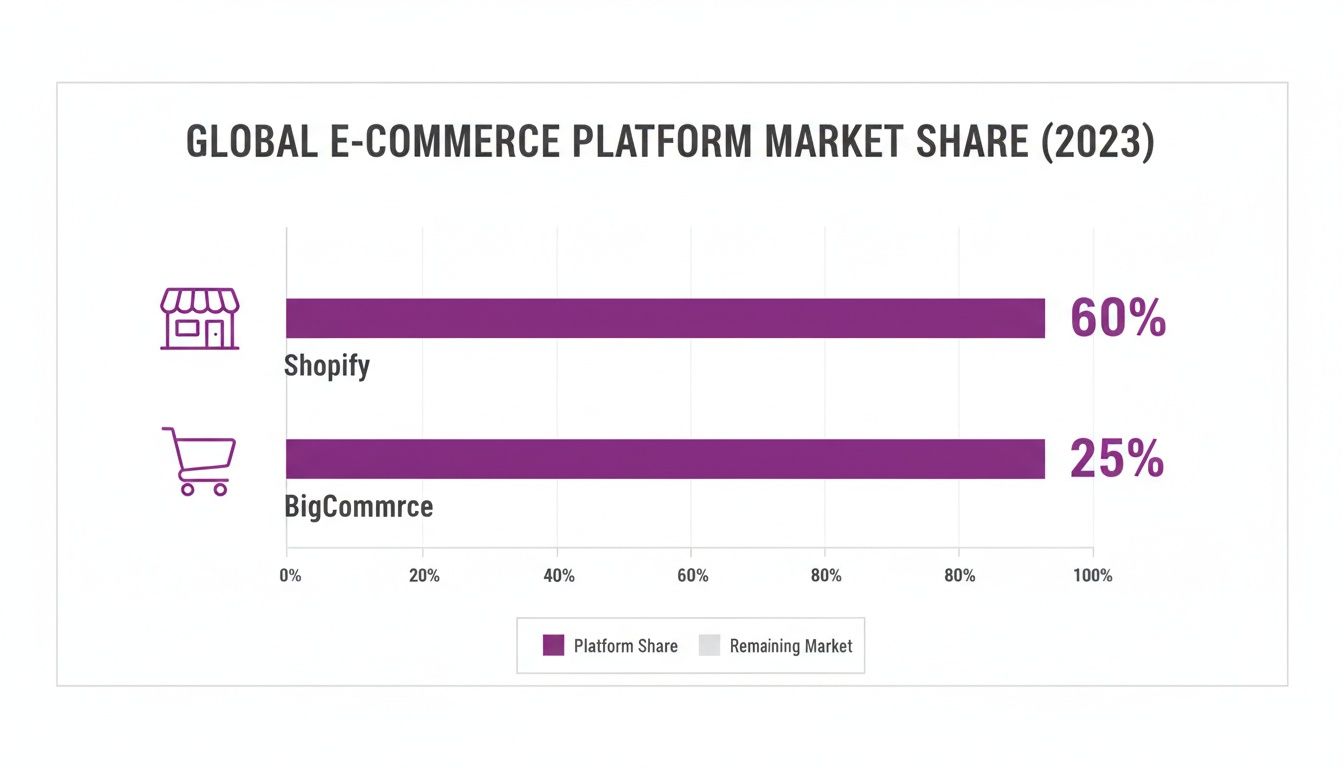
Shopify’s huge market share means it can pour resources into its ecosystem, especially integrated solutions like Shopify Payments, which directly shapes the TCO for every merchant on its platform.
To give you a clearer picture, let's project what your monthly costs might actually look like as you grow.
Projected Monthly Costs by Business Size
The table below gives a ballpark estimate of the Total Cost of Ownership (TCO) for different business sizes on both platforms. This isn't just the subscription fee; it's a more realistic blend of the plan, typical app fees, and estimated transaction fees to show how costs can evolve.
As you can see, the "cheaper" platform really depends on your specific needs and sales volume. A Shopify store with minimal apps might be more affordable early on, but BigCommerce often becomes more cost-effective as revenue and feature needs increase, thanks to its built-in functionality and zero transaction fees.
Ultimately, the Shopify vs. BigCommerce cost debate isn't about which one is cheaper on paper. It’s about which pricing model fits your business's growth plan and feature needs. You have to run the numbers and calculate a realistic TCO to make a smart decision that will support your store in the long run.
Analyzing Core Features and The App Ecosystem
When you dig into the core of Shopify vs. BigCommerce, you find a fundamental difference in philosophy. Shopify gives you a polished, powerful engine and hands you the keys to its massive app marketplace to build out the rest. BigCommerce, on the other hand, packs a ton of features directly into its platform from the get-go. This sets up a classic trade-off: curated flexibility versus out-of-the-box power.
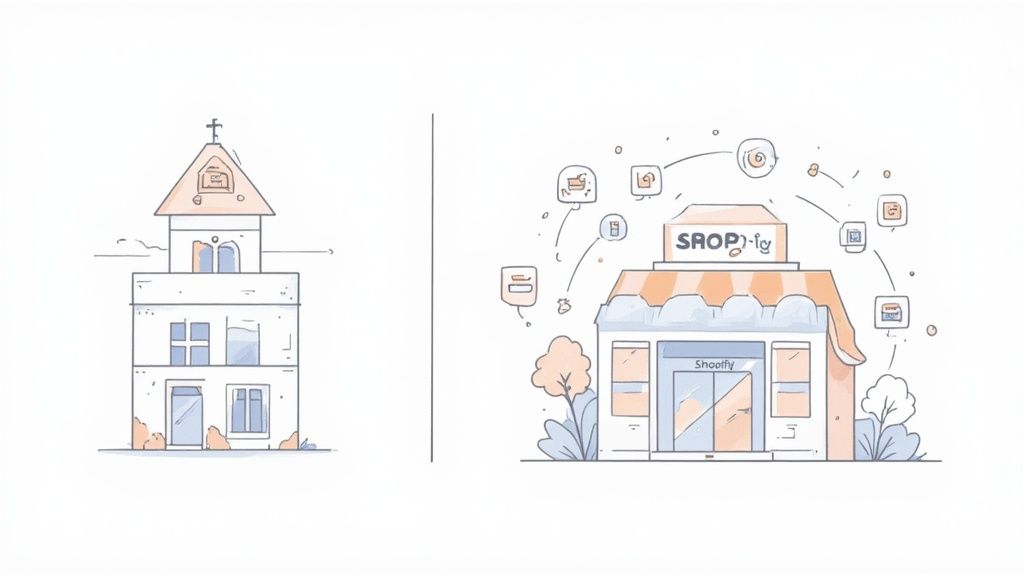
Shopify’s main draw has always been its incredible ease of use. The user interface is clean, intuitive, and just makes sense. From adding your first product to fulfilling orders, everything feels smooth, which is why it's the go-to for brands that want to get to market quickly. This simplicity is intentional, as they expect you to turn to their legendary app ecosystem for more complex functions.
Shopify's App-Centric Model
With over 16,000 apps in the Shopify App Store, it's easily the biggest in the e-commerce space. This gives you an almost limitless ability to bolt on any feature you can dream up, from advanced subscription models and loyalty programs to really intricate product customizers.
But this app-first approach has a couple of significant downsides. First, your total cost of ownership can creep up fast, as many of these essential apps come with their own monthly subscription fees. Second, juggling a dozen apps from different developers can get complicated, sometimes leading to code conflicts or a clunky experience in your store’s backend.
A perfect example of Shopify's strength is its native Point of Sale (POS) system. Shopify POS is a best-in-class solution that brilliantly syncs your online and brick-and-mortar sales, inventory, and customer data. For any retailer with a physical footprint, this is a huge advantage that BigCommerce can only replicate with third-party apps.
Key Differentiator: Shopify's approach is to provide an immaculate core platform and let merchants customize it with apps. You get maximum flexibility, but it often means more complexity and recurring fees for features that others might consider standard.
BigCommerce's Built-In Functionality
BigCommerce flips the script by loading its platform with native features that Shopify merchants usually have to pay extra for. The goal here is to give you more power right out of the box, so you spend less time (and money) hunting for, installing, and managing third-party apps.
If you have a complex product catalog, BigCommerce is the clear winner. It natively supports up to 600 variants per product. Compare that to Shopify’s hard limit of 100 variants spread across just 3 options. For anyone in fashion, auto parts, or industrial supply, this one feature can be a complete game-changer.
Let's look at a few direct comparisons to see where this really matters.
This table makes it pretty clear how BigCommerce delivers more horsepower for specific, often complex, business needs without forcing you into the app store. For example, its native multi-currency support with automatic exchange rate updates is a massive plus for international sellers—something that feels tacked-on in Shopify's standard plans.
The B2B functionality is another area where BigCommerce is deeply integrated. Tools for setting custom pricing for different customer groups, managing quotes, and offering bulk discounts are all baked into the higher plans. To get that same level of B2B sophistication on Shopify, you’re almost always looking at an upgrade to Shopify Plus plus a handful of specialized apps.
Ultimately, deciding between Shopify and BigCommerce's feature sets comes down to your business model. If you want a simple, clean foundation and the freedom to add very specific functions through a world-class app store, Shopify is your platform. But if your business has complex product needs, global ambitions, or a B2B sales channel, BigCommerce’s feature-packed core offers a more integrated and potentially more cost-effective solution right from the start.
Evaluating Headless Commerce and B2B Capabilities
For brands mapping out their future, the Shopify vs. BigCommerce debate quickly evolves past standard storefronts. The real conversation shifts to advanced setups like headless commerce and business-to-business (B2B) models. These aren’t just trendy terms; they're strategic moves that can open up entirely new ways to sell and build incredible customer experiences.
But this is where the two platforms really show their different DNA. They approach these advanced capabilities from fundamentally different philosophies.
Headless commerce is all about decoupling your front-end customer experience (the "head") from the back-end commerce engine. This gives you total creative control to build custom storefronts on any tech stack, launch mobile apps, or even integrate shopping into IoT devices—all powered by a reliable back-end for products and orders.
The Headless Commerce Approach
Shopify has made some serious moves in the headless world, primarily with its Hydrogen framework and Oxygen hosting. This combo is purpose-built to work with Shopify's Storefront API, offering a structured, and some might say opinionated, path for developers. It's a fantastic toolkit if you're already bought into the Shopify ecosystem.
BigCommerce, on the other hand, was built with an API-first philosophy right from the start. Its entire architecture is inherently more open and flexible, designed to play nicely with whatever front-end framework you throw at it. Developers often point to BigCommerce's less restrictive APIs and higher call limits as a major plus for complex, high-volume headless projects.
Key Insight: Shopify gives you a guided, powerful path to headless with its own framework, making it a solid choice for brands that want a more managed experience. BigCommerce offers a more open, agnostic foundation, handing developers the raw power to build truly custom solutions without being locked into a specific front-end technology.
If this is a new concept for you, our guide gives a great breakdown of what headless commerce is and why it could be a game-changer for your brand.
Comparing Headless Implementation Scenarios
So, what does this look like in the real world?
- A fast-growing DTC brand launching an immersive mobile app: Shopify's Hydrogen could get them to market faster. The framework is designed to work perfectly with the Shopify back-end, creating a clearer, well-documented development path.
- An enterprise business integrating commerce into multiple touchpoints (like smart mirrors or in-store kiosks): BigCommerce’s API-first design is the winner here. It provides the raw flexibility needed to connect to all sorts of unconventional front-ends without worrying about hitting restrictive API limits.
A Deeper Look at B2B Functionality
The philosophical divide between the platforms gets even wider when we look at B2B. This is an area where BigCommerce’s "features-first" approach really pays off, with a powerful suite of B2B tools baked directly into its higher-tier plans.
BigCommerce’s native B2B functionality gives wholesalers and distributors the tools they actually need, right out of the box:
- Customer-Specific Pricing: Create unique price lists for different customer groups without any fuss.
- Bulk Pricing Tiers: Automatically set up tiered discounts based on order quantity.
- Quote Management: Let your B2B customers request quotes directly through the storefront.
- Corporate Account Management: Allow companies to manage multiple buyers under a single parent account.
Shopify holds back its core B2B features for its most expensive plan, Shopify Plus. While the tools are certainly powerful, it means smaller businesses with wholesale ambitions have to stitch together a solution using third-party apps to get what BigCommerce offers standard on its advanced plans. This can quickly add up in monthly costs and create a more complicated tech stack to juggle.
If B2B is a core part of your revenue, BigCommerce delivers a more unified and cost-effective solution from day one. The functionality is built-in, creating a seamless experience for you and your B2B clients. For a Shopify merchant to reach that same level of B2B sophistication, it often means a big jump to Shopify Plus plus the added cost and management of multiple paid apps.
Comparing SEO and Conversion Rate Optimization
Getting traffic to your site and turning those visitors into customers are the two jobs that define ecommerce success. How well your platform sets you up for Search Engine Optimization (SEO) and Conversion Rate Optimization (CRO) has a direct line to your bank account. In the Shopify vs. BigCommerce showdown, both give you a solid starting point, but the devil is in the details—the small things that can give you a real competitive advantage.
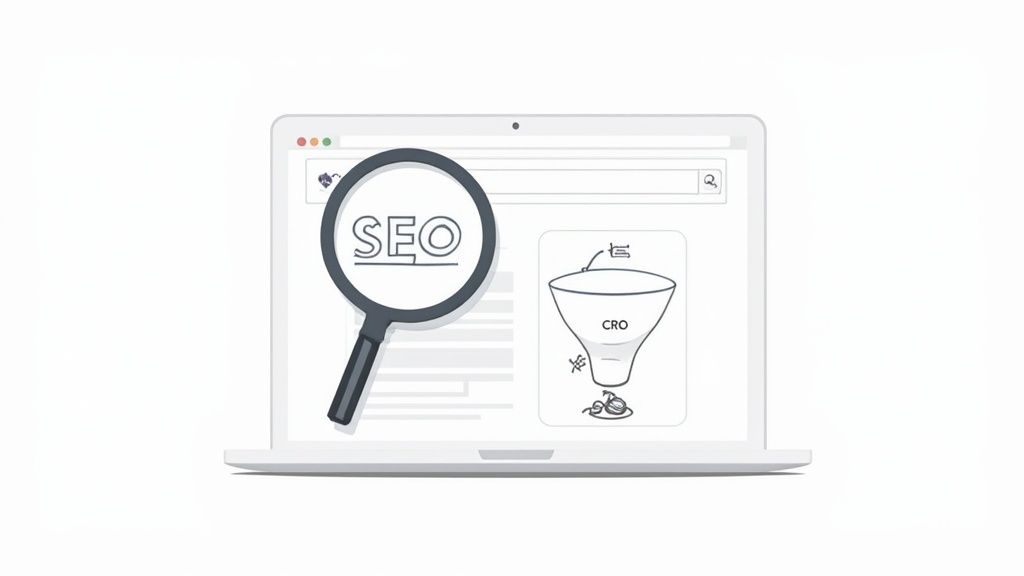
We'll skip past the obvious stuff like meta titles and descriptions. Instead, let's dig into the technical differences that really matter: URL structures, site speed, and the all-important checkout experience.
Unpacking SEO Capabilities and Challenges
Both platforms nail the SEO fundamentals. You can easily edit titles, descriptions, and alt tags. The real separation happens when you look for the kind of advanced control that serious marketers demand.
Right out of the box, BigCommerce gives you way more control over your URL structures. You can customize them completely, stripping out extra words or folders to build clean, keyword-rich URLs that search engines love.
Shopify, on the other hand, locks you into a rigid URL structure. It automatically adds subfolders like /collections/ and /products/ that you can't get rid of. While this isn't an SEO death sentence, it's a known frustration for SEO purists who want total command over every on-page signal.
Key SEO Differentiator: BigCommerce offers superior URL customization natively, a small but meaningful win for technical SEO. Shopify's rigid structure is a well-known limitation, though its massive app ecosystem often provides workarounds for other SEO tasks.
Another massive factor for SEO is site speed. And here, Shopify has a clear lead. Research shows that Shopify stores are, on average, up to 1.4x faster than BigCommerce stores. That performance boost, thanks to Shopify's hyper-optimized global infrastructure, can directly and positively impact your search rankings and user experience.
Here’s a quick rundown of other technical SEO points:
- Robots.txt Access: BigCommerce lets you edit your
robots.txtfile directly, giving you precise control over search engine crawlers. With Shopify, you only get this level of access on the Shopify Plus plan. - Schema Markup: Both platforms generate basic schema markup for products automatically. But if you need to implement more advanced or custom schema, you'll likely be heading to the app store on either platform.
- Blogging Platform: Shopify’s built-in blog is straightforward and gets the job done for content marketing. BigCommerce also has a native blog, but it’s generally seen as less intuitive than Shopify's.
For most businesses, either platform gives you the tools you need to rank well. Shopify’s speed is a major point in its favor, but BigCommerce’s URL control is a valuable asset if you're laser-focused on technical SEO precision.
Dissecting the Conversion and Checkout Experience
Once you get someone to your site, the entire experience needs to be laser-focused on making the sale. This is CRO's time to shine, and the checkout process is the final, most important battle.
Shopify is legendary for its streamlined, high-converting checkout. It’s been refined over years of testing across millions of transactions, turning it into a conversion machine. The addition of Shop Pay, Shopify's one-click checkout, obliterates friction and has been shown to boost conversions significantly.
BigCommerce puts up a good fight with a customizable one-page checkout. This is a great feature that lets customers see everything—shipping, billing, and payment—on a single screen, which can be a powerful tool against cart abandonment.
But the data points to a clear winner. One study found that Shopify's checkout converts 12% better on average than BigCommerce's. That is a huge number that translates directly into more revenue, making Shopify’s checkout a seriously powerful advantage.
Of course, a great checkout is only part of the puzzle. Effective user experience (UX) is critical for CRO, ensuring visitors have a smooth journey from landing page to thank you page. For anyone wanting to master this, investing in quality UX design services can provide invaluable insights that apply to any platform you choose.
When it comes to CRO tools, both platforms lean on their app marketplaces for things like A/B testing, personalization, and advanced pop-ups. Shopify’s bigger app store gives it an edge in the sheer number of tools available. However, BigCommerce bakes some CRO-friendly features in natively, like an abandoned cart saver on all plans, which Shopify only offers on its pricier tiers. At the end of the day, your ability to convert comes down to a smart strategy and the right set of tools, which you can find on either platform.
Making The Right Choice for Your Business
Choosing between Shopify and BigCommerce isn't about crowning one platform as the undisputed champion. It’s about finding the right partner for where your business is today—and where you plan to take it tomorrow. We've torn down the pricing, features, and performance, and the best choice really boils down to your operational setup, growth plans, and how comfortable you are with the technical side of things.
Instead of a generic verdict, let's map these platforms to the business profiles we see every day. This will give you clear, actionable advice to make a confident, future-proof decision.
The Ambitious DTC Startup
For a new direct-to-consumer brand, the game is all about a fast launch, building a brand from scratch, and validating your market. In this scenario, Shopify is the clear frontrunner. Its interface is famously easy to use, meaning you can get a beautiful, functional store live in days, not weeks. The main goal here is speed-to-market and getting those first customers, and the entire Shopify ecosystem is engineered for exactly that.
The massive app marketplace gives you incredible flexibility to test out different marketing tactics, from loyalty programs to subscriptions, without ever needing a developer. Most importantly, its world-class, conversion-focused checkout, powered by Shop Pay, gives a new brand the absolute best shot at turning early traffic into actual sales.
The Mid-Market Retailer with B2B Needs
Now, let's picture a growing retailer. Maybe you have a complex catalog with over 200 SKUs and a wholesale or B2B channel that’s starting to take off. For this kind of business, BigCommerce often presents a more compelling, all-in-one solution. Its real power is in the robust features that come built-in, which can seriously simplify your tech stack.
For a business like this, the key advantages are:
- Advanced Product Options: It natively supports up to 600 product variants per item. This gets rid of the need for the clunky and expensive apps you'd have to rely on with Shopify.
- Built-in B2B Functionality: On its higher-tier plans, you get tools for customer-specific pricing, bulk discounts, and quote management right out of the box—no need to stitch together a patchwork of third-party apps.
- Zero Transaction Fees: As your sales volume climbs, the freedom to use any payment gateway you want without paying extra platform fees becomes a huge cost-saver.
The Enterprise Brand Going Headless
When an established enterprise brand is ready to go headless for total creative freedom and to build omnichannel experiences, BigCommerce’s API-first architecture usually offers a more flexible foundation. While Shopify’s Hydrogen framework is a strong contender, it's more of a guided path that keeps you within the Shopify ecosystem.
BigCommerce was built from the ground up to be open and platform-agnostic. It gives developers less restrictive API limits, which is absolutely critical for complex projects that connect commerce to mobile apps, in-store kiosks, and other custom front-ends without hitting frustrating technical walls.
Your Final Decision Checklist
To make the final call, get your team together and walk through these critical questions. Your answers will point you straight to the platform that fits your reality.
- Technical Resources: Do we have developers in-house, or do we need a low-code platform our marketing team can manage on their own?
- Product Complexity: How many variants and options do our products have? Is our catalog simple, or do we need advanced filtering and product options out-of-the-box?
- Sales Channels: Is B2B or wholesale a big part of our strategy now or in the near future?
- Budget Predictability: Do we prefer a predictable monthly cost (Shopify), or a model that avoids transaction fees but ties plan costs to revenue (BigCommerce)?
- Growth Ambitions: Are we seriously planning for advanced projects like headless commerce in the next 2-3 years?
Got Questions? We've Got Answers
When you're deep in the Shopify vs. BigCommerce debate, the same questions tend to pop up. Let's cut through the noise and get straight to the answers you're looking for.
Is Shopify Really the Best Choice for Beginners?
Without a doubt. If you're a non-technical founder, Shopify’s dashboard is about as intuitive as it gets. The entire setup is designed to get your store live in the shortest time possible, letting you focus on what really matters—marketing your products and making sales.
BigCommerce isn't necessarily difficult, but it does have a slightly steeper learning curve. This is mainly because it packs more complex features right into the core platform, which can feel a bit much when you're just starting out.
The Bottom Line: If your number one goal is a quick, painless launch without getting bogged down in technical details, Shopify is the clear winner. Its user experience is built from the ground up to be accessible for everyone.
Which Platform is Actually Cheaper in the Long Run?
This one truly depends on your business model and growth trajectory. At first glance, BigCommerce looks like the better deal with its promise of zero transaction fees on every plan. The catch? Their pricing is directly tied to your annual sales volume. As you grow, you can get hit with forced—and often unexpected—plan upgrades.
With Shopify, you might see costs creep up from app subscriptions, but the core plan pricing is fixed and isn't based on your revenue. For a lot of high-growth stores, especially those leveraging Shopify Payments, Shopify's total cost of ownership (TCO) ends up being more predictable and, frequently, lower over time.
Can BigCommerce Really Handle High-Volume Sales?
Absolutely. BigCommerce is a beast built for scalability and has no problem handling high-traffic events and massive order volumes. Its API-first architecture and powerful infrastructure make it a solid choice for established businesses and enterprise-level brands processing thousands of transactions.
The difference isn't about capability, it's about philosophy. Shopify scales through its incredible ecosystem and app store, letting you add functionality as you need it. BigCommerce, on the other hand, scales by giving you a powerful, built-in feature set and an open architecture right out of the box.
Trying to navigate a platform migration or figure out how to optimize your current store can feel overwhelming. At ECORN, we turn those headaches into growth opportunities. Whether you need expert Shopify development, a serious boost in your conversion rates, or just some strategic guidance, we have a plan that fits. Explore our services and see how we can help you scale.


Shopify Website Design Packages: What You Actually Get

How to Choose a Shopify Plus Web Design Agency in 2026
Shopify Plus Ecommerce Agency: How to Pick the Right One
Shopify Themes Retina: How to Serve 2x Images

How to Cross Sell on Shopify Without Friction
Best Shopify Theme for Custom Products Compared
Multi Store Inventory Management: A Practical Guide

SEO Consulting for Ecommerce: A Practical Guide
Shopify Theme Updater App: A Safe Update Playbook
Shopify Git Integration: A Developer's Guide to 2026
Headless Ecommerce Development Services Explained

How to Build a Shopify Clothing Website That Converts
How to Launch a Box Subscription Business in 2026

Luxury Skincare Branding Playbook That Converters
10 Best Podcast Ecommerce Shows for Store Growth in 2026
Shopify Developer Hourly Rate: What to Pay in 2026
Critical Shopify Setup Errors That Are Secretly Sabotaging Your Store
Ecommerce Conversion Tracking: The Complete How-To Guide
Shopify Design Agency: How to Pick the Right Partner
Mastering Multi Store Management on Shopify
Scale Shopify Store
10 Shopify App Ideas Worth Building in 2026
Conversion Rate Optimization for Landing Pages: The Playbook
Shopify Plus Automation: A Guide for 2026
10 Social Selling Platforms for Shopify Merchants
Shopify Website Design Examples: 7 Stores Worth Studying
7 Ecommerce Newsletter Examples for Shopify Brands
One Product Shopify Store: Build and Scale
Mobile Pop Up Strategy for Shopify Stores That Converts
Sitemap for Shopify: How to Find, Optimize, and Submit It
7 Single Product Websites Worth Emulating
Product Variants Shopify: The Complete 2026 Guide
Ecommerce Analytics Consulting for Growth
What Is AI Integration for eCommerce
How to Choose the Right eCommerce Website Development Firm
E Business Strategy Implementation
Conversion Tracking Setup for Shopify Stores
BigCommerce vs Shopify Plus Which Enterprise Wins in 2026
Shopify Theme Kit: Setup, Commands, and Migration Guide
Shopify Extension Development: A Practical 2026 Guide
Shopify Speed Score Explained and How to Improve It
Shopify Mobile Optimization: The 2026 Playbook
How to Add Subcategory in Shopify for Better UX
How to Implement Structured Data for Ecommerce in 2026
SEO App Mobile: Shopify Store Optimization Guide
Shopify Plus Support: What It Includes and How to Choose
Google Ads for Shopify: The Complete 2026 Playbook
Shopify New York: How to Find and Hire the Right Agency
Google Search Console for Shopify: The Complete Setup
First Party Data Collection for eCommerce Growth
FAQ Online Store Guide: Build and Measure It Right
Do FB Ads Work for eCommerce in 2026?
One Page Checkout for Shopify: Design and Implementation
Shopify GraphQL vs REST: The 2026 Developer Decision
Shopify Ecommerce Consulting: Strategy, Pricing &
Are Reddit Ads Worth It for eCommerce Brands

Shopify Title and Meta Description: A Practical 2026 Guide

Product Video Best Practices for Shopify Brands
Real-Time Inventory Management: A 2026 Guide
AI Chatbot Integration for Shopify Stores
Affiliate Program Management: A Shopify Guide
10 Best Performance Monitoring Tools for Shopify in 2026
Digital Asset Management for eCommerce Brands in 2026
Every Type of Facebook Ads Explained for eCommerce Growth
Product Information Management Explained for Shopify Brands
Support Ticket System: A Guide for Shopify Stores

10 Best Customer Service Tools for Shopify in 2026

Can I Start a Business with No Money? a 2026 Blueprint

What Sells Good on Etsy: Best Niches for 2026

Shopify Add to Cart Button: A Practical 2026 Guide

Customer Feedback Automation: A Practical eCommerce Guide
Critical Rendering Path: A Guide for Shopify Stores

How to Promote on TikTok for eCommerce in 2026

B2B eCommerce Consulting That Drives Real Revenue
10 Best Practices for Site Navigation in 2026
Return vs Refund for Shopify Stores: A Practical Guide
What Is Customer Lifetime Value and Why It Matters
What Is Voice of Customer Research for eCommerce

SMS Marketing for Ecommerce That Actually Converts

Master How to Improve Email Deliverability in 2026

Top 8 eCommerce Partners NYC for Shopify Brands in 2026
Machine Learning for Ecommerce: Boost Your Shopify Store

Beauty Market Research: Your 2026 Growth Guide

Shopify International Expansion: A 2026 Roadmap
What Does CRO Stand for in Business: Understanding CRO

Shopify Visual Merchandising: A Playbook for Higher Sales

Shopify Landing Page Design: Master Conversion in 2026
10 Best AI SEO Optimization Tools for Shopify in 2026

Agentic AI for Ecommerce: Boost Your Sales in 2026
Mastering Email Marketing Data for eCommerce Growth
Conversion Rate Optimisation Australia: Boost Your Sales
Conversion Rate Optimization AI: Your Shopify Store Guide

10 Product Bundling Strategies for Shopify in 2026
How to Increase Customer Lifetime Value: A Shopify Playbook
AI Customer Service Automation: Shopify Guide 2026
Clean Website Design: A Shopify Conversion Playbook

Omnichannel Retail Strategy: A Shopify Playbook
Product Data Enrichment: A Guide for Shopify Brands
Instagram Shopping Features a Guide for Shopify Stores
What Is Revenue Optimization: A Holistic RevOps Guide


newsletter in your inbox