

The real difference between BigCommerce and Shopify boils down to a simple choice of philosophy. Do you want a super user-friendly experience with a massive app store to grow into, or do you prefer a platform packed with powerful features right out of the box?
Shopify is built for simplicity and speed, making it perfect for rapid growth. On the other hand, BigCommerce gives you more core functionality from the get-go, aiming to reduce your reliance on third-party add-ons. It really comes down to whether you prioritize flexibility or built-in power.
Choosing Your Ecommerce Platform
Picking between BigCommerce and Shopify is easily one of the most critical decisions you'll make for your online business. Both are top-tier, hosted platforms, meaning you can build a killer store without ever touching a server. But they're built for different kinds of merchants.
Shopify’s main selling point is its incredible ease of use. The interface is clean and intuitive, which is why it’s the go-to for beginners and brands that just need to get online fast. Its true power, though, lies in its massive app ecosystem, with over 16,000 applications that let you bolt on pretty much any feature you can dream of.
BigCommerce takes a different route, focusing on built-in capabilities. It comes loaded with more native features for things like complex product catalogs, international selling, and B2B functionality. This approach is a magnet for merchants who need advanced tools from day one and want to keep their monthly app subscriptions to a minimum. For a broader look at your options, guides like Finding the Best Ecommerce Platforms for Small Business can be a great starting point.
This simple decision tree really drives the point home: if user-friendliness is your absolute top priority, Shopify is the obvious choice.
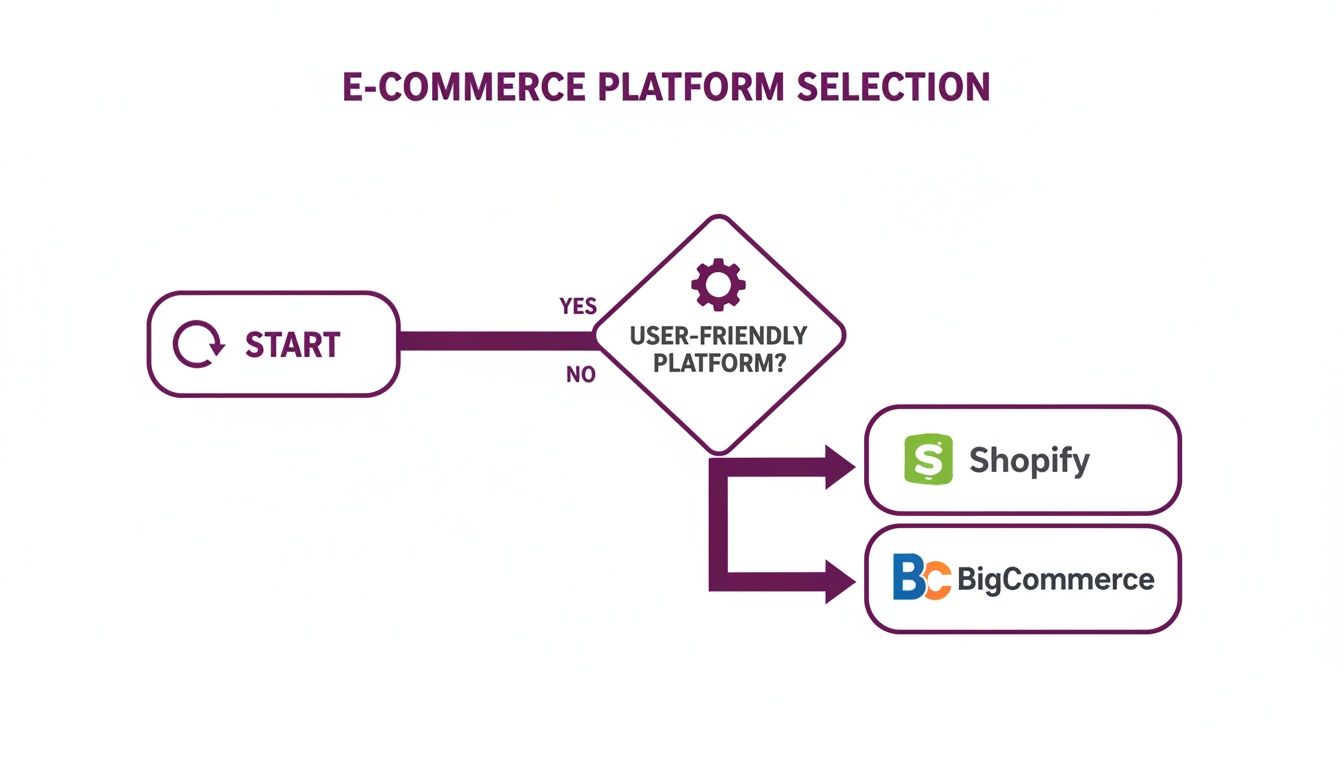
As you can see, that first fork in the road often comes down to how much you value a simple, hands-on experience versus needing more complex tools baked right into the platform.
Quick Decision Framework Shopify vs BigCommerce
To make this even clearer, I've put together a quick table to help you map your business priorities to the right platform. Use this as a gut check to see which one feels like a better home for your brand.
Ultimately, choosing the right platform from the start saves a lot of headaches down the line. If you're still weighing your options, you can dive deeper with our detailed guide on how to choose an ecommerce platform for your business.
Unpacking Market Share and Ecosystem Health
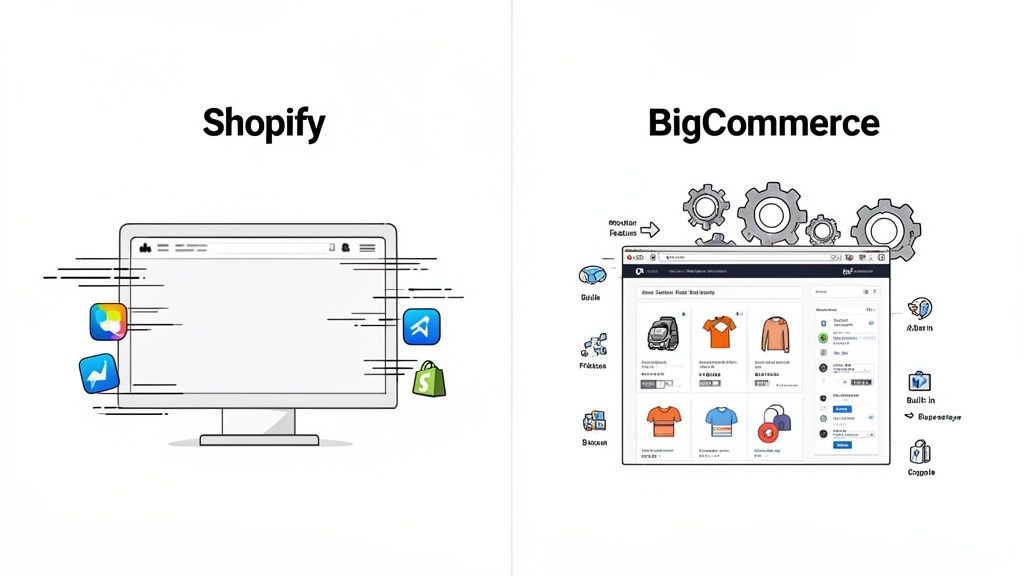
A platform's market share isn't just a vanity metric. It's a real indicator of its stability, long-term health, and the kind of support you can expect down the road. It tells you a story about how many developers are building for it and how big the community is. When you line up BigCommerce vs Shopify, this is where a massive gap starts to appear.
This difference in market presence creates a powerful network effect. The bigger platform draws in more developers, which leads to a bigger, better app marketplace. It also means there’s a larger pool of expert agencies and freelancers, making it much easier to find help when you’re in a jam.
Shopify's Dominant Market Position
It’s hard to overstate just how big Shopify is. They aren’t just a leader; for millions of businesses, they’re the default choice, from tiny startups to household-name brands. This massive adoption has created a self-feeding cycle of growth and constant improvement.
The numbers really lay it all out. Globally, Shopify holds a commanding 10.32% of the ecommerce platform market. BigCommerce, in contrast, sits around 3% in the U.S. and just 5% worldwide. Shopify powers an incredible 4.8 million active stores—3 million of which are in the U.S. alone. This gives them nearly 30% of the domestic market, driving over 12% of all U.S. ecommerce sales. Meanwhile, BigCommerce serves a much smaller slice of the pie with roughly 41,000 active stores. You can dig into more Shopify statistics and trends analysis to see the full picture.
This isn't just about being popular. A platform that supports millions of stores has seen it all—from Black Friday traffic surges to navigating complex global compliance rules. That kind of battle-tested reliability gives you a peace of mind that a smaller platform just can't offer.
For a growing brand, this is a huge plus. You're not just buying a piece of software; you're plugging into an ecosystem that has proven it can scale with businesses from their first sale all the way to billions in revenue.
How Ecosystem Health Impacts Your Business
The health of the ecosystem around your platform directly impacts your store's potential. Think of it like choosing a city for a brick-and-mortar shop. A small town might have what you need to get started, but a massive city offers way more foot traffic, better infrastructure, and access to all kinds of specialized services.
In this analogy, Shopify is the metropolis. Its enormous app store, with over 16,000 applications, has a solution for almost any problem you can imagine. This depth means you're far more likely to find the perfect tool for your specific need, whether that's for sophisticated analytics, subscription management, or hyper-personalized marketing campaigns.
Here’s how this difference plays out day-to-day:
- Developer Availability: Need custom work done? The talent pool of Shopify developers is massive, which means more competitive pricing and quicker turnarounds for your projects.
- Third-Party Integrations: The hot new marketing tool or payment gateway will almost always build an integration for Shopify first. It just makes sense, given the size of their user base.
- Community Support: Stuck on an issue at 2 AM? Shopify’s forums and online communities are huge and incredibly active, full of shared knowledge you can tap into anytime.
While BigCommerce has a solid ecosystem that serves its users well, the sheer scale of Shopify’s network gives it a clear advantage in flexibility and future-proofing your business. It means that as your needs change, the platform and its community are ready to change with you.
Comparing Core Features and Total Cost
When you get down to the brass tacks of BigCommerce vs Shopify, you’ll find their entire approach to building a store is fundamentally different. It's not just about the features you see on a pricing page; it’s about their core philosophy, and that directly impacts your store’s capabilities and, crucially, your total cost of ownership.
BigCommerce built its platform on an "all-in-one" promise. They pack a ton of powerful, often complex features directly into the core software. The goal is to give you everything you need right out of the box, without forcing you to hunt down and pay for a dozen different apps.
Shopify, on the other hand, champions a "lean core" model. They focus on perfecting the basics and maintaining a clean, incredibly user-friendly interface. For anything more specialized, they point you to their massive app ecosystem. This keeps the main platform from feeling bloated and lets you add complexity only as your business demands it.
Deconstructing the Pricing Tiers
At a glance, the pricing plans for Shopify and BigCommerce look almost identical. Both start their subscriptions around $29/month and scale up to $299/month for their advanced tiers. But that sticker price is just the tip of the iceberg.
The real cost difference bubbles up when you start looking at what's included and how transactions are handled.
- BigCommerce's Value Proposition: Since so many features are baked in, your monthly bill is far more predictable. You could easily save a significant amount on app subscriptions. For instance, things like advanced product options (up to 600 variants per product), multi-currency selling for international customers, and real-time shipping quotes are native to BigCommerce. On Shopify, you'd be reaching for paid apps to get that same functionality.
- Shopify's Scalable Model: With its reliance on apps, your Shopify bill can definitely climb as you add more tools. But there's an upside to this: new stores can start with incredibly low overhead. You pay for complexity as you go, investing in new features only when your growth justifies it.
This creates a clear trade-off. With BigCommerce, you get a powerful feature set from day one, but you're paying for it whether you use it or not. With Shopify, you build your store's functionality à la carte, which gives you flexibility but can lead to a surprisingly high monthly bill once you need a handful of add-ons.
The total cost of ownership is a far more important metric than the monthly subscription fee. It’s the sum of your plan, transaction fees, payment processing rates, and essential app subscriptions. Overlooking these "hidden" costs is a common mistake that can significantly impact your profitability.
Analyzing Hidden Costs Transaction Fees and App Spend
Beyond the monthly plan, a few other costs will make up your total investment. The big ones are transaction fees and payment processing rates. When you're weighing the core features and total cost of platforms like these, it's critical to dig into the payment options and associated fees. For a deeper dive on this specific topic, you can always consult with payment experts.
Shopify heavily incentivizes using its own gateway, Shopify Payments. Use it, and they waive all transaction fees. If you decide to use a third-party gateway like Stripe or PayPal instead, Shopify will charge an additional fee on top of what the processor already takes. This fee ranges from 2.0% on the Basic plan down to 0.6% on the Advanced plan.
BigCommerce takes a different route. It charges zero transaction fees on all of its plans, no matter which payment gateway you use. For businesses that have a preferred third-party processor or operate in countries where Shopify Payments isn't an option, this can lead to massive savings.
To make this clear, let's compare how each platform approaches its core features and the extensibility that drives up your total cost.
Shopify vs BigCommerce Core Feature Philosophy
The table below breaks down how each platform's philosophy—"lean core" vs. "built-in"—translates into real-world functionality and potential costs. It helps clarify where you'll be paying for apps versus getting features included in your monthly plan.
Ultimately, choosing between BigCommerce and Shopify on cost alone requires a bit of forecasting. If your store needs complex product options, international pricing, and B2B tools from the get-go, BigCommerce’s all-inclusive model will almost certainly be more cost-effective. But if you prioritize simplicity and want to add features piece by piece as you grow, Shopify’s lean and flexible model is a much more approachable starting point.
App Ecosystems and Customization: Where the Real Power Lies
A platform’s true muscle isn’t just its built-in features, but how well it adapts as you grow. This is where the app ecosystem and theme customization become make-or-break factors in the BigCommerce vs. Shopify decision. The right tools can turn a standard storefront into a high-octane, personalized selling machine.
Shopify’s killer feature is arguably its App Store, a sprawling marketplace with over 16,000 applications. This isn't just a numbers game; the sheer depth and quality mean there’s a solution for almost any problem you can dream up, from obscure marketing automations to intricate subscription models.
BigCommerce plays a different game. Its marketplace is much smaller, with around 1,300 apps. Their strategy is to bake more functionality directly into the core platform, aiming to reduce your reliance on third-party add-ons. It’s a cleaner approach that can simplify your tech stack, but you might hit a wall when you need a very specific, specialized tool.
The Shopify App Store: An Unbeatable Advantage
When you pick Shopify, you’re not just getting a platform; you're gaining access to a massive, hyper-competitive ecosystem. Developers are constantly pushing each other to innovate, and this market dominance gives Shopify merchants a huge leg up. In the crowded U.S. ecommerce space, Shopify commands a hefty 29-30% market share, dwarfing BigCommerce's 3%.
This popularity means the best software providers almost always build for Shopify first. You get the newest, most exciting tools before they even think about launching on other platforms. You can dig into more of Shopify's market position data on redstagfulfillment.com.
The difference is stark when you look at specific functions:
- Marketing & SEO: From email marketing giants to loyalty programs and bleeding-edge SEO analytics, Shopify's selection is endless.
- Personalization: The marketplace is flooded with highly-rated apps for product recommendations, "find your fit" quizzes, and unique shopping experiences.
- Niche Operations: Need a tool for dropshipping, print-on-demand, or even event ticketing? You'll find a dozen well-supported options, not just one or two.
The philosophy is pretty clear: Shopify gives you a rock-solid, incredibly easy-to-use foundation and then lets you build your dream store à la carte. Yes, this can add up in monthly costs, but for ambitious brands focused on growth, that flexibility and access to best-in-class tools is an investment that pays for itself.
Theme Customization and Creative Control
Your storefront is your brand’s digital handshake, and both platforms give you powerful ways to customize it—they just go about it differently. Your choice here really boils down to your team’s technical skills and how much creative freedom you want.
Shopify’s Online Store 2.0 was a total game-changer. It introduced "sections everywhere," which lets you drag and drop content blocks onto any page, not just the homepage. This empowers non-technical users to build stunning, dynamic layouts without ever writing a line of code. For developers, Shopify’s template language, Liquid, is incredibly well-documented and has a huge community, making custom projects a breeze.
BigCommerce themes are built on the Stencil framework. Stencil is a modern, powerful system that gives developers deep access to theme files for some seriously advanced customization. But all that power comes with a steeper learning curve. If you don't have a developer on standby, making big changes beyond the theme's built-in editor can be a real headache.
Let’s look at how they stack up in the real world.
At the end of the day, Shopify hits the sweet spot for most businesses. It offers amazing ease of use for day-to-day changes while still providing a robust foundation for custom development when you need it. BigCommerce gives developers a ton of raw power, but you’ll likely need specialized talent to truly unlock its potential.
Analyzing Scalability for Enterprise Brands
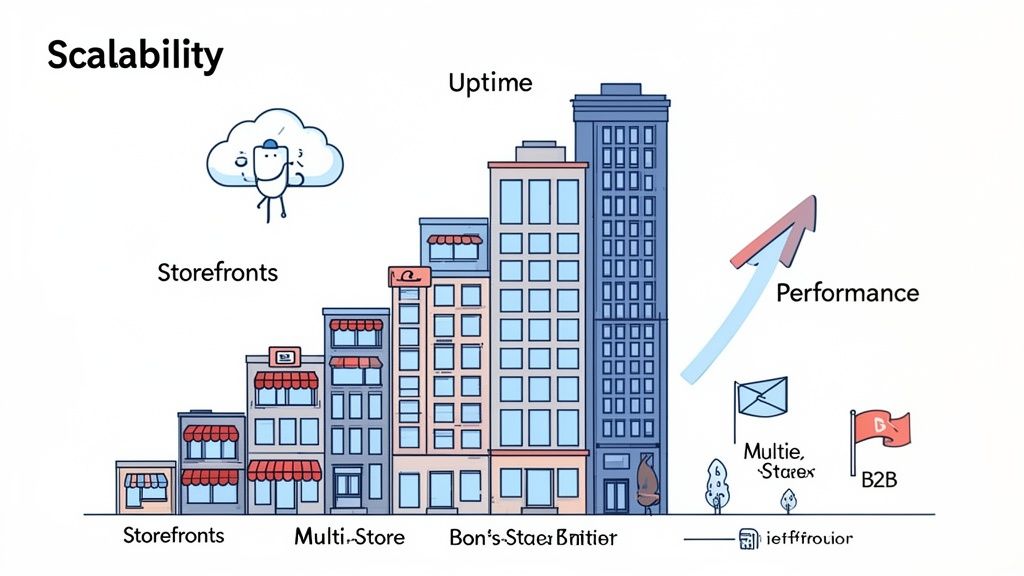
When your brand starts hitting multi-million dollar revenue, scalability stops being a buzzword and becomes the very foundation of your growth strategy. This is where the standard plans just don't cut it. You're in the big leagues now, looking at the heavyweight contenders: Shopify Plus and BigCommerce Enterprise. Making the right choice here means digging deeper than surface-level features to see which platform is truly engineered to handle the relentless pressure of enterprise commerce.
The raw numbers alone paint a pretty clear picture. Shopify's sheer scale is staggering, with a $292.3 billion Gross Merchandise Volume (GMV) in 2024 and over $1 trillion in cumulative sales processed. Compare that to BigCommerce's $332.9 million revenue in 2024, and you can see which platform is playing on a global stage. By Q3 2025, Shopify's GMV hit $92 billion—a 31% year-over-year jump. Their merchants pulled in an incredible $14.6 billion during the Black Friday Cyber Monday weekend, a 27% increase. While BigCommerce also saw a respectable 26% GMV growth during that peak season, the numbers highlight a platform built for global empires, serving over 4.8 million merchants across 175 countries. You can explore more of this data in these ecommerce statistics on ecommercetrix.com.
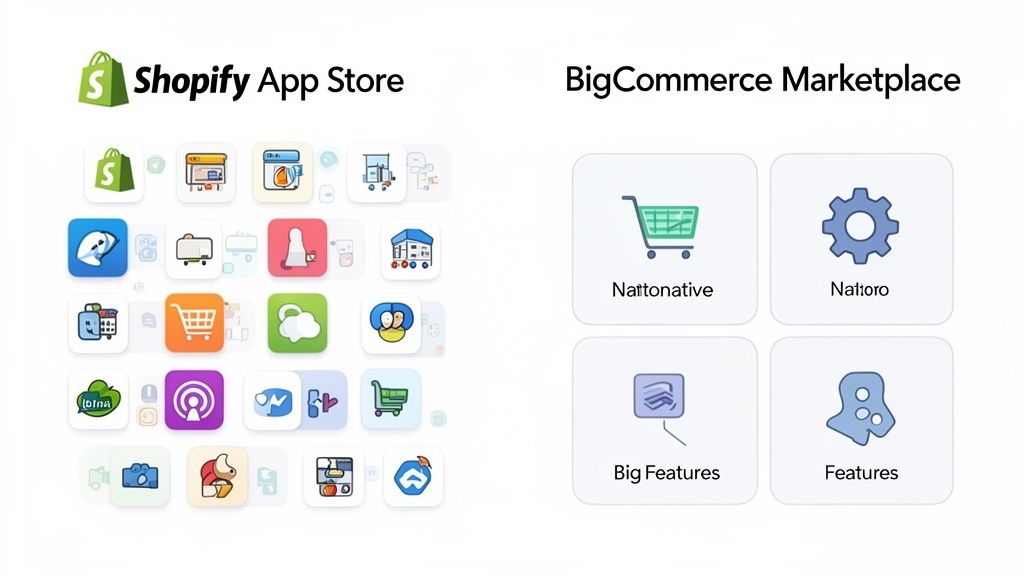
This massive difference in scale proves Shopify has been battle-tested by the world's largest brands during their most critical sales events.
Enterprise Ecosystem and Automation
Shopify Plus isn't just a platform; it’s an entire ecosystem designed for growth. One of its crown jewels is Shopify Flow, an automation engine that lets you build custom workflows to handle repetitive tasks without touching a line of code. Think about automatically tagging your VIP customers, flagging potentially fraudulent orders, or adjusting inventory based on sales velocity. It’s a game-changer for operational efficiency.
BigCommerce Enterprise, while powerful in its own right, doesn't have a comparable native automation tool. To get that same level of efficiency, you'll likely find yourself leaning on third-party apps or custom development. For large teams trying to cut down on manual work and scale their operations, this is a massive distinction.
For enterprise brands, the conversation shifts from "what can the platform do?" to "what can the platform automate for me?" Shopify Plus has a clear upper hand here, offering tools that directly reduce operational drag and let your team focus on strategy.
Headless Commerce and API Power
Both platforms have strong headless commerce capabilities, which let you separate your front-end customer experience from the back-end commerce engine. This API-first approach is crucial for creating unique, high-performance experiences across websites, mobile apps, and any other customer touchpoint you can imagine.
BigCommerce has always been proud of its API-first architecture, giving developers a ton of flexibility and control. Their APIs are well-documented and known for solid performance, making them a great fit for businesses with highly specific or complex technical needs.
Shopify Plus, however, has gone all-in on its headless offerings with the Hydrogen framework and Oxygen hosting solution. This setup provides a more guided, yet incredibly powerful, toolkit for building custom storefronts directly on Shopify’s global infrastructure. For many brands, this structured approach actually simplifies development and gets you to market faster than a more wide-open API environment.
Let's break down where each platform shines for enterprise operations.
- Automation: Shopify Flow is a native powerhouse for automating complex business logic and operational tasks, a clear advantage.
- Ecosystem Maturity: You get access to a massive pool of certified apps, partners, and developers who have deep experience with enterprise-level challenges.
- Checkout Performance: The Shopify Checkout, supercharged by Shop Pay, is battle-hardened to handle insane traffic spikes and convert at a world-class level.
- Native B2B Functionality: Its built-in features for wholesale pricing, customer groups, and quote management are often more robust right out of the box.
- Multi-Storefront Management: BigCommerce gives you a more streamlined way to manage multiple, distinct storefronts from a single dashboard.
So, what's the final verdict? It really boils down to your specific needs. If your growth depends on operational efficiency, a vast partner network, and the best checkout conversion in the business, Shopify Plus offers a more complete and proven path to scale. But if your business model is built on complex B2B sales or requires managing many different brand sites from one account, BigCommerce Enterprise is a compelling and feature-rich alternative worth considering.
Making the Right Choice for Your Business
After breaking down all the features, pricing, and technical specs, the BigCommerce vs. Shopify debate really comes down to one simple question: which platform is the right fit for your business, right now? Forget one-size-fits-all answers. The best choice is the one that aligns with your specific business model and where you plan to take it.
Let's cut through the noise and translate this comparison into a practical decision-making framework, tailored to your unique situation.
For New Businesses and Startups
When you're just starting out, speed is everything. You need to get your store live, test your ideas, and land your first sales without getting tangled up in technical weeds. Your most valuable asset is momentum.
This is where Shopify truly shines for new ventures. Its interface is famously intuitive, and the guided setup can get you from zero to a professional-looking, functional store in hours, not weeks. The platform's philosophy is to give you a clean, simple core, letting you add features from the App Store only as you need them.
BigCommerce, on the other hand, can feel a bit overwhelming for a first-time founder. While its powerful built-in features offer fantastic long-term value, the initial setup is more involved and can easily slow down your launch.
Verdict for Startups: Go with Shopify. It offers the path of least resistance to getting your business off the ground and making money. The massive ecosystem of apps and experts will be there to support you every step of the way.
For Scaling Brands and Growing Businesses
Once you’ve found your market and are ready to scale, the decision gets more interesting. Your priorities shift from just launching to improving operational efficiency, automating marketing, and creating a more sophisticated customer experience.
At this stage, the right choice depends heavily on your business model. If you thrive on agility, best-in-class marketing tools, and rapid experimentation, Shopify's app-centric approach is a massive advantage. You can hand-pick top-tier apps for everything from personalization to subscriptions, giving you incredible flexibility.
However, if your business has a complex catalog with tons of variants or you're expanding into B2B, BigCommerce becomes a very strong contender. Its native support for advanced product options and wholesale pricing can save you hundreds of dollars a month in app fees, resulting in a cleaner tech stack and better value. If you're considering a move, it’s worth understanding the work involved in a potential migration from BigCommerce to Shopify to properly weigh your options.
For Enterprise-Level Companies
At the enterprise level, the choice between Shopify Plus and BigCommerce Enterprise is a strategic one. You're no longer just picking an ecommerce platform; you're choosing a long-term technology partner based on total cost of ownership, scalability, and custom development needs.
Shopify Plus is built for high-volume, direct-to-consumer brands that live and die by conversion rates. Its world-class checkout, supercharged by Shop Pay, and powerful automation tools like Shopify Flow create an ecosystem designed to streamline complex operations and maximize revenue. It’s a powerhouse for DTC.
BigCommerce Enterprise excels for businesses with intricate B2B requirements or those managing multiple, distinct storefronts from a single backend. Its robust, out-of-the-box B2B functionality and superior multi-store management can dramatically simplify complex organizational structures. It’s the go-to for brands that need deep, built-in flexibility for specialized sales channels.
Burning Questions: Shopify vs. BigCommerce
When you get down to the brass tacks, a few key questions always pop up. Let's tackle the common sticking points merchants run into when making their final call.
Which One is Actually Better for SEO?
Look, both platforms give you a solid SEO starting line. You can tweak your URLs, write meta descriptions, and use structured data on either one. The real difference is in how you get the job done.
BigCommerce packs a few more advanced SEO tools right into its core product, which is a nice touch for the more technically-minded. Shopify, on the other hand, keeps its core clean and relies on its incredible app store for heavy lifting. With best-in-class apps, you can often build a more powerful, tailored SEO machine on Shopify than what comes standard on BigCommerce.
For most businesses, the flexibility of Shopify plus a top-tier app or two ends up being the winning strategy for the long game.
Can I Use Shopify Payments on BigCommerce?
That's a hard no. Shop Pay, Shopify's killer accelerated checkout, is exclusive to the Shopify ecosystem. You absolutely cannot use it on BigCommerce.
This is a bigger deal than it sounds. Shop Pay is famous for bumping up conversion rates because it creates a frictionless, one-click experience for millions of returning shoppers across the web. It's a massive advantage.
On BigCommerce, you'll be using proven gateways like Stripe, PayPal, or Braintree. They're all great, but they just don't have that built-in network effect that makes Shop Pay so powerful for direct-to-consumer brands.
For DTC brands, checkout optimization is where the money is made. The inability to access Shop Pay on BigCommerce is a critical dealbreaker for many, as Shopify's native solution is a proven market leader in boosting conversions.
How Big of a Headache is it to Migrate Between Them?
Let's be clear: switching platforms is a major project, not a weekend task. It requires real planning and a clear understanding of what's involved. You're not just flipping a switch; you're moving your entire business infrastructure.
The core data you'll need to move includes:
- Product Data: All your titles, descriptions, images, SKUs, and variants.
- Customer Information: Names, contact details, and precious order histories.
- Order History: Absolutely essential for customer support and business reporting.
While there are tools and agencies that can automate parts of this, a migration almost always needs technical help to make sure no data gets lost or corrupted. You'll also have to completely rebuild your store's design on the new platform. Plan for a multi-week project, not an overnight fix.
Ready to build a high-converting storefront with a team of dedicated experts? ECORN specializes in Shopify development and conversion rate optimization, helping brands like yours scale efficiently. Explore our flexible subscription packages and see how we can accelerate your growth.


Shopify Theme Kit: Setup, Commands, and Migration Guide
Shopify Extension Development: A Practical 2026 Guide
Shopify Speed Score Explained and How to Improve It
Shopify Mobile Optimization: The 2026 Playbook
How to Add Subcategory in Shopify for Better UX
How to Implement Structured Data for Ecommerce in 2026
SEO App Mobile: Shopify Store Optimization Guide
Shopify Plus Support: What It Includes and How to Choose
Google Ads for Shopify: The Complete 2026 Playbook

Shopify New York: How to Find and Hire the Right Agency
Google Search Console for Shopify: The Complete Setup
First Party Data Collection for eCommerce Growth
FAQ Online Store Guide: Build and Measure It Right
Do FB Ads Work for eCommerce in 2026?
One Page Checkout for Shopify: Design and Implementation
Shopify GraphQL vs REST: The 2026 Developer Decision
Shopify Ecommerce Consulting: Strategy, Pricing &
Are Reddit Ads Worth It for eCommerce Brands

Shopify Title and Meta Description: A Practical 2026 Guide

Product Video Best Practices for Shopify Brands
Real-Time Inventory Management: A 2026 Guide
AI Chatbot Integration for Shopify Stores
Affiliate Program Management: A Shopify Guide
10 Best Performance Monitoring Tools for Shopify in 2026
Digital Asset Management for eCommerce Brands in 2026
Every Type of Facebook Ads Explained for eCommerce Growth
Product Information Management Explained for Shopify Brands
Support Ticket System: A Guide for Shopify Stores

10 Best Customer Service Tools for Shopify in 2026

Can I Start a Business with No Money? a 2026 Blueprint

What Sells Good on Etsy: Best Niches for 2026

Shopify Add to Cart Button: A Practical 2026 Guide

Customer Feedback Automation: A Practical eCommerce Guide
Critical Rendering Path: A Guide for Shopify Stores

How to Promote on TikTok for eCommerce in 2026

B2B eCommerce Consulting That Drives Real Revenue
10 Best Practices for Site Navigation in 2026
Return vs Refund for Shopify Stores: A Practical Guide
What Is Customer Lifetime Value and Why It Matters
What Is Voice of Customer Research for eCommerce

SMS Marketing for Ecommerce That Actually Converts

Master How to Improve Email Deliverability in 2026

Top 7 eCommerce Partners NYC for Shopify Brands in 2026
Machine Learning for Ecommerce: Boost Your Shopify Store

Beauty Market Research: Your 2026 Growth Guide

Shopify International Expansion: A 2026 Roadmap
What Does CRO Stand for in Business: Understanding CRO

Shopify Visual Merchandising: A Playbook for Higher Sales

Shopify Landing Page Design: Master Conversion in 2026
10 Best AI SEO Optimization Tools for Shopify in 2026

Agentic AI for Ecommerce: Boost Your Sales in 2026
Mastering Email Marketing Data for eCommerce Growth
Conversion Rate Optimisation Australia: Boost Your Sales
Conversion Rate Optimization AI: Your Shopify Store Guide

10 Product Bundling Strategies for Shopify in 2026
How to Increase Customer Lifetime Value: A Shopify Playbook
AI Customer Service Automation: Shopify Guide 2026
Clean Website Design: A Shopify Conversion Playbook

Omnichannel Retail Strategy: A Shopify Playbook
Product Data Enrichment: A Guide for Shopify Brands
Instagram Shopping Features a Guide for Shopify Stores
What Is Revenue Optimization: A Holistic RevOps Guide
Benefits of Conversion Rate Optimization: Boost Your
WordPress to Shopify Migration: Your 2026 Seamless Switch
Boost Sales: Ecommerce Payment Processing Guide 2026
Unified Commerce Platform: Benefits, KPIs & Shopify Guide

How to Reduce Bounce Rate eCommerce: Your 2026 Guide
Shopify API Integration: A Practical End-to-End Guide

How to Implement Data Governance: A 2026 Guide
Shopify Store Development Cost: A 2026 Breakdown
What Is Server Side Tracking: The Shopify Guide 2026
Marketing Automation Workflows: A Shopify Guide for 2026

Shopify: How to Reduce Technical Debt

Shopify UX Design Change: A Playbook for Growth
User Generated Content Strategy: Shopify Playbook

Shopify Pause and Build Plan Cost: A Complete 2026 Guide
Compare at Price on Shopify: A Complete Guide for 2026
Where Can I Sell My Prints? 10 Best Platforms for 2026
Shopify Order Management System: The Ultimate Guide 2026
What Is Marketing Attribution? an eCommerce Guide for 2026

10 Best Black Friday Sales Sheets for 2026

Discover the Top Social Media Marketing Agencies For
Consumer Confidence Definition for eCommerce in 2026
What Is Social Commerce? Your 2026 Guide to Boosting Sales
A Social Ad Campaign Playbook for eCommerce Growth
7 Best FAQ Page Examples for SaaS & eCommerce

Market Research in Fashion Industry: A Guide for Shopify
Shopify Migration Services: Expert Guide for 2026
Mastering FB Retargeting Ads for Shopify in 2026
What Is Omnichannel Ecommerce

Master Your Shopify Plus Migration: The 2026 Guide
Shopify Integration Services: A Merchant's 2026 Guide
Shopify Collection Description: A Guide to SEO & Sales

Shopify Plus Contact: Reach Sales & Support Effectively

Top Luxury Shopify Stores: Design & UX Strategies
How to Improve Customer Experience: A Shopify Roadmap

Creative Facebook Ads: 10 Examples for Shopify Brands

Remarketing with Facebook Ads: A Shopify Guide for 2026

SEO Linking Strategies for Shopify Stores
Top 7 Statistics YouTube Channels for eCommerce in 2026


newsletter in your inbox