

In a fiercely competitive eCommerce environment, relying on outdated or simplistic tactics is a recipe for stagnation. Sustainable growth is no longer about a single silver bullet; it demands a sophisticated, multi-faceted approach that intertwines aggressive customer acquisition with deep-rooted retention and operational excellence. The core challenge for ambitious Shopify brands has shifted. It's not just about finding new customers anymore, it's about building a resilient, profitable business that can withstand market volatility and navigate the reality of rising acquisition costs.
This guide moves beyond generic advice to provide a comprehensive blueprint of 10 powerful e commerce growth strategies. We will dissect each strategy, offering actionable frameworks, practical implementation steps, and real-world examples tailored for high-growth merchants. A cornerstone of any successful eCommerce growth strategy is effective eCommerce advertisement strategies that consistently convert, a crucial element we will explore within our broader look at performance marketing.
From mastering conversion rate optimization (CRO) and leveraging AI-driven personalization to engineering robust omnichannel retail experiences and optimizing brand loyalty programs, this listicle is your playbook. You will gain the specific insights needed to not just compete, but to create a dominant market presence. Whether your goal is to refine your customer journey, scale your organic traffic, or implement sophisticated data analytics, the following sections detail the essential strategies that will define your brand's next chapter of success. Let's dive in.
1. Conversion Rate Optimization (CRO)
Conversion Rate Optimization (CRO) is one of the most powerful e-commerce growth strategies because it focuses on maximizing the value of the traffic you already have. Instead of simply buying more ads to get more visitors, CRO is the systematic process of improving your website to increase the percentage of visitors who complete a desired action, most commonly making a purchase. This directly boosts revenue and profitability without increasing your customer acquisition cost (CAC).
By analyzing user behavior, identifying friction points, and running controlled experiments like A/B tests, you can make data-driven improvements to your site. This could involve simplifying the checkout process, clarifying product descriptions, or improving mobile navigation. The goal is to create a smoother, more persuasive path from landing page to "thank you" page.
Why It's a Key Growth Strategy
CRO offers a compounding return on investment. A small lift in your conversion rate, say from 1.5% to 2%, represents a significant increase in sales from the same number of visitors. This makes every dollar spent on marketing more efficient, improving your overall return on ad spend (ROAS) and fueling sustainable growth.
Key Insight: CRO isn't about guesswork or blindly copying competitors. It's a scientific method that uses your own customer data to uncover what truly motivates them to buy, leading to incremental gains that build substantial long-term value.
Actionable CRO Tips
- Start with High-Impact Pages: Focus initial efforts on your highest-traffic pages like the homepage, key product pages, and the shopping cart. Small improvements here yield the biggest results.
- Analyze User Behavior: Use tools like heatmaps (e.g., Hotjar) and session recordings to see where users get stuck or confused. This provides direct insight into friction points.
- Isolate Your Variables: When A/B testing, change only one element at a time (e.g., the button color, the headline, or an image). This ensures you know exactly what caused the change in performance.
- Optimize for Mobile First: With the majority of e-commerce traffic coming from mobile devices, ensure your site is not just mobile-friendly but optimized for conversions on a small screen.
For a deeper dive into the specific steps involved, explore our complete guide on conversion funnel optimization to learn how to turn more visitors into loyal customers.
2. Personalization and Customer Segmentation
Personalization is a powerful e-commerce growth strategy that moves beyond a one-size-fits-all approach. It involves using customer data, behavioral patterns, and stated preferences to deliver tailored experiences, product recommendations, and marketing messages across all touchpoints. This is achieved by segmenting your audience into distinct groups based on demographics, purchase history, browsing behavior, or engagement levels.
Modern AI-powered personalization engines can dynamically customize the entire customer journey in real-time. This ranges from showing different homepage banners to new versus returning visitors, to sending targeted email campaigns about abandoned carts. Done effectively, this makes customers feel understood and valued, which significantly improves conversion rates, average order value (AOV), and customer lifetime value (LTV).
Why It's a Key Growth Strategy
Personalization directly addresses the modern consumer's expectation for relevant and individualized shopping experiences. By showing the right products to the right person at the right time, you reduce friction and increase the likelihood of a purchase. This strategy turns your customer data into a competitive advantage, fostering deeper loyalty and making your marketing spend far more efficient than generic, broad-stroke campaigns.
Key Insight: Effective personalization isn't about being intrusive; it's about being helpful. It uses data to anticipate customer needs and guide them to products they'll genuinely love, transforming a transactional relationship into a loyal one.
Actionable Personalization Tips
- Start with Email Segmentation: Use your email platform (like Klaviyo) to create simple segments based on purchase behavior, such as "first-time buyers," "high-value customers," or "lapsed customers," and tailor your messaging accordingly.
- Implement Product Recommendations: Add widgets like "Frequently Bought Together" or "You Might Also Like" to your product and cart pages. Platforms like Shopify Plus often have built-in tools or easy integrations for this.
- Use Browsing History: Leverage first-party data to show recently viewed items on the homepage for returning visitors, reminding them of products they've already shown interest in.
- Personalize Exit-Intent Offers: For users about to leave your site with items in their cart, trigger a personalized exit-intent pop-up offering a small discount or a reminder of your shipping policy to encourage them to complete the purchase.
For a comprehensive look at how data can fuel your marketing, consider reviewing our guide on leveraging a Customer Data Platform (CDP) to unify your personalization efforts.
3. Omnichannel Retail Strategy
An omnichannel retail strategy is one of the most customer-centric e commerce growth strategies available, focusing on integrating every customer touchpoint into one seamless, unified experience. It breaks down the silos between online, mobile, social, and physical retail, allowing customers to move fluidly between channels. For example, a shopper might discover a product on Instagram, research it on your website, add it to their cart on a mobile app, and complete the purchase in a physical store.
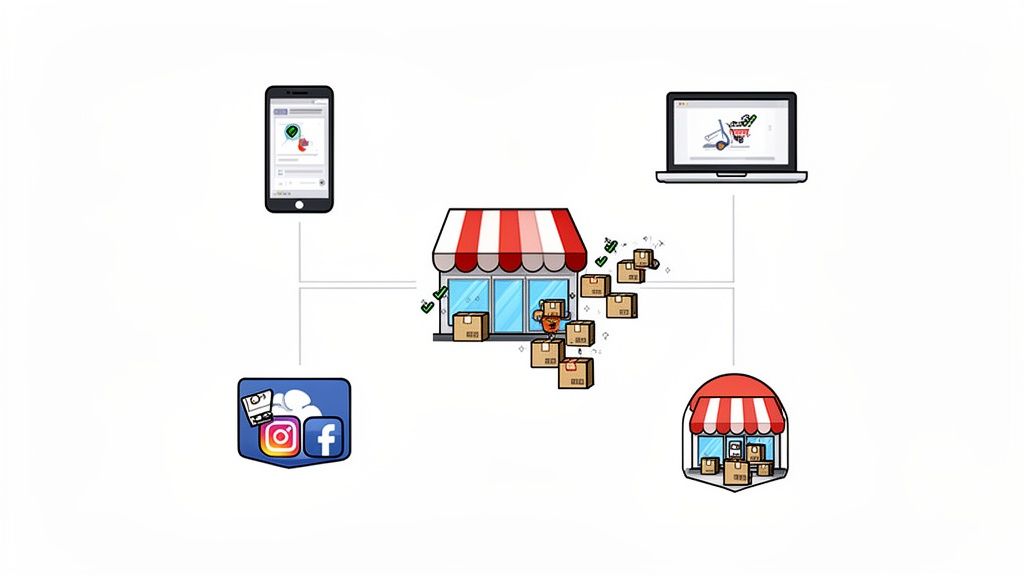
For Shopify brands, this means creating a cohesive ecosystem where inventory, customer data, and brand messaging are consistent everywhere. The goal is to meet customers wherever they are, providing a convenient and frictionless journey that strengthens brand loyalty and increases lifetime value.
Why It's a Key Growth Strategy
Adopting an omnichannel approach directly responds to modern consumer behavior. Customers expect convenience and consistency, and brands that deliver this interconnected experience see higher retention rates and average order values. By unifying channels, you gain a 360-degree view of your customer, enabling deeper personalization and more effective marketing campaigns that drive sustainable growth.
Key Insight: Omnichannel isn't just about being present on multiple channels; it's about making those channels work together intelligently. True omnichannel commerce ensures the customer's experience is continuous and cohesive, not fragmented and repetitive.
Actionable Omnichannel Tips
- Unify Your Point-of-Sale (POS): Use a system like Shopify POS that integrates your in-store and online sales, inventory, and customer data into a single back-end. This is the foundation of a true omnichannel setup.
- Sync Inventory in Real-Time: Prevent stockouts and customer frustration by ensuring inventory levels are automatically updated across all sales channels, including your website, social shops, and physical locations.
- Offer Flexible Fulfillment: Implement options like Buy Online, Pick-up In-Store (BOPIS), curbside pickup, and ship-from-store. These conveniences are a major competitive advantage and a hallmark of omnichannel retail.
- Create Unified Customer Profiles: Consolidate customer data from all touchpoints to understand their complete shopping history. This allows for powerful personalization, such as sending an email about a product they viewed in-store.
4. Strategic Email Marketing and Retention
Strategic email marketing is a cornerstone of effective e-commerce growth strategies, focusing on nurturing customer relationships and driving repeat purchases. It moves beyond simple newsletters to a sophisticated system of automated, personalized communications triggered by customer behavior. This includes welcome series for new subscribers, abandoned cart recovery flows, and post-purchase follow-ups designed to build loyalty.
By segmenting your audience based on purchase history, browsing behavior, and engagement levels, you can deliver highly relevant content that resonates with each customer. This approach transforms email from a broadcast channel into a powerful one-to-one conversation tool, dramatically increasing its effectiveness. Retention through email is vastly more cost-effective than acquisition, making it essential for sustainable profitability.
Why It's a Key Growth Strategy
Email marketing consistently delivers one of the highest returns on investment of any digital channel, often cited at over 40:1. It provides a direct line to your customers that you own, unlike social media or paid search where you are subject to algorithm changes and rising costs. A well-executed email strategy boosts Customer Lifetime Value (CLTV) by encouraging repeat business and turning one-time buyers into loyal brand advocates.
Key Insight: The most powerful email marketing isn't about selling; it's about building relationships. Use your data to provide value, personalization, and relevance in every message, turning your email list into a community, not just a contact database.
Actionable Email & Retention Tips
- Implement a 3-Email Welcome Series: Greet new subscribers immediately with an offer, follow up with brand storytelling, and then showcase your best-selling products to drive their first purchase.
- Automate Abandoned Cart Recovery: Set up a sequence that triggers within a few hours of abandonment. The first email should be a simple reminder, followed by messages that address potential concerns like shipping costs or offer a small incentive.
- Segment by Purchase History: Create segments for VIP customers, one-time buyers, and customers who haven't purchased in a while. Tailor your campaigns and offers specifically to re-engage each group.
- Focus on Relevance Over Frequency: Monitor your open, click, and unsubscribe rates closely. If engagement drops, it’s a sign to re-evaluate your content strategy or send frequency rather than just sending more emails.
5. SEO and Organic Traffic Growth
Search Engine Optimization (SEO) is the fundamental practice of improving your store's visibility in search engine results pages (SERPs) like Google. Unlike paid ads that stop when you stop paying, SEO builds a sustainable asset. It involves optimizing your site's technical structure, on-page content, and off-page authority to attract highly qualified organic traffic from users actively searching for products you sell. This is one of the most cost-effective e-commerce growth strategies for long-term, scalable success.
For e-commerce, this means going beyond a basic blog. Effective SEO involves deep keyword research for product and category pages, optimizing site architecture for easy crawling, and ensuring technical health, including fast page load speeds and mobile-friendliness. The goal is to rank for "buyer intent" keywords that signal a user is ready to make a purchase, driving valuable, conversion-ready traffic directly to your product pages.
Why It's a Key Growth Strategy
Organic traffic is highly valuable because it carries implicit trust; users often view organic results as more credible than paid ads. A strong SEO foundation creates a competitive moat that is difficult and time-consuming for rivals to replicate. As your rankings improve, you generate a consistent stream of "free" traffic, which lowers your blended customer acquisition cost (CAC) and increases the profitability of your entire marketing ecosystem.
Key Insight: Effective e-commerce SEO isn't just about ranking for keywords. It's about matching search intent with the right page type, from informational blog posts for top-of-funnel users to highly optimized collection and product pages for those ready to buy.
Actionable SEO Tips
- Target Buyer-Intent Keywords: Focus on keywords that include transactional terms like "buy," "price," or specific product model numbers. These searches indicate a high probability of a purchase.
- Optimize Product & Collection Pages: These are your money pages. Ensure they have unique, descriptive meta titles, descriptions, and on-page content that incorporates target keywords naturally. Use high-quality images with descriptive alt text.
- Improve Site Speed & Core Web Vitals: Site speed is a critical ranking factor and conversion lever. Use tools like Google PageSpeed Insights to diagnose issues and compress images, leverage browser caching, and minimize app code.
- Build a Smart Internal Linking Structure: Create a logical link flow from your homepage to category pages and then down to product pages. This helps distribute link equity (ranking power) throughout your site and improves user navigation.
For a deeper dive into making your Shopify store more visible, Ahrefs offers a comprehensive Shopify SEO guide that covers everything from the basics to advanced tactics.
6. Paid Advertising and Performance Marketing
Paid advertising, often called performance marketing, is a direct and scalable e-commerce growth strategy focused on acquiring customers through paid channels. Unlike organic methods that take time to build, platforms like Google Ads, Meta (Facebook/Instagram), and TikTok allow you to reach highly targeted audiences almost immediately, paying only for specific results like clicks or conversions. This makes it a powerful lever for rapid growth.
The core principle is to invest in advertising that generates a positive return. By meticulously tracking performance, segmenting audiences, and continuously testing ad creative, you can build a predictable engine for customer acquisition. Brands like Allbirds have leveraged Google Shopping to dominate search results, while countless Shopify stores use Meta's dynamic ads to scale quickly.
Why It's a Key Growth Strategy
Paid advertising provides unparalleled control and speed. You can turn traffic on and off like a tap, targeting users based on demographics, interests, and past behaviors. This allows you to test product-market fit, promote new launches, and scale revenue far faster than relying on organic channels alone. When optimized correctly, it delivers a measurable and profitable return on ad spend (ROAS).
Key Insight: Success in performance marketing isn't about having the biggest budget. It's about having the smartest strategy, built on rigorous testing, precise audience targeting, and a deep understanding of your unit economics to ensure every ad dollar drives profitable growth.
Actionable Paid Advertising Tips
- Start with Bottom-of-Funnel: Begin with Google Shopping and brand search ads to capture high-intent buyers who are already looking for your products. This often yields the highest initial ROAS.
- Segment Your Audiences: Go beyond broad targeting. Create specific audiences for new visitors, website visitors, cart abandoners, and past purchasers, tailoring your message and offer for each group.
- Test Creative Relentlessly: Continuously A/B test different ad images, videos, headlines, and calls-to-action. To enhance your visual content for paid campaigns, exploring resources like the list of the best TikTok editing apps can give your video ads a competitive edge.
- Implement Robust Tracking: Ensure your conversion tracking (like the Meta Pixel and Google Ads tag) is set up correctly to accurately attribute sales and optimize your campaigns based on real performance data.
7. Product Expansion and SKU Optimization
Strategic product expansion is an e-commerce growth strategy focused on increasing revenue by intelligently adding new products or variations. This isn't about random additions; it involves data-driven decisions to introduce items that appeal to your existing customers or attract new market segments. Paired with SKU (Stock Keeping Unit) optimization, it ensures your catalog is a finely tuned engine for profitability, not just a collection of goods.
This dual approach involves analyzing sales data, customer feedback, and market trends to decide what to add, promote, bundle, or discontinue. For example, a successful skincare brand like Glossier might expand from a core set of makeup into cleansers and serums, while a company like GoPro builds an entire ecosystem of profitable accessories around its main camera. The goal is to maximize revenue per customer and improve cash flow by stocking more winners.
Why It's a Key Growth Strategy
Smart product catalog management directly impacts both average order value (AOV) and customer lifetime value (LTV). By offering more relevant products, you give existing happy customers more reasons to return and spend more with each purchase. SKU optimization frees up capital tied in slow-moving inventory, allowing you to reinvest in high-performing products and marketing, creating a powerful cycle of profitable growth.
Key Insight: Your product catalog shouldn't be static. Treat it as a dynamic asset that is continuously refined based on profitability data, customer demand, and inventory performance. The most successful brands curate their offerings, they don't just accumulate them.
Actionable Product & SKU Tips
- Analyze Purchase Combinations: Use Shopify analytics to see which products are frequently bought together. This is a goldmine for creating strategic product bundles that increase AOV.
- Survey Your Best Customers: Ask your loyal customers what other products they wish you sold. This direct feedback can guide your product development and reduce the risk of a failed launch.
- Monitor Inventory Turnover: Identify your slow-moving SKUs. These products tie up cash and warehouse space. Consider discontinuing them or running a clearance sale to liquidate stock.
- Test with Product Variations: Before committing to entirely new product lines, test the waters with new colors, sizes, or seasonal variations of your existing best-sellers to gauge customer interest with lower risk.
For a comprehensive look at leveraging your data to make these decisions, review how Shopify Analytics can reveal which products are driving the most profit for your store.
8. Community Building and Brand Loyalty Programs
Building a community is one of the most durable e-commerce growth strategies because it transforms transactional customer relationships into emotional connections. Rather than constantly paying to acquire new customers, this strategy focuses on nurturing existing ones through loyalty programs, exclusive content, and shared experiences. This creates a powerful, self-sustaining ecosystem of brand advocates.
An engaged community provides invaluable feedback, generates authentic user-generated content (UGC), and fosters a sense of belonging that competitors can't easily replicate. By rewarding repeat purchases and encouraging interaction, you shift focus from short-term sales to long-term customer lifetime value (LTV), creating a stable foundation for scalable growth.
Why It's a Key Growth Strategy
In a crowded market, brand loyalty is the ultimate competitive advantage. A strong community and an effective loyalty program reduce customer churn and lower customer acquisition costs (CAC) as happy members become your most effective marketers through word-of-mouth and referrals. This creates a positive feedback loop where loyalty drives growth, which in turn allows for greater investment in the community.
Key Insight: Community isn't just a marketing channel; it's a strategic asset. While advertising buys attention, an authentic community earns trust and advocacy, creating a moat around your business that is incredibly difficult for others to cross.
Actionable Community & Loyalty Tips
- Launch a Tiered Loyalty Program: Start with a simple points-for-purchase system and add VIP tiers with escalating rewards. This gamifies purchasing and gives your best customers a status to strive for, like Sephora’s renowned Beauty Insider program.
- Create an Exclusive Hub: Use platforms like Circle, Discord, or a private Facebook Group to create a dedicated space for your most engaged customers to connect with each other and your brand.
- Incentivize Referrals: Empower your loyal customers to become brand ambassadors by implementing a referral program that rewards both the referrer and the new customer.
- Host Member-Only Events: Offer exclusive access to sales, new product launches, or digital events. This reinforces the value of being part of the community and makes members feel like insiders.
For a comprehensive look at building a program that keeps customers coming back, review our guide on designing a successful customer loyalty strategy.
9. Marketing Automation and Customer Journey Mapping
Marketing automation is a technology-driven strategy that allows e-commerce brands to streamline, automate, and measure marketing tasks and workflows. Instead of manually sending every email or social media post, automation tools execute these actions based on predefined triggers and schedules. This is most effective when paired with customer journey mapping, the process of visualizing every touchpoint a customer has with your brand, from initial awareness to post-purchase advocacy.
By understanding the customer journey, you can identify key moments to deliver personalized, timely messages automatically. For example, a shopper abandoning their cart can trigger an email sequence, or a first-time buyer can receive a welcome series with product tips. This combination of insight and technology enables you to nurture leads and customers at scale, creating a more cohesive and responsive brand experience.
Why It's a Key Growth Strategy
This approach is one of the most scalable e commerce growth strategies because it creates a system that works for you 24/7. It boosts efficiency by reducing manual labor and minimizes human error, freeing up your team to focus on higher-level strategy. More importantly, it enhances the customer experience by delivering relevant content at the exact moment it's most impactful, which directly improves engagement, conversion rates, and lifetime value.
Key Insight: Effective marketing automation isn't about sending more messages; it's about sending the right message to the right person at the right time. The customer journey map provides the "why" and "when," while automation provides the "how."
Actionable Marketing Automation Tips
- Map Before You Automate: Always begin by outlining the customer journey. Identify key stages, pain points, and opportunities before building any workflows in a tool like Klaviyo or ActiveCampaign.
- Start with a High-Value Workflow: Don't try to automate everything at once. Focus on a single, high-impact sequence first, such as an abandoned cart series or a new subscriber welcome flow.
- Use Behavioral Triggers: Move beyond simple time-based emails. Trigger automations based on user actions like viewing a specific product category, making a second purchase, or clicking a link in a previous campaign.
- Segment Your Audience: Use the data you collect to create dynamic segments. This allows you to send highly targeted messages that resonate far better than generic "email blasts."
To learn more about implementing these systems, HubSpot offers extensive resources on creating automated email workflows that can help you get started.
10. Data Analytics, Attribution, and Performance Measurement
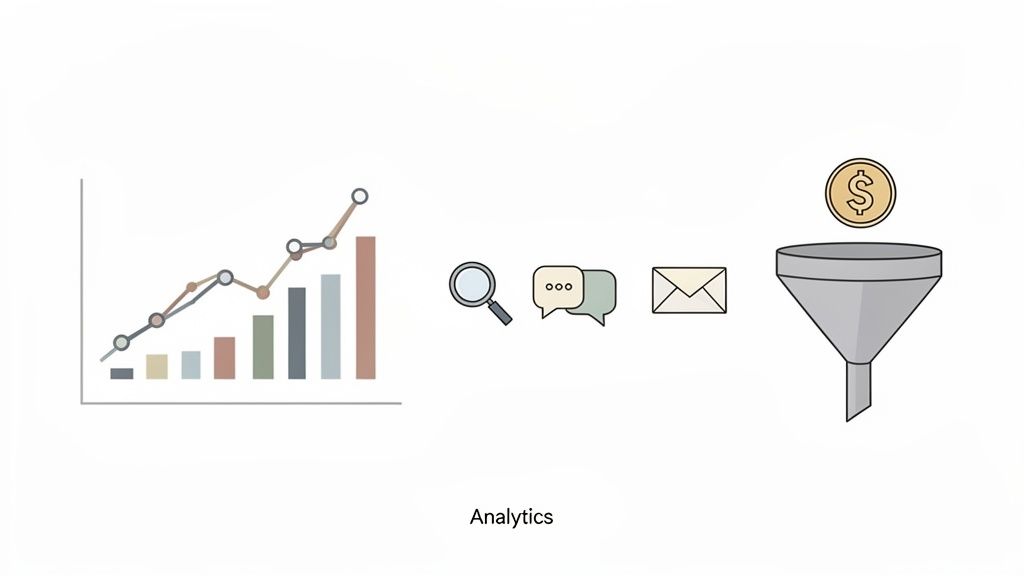
One of the most critical e-commerce growth strategies is shifting from assumption-based decisions to data-driven ones. This involves leveraging sophisticated analytics to deeply understand customer behavior, channel performance, and true return on investment. By implementing proper performance measurement and attribution modeling, you can see exactly which marketing touchpoints lead to conversions, allowing you to allocate your budget with precision and confidence.
This strategy moves beyond surface-level metrics like traffic and revenue. It's about building a robust data infrastructure with real-time dashboards and reporting that enables quick, informed optimization decisions. Instead of guessing what works, you know what works, ensuring every growth initiative is measurable and continuously improved based on actual performance data.
Why It's a Key Growth Strategy
In a competitive market, capital efficiency is paramount. Data analytics and attribution directly impact your profitability by preventing wasted ad spend on underperforming channels and doubling down on what truly drives sales. Brands that master this can lower their customer acquisition cost (CAC) while increasing lifetime value (LTV), creating a powerful and sustainable engine for growth.
Key Insight: Growth isn't just about spending more; it's about spending smarter. Accurate attribution and analytics provide the roadmap to invest your marketing dollars where they will generate the highest possible return, turning your data into a significant competitive advantage.
Actionable Analytics Tips
- Implement Google Analytics 4: Ensure GA4 is set up correctly with e-commerce tracking to analyze the entire customer journey, from first touch to final purchase and beyond.
- Track UTM Parameters Religiously: Use consistent UTM parameters across all marketing campaigns. This is fundamental for attributing sales back to the correct source, medium, and campaign.
- Calculate CAC and LTV Per Channel: Move beyond blended metrics. Understand the cost to acquire a customer and their long-term value for each specific channel (e.g., Facebook Ads, Google Ads, email).
- Use Cohort Analysis: Group customers by their sign-up or first purchase date to analyze their behavior over time. This is invaluable for understanding retention rates and the long-term impact of your efforts.
To equip your store with the right tools for the job, check out our guide to the top e-commerce analytics tools and start making smarter decisions today.
10-Point E-commerce Growth Strategy Comparison
Turning Strategy Into Sustainable Growth
The journey from a promising online store to a dominant eCommerce brand is paved with strategic decisions and relentless optimization. We've explored a comprehensive suite of high-impact e commerce growth strategies, from fine-tuning your conversion rate and personalizing every touchpoint to scaling your organic reach through SEO and building an unshakeable community. The path forward isn't about implementing all ten strategies at once; it's about building a sustainable growth engine where each component reinforces the others.
True growth is systematic, not sporadic. It's the result of a culture of continuous improvement fueled by data, creativity, and a deep understanding of your customer. The most successful brands treat their online store not as a static entity, but as a living system that is constantly evolving to meet and exceed customer expectations.
From Knowledge to Momentum: Your Action Plan
Information is only powerful when acted upon. To transform this list of strategies into tangible results, you need a clear, prioritized plan. Avoid the temptation to chase every shiny object or overhaul your entire operation overnight. Sustainable growth is built one focused initiative at a time.
Here is a practical framework to get started:
- Conduct a Growth Audit: Begin by identifying your single biggest bottleneck. Is it traffic acquisition? On-site conversion? Customer retention? Use analytics tools like Google Analytics, your Shopify dashboard, and heat-mapping software to pinpoint the area where improvement will have the most significant ripple effect across your business.
- Prioritize with an ICE Score: For each potential initiative, evaluate it based on Impact (How much will this move the needle?), Confidence (How sure are we this will work?), and Ease (How many resources will this take?). This simple scoring model helps you focus on high-impact, low-effort "quick wins" first to build momentum.
- Create a 90-Day Roadmap: Don't plan for a full year. The digital landscape changes too quickly. Instead, create a focused 90-day roadmap with specific, measurable goals (KPIs) for your chosen strategy. For example, if you choose CRO, your goal might be "Increase add-to-cart rate by 15% in Q3."
- Execute, Measure, Iterate: Launch your initiative, but don't "set it and forget it." Meticulously track your predefined KPIs. Use the data you gather to inform your next move, whether it's doubling down on what works, pivoting your approach, or moving on to the next priority on your list.
This iterative cycle of auditing, prioritizing, and executing is the fundamental rhythm of all successful e commerce growth strategies. It transforms your business from being reactive to proactive, allowing you to build a powerful flywheel where improved customer acquisition feeds into better retention, which in turn fuels higher lifetime value and new customer referrals.
The Flywheel Effect: Building Your Unstoppable Brand
Think of each strategy we've discussed, from SEO and paid ads to email marketing and community building, as a push on a giant flywheel. The first few pushes are difficult and require immense effort for very little movement. But as you continue to apply consistent, targeted force, the wheel begins to spin faster and faster.
Eventually, the flywheel's own momentum starts to do the work for you. Your strong brand community advocates for you, your high organic rankings bring in consistent free traffic, and your optimized retention funnels turn one-time buyers into lifelong fans with minimal ongoing effort. This is the ultimate goal: to build a self-perpetuating system of sustainable growth that isn't dependent on any single channel or tactic. The strategies in this guide are your playbook for building that very machine.
Ready to turn these strategies into a powerful, integrated growth engine for your brand? The team at ECORN combines expert Shopify development with data-driven CRO and design to build scalable eCommerce solutions that drive real results. Learn how our flexible subscription model can help you implement these advanced e commerce growth strategies and accelerate your journey to the next level at ECORN.


Shopify Mobile Optimization: The 2026 Playbook
How to Add Subcategory in Shopify for Better UX
How to Implement Structured Data for Ecommerce in 2026
SEO App Mobile: Shopify Store Optimization Guide
Shopify Plus Support: What It Includes and How to Choose
Google Ads for Shopify: The Complete 2026 Playbook

Shopify New York: How to Find and Hire the Right Agency
Google Search Console for Shopify: The Complete Setup
First Party Data Collection for eCommerce Growth
FAQ Online Store Guide: Build and Measure It Right
Do FB Ads Work for eCommerce in 2026?
One Page Checkout for Shopify: Design and Implementation
Shopify GraphQL vs REST: The 2026 Developer Decision
Shopify Ecommerce Consulting: Strategy, Pricing &
Are Reddit Ads Worth It for eCommerce Brands
Shopify Title and Meta Description: A Practical 2026 Guide

Product Video Best Practices for Shopify Brands
Real-Time Inventory Management: A 2026 Guide
AI Chatbot Integration for Shopify Stores
Affiliate Program Management: A Shopify Guide
10 Best Performance Monitoring Tools for Shopify in 2026
Digital Asset Management for eCommerce Brands in 2026
Every Type of Facebook Ads Explained for eCommerce Growth
Product Information Management Explained for Shopify Brands
Support Ticket System: A Guide for Shopify Stores

10 Best Customer Service Tools for Shopify in 2026

Can I Start a Business with No Money? a 2026 Blueprint

What Sells Good on Etsy: Best Niches for 2026

Shopify Add to Cart Button: A Practical 2026 Guide

Customer Feedback Automation: A Practical eCommerce Guide
Critical Rendering Path: A Guide for Shopify Stores

How to Promote on TikTok for eCommerce in 2026

B2B eCommerce Consulting That Drives Real Revenue
10 Best Practices for Site Navigation in 2026
Return vs Refund for Shopify Stores: A Practical Guide
What Is Customer Lifetime Value and Why It Matters
What Is Voice of Customer Research for eCommerce

SMS Marketing for Ecommerce That Actually Converts

Master How to Improve Email Deliverability in 2026

Top 7 eCommerce Partners NYC for Shopify Brands in 2026
Machine Learning for Ecommerce: Boost Your Shopify Store

Beauty Market Research: Your 2026 Growth Guide

Shopify International Expansion: A 2026 Roadmap
What Does CRO Stand for in Business: Understanding CRO

Shopify Visual Merchandising: A Playbook for Higher Sales

Shopify Landing Page Design: Master Conversion in 2026
10 Best AI SEO Optimization Tools for Shopify in 2026

Agentic AI for Ecommerce: Boost Your Sales in 2026
Mastering Email Marketing Data for eCommerce Growth
Conversion Rate Optimisation Australia: Boost Your Sales
Conversion Rate Optimization AI: Your Shopify Store Guide

10 Product Bundling Strategies for Shopify in 2026
How to Increase Customer Lifetime Value: A Shopify Playbook
AI Customer Service Automation: Shopify Guide 2026
Clean Website Design: A Shopify Conversion Playbook

Omnichannel Retail Strategy: A Shopify Playbook
Product Data Enrichment: A Guide for Shopify Brands
Instagram Shopping Features a Guide for Shopify Stores
What Is Revenue Optimization: A Holistic RevOps Guide
Benefits of Conversion Rate Optimization: Boost Your
WordPress to Shopify Migration: Your 2026 Seamless Switch
Boost Sales: Ecommerce Payment Processing Guide 2026
Unified Commerce Platform: Benefits, KPIs & Shopify Guide
How to Reduce Bounce Rate eCommerce: Your 2026 Guide
Shopify API Integration: A Practical End-to-End Guide
How to Implement Data Governance: A 2026 Guide
Shopify Store Development Cost: A 2026 Breakdown
What Is Server Side Tracking: The Shopify Guide 2026
Marketing Automation Workflows: A Shopify Guide for 2026
Shopify: How to Reduce Technical Debt

Shopify UX Design Change: A Playbook for Growth
User Generated Content Strategy: Shopify Playbook
Shopify Pause and Build Plan Cost: A Complete 2026 Guide
Compare at Price on Shopify: A Complete Guide for 2026
Where Can I Sell My Prints? 10 Best Platforms for 2026
Shopify Order Management System: The Ultimate Guide 2026
What Is Marketing Attribution? an eCommerce Guide for 2026
10 Best Black Friday Sales Sheets for 2026

Discover the Top Social Media Marketing Agencies For
Consumer Confidence Definition for eCommerce in 2026
What Is Social Commerce? Your 2026 Guide to Boosting Sales
A Social Ad Campaign Playbook for eCommerce Growth
7 Best FAQ Page Examples for SaaS & eCommerce

Market Research in Fashion Industry: A Guide for Shopify
Shopify Migration Services: Expert Guide for 2026
Mastering FB Retargeting Ads for Shopify in 2026
What Is Omnichannel Ecommerce

Master Your Shopify Plus Migration: The 2026 Guide
Shopify Integration Services: A Merchant's 2026 Guide
Shopify Collection Description: A Guide to SEO & Sales
Shopify Plus Contact: Reach Sales & Support Effectively

Top Luxury Shopify Stores: Design & UX Strategies
How to Improve Customer Experience: A Shopify Roadmap

Creative Facebook Ads: 10 Examples for Shopify Brands

Remarketing with Facebook Ads: A Shopify Guide for 2026

SEO Linking Strategies for Shopify Stores
Top 7 Statistics YouTube Channels for eCommerce in 2026

Hiring Shopify Plus Designers: A Founder's Guide

Shopify Product Variation: Master Your Variants for 2026
Leverage Ai Solutions Brands: Your 2026 Shopify Growth Guide


newsletter in your inbox