

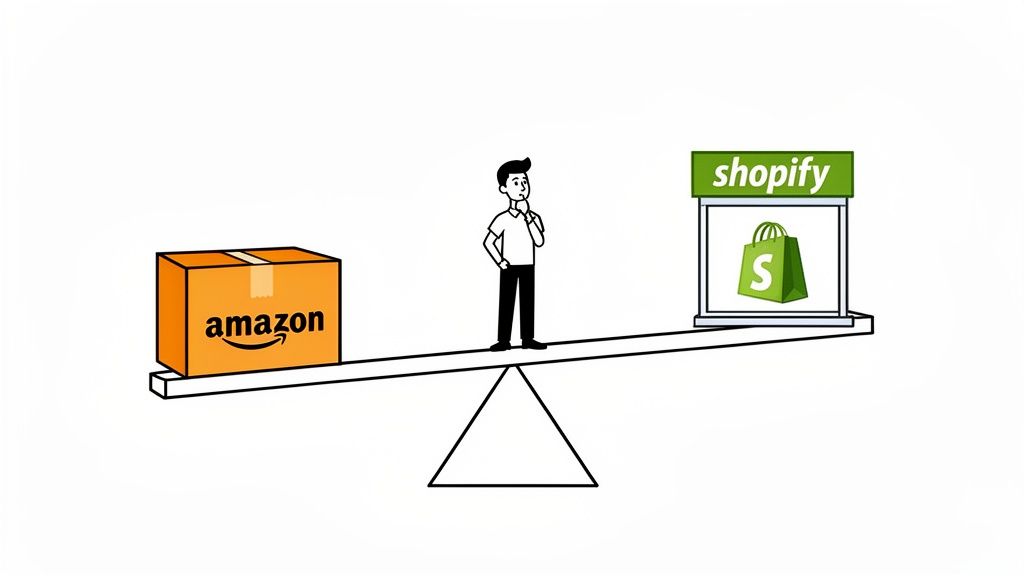
Think of it this way: Amazon is like renting a stall in a massive, bustling digital mall. You get instant access to a flood of shoppers, but you're playing by the mall's rules. Shopify, on the other hand, is the toolkit to build and own your digital property from the ground up. You're the landlord, but you're also responsible for getting every single person to walk through your door.
Your choice here isn't just about software; it's about your entire business model. Do you prioritize immediate reach or long-term brand ownership? That's the core question.
Choosing Your eCommerce Path: Amazon vs. Shopify
Deciding between Amazon and Shopify is one of the first—and most critical—strategic choices you'll make. This isn't just about picking a platform; it’s about choosing how you want to build your business. Amazon is a massive marketplace where you're one of thousands of sellers competing for the attention of millions of buyers who are already there, credit card in hand. Shopify gives you the software to build a standalone, independent online store that is completely your own.
This one distinction creates a ripple effect that touches every part of your business, from how you build your brand and talk to customers to your cost structure and marketing playbook.
- Marketplace vs. Storefront: With Amazon, you are essentially a third-party seller operating within its walled garden. With Shopify, you are the owner and operator of your own eCommerce website.
- Audience Access: Amazon comes with a massive, built-in audience of high-intent shoppers ready to buy. With Shopify, you have to generate all your own traffic through SEO, paid ads, social media, and other marketing efforts.
- Brand Control: Shopify gives you total control over your store’s design, the customer journey, and your overall brand story. Amazon offers very limited branding options, forcing you to fit into its standardized listing format.
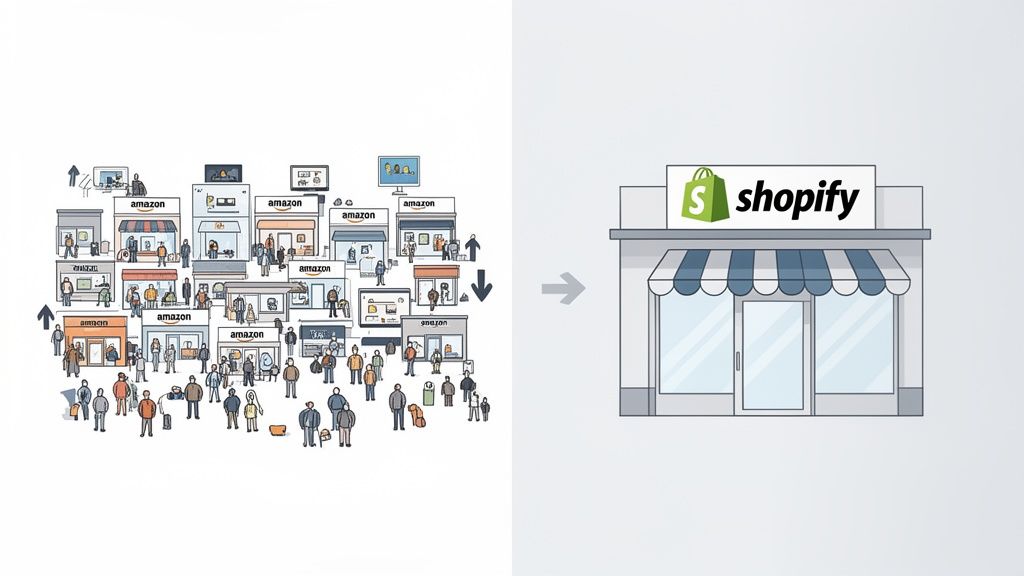
As you weigh your options, it's worth digging into the specific business models each platform enables. For example, exploring an opportunity like Print on Demand on Amazon can give you a real feel for the kind of ventures that thrive in its ecosystem.
Amazon vs. Shopify At a Glance
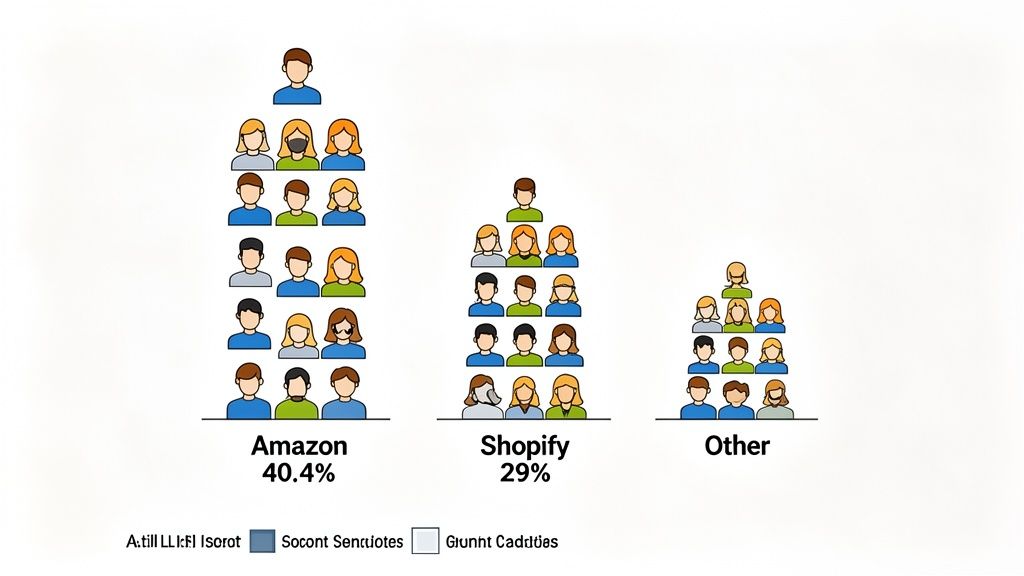
Let's break down the core differences between these two eCommerce giants. It's a classic battle of a marketplace versus a platform, and the numbers show just how dominant both are. Amazon currently captures an astounding 40.4% of all US retail eCommerce sales. Meanwhile, Shopify holds 29% of the eCommerce platform market, and its merchants collectively make up over 12% of online retail sales. They represent fundamentally different ways to do business online.
Here's a quick side-by-side look at what that means for you.
Ultimately, one isn't definitively "better" than the other—they just serve different strategic goals. Understanding this core difference is the first step toward choosing the right path for your brand's growth.
Comparing Market Dominance and Scale
Before we dive into the nitty-gritty, let’s talk about scale. Understanding just how big Amazon and Shopify are isn’t just about impressive numbers; it shapes your entire growth strategy. The market position of each platform dictates your customer access, the competition you’ll face, and the fundamental way you have to approach selling.
Ultimately, you’re choosing between tapping into a pre-built highway of shoppers or building your own destination. Amazon is the established ocean—vast, full of life, but also crowded and unpredictable. Shopify gives you the tools to create your own rivers and streams that flow into it, giving you total control over the journey.
Amazon: The Undisputed Market Leader
When it comes to pure eCommerce dominance, Amazon is in a league of its own. It’s more than a platform; for millions, it's a deeply ingrained consumer habit. That scale is both a massive opportunity and a serious challenge.
Amazon is the undisputed heavyweight champion, commanding a staggering 40.4% of all U.S. retail eCommerce sales as of 2025. This isn't just market share; it's a colossal infrastructure built on over 310 million active users who are logged in and ready to buy. With 4.79 billion monthly visits, its digital footprint creates a built-in traffic advantage that’s almost impossible to replicate on your own. You can discover more insights about the largest eCommerce market shares and what they mean for sellers.
What does this mean for you? Unparalleled access to a high-intent audience from day one. You don't have to spend months building SEO authority or mastering paid ads to get your products in front of people actively searching for them.
For a new brand, Amazon's scale is a double-edged sword. It offers immediate visibility and access to an enormous customer base, but you are a small fish in an ocean teeming with predators. Success requires mastering Amazon's internal ecosystem, not just listing a product.
But that immense scale also fuels cutthroat competition. You’re not just up against other small brands. You’re often fighting for the Buy Box against Amazon's own private-label products and massive global sellers on the very same listing. Your ability to stand out is constrained by Amazon's standardized format, making price and reviews the primary battlegrounds.
Shopify: The Powerhouse for Independent Brands
While Amazon owns the marketplace model, Shopify has cemented itself as the go-to platform for direct-to-consumer (DTC) brands building their own empires. It’s a fundamentally different philosophy—one centered on brand ownership and direct customer relationships.
Shopify’s scale isn’t measured by a single marketplace's traffic but by the collective power of the millions of independent businesses it enables. The platform holds an impressive 29% of the entire eCommerce software market in the United States, making it the backbone for a huge slice of online retail.
This collective strength creates a powerful ecosystem with some clear advantages:
- A Robust App Marketplace: With over 8,000 apps, you can add almost any feature you can dream up, from advanced email marketing to sophisticated subscription models.
- A Network of Experts: A huge community of developers, designers, and marketers specialize in Shopify, offering a deep well of resources for brands at every stage.
- Integrated Solutions: Services like Shopify Payments and Shopify Shipping are baked right in, simplifying operations for merchants.
Shopify’s growth mirrors the larger trend of brand-first commerce. Instead of battling for visibility inside a crowded third-party ecosystem, businesses are choosing to build their own destinations. Sure, this approach demands more upfront work in marketing and traffic generation, but the long-term rewards—customer loyalty, higher margins, and complete control—are often well worth it. The real question isn’t about which is bigger, but which type of scale truly fits your business goals.
Strategies for Customer Acquisition and Traffic
How you get customers in the door is probably the biggest difference in the whole Amazon vs Shopify debate. It really boils down to this: one platform gives you a built-in audience but takes your control, while the other gives you total control but forces you to build that audience from scratch.
This isn't just a simple marketing choice. It's a core business model decision that dictates where you're going to spend your time, money, and energy. On Amazon, you’re playing an internal game, fighting for visibility inside a massive, walled garden. With Shopify, you’re out in the wild, competing for attention across the entire internet.
Let's unpack what each path actually looks like.
Capturing Demand on Amazon
Success on Amazon isn't about driving traffic to the platform; it’s about mastering the art of getting found by the millions of shoppers already there, credit card in hand. Your entire strategy orbits around Amazon's internal search engine, the A9 algorithm.
Think of it like Google, but purely for products. The listings that show up first, win. That means your focus has to be razor-sharp on a few key areas:
- Product Listing Optimization: This is your Amazon SEO. It starts with deep keyword research to figure out exactly what terms your customers are typing into the search bar. Then, you have to skillfully weave those keywords into your product titles, bullet points, and backend search terms.
- Winning the Buy Box: This is non-negotiable. A staggering 80% of all Amazon sales happen through the "Buy Box." To win it, you need a combination of competitive pricing, stellar seller metrics, and using Fulfillment by Amazon (FBA).
- Amazon PPC (Sponsored Products): Paid ads are essential. They’re how you get your product to the top of the search results right away, giving you a shot at generating those crucial first sales and reviews.
The huge advantage here is the immediate access to high-intent buyers. People don’t go to Amazon to browse aimlessly; they go to buy something specific. You're tapping directly into that transactional mindset from day one.
The core trade-off on Amazon is exchanging customer ownership for immediate traffic. You gain access to a massive, ready-to-buy audience, but Amazon owns the customer relationship and all the valuable data that comes with it.
This model is a powerhouse for validating a new product or for brands that are brilliant at operations and competitive analysis. But the brutal competition and zero direct communication with customers make building any real, long-term brand equity a serious uphill battle.
Building an Audience with Shopify
Over on the Shopify side, the playbook is the complete opposite. You start day one with a beautiful, functional store... and zero visitors. Your job is to build sustainable traffic channels from the ground up, which is a long-term investment in your brand’s future.
This approach means you have to become more than just a seller. You’re a publisher, an advertiser, and a community builder all rolled into one. It requires developing real expertise across a few marketing disciplines.
Key Traffic-Building Disciplines for Shopify
- Search Engine Optimization (SEO): This is about optimizing your entire website—from product pages to blog posts—to show up on search engines like Google. It’s a slow burn, but it’s how you build a steady stream of "free," high-quality organic traffic over time.
- Content Marketing: This means creating genuinely useful content like guides, videos, or articles that attract and educate your target audience. It's how you build trust and authority, turning casual visitors into repeat buyers.
- Paid Advertising: Using platforms like Google Ads and social media ads (Facebook, Instagram, TikTok) lets you get in front of specific demographics and interests to drive immediate, scalable traffic directly to your store.
- Email and SMS Marketing: Building an email list is one of the most valuable assets you can have. It gives you a direct, owned communication channel to nurture leads, announce sales, and drive repeat purchases without paying an algorithm for access.
This multi-channel approach is definitely more complex and often more expensive upfront than just listing a product on Amazon. But the payoff is huge: you own the customer relationship, period. You can retarget them, build loyalty programs, and actually maximize their lifetime value.
For those looking to get the best of both worlds, our guide on how to connect Shopify to Amazon offers a practical playbook for an omnichannel strategy.
Ultimately, you can think of it this way: Amazon is a sprint for sales, while Shopify is a marathon for building a durable brand.
Building Your Brand and Customer Experience
Beyond the traffic and the fees, we get to the real heart of the Amazon vs. Shopify debate: brand building. This is the fundamental fork in the road. One path prioritizes transactional efficiency above all else, while the other is purpose-built for creating a unique brand story and fostering deep customer relationships.
Your choice here dictates how customers see you—and whether they become a one-time buyer or a loyal advocate for life. Amazon is about getting the sale, fast. Shopify is about building an entire world around your products that keeps people coming back for more.
Branding Within Amazon's Walls
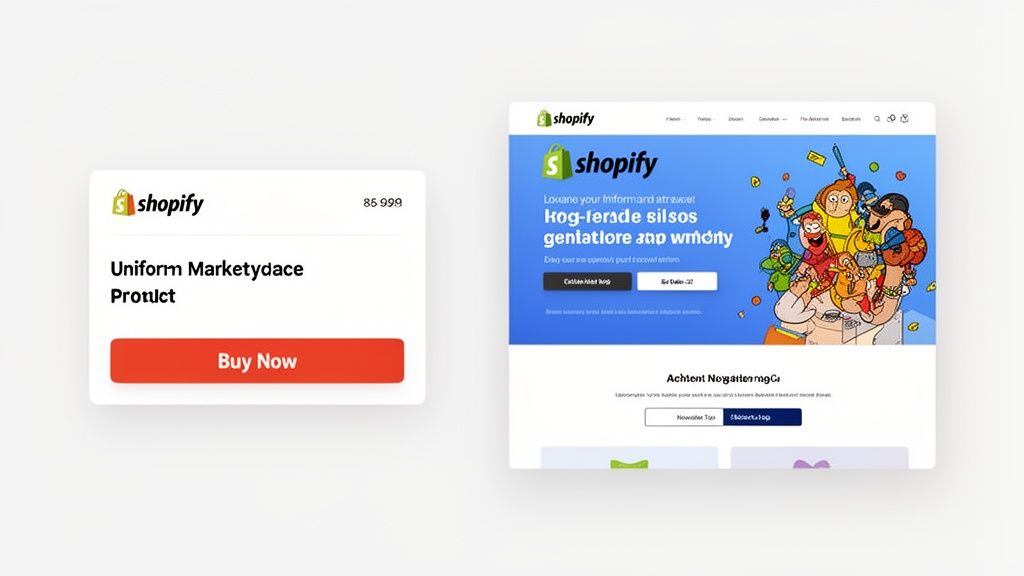
Let's be clear: on Amazon, you’re a tenant in their massive digital mall. You have to play by their rules and operate within their strict architectural guidelines. The customer experience is intentionally uniform because it's designed to optimize for Amazon’s conversion machine, not your brand identity. Every single product page looks and feels like an Amazon page, reinforcing their brand, not yours.
This rigid standardization is a double-edged sword. For the customer, it creates a trusted, familiar, and ridiculously frictionless buying process. For you, it severely limits your ability to tell a compelling brand story. Your main creative outlets are:
- A+ Content: This feature lets you add enhanced images and text to your product description section, offering a richer visual narrative than a simple block of text. It's your best shot at making the product detail page feel a bit more like yours.
- Amazon Brand Stores: Think of this as a dedicated "storefront" within Amazon. It's a multi-page destination where you can showcase your brand story and full product catalog away from the direct glare of competitors on a search results page.
But even with these tools, your brand is always playing second fiddle to the Amazon user interface. You can't touch the layout, the fonts, or the checkout process. Most importantly, the customer belongs to Amazon. Your ability to build a direct relationship is almost zero.
Architecting Your Brand Universe on Shopify
Shopify, in sharp contrast, hands you a completely blank canvas. From the second a visitor hits your homepage to the final "thank you" page after checkout, you have 100% control over the entire customer journey. This is where brands that live and breathe narrative, community, and experience truly shine.
Shopify isn't just a storefront; it's the foundation for building a unique digital world. Smart brands use this freedom to create a powerful competitive moat that has nothing to do with product features or price.
Shopify is purpose-built for brands that see the customer experience as their primary product. It’s for founders who understand that loyalty isn't just earned at checkout—it's built through every interaction, from the design of a landing page to the tone of a confirmation email.
You have total command over every element, allowing you to craft a cohesive and memorable brand that people connect with on an emotional level.
Key Tools for a Unique Shopify Experience
- Custom Themes: You can pick from thousands of free and premium themes in the theme store or hire a developer to build a completely custom design from scratch that perfectly captures your brand's aesthetic.
- App Integrations: The Shopify App Store, with over 8,000 apps, is a game-changer. It lets you bolt on specialized features like loyalty programs, subscription boxes, personalized quizzes, and advanced review systems to create a deeply engaging experience.
- Headless Commerce: For ultimate flexibility, ambitious brands can use Shopify as a powerhouse backend while building a completely custom front-end experience using modern web technologies. This approach allows for unparalleled creativity and performance.
Ultimately, the choice is a strategic one. Amazon gives you a standardized, high-trust environment perfect for quick transactions. Shopify gives you the tools to build a distinct brand identity that can command higher margins and cultivate lifetime customer value. It all comes down to whether you're playing for the quick sale or building a brand that lasts.
A Realistic Breakdown of Costs and Profitability
Let's get real about the money. A true comparison of Amazon versus Shopify goes way beyond the sticker price of a subscription. To understand which one is right for you, you have to dig into where every single dollar goes. The real costs are a complex mix of variable fees, marketing spend, and operational hits that directly shape your bottom line.
On Amazon, your costs are almost entirely variable, tied directly to each sale. With Shopify, you start with more predictable fixed costs, but then you're on the hook for finding—and funding—your own customers. Let’s break down the actual financial picture for both.
The True Cost of Selling on Amazon
Amazon's pricing is a classic "pay-to-play" model, but it’s loaded with layers that can quickly slice up your margins if you're not paying close attention. Your profitability is chained to a long list of fees that grow right alongside your sales.
Here are the primary costs you'll run into:
- Seller Plan: You'll start with either the Individual plan ($0.99 per item sold) or, more realistically for a growing business, the Professional plan at $39.99 per month.
- Referral Fees: This is Amazon’s cut of every sale. It’s typically between 8% and 15% of the total price, depending on your product category.
- Fulfillment by Amazon (FBA) Fees: If you use FBA (and most serious sellers do), you're paying for picking, packing, shipping, and monthly inventory storage. These fees are all based on your product's size and weight.
- Advertising Spend: Let's be honest, organic visibility is a unicorn on Amazon. Running Sponsored Products campaigns is pretty much mandatory, making it a major variable cost you absolutely have to budget for.
The Amazon model gives you customers upfront but makes you pay for that access on the back end of every single transaction. Your profit isn't what's left after your cost of goods; it's what's left after Amazon takes its hefty slice from every sale.
Unpacking Shopify's Financial Model
Shopify seems more straightforward with its fixed monthly subscriptions, but that’s just the cover charge. That platform fee doesn't include the single biggest expense for any new Shopify store: customer acquisition.
Here’s where your money is really going:
- Monthly Subscription: You've got your Basic, Shopify, and Advanced plans with clear monthly rates. This is your most predictable cost, no surprises here.
- Payment Processing Fees: Using Shopify Payments, you’ll pay a standard rate like 2.9% + 30¢ for each transaction on the Basic plan. Beyond Shopify's own offering, understanding the landscape of payment solutions is critical. You might even consult with payments experts to find the most cost-effective setup for your business.
- App and Theme Costs: Sure, there are free options. But scaling brands almost always invest in premium themes and paid apps for crucial functionality. These can easily add up to hundreds of dollars a month.
- Marketing and Advertising Budget: This is the big one. It's the most significant and unpredictable "hidden cost." You are responsible for 100% of your traffic generation, whether that’s through SEO, content, or paid ads on Google and Meta.
Modeling Profitability: A Side-by-Side Look
To make this crystal clear, let's run the numbers on a hypothetical $50 product sold on both platforms. This is a simplified model, but it really highlights how the different fee structures impact what you actually take home.
Hypothetical Profitability on a $50 Product
At first glance, Shopify looks like the clear winner on a per-sale basis. But hold on—this table is missing a crucial piece of the puzzle: the customer acquisition cost. That Shopify sale didn't just happen. It might have cost you $10, $20, or even more in ads to get that customer to your store. To see how this plays out with your own numbers, check out our guide on using an eCommerce profit calculator to model your specific scenarios.
Ultimately, the Amazon vs. Shopify cost debate boils down to a fundamental business choice: do you pay a commission for instant access to a massive market, or do you pay to build your own audience from the ground up?
Making the Right Choice for Your Business
The whole Amazon vs. Shopify debate doesn't have a universal winner. The right platform is simply the one that clicks with your specific business model, your resources, and where you want to be in a few years. While you can always switch later, getting it right from the jump saves a massive amount of time and money.
Instead of some generic recommendation, let's walk through a few real-world scenarios. We'll break down exactly when each platform is the clear winner, from testing your first product idea all the way to scaling for market dominance.
When Amazon Is Your Best Bet
Amazon is the undisputed champion for getting to market fast and tapping into a colossal audience that's already primed to buy. It's the perfect choice when your main goal is to generate sales and prove your concept, and building a standalone brand can wait.
You should seriously lean toward Amazon if you find yourself nodding along to these situations:
- You're testing a new product with a tight marketing budget. Amazon lets you plug directly into its river of traffic without needing a big upfront investment in ads or content creation. Think of it as the ultimate product validation engine.
- Your product is a high-demand commodity. If you're selling a popular item where brand loyalty is low and price is king, using Amazon's built-in audience and the lightning-fast shipping of FBA is a massive leg up.
- You want operational simplicity above all else. For founders who'd rather focus on sourcing and inventory management, outsourcing the headaches of shipping, returns, and customer service to FBA is an almost unbeatable deal.
For new founders, Amazon answers the most critical question first: "Will people actually buy my product?" It's a lower-risk environment for testing the waters before committing to the heavier lift of building a standalone brand.
When Shopify Is the Clear Choice
Shopify is the foundation for building a brand that lasts. It's an investment in an asset you own completely—your brand identity, your website, and, most critically, your customer relationships and data.
Shopify is definitely the right move for your business in these cases:
- You're a DTC brand built on community and storytelling. If your product's value is deeply tied to your brand's narrative and mission, you need the total creative control Shopify offers to tell that story right.
- Your entire strategy hinges on maximizing customer lifetime value (LTV). By owning all your customer data, you can build sophisticated email funnels, loyalty programs, and remarketing campaigns that turn one-time buyers into lifelong fans.
- You sell complex, customizable, or subscription-based products. Shopify's massive app ecosystem gives you the flexibility to build unique buying experiences that are flat-out impossible within Amazon's rigid marketplace structure.
This decision tree gives you a visual for the core choice: are you prioritizing quick sales or long-term brand control? Your answer will point you down the right path.
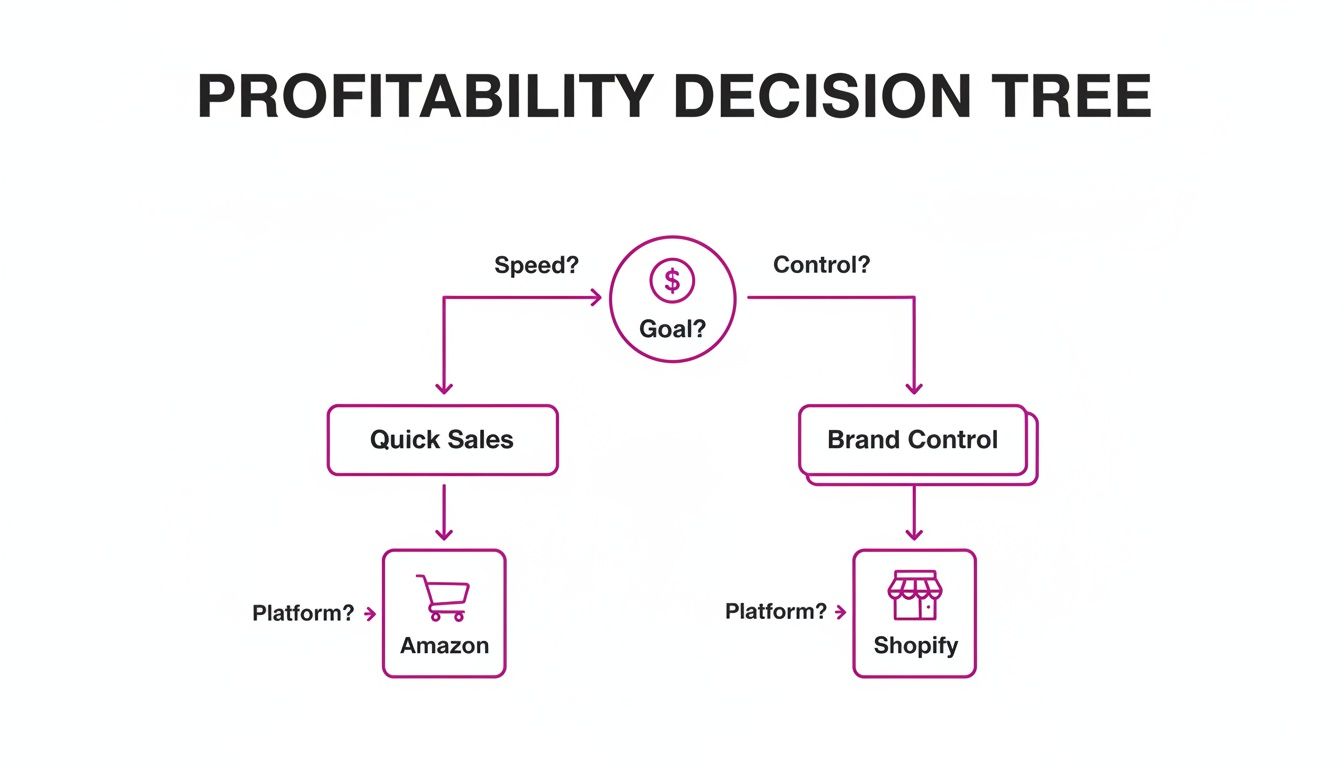
As the visual shows, your primary business goal should be the main driver of your decision, steering you toward the platform built to deliver on that objective.
The Hybrid Strategy: Using Both to Dominate the Market
For established brands, the question isn't "Amazon or Shopify?" It's "How do we best use both?" A smart omnichannel strategy leverages each platform for its unique strengths, creating a powerful growth engine.
Here’s how that model works:
- Shopify is your central command hub. This is your branded home base where you control the entire customer experience, capture priceless data, and nurture your most loyal customers. It's where your highest-margin sales happen.
- Amazon is your high-volume acquisition channel. You tap into its immense reach to find new customers who might have never discovered your brand otherwise. It's a tool for penetrating the market and grabbing shoppers who live and breathe inside the Amazon ecosystem.
This dual-platform approach helps you build a more resilient brand with diversified revenue streams. While Amazon is a sales juggernaut, the growth of independent commerce is undeniable. Shopify has carved out a formidable position, commanding 10.32% of the global eCommerce platform market share as of 2025. In the U.S., its dominance is even clearer, controlling roughly 29% of the eCommerce software market. This incredible momentum is reflected in its gross merchandise volume, which soared to $92 billion in Q3 2025—a remarkable 31% year-over-year jump. You can learn more about Shopify's impressive growth trajectory and what it signals for the future of DTC brands.
Common Questions: Amazon vs. Shopify
Even after weighing the pros and cons, a few common questions always seem to pop up. Let's tackle them head-on to help you make the final call for your business.
How Much Does Amazon Take From a $100 Sale?
This is where the rubber meets the road. For a $100 sale on Amazon, you're not taking home anything close to that. First, you'll have referral fees, which typically run between 8-15% (that's $8-$15 right there).
Then, if you're using FBA for fulfillment—which most sellers do—you can expect another 15-20% to vanish. All in, it's not unusual for Amazon's total take to be over 30% of your revenue. And that's before you've even paid for your products or your advertising.
Can I Just Use Both Platforms?
You absolutely can. In fact, many of the smartest scaling brands operate on a hybrid model. Think of it this way: your Shopify store is your brand's flagship, the central hub where you build real customer relationships and protect your profit margins.
At the same time, you can treat Amazon as a massive, if expensive, customer acquisition engine. It’s a powerful way to get your products in front of millions of new shoppers who live and breathe on the marketplace.
The best strategy for growth is often a mix of both. Use Shopify as your brand headquarters and leverage Amazon as a high-volume sales channel to fuel customer acquisition.
Is Shopify or Amazon Better for Beginners?
This really boils down to what you're trying to achieve right now.
If your only goal is to validate a product idea as quickly as possible with the least amount of marketing heavy lifting, Amazon is your best bet. The built-in traffic is a huge advantage and lets you test demand almost immediately.
But if you're in it for the long haul—to build an actual brand and own the relationship with your customers—then Shopify is the better starting point. It forces you to learn the marketing skills that are non-negotiable for sustainable eCommerce success.
Ready to build an eCommerce brand that you own and control? At ECORN, our team of dedicated Shopify specialists can help you design, develop, and optimize a store built for growth. Explore our scalable solutions and start your project today.


Shopify Theme Kit: Setup, Commands, and Migration Guide
Shopify Extension Development: A Practical 2026 Guide
Shopify Speed Score Explained and How to Improve It
Shopify Mobile Optimization: The 2026 Playbook
How to Add Subcategory in Shopify for Better UX
How to Implement Structured Data for Ecommerce in 2026
SEO App Mobile: Shopify Store Optimization Guide

Shopify Plus Support: What It Includes and How to Choose
Google Ads for Shopify: The Complete 2026 Playbook
Shopify New York: How to Find and Hire the Right Agency
Google Search Console for Shopify: The Complete Setup
First Party Data Collection for eCommerce Growth
FAQ Online Store Guide: Build and Measure It Right
Do FB Ads Work for eCommerce in 2026?
One Page Checkout for Shopify: Design and Implementation
Shopify GraphQL vs REST: The 2026 Developer Decision
Shopify Ecommerce Consulting: Strategy, Pricing &
Are Reddit Ads Worth It for eCommerce Brands

Shopify Title and Meta Description: A Practical 2026 Guide

Product Video Best Practices for Shopify Brands

Real-Time Inventory Management: A 2026 Guide
AI Chatbot Integration for Shopify Stores

Affiliate Program Management: A Shopify Guide
10 Best Performance Monitoring Tools for Shopify in 2026
Digital Asset Management for eCommerce Brands in 2026
Every Type of Facebook Ads Explained for eCommerce Growth
Product Information Management Explained for Shopify Brands
Support Ticket System: A Guide for Shopify Stores

10 Best Customer Service Tools for Shopify in 2026

Can I Start a Business with No Money? a 2026 Blueprint

What Sells Good on Etsy: Best Niches for 2026

Shopify Add to Cart Button: A Practical 2026 Guide

Customer Feedback Automation: A Practical eCommerce Guide
Critical Rendering Path: A Guide for Shopify Stores

How to Promote on TikTok for eCommerce in 2026

B2B eCommerce Consulting That Drives Real Revenue
10 Best Practices for Site Navigation in 2026
Return vs Refund for Shopify Stores: A Practical Guide

What Is Customer Lifetime Value and Why It Matters
What Is Voice of Customer Research for eCommerce

SMS Marketing for Ecommerce That Actually Converts

Master How to Improve Email Deliverability in 2026

Top 7 eCommerce Partners NYC for Shopify Brands in 2026
Machine Learning for Ecommerce: Boost Your Shopify Store

Beauty Market Research: Your 2026 Growth Guide

Shopify International Expansion: A 2026 Roadmap
What Does CRO Stand for in Business: Understanding CRO

Shopify Visual Merchandising: A Playbook for Higher Sales

Shopify Landing Page Design: Master Conversion in 2026
10 Best AI SEO Optimization Tools for Shopify in 2026

Agentic AI for Ecommerce: Boost Your Sales in 2026
Mastering Email Marketing Data for eCommerce Growth

Conversion Rate Optimisation Australia: Boost Your Sales
Conversion Rate Optimization AI: Your Shopify Store Guide

10 Product Bundling Strategies for Shopify in 2026

How to Increase Customer Lifetime Value: A Shopify Playbook
AI Customer Service Automation: Shopify Guide 2026

Clean Website Design: A Shopify Conversion Playbook

Omnichannel Retail Strategy: A Shopify Playbook
Product Data Enrichment: A Guide for Shopify Brands
Instagram Shopping Features a Guide for Shopify Stores
What Is Revenue Optimization: A Holistic RevOps Guide

Benefits of Conversion Rate Optimization: Boost Your
WordPress to Shopify Migration: Your 2026 Seamless Switch
Boost Sales: Ecommerce Payment Processing Guide 2026
Unified Commerce Platform: Benefits, KPIs & Shopify Guide
How to Reduce Bounce Rate eCommerce: Your 2026 Guide
Shopify API Integration: A Practical End-to-End Guide

How to Implement Data Governance: A 2026 Guide
Shopify Store Development Cost: A 2026 Breakdown
What Is Server Side Tracking: The Shopify Guide 2026
Marketing Automation Workflows: A Shopify Guide for 2026

Shopify: How to Reduce Technical Debt

Shopify UX Design Change: A Playbook for Growth

User Generated Content Strategy: Shopify Playbook

Shopify Pause and Build Plan Cost: A Complete 2026 Guide
Compare at Price on Shopify: A Complete Guide for 2026
Where Can I Sell My Prints? 10 Best Platforms for 2026
Shopify Order Management System: The Ultimate Guide 2026
What Is Marketing Attribution? an eCommerce Guide for 2026
10 Best Black Friday Sales Sheets for 2026

Discover the Top Social Media Marketing Agencies For
Consumer Confidence Definition for eCommerce in 2026
What Is Social Commerce? Your 2026 Guide to Boosting Sales
A Social Ad Campaign Playbook for eCommerce Growth

7 Best FAQ Page Examples for SaaS & eCommerce

Market Research in Fashion Industry: A Guide for Shopify
Shopify Migration Services: Expert Guide for 2026

Mastering FB Retargeting Ads for Shopify in 2026
What Is Omnichannel Ecommerce

Master Your Shopify Plus Migration: The 2026 Guide
Shopify Integration Services: A Merchant's 2026 Guide
Shopify Collection Description: A Guide to SEO & Sales

Shopify Plus Contact: Reach Sales & Support Effectively

Top Luxury Shopify Stores: Design & UX Strategies
How to Improve Customer Experience: A Shopify Roadmap
Creative Facebook Ads: 10 Examples for Shopify Brands

Remarketing with Facebook Ads: A Shopify Guide for 2026

SEO Linking Strategies for Shopify Stores
Top 7 Statistics YouTube Channels for eCommerce in 2026


newsletter in your inbox