

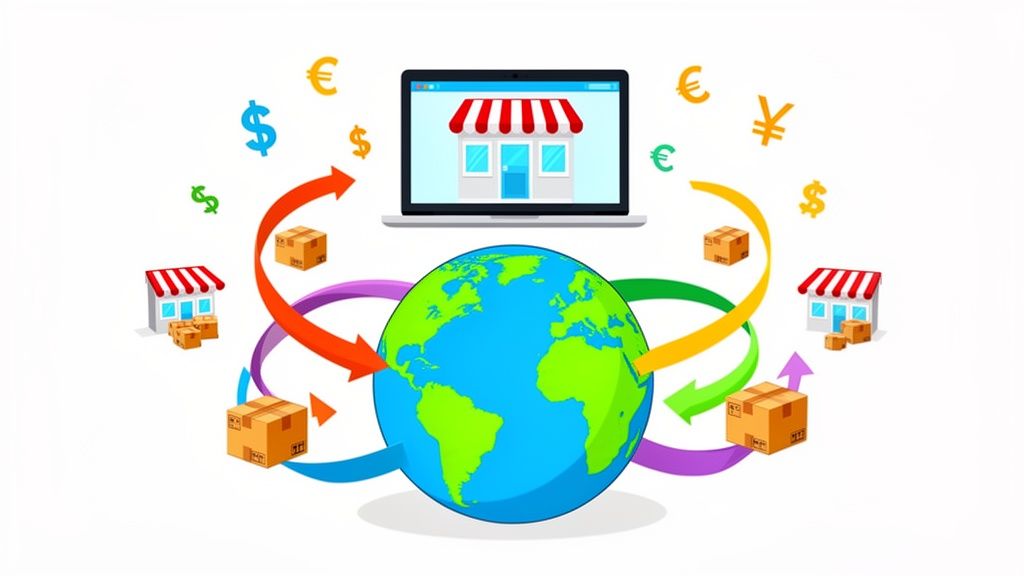
Has your brand's growth started to flatline? If you're only selling within your own country, it's a common story. But what if there was a global market with billions of potential customers just waiting to discover your products?
This is the reality of cross-border eCommerce. It’s more than just a buzzword; it’s a strategic leap into new markets that can reignite your growth and transform your business into a global force.
The Untapped Potential of Cross-Border eCommerce
For many brands, the thought of selling internationally feels overwhelming. You immediately think of complex logistics, confusing regulations, and a dozen other headaches. But staying confined to a single domestic market is like fishing in a small pond when an entire ocean of opportunity is right there.
Cross-border eCommerce isn't just about sticking a new shipping option on your checkout page. It's a fundamental shift in mindset that unlocks access to a massive, diverse customer base eager for what you offer.
The digital age has torn down the old geographic barriers. Shoppers are no longer limited to local stores; they actively hunt for unique products, better deals, and brands that truly connect with them, no matter where in the world they are. This creates a massive pull for businesses ready to meet that demand.
The journey from domestic limitation to global expansion is a clear, three-step process.
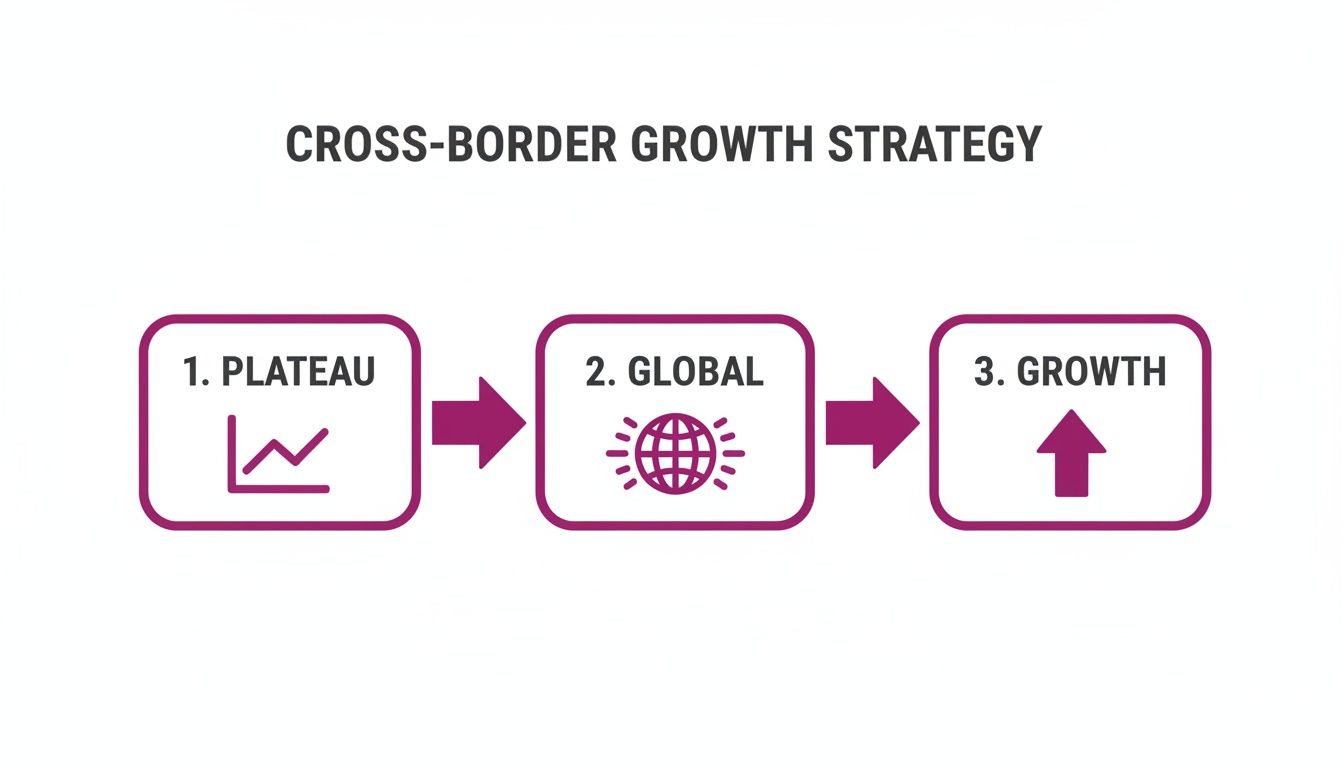
This visualizes a simple truth: breaking through a sales plateau requires a deliberate move toward a global mindset, which ultimately sparks renewed growth.
Quantifying the Global Opportunity
The numbers here are staggering, and they're only getting bigger.
Below is a snapshot of the global market. It’s not just about abstract figures; it’s about understanding the tangible opportunity waiting for your brand.
These figures show that tapping into international markets is no longer a "nice to have"—it's a core growth driver for ambitious brands.
This isn’t just a forecast; it’s a present-day reality. By venturing into new territories, your brand can:
- Diversify Revenue Streams: Stop being so reliant on a single country's economy. This builds incredible resilience against local market downturns.
- Increase Brand Recognition: A global presence instantly elevates your brand's authority and makes you a bigger player on the world stage.
- Reach Untapped Customer Segments: You'll connect with new audiences whose needs and tastes are a perfect match for your products.
The question for forward-thinking brands is no longer if they should sell internationally, but how to start effectively. The key is to turn perceived challenges into a powerful competitive advantage.
Making the First Move
Jumping into global sales without a plan is a recipe for disaster. The first steps require a clear strategy.
For businesses looking for a blueprint, a practical guide on how to export from South Africa can offer a solid framework, covering crucial steps like registration, market research, and logistics.
This guide will walk you through a similar step-by-step process, tailored for any brand looking to win at cross-border eCommerce.
Navigating International Taxes and Duties
Taking your brand global is an incredible way to unlock new revenue, but it also means wading into the complex world of international compliance. Think of taxes and duties as the official passport for your products—getting this right isn't just a good idea, it's essential for a smooth customer experience and a profitable international strategy.
Get it wrong, and you're looking at frustrating customs delays, angry customers slapped with unexpected fees, and even hefty fines for your business. The key to dodging these headaches is to understand the rules and be completely transparent from the get-go.
Demystifying Core Compliance Concepts
The language of global trade can feel a bit like alphabet soup, full of acronyms and jargon. But once you break it down, the core concepts are actually pretty straightforward.
Let’s quickly unpack the three big ones you absolutely need to know:
- Tariffs: These are simply taxes a country slaps on imported goods. Think of it as an entry fee for your product, often designed to protect that country's local industries.
- VAT/GST (Value-Added Tax/Goods and Services Tax): This is a consumption tax, similar to sales tax in the US, but applied to goods and services sold within a specific country. The rules for how you collect and pay it internationally are where things get tricky.
- HS Codes (Harmonized System Codes): This is the universal language for classifying products. Every single item you ship needs a specific HS code, which tells customs officials exactly what's in the box so they can apply the right tariffs and taxes. Getting this wrong is a common—and expensive—mistake.
Nailing these fundamentals is your first step. For a deeper dive, check out our guide on ecommerce tariffs.
The Importance of Calculating Landed Cost
If there’s one thing that can make or break your international sales, it’s the landed cost. This is the total price your customer pays to get the product to their door. It includes the product price, shipping, duties, taxes, and any other customs fees.
Showing this all-in price at checkout is a game-changer for building trust. No surprises, no hidden fees. This simple act of transparency drastically cuts down on abandoned carts. More importantly, it avoids the nightmare scenario where a customer has to pay extra just to receive their package—a surefire way to lose them for good.
A surprise bill from a courier for customs fees is one of the fastest ways to destroy customer loyalty and generate negative reviews. Transparency in landed cost is not just a best practice; it's a core conversion and retention strategy.
The data shows just how big the challenge is. A staggering 91% of businesses now sell cross-border, with 92% using marketplaces to do so. Yet, the hurdles are real: 75% struggle with HS codes, 38% have been hit with tariff fines, and 35% can't calculate duties and taxes correctly. A further 22% don't even calculate the full landed cost, which is a direct hit to sales and customer trust. You can see more on this in the latest cross-border ecommerce market research.
Automating Global Compliance
Look, manually calculating duties, taxes, and HS codes for every product in every country just isn't going to work. The rules change constantly, and the risk of human error is way too high. For any brand serious about selling internationally, automation is the only way forward.
Modern tools and platforms can do all the heavy lifting for you. By integrating specialized apps or using the built-in power of platforms like Shopify Markets, you can:
- Assign HS Codes Automatically: Smart tools can classify your entire catalog, slashing the risk of customs penalties.
- Calculate Duties and Taxes in Real-Time: The system crunches the numbers instantly based on your customer’s location and what’s in their cart.
- Display the Full Landed Cost at Checkout: You present one clear, final price. Your customer feels confident, and they click "buy."
By letting technology handle compliance, you take the guesswork and the operational grind off your plate. This frees you up to focus on what you do best—marketing and growing your brand—knowing your international orders will arrive without any nasty surprises.
Mastering Global Shipping and Payments
You've navigated the maze of international taxes and duties. Great. But don't celebrate just yet, because the next hurdles—checkout and delivery—are where many brands stumble right before the finish line.
Think of it this way: a clunky payment process or surprisingly high shipping costs can completely derail an otherwise perfect customer journey. It erases all the hard work you did to get them there in the first place. For international customers, a seamless, trustworthy experience at this final stage isn't just nice to have; it's a dealbreaker.
Why Local Payment Methods Are Non-Negotiable
Imagine you’re on vacation, you find the perfect souvenir, but the shop owner tells you they don't take credit cards—only a local payment app you’ve never heard of. You'd probably just walk out. That’s exactly what happens online when you force international customers to use your preferred payment methods. It's a massive conversion killer.
Offering familiar, trusted payment options is one of the fastest ways to build credibility. Preferences vary wildly from one region to another, so a one-size-fits-all approach is doomed to fail.
- Asia Pacific: Digital wallets reign supreme. In China, Alipay and WeChat Pay are essential. In Southeast Asia, you'll need to consider options like GrabPay and GoPay.
- Europe: The payment landscape here is incredibly fragmented. Germans often lean towards bank transfers like Giropay or "buy now, pay later" systems like Klarna. Meanwhile, iDEAL is the go-to standard in the Netherlands.
- Latin America: Cash is still a major player. Voucher systems like OXXO in Mexico are incredibly popular for shoppers without credit cards, sitting alongside various local card schemes.
Failing to offer local payment methods is like speaking a different language at the checkout. It creates friction and distrust precisely when you need the customer to feel most secure.
Adapting your payment gateway to include these regional favorites shows you understand and respect the local market. It's a relatively small technical change that has a huge psychological payoff, making the customer feel like your store was built just for them.
Choosing Your Global Fulfillment Strategy
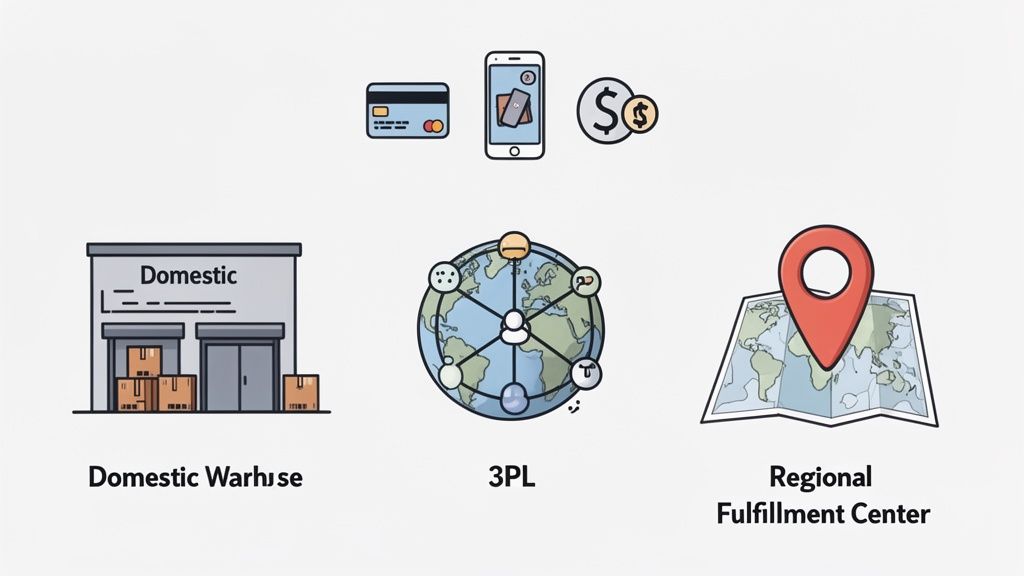
With payments sorted, the final piece of the puzzle is actually getting your products into your customers' hands. Your fulfillment strategy directly impacts shipping costs, delivery speed, and the entire post-purchase experience. There are three main models to think about as you expand.
1. Centralized Domestic Fulfillment
This is the most straightforward way to start. You simply ship all international orders from your main, domestic warehouse.
- Pros: It’s simple, requires almost no initial investment, and keeps your inventory management centralized. It’s the perfect way to dip your toes into new markets without a massive commitment.
- Cons: Shipping times will be longer and costs will be higher for the customer, which can definitely hurt your conversion rates. You also lose control over the delivery experience once the package crosses the border.
2. Third-Party Logistics (3PL) with a Global Network
With this model, you partner up with a 3PL provider that has a network of warehouses in your key international markets. You ship them inventory in bulk, and they handle the local picking, packing, and shipping for you.
- Pros: You can offer dramatically faster and cheaper shipping, which is a huge win for your customers. Plus, you offload the headaches of managing international warehouses and staff.
- Cons: This comes with higher operational costs. You also give up some direct control over your inventory and how your packages are branded.
3. Regional Fulfillment Centers
For brands with serious volume in a particular region, setting up your own (or leased) fulfillment centers offers the ultimate level of control.
- Pros: You control the entire end-to-end customer experience, from custom packaging to returns. At a very large scale, this can become the most cost-effective model.
- Cons: This requires a massive capital investment in real estate, technology, and staffing. It's by far the most complex and highest-risk option on the table.
The right choice really depends on your brand's current scale, budget, and long-term goals. Most businesses start with centralized fulfillment, graduate to a 3PL as sales grow, and only consider their own regional centers once they’ve established a dominant presence in a market.
Creating a Truly Local Shopping Experience
Success in ecommerce cross border boils down to a simple but powerful idea: making your international customers feel like you built your store just for them. Real localization isn't about plugging your product descriptions into a translation app. It’s about building an entire shopping experience that feels native, familiar, and trustworthy from the ground up.
Think about walking into a store in another country where everything—the language on the signs, the currency on the price tags, even the way the aisles are organized—feels exactly like home. That’s the feeling you need to replicate online. Get this right, and you stop being a "foreign company" and start becoming a trusted local brand.
This level of detail means ditching the one-size-fits-all approach. Instead, you need to focus on three core pillars that create a genuinely local shopping journey.
Content That Connects and Resonates
The first pillar is your content. This is so much more than translating words; it's about translating meaning and intent. Your marketing messages, product descriptions, and even the tone of your customer support emails have to align with local cultural nuances.
For instance, a humorous marketing campaign that crushes it in the United States might fall completely flat—or even cause offense—in Japan. In the same way, a product description focused on individual achievement might click in a Western market but flop in a collectivist culture where community benefits are a much bigger selling point.
Think of localization as a conversation. If you're shouting in a language your customer barely understands, or using slang they find confusing, the conversation ends before it even begins. True connection requires speaking their language, both literally and culturally.
To really nail this, focus on these key areas:
- Marketing and Ad Copy: Don't just translate your ads. Adapt the imagery, headlines, and calls-to-action to reflect what people in that market actually value.
- Product Descriptions: Hire native speakers to not just translate but transcreate your copy. This ensures it captures the right tone and speaks directly to local customer pain points.
- Customer Support: Offering support in the local language is a massive trust signal. It shows customers you’ve got their back if something goes wrong.
Currency and Pricing That Feel Familiar
The second pillar is making your prices feel completely natural to the local shopper. This is a critical step in removing friction at checkout. Forcing a customer to pull out a calculator or do mental math to convert currencies is a guaranteed way to send them running.
Displaying prices in the local currency is the absolute minimum. But smart brands go further, adapting their pricing strategies to what customers in that market expect.
This means considering things like:
- Psychological Pricing: In many Western countries, prices ending in .99 are standard practice. That's not a universal rule. In some cultures, round numbers can signal quality and transparency.
- Inclusive Pricing: Be crystal clear about what the price includes. In Europe, for example, shoppers expect the price they see to already include VAT. Showing a pre-tax price can feel sneaky.
- Payment Options: We've touched on this before, but it bears repeating: offering familiar local payment methods is non-negotiable. It's a huge part of making the whole transaction feel secure and normal.
A User Experience Adapted to Cultural Norms
Finally, the third pillar is the user experience (UX) itself. How a customer moves through your site, the promotions they see, and even the page layout can all be influenced by cultural expectations. A website that feels clean and intuitive in North America might seem cluttered or confusing to a user in Asia.
Take a hard look at the visual and functional pieces of your site. This could mean adjusting your website's layout, color schemes, or the kinds of promotions you feature. Some cultures, for example, respond better to busy, information-rich homepages, while others prefer a minimalist, clean design. Even the holidays you celebrate with promotions—think Singles' Day in China versus Black Friday in the West—should be localized to stay relevant.
Choosing Your Shopify Architecture for Global Scale
For any brand serious about going global on Shopify, your technical setup is everything. It's the foundation for your entire cross-border strategy.
Think of it like building a house. Do you build one massive mansion with different wings for each family member (a single, unified store)? Or do you build several unique, custom houses on the same piece of land (multiple, dedicated stores)? Each path has its perks, and the right choice really boils down to your brand's scale, budget, and where you see yourself in five years.
The decision really comes down to two main blueprints. First, there's the multi-store approach, where you spin up completely separate Shopify stores for each of your key regions. The second is the single-store approach, which uses powerful tools like Shopify Markets to run multiple currencies, languages, and domains from a single, central dashboard.
Getting this decision right from the get-go is huge. It will shape everything from your daily operations to how smoothly you can scale down the road.

H3: Comparing Global Storefront Models
So, let's get into the weeds and compare these two strategies. One gives you incredible customization but comes with higher operational headaches. The other keeps things simple and streamlined, but with a few trade-offs on how deep you can go with localization.
There's no single "best" answer here—it's all about what makes sense for your business.
Choosing your Shopify architecture is a strategic fork in the road. One path leads to deep, granular control over individual markets, while the other prioritizes operational simplicity and a unified brand presence.
Figuring out the pros and cons is the first step to making a smart call that will pay off for years. If you want to dive even deeper into the financial side of this, you can learn more about managing Shopify multiple currencies in our strategic guide.
To help you weigh the factors that matter most, here’s a side-by-side comparison.
Shopify Multi-Store vs Single-Store Architecture
So, what's the verdict?
For most brands just dipping their toes into international waters, the single-store approach using Shopify Markets is a fantastic starting point. It's accessible and gives you a powerful set of tools to create a localized experience without the heavy operational lift of running totally separate sites.
But as your brand grows and you start to dominate certain markets, you might find yourself graduating to a multi-store setup for those high-performing regions. This lets you unlock that next level of granular control. It’s a phased approach that allows your tech to scale right alongside your global success.
Using CRO and AI to Optimize International Sales
Getting your global storefront live is a huge milestone, but it's really just the starting line. The next phase is all about turning that presence into profit through relentless refinement. True success in ecommerce cross border isn't just about being available in new countries; it’s about constantly tweaking and improving the customer experience to drive more sales.
This is where Conversion Rate Optimization (CRO) and Artificial Intelligence (AI) shift from being buzzwords to becoming your most valuable assets.
Adapting CRO for Global Markets
You can't just copy-paste your domestic CRO strategy and expect it to work everywhere. What converts customers in your home market might completely fall flat somewhere else. International CRO is about developing cultural empathy and backing it up with hard data.
This means you have to question every assumption. For instance, a bright, urgent call-to-action button might crush it in North America but come across as pushy or untrustworthy in parts of Asia.
To get it right, focus your A/B tests on elements that are deeply tied to culture:
- Localized Messaging: Don't just translate; transcreate. Test headlines and value props that resonate with local values. Is the message about individual achievement, or is it about family and community?
- Visuals and Imagery: Test lifestyle photos that feature models and settings that your target market can see themselves in. Representation isn't just a buzzword; it’s a powerful tool for building instant trust.
- Checkout Flow: Is a one-page checkout always better? Not necessarily. Some markets are accustomed to multi-step processes that feel more secure, while others demand ultimate simplicity. Test both.
The competitive environment also gives you crucial clues. Just look at the meteoric rise of platforms like Temu, which is projected to grab 24% of cross-border sales by 2025. This shows just how fierce the competition is on price and user experience. With 59% of shoppers worldwide already buying from abroad, you can’t afford to guess. You can dig into more insights on this seismic shift in global shopping on Digital Commerce 360.
Supercharging Optimization with AI
This is where things get really exciting. AI takes your international CRO efforts and puts them on steroids, allowing for personalization and automation at a scale that's simply impossible for a human team to handle. AI can sift through massive datasets from all your different regions, spotting patterns and opportunities you would have otherwise missed.
Think of AI as your team of hyper-intelligent, 24/7 market analysts, one dedicated to each country you sell in. It constantly learns from customer behavior and makes real-time adjustments to maximize revenue.
Here’s how AI can make a direct, tangible impact on your international sales:
- Dynamic Pricing: AI algorithms can adjust your prices on the fly based on local demand, what your competitors are doing, and even currency swings. This ensures you're always priced competitively without sacrificing your margins.
- Personalized Recommendations: Forget showing the same "bestsellers" to everyone. AI can serve up product suggestions based on regional trends, upcoming local holidays, or even the weather in the customer's city.
- Automated Multilingual Support: AI-powered chatbots can deliver instant, 24/7 customer service in dozens of languages. They can handle all the common questions about shipping, returns, and product specs, building customer confidence while freeing up your human support team to tackle the really tough problems.
For a deeper dive into how artificial intelligence can reshape your sales strategy and fuel growth, check out this guide to the best AI tools for ecommerce.
When you combine sharp, data-driven CRO with the predictive muscle of AI, you can build a shopping experience that feels personal, relevant, and incredibly effective—no matter where in the world your customers are.
Got Questions About Going Global? We've Got Answers.
Stepping into international markets always kicks up a few questions. Once you get past the big-picture strategy, you start hitting those practical, "what-if" scenarios that can keep you up at night. This is where we tackle the most common hurdles brands face when they launch their ecommerce cross border operations.
Think of it as a final gut-check to build your confidence. Getting ahead of these common sticking points means your global strategy is not just well-planned, but tough enough to handle the real world from day one.
How Should I Handle International Returns?
International returns can feel like a logistical nightmare, but you absolutely cannot ignore them. A clear, customer-friendly policy is non-negotiable for building trust, and a clunky process is one of the fastest ways to kill your brand's reputation in a new market.
Here are a few smart ways to manage this:
- Set Up Regional Return Hubs: Don't ship single items across the world. Partner with a 3PL that offers regional returns consolidation. Your customers send items to a local address, and the 3PL bundles everything for one cost-effective shipment back to your main warehouse.
- Lean into Store Credit: Encourage customers to choose store credit or an exchange instead of a cash refund. This keeps the revenue in your business and is often way simpler than processing an international refund.
- Know When to Cut Your Losses: For lower-cost items, do the math. The cost of return shipping, processing, and restocking can sometimes be more than the product is even worth. In those cases, it might be more economical to just refund the customer and let them keep it.
What's The Best Way To Market In a New Country?
You can't just copy-paste the ads that work back home and expect the same results. Real international marketing success comes from a "think global, act local" approach. You have to connect with customers on their terms, using messages and channels that feel completely natural to them.
A one-size-fits-all marketing campaign is a recipe for wasted ad spend. True connection comes from tailoring your message, visuals, and promotions to each market's unique cultural context.
Start by validating the market with data. Use your analytics to see where you're already getting organic interest before you dump a ton of money into a new region. Once you've picked a winner, get serious about localizing your campaigns. That means native-language copy, geo-targeted ads with culturally relevant imagery, and promotions built around local holidays and shopping events, not just your own.
How Do I Manage Customer Support Across Time Zones?
Great support has to be timely, no matter where your customers live. Making someone wait a full day for an answer because of time zone gaps is a terrible customer experience. The good news is, you don't need a massive, 24/7 global team to solve this.
First, build out a killer, multilingual FAQ or knowledge base that proactively answers the most common questions about shipping, returns, and your products. This lets customers help themselves instantly. Then, bring in an AI-powered chatbot to handle the simple, first-line inquiries 24/7. It can provide instant answers and escalate the tricky stuff to your human team, ensuring customers always get a fast response, day or night.
Ready to build a global storefront that actually converts? The team of Shopify specialists at ECORN can help you navigate every step of your cross-border expansion, from technical architecture to conversion rate optimization. Get in touch to scale your brand globally.


What Is AI Integration for eCommerce
How to Choose the Right eCommerce Website Development Firm
E Business Strategy Implementation
Conversion Tracking Setup for Shopify Stores
BigCommerce vs Shopify Plus Which Enterprise Wins in 2026
Shopify Theme Kit: Setup, Commands, and Migration Guide

Shopify Extension Development: A Practical 2026 Guide
Shopify Speed Score Explained and How to Improve It

Shopify Mobile Optimization: The 2026 Playbook
How to Add Subcategory in Shopify for Better UX
How to Implement Structured Data for Ecommerce in 2026

SEO App Mobile: Shopify Store Optimization Guide

Shopify Plus Support: What It Includes and How to Choose

Google Ads for Shopify: The Complete 2026 Playbook

Shopify New York: How to Find and Hire the Right Agency
Google Search Console for Shopify: The Complete Setup
First Party Data Collection for eCommerce Growth
FAQ Online Store Guide: Build and Measure It Right
Do FB Ads Work for eCommerce in 2026?

One Page Checkout for Shopify: Design and Implementation

Shopify GraphQL vs REST: The 2026 Developer Decision
Shopify Ecommerce Consulting: Strategy, Pricing &

Are Reddit Ads Worth It for eCommerce Brands

Shopify Title and Meta Description: A Practical 2026 Guide

Product Video Best Practices for Shopify Brands

Real-Time Inventory Management: A 2026 Guide
AI Chatbot Integration for Shopify Stores
Affiliate Program Management: A Shopify Guide
10 Best Performance Monitoring Tools for Shopify in 2026
Digital Asset Management for eCommerce Brands in 2026
Every Type of Facebook Ads Explained for eCommerce Growth
Product Information Management Explained for Shopify Brands
Support Ticket System: A Guide for Shopify Stores

10 Best Customer Service Tools for Shopify in 2026

Can I Start a Business with No Money? a 2026 Blueprint

What Sells Good on Etsy: Best Niches for 2026

Shopify Add to Cart Button: A Practical 2026 Guide

Customer Feedback Automation: A Practical eCommerce Guide
Critical Rendering Path: A Guide for Shopify Stores

How to Promote on TikTok for eCommerce in 2026

B2B eCommerce Consulting That Drives Real Revenue
10 Best Practices for Site Navigation in 2026
Return vs Refund for Shopify Stores: A Practical Guide

What Is Customer Lifetime Value and Why It Matters
What Is Voice of Customer Research for eCommerce

SMS Marketing for Ecommerce That Actually Converts

Master How to Improve Email Deliverability in 2026

Top 7 eCommerce Partners NYC for Shopify Brands in 2026
Machine Learning for Ecommerce: Boost Your Shopify Store

Beauty Market Research: Your 2026 Growth Guide
Shopify International Expansion: A 2026 Roadmap

What Does CRO Stand for in Business: Understanding CRO

Shopify Visual Merchandising: A Playbook for Higher Sales

Shopify Landing Page Design: Master Conversion in 2026
10 Best AI SEO Optimization Tools for Shopify in 2026

Agentic AI for Ecommerce: Boost Your Sales in 2026
Mastering Email Marketing Data for eCommerce Growth

Conversion Rate Optimisation Australia: Boost Your Sales
Conversion Rate Optimization AI: Your Shopify Store Guide

10 Product Bundling Strategies for Shopify in 2026

How to Increase Customer Lifetime Value: A Shopify Playbook
AI Customer Service Automation: Shopify Guide 2026

Clean Website Design: A Shopify Conversion Playbook

Omnichannel Retail Strategy: A Shopify Playbook

Product Data Enrichment: A Guide for Shopify Brands

Instagram Shopping Features a Guide for Shopify Stores

What Is Revenue Optimization: A Holistic RevOps Guide

Benefits of Conversion Rate Optimization: Boost Your
WordPress to Shopify Migration: Your 2026 Seamless Switch
Boost Sales: Ecommerce Payment Processing Guide 2026
Unified Commerce Platform: Benefits, KPIs & Shopify Guide
How to Reduce Bounce Rate eCommerce: Your 2026 Guide
Shopify API Integration: A Practical End-to-End Guide

How to Implement Data Governance: A 2026 Guide
Shopify Store Development Cost: A 2026 Breakdown
What Is Server Side Tracking: The Shopify Guide 2026
Marketing Automation Workflows: A Shopify Guide for 2026

Shopify: How to Reduce Technical Debt

Shopify UX Design Change: A Playbook for Growth

User Generated Content Strategy: Shopify Playbook

Shopify Pause and Build Plan Cost: A Complete 2026 Guide
Compare at Price on Shopify: A Complete Guide for 2026

Where Can I Sell My Prints? 10 Best Platforms for 2026
Shopify Order Management System: The Ultimate Guide 2026
What Is Marketing Attribution? an eCommerce Guide for 2026

10 Best Black Friday Sales Sheets for 2026

Discover the Top Social Media Marketing Agencies For
Consumer Confidence Definition for eCommerce in 2026
What Is Social Commerce? Your 2026 Guide to Boosting Sales
A Social Ad Campaign Playbook for eCommerce Growth

7 Best FAQ Page Examples for SaaS & eCommerce

Market Research in Fashion Industry: A Guide for Shopify
Shopify Migration Services: Expert Guide for 2026

Mastering FB Retargeting Ads for Shopify in 2026
What Is Omnichannel Ecommerce

Master Your Shopify Plus Migration: The 2026 Guide
Shopify Integration Services: A Merchant's 2026 Guide
Shopify Collection Description: A Guide to SEO & Sales

Shopify Plus Contact: Reach Sales & Support Effectively

Top Luxury Shopify Stores: Design & UX Strategies


newsletter in your inbox