


Product merchandising is really just the art and science of showing off your products in a way that makes people want to buy them. Think of it as the silent salesperson for your brand, working behind the scenes to arrange everything from your website layout to your product photos to create a shopping journey that’s impossible to resist.
What Is Product Merchandising in Ecommerce
Imagine walking into a physical boutique. Product merchandising is how everything inside is arranged—from the gorgeous window display that drew you in to the way items are grouped on each shelf. In eCommerce, it’s the exact same idea, just with pixels instead of paint. It's the craft of guiding customers through your online store, telling your brand’s story, and ultimately, making it easy and exciting for them to click "add to cart."
This goes way beyond some dry, textbook definition. The whole point is to strategically present your products to grab attention, drive sales, and build the kind of brand loyalty that keeps customers coming back. When you nail your merchandising, you're showing the right product to the right person, at the perfect time, and for the right price.

Beyond the Digital Shelf
Back in the early days of online shopping, "merchandising" was little more than a basic grid of products. Not anymore. Today, it’s a sophisticated discipline that blends creative intuition with hard data.
Knowing how to present your products visually is everything. For instance, a solid guide on creating high-converting fashion images can give you incredible insights into making your items pop off the screen.
Modern product merchandising is a mix of several key ingredients:
- Visual Appeal: Using high-quality images, videos, and a consistent aesthetic that makes your products feel desirable and tangible.
- Intuitive Navigation: Organizing your site so customers can find what they’re looking for without hitting a dead end or getting frustrated. It should just feel easy.
- Personalization: Showing shoppers relevant product recommendations based on what they've looked at before. It's about making them feel like you get them.
- Strategic Promotions: Crafting compelling offers, bundles, and discounts that encourage people to buy more than they originally planned.
Merchandising is no longer just a visual accessory; it's a critical lever for performance and profitability. A great strategy can significantly improve key metrics like conversion rates and average order value.
To give you a clear roadmap for the strategies we're about to dive into, we've broken the concept down into its core components. The table below outlines the four pillars that form the foundation of any truly powerful product merchandising plan.
The Four Pillars Of Effective Product Merchandising
Here’s a quick look at the core components that come together to form a powerful product merchandising strategy. Getting these four areas right is fundamental to driving growth.
Mastering these four pillars will transform your online store from a simple product catalog into a dynamic and persuasive selling machine.
The Core Types Of Ecommerce Product Merchandising
Product merchandising isn’t a single, one-off task. It’s a collection of coordinated strategies all working together. Think of it like a master chef's kitchen, where different stations—the grill, the sauce station, the plating area—each have a specific role but contribute to the final, delicious dish. In ecommerce, these "stations" are the core types of merchandising that shape how a customer feels and acts in your store.
Getting these techniques right is the key to moving beyond a simple product list and creating a truly dynamic shopping environment. Each type tackles a different part of the customer journey, from the first visual hook to the final click of the "buy" button. Let's break down the essential disciplines you need to know.

Visual Merchandising: The Art of Attraction
First impressions are everything online, and your visuals do all the talking. Visual merchandising is all about using high-quality images, engaging videos, and a consistent brand aesthetic to make your products look absolutely irresistible. Since shoppers can't physically touch or hold your items, your visuals have to bridge that sensory gap.
This is about much more than just clear product photos on a white background. It's about creating a mood and telling a story.
- Lifestyle Photography: Show your products in context. A picture of a couch in a beautifully decorated living room is far more compelling than that same couch floating in a white void.
- Product Videos: Demonstrate how a product works, its scale, or how a piece of clothing fits and moves on a real person. Videos give customers a much more accurate feel for what they're buying, which can seriously cut down on returns.
- Consistent Aesthetics: Make sure all your visuals—from homepage banners to product shots—stick to your brand's color palette and style. This kind of cohesion builds brand recognition and, more importantly, trust.
On-Site Merchandising: The Science of Navigation
Once your visuals have captured a customer's attention, they need to be able to find their way around your store effortlessly. On-site merchandising focuses on the structure and flow of your website, creating a seamless and intuitive shopping journey. A confusing website is the digital equivalent of a messy, disorganized physical store—customers will just turn around and leave.
The main goal here is to remove friction and guide shoppers to what they need with as little effort as possible. This means optimizing several key areas of your digital storefront.
A well-executed on-site merchandising strategy transforms your website from a mere catalog into a guided shopping experience. It anticipates customer needs and makes product discovery feel natural and rewarding.
Key elements of on-site merchandising include:
- Homepage Curation: Your homepage is your digital storefront window. Use it to showcase best-sellers, new arrivals, current promotions, or seasonal collections.
- Category Navigation: Organize products into logical, easy-to-understand categories and subcategories. A clean navigation structure helps shoppers narrow their choices without feeling overwhelmed.
- Search Functionality: A powerful, intelligent search bar is non-negotiable. Features like autocomplete, synonym recognition, and visual search can dramatically improve product discovery. Some studies even show AI-enhanced search can increase conversions by 2-4x.
Assortment Merchandising: The Curated Collection
Assortment merchandising is the strategic process of selecting and presenting the right mix of products for your target audience. It's about being a curator, not just a warehouse. You could have the most beautiful website in the world, but if you're selling the wrong stuff, you won't make any sales.
This requires a deep understanding of your customers' needs, preferences, and buying habits. It’s a balancing act between offering enough variety to be interesting without causing "choice paralysis" by offering too much. An effective assortment strategy means every product has a purpose, whether it's a high-margin hero product or an entry-level item designed to attract new customers. For a deeper dive, you can explore our full guide on ecommerce merchandising strategies.
Pricing and Promotional Merchandising: The Deal Closer
Finally, pricing and promotional merchandising uses financial incentives to drive urgency and maximize revenue. This is where you bring out the discounts, bundles, and special offers to encourage a purchase and increase the average order value (AOV).
But effective promotional merchandising isn't about randomly slashing prices. It's a calculated approach designed to influence buying behavior. Popular tactics include:
- Product Bundling: Grouping complementary items together for a single, often discounted, price (e.g., a "Skincare Starter Kit"). This increases the perceived value and helps you move more inventory.
- Strategic Discounts: Offering time-sensitive deals like flash sales or seasonal promotions paired with countdown timers to create a powerful sense of urgency.
- Tiered Promotions: Encouraging larger purchases with offers like "Save 10% on orders over $50, 20% on orders over $100."
By combining these four core types of merchandising, you create a powerful, holistic strategy that attracts, guides, and converts shoppers far more effectively.
Of course! Here is the rewritten section, crafted to sound completely human-written and natural, following the provided style guide.
Why Product Merchandising Is Your Secret Weapon in Modern Retail
So, we know what product merchandising is. But the real game-changer is understanding why it matters so much. In a marketplace overflowing with options, good merchandising isn't just a "nice-to-have" anymore—it's the engine that powers growth, forges your brand identity, and separates the stores that thrive from the ones that fade away.
Think about it like this: two cafes on the same street could be selling the exact same coffee beans. One is always buzzing with people, while the other is dead quiet. The difference isn't the product. It’s the experience. The busy cafe has a warm, inviting vibe, a menu that’s easy to read, and delicious-looking pastries right by the cash register. That's the soul of merchandising, and it’s what turns a simple purchase into an experience people remember and return for.
This very same idea applies online, but with even more at stake. A smart merchandising strategy is directly tied to the metrics that actually matter to your business.
From Pretty to Profitable: Connecting Merchandising to Growth
Effective product merchandising goes way beyond just making your store look good; it's a straight line to boosting your bottom line. Every single decision—from the hero image on your homepage to how you bundle products—has a real, measurable impact on your key performance indicators.
Here’s how that translates into actual results:
- Higher Conversion Rates: When you make products easy to find, visually appealing, and relevant to what the shopper is looking for, you're clearing the path to purchase. A smooth journey from discovery to checkout just naturally leads to more sales. It's that simple.
- Increased Average Order Value (AOV): Clever tactics like product bundles, "complete the look" sections, and well-placed upsells nudge customers to add just one more thing to their cart. Those little additions really add up.
- Improved Customer Lifetime Value (CLV): A fantastic merchandising experience builds a ton of trust and loyalty. When customers feel like you "get" them and can easily find what they need, they're far more likely to come back again and again.
- Stronger Brand Identity: Your merchandising is your brand's story in action. The way you curate collections, the voice in your product descriptions, and the quality of your photography all work together to scream who you are and what you stand for.
Merchandising is the bridge between your product and your customer. It’s the critical function that ensures your amazing products don't get lost in a sea of digital noise, ultimately shaping perception and driving purchase decisions.
Thriving in an Omnichannel World
One of the biggest myths in retail today is that the internet killed the physical store. The reality is much more interesting. Great product merchandising has become a huge differentiator, with brick-and-mortar stores holding their ground surprisingly well against the eCommerce wave.
In fact, around 80% of all shopping still happens in physical stores. Even with online growth, projections show that by 2030, physical retail will likely still account for a massive 76% of total sales. This resilience, which you can read more about in this top retail trends analysis on Smurfit Westrock, points to a simple truth: customers don't see "online" and "offline" as two separate things. They just see one brand.
This is where having a solid omnichannel merchandising strategy becomes non-negotiable. A customer might see your product on Instagram, do some research on your website, and then head to your physical store to check it out before they buy.
A consistent experience is everything. Your pricing, promotions, product info, and brand vibe need to feel the same everywhere. When they don't, it creates friction and kills trust. But a seamless experience makes the customer feel seen and understood, no matter how they choose to shop. At the end of the day, a well-merchandised presence everywhere your customer is—that's the ultimate key to building a scalable and successful brand.
Implementing A Winning Merchandising Strategy On Shopify
Knowing what product merchandising is and why it matters is half the battle. The other half—the part where the magic happens—is actually turning that knowledge into a real, high-impact strategy on your Shopify store. This is your playbook for moving from theory to action.
A winning strategy isn't about guesswork. It’s about making deliberate choices that guide your customers on a seamless journey from homepage to checkout. It’s a mix of smart organization, compelling visuals, and data-driven insights that create an experience that feels both intuitive and irresistible. Let's break down how to build this on Shopify, step by step.
Master Shopify's Built-In Tools
Before you start piling on the apps, get a firm grip on the native features Shopify already gives you. These foundational tools are surprisingly powerful for building a solid merchandising framework, yet they're often the most underutilized assets a store owner has.
Start by zeroing in on these key areas:
- Collections: This is your primary organizational tool. Think beyond basic categories like "T-Shirts" or "Pants." Get creative and build curated collections like "Fall Essentials," "Gifts Under $50," or "Trending Now." These tell a story and guide shopper discovery. Shopify lets you create manual collections where you hand-pick every item, or automated ones that pull in products based on tags, price, or inventory.
- Product Tagging: Tags are your secret weapon for granular filtering and organization. A really solid tagging system lets customers drill down into your catalog with precision. For a single t-shirt, you might use tags like
cotton,crewneck,red,bestseller, andsummer-collection. This is what powers those sidebar filters customers have come to expect. - Theme Customization: Your Shopify theme is your digital canvas. Use the theme editor to create a clear visual hierarchy. Put your most important collections and promotions front-and-center on the homepage, tweak your product page layouts to spotlight key features, and keep your branding consistent everywhere. For a much deeper dive, check out our guide on Shopify product page optimization to make sure your most valuable pages are built to convert.
This flow chart really drives home how effective merchandising directly fuels growth and builds that all-important brand loyalty.
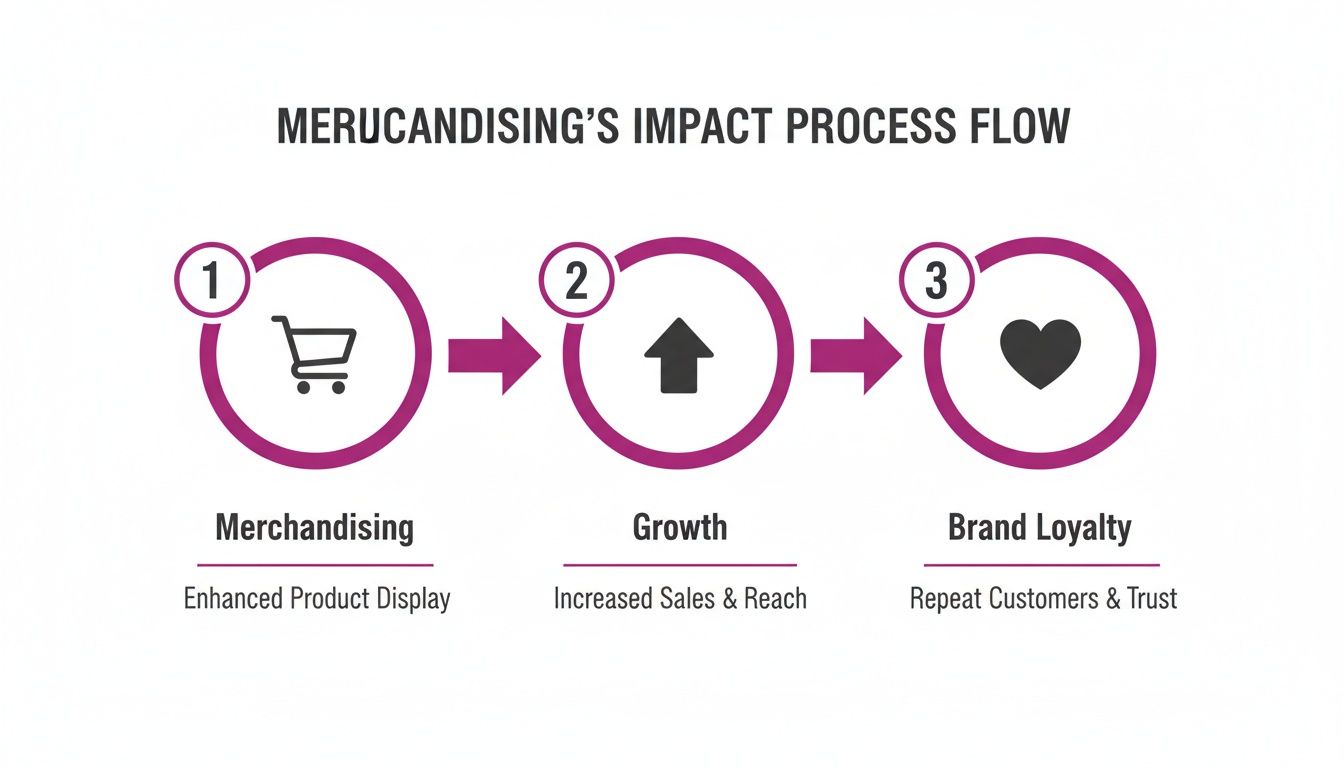
As you can see, a strategic approach to merchandising kicks off a cycle of positive outcomes for your business.
Elevate Your Strategy With The Right Apps
Once your foundation is rock-solid, the right Shopify apps can take your merchandising from good to great. The App Store is packed with tools designed to automate and enhance the customer experience, saving you time while driving up sales.
Think of apps not as a replacement for strategy, but as a force multiplier. They automate the tactics that allow your core merchandising strategy to shine at scale.
Here are a few types of apps that are pretty much non-negotiable for a serious store:
- AI-Powered Recommendations: Apps like LimeSpot or Recombee look at customer behavior to show hyper-relevant "You Might Also Like" or "Frequently Bought Together" sections. This is easily one of the most effective ways to increase your average order value.
- Advanced Search and Filtering: Tools like Algolia or Searchanise swap out Shopify's default search with a much smarter engine. It understands synonyms, fixes typos, and offers filtering capabilities that help customers find what they want, fast.
- User-Generated Content (UGC) Galleries: Using apps like Yotpo or Loox, you can pull in customer photos and reviews from social media to create shoppable galleries. This kind of social proof builds massive trust by showing your products in real-world situations.
Embrace Data-Driven Merchandising
The most successful merchandisers don't operate on gut feelings. They let data call the shots. Your Shopify Analytics dashboard is a goldmine of information telling you exactly how people are interacting with your store.
Start by digging into your data to answer these questions:
- What are my top-selling products? You should be featuring these prominently on your homepage and in your marketing. No question.
- Which products get a ton of views but have low conversion rates? This is a red flag. It could signal an issue with the product page, the price, or maybe the photography isn't doing its job.
- What are people searching for on my site? If you see repeated searches for things you don’t carry, you might have just found a gap in your product line. If they're searching for items you do carry, you could have a navigation problem.
By regularly checking your analytics, you can shift from making reactive tweaks to building a proactive merchandising strategy. This continuous loop—analyze the data, make an informed change, measure the results—is the true hallmark of a winning approach.
The Future Of Merchandising With AI And Personalization
Product merchandising is quickly evolving past manual, one-size-fits-all approaches. The next big thing isn't just about showing products; it’s about creating deeply personal, one-to-one shopping journeys. The engine behind this shift? Artificial Intelligence (AI).
We're moving from a static storefront to a dynamic experience that adapts in real-time to every single person who lands on your site.
Think of it like a physical store that completely rearranges its shelves the moment a customer walks in, instantly highlighting everything they'd love based on their unique tastes and past behavior. This isn't science fiction anymore. It's the new standard for effective product merchandising.
AI algorithms analyze huge amounts of customer data in a split second—from browsing history and past purchases to items left in a cart. This allows them to power dynamic sorting on collection pages, pushing the most relevant products straight to the top for each individual shopper. Instead of just showing off the same best-sellers to everyone, it prioritizes items a specific person is far more likely to buy.
How AI Creates Hyper-Relevant Experiences
At its heart, AI-powered merchandising is all about prediction. The system learns to anticipate what a customer wants, presenting solutions before they even have to search. This proactive approach turns a simple transaction into a helpful, guided interaction that builds serious brand loyalty.
Here's how it comes to life:
- Predictive Search: AI supercharges your site search to understand natural language, fix typos, and even predict what someone is looking for as they type. It goes way beyond simple keywords to figure out what the shopper actually wants.
- Dynamic Product Recommendations: Forget static "You might also like" carousels. AI generates hyper-relevant suggestions based on real-time behavior. If a user clicks on three different floral dresses, the AI will immediately start showcasing similar styles, complementary accessories, and even user-generated photos of those specific items.
- Automated Product Bundling: AI can spot which products are frequently bought together and automatically suggest them as compelling bundles. This not only bumps up the average order value but also helps customers discover useful combos they might have missed on their own.
Integrating artificial intelligence into product merchandising isn't a luxury anymore; it's a core part of a modern retail strategy. It's the key to unlocking a truly personalized, scalable, and profitable customer experience.
The Financial Impact Of AI In Retail
The industry is betting big on this technology, and the numbers prove it. Global AI spending is projected to blow past $2 trillion in 2026, a huge jump from $1.48 trillion in 2025. For Shopify merchants, this trend signals a massive opportunity. AI-powered tools can turn shopper data into perfectly tailored experiences, a topic covered in this insightful NRF report on retail predictions.
This level of investment makes one thing clear: personalization at scale is the future of eCommerce. Brands that lean into these tools will be able to offer the kind of individualized attention that was once only possible in a tiny local boutique. To get a better handle on this evolution, check out how AI is transforming e-commerce strategy.
Ultimately, the goal is to make every customer feel like you know them personally. By tailoring website content, product sorting, and special offers to the individual, you can forge stronger connections, drive up conversion rates, and build a loyal customer base that feels genuinely seen and valued. This is the new benchmark for merchandising.
Time to Bring in the Experts?
Let’s be honest. Getting product merchandising right isn’t a “set it and forget it” task. It’s a living, breathing part of your business that needs constant attention. You need a good eye for design, a handle on the tech, and a gut instinct for what makes people click “buy.” To stay on top of it, you’re in a perpetual cycle of testing, learning, and tweaking.
This is where a lot of growing brands hit a snag. Juggling data, figuring out new tools, and keeping up with what customers want is more than a full-time job. It's tough to give merchandising the focus it deserves when you're also managing inventory, running marketing campaigns, and just keeping the lights on.
Focus on What You Do Best, Let Experts Handle the Rest
This is where partnering with a specialized team, like the Shopify experts at ECORN, can be a game-changer. Instead of trying to become an expert in a dozen different things, you can lean on a team that lives and breathes online store optimization.
This kind of partnership frees you up to focus on your core business—creating amazing products, building your brand, and connecting with your customers. In the background, your partners are making sure your merchandising strategy isn't just working, but actively pushing your store forward. A dedicated team can implement the sophisticated strategies we’ve talked about, turning raw data into real results and using powerful tools to create a better shopping experience.
An expert partnership is more than just outsourcing tasks. It’s about gaining a strategic ally who’s just as invested in making sure your merchandising innovates, evolves, and consistently fuels your growth.
Taking the Next Step
Bringing in outside help gives you immediate access to specialized knowledge in conversion rate optimization and the latest eCommerce tech, all without the overhead of hiring an in-house team. It’s a scalable way to professionalize your merchandising and transform your Shopify store into a true sales engine.
Ready to see how a dedicated team can elevate your brand? ECORN is here to help you optimize your merchandising for measurable growth.
Got Questions About Product Merchandising?
Let's wrap things up by tackling some of the most common questions that come up around product merchandising. These quick answers should help lock in the key ideas we've covered and give you a few more practical takeaways for your own strategy.
What Is The Difference Between Product Merchandising And Marketing?
Think of it like this: marketing's job is to get people to the front door of your store. It's the ads, the social media campaigns, the SEO—everything that drives traffic.
Product merchandising is what convinces them to buy once they're inside. It’s all about the strategic presentation of your products that creates a compelling journey from the moment they land on your site to the final click at checkout. Marketing brings the traffic; merchandising converts it.
How Can A Small Store Start Merchandising On A Budget?
You absolutely don't need a huge budget to make a big impact. It's more about smarts than cash. The key is to focus on high-impact, low-cost fundamentals that rely on your time and strategy, not your wallet.
- Invest in great product photography. This is non-negotiable and the single most important thing you can do.
- Write rich, detailed product descriptions. Your goal is to answer every question a customer might have before they even think to ask it.
- Group your products into logical collections. Use Shopify's native tagging system to make filtering a breeze for your customers.
- Regularly feature your best-sellers or seasonal items right on the homepage where everyone can see them.
Effective merchandising isn’t about shelling out for expensive tools. It’s about deeply understanding your customer and making smart, strategic decisions about how you present your products.
How Often Should I Update My Merchandising Strategy?
Product merchandising is never a "set it and forget it" task—it’s a living, breathing part of your store. As a general rule, plan for a major strategic review each quarter. This lets you align your efforts with new inventory, upcoming seasons, and your broader business goals.
But on a more granular level, you should be making small, data-driven tweaks weekly, or even daily. Keep a close eye on your analytics. See what's selling, where people are dropping off, and what they're searching for. Use those little nuggets of insight to constantly refine your product placement and promotions.
Ready to stop guessing and start growing? ECORN specializes in transforming Shopify stores with expert merchandising strategies that drive conversions and increase revenue. Let's build a better shopping experience together.


E Business Strategy Implementation
Conversion Tracking Setup for Shopify Stores
BigCommerce vs Shopify Plus Which Enterprise Wins in 2026
Shopify Theme Kit: Setup, Commands, and Migration Guide
Shopify Extension Development: A Practical 2026 Guide
Shopify Speed Score Explained and How to Improve It
Shopify Mobile Optimization: The 2026 Playbook
How to Add Subcategory in Shopify for Better UX
How to Implement Structured Data for Ecommerce in 2026
SEO App Mobile: Shopify Store Optimization Guide
Shopify Plus Support: What It Includes and How to Choose
Google Ads for Shopify: The Complete 2026 Playbook
Shopify New York: How to Find and Hire the Right Agency
Google Search Console for Shopify: The Complete Setup
First Party Data Collection for eCommerce Growth
FAQ Online Store Guide: Build and Measure It Right
Do FB Ads Work for eCommerce in 2026?
One Page Checkout for Shopify: Design and Implementation
Shopify GraphQL vs REST: The 2026 Developer Decision
Shopify Ecommerce Consulting: Strategy, Pricing &
Are Reddit Ads Worth It for eCommerce Brands
Shopify Title and Meta Description: A Practical 2026 Guide

Product Video Best Practices for Shopify Brands
Real-Time Inventory Management: A 2026 Guide
AI Chatbot Integration for Shopify Stores
Affiliate Program Management: A Shopify Guide
10 Best Performance Monitoring Tools for Shopify in 2026
Digital Asset Management for eCommerce Brands in 2026
Every Type of Facebook Ads Explained for eCommerce Growth
Product Information Management Explained for Shopify Brands
Support Ticket System: A Guide for Shopify Stores

10 Best Customer Service Tools for Shopify in 2026

Can I Start a Business with No Money? a 2026 Blueprint
What Sells Good on Etsy: Best Niches for 2026

Shopify Add to Cart Button: A Practical 2026 Guide

Customer Feedback Automation: A Practical eCommerce Guide
Critical Rendering Path: A Guide for Shopify Stores

How to Promote on TikTok for eCommerce in 2026

B2B eCommerce Consulting That Drives Real Revenue
10 Best Practices for Site Navigation in 2026
Return vs Refund for Shopify Stores: A Practical Guide
What Is Customer Lifetime Value and Why It Matters
What Is Voice of Customer Research for eCommerce

SMS Marketing for Ecommerce That Actually Converts

Master How to Improve Email Deliverability in 2026
Top 7 eCommerce Partners NYC for Shopify Brands in 2026
Machine Learning for Ecommerce: Boost Your Shopify Store
Beauty Market Research: Your 2026 Growth Guide

Shopify International Expansion: A 2026 Roadmap
What Does CRO Stand for in Business: Understanding CRO
Shopify Visual Merchandising: A Playbook for Higher Sales
Shopify Landing Page Design: Master Conversion in 2026
10 Best AI SEO Optimization Tools for Shopify in 2026

Agentic AI for Ecommerce: Boost Your Sales in 2026
Mastering Email Marketing Data for eCommerce Growth
Conversion Rate Optimisation Australia: Boost Your Sales
Conversion Rate Optimization AI: Your Shopify Store Guide

10 Product Bundling Strategies for Shopify in 2026
How to Increase Customer Lifetime Value: A Shopify Playbook
AI Customer Service Automation: Shopify Guide 2026
Clean Website Design: A Shopify Conversion Playbook

Omnichannel Retail Strategy: A Shopify Playbook
Product Data Enrichment: A Guide for Shopify Brands
Instagram Shopping Features a Guide for Shopify Stores
What Is Revenue Optimization: A Holistic RevOps Guide
Benefits of Conversion Rate Optimization: Boost Your
WordPress to Shopify Migration: Your 2026 Seamless Switch
Boost Sales: Ecommerce Payment Processing Guide 2026
Unified Commerce Platform: Benefits, KPIs & Shopify Guide
How to Reduce Bounce Rate eCommerce: Your 2026 Guide
Shopify API Integration: A Practical End-to-End Guide

How to Implement Data Governance: A 2026 Guide
Shopify Store Development Cost: A 2026 Breakdown
What Is Server Side Tracking: The Shopify Guide 2026
Marketing Automation Workflows: A Shopify Guide for 2026
Shopify: How to Reduce Technical Debt

Shopify UX Design Change: A Playbook for Growth
User Generated Content Strategy: Shopify Playbook
Shopify Pause and Build Plan Cost: A Complete 2026 Guide
Compare at Price on Shopify: A Complete Guide for 2026
Where Can I Sell My Prints? 10 Best Platforms for 2026
Shopify Order Management System: The Ultimate Guide 2026
What Is Marketing Attribution? an eCommerce Guide for 2026
10 Best Black Friday Sales Sheets for 2026

Discover the Top Social Media Marketing Agencies For
Consumer Confidence Definition for eCommerce in 2026
What Is Social Commerce? Your 2026 Guide to Boosting Sales
A Social Ad Campaign Playbook for eCommerce Growth
7 Best FAQ Page Examples for SaaS & eCommerce

Market Research in Fashion Industry: A Guide for Shopify
Shopify Migration Services: Expert Guide for 2026
Mastering FB Retargeting Ads for Shopify in 2026
What Is Omnichannel Ecommerce
Master Your Shopify Plus Migration: The 2026 Guide
Shopify Integration Services: A Merchant's 2026 Guide
Shopify Collection Description: A Guide to SEO & Sales
Shopify Plus Contact: Reach Sales & Support Effectively

Top Luxury Shopify Stores: Design & UX Strategies
How to Improve Customer Experience: A Shopify Roadmap
Creative Facebook Ads: 10 Examples for Shopify Brands


newsletter in your inbox