

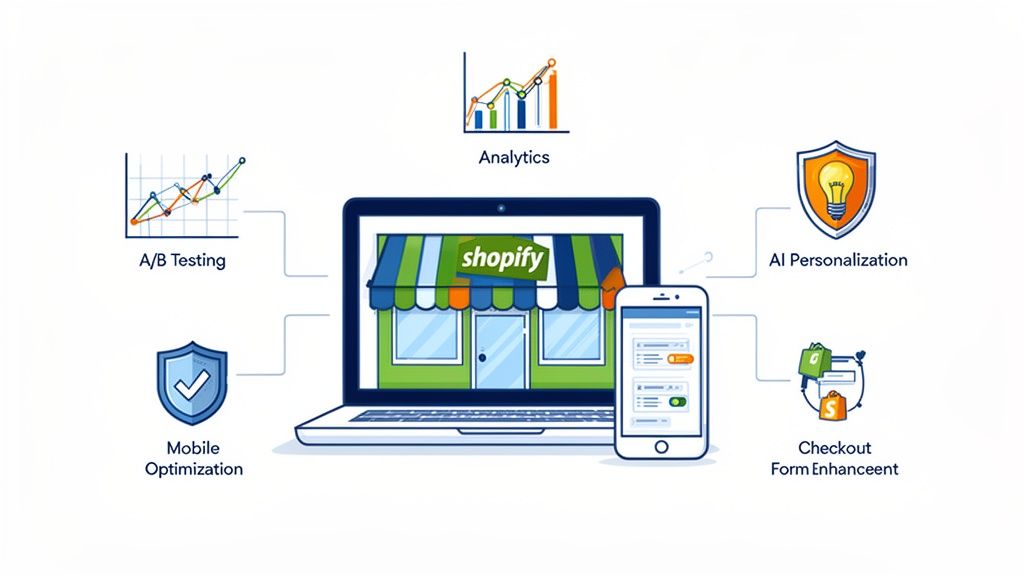
In the hyper-competitive world of eCommerce, driving traffic to your Shopify store is only half the battle. The real challenge, and the greatest opportunity, lies in turning those visitors into loyal customers. This is where a strategic approach to conversion rate optimization (CRO) becomes your most powerful asset, transforming existing traffic into measurable revenue growth without increasing your ad spend. Effective CRO means systematically improving your website experience to guide users toward a desired action, whether it's making a purchase, signing up for a newsletter, or adding an item to their cart.
This guide cuts through the noise to deliver a comprehensive roundup of essential conversion optimization best practices, specifically tailored for ambitious Shopify merchants. We will move beyond generic advice and dive deep into actionable frameworks, proven tactics, and the latest AI-driven strategies that separate thriving brands from the rest. You will learn how to implement a culture of continuous A/B testing, dissect your conversion funnel for critical drop-off points, and significantly reduce checkout friction.
Furthermore, we'll explore the nuances of persuasive copywriting, building unshakeable trust with social proof, and leveraging advanced personalization to create unique customer journeys. To truly unlock your Shopify store's full potential, a dedicated focus on optimizing every stage of the customer journey is essential. For additional foundational strategies, you can explore these 7 proven techniques to boost sales to complement the advanced practices covered here. This list provides a clear roadmap to boosting your revenue and scaling your brand effectively.
1. A/B Testing, Multivariate Testing & Continuous Testing Culture
At the heart of any successful conversion optimization best practices framework lies a commitment to data-driven decision-making, not guesswork. A/B testing, which compares two versions of a webpage (an "A" control and a "B" variation) to see which performs better, is the foundational tactic. By showing each version to a segment of your audience, you can definitively measure which one drives more conversions, whether that’s a click, a purchase, or a sign-up.
Beyond simple A/B tests, advanced methodologies like understanding and implementing complex strategies such as multivariate testing allow you to test multiple variables simultaneously. For example, you could test two different headlines, three call-to-action buttons, and two images all at once to find the highest-performing combination.
However, the tools are only part of the equation. The true goal is to build a continuous testing culture. This means moving from occasional, ad-hoc tests to a systematic process of hypothesizing, experimenting, learning, and iterating. Companies like Amazon and Netflix live by this, running thousands of tests annually to compound small wins into massive revenue gains.
How to Implement a Testing Culture
To effectively integrate testing into your operations, follow a structured approach:
- Prioritize High-Impact Pages: Start with pages that have the most traffic and a direct impact on revenue, such as your homepage, product detail pages (PDPs), and checkout flow.
- Formulate a Clear Hypothesis: Every test should begin with an "If I change [X], then [Y] will happen because of [Z]" statement. This clarifies your goal and rationale.
- Ensure Statistical Significance: Don’t end tests prematurely. Aim for at least 95% statistical confidence and run the test for a full business cycle (typically 1-2 weeks) to account for daily traffic variations.
- Document Everything: Create a central repository or knowledge base to log every test, its hypothesis, the results, and key learnings. This prevents re-running failed tests and builds institutional knowledge.
By adopting this disciplined approach, you can systematically de-risk changes and ensure every optimization is a step forward. For a deeper dive into setting up experiments specifically on Shopify, explore this guide on how to run effective A/B tests.
2. Conversion Funnel Analysis and Optimization
Understanding the customer journey is fundamental to improving it. Conversion funnel analysis is the process of mapping and measuring the path visitors take from their first interaction, like landing on a product page, all the way to a successful purchase. By visualizing this journey, you can pinpoint exactly where potential customers are dropping off, allowing you to fix the leaks that are costing you sales. This diagnostic approach moves beyond guesswork and focuses on addressing specific, quantifiable friction points.
For example, a high-end fashion retailer might use funnel analysis to discover a significant spike in cart abandonment right when shipping costs are revealed. This insight could lead them to test a free shipping threshold, potentially recapturing a large percentage of lost orders. Similarly, a Shopify Plus brand might find a 40% drop-off at the payment selection stage, prompting them to integrate more popular payment gateways like Apple Pay or Shop Pay to streamline the checkout process.
This method is crucial because it provides a clear roadmap for your optimization efforts. Instead of randomly testing elements, you focus your resources on the weakest links in the chain, where improvements will have the greatest impact on your bottom line. It's one of the most effective conversion optimization best practices for identifying high-impact opportunities.
How to Implement Funnel Analysis
To effectively analyze and optimize your funnel, follow a structured process:
- Define and Track Funnel Stages: Map out the critical steps in your buyer’s journey (e.g., viewed product, added to cart, initiated checkout, entered shipping, selected payment, completed purchase). Use tools like Google Analytics 4 or native Shopify analytics to set up and track events for each stage.
- Segment Your Data: Don't just look at the overall funnel. Segment your analysis by traffic source, device type, and new vs. returning visitors to uncover more specific insights. You might find that mobile users drop off at a different stage than desktop users.
- Identify Major Drop-Off Points: Analyze the data to find the biggest leaks. A large drop-off between adding an item to the cart and initiating checkout suggests a problem with the cart page or a confusing next step.
- Formulate a Hypothesis and Test: Once you identify a problem area, develop a hypothesis for a fix. For the shipping cost example, the hypothesis would be: "If we offer free shipping on orders over $100, then cart abandonment at the shipping stage will decrease because the perceived value will outweigh the cost." A/B test your proposed solution to validate its impact.
3. User Experience (UX) and Page Speed Optimization
A seamless user experience (UX) is the bedrock of high-converting websites. It encompasses everything from intuitive navigation and clear visual design to site accessibility. A critical, non-negotiable component of modern UX is page speed. In an era of shrinking attention spans, even a minor delay can cause a potential customer to abandon their cart and your site entirely. Slow load times frustrate users, damage brand perception, and directly harm your bottom line.
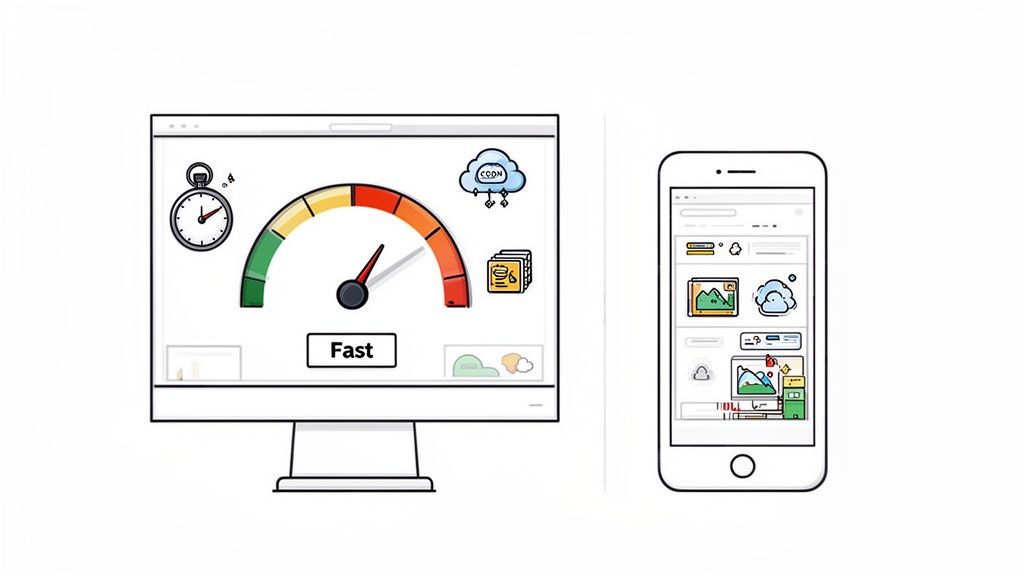
The impact of speed on revenue is well-documented. Amazon famously found that a 100-millisecond delay costs them 1% in sales, a figure echoed by Walmart's findings. Recognizing this, Google has made page experience, measured by Core Web Vitals, a significant ranking factor. Fast, responsive sites not only convert better but also rank higher, creating a powerful flywheel for growth. This is why optimizing for speed is a fundamental aspect of any serious conversion optimization best practices strategy.
For a comprehensive look at how these metrics impact user perception, this video offers valuable insights:
How to Implement Speed and UX Enhancements
Improving your site's performance involves a systematic approach to identifying and eliminating bottlenecks:
- Benchmark and Monitor Performance: Use tools like Google's PageSpeed Insights and Shopify's built-in speed report to get a baseline score. Regularly monitor Core Web Vitals: Largest Contentful Paint (LCP), First Input Delay (FID), and Cumulative Layout Shift (CLS).
- Optimize All Media Assets: Compress images before uploading them, ideally using modern formats like WebP. Implement lazy loading for images and videos below the fold so they only load as the user scrolls down.
- Audit Themes and Apps: Choose a lightweight, performance-optimized Shopify theme. Regularly audit your installed apps and remove any that are unused or slow down your site, as their scripts can significantly increase load times.
- Leverage a Content Delivery Network (CDN): Shopify includes a world-class CDN (powered by Cloudflare) by default. Ensure your theme is configured to serve assets like images, CSS, and JavaScript from it to reduce latency for global customers.
4. Persuasive Copywriting and Value Communication
Your product features tell customers what your product does, but persuasive copywriting tells them what it does for them. This critical distinction is at the core of effective value communication. It’s the art of using words to articulate a clear, benefit-focused value proposition, anticipate and address customer objections, and deploy emotional and logical triggers to motivate action. Strategic copy on product pages, calls-to-action (CTAs), and checkout flows builds confidence and clarity, directly reducing friction and increasing conversions.
Beyond just describing products, great copy creates a narrative that resonates with the target audience. Brands like Dollar Shave Club mastered this with irreverent, benefit-driven messaging that fueled explosive subscription growth. Their copy wasn't about the razor's steel; it was about the convenience and savings. This approach shifts the focus from the "what" to the "so what," answering the customer's unspoken question: "Why should I choose this?"
Ultimately, your copy is your 24/7 salesperson. Investing in strong, persuasive language is one of the highest-leverage conversion optimization best practices you can implement. Many successful Shopify stores have seen conversion lifts of 15-25% through rigorous copy optimization alone, proving that the right words can be just as impactful as a site redesign.
How to Implement Persuasive Copywriting
To transform your site’s text into a conversion engine, focus on a structured and customer-centric approach:
- Lead with the Primary Benefit: Your headlines and opening lines should immediately communicate the most compelling outcome for the customer. Support this primary benefit with features, not the other way around.
- Use Power Words and Action-Oriented Language: Replace passive phrases with dynamic verbs. Words like ‘Unlock,’ ‘Discover,’ ‘Transform,’ and ‘Guarantee’ create urgency and inspire action in your CTAs and descriptions.
- Incorporate Social Proof: Weave testimonials, user counts, and review snippets directly into your product copy. Placing a positive customer quote next to the "Add to Cart" button can be incredibly effective.
- Address Objections Head-On: Use your copy to proactively answer common questions about shipping costs, return policies, or product guarantees. This builds trust and removes hesitation right at the point of decision.
- Optimize for Readability: Keep sentences short and scannable. Use bullet points for product features and benefits, ensuring mobile users can quickly grasp the key information without being overwhelmed by dense text blocks.
5. Checkout Optimization and Friction Reduction
The checkout process is the final and most critical step in the customer journey; it's where revenue is either captured or lost. Checkout optimization focuses on streamlining this process by removing unnecessary steps, simplifying forms, and building trust. Even minor friction points, like a surprise shipping fee or a mandatory account creation, are responsible for a significant percentage of cart abandonment. Addressing these issues offers one of the highest returns on investment for any conversion optimization effort.
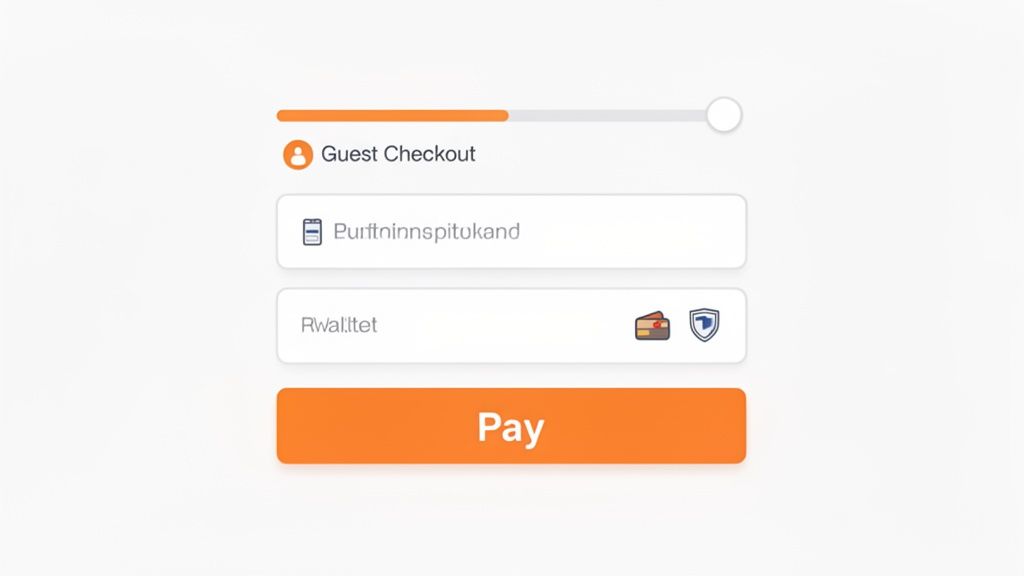
The goal is to make the transaction as seamless and transparent as possible. Amazon pioneered this with its one-click purchase, setting a high standard for user expectations. Similarly, brands that reduce form fields from 15 to just the essential 5 have seen checkout completion rates jump by 25-40%. On Shopify, the native checkout is continuously optimized, with features like Shop Pay drastically reducing friction for millions of returning shoppers across the platform.
How to Implement Checkout Optimization
To minimize friction and maximize conversions in your checkout flow, focus on these high-impact tactics:
- Offer Guest Checkout: Forcing users to create an account is a major conversion killer. Prominently display a "Guest Checkout" option. You can always ask them to create an account on the post-purchase confirmation page.
- Simplify Form Fields: Only ask for what is absolutely necessary to process the order. Leverage tools that auto-fill address and payment information to reduce manual entry and potential errors.
- Provide Payment Flexibility: Cater to user preferences by offering multiple payment methods, including major credit cards, digital wallets like Apple Pay and Google Pay, and "Buy Now, Pay Later" (BNPL) options like Afterpay or Klarna.
- Ensure Transparency: Display all costs, including shipping fees and taxes, as early as possible. Surprise charges are the number one reason for cart abandonment. Use a progress bar to show users where they are in the process.
6. Social Proof and Trust Building
In eCommerce, trust is the ultimate currency. Shoppers are inherently skeptical, especially when encountering a new brand, and overcoming this barrier is a critical conversion optimization best practice. Social proof leverages the psychological principle that people conform to the actions of others under the assumption that those actions are the correct behavior. By showcasing positive reviews, testimonials, and user-generated content, you reduce purchase anxiety and build credibility.
This isn't just theory; it has a direct revenue impact. Brands like Glossier built their empires on user-generated content, leading to conversion rates over 40% higher than campaigns without it. Similarly, simply adding a trusted review app like Yotpo or Judge.me to a Shopify store can result in a 15-25% lift in conversions, demonstrating the power of external validation.

Beyond reviews, trust signals like security badges, money-back guarantees, and recognizable payment logos (Visa, PayPal) act as instant credibility boosters. These elements reassure visitors that their data is safe and their purchase is risk-free, which is especially vital during the checkout process where cart abandonment rates are highest.
How to Implement Social Proof and Trust Signals
To effectively weave these elements into your customer journey, focus on a multi-layered strategy:
- Automate Review Collection: Use Shopify apps like Loox or Judge.me to automatically send post-purchase emails requesting reviews. Offer a small incentive, like a 10% discount on a future purchase, to increase submission rates.
- Showcase Reviews Prominently: Don’t hide your reviews. Display star ratings and review counts directly below the product title on both collection and product pages. Feature detailed, high-quality testimonials on your homepage and landing pages.
- Encourage User-Generated Content (UGC): Create a branded hashtag and encourage customers to share photos of your products on social media. Feature the best submissions in a dedicated gallery on your product pages to provide authentic, real-world context.
- Deploy Trust Badges Strategically: Place security badges (e.g., McAfee Secure, Norton) and payment logos in your site footer and throughout the checkout process. A "30-Day Money-Back Guarantee" badge near the 'Add to Cart' button can significantly reduce hesitation.
7. Personalization and Segmentation
Moving beyond a one-size-fits-all approach is crucial for modern eCommerce. Personalization tailors the shopping experience to individual users based on their behavior, demographics, and purchase history. Segmentation, a related concept, groups users with similar characteristics, allowing you to deliver highly relevant messaging, offers, and product recommendations that resonate on a deeper level.
This strategy transforms the user journey from a generic interaction into a curated conversation. By showing customers what they are most likely to want, you reduce friction, increase relevance, and significantly boost engagement. Giants like Amazon, whose recommendation engine drives a huge portion of its sales, have proven the immense power of this tactic. For Shopify brands, this level of sophistication is more accessible than ever through integrated apps and platforms.
Implementing personalization is one of the most effective conversion optimization best practices because it directly addresses user intent. When a shopper feels understood, their trust in your brand deepens, leading to higher average order values, improved customer loyalty, and ultimately, a better conversion rate. It shifts the focus from just selling products to building relationships.
How to Implement Personalization and Segmentation
To effectively personalize the customer experience, begin with a foundational strategy and expand from there:
- Start with Basic Segmentation: Begin by grouping your audience in your email platform, like Klaviyo. Create segments for new vs. returning customers, high-value purchasers, or users who have viewed specific product categories.
- Leverage Product Recommendations: Use Shopify apps like Nosto or Genius to add personalized product recommendation blocks to your homepage, product pages, and cart. Test different algorithms, such as "Frequently Bought Together" or "Products You May Like."
- Implement Behavioral Targeting: Show dynamic content or pop-ups based on user behavior. For example, use an exit-intent offer with a specific discount for a user who has an item from a high-margin category in their cart.
- Personalize Email Campaigns: Go beyond using just a first name. Create dynamic email campaigns that automatically pull in products a user has recently viewed or abandoned in their cart. This hyper-relevant content dramatically increases click-through and conversion rates.
8. Mobile Optimization and Responsive Design
With the majority of eCommerce traffic originating from smartphones and tablets, a mobile-first approach is no longer optional; it's a fundamental requirement for survival and growth. Mobile optimization is the practice of ensuring your site delivers a seamless, intuitive, and fast experience on smaller screens. This involves more than just a shrunken-down desktop site; it requires responsive layouts, touch-friendly interfaces, and streamlined navigation designed specifically for on-the-go users.
A poor mobile experience is one of the fastest ways to lose a potential customer. Brands that neglect this critical part of their conversion optimization best practices can see mobile conversion rates plummet, often losing over half of their potential sales from this channel. Conversely, successful Shopify brands frequently report that over 50% of their total revenue comes directly from mobile devices, a testament to the power of a well-executed mobile strategy.
The goal is to eliminate friction at every touchpoint of the mobile journey. From initial product discovery on a social app to a one-tap purchase using a mobile wallet, the entire flow must be effortless. Companies like Pinterest and Instagram have built entire eCommerce ecosystems on a mobile-first foundation, demonstrating that a dedicated mobile focus can unlock immense commercial success.
How to Implement Mobile Optimization
To ensure your store is fully optimized for mobile users, focus on these core areas:
- Prioritize a Mobile-First Theme: Start with a Shopify theme built with a strong mobile foundation. Always test demos on actual devices, not just your desktop browser's mobile view, to get a true feel for the user experience.
- Design for Touch: Ensure all buttons, links, and interactive elements have large touch targets, with a recommended minimum size of 44x44 pixels. This prevents frustrating mis-taps and improves usability.
- Streamline Mobile Checkout: Simplify the checkout process by minimizing form fields and integrating mobile wallets like Apple Pay, Google Pay, and Shop Pay. This dramatically reduces the effort required to complete a purchase.
- Optimize for Speed: Mobile users are notoriously impatient. Compress images, minimize redirects, and leverage browser caching to ensure your pages load quickly, even on slower 3G networks. Monitor your mobile Core Web Vitals in Google Search Console to identify performance bottlenecks.
9. Email Marketing and Automation
Email marketing remains one of the highest ROI channels in eCommerce, serving as a direct line to your customers for nurturing relationships and driving sales. By implementing automated email sequences, you can send timely, relevant messages triggered by specific user actions. This transforms email from a simple broadcast tool into a personalized engine for recovering lost sales, welcoming new subscribers, and encouraging repeat business.
The power of this strategy lies in its ability to deliver the right message at the right moment. For instance, abandoned cart emails can recover a significant percentage of otherwise lost revenue, while welcome sequences capitalize on the initial interest of a new subscriber to drive their first purchase. Platforms like Klaviyo have popularized this for Shopify stores, demonstrating how targeted automation can generate returns that far exceed other marketing channels.
This approach is a cornerstone of effective conversion optimization best practices because it focuses on maximizing the value of every visitor, not just acquiring new ones. It builds a sustainable loop of engagement and repeat purchases.
How to Implement Email Automation
To build an effective email automation strategy, focus on key customer journey touchpoints:
- Implement an Abandoned Cart Sequence: This is non-negotiable. Set up a series of 2-3 emails sent over 24-72 hours after a cart is abandoned. The first can be a simple reminder, the second can address common objections, and a third could offer a small incentive.
- Create a Robust Welcome Series: Greet new subscribers with a 3-5 email sequence. Use it to introduce your brand story, showcase best-selling products, offer an initial discount, and set expectations for future communication.
- Segment Your Audience: Don't send the same message to everyone. Create segments based on purchase history, engagement level, and browsing behavior. This allows for highly personalized and effective campaigns, from VIP offers to re-engagement emails.
- Optimize and Test: Continuously test everything: subject lines, send times, email content, and calls-to-action. Monitor key metrics like open rates, click-through rates, and conversion rates to refine your strategy.
- Balance Promotion and Value: Follow the 80/20 rule. Ensure 80% of your content provides value (tips, brand stories, user-generated content) while only 20% is directly promotional to avoid list fatigue.
10. Strategic Use of AI and Machine Learning for Optimization
Artificial intelligence (AI) and machine learning are no longer futuristic concepts; they are essential tools in modern conversion optimization best practices. These technologies move beyond manual A/B testing by automating personalization, predicting user behavior, and uncovering complex patterns in data. By analyzing thousands of data points in real time, AI can deliver dynamic experiences that are impossible to create manually, from personalized product recommendations to optimized pricing.
Platforms like Dynamic Yield and Nosto use AI to power sophisticated personalization, resulting in conversion lifts between 15-30% by showing the right product to the right user at the right time. Likewise, AI-driven dynamic pricing tools can adjust prices based on demand, inventory, and competitor activity, often boosting revenue by 5-15%. This level of automation allows eCommerce brands to scale their optimization efforts far beyond what human analysts can manage alone.
The goal is to leverage AI not as a replacement for human strategy but as a powerful amplifier. It automates routine tasks, surfaces high-impact opportunities, and provides the data-driven foundation for smarter, faster decisions. Companies that integrate AI into their CRO workflow gain a significant competitive advantage by creating more relevant and compelling customer journeys.
How to Implement AI in Your Optimization Strategy
To strategically integrate AI into your eCommerce operations, focus on practical, high-impact applications first:
- Start with Built-in Tools: Leverage Shopify's native AI features like Shopify Magic and Sidekick. These tools can help automate product description writing, generate marketing copy, and provide business insights, offering a low-barrier entry point to AI.
- Enhance Customer Support: Implement AI-powered chatbots from providers like Gorgias or Tidio to offer 24/7 customer support, answer common questions instantly, and guide users toward a purchase, freeing up human agents for more complex issues.
- Automate Personalization: Use AI-driven recommendation engines such as Nosto or Dynamic Yield to personalize the shopping experience. These tools can power product recommendations, personalize on-site search results, and tailor content to individual user behavior, often leading to a 10-30% higher AOV.
- Audit and Monitor: Regularly review the outputs and decisions made by your AI systems to check for accuracy, relevance, and potential bias. Combine AI-generated insights with human judgment to ensure the technology aligns with your brand values and business goals.
By starting with these targeted applications, you can build a scalable AI framework that drives meaningful improvements. To explore this topic further, check out this guide on how to use AI in eCommerce.
10-Point Conversion Optimization Comparison
From Best Practices to Best Performance
Navigating the landscape of conversion optimization can feel like an overwhelming task. We've explored a comprehensive suite of ten critical areas, from the foundational principles of A/B testing and funnel analysis to the advanced frontiers of AI-driven personalization and mobile-first design. Each of these pillars represents not just a tactic, but a fundamental shift in how you approach your relationship with your customers.
The journey from a standard Shopify store to a high-converting eCommerce powerhouse is not achieved through a single, magical change. Instead, it's the result of a persistent, iterative process. The most successful brands understand that mastering conversion optimization best practices is less about finding a secret formula and more about building a culture of continuous improvement, curiosity, and customer-centricity.
Synthesizing Strategy: Your Path Forward
As you reflect on the strategies discussed, it's crucial to avoid analysis paralysis. The key is to transform this knowledge into a tangible action plan. Don't try to implement everything at once. Instead, adopt a prioritized approach that aligns with your specific business goals and resources.
Your immediate next steps should focus on establishing a strong foundation:
- Audit Your Analytics: Before you change anything, ensure your data is clean and your KPIs are clearly defined. You cannot optimize what you cannot accurately measure. Revisit your Google Analytics 4 setup and Shopify Analytics to confirm you are tracking the right events.
- Identify the "Leakiest Bucket": Use funnel analysis to pinpoint the single biggest drop-off point in your customer journey. Is it the product discovery phase, the cart-to-checkout transition, or the final payment step? Focus your initial efforts there for the most significant impact.
- Launch Your First High-Impact Test: Select one meaningful hypothesis based on your data. This could be simplifying your checkout form, rewriting your primary call-to-action, or testing a new headline on a high-traffic product page. The goal is to build momentum and prove the value of a testing mindset.
The True Value of Optimization: Beyond the Conversion Rate
While the primary metric is the conversion rate, the benefits of a robust CRO program extend far deeper. By systematically improving your user experience, you are not just coaxing a user to click "buy." You are building a brand that customers trust, enjoy interacting with, and want to return to.
A higher conversion rate is the symptom of a better customer experience. When you solve for the customer by reducing friction, clarifying your value, and building trust, increased revenue becomes the natural outcome.
This commitment to the customer experience creates a powerful flywheel effect. Improved usability leads to better engagement, which in turn fosters customer loyalty and increases lifetime value. Positive experiences generate stronger social proof through reviews and word-of-mouth referrals, lowering your customer acquisition costs over time. Ultimately, a deep-seated optimization culture transforms your business from being merely reactive to proactively anticipating and meeting customer needs. It's a strategic investment that pays dividends across every facet of your eCommerce operation, creating a more resilient and profitable brand. Your dedication to implementing these conversion optimization best practices is what will separate you from the competition, turning fleeting visitors into lifelong advocates.
Ready to move from theory to tangible results? Implementing a world-class CRO program requires dedicated expertise and resources. The team of Shopify specialists at ECORN can help you build and execute a data-driven optimization roadmap, from A/B testing to AI integration. Schedule a free consultation to see how our flexible subscription packages can accelerate your growth. Find out more at ECORN.


Mobile Pop Up Strategy for Shopify Stores That Converts
Sitemap for Shopify: How to Find, Optimize, and Submit It
7 Single Product Websites Worth Emulating
Product Variants Shopify: The Complete 2026 Guide
Ecommerce Analytics Consulting for Growth
What Is AI Integration for eCommerce
How to Choose the Right eCommerce Website Development Firm
E Business Strategy Implementation
Conversion Tracking Setup for Shopify Stores
BigCommerce vs Shopify Plus Which Enterprise Wins in 2026
Shopify Theme Kit: Setup, Commands, and Migration Guide
Shopify Extension Development: A Practical 2026 Guide
Shopify Speed Score Explained and How to Improve It
Shopify Mobile Optimization: The 2026 Playbook
How to Add Subcategory in Shopify for Better UX
How to Implement Structured Data for Ecommerce in 2026
SEO App Mobile: Shopify Store Optimization Guide
Shopify Plus Support: What It Includes and How to Choose
Google Ads for Shopify: The Complete 2026 Playbook

Shopify New York: How to Find and Hire the Right Agency
Google Search Console for Shopify: The Complete Setup
First Party Data Collection for eCommerce Growth
FAQ Online Store Guide: Build and Measure It Right
Do FB Ads Work for eCommerce in 2026?

One Page Checkout for Shopify: Design and Implementation
Shopify GraphQL vs REST: The 2026 Developer Decision
Shopify Ecommerce Consulting: Strategy, Pricing &

Are Reddit Ads Worth It for eCommerce Brands

Shopify Title and Meta Description: A Practical 2026 Guide

Product Video Best Practices for Shopify Brands
Real-Time Inventory Management: A 2026 Guide
AI Chatbot Integration for Shopify Stores
Affiliate Program Management: A Shopify Guide
10 Best Performance Monitoring Tools for Shopify in 2026
Digital Asset Management for eCommerce Brands in 2026
Every Type of Facebook Ads Explained for eCommerce Growth
Product Information Management Explained for Shopify Brands
Support Ticket System: A Guide for Shopify Stores

10 Best Customer Service Tools for Shopify in 2026

Can I Start a Business with No Money? a 2026 Blueprint

What Sells Good on Etsy: Best Niches for 2026

Shopify Add to Cart Button: A Practical 2026 Guide

Customer Feedback Automation: A Practical eCommerce Guide
Critical Rendering Path: A Guide for Shopify Stores

How to Promote on TikTok for eCommerce in 2026

B2B eCommerce Consulting That Drives Real Revenue
10 Best Practices for Site Navigation in 2026
Return vs Refund for Shopify Stores: A Practical Guide
What Is Customer Lifetime Value and Why It Matters
What Is Voice of Customer Research for eCommerce

SMS Marketing for Ecommerce That Actually Converts

Master How to Improve Email Deliverability in 2026

Top 7 eCommerce Partners NYC for Shopify Brands in 2026
Machine Learning for Ecommerce: Boost Your Shopify Store

Beauty Market Research: Your 2026 Growth Guide

Shopify International Expansion: A 2026 Roadmap
What Does CRO Stand for in Business: Understanding CRO

Shopify Visual Merchandising: A Playbook for Higher Sales

Shopify Landing Page Design: Master Conversion in 2026
10 Best AI SEO Optimization Tools for Shopify in 2026

Agentic AI for Ecommerce: Boost Your Sales in 2026
Mastering Email Marketing Data for eCommerce Growth
Conversion Rate Optimisation Australia: Boost Your Sales
Conversion Rate Optimization AI: Your Shopify Store Guide

10 Product Bundling Strategies for Shopify in 2026
How to Increase Customer Lifetime Value: A Shopify Playbook
AI Customer Service Automation: Shopify Guide 2026

Clean Website Design: A Shopify Conversion Playbook

Omnichannel Retail Strategy: A Shopify Playbook
Product Data Enrichment: A Guide for Shopify Brands

Instagram Shopping Features a Guide for Shopify Stores
What Is Revenue Optimization: A Holistic RevOps Guide
Benefits of Conversion Rate Optimization: Boost Your
WordPress to Shopify Migration: Your 2026 Seamless Switch
Boost Sales: Ecommerce Payment Processing Guide 2026
Unified Commerce Platform: Benefits, KPIs & Shopify Guide
How to Reduce Bounce Rate eCommerce: Your 2026 Guide
Shopify API Integration: A Practical End-to-End Guide

How to Implement Data Governance: A 2026 Guide
Shopify Store Development Cost: A 2026 Breakdown
What Is Server Side Tracking: The Shopify Guide 2026
Marketing Automation Workflows: A Shopify Guide for 2026

Shopify: How to Reduce Technical Debt

Shopify UX Design Change: A Playbook for Growth
User Generated Content Strategy: Shopify Playbook
Shopify Pause and Build Plan Cost: A Complete 2026 Guide
Compare at Price on Shopify: A Complete Guide for 2026

Where Can I Sell My Prints? 10 Best Platforms for 2026
Shopify Order Management System: The Ultimate Guide 2026
What Is Marketing Attribution? an eCommerce Guide for 2026

10 Best Black Friday Sales Sheets for 2026

Discover the Top Social Media Marketing Agencies For
Consumer Confidence Definition for eCommerce in 2026
What Is Social Commerce? Your 2026 Guide to Boosting Sales
A Social Ad Campaign Playbook for eCommerce Growth

7 Best FAQ Page Examples for SaaS & eCommerce

Market Research in Fashion Industry: A Guide for Shopify

Shopify Migration Services: Expert Guide for 2026

Mastering FB Retargeting Ads for Shopify in 2026
What Is Omnichannel Ecommerce


newsletter in your inbox