

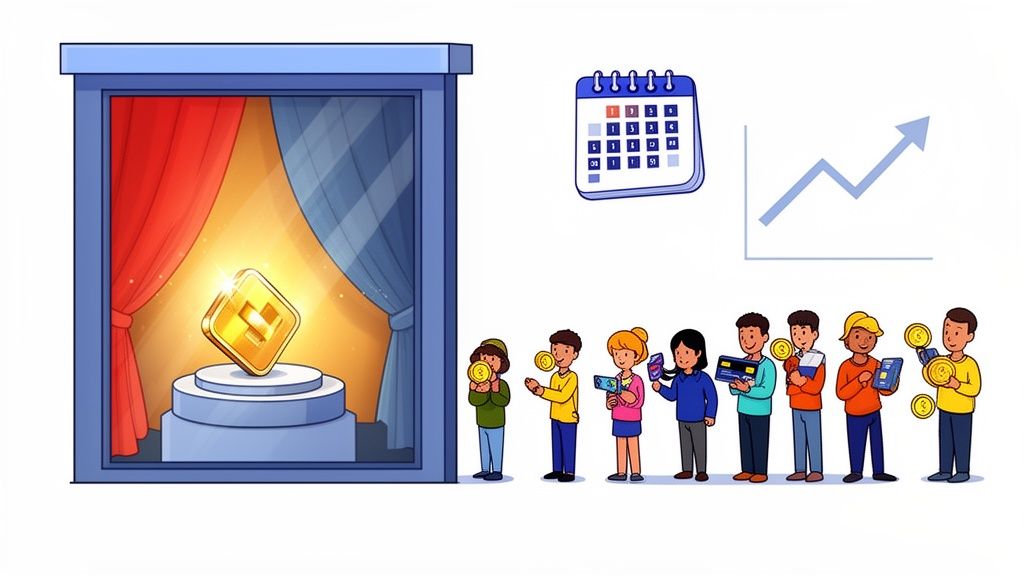
At its heart, a pre-order is simply an order a customer places for an item that isn’t available yet. This could be because it hasn’t been manufactured or officially released. Essentially, customers pay now to get their product later, locking in their purchase before anyone else.
The True Meaning of a Pre Order in Ecommerce
Let's cut through the fluff. A pre-order is way more than just another sale. For modern brands, it's a powerful strategic tool to prove a product idea is a winner, generate cash flow before you've even made the thing, and build a real community around an upcoming launch.
Think about it like tickets for a massive concert or the release of a blockbuster video game. Fans eagerly buy their spot or reserve their copy months ahead of time. This creates a huge wave of excitement and brings in revenue long before the big day arrives. That’s the kind of energy a pre-order brings to your product launch, turning a standard release into an exclusive event.
For the customer, it's a simple guarantee: they won't miss out. For your business, it’s a direct signal from the market that you've hit on something people genuinely want to buy.
Key Attributes of a Pre Order
So, what makes a pre-order a pre-order? It all boils down to a few core ideas that set it apart from your everyday purchase:
- Future Fulfillment: The core promise is that the product will be shipped out on a specific date in the future.
- Upfront Payment: Customers pay in full when they place the pre-order, not when the item is ready to ship.
- Demand Validation: It’s the ultimate real-world test. You confirm genuine customer interest before sinking money into a massive production run.
- Exclusivity and Hype: Pre-orders often come with perks like special pricing or bonus gifts, making those first customers feel like VIPs and fueling the excitement.
A well-executed pre-order campaign does so much more than just lock in sales. It builds a story and invites customers to be part of your product’s journey, from a simple concept to a real, tangible item. That shared experience creates a level of brand loyalty a normal transaction just can't match.
At the end of the day, a pre-order is a powerful exchange of trust. Your customer trusts you to deliver an amazing product on time. In return, you get the financial backing and marketing buzz needed to make your launch a massive success.
Here's a quick summary of what makes a pre-order tick.
Pre Order At a Glance
The table below breaks down the essential components of a pre-order strategy, giving you a quick reference for how it works.
Understanding these basics is the first step. When used correctly, pre-orders can be a game-changer for managing inventory, cash flow, and building a loyal customer base.
Pre Order vs Backorder What Is the Difference
In the world of eCommerce, it's easy to see terms like pre-order and backorder and assume they mean the same thing. But mixing them up is a critical mistake—one that can lead to confused customers and logistical nightmares behind the scenes.
Getting this right is all about setting clear expectations and managing your inventory like a pro.
The core difference really comes down to the product's history. A pre-order is always for a brand-new product, something that has never hit the shelves before. It’s a chance for your most eager customers to get their hands on an item before its official release.
On the other hand, a backorder is for an existing product in your catalog that's just temporarily out of stock. Customers can still buy it, but they know there will be a short delay until you’ve restocked.
Core Differences in Strategy
Think of it this way: pre-ordering the next-generation video game console is the classic example. It's a totally new device that isn't even on the market yet. But ordering that popular blue hoodie that sold out last week? That’s a backorder. The hoodie exists; it’s just waiting on the next shipment.
This simple decision tree can help customers figure out if waiting on a pre-order makes sense for them.
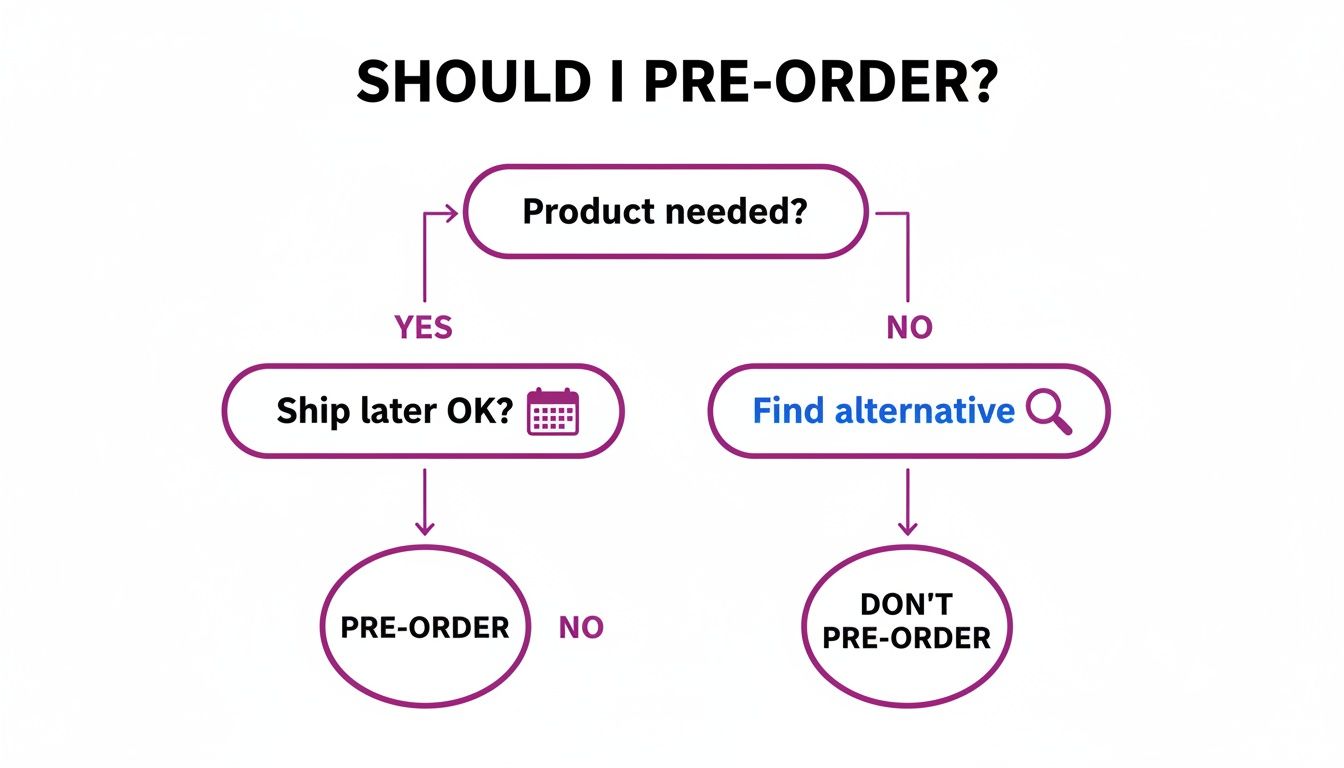
As you can see, the key factor for a customer is simply their willingness to wait. For your business, though, the distinction is all about managing future hype versus current demand.
Each of these strategies serves a completely different business goal. Pre-orders are a marketing tool used to build buzz, validate an idea, and generate cash flow for a future product. A backorder is a fulfillment tactic to avoid losing sales on a proven winner during a temporary stockout.
A Head-to-Head Comparison
To truly clarify the difference, let’s break down their defining characteristics. Each one has a distinct purpose and creates a totally different set of expectations for your customers. Grasping these nuances is crucial for any eCommerce brand.
The customer’s mindset is entirely different for each scenario. A pre-order customer is an early adopter, excited to be first. A backorder customer simply wants a product they know and love, and they're willing to wait a short time for it.
To help you decide which approach fits your situation, here's a detailed comparison table that breaks down their distinct uses and what they mean for your business.
Pre Order vs Backorder Comparison
Ultimately, choosing between a pre-order and a backorder comes down to understanding the product's lifecycle and the customer's journey. Use pre-orders to launch something new with a bang, and lean on backorders to keep the momentum going for your bestsellers, even when inventory runs low.
Strategic Benefits of a Pre Order Model
A well-executed pre-order strategy can be a complete game-changer for your brand's financial health and market position. It's about so much more than just locking in a sale early. The smartest brands use pre-orders to de-risk launches, build unstoppable momentum, and forge a stronger connection with their customers.

Right off the bat, the most obvious benefit is the massive boost to your cash flow. You're collecting revenue before the product is even made, which means you can fund production runs without taking on debt or draining your operational capital. This financial cushion fundamentally changes how you approach bringing new products to life.
Secure Revenue and Validate Demand
Generating sales upfront does more than just pay the bills—it's undeniable proof that people actually want what you're selling. Pre-orders are a fantastic tool for product-market fit validation, confirming real demand before you sink a ton of cash into inventory.
This data-driven approach takes all the guesswork out of forecasting. Instead of just estimating how many units you might sell, you have concrete numbers. This insight is absolutely crucial for a few reasons:
- You avoid overstocking. No more tying up capital and warehouse space with inventory that just won't move.
- You prevent understocking. You can meet that initial wave of demand without frustrating customers who missed out, capitalizing on all that launch day excitement.
- You inform future strategy. The sales data tells you exactly which product variations, colors, or features are the real crowd-pleasers.
What you pre-order is what you truly need. You get to make smarter, more profitable inventory decisions from day one.
Build Hype and Create Exclusivity
Think of a pre-order campaign as a powerful marketing engine. It turns a simple product release into a full-blown event, creating a sense of urgency and scarcity that really drives sales. This is a classic move in the gaming industry, where huge titles like Call of Duty offer exclusive in-game items or early beta access to people who pre-order.
The anticipation built during a pre-order window is a marketing asset in itself. It generates organic social proof and word-of-mouth buzz, effectively turning your earliest customers into your most passionate brand ambassadors.
By offering a limited-time "early-bird" discount or bundling in some exclusive add-ons, you're rewarding your most loyal fans. This makes them feel like valued insiders and deepens their connection to your brand. The excitement and community you build long before the product even ships is what it's all about.
Ultimately, all these benefits feed into each other, creating a powerful cycle of success. The upfront cash pays for production, the sales data proves the demand, and the marketing hype guarantees a strong launch—setting the stage for real, sustained growth.
How to Navigate Pre-Order Risks and Challenges
While the benefits of a pre-order campaign are huge, they’re far from a guaranteed win. Pre-orders come with their own unique set of risks, and if you mishandle them, you can burn your brand’s reputation to the ground. Getting a handle on these challenges is the first step to launching a campaign that builds trust instead of breaking it.
The single biggest threat to any pre-order is a delay. It doesn't matter if it's a manufacturing snag, a customs hold-up, or a fulfillment bottleneck on your end—falling behind schedule can turn customer excitement into pure frustration. A late product isn't just an inconvenience; to your earliest and most loyal supporters, it feels like a broken promise.
Plan for Delays and Communicate Everything
Hope is not a strategy. The real key to navigating potential delays is to build buffer time directly into your fulfillment timeline right from the very beginning.
You have to assume something will go wrong. If your supplier gives you a 30-day production window, don't turn around and promise that exact timeline to your customers. Pad it. Add a week or two for unexpected quality control issues or shipping slowdowns. This proactive cushioning is your absolute best defense against letting people down.
Transparency is completely non-negotiable. When customers pre-order, they're not just buying a product; they're buying into your brand's journey. Keeping them in the dark is the fastest way to lose every ounce of their trust. You need to over-communicate at every single stage, especially when things don’t go according to plan.
A simple, honest email explaining a minor delay is infinitely better than radio silence. You’d be surprised how understanding customers can be when they feel included and respected.
Managing Expectations and Minimizing Cancellations
Cancellations are just part of the pre-order game, but if you're seeing a high rate, it's a huge red flag that you've failed to manage customer expectations. The goal is to keep your audience engaged and confident from the second they click "buy" until the package lands on their doorstep.
To keep cancellations low and satisfaction high, you need to nail your communication strategy:
- Set Clear Timelines: Be painfully upfront with your estimated shipping date on the product page. Use language like "Expected to ship in late October" instead of promising a single, rigid date you might not be able to hit.
- Send Regular Updates: Don’t just get in touch when there's bad news. Send periodic updates that celebrate production milestones. A quick email with a photo of the first units coming off the assembly line can reignite excitement and reinforce their decision to back you.
- Make Cancellation Easy: Nothing creates an angry ex-customer faster than a difficult cancellation process. Make your policy crystal clear and simple to follow. It shows you stand behind your brand and builds trust, even if someone changes their mind.
By planning for the worst and prioritizing communication, you can transform potential pitfalls into opportunities to build even stronger, more loyal relationships with your customers.
Setting Up Your Winning Shopify Pre-Order Campaign
Launching a great pre-order campaign is part art, part science. You need a tactical approach that builds both trust and excitement the second a potential customer hits your product page. For Shopify merchants, this whole process is a lot less daunting thanks to a handful of powerful apps built specifically for managing pre-orders.

First things first, you need to pick the right tool for the job. Apps like Pre-Order Now, Pre-Order Manager, or Timesact plug right into your store, letting you easily swap the standard "Add to Cart" button for a "Pre-Order" one. These tools handle all the technical heavy lifting, freeing you up to focus on what really matters: crafting an offer that turns casual browsers into committed buyers.
Optimizing Your Product Page for Conversions
Your product page is the heart and soul of your campaign. Since customers can't see or touch the item yet, your page has to do all the work to build confidence and create that "I need this now" feeling. This is where high-quality mockups and detailed product renders become absolutely essential, giving shoppers a crystal-clear vision of what's coming.
And your product description? It needs to be more than just a list of features—it has to tell a story. Explain why you're launching this as a pre-order and what makes it so special. Be radically transparent about your timelines.
The single most critical element on your pre-order page is a bold, impossible-to-miss estimated shipping date. Vague promises like "coming soon" just create uncertainty and will absolutely tank your conversions. Instead, be specific: "Expected to ship the week of November 15th."
This kind of clarity manages expectations right from the start, which is the foundation of a great customer experience. With mobile orders expected to account for 63% of all online sales by 2026, making sure this information is front and center on every device isn't just a good idea—it's critical.
Crafting an Irresistible Pre-Order Offer
Now, let's talk strategy. A killer pre-order offer gives customers a compelling reason to buy now instead of waiting. The goal is to reward your earliest supporters and build a genuine sense of urgency. For a deep dive into the nuts and bolts, check out our complete guide to setting up a pre-order on Shopify.
Here are a few proven tactics that just plain work:
- Early-Bird Discount: This one is simple but effective. Offer a limited-time discount (say, 15% off) just for pre-order customers. It's often the only nudge people need to pull the trigger.
- Exclusive Bundles: Package the pre-order item with a related product or a special freebie that won't be available after the official launch. This instantly increases the perceived value of ordering early.
- Tiered Rewards: Get creative by offering different pre-order levels. Think about how video games launch—a basic tier gets the product, while a deluxe tier might include exclusive merch or bonus content.
When you combine a smooth technical setup with a beautifully optimized product page and an offer they can't refuse, you create an experience built on trust. This is how you turn passive interest into a community of committed customers, fueling a successful launch before your inventory even hits the warehouse.
Mastering Pre-Order Communication and Fulfillment
The moment a customer hits "complete pre-order," a new kind of clock starts ticking. That gap between taking their money and shipping their product is the ultimate test of your brand's credibility. Nail it, and you’ve just created a customer for life. Fumble it, and you risk turning your biggest fans into your loudest critics.
Getting this right comes down to two things: crystal-clear communication and rock-solid fulfillment. Your job isn't just to ship a box. It's to guide your customers through the journey, making them feel like they made a smart bet on your brand's future.
A proactive communication plan is what separates the pros from the amateurs who don't fully grasp what a pre-order means for customer trust.
Crafting Your Communication Cadence
Going silent after taking someone's money is the fastest way to kill a pre-order campaign. You need a simple, structured plan to keep excitement high and buyer's remorse low. Think of it as telling a story over time, where each chapter reminds them why they were so excited to buy in the first place.
Your communication should follow a clear, three-part rhythm:
- The Instant Confirmation: This email needs to land in their inbox immediately. It should confirm their order, repeat the estimated shipping window you promised, and offer a genuine thank you for their early support. It’s all about providing instant peace of mind.
- Regular Progress Updates: Don't just get in touch when there's a problem. Send updates every couple of weeks to share good news and celebrate milestones. A quick email with a behind-the-scenes photo of the first production run can do wonders for building goodwill and keeping that initial excitement alive.
- The "It's Shipped!" Notice: This is the big one. The moment that label is printed, send a clear, celebratory email with the tracking information.
When you treat pre-order customers like VIP insiders, you change the entire dynamic. The wait is no longer a frustrating delay; it becomes an exclusive experience. This simple shift in perspective transforms passive buyers into a real community of fans who feel connected to your product's story.
Preparing for Flawless Fulfillment
While your emails are managing expectations, your logistics have to deliver on the reality. You absolutely must have your fulfillment process dialed in before the inventory even hits your warehouse. The goal is to get those boxes out the door the second they're ready.
If you’re looking to get your shipping operations in order, checking out a resource like Australia's ultimate courier guide for e-commerce stores can provide a solid framework. This kind of prep work is non-negotiable for a smooth launch. For a deeper dive into the mechanics, you can also explore our article explaining how do preorders work from a logistical perspective.
Master both communication and fulfillment, and you won’t just make a sale. You'll deliver on the promise of your pre-order and earn a customer's trust for the long haul.
Your Top Pre-Order Questions Answered
When you're thinking about running a pre-order campaign, a few common questions always pop up. Let's tackle them head-on.
Can I Pre-Order Something That's Sold Out?
In short, no. The term pre-order is specifically for a brand-new product that hasn’t officially hit the shelves yet.
If an item you already sell is just out of stock, customers would place a backorder. That’s just a fancy way of saying they’re buying it now and are willing to wait for the next restock.
What's the Real Point of a Pre-Order, Anyway?
From your customer's seat, it’s all about getting their hands on a hot new item without fighting the crowds. They get to lock in their purchase, often with a nice little discount or an exclusive bonus for being an early supporter.
For you, the merchant? Oh, it’s a game-changer. A pre-order validates your product idea before you sink a ton of cash into a huge production run. It pumps cash into your business when you need it most and dramatically cuts down on the risk of sitting on unsold inventory. You're not just launching a product; you're orchestrating a hyped-up event with a built-in audience.
Are Pre-Orders Actually a Guaranteed Sale?
Absolutely. A pre-order is a solid commitment to buy. While a customer can usually cancel their order for a refund before it ships, that initial transaction counts as a guaranteed sale for you.
This guarantee is what makes pre-orders so powerful. It provides the financial security and market data needed to confidently move forward with production, knowing you have a built-in customer base ready and waiting.
It completely flips the script on a product launch, turning it from a high-stakes gamble into a smart, data-backed strategy.
Ready to turn your next product launch into a guaranteed success? The experts at ECORN specialize in crafting high-converting Shopify experiences that drive sales before your inventory ever lands. Discover how we can build your winning pre-order campaign today.


Sitemap for Shopify: How to Find, Optimize, and Submit It
7 Single Product Websites Worth Emulating
Product Variants Shopify: The Complete 2026 Guide
Ecommerce Analytics Consulting for Growth
What Is AI Integration for eCommerce
How to Choose the Right eCommerce Website Development Firm
E Business Strategy Implementation
Conversion Tracking Setup for Shopify Stores
BigCommerce vs Shopify Plus Which Enterprise Wins in 2026
Shopify Theme Kit: Setup, Commands, and Migration Guide
Shopify Extension Development: A Practical 2026 Guide
Shopify Speed Score Explained and How to Improve It
Shopify Mobile Optimization: The 2026 Playbook
How to Add Subcategory in Shopify for Better UX
How to Implement Structured Data for Ecommerce in 2026
SEO App Mobile: Shopify Store Optimization Guide
Shopify Plus Support: What It Includes and How to Choose
Google Ads for Shopify: The Complete 2026 Playbook
Shopify New York: How to Find and Hire the Right Agency
Google Search Console for Shopify: The Complete Setup
First Party Data Collection for eCommerce Growth
FAQ Online Store Guide: Build and Measure It Right
Do FB Ads Work for eCommerce in 2026?
One Page Checkout for Shopify: Design and Implementation
Shopify GraphQL vs REST: The 2026 Developer Decision
Shopify Ecommerce Consulting: Strategy, Pricing &
Are Reddit Ads Worth It for eCommerce Brands
Shopify Title and Meta Description: A Practical 2026 Guide
Product Video Best Practices for Shopify Brands
Real-Time Inventory Management: A 2026 Guide
AI Chatbot Integration for Shopify Stores
Affiliate Program Management: A Shopify Guide
10 Best Performance Monitoring Tools for Shopify in 2026
Digital Asset Management for eCommerce Brands in 2026
Every Type of Facebook Ads Explained for eCommerce Growth
Product Information Management Explained for Shopify Brands
Support Ticket System: A Guide for Shopify Stores

10 Best Customer Service Tools for Shopify in 2026

Can I Start a Business with No Money? a 2026 Blueprint
What Sells Good on Etsy: Best Niches for 2026

Shopify Add to Cart Button: A Practical 2026 Guide

Customer Feedback Automation: A Practical eCommerce Guide
Critical Rendering Path: A Guide for Shopify Stores

How to Promote on TikTok for eCommerce in 2026

B2B eCommerce Consulting That Drives Real Revenue
10 Best Practices for Site Navigation in 2026
Return vs Refund for Shopify Stores: A Practical Guide
What Is Customer Lifetime Value and Why It Matters
What Is Voice of Customer Research for eCommerce

SMS Marketing for Ecommerce That Actually Converts

Master How to Improve Email Deliverability in 2026
Top 7 eCommerce Partners NYC for Shopify Brands in 2026
Machine Learning for Ecommerce: Boost Your Shopify Store

Beauty Market Research: Your 2026 Growth Guide
Shopify International Expansion: A 2026 Roadmap
What Does CRO Stand for in Business: Understanding CRO
Shopify Visual Merchandising: A Playbook for Higher Sales
Shopify Landing Page Design: Master Conversion in 2026
10 Best AI SEO Optimization Tools for Shopify in 2026

Agentic AI for Ecommerce: Boost Your Sales in 2026
Mastering Email Marketing Data for eCommerce Growth
Conversion Rate Optimisation Australia: Boost Your Sales
Conversion Rate Optimization AI: Your Shopify Store Guide

10 Product Bundling Strategies for Shopify in 2026
How to Increase Customer Lifetime Value: A Shopify Playbook
AI Customer Service Automation: Shopify Guide 2026
Clean Website Design: A Shopify Conversion Playbook

Omnichannel Retail Strategy: A Shopify Playbook
Product Data Enrichment: A Guide for Shopify Brands
Instagram Shopping Features a Guide for Shopify Stores
What Is Revenue Optimization: A Holistic RevOps Guide
Benefits of Conversion Rate Optimization: Boost Your
WordPress to Shopify Migration: Your 2026 Seamless Switch
Boost Sales: Ecommerce Payment Processing Guide 2026
Unified Commerce Platform: Benefits, KPIs & Shopify Guide
How to Reduce Bounce Rate eCommerce: Your 2026 Guide
Shopify API Integration: A Practical End-to-End Guide
How to Implement Data Governance: A 2026 Guide
Shopify Store Development Cost: A 2026 Breakdown
What Is Server Side Tracking: The Shopify Guide 2026
Marketing Automation Workflows: A Shopify Guide for 2026
Shopify: How to Reduce Technical Debt

Shopify UX Design Change: A Playbook for Growth
User Generated Content Strategy: Shopify Playbook
Shopify Pause and Build Plan Cost: A Complete 2026 Guide
Compare at Price on Shopify: A Complete Guide for 2026
Where Can I Sell My Prints? 10 Best Platforms for 2026
Shopify Order Management System: The Ultimate Guide 2026
What Is Marketing Attribution? an eCommerce Guide for 2026
10 Best Black Friday Sales Sheets for 2026

Discover the Top Social Media Marketing Agencies For
Consumer Confidence Definition for eCommerce in 2026
What Is Social Commerce? Your 2026 Guide to Boosting Sales
A Social Ad Campaign Playbook for eCommerce Growth
7 Best FAQ Page Examples for SaaS & eCommerce

Market Research in Fashion Industry: A Guide for Shopify
Shopify Migration Services: Expert Guide for 2026
Mastering FB Retargeting Ads for Shopify in 2026
What Is Omnichannel Ecommerce
Master Your Shopify Plus Migration: The 2026 Guide


newsletter in your inbox