

Ecommerce AI solutions are essentially smart software tools designed to tackle the common growth challenges every online store faces. Forget about complex robotics; think of them as a team of digital experts working around the clock to personalize customer experiences, automate tedious tasks, and even predict what your customers want before they do. They're built to solve real-world problems like high cart abandonment and low conversion rates.
What Are Ecommerce AI Solutions, Really?
Let's cut through the buzzwords. At its core, an AI solution for your store is any tool that uses data to make intelligent decisions and automate actions you'd otherwise have to do manually. It’s not about replacing human insight—it’s about amplifying it.
Imagine your store having a personal shopper for every single visitor. This shopper knows their style, remembers past purchases, and suggests the perfect next item at just the right moment. That’s AI-powered personalization in a nutshell.
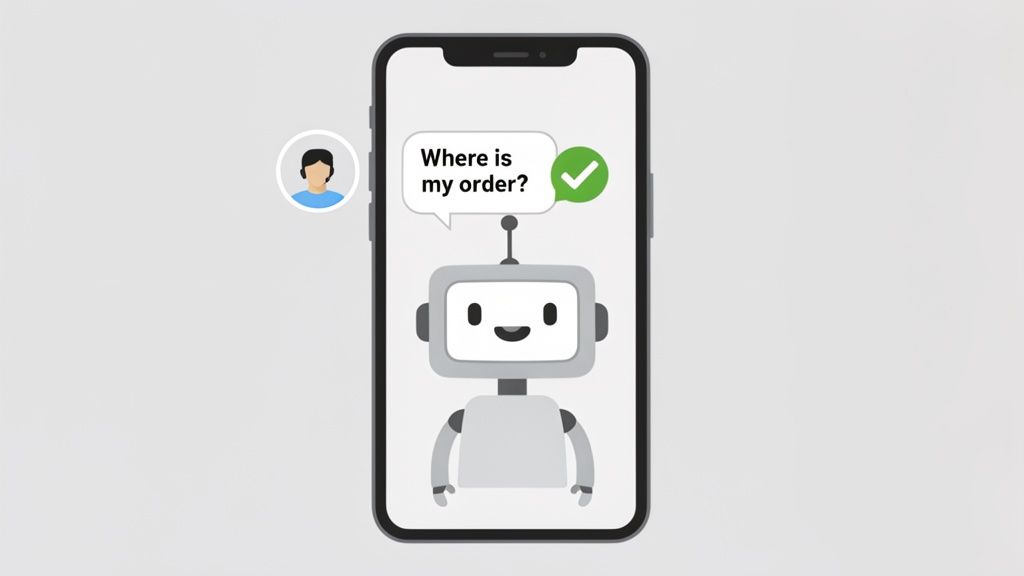
Now, picture a customer support agent who never sleeps, instantly answers "where's my order?" questions, and frees up your human team to handle the truly complex problems. That’s an AI chatbot. These are the kinds of accessible tools designed to plug right into platforms like Shopify, solving everyday headaches for growing brands.
The Core Job of AI in Your Store
The main purpose of these systems is to sift through massive amounts of customer and operational data far more effectively than any human team ever could. By spotting patterns in this data, AI can drive specific, profitable outcomes for your business.
AI's true value isn't just in the automation; it's about making smarter, data-backed decisions at scale. It turns guesswork into a predictive strategy, transforming your store's data from a simple record into a roadmap for growth.
This capability is exactly why the market is blowing up. The global market for AI-enabled e-commerce solutions was valued at USD 6.90 billion in 2024 and is projected to skyrocket to USD 31.43 billion by 2034. This isn't just a trend; it's a massive shift as more retailers adopt these tools to sharpen their competitive edge. You can read more on the market's growth projections at insightaceanalytic.com.
To put it simply, here's a quick look at the main types of AI solutions and what they do for your store.
Key AI Solutions for Ecommerce Growth
These tools are designed to integrate smoothly and deliver measurable results without needing a massive in-house tech team.
How AI Addresses Common Growth Hurdles
For emerging and growing Shopify brands, AI offers practical solutions to the most common pain points that hold you back. It's no longer just a toy for massive corporations.
Here’s how ecommerce AI solutions can help you right now:
- Tackling Cart Abandonment: AI can trigger a personalized pop-up with a unique discount or send a perfectly timed email reminder just as a visitor is about to leave, clawing back sales you would have otherwise lost.
- Improving Conversion Rates: By showing the right products to the right person at the right time, AI recommendation engines make the shopping experience feel incredibly relevant, nudging more visitors to click "buy."
- Optimizing Stock Management: Predictive analytics forecast future demand with surprising accuracy, helping you avoid running out of popular items or, just as bad, wasting cash on products that just won't sell.
At ECORN, we help brands figure out which of these solutions will make the biggest immediate impact, ensuring your first step into AI is a profitable one.
Driving Revenue with AI Personalization

This is where AI really starts to make a difference to your bottom line. Forget those old-school "customers who bought this also bought" widgets. Today’s AI personalization engines are like having a brilliant personal shopper for every single person who visits your website.
These systems are smart. They look at a whole tapestry of data in real-time—browsing habits, purchase history, what's been viewed, what’s been added to the cart—to figure out exactly what each customer is looking for.
The result? You get to show them hyper-relevant product suggestions that feel like they were picked out just for them. This shifts the shopping trip from a passive browse into a fun, discovery-led experience and is a huge part of improving the overall ecommerce customer experience.
The Power of Hyper-Relevant Recommendations
Think of it this way: a normal store shows everyone the same window display. But an AI-powered store instantly redesigns its window display to perfectly match the taste of the person looking in at that exact moment.
This is a complete game-changer for your most important metrics. The goal isn't just to show products; it's to predict what a customer will love next and guide them to a purchase they’ll be genuinely happy with.
Personalization is no longer about just dropping a customer's first name in an email. It’s about proving you get them by showing the right product at the right time, on the right channel.
This kind of precision pays off. Seriously. Brands using AI-driven product recommendations have seen revenue increase by up to 300%, conversions jump by 150%, and average order value climb by 50%. These aren't just vanity metrics; this is real growth.
Deploying Personalization Across the Customer Journey
To get the most out of AI, you can’t just stick recommendations in one corner of your site. The best approach is to strategically place these smart suggestions at key moments all the way through the buying process.
Here are the most effective spots to put AI personalization to work:
- Homepage: Welcome back returning visitors with a "Picked for You" carousel based on what they looked at last time.
- Product Pages: Use "Complete the Look" or "Frequently Bought Together" sections to make cross-selling feel natural and helpful.
- Cart and Checkout: Offer a last-minute, low-cost "You Might Need This" item to bump up the final order value.
- Post-Purchase Emails: Follow up with personalized ideas for their next purchase, turning a one-time buyer into a loyal fan.
By weaving recommendations into all these stages, you create a seamless, personal experience that builds trust and drives more sales. We dive deeper into this with more AI personalization ecommerce examples in another one of our posts.
From Browser to Loyal Customer
At the end of the day, the magic of AI personalization is making every customer feel seen and understood. When your product suggestions hit the mark, it builds a powerful sense of trust and shows your brand is actually paying attention.
That positive feeling is what convinces a casual browser to make that first purchase and, eventually, become a loyal advocate for your brand. The higher conversions and bigger order values are simply the natural result of building a smarter, data-driven relationship with your customers.
An agency like ECORN can help you sort through the options and implement the right personalization tools for your specific audience and business goals, making sure you see the best possible return on your investment.
Automating Support with Smarter Chatbots
Let's be honest: customer service expectations are sky-high, and for a growing brand, keeping up can feel like an impossible task. This is where modern AI chatbots come in, and they are a world away from the clunky, frustrating bots that made us all want to scream "speak to a human!"
Today’s ecommerce AI solutions for support run on Natural Language Processing (NLP). Think of NLP as the bot's ability to understand context and nuance, not just basic keywords. It's the difference between a bot that gets stuck on anything other than "track my order" and one that can actually understand what a customer is trying to say.
This means you get an intelligent assistant that can instantly handle a huge range of issues—from "Where is my order?" to detailed product questions—without needing a human to step in.
The Strategic Value of 24/7 Intelligent Support
The most obvious win here is offering instant, around-the-clock support. Your customers don't live on a 9-to-5 schedule. An AI chatbot ensures they get the answers they need at 2 AM on a Sunday just as fast as they would on a Tuesday afternoon.
This immediate availability is a massive boost to the customer experience. In fact, 60% of consumers say getting a quick response is crucial for good customer service. AI chatbots deliver on that promise without you having to hire a massive, global support team.
But it goes way beyond just being "on." These bots bring some serious operational advantages:
- Slash Operational Costs: By deflecting all the repetitive, high-volume questions, chatbots drastically reduce the number of tickets your team has to touch. That directly lowers your cost-per-interaction.
- Increase Team Efficiency: With the bot handling the routine stuff, your expert human agents are freed up to tackle the complex, high-value problems that actually require a human touch—like managing a tricky return or giving in-depth product advice.
- Scale Without Limits: As your orders grow, so will your support requests. An AI chatbot can manage ten conversations or ten thousand simultaneously, letting your support capacity grow with demand, instantly.
If you want to go deeper on this, there's a great ultimate guide on using an AI Chatbot for Ecommerce that's packed with detailed insights.
From Frustration to First-Contact Resolution
A well-implemented chatbot doesn't just answer questions; it solves problems on the first try. By integrating directly with your Shopify store's data, the bot can pull a customer's order history, check the shipping status, and provide a real-time update in seconds.
The goal of a modern AI chatbot isn't to deflect customers—it's to resolve their issues so effectively and efficiently that they don't need to speak to a human. This boosts satisfaction and builds long-term trust.
This level of integration is what separates the good from the great. When a customer asks, "What's the status of my latest purchase?" the bot can instantly reply with the tracking number and a link, closing the ticket on the spot. It's a huge leap from older bots that would just point you to a generic FAQ page. We explore these kinds of integrations more in our own guide to AI chatbots for ecommerce.
Mini Case Study: A Fashion Boutique's Success
Let’s make this real. A growing Shopify fashion boutique was drowning in support tickets, mostly about order status and return policies. Their small team was swamped, first-response times were lagging, and their customer satisfaction (CSAT) scores were taking a hit.
They brought in an AI-powered chatbot and integrated it with their order management system. They also trained it on their specific return policy and product catalog.
The results were almost immediate:
- First-Response Time: Plummeted from an average of eight hours to under 30 seconds.
- Ticket Volume: The bot automated so many common questions that it cut the human support team's ticket load by 45%.
- Customer Satisfaction: Their CSAT score jumped by 15% within three months because customers were getting instant, accurate help.
This isn't just about cutting costs. It's a powerful strategy for improving the customer experience and building a more efficient, scalable business. An agency like ECORN can help you choose and implement the right chatbot solution to see these kinds of results for yourself.
Optimizing Your Back-End Operations with AI
While personalized recommendations and chatbots get all the attention, some of the most powerful ecommerce AI solutions are the ones working quietly behind the scenes. These tools are all about tuning up your back-end operations, turning mountains of complex data into a straight line toward higher efficiency and healthier profit margins.
Think of it like the stage crew for a hit Broadway show. The audience only sees the flawless performance, but it’s the crew’s mastery of logistics, timing, and resources that makes it all possible. AI does the exact same thing for your business, ensuring everything runs like a well-oiled machine so the customer experience never misses a beat.
This is where you stop reacting to the market and start proactively shaping your own success. It’s about making smarter, data-backed calls on two of the most critical parts of any ecommerce business: what you stock and how you price it.
Forecasting Demand with Predictive Analytics
Inventory management is one of the biggest gambles in retail. Order too much, and you’re stuck with capital tied up in stock that’ll eventually need a steep clearance sale. Order too little, and you’re dealing with frustrating stockouts and sending would-be customers straight to your competitors. Predictive analytics AI is like a crystal ball for your supply chain, taking the guesswork out of this delicate balancing act.
These AI models sift through a huge amount of data to forecast future demand with startling accuracy. They go way beyond just looking at your past sales figures, pulling in factors like:
- Seasonality and Trends: Spotting those recurring sales patterns around holidays, seasons, or new market crazes.
- Marketing Impact: Figuring out how that big promotion or ad campaign you’ve got planned will actually move the needle on specific products.
- External Factors: They can even account for broader economic signals or what your competitors are doing to sharpen their predictions.
By getting ahead of what your customers will want to buy, you can keep your stock levels just right—avoiding the cost of overstock while making sure your bestsellers are always ready to ship.
Protecting Margins with Dynamic Pricing
Finding the perfect price for a product is a notoriously tough nut to crack. Go too high, and shoppers will bounce to a competitor. Go too low, and you're just leaving money on the table. Dynamic pricing AI automates this whole headache, helping you find that profitable sweet spot in real-time.
AI-driven pricing isn't about just randomly changing numbers. It's a strategic, continuous analysis of market data to find the optimal price that maximizes both sales and profit margin, moment by moment.
These algorithms are constantly keeping an eye on the competitive landscape. They know when a rival launches a sale, when a product suddenly starts trending on social media, or when your own inventory on a hot item is getting low. Based on all this live data, the AI can suggest—or even automatically make—price adjustments to keep you competitive and protect your profitability.
For instance, if the AI sees your main competitor just sold out of a popular gadget, it might suggest a slight price increase on your remaining stock to capitalize on that sudden spike in demand. It’s a simple way to ensure you're never under-selling your products when the market is hot.
Turning Operational Data into a Competitive Edge
Ultimately, these back-end AI tools are about changing the role of your operational data. It stops being a simple record of what already happened and becomes a powerful playbook for dictating what happens next. You’re no longer just fulfilling orders; you’re strategically managing your entire business, from purchasing to the final sale.
Here’s a quick breakdown of what that actually looks like:
Getting these systems up and running doesn't require a data science degree, either. Many of the best tools today are built to plug right into platforms like Shopify, with intuitive dashboards that turn all that complex number-crunching into clear, actionable insights. An agency like ECORN can help you pick and set up the right operational AI tools, making sure they’re perfectly aligned with your business goals and start delivering measurable results right away.
How to Implement AI Solutions on Your Store
Bringing powerful ecommerce AI solutions into your business might sound like a massive technical project, but it’s far more about smart planning than it is about complex coding. The trick is to treat it like a strategic initiative, not just another tech upgrade. Think of it as a clear, step-by-step journey from spotting a problem to measuring some seriously impressive results.
Your first move should always be to look inward at your own operations. Don't get distracted by browsing flashy AI apps; start by putting your finger on your biggest operational headache or your most stubborn growth blocker. Is cart abandonment keeping you up at night? Are you constantly battling inventory forecasting?
Once you've identified a specific problem, you can set a clear, measurable goal. Instead of a vague target like "improve conversions," get specific: "Increase the conversion rate from product page to checkout by 15% in the next quarter." That kind of clarity makes every other decision a whole lot simpler.
Choosing the Right Tool for the Job
With your goal locked in, it's time to hit the app marketplace. Platforms like the Shopify App Store are overflowing with AI-powered tools, but you need a system to cut through the noise. To find a solution that’s a genuine fit for your brand, focus your search on a few key areas.
First off, compatibility is non-negotiable. Make sure the tool plays nicely with your existing tech stack—that means your email platform, your inventory system, and, of course, your Shopify theme. An app that creates conflicts is more trouble than it's worth.
Next, do your homework by digging into user reviews and case studies. Look for feedback from brands that are similar to yours in size and industry. What kind of results did they get? Did they hit any snags during setup? Finally, give their customer support a test run. A responsive and helpful support team is an absolute lifesaver, especially when you're just getting started.
Integrating and Configuring Your New Solution
After you’ve picked your tool, the integration process kicks off. For most modern Shopify apps, this is a guided, user-friendly experience. Your main task is to connect your store’s data so the AI has the raw material it needs to start learning.
This usually involves granting permissions and allowing the app to sync your product catalog, customer history, and order data. The AI uses this historical information as its foundation to begin recognizing the unique patterns of your business. The initial setup might involve tweaking a few rules, like what kinds of products to recommend together or what tone of voice your new chatbot should use.
A common mistake is to flick every switch on at once. A phased rollout is a much smarter approach. Start by activating the AI tool for a small segment of your audience or on just a few product pages. This lets you test its performance and iron out any kinks in a controlled environment.
This flow diagram shows how back-end AI tools typically process data to drive operational improvements.
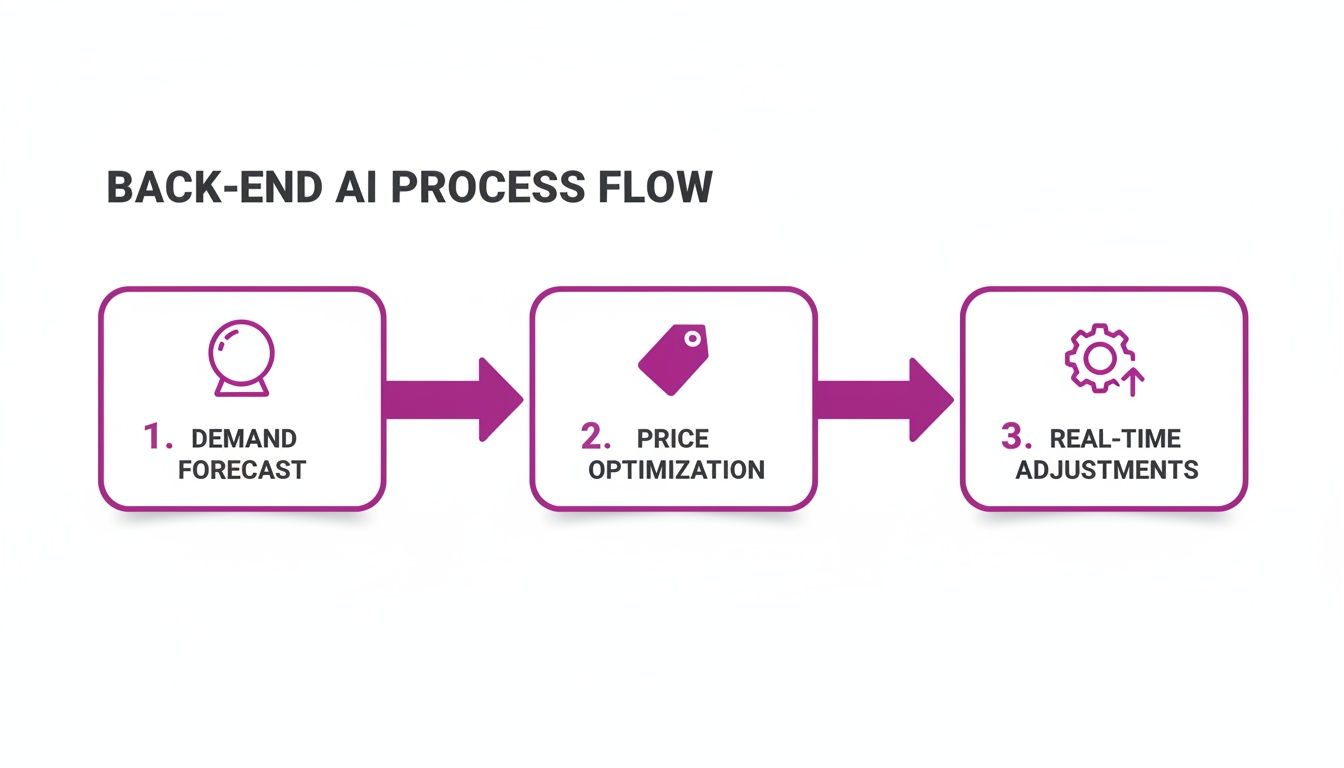
You can see how the AI transforms raw data into predictive actions, moving from demand forecasting all the way to real-time price optimization.
Monitoring Performance and Proving ROI
Your job isn't over once the tool goes live. You need to keep a close eye on performance to make sure you're getting a strong return on your investment. Remember that crystal-clear goal you set at the beginning? It’s time to track it.
Use the analytics dashboard inside the AI tool, but always cross-reference it with your main Shopify analytics. Are you seeing the lift you expected in your key metrics?
Here are a few key actions to take during this phase:
- Establish a Baseline: Before you started, you should have a clear picture of your metrics. Compare the "after" to the "before" to measure the true impact.
- Run A/B Tests: Many AI tools let you test them against your old way of doing things. For example, run AI-powered recommendations for 50% of your traffic and show your old manual recommendations to the other 50%. Let the data decide which one wins.
- Iterate and Optimize: Use the insights you gather to tweak the AI’s settings. You might discover that certain recommendation styles perform better or that your chatbot needs a bit more training on specific product questions.
This whole process can feel like a lot to juggle on top of running your day-to-day business. An agency like ECORN can act as your implementation partner. We can help you define the right goals, select the best-fit tools, and manage the entire rollout to ensure a smooth and profitable transition into using AI.
Your AI Implementation Checklist
To make this process even clearer, we've broken it down into a simple checklist. Following these steps will help you stay organized and ensure you cover all your bases when bringing a new AI solution into your store.
By working through this checklist, you can move from idea to impact methodically, making sure your investment in AI pays off in real, measurable growth for your brand.
The Future of AI in Ecommerce
The AI solutions we’ve covered so far—personalization, chatbots, operational analytics—are already making a massive difference for Shopify stores. But the next big leap isn't just about making current processes smarter; it's about giving them autonomy. The future is hurtling toward autonomous AI agents, a concept that will completely reshape how online stores are managed.
Think of it less like using a tool and more like hiring a specialist. Imagine an "AI Marketing Manager" that you hand a budget and a clear goal, like, "increase sales for our new summer collection by 20%." This agent would then go off and independently plan, create, launch, and optimize ad campaigns across different platforms. It would learn and adjust its strategy in real-time, all without you needing to step in.
This is the core idea behind agentic AI. These systems are built to take a high-level goal, break it down into smaller, actionable tasks, and then get them done with minimal supervision. It’s a huge shift from AI as a reactive assistant to AI as a proactive strategist.
Hiring Your First AI Managers
This isn't just a sci-fi dream; major retailers are already experimenting with these systems to get a serious leg up on the competition. For growing Shopify brands, this technology is a game-changer, offering a way to automate strategic work that used to require a whole team of people.
Think about the roles an AI agent could fill in your business:
- Supply Chain Agent: This agent could monitor your inventory, predict demand spikes, automatically negotiate with suppliers for better rates, and place purchase orders to stop stockouts before they even happen.
- Customer Retention Agent: This one would analyze customer behavior to spot shoppers who might be about to churn. It could then independently design and send personalized retention campaigns—maybe a unique discount or a surprise loyalty bonus—to bring them back.
The real magic of autonomous agents is their ability to connect the dots between different parts of your business. An agent could notice a marketing campaign is driving way more demand for a product than expected and instantly ping the supply chain agent to adjust inventory.
This kind of integrated, self-sufficient operation is what will separate the successful ecommerce businesses from the rest in the coming years.
The Emerging Agentic Economy
The market is already racing to catch up with this shift. Agentic AI in retail is the fastest-growing slice of the AI-powered commerce pie, with a market size projected to hit USD 60.43 billion in 2026. Experts see this number exploding to USD 218.37 billion by 2031, which is a massive signal of where the industry is headed. You can explore more data on this incredible growth trend to get the full picture.
For growing brands, getting ready for this future means building a rock-solid data foundation today. The effectiveness of these future agents will depend entirely on the quality and accessibility of your sales, customer, and operational data. By putting the ecommerce AI solutions available now—like smart analytics and personalization engines—to work, you’re not just solving today's problems. You're laying the critical groundwork for the autonomous systems that will define tomorrow's market leaders.
An agency like ECORN can help you build this data-first strategy, making sure that when these advanced technologies become mainstream, your business is in the perfect spot to adopt them and lock in a long-term advantage. The future of AI is coming fast, and the time to prepare is now.
Common Questions About Ecommerce AI
It's completely normal to have a few questions when you start exploring AI for your store. Even with all the hype, smart store owners are asking about the real-world costs, the technical lift, and how to actually tell if it's working.
Let's cut through the noise and tackle these common concerns. The goal here is to show you that AI is way more accessible and practical than you might think, especially for brands that are on the move.
Is AI Too Expensive for a Growing Business?
This is probably the biggest myth out there. Forget the idea that AI is only for massive, enterprise-level companies with bottomless budgets. The game has changed completely.
Today’s best AI tools are built for growing brands like yours. Many of them run on flexible subscription models, often with free trials or pricing that scales with your usage. This means you can start small. Pick one high-impact problem—like product recommendations—prove the tool works, and only scale up your investment once you see a clear return.
How Much Technical Skill Do I Need?
Surprisingly little. The days of needing a data scientist on staff to run an AI tool are long gone. Most modern apps are designed with clean, intuitive dashboards and simple, guided setups.
Your most important skill isn't coding; it's knowing your business inside and out.
The real expertise you need is understanding what you're trying to achieve. Do you want to cut down on cart abandonment? Boost your average order value? The AI is just the tool to help you get there.
And if you want to get into more advanced setups or really fine-tune the performance, that’s where an agency like ECORN can step in to handle the heavy lifting, leaving you to focus on strategy.
How Can I Measure the ROI of an AI Tool?
This is crucial. You can't just "set it and forget it." Measuring the return on your investment comes down to tying the tool directly to a business goal. The key is to get your baseline metrics before you turn anything on so you have a clear "before and after" picture.
Here’s a practical way to think about it:
- For a personalization tool: You should be watching your conversion rate, average order value (AOV), and the specific revenue generated from AI-powered recommendations.
- For a support chatbot: Look at your customer satisfaction (CSAT) scores, how quickly customers get a first response, and your overall ticket resolution rate. A great sign is seeing a drop in the number of simple tickets your human support team has to handle.
By connecting the AI tool directly to these core business numbers, you’ll have a rock-solid, data-backed case that proves its worth.
Ready to implement AI solutions that drive real growth for your Shopify store? The team of experts at ECORN can help you identify the right tools, manage implementation, and optimize for maximum ROI. Explore our Shopify services and see how we can help you scale.



Shopify Website Design Examples: 7 Stores Worth Studying
7 Ecommerce Newsletter Examples for Shopify Brands
One Product Shopify Store: Build and Scale

Mobile Pop Up Strategy for Shopify Stores That Converts
Sitemap for Shopify: How to Find, Optimize, and Submit It
7 Single Product Websites Worth Emulating
Product Variants Shopify: The Complete 2026 Guide
Ecommerce Analytics Consulting for Growth
What Is AI Integration for eCommerce
How to Choose the Right eCommerce Website Development Firm
E Business Strategy Implementation
Conversion Tracking Setup for Shopify Stores
BigCommerce vs Shopify Plus Which Enterprise Wins in 2026
Shopify Theme Kit: Setup, Commands, and Migration Guide
Shopify Extension Development: A Practical 2026 Guide
Shopify Speed Score Explained and How to Improve It
Shopify Mobile Optimization: The 2026 Playbook
How to Add Subcategory in Shopify for Better UX
How to Implement Structured Data for Ecommerce in 2026
SEO App Mobile: Shopify Store Optimization Guide

Shopify Plus Support: What It Includes and How to Choose
Google Ads for Shopify: The Complete 2026 Playbook

Shopify New York: How to Find and Hire the Right Agency
Google Search Console for Shopify: The Complete Setup
First Party Data Collection for eCommerce Growth
FAQ Online Store Guide: Build and Measure It Right
Do FB Ads Work for eCommerce in 2026?

One Page Checkout for Shopify: Design and Implementation
Shopify GraphQL vs REST: The 2026 Developer Decision
Shopify Ecommerce Consulting: Strategy, Pricing &

Are Reddit Ads Worth It for eCommerce Brands
Shopify Title and Meta Description: A Practical 2026 Guide

Product Video Best Practices for Shopify Brands
Real-Time Inventory Management: A 2026 Guide
AI Chatbot Integration for Shopify Stores
Affiliate Program Management: A Shopify Guide
10 Best Performance Monitoring Tools for Shopify in 2026
Digital Asset Management for eCommerce Brands in 2026
Every Type of Facebook Ads Explained for eCommerce Growth
Product Information Management Explained for Shopify Brands
Support Ticket System: A Guide for Shopify Stores

10 Best Customer Service Tools for Shopify in 2026

Can I Start a Business with No Money? a 2026 Blueprint

What Sells Good on Etsy: Best Niches for 2026

Shopify Add to Cart Button: A Practical 2026 Guide

Customer Feedback Automation: A Practical eCommerce Guide
Critical Rendering Path: A Guide for Shopify Stores

How to Promote on TikTok for eCommerce in 2026

B2B eCommerce Consulting That Drives Real Revenue
10 Best Practices for Site Navigation in 2026
Return vs Refund for Shopify Stores: A Practical Guide
What Is Customer Lifetime Value and Why It Matters
What Is Voice of Customer Research for eCommerce

SMS Marketing for Ecommerce That Actually Converts

Master How to Improve Email Deliverability in 2026

Top 7 eCommerce Partners NYC for Shopify Brands in 2026
Machine Learning for Ecommerce: Boost Your Shopify Store

Beauty Market Research: Your 2026 Growth Guide

Shopify International Expansion: A 2026 Roadmap
What Does CRO Stand for in Business: Understanding CRO

Shopify Visual Merchandising: A Playbook for Higher Sales

Shopify Landing Page Design: Master Conversion in 2026
10 Best AI SEO Optimization Tools for Shopify in 2026

Agentic AI for Ecommerce: Boost Your Sales in 2026
Mastering Email Marketing Data for eCommerce Growth
Conversion Rate Optimisation Australia: Boost Your Sales
Conversion Rate Optimization AI: Your Shopify Store Guide

10 Product Bundling Strategies for Shopify in 2026
How to Increase Customer Lifetime Value: A Shopify Playbook
AI Customer Service Automation: Shopify Guide 2026

Clean Website Design: A Shopify Conversion Playbook

Omnichannel Retail Strategy: A Shopify Playbook
Product Data Enrichment: A Guide for Shopify Brands

Instagram Shopping Features a Guide for Shopify Stores
What Is Revenue Optimization: A Holistic RevOps Guide
Benefits of Conversion Rate Optimization: Boost Your
WordPress to Shopify Migration: Your 2026 Seamless Switch
Boost Sales: Ecommerce Payment Processing Guide 2026
Unified Commerce Platform: Benefits, KPIs & Shopify Guide
How to Reduce Bounce Rate eCommerce: Your 2026 Guide
Shopify API Integration: A Practical End-to-End Guide
How to Implement Data Governance: A 2026 Guide
Shopify Store Development Cost: A 2026 Breakdown
What Is Server Side Tracking: The Shopify Guide 2026
Marketing Automation Workflows: A Shopify Guide for 2026

Shopify: How to Reduce Technical Debt

Shopify UX Design Change: A Playbook for Growth
User Generated Content Strategy: Shopify Playbook

Shopify Pause and Build Plan Cost: A Complete 2026 Guide
Compare at Price on Shopify: A Complete Guide for 2026

Where Can I Sell My Prints? 10 Best Platforms for 2026
Shopify Order Management System: The Ultimate Guide 2026
What Is Marketing Attribution? an eCommerce Guide for 2026

10 Best Black Friday Sales Sheets for 2026

Discover the Top Social Media Marketing Agencies For
Consumer Confidence Definition for eCommerce in 2026
What Is Social Commerce? Your 2026 Guide to Boosting Sales

A Social Ad Campaign Playbook for eCommerce Growth
7 Best FAQ Page Examples for SaaS & eCommerce

Market Research in Fashion Industry: A Guide for Shopify


newsletter in your inbox