

Welcome to your playbook for actually scaling a brand on Shopify. This isn't about chasing scattered tactics. It's about building an integrated marketing engine where everything—from your owned channels like email and SMS to your paid campaigns and on-site experience—works in perfect harmony.
Think of this as the strategic briefing before you go out and execute.
Building Your Shopify Marketing Foundation
Let’s get one thing straight: generic advice won't cut it. We're here to build a system for predictable, sustainable growth. Real success on Shopify isn’t about mastering just one channel; it’s about creating a cohesive framework where every piece makes the others stronger. A deep dive into comprehensive ecommerce growth strategies is the essential groundwork for driving both new sales and long-term retention.
Taking this strategic approach is non-negotiable, especially when you consider the sheer scale of the platform. Shopify now powers over 6.5 million active stores around the globe. In the U.S. alone, it commands a massive 30% market share of the eCommerce platform market, leaving competitors far behind. In an ecosystem this crowded, a sharp, integrated strategy is the only way to stand out.
To give you a clearer picture of what this system looks like, we've broken it down into its core components.
Core Pillars of Shopify Marketing
Each pillar builds on the last, creating a seamless journey for your customers and a profitable, repeatable system for your business.
A Three-Pillar Framework
Your marketing efforts can be neatly organized into three core pillars: Foundation, Acquisition, and Conversion. Each stage is built on the one before it, creating a customer journey that’s both intuitive for the user and profitable for your brand.
This visual really brings home how a solid foundation underpins your customer acquisition, which in turn is what fuels your on-site conversions.
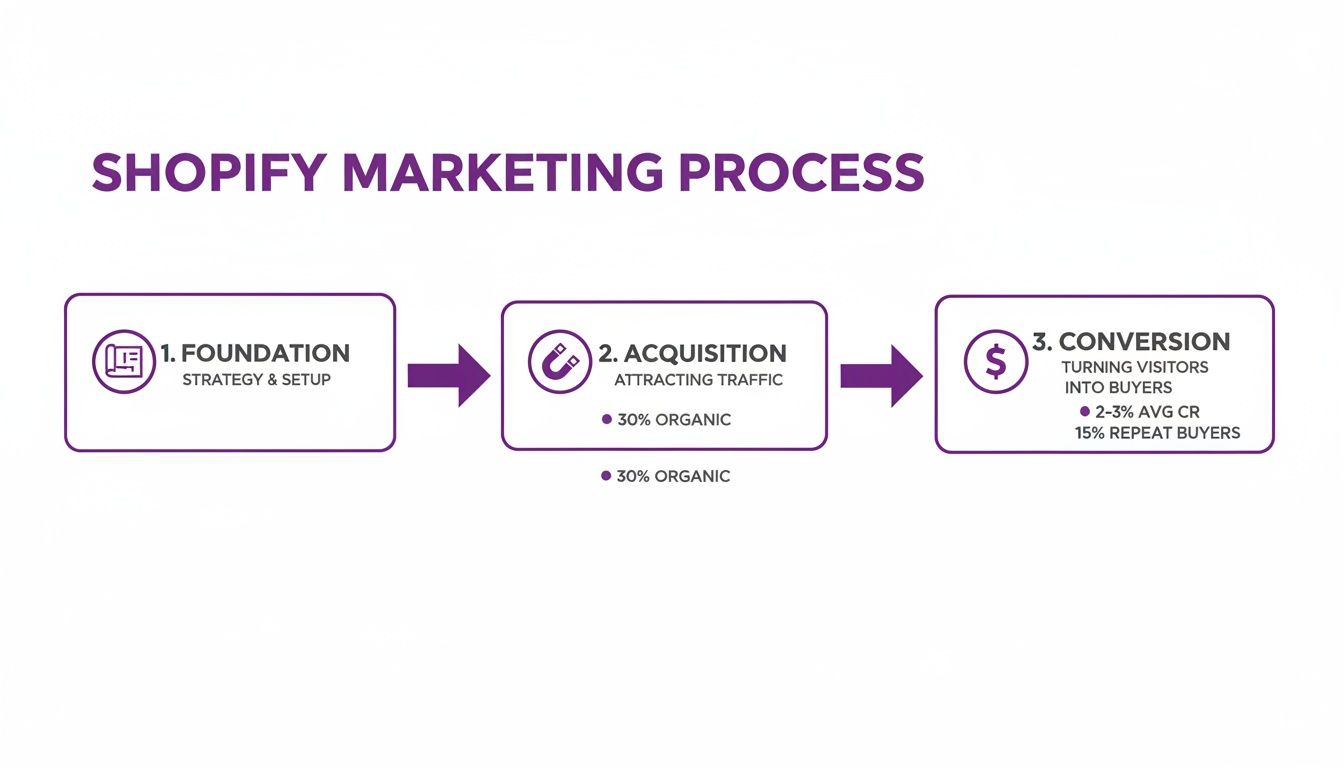
As the diagram shows, without a solid brand and technical foundation, your acquisition and conversion efforts are going to feel like you're trying to build a house on sand. It just won’t be efficient.
The goal here is to build a defensible, profitable brand, not just a store that gets lucky with a few sales. That means moving away from random acts of marketing and toward a structured, repeatable system.
This guide will give you a clear roadmap for every critical component, from finding new customers with SEO to maximizing their lifetime value with smart automation. Building this system is the heart of any powerful https://www.ecorn.agency/blog/building-powerful-ecommerce-digital-marketing-strategy. We’ll give you the strategic framework and the tactical plays to make it happen.
Turning Owned Channels into Revenue Machines
Sure, paid ads and SEO are great for getting new people to your store, but your email and SMS lists? That's where you build real relationships and generate revenue you can actually count on. These aren't just rows in a spreadsheet; they're your most valuable marketing assets, period. The magic happens when you move beyond basic newsletters and start building sophisticated, automated sequences that work for you around the clock.
These automated messages, often called "flows," are triggered by specific things a customer does. Instead of blasting everyone with the same generic sale announcement, you’re delivering a super-relevant message right when it matters most. This is the secret to turning a one-time buyer into a die-hard fan.
Building Your Core Marketing Automations
You don't need to overcomplicate things right out of the gate. A handful of foundational automations can capture a huge amount of otherwise lost revenue and put your customer communication on autopilot.
Start with these three essentials:
- The Welcome Series: This is your first impression, so make it count. When someone signs up, send a sequence of 3-5 emails that tells your brand story, showcases your best-sellers, and maybe offers a little something to nudge them toward that first purchase.
- The Abandoned Cart Flow: It’s a classic for a reason. Nearly 70% of online shopping carts are left behind. This automation is your safety net, sending a few timely reminders to shoppers who got distracted. You’d be shocked at how much revenue a simple email sequence can recover.
- The Post-Purchase Nurture: The job isn't done at checkout. This flow is perfect for saying thanks, sharing shipping updates, asking for a review, and introducing related products. It builds a ton of trust and gets them thinking about their next purchase before the first one has even arrived.
These three flows are the bedrock of any solid owned marketing strategy. They make sure you’re engaging customers at the most critical moments, all without you having to manually hit "send" every single time.
By automating these key touchpoints, you create a consistent, on-brand experience that guides customers from their first visit to their tenth purchase. It’s what separates a transactional store from a real, community-driven brand.
Choosing the Right Tools for the Job
The Shopify App Store is loaded with powerful tools built for exactly this. There’s a reason platforms like Klaviyo and Attentive dominate the space—they integrate so deeply with Shopify's data. This lets you slice and dice your audience and trigger automations based on real-time behavior, like what they've bought, what they've looked at, or even their predicted lifetime value.
For example, you could easily create a segment of customers who bought a specific coffee blend and automatically send them a cross-sell campaign for a matching mug 30 days later. That level of personal touch is what drives killer engagement and conversion rates.
Here's a look inside the Klaviyo dashboard, which becomes your command center for managing and analyzing all of your automated flows.
From here, you can see at a glance which automations are printing money and which ones need a little love. It's all about making decisions based on real data, not just gut feelings.
The scale of the Shopify ecosystem is staggering. The platform has processed over $1 trillion in total sales in its history and now pulls in $292.3 billion in gross merchandise volume (GMV) annually. That incredible volume highlights just how crucial these marketing tools are for grabbing your slice of the pie. You can dig into more Shopify statistics and trends to get the full picture.
Advanced Strategies for List Growth
Once your core automations are humming along, it's time to focus on growing your subscriber lists with people who actually want to hear from you. That generic "Sign up for our newsletter" link in your footer just doesn't cut it anymore.
Try mixing in some of these more engaging tactics:
- Interactive Pop-Ups: Use apps like Justuno or Privy to launch pop-ups based on user behavior. Offer a 10% discount on their first visit, or catch them with an exit-intent offer right before they bounce.
- Gamified Lead Capture: Who doesn't love a "spin-to-win" wheel? Offer a range of prizes (free shipping, 15% off, a free gift) in exchange for an email and SMS sign-up. It adds a bit of fun to the experience and can dramatically increase opt-in rates.
- Loyalty Program Integration: If you're using a loyalty app like LoyaltyLion, connect it to your email platform. You can reward customers with points just for subscribing and engaging with your marketing, creating a powerful feedback loop.
- Blog Content Upgrades: For those with a blog, offer a high-value download—like a free guide, checklist, or ebook—in exchange for an email. This is a great way to attract subscribers who are already deeply interested in what you have to say.
By getting creative with your list growth, you’re not just collecting contacts. You’re building a direct line to your best customers and turning your owned channels into the most reliable revenue drivers you have.
Scaling Acquisition With Paid Media and SEO
Once you've got your owned channels dialed in—capturing leads and warming them up—it's time to pour some fuel on the fire. This is where you really start to scale customer acquisition. We're talking about combining the instant gratification of paid advertising with the long-game, compounding power of search engine optimization (SEO).
A smart Shopify marketing strategy doesn’t treat these as two separate things. It weaves them together into a single, cohesive engine that drives a steady, predictable stream of qualified buyers to your store.
Paid media on platforms like Meta (Facebook and Instagram) and Google gives you an incredible ability to target specific audiences. You can literally go from zero to a thousand visitors overnight by getting your products in front of the right eyeballs at the right moment. But spending money effectively is way more than just "boosting a post."

First things first: you need to install the Meta Pixel and set up the Google channel in Shopify. This is non-negotiable. These tools track every single action a visitor takes, and that data is the lifeblood of your campaigns. It's what lets you build powerful custom audiences and accurately measure your Return on Ad Spend (ROAS).
Structuring Your Paid Ad Funnel
One of the biggest mistakes I see brands make is running a single type of ad and just hoping it works for everyone. That's a recipe for burning cash. Instead, you need to structure your campaigns to mirror the customer's journey, from their first "hello" with your brand to the final "add to cart."
- Top of Funnel (Prospecting): This is your introduction. You're trying to reach brand new audiences who have never heard of you. Use broad interest-based targeting or lookalike audiences to find people who look like your best customers. The creative here needs to be thumb-stopping and focused on brand storytelling or a really compelling offer.
- Middle of Funnel (Consideration): Now you're talking to people who've shown some interest. Maybe they visited your site, watched one of your videos, or liked a post. It's the perfect time to retarget them with product-focused ads, customer testimonials, or user-generated content (UGC) to build that crucial trust and social proof.
- Bottom of Funnel (Conversion): These are your hottest leads—the people who’ve added to their cart or started the checkout process. Hit them with direct, action-oriented Dynamic Product Ads (DPAs) that show them the exact items they left behind. A gentle nudge like a "free shipping" offer can be insanely effective at this stage.
This full-funnel approach ensures you're not just chasing cold traffic. You're systematically building a relationship and warming up potential customers until they're ready to pull the trigger.
Building a Lasting Organic Presence
While paid ads get you results today, SEO is your long-term investment in sustainable, "free" traffic. A massive part of scaling acquisition is knowing exactly how to improve Shopify SEO to pull in organic traffic. It’s all about making your store the best possible answer to the questions your ideal customers are typing into Google.
The foundation of solid Shopify SEO is understanding the keywords your audience uses. These aren't just single words. They're phrases that reveal intent, like "best vegan leather tote bag" or "organic cotton baby clothes."
Think of your SEO efforts as building digital real estate. Every optimized product page, collection, and blog post is an asset that can attract customers for years to come, long after you've turned off your ad spend.
Once you have your keywords, the real work of on-page optimization begins. This means weaving them naturally into the essential elements of your site.
Key On-Page SEO Elements for Shopify
Optimizing your store for search engines isn't a "set it and forget it" task. It requires consistent attention to a few key areas that Google and other search engines care about deeply.
- Product & Collection Pages: These are your money pages. You absolutely must optimize your product titles, descriptions, and image alt text with your target keywords. For collection pages, write a genuinely helpful, keyword-rich description that explains what the collection is all about.
- Blog Content: Your blog is an incredibly powerful tool for targeting informational keywords. If you sell running shoes, write articles like "How to Choose the Right Running Shoe for Flat Feet." This attracts potential customers early in their buying journey and establishes your brand as an authority they can trust.
- Technical Health: A beautiful site is useless if it's slow, broken, or a nightmare on mobile. Make sure your site speed is snappy, the mobile experience is flawless, and your site structure is clean and easy for Google to crawl. Learn more about getting this right in our complete guide to SEO for Shopify stores.
Ultimately, your paid and organic efforts should feed each other. Use insights from your paid campaigns—like which ad copy or headlines get the most clicks—to inform your SEO title tags and meta descriptions. This holistic approach to marketing with Shopify creates a powerful flywheel, where each channel makes the other more effective, driving scalable and profitable growth for your brand.
Optimizing Your Store for Higher Conversions
Driving traffic to your Shopify store is a huge win, but it’s only half the battle. The real magic happens when those visitors pull out their wallets. This is where Conversion Rate Optimization (CRO) comes in—it’s the art and science of turning casual browsers into loyal customers. It's the step that makes sure all your hard work in marketing actually translates into revenue.
Think of it like a brick-and-mortar shop. If people walk in but can't find what they're looking for and leave frustrated, you don't just need more foot traffic; you need to fix the store layout. CRO is the digital version of that, focused on making the path to purchase on your site as smooth and persuasive as possible.
First, Get Inside Your Customer's Head
You can't optimize what you don't understand. Before you start changing buttons and rewriting copy, you need to dig into how people are actually using your site. This means moving beyond sales numbers and looking at real user behavior.
Tools like Hotjar or the free Microsoft Clarity are absolute game-changers here. They give you heatmaps to see where people are clicking (and where they aren't) and session recordings that let you watch a visitor's entire journey, clicks, scrolls, and all. You might discover that your main banner image is getting a ton of clicks, even though it doesn't link anywhere. That's pure gold.
Don't forget about Shopify’s built-in analytics, either. A quick look can show you pages with shockingly high drop-off rates. If your shipping info page has a 90% exit rate, that’s a massive red flag. It’s practically screaming that your policies are either confusing or a deal-breaker.
Create Product Pages That Actually Sell
The product detail page (PDP) is your final sales pitch. This is where the purchase decision happens, so it needs to do more than just list features—it has to build trust and sell a solution.
Here are the non-negotiables for a PDP that converts:
- Knockout Visuals: This is table stakes. You need high-resolution images from every angle, lifestyle shots showing the product in use, and video if you can swing it. Help customers imagine the product in their lives.
- Benefit-Focused Copy: Don’t just list specs. Translate them into benefits. Instead of "100% merino wool," try "Stay warm without the itch, thanks to ultra-soft and breathable merino wool."
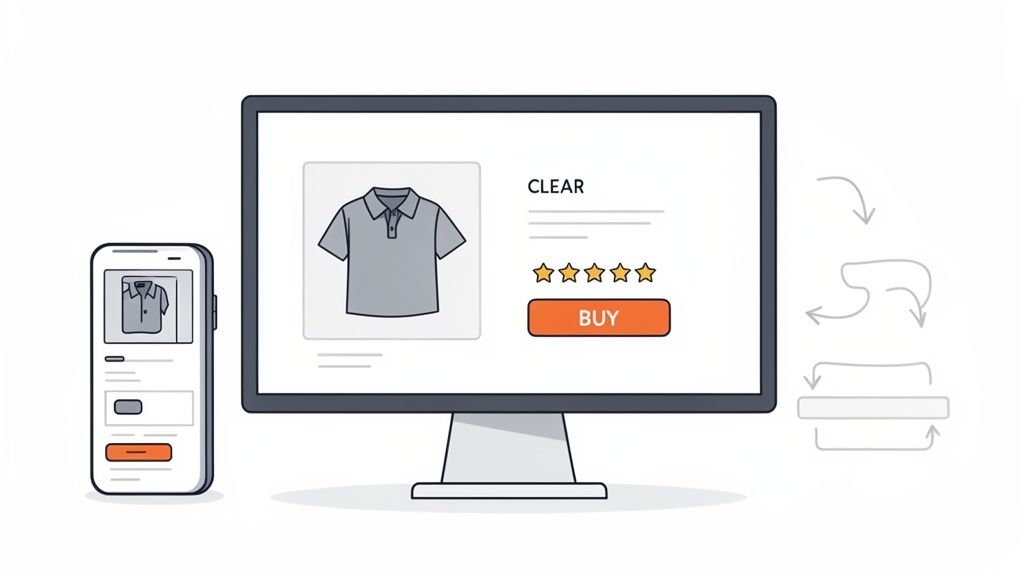
- Trust Signals Everywhere: You have to crush any skepticism. Prominently display star ratings, customer reviews, and any user-generated content (UGC) you can find. Apps like Yotpo or Judge.me can put this on autopilot.
- An Unmistakable Call-to-Action (CTA): The "Add to Cart" button should be impossible to miss. Use a color that pops against the rest of the page and keep the text direct.
A great product page anticipates and answers every single question a customer has before they even think to ask it. It erases all doubt and makes clicking "Add to Cart" feel like the most obvious next step.
Start a Prioritized Testing Plan
So, where do you start? You can't test everything at once. A prioritized approach ensures you're working on changes that will have the biggest impact with the least amount of heavy lifting. This is about working smarter, not just harder.
The idea is to find the sweet spot between high potential impact and low implementation effort. A small copy change on your homepage banner (low effort) could have a massive impact, whereas a complete checkout redesign (high effort) might only yield marginal gains.
CRO Testing Priority Framework
Using a framework like this helps you stay focused. You'll build momentum with quick wins while methodically tackling bigger projects that promise a significant return.
Use Strategic Merchandising to Boost AOV
Getting more conversions is one thing. Getting each customer to spend more is another level entirely. Strategic on-site merchandising guides customers toward discovering more products they'll love, which is a win for both of you.
- Product Bundling: Group related products into a discounted kit. Think a "Skincare Starter Set" or a "Complete Coffee Lover's Bundle." It simplifies the decision for the customer and bumps up your cart value.
- Cross-Sells: On the product page or in the cart, suggest items that complete the purchase. Someone buying a camera? Show them a memory card and a camera bag. Shopify apps like Rebuy can automate these suggestions with scary accuracy.
- Upsells: Offer a slightly better, more premium version of the product they're looking at. This could be a larger size, a more durable material, or a model with extra features.
These tactics don't just increase your Average Order Value (AOV); they make for a better customer experience by introducing shoppers to products they genuinely need.
Think Globally and Nail the Checkout
As your brand grows, you'll start attracting customers from all over the world. Shopify is already a global powerhouse, operating in over 175 countries. While North America still makes up 54% of its merchants, the platform's growth in Europe, Asia, and Latin America is explosive. This is a massive opportunity you can tap into.
Finally, don't trip at the last hurdle: the checkout. Shopify's checkout is one of the best in the business, but there's always room for improvement.
Be transparent with all costs upfront—nobody likes a surprise shipping fee. Offer a range of payment options, especially express checkouts like Shop Pay, Apple Pay, and PayPal. Every field you can remove and every click you can save reduces friction and brings you one step closer to a sale.
How to Build Your Shopify Marketing Tech Stack
The right tools can make or break your marketing, but a killer tech stack isn't about having the most apps—it's about having the right ones that work together seamlessly. Think of it less like a collection of software and more like a single, cohesive growth engine. When your tools talk to each other, you unlock powerful automation and get a much clearer picture of your customers.
Instead of just running down a list of popular apps, let's look at the core jobs your stack needs to do. These are the foundational pillars for your entire marketing with Shopify operation. Get these right, and everything else becomes more efficient and a hell of a lot more effective.
Email and SMS Communication Hubs
Your owned channels—email and SMS—are your direct line to revenue. A dedicated platform to manage them isn't a "nice to have," it's non-negotiable once you start to scale. These tools are so much more than just campaign senders; they're sophisticated customer data platforms that track behavior and fire off personalized, automated messages that literally make you money while you sleep.
- Top Contenders: Klaviyo and Attentive are the undisputed heavyweights. Their deep Shopify integrations are what set them apart, letting you slice and dice your audience based on everything from purchase history to what they've browsed.
- Why It Matters: This is how you achieve hyper-relevance. For instance, you could automatically text a special offer for a new product only to customers who have previously bought from a similar collection. The relevance is off the charts, and so are the conversion rates.
Reviews and User-Generated Content Platforms
In eCommerce, trust is everything. Social proof, especially genuine customer reviews and photos, is one of the most powerful conversion levers you can pull. A dedicated review platform automates the whole process of collecting and showcasing this user-generated content (UGC).
- Top Contenders: Yotpo and Judge.me are masters at this. They plug right into your post-purchase flow, automatically pinging customers for reviews and making it dead simple to upload photos or videos.
- Why It Matters: These platforms don't just keep reviews on your product pages. They syndicate them across your site—homepage, collections, even into Google Shopping ads. This creates a powerful web of trust that can give your conversion rate a serious lift, especially since over 90% of consumers read reviews before buying.
Your tech stack should feel like a well-oiled machine, not a collection of disconnected parts. The goal is a seamless flow of data that creates a unified customer profile, enabling you to deliver a consistently personal and relevant experience across every touchpoint.
Loyalty and Referral Programs
Let’s be real: acquiring a new customer costs a fortune—up to five times more than keeping an existing one. A loyalty program is your best tool for turning one-time buyers into repeat customers and, eventually, true brand advocates. These apps give you a framework for rewarding people for sticking around and spreading the word.
- Top Contenders: LoyaltyLion and Smile.io are fantastic for building engaging, points-based programs. They let you reward customers for more than just spending money—think points for writing a review, a social follow, or referring a friend.
- Why It Matters: A good loyalty program directly pumps up your customer lifetime value (LTV). You're giving people a concrete reason to come back to you instead of a competitor, building a moat around your brand that's tough to copy.
A Real-World Integrated Scenario
So, how does this all come together?
Imagine a shopper is on your site and has a question. They pop open a live chat window powered by an app like Gorgias. After a quick answer, they're confident and complete their purchase.
This is where the magic of an integrated stack kicks in:
- Purchase Trigger: The second the Shopify order is placed, it syncs with Klaviyo, which automatically enrolls the customer in your post-purchase welcome series.
- Review Request: Ten days later, Yotpo sends an automated email asking for a product review. The customer is thrilled and leaves a 5-star review with a photo.
- Loyalty Reward: That review action is instantly passed to LoyaltyLion, which automatically drops 50 points into the customer's account and notifies them.
- Customer Service Context: Now, when your support team looks up that customer in Gorgias, they see the entire history: the initial chat, the purchase, the 5-star review, and the loyalty points. They have the full picture.
This isn't just a bunch of apps doing their own thing. It's a single, elegant customer journey powered by a stack you built with purpose. Each piece of software makes the others smarter, creating an experience that feels personal, rewarding, and smooth—driving the long-term loyalty that truly grows your brand.
Knowing When to Upgrade to Shopify Plus
As your brand really starts to hit its stride, you'll find that the marketing strategies that got you here begin to feel… a little tight. Standard Shopify is a beast, but there's a definite ceiling you can hit that starts to choke your growth. This is when the conversation about upgrading to Shopify Plus or bringing in a specialized Shopify agency should start.
This isn't just about handling more traffic or orders. It’s about unlocking a whole new level of marketing firepower.
The real game-changer with Shopify Plus is the ability to get granular with control and automation at a massive scale. You’re not just managing a store anymore; you're orchestrating a complex marketing machine, and Plus gives you access to the tools built for that.

Key Marketing Features in Shopify Plus
- Shopify Flow: Think of this as your personal automation engineer. You can build custom workflows for just about any repetitive marketing task. Imagine automatically segmenting your top-tier customers for exclusive offers, flagging potentially fraudulent orders for review, or getting a Slack notification the second a bestseller's inventory drops below a certain threshold. It’s a huge time-saver.
- Launchpad: This tool is your best friend during huge sales events like Black Friday Cyber Monday. With Launchpad, you can schedule and automate everything ahead of time—product drops, theme swaps, sitewide discounts, you name it. Your campaigns will kick off flawlessly, even if you’re miles away from your laptop.
- Customizable Checkout: The standard Shopify checkout is solid, but Plus gives you the keys to the kingdom by letting you edit the
checkout.liquidfile. This is where you can implement some serious CRO wins. Think about adding trust badges, glowing customer testimonials, or one-click upsell offers right in the checkout flow to boost your AOV.
Recognizing the right time to upgrade is a strategic decision that aligns your platform's capabilities with your brand's ambition. It’s about ensuring your technology is a growth accelerator, not a bottleneck.
So, what are the tell-tale signs that it’s time to make the leap? If you're nodding along to most of the points on this list, it's probably time to start a conversation about Shopify Plus.
Upgrade Checklist When Your Brand Is Scaling
- Revenue Growth: You’re consistently hitting $1 million or more in annual revenue, and your growth chart is pointing sharply up and to the right.
- International Expansion: You're selling across borders and are tired of juggling multiple currencies, languages, and regional storefronts with clumsy workarounds.
- Wholesale or B2B Needs: Your B2B side of the business is getting too clunky to manage with third-party apps. You need a dedicated wholesale channel with custom pricing tiers and net terms.
- Automation Demands: Your team is bogged down in manual, repetitive tasks. You know that if you could just automate them with a tool like Shopify Flow, you could free them up for more strategic work.
- High-Volume Events: Your business thrives on flash sales and limited-edition product drops. You need the rock-solid stability and powerful scheduling of Launchpad to pull them off without a hitch.
Got Questions About Shopify Marketing? We've Got Answers.
Here are some of the most common questions we hear from brands diving into Shopify marketing, along with some straight-up, practical answers.
How Much Should I Actually Budget for Marketing?
This is the million-dollar question, isn't it? While there's no single magic number, a healthy starting point for a growing brand is to earmark 10-20% of your total revenue for marketing.
Keep in mind, that’s not just for ads. This figure should cover your whole marketing ecosystem—the tech you use, any content you create, and the cost of freelancers or an agency partner.
When you're just starting out, you’ll probably find yourself putting more resources into channels with lower upfront costs, like building out your blog or growing an organic social following. As you start to see what’s resonating with your audience, you can confidently start shifting that budget toward paid channels like Meta and Google ads to really step on the gas.
What Are the "Can't Live Without" Shopify Marketing Apps?
Every brand's tech stack will look a little different, but there are a few workhorses that form a solid foundation for almost any Shopify store. The key is to start smart, not just download everything that looks cool.
Focus on these core functions first:
- Email & SMS: A powerhouse like Klaviyo is non-negotiable. It's the key to building automated flows (like abandoned cart reminders) and talking directly to your customers.
- Reviews & UGC: You need social proof to build trust, period. An app like Yotpo or Judge.me puts collecting those crucial reviews and user-generated photos on autopilot.
- Analytics & CRO: Ever wonder what people are actually doing on your site? Tools like Hotjar or Microsoft Clarity give you heatmaps and session recordings to see where users click, scroll, and get stuck.
The goal isn't to have the most apps; it's to have the right apps. You want a lean, integrated stack where every tool talks to each other to create a seamless experience for your customers and give you data you can actually use.
Can I Put My Blog Post Announcements on Autopilot?
Yes, and you absolutely should. Manually crafting an email every single time you publish a new article is a huge time-waster that could be better spent elsewhere.
Apps like Seguno are built for this. It plugs right into your Shopify blog and automatically fires off a newsletter to your subscribers whenever a new post is published.
You can set it up to check for new content daily and send it out at a specific time, ensuring your audience consistently sees your latest posts. It's a simple, set-it-and-forget-it way to drive traffic and boost engagement.
Ready to stop guessing and start growing? The team of Shopify experts at ECORN can help you build a powerful, integrated marketing strategy that drives real results. Explore our flexible solutions and see how we can help you scale.


7 Ecommerce Newsletter Examples for Shopify Brands
One Product Shopify Store: Build and Scale
Mobile Pop Up Strategy for Shopify Stores That Converts
Sitemap for Shopify: How to Find, Optimize, and Submit It
7 Single Product Websites Worth Emulating
Product Variants Shopify: The Complete 2026 Guide
Ecommerce Analytics Consulting for Growth
What Is AI Integration for eCommerce
How to Choose the Right eCommerce Website Development Firm
E Business Strategy Implementation
Conversion Tracking Setup for Shopify Stores
BigCommerce vs Shopify Plus Which Enterprise Wins in 2026
Shopify Theme Kit: Setup, Commands, and Migration Guide
Shopify Extension Development: A Practical 2026 Guide
Shopify Speed Score Explained and How to Improve It
Shopify Mobile Optimization: The 2026 Playbook
How to Add Subcategory in Shopify for Better UX
How to Implement Structured Data for Ecommerce in 2026
SEO App Mobile: Shopify Store Optimization Guide
Shopify Plus Support: What It Includes and How to Choose
Google Ads for Shopify: The Complete 2026 Playbook
Shopify New York: How to Find and Hire the Right Agency
Google Search Console for Shopify: The Complete Setup
First Party Data Collection for eCommerce Growth
FAQ Online Store Guide: Build and Measure It Right
Do FB Ads Work for eCommerce in 2026?
One Page Checkout for Shopify: Design and Implementation
Shopify GraphQL vs REST: The 2026 Developer Decision
Shopify Ecommerce Consulting: Strategy, Pricing &
Are Reddit Ads Worth It for eCommerce Brands
Shopify Title and Meta Description: A Practical 2026 Guide
Product Video Best Practices for Shopify Brands
Real-Time Inventory Management: A 2026 Guide
AI Chatbot Integration for Shopify Stores
Affiliate Program Management: A Shopify Guide
10 Best Performance Monitoring Tools for Shopify in 2026
Digital Asset Management for eCommerce Brands in 2026
Every Type of Facebook Ads Explained for eCommerce Growth
Product Information Management Explained for Shopify Brands
Support Ticket System: A Guide for Shopify Stores

10 Best Customer Service Tools for Shopify in 2026

Can I Start a Business with No Money? a 2026 Blueprint
What Sells Good on Etsy: Best Niches for 2026

Shopify Add to Cart Button: A Practical 2026 Guide

Customer Feedback Automation: A Practical eCommerce Guide
Critical Rendering Path: A Guide for Shopify Stores

How to Promote on TikTok for eCommerce in 2026

B2B eCommerce Consulting That Drives Real Revenue
10 Best Practices for Site Navigation in 2026
Return vs Refund for Shopify Stores: A Practical Guide
What Is Customer Lifetime Value and Why It Matters
What Is Voice of Customer Research for eCommerce

SMS Marketing for Ecommerce That Actually Converts

Master How to Improve Email Deliverability in 2026

Top 7 eCommerce Partners NYC for Shopify Brands in 2026
Machine Learning for Ecommerce: Boost Your Shopify Store

Beauty Market Research: Your 2026 Growth Guide

Shopify International Expansion: A 2026 Roadmap
What Does CRO Stand for in Business: Understanding CRO

Shopify Visual Merchandising: A Playbook for Higher Sales

Shopify Landing Page Design: Master Conversion in 2026
10 Best AI SEO Optimization Tools for Shopify in 2026

Agentic AI for Ecommerce: Boost Your Sales in 2026
Mastering Email Marketing Data for eCommerce Growth
Conversion Rate Optimisation Australia: Boost Your Sales
Conversion Rate Optimization AI: Your Shopify Store Guide

10 Product Bundling Strategies for Shopify in 2026
How to Increase Customer Lifetime Value: A Shopify Playbook
AI Customer Service Automation: Shopify Guide 2026
Clean Website Design: A Shopify Conversion Playbook

Omnichannel Retail Strategy: A Shopify Playbook
Product Data Enrichment: A Guide for Shopify Brands
Instagram Shopping Features a Guide for Shopify Stores
What Is Revenue Optimization: A Holistic RevOps Guide
Benefits of Conversion Rate Optimization: Boost Your
WordPress to Shopify Migration: Your 2026 Seamless Switch
Boost Sales: Ecommerce Payment Processing Guide 2026
Unified Commerce Platform: Benefits, KPIs & Shopify Guide
How to Reduce Bounce Rate eCommerce: Your 2026 Guide
Shopify API Integration: A Practical End-to-End Guide

How to Implement Data Governance: A 2026 Guide
Shopify Store Development Cost: A 2026 Breakdown
What Is Server Side Tracking: The Shopify Guide 2026
Marketing Automation Workflows: A Shopify Guide for 2026
Shopify: How to Reduce Technical Debt

Shopify UX Design Change: A Playbook for Growth
User Generated Content Strategy: Shopify Playbook
Shopify Pause and Build Plan Cost: A Complete 2026 Guide
Compare at Price on Shopify: A Complete Guide for 2026
Where Can I Sell My Prints? 10 Best Platforms for 2026
Shopify Order Management System: The Ultimate Guide 2026
What Is Marketing Attribution? an eCommerce Guide for 2026
10 Best Black Friday Sales Sheets for 2026

Discover the Top Social Media Marketing Agencies For
Consumer Confidence Definition for eCommerce in 2026
What Is Social Commerce? Your 2026 Guide to Boosting Sales
A Social Ad Campaign Playbook for eCommerce Growth
7 Best FAQ Page Examples for SaaS & eCommerce

Market Research in Fashion Industry: A Guide for Shopify
Shopify Migration Services: Expert Guide for 2026


newsletter in your inbox