


Ecommerce consulting firms are your strategic partners, the specialists you bring in to smash through growth plateaus, streamline your operations, and ultimately, boost your bottom line. They offer deep expertise in areas like conversion rate optimization, tech stack management, and market expansion—skills that even strong in-house teams might not have.
When Do You Need an Ecommerce Consulting Firm?
That feeling of hitting a wall is all too common. Your revenue has gone flat, conversion rates aren't budging, and the strategies that got you here just aren't cutting it anymore. This is a critical moment for many top brands, and it's precisely when they decide to bring in outside experts.
Hiring a consultant isn't about admitting defeat. It's about making a smart, strategic investment to unlock your next level of growth.
The decision often comes down to a simple reality: your internal team is stretched thin. Maybe you're a fast-growing brand struggling to tame a complex Shopify Plus setup, or perhaps you're an established business that just can't seem to break a stubborn conversion rate ceiling.
Self-Assessment: Is a Consulting Firm Right for You?
Not sure if it's the right move? This quick checklist maps common business challenges to the solutions a consulting firm typically provides. See if your situation lines up.
If you found yourself nodding along to any of these scenarios, it’s a strong sign that an external partner could provide significant value.
Common Growth Blockers That Signal It's Time for Help
Recognizing the specific warning signs can help you act before stagnation really takes hold. If your team is constantly putting out fires instead of proactively building for the future, you need a fresh perspective.
Here are a few key triggers I see all the time:
- Declining ROAS: Your ad spend is climbing, but your return is consistently dropping. This points to underlying issues with your targeting, creative, or, more often than not, the on-site experience.
- Technology Overwhelm: Your site is held together by a tangled web of apps and integrations. It’s slow, buggy, and creates more operational headaches than it solves.
- Marketplace Complexity: You know you need to be on Amazon, but the idea of navigating that ecosystem is overwhelming. A good Amazon advertising agency does more than just manage campaigns; they build a comprehensive channel strategy.
- Plateaued KPIs: Your core metrics—conversion rate, average order value (AOV), and customer lifetime value (CLV)—haven't moved in months, no matter what you try.
The global marketing consulting market, which covers eCommerce advisory services, is on track to hit USD 45.52 billion by 2031. This boom shows just how many brands are seeking specialized expertise to handle new challenges like privacy-first advertising and omnichannel retail. You can read more on these marketing consulting market trends.
This guide will give you a clear roadmap for figuring out what you need, vetting the right experts, and making a hiring decision you won't regret. Remember, you're not just outsourcing tasks; you're finding a strategic ally to help you win.
For a deeper dive into growth tactics, check out our guide on how to properly scale your ecommerce business.
Defining Your Needs Before You Start Your Search
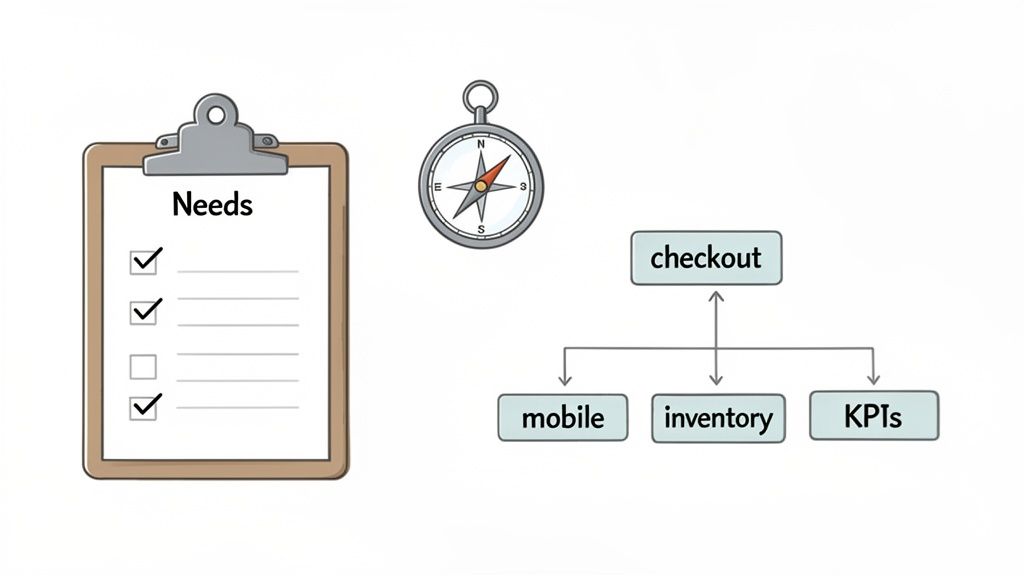
Jumping into calls with ecommerce consulting firms without a clear game plan is a recipe for disaster. It wastes your time, their time, and ultimately, your money. It’s like asking a doctor for a cure without even mentioning your symptoms.
Before you send a single email, you need to look inward. A thorough internal audit will turn that vague feeling of "we need help" into a concrete document that steers your entire search.
Get your team in a room and ask the hard questions. What’s really holding you back? Is it a leaky checkout funnel where a staggering 77% of carts are abandoned? Is it a clunky mobile experience that sends potential customers running? Or is your inventory management so inefficient that you're constantly dealing with stockouts and missed sales?
Document Your Current State
To get real clarity, you need data. Pull together a simple dashboard of your core Key Performance Indicators (KPIs). This isn't just about top-line revenue; it’s about the health of your entire customer journey, from first click to repeat purchase.
Your snapshot should include metrics like:
- Conversion Rate: What percentage of visitors actually buy something? Is that number trending up or down?
- Average Order Value (AOV): How much is the typical customer spending in one go?
- Customer Lifetime Value (CLV): What’s the total worth of a customer over their entire relationship with your brand?
- Add to Cart Rate: Are people engaging with products but stalling before checkout? A 6.2% rate is a common benchmark to measure against.
- Site Speed & Performance: How fast do your key pages load? Check it on both desktop and mobile—the numbers are often very different.
Having these figures on hand creates a solid baseline. It lets you approach a potential consultant and say, "Our conversion rate is stuck at 1.5%, and we need a strategy to hit 2.5% in the next six months." That’s worlds more effective than a vague, "We want to grow."
Map Your Tech Stack and Goals
Your technology is the engine powering your store. Make a clear list of the platforms and tools you're currently using, especially if you're on Shopify or Shopify Plus. This includes everything from your email service provider and loyalty app to your review platform and any custom integrations you've built.
Once you have your tech stack and KPIs documented, you can start setting specific, measurable goals. Think in terms of outcomes, not just tasks.
- Vague Goal: "Improve our email marketing."
- Specific Goal: "Increase revenue from our Klaviyo welcome series by 20% within 90 days."
Global eCommerce sales are projected to hit USD 7.89 trillion by 2028, a testament to the immense opportunity—and competition—in the market. Within this ecosystem, Shopify is a giant, powering over 6.8 million stores and commanding about 30% of the U.S. eCommerce platform market. This scale highlights why specialized expertise is no longer a luxury but a necessity for standing out. Discover more insights from these global ecommerce statistics.
This needs-assessment document becomes your compass. It ensures every conversation you have is focused, productive, and centered on solving your most pressing business challenges.
Tailor Needs to Your Business Size
The right kind of help changes as you grow. Your needs document has to reflect your current reality, whether you're just starting out or you're a major enterprise player.
- Emerging Brands (Under $1M/year): Your focus is on the fundamentals. You might need help defining your market position, setting up foundational analytics, or figuring out your initial customer acquisition channels.
- Growing Brands ($1M - $10M/year): Here, the challenge shifts to scaling smart. Your primary needs could be advanced Conversion Rate Optimization (CRO), improving customer retention, or streamlining operations to handle a higher order volume.
- Enterprise Brands (Over $10M/year): Complexity becomes the main hurdle. At this level, you might be looking for sophisticated AI-driven personalization, headless commerce architecture, or a robust strategy for international expansion.
By the end of this self-audit, you won't just be looking for "an ecommerce consultant." You'll be searching for a strategic partner with proven expertise in solving the specific problems you've identified, and you'll have the data to back it up.
How to Evaluate a Firm's True Expertise
Every ecommerce consulting firm's website is going to promise you the moon. They'll flash glossy logos from past clients and drone on about their "proprietary frameworks." Your job is to be the detective, cutting through the marketing fluff to find out what they can really do.
Assessing a firm's expertise isn't about what they say they can do; it's about finding hard proof of what they've already done. You're looking for deep, specific knowledge in the areas that will actually move the needle for your brand.
Beyond the Shopify Partner Badge
Seeing a Shopify Plus Partner badge is a good sign, but it's just the start. Think of it as a driver's permit, not a commercial license. True expertise goes way beyond a certification. You need a partner who gets the platform’s weird quirks, its limitations, and—most importantly—how to build a scalable tech stack that won’t buckle when you're having your biggest sales day ever.
Look for stories of them solving genuinely tough problems. Ask them to walk you through specific examples:
- A messy migration: How did they move a huge product catalog and years of customer history from a clunky platform like Magento to Shopify Plus without losing data or tanking their SEO?
- Custom app needs: When did a client’s requirements get too complex for off-the-shelf apps? How did they plan, build, and integrate a custom solution that actually worked?
- Headless commerce builds: Have they actually launched a headless site? What were the real performance gains, and how did they handle the extra complexity that comes with it?
Their answers should be packed with details and real-world examples, not just textbook best practices.
Verifying Conversion Rate Optimization Prowess
Conversion Rate Optimization (CRO) is a huge reason brands hire consultants, but it's an area filled with snake oil salesmen. Vague promises of "boosting conversions" are a massive red flag. Real CRO experts are part data scientist, part psychologist—they aren't just designers who make buttons bigger and change the color to green.
Demand to see their work. A proper case study isn't a fluffy blog post; it should include:
- The Hypothesis: What specific problem did they identify in the data?
- The Solution: What exact changes did they test based on that insight?
- The Results: What were the numbers—conversion lift, AOV increase, revenue impact—backed by screenshots from analytics or testing tools?
- The Learnings: What did they learn from the experiment, especially if it didn't work?
A great consultant is honest about their wins and their losses. Ask them about a CRO test that failed. The way they break down why it flopped and what they learned is a much better indicator of expertise than a simple success story.
While you're at it, dig into their knowledge of modern e-commerce advertising strategies. A firm that truly understands the entire customer journey, from the first ad click to the final checkout confirmation, can build a much more powerful growth engine for your brand.
Choosing the Right Engagement Model
How a firm works with you is just as critical as what they do. The partnership structure directly affects your budget, your team's involvement, and the results you'll see. The two most common setups are project-based work and ongoing retainers.
Figuring out the difference is crucial for matching their process to your needs.
Here's a quick breakdown to help you decide which model is the right fit.
Comparing Engagement Models Project vs. Retainer
For a brand that needs a full site rebuild before Black Friday, a project-based model is a no-brainer. The deliverable is clear and the timeline is fixed. On the other hand, a brand trying to improve its conversion rate month after month would get way more value from a retainer model, which allows for constant testing and strategy tweaks.
Picking the right model ensures you’re not paying for a team to sit on their hands or trying to squeeze a long-term growth strategy into a short-term project box.
Mastering the Vetting and Interview Process
You’ve got a shortlist of potential ecommerce consulting firms. Now the real work begins. This is where you dig past the slick websites and polished case studies to find out if they can actually solve your problems. It’s how you separate the true strategic partners from those just recycling the same tired playbook for every client.
To pull this off, you need a structured game plan. A detailed Request for Proposal (RFP) is your opening move. It forces firms to respond directly to your needs, which makes comparing them apples-to-apples so much easier.
Your RFP should do more than just ask about company size or services. Push for deeper insights:
- How do they interpret your problem? Ask them for a diagnosis based on the info you’ve shared. What’s their initial take on your main challenge?
- What’s their proposed methodology? Get a high-level view of their approach. Will they start with a technical audit, customer research, or jump straight into A/B testing?
- Who is on the team? Get the names and roles of the people who will actually be in the trenches with you, not just the sales lead.
- How will they measure success? Their answer here needs to match the KPIs you defined earlier. If it doesn’t, that’s a major disconnect.
This approach gives you a clear framework for evaluating the core components: their expertise, how they work, and whether they’ll be a good fit for your team.
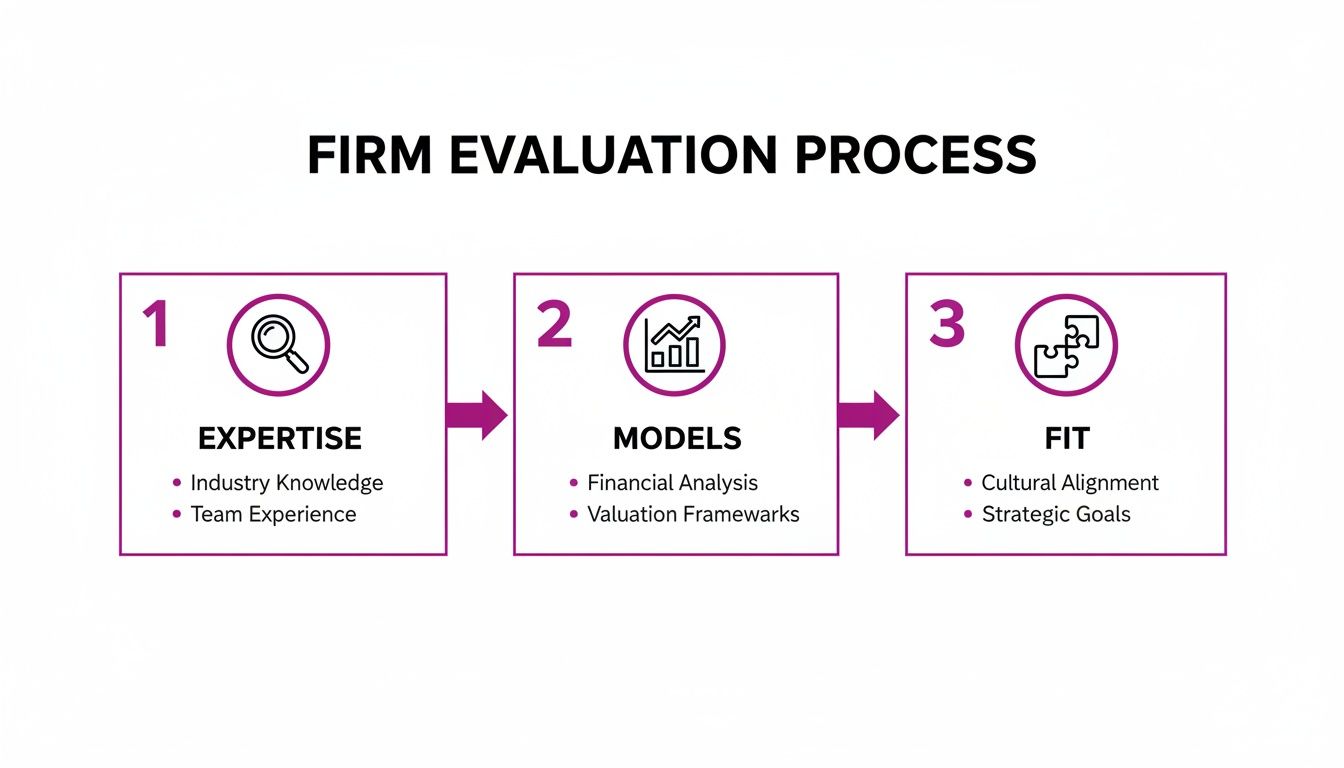
This evaluation flow makes sure you’re looking at each candidate from all angles—from raw technical skill to how they’ll actually mesh with your company culture.
Insightful Interview Questions to Ask
Once the RFPs are in, it’s time for interviews. This is your chance to see how they think on their feet. Generic questions lead to generic, rehearsed answers. So, ditch "What's your process?" and ask questions that reveal their true character and real-world experience.
Try throwing these into the mix:
- "Tell me about a project that went completely off the rails. What happened, how did you help fix it, and what did you learn?"
- "Describe a time a client strongly disagreed with a recommendation you made. How did you manage that conflict, and what was the result?"
- "Looking at our brand, what’s one huge opportunity you think we're missing right now? Why that one specifically?"
- "How do you make sure your big strategic ideas get translated into tasks our internal team can realistically handle?"
The answers to these questions will tell you far more than any case study ever could. A great partner won’t be afraid to talk about failure and will demonstrate a collaborative spirit, not a dictatorial one. If you’re hunting for a Shopify-specific partner, our guide on how to choose the right Shopify marketing agency has even more questions tailored to the platform.
Critical Red Flags to Watch For
Asking the right questions is only half the battle; you also need to spot the warning signs. Some red flags are subtle, but others are blaring alarms telling you to walk away.
Be extremely wary of any firm that guarantees specific results, like "we'll double your conversion rate in 90 days." True experts know ecommerce growth is messy. They set goals and build strategies, but they don't make impossible promises.
Keep a sharp eye out for these other deal-breakers:
- Vague, Buzzword-Filled Answers: If they can’t explain their strategy in plain English, they either don’t get it themselves or they’re hiding a lack of real substance.
- A Rigid, Cookie-Cutter Approach: Your business is unique. If their proposed solution sounds like a copy-paste job they’ve used a hundred times, they weren’t listening to you.
- Focusing on Vanity Metrics: Are they talking about traffic and social media likes? Or are they focused on revenue, profit, and customer lifetime value (CLV)? The former is a classic sign of inexperience.
- The Bait-and-Switch: The senior expert who dazzled you on the sales call is suddenly “unavailable,” and you’re passed off to a junior account manager. Insist on meeting the actual team you’ll be working with day-to-day.
This careful vetting process ensures you don't just hire a consultant. You bring on a partner who is genuinely invested in seeing you win.
Finalizing the Partnership and Setting Expectations
You've made your final choice. It's a huge milestone, but don't pop the champagne just yet. This isn't the finish line; it’s the starting block. What happens next—getting the contract right and kicking things off smoothly—is what truly sets the stage for a successful partnership. Too many brands rush this part and end up dealing with misaligned expectations and friction later on.
Think of the contract as your single source of truth. It’s not about being adversarial; it’s about creating total clarity for both you and the firm. This document is what turns a handshake deal into a professional engagement where success is clearly defined from day one.
Deconstructing the Consulting Contract
Don't just give the contract a quick skim before you sign. A solid consulting agreement is made up of several key parts, and you need to understand every single one of them.
The absolute heart of the document is the Scope of Work (SOW). This needs to be incredibly specific. If you see vague language like "improve SEO," that’s a major red flag. A well-written SOW will detail concrete activities, like "conduct a full technical SEO audit, deliver a prioritized list of fixes, and implement the top five critical recommendations by the end of Q2." See the difference?
Beyond the SOW, you'll want to dig into these areas:
- Payment Terms: Is it a fixed project fee billed at key milestones? A monthly retainer due on the first of the month? Get the payment schedule, invoicing process, and any late fee policies locked down.
- Intellectual Property (IP): Who owns the work when it's all said and done? The standard arrangement is that you (the client) own the final deliverables after you've paid in full, but the firm keeps the rights to their internal processes and any proprietary tools they use. This is normal, but always confirm it in writing.
- Confidentiality: A basic non-disclosure agreement (NDA) is non-negotiable. This is what protects your sensitive business data.
- Termination Clause: What happens if things just aren't working out? Look for a clause that allows either side to exit the agreement cleanly with a reasonable notice period, usually around 30 days.
Setting Clear Service-Level Agreements
Often part of the main contract or attached as an appendix, the Service-Level Agreement (SLA) is a must-have for a healthy partnership. An SLA simply defines the ground rules for working together—things like service expectations, response times, and availability.
An SLA isn't about micromanaging your new partner. It’s about mutual respect for each other's time and priorities. It answers all the practical "how will we work together?" questions before they turn into urgent problems.
For instance, a good SLA will clearly state:
- Response Times: How quickly can you expect a reply to an email or support ticket? A common standard is within 24 hours for regular requests and bumped up to 2-4 hours for anything business-critical.
- Communication Channels: Are you using Slack, email, or a project management tool like Asana? Defining this upfront keeps important messages from falling through the cracks.
- Meeting Cadence: Will you have a standing weekly check-in call? A monthly deep-dive strategy session? Getting a regular rhythm on the calendar ensures communication stays consistent.
This simple document prevents that all-too-common frustration of sending an urgent message into the void and hearing nothing back for days.
Mapping Out a Successful Onboarding
Once the contract is signed, the real work begins with onboarding. A smooth start is absolutely critical for building momentum and getting the consulting firm integrated with your team. This shouldn't be a one-sided process; it's a collaboration with clear steps for everyone.
A smart onboarding plan usually looks something like this:
- The Kickoff Meeting: This is the first official meeting with all the key players from your team and the firm. The agenda should cover introductions, a final review of the SOW, and a clear confirmation of the project's primary goals.
- Granting System Access: This is a logistical but crucial step. You'll need to grant them access to your Shopify admin, Google Analytics, ad accounts, and any other relevant tools. Always use secure methods for sharing credentials and start with the lowest level of permissions they need to do their job.
- Team Integration: Make the formal introductions. Let your internal team members know who they'll be working with from the consulting firm, what their roles are, and how they'll collaborate. This helps break down silos and fosters a sense of one unified team working toward the same goal.
- Establishing a KPI Dashboard: This is where you make success tangible. Work together to build a shared dashboard that tracks the key performance indicators you've agreed upon. This dashboard becomes the centerpiece of your check-in meetings, giving everyone a transparent, data-driven view of progress.
When you take the time to finalize the partnership with this level of care, you're not just hiring another vendor. You’re building a genuine strategic alliance focused on a shared vision of success.
Got Questions About Ecommerce Consulting? We've Got Answers.
Even after you've done your homework, a few last-minute questions always seem to surface just before you’re ready to sign on the dotted line. Getting straight answers is that final checkpoint before you commit. Let's tackle the big ones we hear from brands all the time.
How Much Does Ecommerce Consulting Really Cost?
This is always the elephant in the room. The truth is, pricing is all over the map, and there’s no single answer. But almost every engagement you'll encounter will fit into one of three buckets. Knowing how they work is key to comparing apples to apples.
Project-Based Fees: This is your classic one-and-done deal. You get a fixed price for a specific outcome, like a Shopify Plus migration or a deep-dive technical SEO audit. These can run anywhere from $15,000 for a tightly scoped project to well over $100,000 for something complex like a full site rebuild.
Monthly Retainers: When you need an ongoing partner for things like Conversion Rate Optimization (CRO) or dedicated tech support, a monthly retainer is the way to go. For smaller brands, these often start around $5,000 per month. For enterprise-level support, it's not uncommon to see retainers climb north of $25,000 per month.
Hourly Rates: Some consultants work by the hour, which makes sense for smaller, ad-hoc tasks or initial discovery sessions. You can expect to see rates from $150 to $400+ per hour, depending on who you're talking to and what their specialty is.
So which one is right for you? It really comes down to the problem you're solving. If you have a clear finish line, a project fee gives you cost certainty. If you're looking for a long-term growth partner, a retainer is built for that kind of flexible, ongoing relationship.
What Is a Realistic ROI to Expect?
Everyone wants to know how long it will take to see a return. While any consultant who guarantees a specific result should be a red flag, they absolutely should be able to build a data-backed forecast. This isn't guesswork; it's based on your numbers and their plan.
Here’s what a typical ROI timeline actually looks like in the real world:
Months 1-3 (The Foundation): The first 90 days are all about digging in—audits, research, strategy, and fixing what’s broken. You might see some quick wins from patching up technical issues, but this phase is really about setting the table for growth. The immediate ROI is small, but the work is absolutely essential.
Months 4-6 (The Momentum): Now we're cooking. This is where the strategic initiatives, like A/B testing or campaign optimizations, really start to pay off. You should see a real, measurable lift in key metrics, maybe a 5-10% bump in conversion rate or a healthier Average Order Value (AOV). The goal is to be ROI-positive by the end of month six.
Your ROI shouldn't be a black box. A good partner works with you to build the business case from day one, showing exactly how their work connects to revenue and profit.
By the six-month mark, the value they bring should be easily covering their fee. If it’s not, or you don't at least see a clear path to profitability, it's time to have a serious chat about the strategy.
What Are the Best Metrics for Measuring Success?
Forget vanity metrics. Clicks, traffic, and followers are nice, but they don't pay the bills. When you hire a consultant, success has to be tied directly to the bottom line. Your shared dashboard should be all about business outcomes.
Focus on these essentials:
- Conversion Rate (CR): This is the big one. It’s the ultimate report card for your site's performance. Every single thing a consultant does should, in some way, be aimed at getting more visitors to click "buy."
- Customer Lifetime Value (CLV): A top-tier consultant isn't just chasing one-time sales; they're building sustainable growth. When your CLV is climbing, it means you're not just acquiring customers—you're acquiring the right customers and keeping them around.
- Average Order Value (AOV): Are shoppers spending more each time they check out? AOV is a direct reflection of how well your upselling, cross-selling, and product bundling strategies are working.
- Profitability Metrics: This is where the pros separate themselves. Don't just look at revenue; track Gross Margin and Contribution Margin. A consultant obsessed with top-line sales without an eye on profit can easily grow you into bankruptcy.
At the end of the day, the best ecommerce consulting firms aren't just vendors; they're partners. They're invested in your success, bring clarity to chaos, and measure their worth by the real, tangible impact they have on your business.
Ready to unlock your brand's true potential? The team at ECORN combines deep Shopify expertise with proven CRO strategies to help you scale smarter. We offer flexible subscription packages and single-project initiatives to fit your needs, whether you're an emerging brand or a Shopify Plus powerhouse. Start your growth journey with us today.


Mobile Pop Up Strategy for Shopify Stores That Converts
Sitemap for Shopify: How to Find, Optimize, and Submit It
7 Single Product Websites Worth Emulating
Product Variants Shopify: The Complete 2026 Guide
Ecommerce Analytics Consulting for Growth
What Is AI Integration for eCommerce
How to Choose the Right eCommerce Website Development Firm
E Business Strategy Implementation
Conversion Tracking Setup for Shopify Stores
BigCommerce vs Shopify Plus Which Enterprise Wins in 2026
Shopify Theme Kit: Setup, Commands, and Migration Guide
Shopify Extension Development: A Practical 2026 Guide
Shopify Speed Score Explained and How to Improve It
Shopify Mobile Optimization: The 2026 Playbook
How to Add Subcategory in Shopify for Better UX
How to Implement Structured Data for Ecommerce in 2026
SEO App Mobile: Shopify Store Optimization Guide
Shopify Plus Support: What It Includes and How to Choose

Google Ads for Shopify: The Complete 2026 Playbook
Shopify New York: How to Find and Hire the Right Agency
Google Search Console for Shopify: The Complete Setup
First Party Data Collection for eCommerce Growth
FAQ Online Store Guide: Build and Measure It Right
Do FB Ads Work for eCommerce in 2026?
One Page Checkout for Shopify: Design and Implementation
Shopify GraphQL vs REST: The 2026 Developer Decision
Shopify Ecommerce Consulting: Strategy, Pricing &
Are Reddit Ads Worth It for eCommerce Brands
Shopify Title and Meta Description: A Practical 2026 Guide

Product Video Best Practices for Shopify Brands
Real-Time Inventory Management: A 2026 Guide
AI Chatbot Integration for Shopify Stores
Affiliate Program Management: A Shopify Guide
10 Best Performance Monitoring Tools for Shopify in 2026
Digital Asset Management for eCommerce Brands in 2026
Every Type of Facebook Ads Explained for eCommerce Growth
Product Information Management Explained for Shopify Brands
Support Ticket System: A Guide for Shopify Stores

10 Best Customer Service Tools for Shopify in 2026

Can I Start a Business with No Money? a 2026 Blueprint

What Sells Good on Etsy: Best Niches for 2026

Shopify Add to Cart Button: A Practical 2026 Guide

Customer Feedback Automation: A Practical eCommerce Guide
Critical Rendering Path: A Guide for Shopify Stores

How to Promote on TikTok for eCommerce in 2026

B2B eCommerce Consulting That Drives Real Revenue
10 Best Practices for Site Navigation in 2026
Return vs Refund for Shopify Stores: A Practical Guide
What Is Customer Lifetime Value and Why It Matters
What Is Voice of Customer Research for eCommerce

SMS Marketing for Ecommerce That Actually Converts

Master How to Improve Email Deliverability in 2026

Top 7 eCommerce Partners NYC for Shopify Brands in 2026
Machine Learning for Ecommerce: Boost Your Shopify Store

Beauty Market Research: Your 2026 Growth Guide

Shopify International Expansion: A 2026 Roadmap
What Does CRO Stand for in Business: Understanding CRO

Shopify Visual Merchandising: A Playbook for Higher Sales
Shopify Landing Page Design: Master Conversion in 2026
10 Best AI SEO Optimization Tools for Shopify in 2026

Agentic AI for Ecommerce: Boost Your Sales in 2026
Mastering Email Marketing Data for eCommerce Growth

Conversion Rate Optimisation Australia: Boost Your Sales
Conversion Rate Optimization AI: Your Shopify Store Guide

10 Product Bundling Strategies for Shopify in 2026
How to Increase Customer Lifetime Value: A Shopify Playbook
AI Customer Service Automation: Shopify Guide 2026
Clean Website Design: A Shopify Conversion Playbook

Omnichannel Retail Strategy: A Shopify Playbook
Product Data Enrichment: A Guide for Shopify Brands

Instagram Shopping Features a Guide for Shopify Stores
What Is Revenue Optimization: A Holistic RevOps Guide

Benefits of Conversion Rate Optimization: Boost Your
WordPress to Shopify Migration: Your 2026 Seamless Switch
Boost Sales: Ecommerce Payment Processing Guide 2026
Unified Commerce Platform: Benefits, KPIs & Shopify Guide
How to Reduce Bounce Rate eCommerce: Your 2026 Guide
Shopify API Integration: A Practical End-to-End Guide
How to Implement Data Governance: A 2026 Guide
Shopify Store Development Cost: A 2026 Breakdown
What Is Server Side Tracking: The Shopify Guide 2026
Marketing Automation Workflows: A Shopify Guide for 2026

Shopify: How to Reduce Technical Debt

Shopify UX Design Change: A Playbook for Growth
User Generated Content Strategy: Shopify Playbook

Shopify Pause and Build Plan Cost: A Complete 2026 Guide
Compare at Price on Shopify: A Complete Guide for 2026
Where Can I Sell My Prints? 10 Best Platforms for 2026
Shopify Order Management System: The Ultimate Guide 2026
What Is Marketing Attribution? an eCommerce Guide for 2026

10 Best Black Friday Sales Sheets for 2026

Discover the Top Social Media Marketing Agencies For
Consumer Confidence Definition for eCommerce in 2026
What Is Social Commerce? Your 2026 Guide to Boosting Sales
A Social Ad Campaign Playbook for eCommerce Growth
7 Best FAQ Page Examples for SaaS & eCommerce

Market Research in Fashion Industry: A Guide for Shopify
Shopify Migration Services: Expert Guide for 2026
Mastering FB Retargeting Ads for Shopify in 2026
What Is Omnichannel Ecommerce


newsletter in your inbox