

Hitting a growth ceiling is a familiar feeling for any successful ecommerce brand. You've got momentum, but that standard Shopify setup that got you here now feels less like a rocket ship and more like a pair of training wheels. This is that critical moment where you have to decide: do you need a standard mechanic, or is it time to bring in a specialized pit crew to win the race?
When Do You Need A Shopify Plus Development Agency
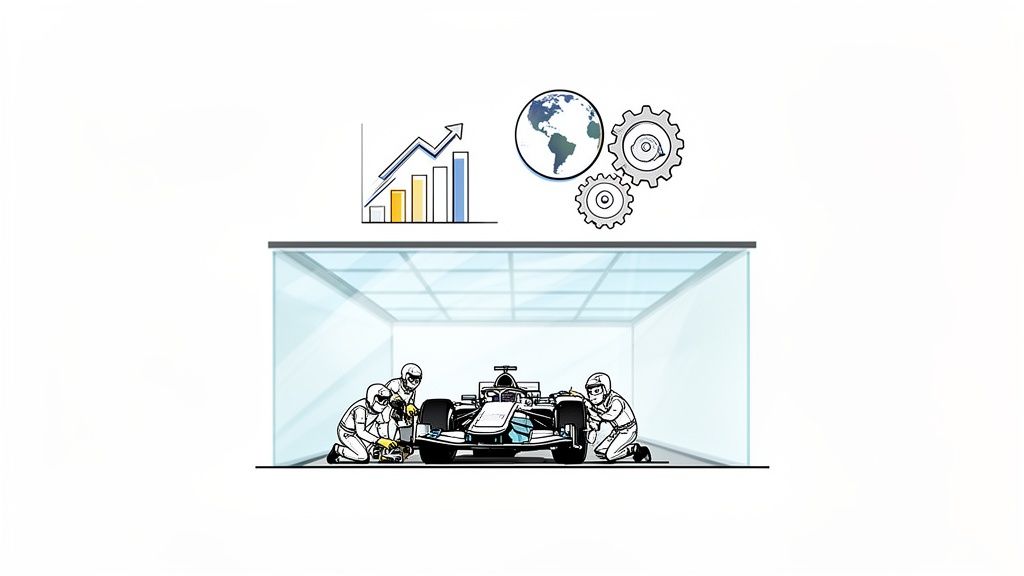
Think of your growing business like a high-performance race car. A general Shopify developer is your trusted local mechanic. They're fantastic for routine maintenance, theme tweaks, and installing a few apps. They keep the engine running day-to-day.
But when you're gunning for the enterprise ecommerce circuit, you need more than a tune-up. You need a dedicated pit crew. A Shopify Plus development agency is that crew—built to handle the intense demands of high-speed growth, complex maneuvers, and the split-second decisions that separate market leaders from the pack.
Identifying Your Growth Triggers
So, what are the flashing warning lights on your dashboard telling you it's time to pull into the pits for an upgrade? These triggers often disguise themselves as "good problems," but they can quickly turn into critical roadblocks if you don't have enterprise-level expertise on your side.
- Your Site Slows Down Under Pressure: Do traffic spikes from marketing campaigns or flash sales make your site lag or, even worse, crash? That's not just a technical glitch; it's lost revenue and a frustrating customer experience.
- Complex Integrations Become a Must-Have: You’re ready to sync your store with an ERP, a custom CRM, or a third-party logistics (3PL) partner. Off-the-shelf apps just aren’t cutting it anymore.
- International Expansion Is On The Horizon: You're gearing up to sell in multiple countries. This means juggling different storefronts, currencies, languages, and regional fulfillment strategies—a puzzle that standard Shopify can't solve alone.
- Custom Functionality Is Limiting You: Your brand’s unique edge relies on features you can't find in the app store, like a sophisticated product customizer or a subscription-based wholesale portal.
If these challenges sound painfully familiar, you’ve hit an inflection point. You're shifting from just running a store to engineering a scalable revenue machine.
The Real Difference Between a Standard Developer and a Plus Agency
It's easy to think all developers are the same, but the distinction becomes crystal clear when you're scaling. A standard developer focuses on the "what" (e.g., "install this app"), while a Plus agency focuses on the "why" and "how" (e.g., "how do we build a system that supports your 5-year growth plan?").
Here’s a quick breakdown of where their paths diverge:
Standard Developer vs Shopify Plus Agency Key Distinctions
Choosing the right partner is about matching their capabilities to your ambition. A standard developer is perfect for getting started, but a Plus agency is who you call when you're ready to scale aggressively and build a lasting enterprise-grade operation.
The True Value of a Plus Partner
The need for a specialized agency is highlighted by the platform's explosive growth. By 2026, it's projected that over 47,000 live websites will be running on Shopify Plus, a huge leap from around 25,000 in 2022. Merchants on this platform, often pulling in between $1 million and $500 million annually, see an average year-over-year growth of 126%. That kind of acceleration demands a partner who truly understands the architecture of scale. You can explore more Shopify growth statistics on Charle Agency.
A Shopify Plus development agency isn't just a team of coders. They are strategic partners who bring a playbook for high-volume success. They have deep knowledge of the Shopify Plus API, exclusive tools like Shopify Scripts and Flow, and the architectural know-how to build a resilient, fast, and high-converting ecommerce machine. They spot the bottlenecks before they happen, making sure your technology fuels your ambition, never limits it.
Unpacking The Core Services That Fuel Growth
Think of a top-tier Shopify Plus development agency less as a to-do list checker and more as a growth partner. Their services aren't just about writing code or tweaking designs; they're strategic levers you pull to solve real business problems and see tangible results. Each one is a tool engineered to drive revenue, boost efficiency, or build a stronger brand.
Let’s use an analogy: your ecommerce platform is like the foundation of a skyscraper. A shaky, generic foundation limits how high you can build. An expert agency comes in and ensures that foundation is solid rock, giving you the confidence to build floor after floor without worrying about collapse.
Here are the core services that make it all happen.
Seamless Platform Migration
Outgrowing your current platform is a good problem to have, but the thought of migrating can be terrifying. Whether you're moving from Magento, BigCommerce, or a clunky custom system, a specialized agency turns this massive technical project into a smooth, strategic upgrade. It’s not just about copying and pasting product data; it’s about rebuilding your business for its next chapter.
A properly managed migration covers all the bases:
- Data Integrity: They make sure every last piece of critical data—customers, orders, products, and reviews—makes it over safely, without any loss or corruption.
- SEO Preservation: This is a big one. They implement a meticulous 301 redirect strategy so you don't lose years of hard-earned search engine rankings. Skipping this step is like changing your business address and not telling the post office.
- Zero Downtime: The final switch is timed and executed perfectly to avoid any interruption in sales or a broken customer experience.
- Feature Parity and Enhancement: They replicate the essential functions from your old store and, more importantly, find ways to improve them using Shopify Plus's powerful native features.
Custom Storefront and Headless Development
In a market this crowded, your storefront is your digital flagship. A generic, off-the-shelf theme simply won't cut it if you have serious ambitions. Custom development is about creating a unique, high-performing experience that truly reflects your brand and guides customers from the first click to the final checkout.
This usually means building a custom theme from the ground up, giving you total control. But for brands that need the absolute best in flexibility and speed, agencies are increasingly turning to headless commerce.
Headless architecture separates the frontend (the "head," or what your customer sees) from the backend (the commerce engine). This allows for blazing-fast site speeds, total design freedom with modern tech, and the power to push your products to any channel—a website, mobile app, or even a smart mirror—all from one Shopify backend.
Strategic Conversion Rate Optimization CRO
Getting people to your store is only half the job. The real magic happens when you turn those visitors into paying customers. That's where Conversion Rate Optimization (CRO) comes in. A great Shopify Plus agency doesn't just build your store and walk away; they help you maximize its performance with services like expert Shopify Conversion Rate Optimization (CRO).
This isn't guesswork. It's a continuous, data-driven process of making incremental improvements to your site to increase the percentage of users who buy something.
The process is methodical:
- Data Analysis: They dig into heatmaps, session recordings, and analytics to find where users are getting stuck or dropping off.
- Hypothesis Creation: Based on the data, they form an educated guess. For example, "We believe changing the 'Add to Cart' button to a brighter color will increase clicks."
- A/B Testing: They test the new version against the old one, showing each to a different segment of your audience to see which one performs better.
- Implementation: The winning version gets rolled out to everyone, and they move on to the next test.
Over time, these small wins compound, leading to huge lifts in revenue without spending a single extra dollar on ads.
Intelligent AI and System Integrations
Efficiency is the secret weapon of any business looking to scale. A Shopify Plus agency acts as the architect for your entire tech stack, weaving everything into a cohesive, automated machine. This means connecting Shopify to your other critical business systems, which cuts out manual work and slashes the risk of human error.
Common integrations include:
- ERP Systems: To keep inventory, orders, and customer data synced in real-time.
- CRM Platforms: To give your marketing and support teams a complete view of every customer.
- 3PL and WMS: To put order fulfillment and logistics on autopilot.
- Custom Apps: To build unique features that your specific business model needs to thrive.
Beyond that, forward-thinking agencies are now plugging in Artificial Intelligence (AI) to handle complex tasks. Imagine AI-powered chatbots resolving 80% of customer service tickets automatically, or intelligent search that serves up personalized product recommendations and boosts your average order value. This isn't science fiction; it's what smart merchants are using right now to get ahead.
By combining these services, a Shopify Plus agency does way more than build websites. They architect complete commerce solutions designed to be scalable, efficient, and primed for growth. To get a better feel for how these pieces fit together, take a look at our flexible Shopify Plus development services and see what’s possible.
Decoding Agency Pricing And Calculating Your ROI
Hiring a Shopify Plus development agency feels like a huge leap, but once you get a handle on the numbers, the decision becomes a lot clearer. The key is to stop thinking of it as a cost and start seeing it as a strategic investment in your brand's future.
Agency pricing isn’t a one-size-fits-all deal. It's built to match the size and complexity of your ambition. Most agencies lean on a few common models, each one a good fit for different business needs and stages of growth.
The flowchart below shows how the core services—migration, development, and optimization—work together to create a powerful growth engine for your business.
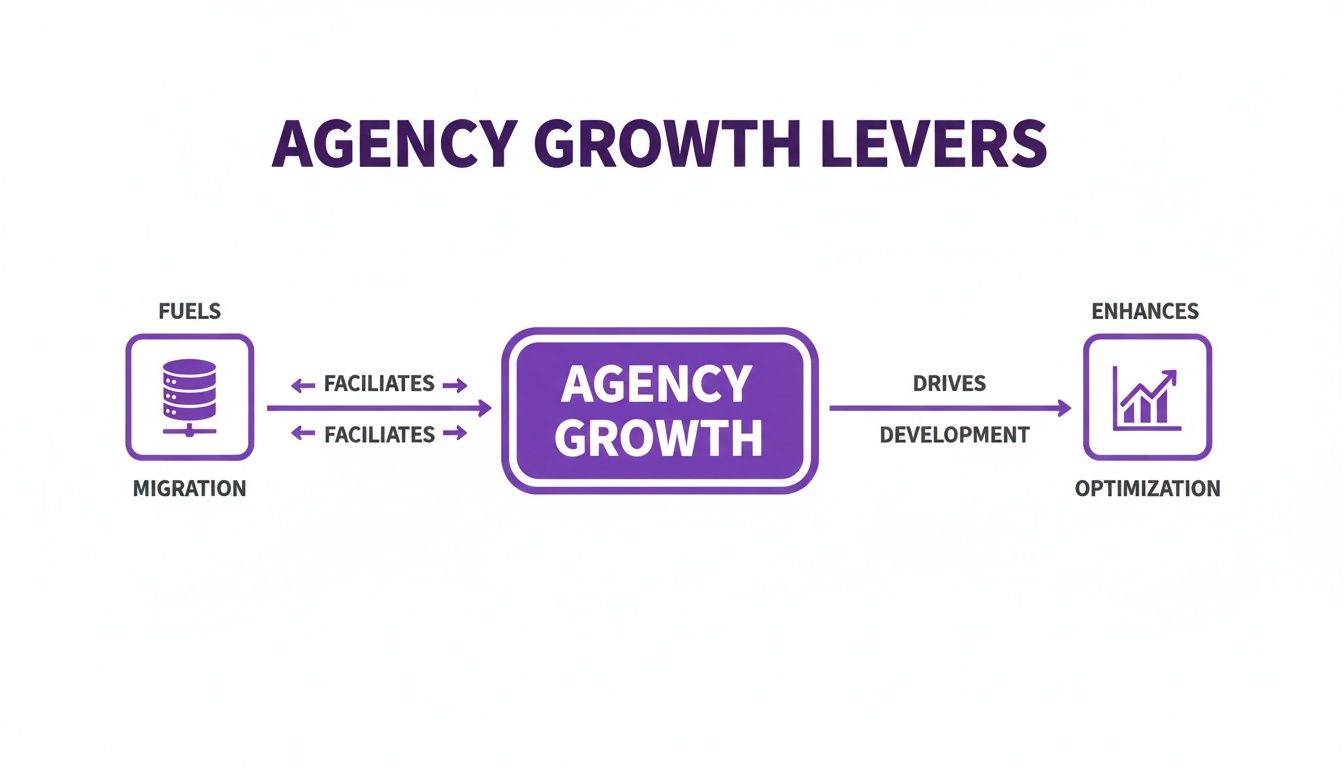
It all starts with a solid foundation. A smooth migration and smart development pave the way for continuous, high-impact optimization that drives long-term returns.
Common Agency Pricing Models
First up is the fixed-price project model. This is perfect for clearly defined, one-off jobs like a full website redesign or a migration from a platform like Magento. You agree on the scope and deliverables upfront for a single, predictable cost. No surprises.
Then there’s the monthly retainer model, which is the go-to for most ongoing partnerships. You pay a set fee each month for access to a dedicated team that handles everything from building new features and squashing bugs to running CRO experiments and providing strategic advice. It’s all about continuous improvement.
Finally, some agencies are moving toward flexible subscription packages. This is a more modern approach, and it's the one we champion here at ECORN. It combines the consistency of a retainer with the adaptability you need to jump on new opportunities. You can scale your services up or down as your needs evolve, giving you the best of both worlds.
Real-World Costs And The ROI Calculation
So, what kind of budget are we talking about? Shopify Plus projects are a serious investment. A full store build can run anywhere from $25,000 to $150,000, while complex migrations often land in the $30,000–$200,000 range. For ongoing support, retainers typically fall between $3,000–$12,000 per month. If you want a deeper dive, check out our ultimate guide to Shopify Plus pricing.
When you compare these figures to the cost of an in-house team—which can easily hit $180,000–$230,000 a year—the value becomes obvious. And the results? They speak for themselves. Brands have seen a 45% lift in conversion rates and a whopping 119% boost in sales after partnering with the right agency.
The real "aha" moment comes when you weigh it against the alternative. Building an in-house team of senior developers, UX designers, and CRO specialists is not only more expensive, it's also incredibly slow. An agency gives you instant access to a seasoned, cohesive team for a fraction of the cost.
How To Measure Your Return
The true value of an agency isn’t just in the code they write—it’s in the business outcomes they create. Calculating your ROI means looking past the initial price tag and focusing on the key performance indicators (KPIs) that actually move the needle.
Here are the big three:
- Conversion Rate (CR): Let's say an agency's CRO work bumps your conversion rate from 1.5% to 2.0%. That seemingly small jump can easily translate into hundreds of thousands of dollars in new revenue over a year.
- Average Order Value (AOV): By implementing smart features like product bundles or tiered promotions, an agency can get each customer to spend more. Even a 10% lift in AOV directly adds 10% to your top line from the exact same amount of traffic.
- Customer Lifetime Value (CLV): A better site experience, personalized features, and a frictionless checkout all build loyalty. When customers stick around longer, you spend less on acquiring new ones, and your profitability soars.
Once you’ve got a handle on the pricing, the next step is to get comfortable with measuring marketing ROI. When you track these metrics, the cost of a Shopify Plus agency shifts from an expense to a clear, justifiable investment in sustainable growth.
How To Choose The Right Agency Partner
Picking a Shopify Plus development agency is one of the most critical decisions you'll make for your brand's growth. This isn’t about hiring a vendor to just check off tasks on a list; it’s about bringing on a strategic partner who will have a direct hand in your revenue and ability to scale.
A polished portfolio is nice, but it's just the starting point. The real proof is in the results they’ve driven for businesses just like yours.
Think of it like hiring a co-pilot for your brand's rocket ship. You wouldn’t just glance at their resume. You’d want to know how they handle turbulence, their track record for successful missions, and if they’ve ever flown a ship with your exact specifications. The right partner knows the difference between a pretty website and a high-octane revenue engine.

Look Beyond The Portfolio
Every agency will show you their best-looking work, but aesthetics are only a tiny piece of the puzzle. Your job is to uncover the real business outcomes hiding behind the slick designs. When looking at an agency's work, train yourself to ask, "What results did this actually drive?" instead of just, "What did they build?"
This means you need to get your hands dirty and dig into their case studies. Hunt for hard numbers that mirror your own goals:
- Conversion Rate Lift: Did they actually increase the percentage of visitors who bought something? By how much?
- Average Order Value (AOV) Growth: How did their work get customers to spend more each time they checked out?
- Revenue Impact: Can they draw a straight line from their development or CRO work to a measurable jump in sales?
- Site Speed Improvement: Did they make the site faster? And what did that do for the user experience and, more importantly, conversions?
A great case study tells a story: here was the problem, here's how we solved it, and here are the data-backed results. If all you see are screenshots and fluffy descriptions, it’s time to press for more details.
Vet Their Reputation And Client Reviews
Reviews and testimonials are your secret window into how an agency really operates. Five-star ratings are great, but the actual content of those reviews is what tells the true story. Look for patterns and recurring themes that speak to their reliability and expertise.
Are clients constantly talking about their sharp project management? Do they bring up proactive communication or a truly collaborative spirit? These are the details that tell you what it’s like to work with them day in and day out. A top-tier Shopify Plus development agency builds its reputation on trust and transparency, not just technical wizardry.
The industry also keeps score. The best agencies are often ranked on their deep mastery of Shopify Plus, client review scores, and their track record with B2B brands. Elite partners can point to incredible metrics like 96% client retention rates, with some having launched over 250 stores and collecting more than 150 five-star reviews. Partnering with an agency that has this kind of proven performance is directly linked to success, as qualifying merchants often report an average of 126% year-over-year growth. Discover more insights about top Shopify Plus agencies from First Page Sage.
A truly great partner won’t hesitate to provide relevant client references. Speaking directly with a current or former client is one of the best ways to get an unfiltered view of an agency's strengths and weaknesses.
Ask The Right Questions During The Interview
Those initial calls are your chance to cut through the sales pitch and find out if they have real strategic depth. Your questions should be designed to pull back the curtain on their thought process, their problem-solving skills, and how they approach a true partnership.
Here are a few sharp questions to get you started:
- "Walk me through a project that didn't go as planned. What happened, and how did your team handle it?"
This question is pure gold. It reveals their transparency, accountability, and how they perform under pressure. - "Based on what you've seen of our brand, what's the single biggest opportunity you see for us on Shopify Plus?"
This tests their strategic thinking and shows you if they’ve actually done their homework. A generic, canned answer is a major red flag. - "How does your team stay on top of Shopify updates and new ecommerce trends?"
You need a partner who is looking forward, not back. This shows their commitment to learning and ensures you’re not getting yesterday’s solutions. - "Describe your project management and communication process. Who would be our main point of contact, and how often can we expect updates?"
This is all about setting clear expectations. Getting this sorted out upfront helps you avoid frustrating communication breakdowns down the road.
Choosing the right agency is a matchmaking process. You're searching for a team that has the technical skills, a proven history of delivering results, and a working style that clicks with your own. The diligence you put in now is the foundation for a long, successful, and profitable partnership.
The Onboarding Process From Kickoff To Launch
So you've signed on the dotted line with a Shopify Plus development agency. That’s a huge step. But what actually happens next? A great partnership isn’t just about the finished product; it’s about a clear, predictable process that keeps surprises at bay and builds momentum from day one.
Think of it like building a custom home. You wouldn't just hand over the keys to a contractor and hope for the best. You'd expect a detailed blueprint, regular check-ins, and a solid timeline. Top-tier agencies operate the same way, guiding you through a structured journey from a simple idea to a fully launched, high-performing store.
Phase 1: The Deep-Dive Discovery And Strategy Session
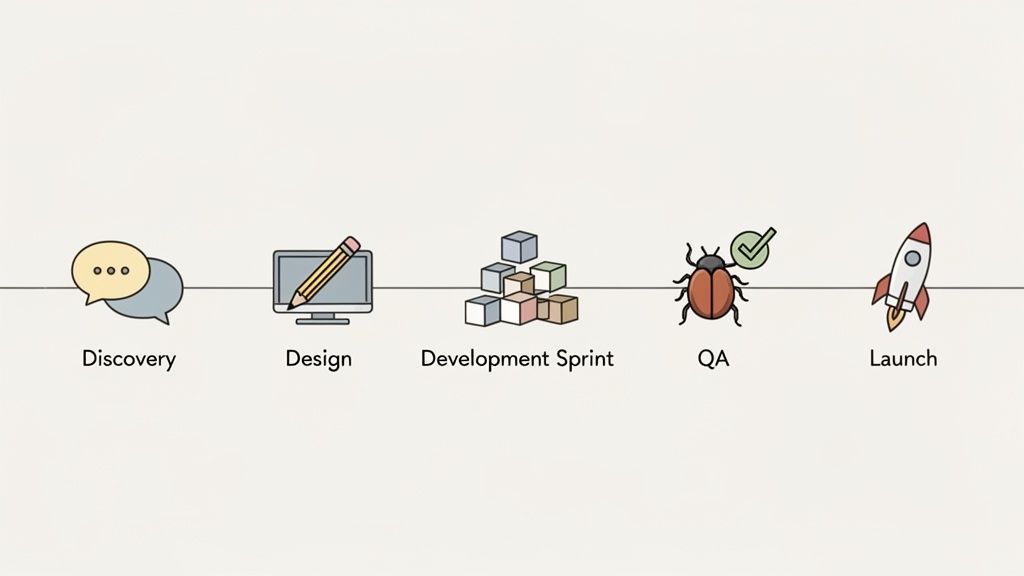
The project officially kicks off with a discovery meeting. This is no simple meet-and-greet. It’s an intensive workshop where the agency’s team digs deep into your business to understand not just what you want to build, but why.
During this phase, get ready for detailed questions about your brand, your customers, your biggest operational headaches, and your long-term ambitions. The goal is to get both teams perfectly aligned on a single, unified vision for the project.
Here's what this stage usually involves:
- Stakeholder Interviews: Talking to the key players in your marketing, operations, and leadership teams.
- Technical Audit: A thorough review of your current tech stack, integrations, and any existing code.
- Goal Setting: Defining clear, measurable Key Performance Indicators (KPIs) that will tell everyone what success looks like.
The main takeaway from this phase is a comprehensive Project Brief or Strategy Document. This becomes the north star for the entire project, laying out the scope, goals, potential risks, and a preliminary timeline.
Phase 2: Collaborative UX/UI Design
With a rock-solid strategy in place, the focus shifts to what your customers will actually see and experience. The User Experience (UX) and User Interface (UI) design phase is a highly collaborative process that turns your brand and business goals into a functional, intuitive, and beautiful storefront.
First, the UX team will map out the user journey by creating wireframes—basically, the architectural blueprints of your site. Once that structure gets the green light, the UI team jumps in to apply your brand’s visual identity, creating high-fidelity mockups that show exactly how the final site will look and feel.
Your feedback here is absolutely critical. This is the time to be vocal. A good agency won’t just show you pretty pictures; they’ll explain the why behind each design choice, connecting every element back to usability and conversions.
Phase 3: Agile Development Sprints
This is where the code starts flying and the designs come to life. Most modern agencies use an agile development methodology, which means breaking the project into small, manageable chunks called "sprints." Each sprint usually lasts one to two weeks and is dedicated to building a specific set of features.
This approach has some major advantages:
- Transparency: You get regular updates and see real, tangible progress at the end of each sprint.
- Flexibility: It's much easier to adapt to new ideas or changes without throwing the entire project off course.
- Quality Control: Bugs are caught and squashed early on, avoiding that stressful, last-minute scramble before launch.
At the end of each sprint, you can expect a demo of the new functionality on a staging server. This gives you a chance to test things out for yourself and provide feedback, ensuring the project stays on track and true to your vision.
Phase 4: Rigorous Quality Assurance And Launch
Before your new site sees the light of day, it has to pass a rigorous Quality Assurance (QA) testing phase. The agency's QA team meticulously combs through every part of the site on different browsers, devices, and screen sizes to hunt down and fix any bugs.
Testing covers everything from basic functionality (do the buttons work?) to the overall user experience (is the checkout process silky smooth?). Once the site is stable and polished, it’s time to prepare for launch. A skilled Shopify Plus agency will have a detailed deployment plan ready to go, ensuring a seamless transition with zero downtime. That’s crucial for protecting your revenue and customer trust.
But the partnership doesn't stop at launch. The agency will monitor the site closely, tackle any post-launch issues, and typically transition into an ongoing support or optimization plan to help you keep the momentum going.
Got Questions About Shopify Plus Agencies?
Stepping up to a Shopify Plus development agency is a big move, and it's totally normal to have a long list of questions. Getting straight answers before you sign anything is non-negotiable. This section is all about cutting through the jargon and tackling the most common questions we hear from eCommerce leaders.
Think of it like a pre-flight checklist. You wouldn't take off without knowing your destination, who's flying the plane, and what a successful landing looks like. Let's get these critical questions sorted so you can move forward with confidence.
When Is The Right Time To Migrate To Shopify Plus And Hire An Agency?
Honestly, the best time to make the move is just before your current platform starts to actively hold you back. You don’t want to wait until the seams are bursting and you're putting out fires daily. The sweet spot is when your growth curve makes it obvious that you're going to hit a wall soon.
Here are a few triggers that should tell you it’s time for a serious conversation with a Shopify Plus agency:
- You're Hitting Big Numbers: Your annual revenue is knocking on the door of $1 million, or you've already blown past it. At this level, the horsepower and advanced features of Plus aren't just nice-to-haves; they're essential for efficient operations.
- You're Going Global (or B2B): You're gearing up for international expansion with different currencies and storefronts. Or maybe you're finally launching that dedicated B2B or wholesale channel you've been planning.
- Your Brand Needs More: Your unique selling point hinges on custom store features—think complex product builders or a one-of-a-kind subscription model that no off-the-shelf app can handle.
- Workarounds Are Your Full-Time Job: Your team spends more time duct-taping solutions and fighting platform limitations than they do on actual growth. That’s a massive red flag that your tech is causing friction, not removing it.
If any of this sounds painfully familiar, it’s probably time to start talking to an expert partner.
What Is The Difference Between A Shopify Expert And A Shopify Plus Partner?
This one's important because people often use these terms interchangeably, but they represent very different levels of vetted experience. While both are recognized by Shopify, a Shopify Plus Partner is the highest, most exclusive tier.
A Shopify Expert has proven they know their way around the standard Shopify platform. They're fantastic for small to medium-sized businesses that need help with theme setups, app installs, and general store management.
A Shopify Plus Partner, on the other hand, is hand-picked for their proven success with enterprise-level merchants. They've been in the trenches and have demonstrated serious expertise in:
- Handling massive sales volume and traffic spikes without the site breaking a sweat.
- Pulling off complex integrations with big-league systems like ERPs, CRMs, and 3PLs.
- Building and managing sophisticated multi-store and international setups.
- Mastering the heavy-duty, Plus-exclusive tools like Shopify Scripts and Flow automations.
Think of it this way: hiring a Plus Partner is your guarantee that you’re working with a team that's fluent in the language of scale. They've already solved the exact challenges you’re about to face for businesses just like yours.
Can I Hire An Agency For A Single Project Instead Of A Retainer?
Absolutely. In fact, it's a really common and smart way to start a relationship with a Shopify Plus development agency. Most of the top agencies are happy to take on project-based work for specific, clearly defined goals—like a full site redesign, a platform migration, or building a custom app.
This approach gives you a few big wins. You get to tackle a high-priority business need with elite talent without jumping into a long-term financial commitment. It's also the perfect way to "try before you buy," giving you a real-world look at their communication, project management, and the quality of their work. A successful one-off project is often the foundation of trust for a longer, retainer-based partnership down the line.
How Does An Agency Measure The Success Of My Store?
A great agency knows their success is tied directly to yours. Their job isn't just to check off technical tasks; it's to move the needle on the business metrics that actually matter to your bottom line. Success should be clearly defined by Key Performance Indicators (KPIs) that you both agree on before any work begins.
The core metrics should always circle back to these four:
- Conversion Rate (CR): Are more of your visitors turning into customers?
- Average Order Value (AOV): Are customers spending more each time they buy?
- Customer Lifetime Value (CLV): Are you getting more total value from each customer over time?
- Revenue Growth: The ultimate scoreboard. Is the business growing month-over-month and year-over-year?
A true partner will give you regular, easy-to-understand reports on these KPIs. They'll show you exactly how their work is delivering a return on your investment and make sure everyone is laser-focused on the real goal: driving sustainable growth for your brand.
Ready to scale without the long-term commitment? ECORN offers flexible subscription packages for Shopify Plus development, CRO, and AI integration, designed to match your pace. Discover how we can fuel your growth today.


10 Social Selling Platforms for Shopify Merchants
Shopify Website Design Examples: 7 Stores Worth Studying
7 Ecommerce Newsletter Examples for Shopify Brands
One Product Shopify Store: Build and Scale
Mobile Pop Up Strategy for Shopify Stores That Converts
Sitemap for Shopify: How to Find, Optimize, and Submit It
7 Single Product Websites Worth Emulating
Product Variants Shopify: The Complete 2026 Guide
Ecommerce Analytics Consulting for Growth
What Is AI Integration for eCommerce
How to Choose the Right eCommerce Website Development Firm
E Business Strategy Implementation
Conversion Tracking Setup for Shopify Stores
BigCommerce vs Shopify Plus Which Enterprise Wins in 2026
Shopify Theme Kit: Setup, Commands, and Migration Guide
Shopify Extension Development: A Practical 2026 Guide
Shopify Speed Score Explained and How to Improve It
Shopify Mobile Optimization: The 2026 Playbook
How to Add Subcategory in Shopify for Better UX
How to Implement Structured Data for Ecommerce in 2026
SEO App Mobile: Shopify Store Optimization Guide
Shopify Plus Support: What It Includes and How to Choose
Google Ads for Shopify: The Complete 2026 Playbook
Shopify New York: How to Find and Hire the Right Agency
Google Search Console for Shopify: The Complete Setup
First Party Data Collection for eCommerce Growth
FAQ Online Store Guide: Build and Measure It Right
Do FB Ads Work for eCommerce in 2026?
One Page Checkout for Shopify: Design and Implementation
Shopify GraphQL vs REST: The 2026 Developer Decision
Shopify Ecommerce Consulting: Strategy, Pricing &
Are Reddit Ads Worth It for eCommerce Brands
Shopify Title and Meta Description: A Practical 2026 Guide
Product Video Best Practices for Shopify Brands
Real-Time Inventory Management: A 2026 Guide
AI Chatbot Integration for Shopify Stores
Affiliate Program Management: A Shopify Guide
10 Best Performance Monitoring Tools for Shopify in 2026
Digital Asset Management for eCommerce Brands in 2026
Every Type of Facebook Ads Explained for eCommerce Growth
Product Information Management Explained for Shopify Brands
Support Ticket System: A Guide for Shopify Stores

10 Best Customer Service Tools for Shopify in 2026

Can I Start a Business with No Money? a 2026 Blueprint
What Sells Good on Etsy: Best Niches for 2026

Shopify Add to Cart Button: A Practical 2026 Guide

Customer Feedback Automation: A Practical eCommerce Guide
Critical Rendering Path: A Guide for Shopify Stores

How to Promote on TikTok for eCommerce in 2026

B2B eCommerce Consulting That Drives Real Revenue
10 Best Practices for Site Navigation in 2026
Return vs Refund for Shopify Stores: A Practical Guide
What Is Customer Lifetime Value and Why It Matters
What Is Voice of Customer Research for eCommerce

SMS Marketing for Ecommerce That Actually Converts

Master How to Improve Email Deliverability in 2026
Top 7 eCommerce Partners NYC for Shopify Brands in 2026
Machine Learning for Ecommerce: Boost Your Shopify Store

Beauty Market Research: Your 2026 Growth Guide
Shopify International Expansion: A 2026 Roadmap
What Does CRO Stand for in Business: Understanding CRO
Shopify Visual Merchandising: A Playbook for Higher Sales
Shopify Landing Page Design: Master Conversion in 2026
10 Best AI SEO Optimization Tools for Shopify in 2026

Agentic AI for Ecommerce: Boost Your Sales in 2026
Mastering Email Marketing Data for eCommerce Growth
Conversion Rate Optimisation Australia: Boost Your Sales
Conversion Rate Optimization AI: Your Shopify Store Guide

10 Product Bundling Strategies for Shopify in 2026
How to Increase Customer Lifetime Value: A Shopify Playbook
AI Customer Service Automation: Shopify Guide 2026
Clean Website Design: A Shopify Conversion Playbook

Omnichannel Retail Strategy: A Shopify Playbook
Product Data Enrichment: A Guide for Shopify Brands
Instagram Shopping Features a Guide for Shopify Stores
What Is Revenue Optimization: A Holistic RevOps Guide
Benefits of Conversion Rate Optimization: Boost Your
WordPress to Shopify Migration: Your 2026 Seamless Switch
Boost Sales: Ecommerce Payment Processing Guide 2026
Unified Commerce Platform: Benefits, KPIs & Shopify Guide
How to Reduce Bounce Rate eCommerce: Your 2026 Guide
Shopify API Integration: A Practical End-to-End Guide

How to Implement Data Governance: A 2026 Guide
Shopify Store Development Cost: A 2026 Breakdown
What Is Server Side Tracking: The Shopify Guide 2026
Marketing Automation Workflows: A Shopify Guide for 2026
Shopify: How to Reduce Technical Debt

Shopify UX Design Change: A Playbook for Growth
User Generated Content Strategy: Shopify Playbook

Shopify Pause and Build Plan Cost: A Complete 2026 Guide
Compare at Price on Shopify: A Complete Guide for 2026
Where Can I Sell My Prints? 10 Best Platforms for 2026
Shopify Order Management System: The Ultimate Guide 2026
What Is Marketing Attribution? an eCommerce Guide for 2026

10 Best Black Friday Sales Sheets for 2026

Discover the Top Social Media Marketing Agencies For
Consumer Confidence Definition for eCommerce in 2026
What Is Social Commerce? Your 2026 Guide to Boosting Sales
A Social Ad Campaign Playbook for eCommerce Growth
7 Best FAQ Page Examples for SaaS & eCommerce


newsletter in your inbox