

So, you’re thinking about Shopify store development. What does that actually mean? It’s the entire process of building a custom online store on the Shopify platform—from the first sketch on a napkin all the way to launch day and beyond. It’s about creating a powerful, high-converting digital flagship for your brand, not just another basic website.
What Shopify Store Development Really Means for Your Business
Let's cut through the jargon. Real Shopify store development isn’t about just picking a theme and uploading your products. It’s about architecting your brand’s primary digital storefront from the ground up. Think of it like building a physical retail location. You wouldn't just rent a space and throw some shelves in, would you?
First, you need the architectural blueprint—that’s your strategy. Here, we figure out your business goals and map out exactly how a customer will move through your store. Next comes the interior design, or UX/UI. This is all about creating a stunning, intuitive experience that feels natural and guides shoppers smoothly from the homepage to the checkout button.
More Than Just a Website
Finally, there’s the actual construction—the coding and configuration. This is where we make sure every button, image, and feature works flawlessly and can handle real-world traffic. The end goal is an immersive online environment that does more than just list products; it tells your brand’s story and turns casual browsers into lifelong fans.
This guide will walk you through that entire strategic journey. We'll show you how proper Shopify store development combines smart technology with your business vision to build a true engine for growth. It’s the difference between simply having an online presence and actually commanding your online market.
A well-developed Shopify store is your best salesperson. It works 24/7 to engage customers, streamline your operations, and drive revenue. It's a foundational investment in your brand's digital future.
The Core Components of Development
A successful project always zeroes in on a few key areas that have a massive impact on performance and your ability to scale. Getting these right is why professional development is so important.
- Custom Theme Development: Sure, pre-built themes are a decent starting point. But custom development lets you create a truly unique brand identity and a user experience designed specifically for your target audience, not someone else's.
- App Integration and Customization: This is about connecting your store to the tools that run your business—think inventory management systems (PIMs), CRMs, and marketing automation. It creates a seamless workflow behind the scenes.
- Performance Optimization: A huge part of development is obsessing over speed. Fast load times and a smooth experience on every device directly impact your conversion rates and where you rank on Google.
- Conversion Rate Optimization (CRO): This isn't a one-and-done task. It's the ongoing process of using real data to refine the customer journey, constantly tweaking things to increase the percentage of visitors who become customers.
At the end of the day, professional Shopify store development pulls together strategy, design, and technology to build a scalable asset for your business. It’s about creating a foundation that doesn’t just meet your needs today, but is ready to grow with you for years to come.
The Six Stages of a Successful Shopify Development Project
Building a high-performance Shopify store is a structured journey, not a chaotic scramble. Much like building a custom home, every phase of a Shopify store development project rests on the one before it, making sure the final result is solid, functional, and exactly what you envisioned. The whole process breaks down into six clear-cut stages, each with its own specific job and set of deliverables.
This is a great visual of how a project flows from initial planning all the way through to the final code.
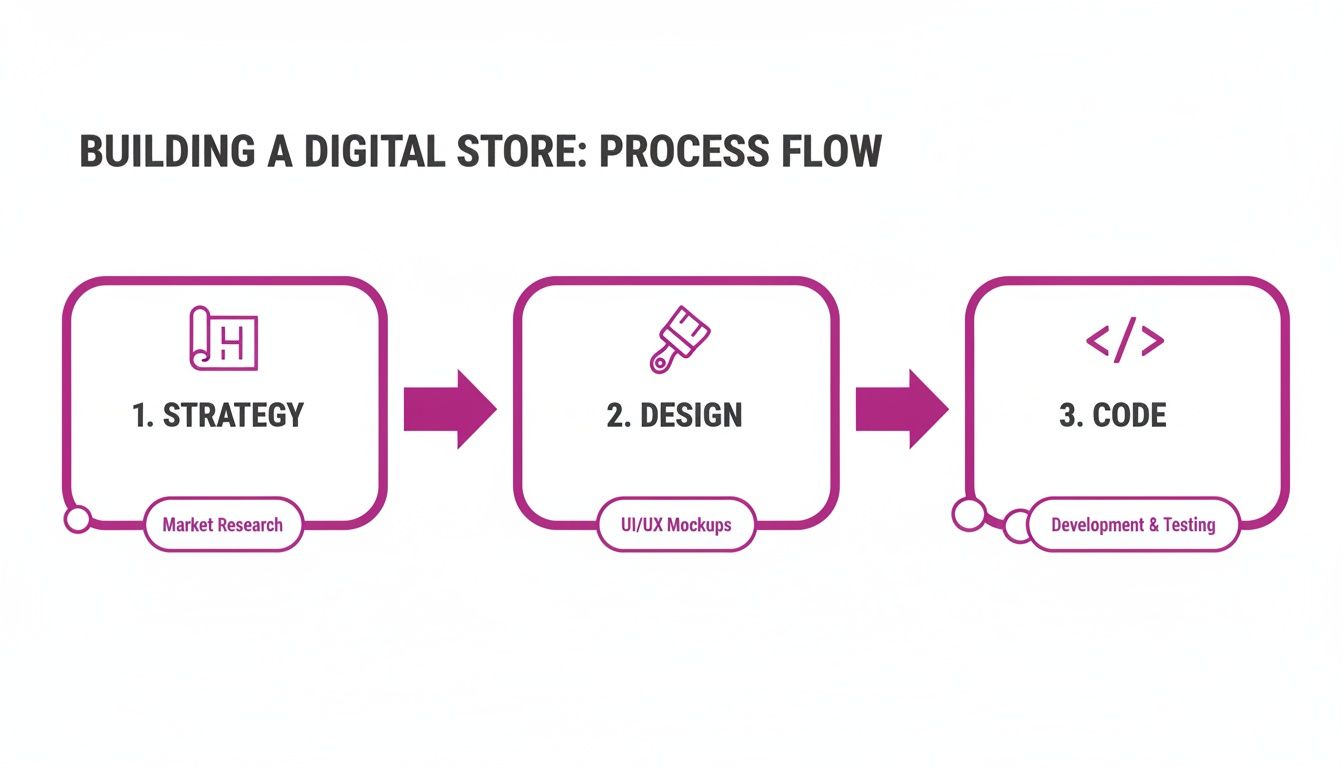
As you can see, the coding is actually one of the last things to happen. It's built on a critical foundation of understanding your business goals and what your customers actually need.
Stage 1: Discovery And Strategy
Before a single pixel is designed or a line of code is written, we need a blueprint. The Discovery and Strategy phase is hands-down the most important stage because it sets the course for the entire project. This is where we get your business goals and the technical reality on the same page.
During this phase, we go deep. We get to know your brand, who you're selling to, what your competitors are up to, and what your technical setup looks like. The real goal here is to define what success actually means for your store. Is it boosting the average order value by 15%? Or maybe it's automating a clunky inventory process to claw back 20 hours of manual work every week?
Key activities usually include:
- Stakeholder Interviews: We talk to the key people in your organization to really understand their goals and frustrations.
- Technical Audit: We take a look at your existing tech stack to figure out how we’ll connect everything, like your ERP or PIM systems.
- Project Roadmapping: We create a detailed game plan with clear milestones, a realistic timeline, and what you can expect to see at each step.
Nailing this strategic foundation helps us avoid expensive changes down the road and guarantees the final store isn't just pretty, but is a genuine engine for growth.
Stage 2: Design And UX/UI
With a rock-solid strategy in hand, we shift our focus to crafting the customer experience. The Design and UX/UI (User Experience/User Interface) stage is where your brand’s personality really starts to take shape visually. It's all about creating a shopping journey that feels intuitive, engaging, and totally seamless.
Think of UX as the invisible architecture of that journey—how easily can someone find a product, pop it in their cart, and check out? The UI is the visual stuff—the colors, fonts, and images that give your store its signature look and feel. A great design gets both right, making sure the store is a pleasure to look at and a breeze to use.
The best designs are invisible. A customer shouldn't have to think about how to use your website; it should just feel natural. This frictionless experience is what separates high-converting stores from the rest.
Deliverables from this stage usually include wireframes, which are like the structural skeletons of your pages, and then high-fidelity mockups that show you exactly what the final store will look like on both desktop and mobile.
Stage 3: Development And Customization
This is where we roll up our sleeves and start building. Our developers take the approved designs and the strategic roadmap and turn them into a fully functional Shopify store. This involves both front-end development (everything the customer sees and clicks on) and back-end development (the behind-the-scenes logic and integrations).
During this stage, we set up the Shopify environment, customize your chosen theme (or build one from scratch), and plug in any necessary third-party apps. For instance, if your strategy calls for a fancy product customizer or a hookup to a specialized shipping provider, this is where that custom coding magic happens.
Stage 4: Quality Assurance And Testing
Before we even think about handing over the keys, every inch of the store gets put through its paces. The Quality Assurance (QA) and Testing phase is all about hunting down and squashing any bugs, errors, or weird quirks before your customers find them. After all, a single broken "Add to Cart" button could cost you thousands in lost sales.
Our QA team runs a battery of tests, including:
- Functional Testing: Making sure every button, link, form, and the entire checkout process works exactly as it should.
- Cross-Browser and Device Testing: Checking that the store looks and works perfectly on Chrome, Safari, Firefox, and on every device from a huge desktop monitor to the smallest smartphone.
- Performance Testing: Analyzing page load speeds and optimizing images and code to make sure the site is lightning-fast and responsive.
This obsessive attention to detail ensures a smooth, professional, and reliable experience for every single visitor right from day one.
Stage 5: Launch And Deployment
Launch day! This is the exciting moment when all the hard work comes together. But a successful launch isn't as simple as flipping a switch. It's a carefully planned process designed to make the transition totally seamless with absolutely zero downtime.
We follow a detailed pre-launch checklist that covers final data migrations, domain configurations, and setting up analytics tracking. We typically schedule the deployment for a time when your store has the least amount of traffic to minimize any potential hiccups. Our team keeps a close eye on the site right after it goes live to jump on any unexpected issues immediately.
Stage 6: Post-Launch Optimization
Your Shopify store is a living, breathing part of your business, not a one-and-done project. The journey doesn’t end at launch; in many ways, it's just getting started. The Post-Launch Optimization phase is all about using real-world data to continually make your store better.
Through Conversion Rate Optimization (CRO), we analyze how users are actually behaving on your site, run A/B tests on things like headlines or button colors, and constantly refine the customer journey to drive more sales. This ongoing partnership ensures your store stays ahead of market trends and customer expectations, delivering a powerful return on your investment long after the initial build is complete.
Choosing Your Foundation: Shopify vs. Shopify Plus
Picking the right Shopify plan is one of the first, and most important, decisions you'll make. This isn't just about choosing a price tier—it’s about laying the right foundation for where your brand is headed. The choice between standard Shopify and Shopify Plus will shape your ability to scale, customize, and automate your entire operation.
Think of standard Shopify as a powerful, finely-tuned engine. It’s perfect for new and growing brands ready to hit the accelerator and grab their piece of the market. It gives you all the core tools to build a beautiful, functional, and profitable online store without getting bogged down in complexity.
Shopify Plus, on the other hand, is the enterprise-grade power plant. It's built for high-volume merchants who are not just growing, but are ready to dominate their market on a global scale. This is the platform for brands dealing with serious order volume and complex operations that need more firepower.
When To Stick With Standard Shopify
For most businesses just starting out or those experiencing steady, consistent growth, the standard Shopify plans (especially the Advanced plan) are more than enough to get the job done. You get fantastic theme customization, access to a massive app ecosystem, and powerful analytics. Honestly, you can build a multi-million dollar brand on this foundation alone.
The platform's growth has been nothing short of explosive, proving it can support businesses of all shapes and sizes. Just a few years ago, Shopify had fewer than 1.75 million live stores in 2020. Today, estimates show it powers anywhere between 2.83 million and 6.9 million active stores. That kind of scale shows it’s a flexible solution that can grow with you.
Making The Leap To Shopify Plus
So, when does the upgrade to Shopify Plus make sense? It's less about hitting a magic revenue number and more about hitting operational roadblocks. The switch becomes a strategic necessity when you outgrow the standard plans or when the math just starts to work in your favor.
Here are a few key triggers that tell you it might be time to upgrade:
- High Transaction Volume: As your sales climb, the lower transaction fees on Shopify Plus can lead to huge cost savings. Often, this alone justifies the higher monthly price tag.
- Automation Needs: You get exclusive access to Shopify Flow, a tool that lets you automate all sorts of repetitive tasks. Think automatically tagging high-value customers, flagging potentially fraudulent orders, or managing inventory without lifting a finger.
- Wholesale and B2B: Shopify Plus comes with a dedicated B2B storefront, letting you manage both your wholesale and direct-to-consumer businesses from one single backend. It's a game-changer for B2B.
- Checkout Customization: This is a big one. Only Plus merchants can directly edit the
checkout.liquidfile. This gives you total control over the branding and functionality of the most critical step in the customer journey.
Shopify Plus is an investment in operational efficiency. It’s for businesses that have outgrown standard solutions and need a platform that removes limitations rather than creating them.
To help you see the differences more clearly, here's a quick breakdown of how the two stack up.
Shopify vs. Shopify Plus At a Glance
Ultimately, the right choice depends on where you are now and, more importantly, where you're planning to go.
Before settling on a platform, it’s smart to get a full picture of what you're signing up for. Diving into a practical guide to Shopify features and pricing will help you make a truly informed decision. For an even more detailed breakdown, we’ve put together a deep dive into the specific differences and benefits. Check out our guide on https://www.ecorn.agency/blog/shopify-plus-vs-shopify for a complete comparison.
Understanding Shopify Development Timelines and Budgets
Let's get right to it. The two questions at the top of everyone's list are always: "How long will this take?" and "How much will it cost?" Getting on the same page with realistic expectations for both is the secret to a great partnership and a project that runs smoothly. While the final answer always depends on the scope, we can definitely break it down into some common scenarios.
A simple project, like taking a premium theme and customizing it to fit your brand, usually lands in the 4-6 week ballpark. If we're adding some custom features or a few key app integrations, that timeline often stretches to 8-12 weeks. For a full-blown, from-the-ground-up custom build with truly unique functionality and a complex data migration, you're typically looking at 3-6 months.
The single biggest variable here is complexity. A project that needs to talk to a custom ERP system is a different beast than one connecting to standard marketing apps. That’s exactly what our initial discovery phase is for—to map out that complexity and give you a transparent, milestone-based roadmap from the start.
Breaking Down Project Costs
Just like timelines, budgets are all over the map. The cost of your Shopify store development is a direct reflection of the time, expertise, and resources needed to make your vision a reality. There's no doubt the platform can handle serious business. In a recent fiscal year, Shopify's total revenue hit $11.6 billion, while its merchants processed an incredible $378.4 billion in Gross Merchandise Volume (GMV). Those numbers prove this is a rock-solid foundation worth investing in. You can dig deeper into how Shopify is shaping the retail industry on markets.financialcontent.com.
So, what drives the final price tag? It usually boils down to a few key things:
- Design Complexity: A completely unique, custom-designed user interface will naturally require more investment than tweaking an off-the-shelf theme.
- Custom Functionality: Do you need a product personalizer, a subscription engine, or a dedicated wholesale portal? These custom-coded features add development hours.
- Third-Party Integrations: Getting your store to sync perfectly with your PIM, ERP, or CRM systems requires careful planning and flawless execution.
- Data Migration: Moving your entire history of products, customers, and orders from another platform can be a major part of the project.
Choosing Your Pricing Model
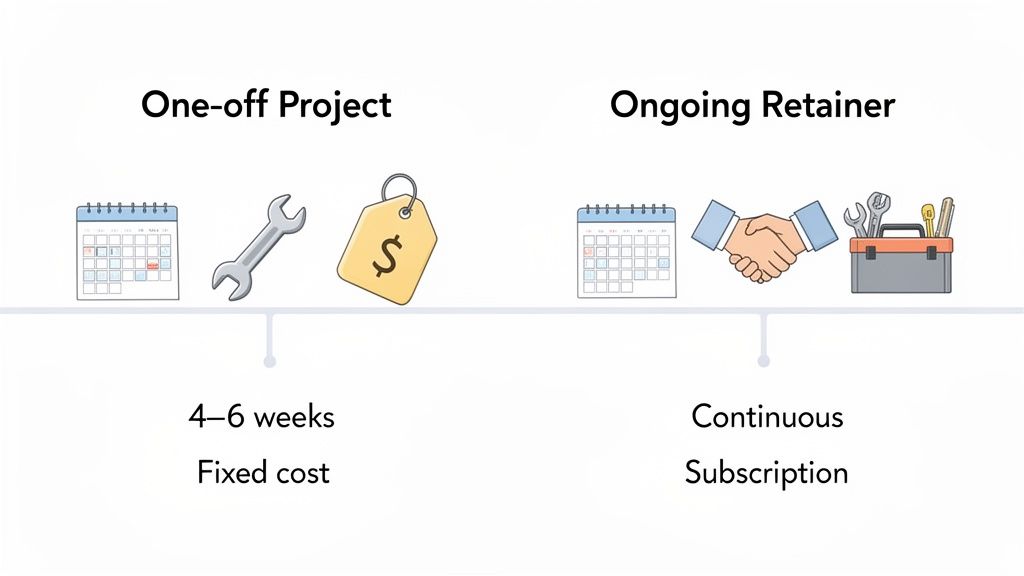
When it comes to paying for development work, you'll generally run into two main models. Understanding them helps you match the financial side of things with your actual business goals. I like to think of it like a home renovation.
A one-off project is like a complete kitchen remodel—a clearly defined scope with a fixed cost to deliver a specific outcome. A subscription or retainer is like having a master craftsman on call for continuous improvements, maintenance, and new additions.
One isn't automatically better than the other; it all comes down to what you need right now. Let's compare them.
1. The One-Off Project Model
This is the classic approach. You have a very specific goal—like launching a new store or a major redesign—with a clearly defined scope of work.
- Best For: New store launches, major redesigns, or building a specific, complex feature.
- Structure: A fixed price for a pre-agreed set of deliverables.
- Benefit: Total budget predictability. You know exactly what you’re getting and precisely what you'll pay for it.
This model is a perfect fit for brands that need a big, foundational push to get started or to level up significantly.
2. The Flexible Subscription (Retainer) Model
This model shifts the mindset from a single project to an ongoing partnership. Instead of scoping one big job, you secure a block of expert time each and every month.
- Best For: Established businesses that are focused on continuous improvement, A/B testing, and long-term, iterative growth.
- Structure: A recurring monthly fee for ongoing access to a dedicated development and strategy team.
- Benefit: Agility and strategic growth. You can react to market changes, roll out new features, and constantly optimize for conversions without having to kick off a brand new project proposal every single time.
This approach recognizes that a great Shopify store is never truly "finished." It's a living, breathing asset that needs constant attention to perform at its best, turning your website from a static storefront into a powerful, proactive tool for growth.
Leveraging Advanced Integrations and AI Tools
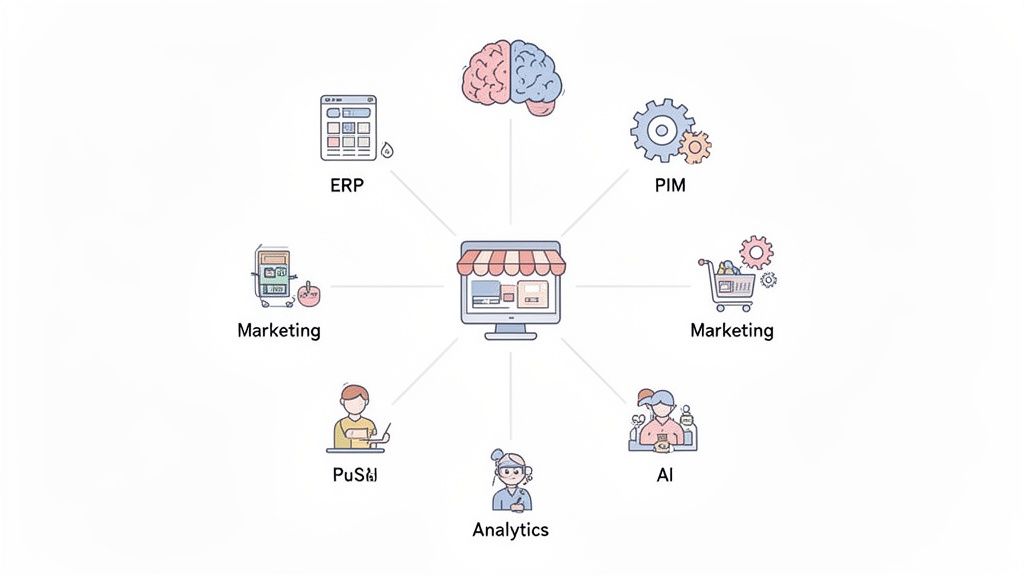
Once your Shopify store is built on a solid foundation, the real fun begins. It's time to build a powerful, interconnected business ecosystem. This is where advanced integrations come in, transforming your store from a simple sales channel into the central command hub for your entire operation.
Think of it like this: your Shopify store is the heart of your business. Integrations are the arteries connecting it to other vital organs—your Enterprise Resource Planning (ERP) for financials, your Product Information Management (PIM) system for catalog data, and your marketing platforms for customer outreach.
When these systems talk to each other automatically, you slash countless hours of manual data entry and minimize the risk of costly human error. An order placed on Shopify can instantly update inventory in your ERP, trigger a shipping workflow, and pop that customer into a specific email sequence. It creates a highly efficient, automated machine built for growth.
The Rise of AI in Shopify Development
Beyond just connecting systems, Artificial Intelligence (AI) is adding a whole new layer of smarts to the Shopify world. This isn't some far-off concept; it’s about practical tools that directly boost your bottom line by analyzing customer behavior in real-time to create uniquely personal experiences.
Good AI implementation is a massive differentiator in today's market. Just look at the numbers. The top 20% of Shopify stores hit conversion rates over 3.2%, while the bottom 20% barely scrape by at 0.4%. That huge gap is all about optimization, which is exactly where AI shines.
AI-powered tools can handle a huge range of tasks to sharpen your store's performance.
- Smarter Product Recommendations: AI algorithms look at a shopper's browsing history, past purchases, and what similar customers bought to suggest products they're almost certain to love.
- Personalized Customer Journeys: From a homepage that changes based on user behavior to perfectly timed emails, AI tailors the entire shopping experience to each individual.
- Predictive Analytics: AI can forecast sales trends, pinpoint your most valuable customer segments, and even flag customers who are about to churn, so you can step in before it's too late.
To really build a high-growth brand, understanding and using the best AI tools for marketing is a non-negotiable next step after your Shopify store is live. It’s how you build smarter campaigns and truly scale.
Practical AI Applications You Can Use Now
Even Shopify itself is baking AI right into its platform, making these powerful tools more accessible than ever. For example, when you're writing a blog post, Shopify’s built-in AI can help generate layouts and content blocks, turning what used to be a coding headache into a simple task.
AI’s real power in e-commerce is its ability to chew through massive amounts of data and spit out actionable insights. It spots patterns and opportunities that a human team could easily miss, giving you a serious competitive edge.
The goal here is to use this tech to create a smarter, more responsive store that doesn't just meet customer expectations but actually anticipates them. By combining solid back-end integrations with intelligent, AI-driven front-end experiences, you're not just building a store—you're building a commerce engine designed for the long haul.
For a deeper dive into this, check out our guide on AI tools for ecommerce.
How to Choose the Right Shopify Development Partner
Picking an agency for your Shopify store development is one of the most important calls you'll make for your brand. This isn't just about finding someone who can write clean code; it’s about finding a true partner in growth. Forget flipping through pretty portfolios—you need a team whose entire process is built around your actual business goals.
A great partner is obsessed with outcomes, not just outputs. They get that a beautiful design is totally worthless if it doesn't turn visitors into paying customers. They should be just as focused on your average order value and customer lifetime value as you are.
Look Beyond the Portfolio
A strong portfolio is a good start, but it's just that—a start. The real magic is in their proven process and their deep expertise in your specific industry. A team that's already scaled a fashion brand will understand the unique hurdles of that vertical way better than a generalist agency ever could.
When you're checking out potential partners, you have to dig deeper. Ask them about their project management style, how they handle communication, and what their support looks like after the site goes live. You're looking for a strategic ally, not just a vendor who builds something and disappears the day after launch.
Questions to Ask a Potential Partner
Those initial discovery calls are your best shot at really vetting an agency. You need to come armed with questions that show you how they think and whether they’re genuinely invested in seeing you win. Your list should go way beyond, "So, how much is this going to cost?"
Here are a few powerful questions to get the ball rolling:
- How do you define and measure a successful project after it launches? This cuts right to whether they focus on business metrics or just ticking off tasks.
- Can you walk me through a past project that ran into challenges similar to what we're facing? Their answer here reveals their problem-solving chops and, just as importantly, their honesty.
- What does your quality assurance and testing process actually look like? This is non-negotiable for ensuring a smooth, bug-free launch for your customers.
- How do you approach conversion rate optimization once the site is live? This tells you if they're thinking long-term about your growth or just about the initial build.
- What’s your team's direct experience with Shopify Plus and its specific features? If you're an enterprise-level brand, this is an absolute must-ask.
The right partner won’t just build what you ask for. They’ll challenge your assumptions and bring fresh ideas to the table, pushing you to get better results than you even thought were possible.
At the end of the day, choosing a Shopify store development partner boils down to trust and a shared vision. Look for a team that communicates clearly, shows a real grasp of e-commerce strategy, and is completely transparent about their process from day one. Investing the time to find the right fit will pay you back over and over again long after your new store goes live, setting you up for sustained, scalable growth.
Frequently Asked Questions About Shopify Development
When you're thinking about a Shopify store development project, it’s natural to have some practical questions. We get it. Let’s walk through some of the most common ones to give you the clarity you need to move forward confidently.
How Long Does a Typical Project Take?
The timeline really hinges on what you need built. For a standard theme customization, we're typically looking at 4-8 weeks from start to finish. If you're going for a fully custom store with unique features and complex integrations, that can take anywhere from 3-6 months.
What really shapes the timeline are things like the depth of strategy needed upfront, the number of custom-coded features on your wishlist, and the complexity of moving your data from another platform. We always map this out with a detailed project roadmap after our initial discovery phase, so you'll know exactly what to expect.
Can I Make Changes to My Store After It Is Built?
Absolutely. We build every store with you in mind, ensuring you can easily manage products, update content, and run promotions right from the Shopify admin panel. The goal is to put you in complete control of your day-to-day operations.
For bigger functional or design changes down the road, our flexible subscription model is a great fit. It gives you ongoing access to our team for continuous improvements and new features, so you don't have to kick off a new project every time you want to make a change.
What Is the Difference Between a Theme Customization and a Custom Build?
Think of a theme customization as renovating a great house. We start with a pre-built Shopify theme and then tailor it to match your brand's style and meet your specific needs. This path is generally faster and more budget-friendly.
A custom build, on the other hand, is like designing and building a house from the ground up. We create your store entirely from scratch, giving you total creative freedom over every pixel and interaction. This is the way to go for brands with very specific design visions or complex features that just can't be shoehorned into a pre-existing theme.
Ultimately, choosing between theme customization and a custom build comes down to your unique goals, budget, and where you see your brand in the long run. We’re here to help you figure out which path will give you the best return.
Ready to build a Shopify store that drives real growth? ECORN specializes in creating high-performance e-commerce experiences. Book a discovery call with us today!


Conversion Rate Optimization for Landing Pages: The Playbook
Shopify Plus Automation: A Guide for 2026
10 Social Selling Platforms for Shopify Merchants

Shopify Website Design Examples: 7 Stores Worth Studying
7 Ecommerce Newsletter Examples for Shopify Brands
One Product Shopify Store: Build and Scale
Mobile Pop Up Strategy for Shopify Stores That Converts
Sitemap for Shopify: How to Find, Optimize, and Submit It
7 Single Product Websites Worth Emulating
Product Variants Shopify: The Complete 2026 Guide
Ecommerce Analytics Consulting for Growth
What Is AI Integration for eCommerce
How to Choose the Right eCommerce Website Development Firm
E Business Strategy Implementation
Conversion Tracking Setup for Shopify Stores
BigCommerce vs Shopify Plus Which Enterprise Wins in 2026
Shopify Theme Kit: Setup, Commands, and Migration Guide
Shopify Extension Development: A Practical 2026 Guide
Shopify Speed Score Explained and How to Improve It
Shopify Mobile Optimization: The 2026 Playbook
How to Add Subcategory in Shopify for Better UX
How to Implement Structured Data for Ecommerce in 2026
SEO App Mobile: Shopify Store Optimization Guide
Shopify Plus Support: What It Includes and How to Choose
Google Ads for Shopify: The Complete 2026 Playbook

Shopify New York: How to Find and Hire the Right Agency
Google Search Console for Shopify: The Complete Setup
First Party Data Collection for eCommerce Growth
FAQ Online Store Guide: Build and Measure It Right
Do FB Ads Work for eCommerce in 2026?
One Page Checkout for Shopify: Design and Implementation
Shopify GraphQL vs REST: The 2026 Developer Decision
Shopify Ecommerce Consulting: Strategy, Pricing &
Are Reddit Ads Worth It for eCommerce Brands
Shopify Title and Meta Description: A Practical 2026 Guide
Product Video Best Practices for Shopify Brands
Real-Time Inventory Management: A 2026 Guide
AI Chatbot Integration for Shopify Stores
Affiliate Program Management: A Shopify Guide
10 Best Performance Monitoring Tools for Shopify in 2026
Digital Asset Management for eCommerce Brands in 2026
Every Type of Facebook Ads Explained for eCommerce Growth
Product Information Management Explained for Shopify Brands
Support Ticket System: A Guide for Shopify Stores

10 Best Customer Service Tools for Shopify in 2026

Can I Start a Business with No Money? a 2026 Blueprint
What Sells Good on Etsy: Best Niches for 2026

Shopify Add to Cart Button: A Practical 2026 Guide

Customer Feedback Automation: A Practical eCommerce Guide
Critical Rendering Path: A Guide for Shopify Stores

How to Promote on TikTok for eCommerce in 2026

B2B eCommerce Consulting That Drives Real Revenue
10 Best Practices for Site Navigation in 2026
Return vs Refund for Shopify Stores: A Practical Guide
What Is Customer Lifetime Value and Why It Matters
What Is Voice of Customer Research for eCommerce

SMS Marketing for Ecommerce That Actually Converts

Master How to Improve Email Deliverability in 2026

Top 7 eCommerce Partners NYC for Shopify Brands in 2026
Machine Learning for Ecommerce: Boost Your Shopify Store

Beauty Market Research: Your 2026 Growth Guide
Shopify International Expansion: A 2026 Roadmap
What Does CRO Stand for in Business: Understanding CRO
Shopify Visual Merchandising: A Playbook for Higher Sales
Shopify Landing Page Design: Master Conversion in 2026
10 Best AI SEO Optimization Tools for Shopify in 2026

Agentic AI for Ecommerce: Boost Your Sales in 2026
Mastering Email Marketing Data for eCommerce Growth
Conversion Rate Optimisation Australia: Boost Your Sales
Conversion Rate Optimization AI: Your Shopify Store Guide

10 Product Bundling Strategies for Shopify in 2026
How to Increase Customer Lifetime Value: A Shopify Playbook
AI Customer Service Automation: Shopify Guide 2026
Clean Website Design: A Shopify Conversion Playbook

Omnichannel Retail Strategy: A Shopify Playbook
Product Data Enrichment: A Guide for Shopify Brands
Instagram Shopping Features a Guide for Shopify Stores
What Is Revenue Optimization: A Holistic RevOps Guide
Benefits of Conversion Rate Optimization: Boost Your
WordPress to Shopify Migration: Your 2026 Seamless Switch
Boost Sales: Ecommerce Payment Processing Guide 2026
Unified Commerce Platform: Benefits, KPIs & Shopify Guide
How to Reduce Bounce Rate eCommerce: Your 2026 Guide
Shopify API Integration: A Practical End-to-End Guide
How to Implement Data Governance: A 2026 Guide
Shopify Store Development Cost: A 2026 Breakdown
What Is Server Side Tracking: The Shopify Guide 2026
Marketing Automation Workflows: A Shopify Guide for 2026
Shopify: How to Reduce Technical Debt
Shopify UX Design Change: A Playbook for Growth
User Generated Content Strategy: Shopify Playbook
Shopify Pause and Build Plan Cost: A Complete 2026 Guide
Compare at Price on Shopify: A Complete Guide for 2026
Where Can I Sell My Prints? 10 Best Platforms for 2026
Shopify Order Management System: The Ultimate Guide 2026
What Is Marketing Attribution? an eCommerce Guide for 2026

10 Best Black Friday Sales Sheets for 2026

Discover the Top Social Media Marketing Agencies For
Consumer Confidence Definition for eCommerce in 2026
What Is Social Commerce? Your 2026 Guide to Boosting Sales


newsletter in your inbox