

It's a story I hear all the time from Shopify brands: traffic is climbing, but the sales needle isn't moving. This is the exact moment when a conversion rate optimisation expert becomes your most valuable player, turning those clicks you're already getting into actual, tangible revenue. The goal shifts from just getting more traffic to getting more value from the traffic you have.
Why Your Shopify Store Needs a CRO Expert
Does your store feel like a leaky bucket? You're pouring plenty of traffic in the top, but very little revenue is actually staying put. If that sounds familiar, you're not alone.
The real problem is usually a series of small, almost invisible friction points scattered throughout the customer journey. Think of them as bottlenecks—sluggish mobile product pages, a confusing checkout flow, you name it. These are the exact spots where potential sales just... evaporate. A CRO expert doesn't guess where these leaks are; they use hard data to find them, patch them, and test the results methodically.
For instance, I once worked with an apparel brand that was tearing its hair out over a sky-high cart abandonment rate. A CRO specialist would dive into their analytics, run heatmaps to literally see where users were getting stuck, and build a hypothesis. Maybe the shipping costs were a nasty surprise at the end, or perhaps the "Proceed to Checkout" button was nearly impossible to see on mobile. From there, they'd run a targeted A/B test to prove it one way or the other.
Moving Beyond Vanity Metrics
The true power of strategic CRO is in shifting your focus from vanity metrics, like sessions or pageviews, to the numbers that actually drive profit. An expert helps you understand the why behind your data.
- Pinpointing Profit Leaks: They meticulously identify the specific drop-off points in your sales funnel where you're actively losing money.
- Data-Driven Decision Making: Every single change is rooted in a testable hypothesis. No more guesswork or chasing shiny new trends.
- Boosting Customer Lifetime Value: A smoother, more intuitive user experience doesn't just lock in that first sale—it creates happy customers who come back for more.
By focusing on incremental, evidence-based improvements, a CRO specialist turns your existing website traffic into a more powerful revenue-generating engine. This shift from acquiring more traffic to optimizing current traffic is fundamental for sustainable growth.
Understanding Industry Benchmarks
A seasoned expert also brings something invaluable to the table: context. The eCommerce landscape is wildly competitive, and conversion rates vary massively between industries.
Food & beverage stores, for example, might see a healthy 6.11% conversion rate, while the luxury & jewelry space averages a tough 1.19%. Knowing this, an expert can tailor their strategy specifically to your vertical, setting realistic and ambitious goals. Globally, the average Shopify store converts at about 1.4%, but the top 20% of stores are hitting 3.2%—a specialist is the one who can help you close that gap.
Digging into specific Shopify Conversion Rate Optimization Tips to Boost Sales really highlights the immediate value a dedicated expert can bring to your store. Their work is a unique blend of customer psychology, data science, and user experience design. You can learn more about what that entails in our complete guide to conversion rate optimization consulting.
How to Vet CRO Agencies and Consultants
Finding the right CRO partner is a massive business decision, not something you knock out with a quick Google search. When you're vetting potential conversion rate optimisation experts, you have to look past the glossy presentations and dig into how they actually think and work.
A truly great agency won’t just flash impressive final numbers from a case study. They should be able to walk you through the entire journey: the initial hypothesis, the nitty-gritty of their testing methodology, the statistical significance of the results, and, maybe most importantly, what they learned from the experiment. This level of detail is what separates the real pros from those who just got lucky on a few tests.
Beyond the Sales Pitch
To get to the heart of their competence, you need to ask the kinds of questions that peel back the layers of their process and culture. Instead of just asking for their biggest win, try flipping the script.
One of my favorite questions to ask is, "Walk me through a failed experiment and what your team learned from it." A confident, transparent expert will have an answer ready to go. Their response tells you more about their commitment to a data-driven culture and continuous learning than any successful case study ever could. It shows they respect the process, not just the outcome.
An expert who readily discusses failures is an expert who truly understands that CRO is about learning, not just winning. Every test, pass or fail, provides valuable data that fuels the next hypothesis.
This is exactly what experts do—they methodically identify and resolve friction points in your sales funnel.
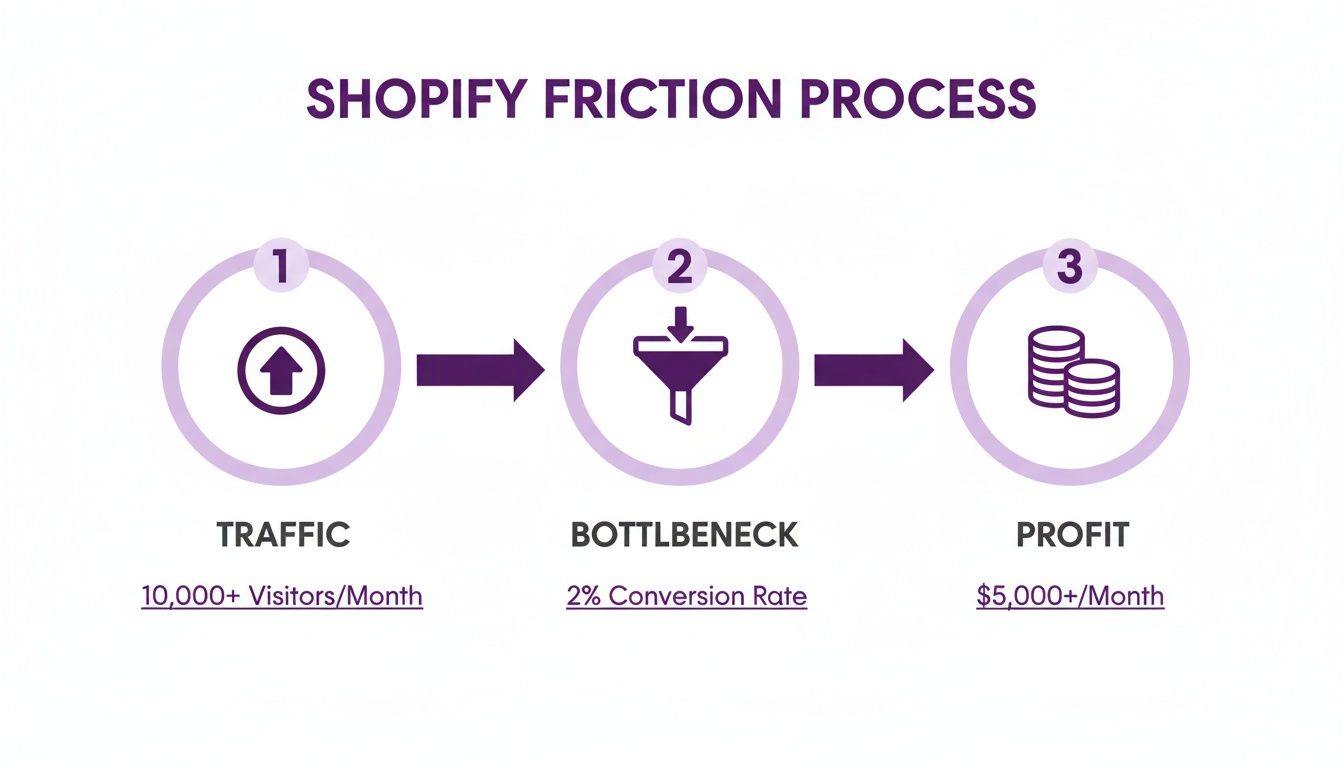
As you can see, their job is to figure out precisely where traffic hits a bottleneck, stopping potential customers from turning into profit.
CRO Expert Evaluation Checklist
Use this checklist to systematically evaluate potential CRO agencies or consultants during your vetting process. It will help you stay organized and ensure you cover all the critical areas before making a decision.
Ultimately, this checklist isn't about finding an agency that just says "yes" to everything. It's about finding a true partner who has the experience and process to challenge your assumptions and drive real growth.
Assessing Their Shopify Mastery
A generalist CRO agency might have a solid strategic framework, but they can easily get tripped up by the unique quirks of the Shopify platform. You absolutely need a partner who understands the Shopify ecosystem inside and out. Their technical skills are just as crucial as their strategic thinking.
Drill down and ask them about their direct experience with:
- Shopify Plus: Can they confidently handle the complexities of multi-storefront setups, custom checkout scripts, and advanced API integrations?
- App Integrations: What’s their process for ensuring new apps or custom features don't drag down site speed and kill conversions?
- Theme Customizations: Do they have the in-house development chops to implement complex A/B tests without wrecking your theme?
The CRO world is moving fast. Top agencies are no longer just running simple tests; they're using advanced tech and, in some cases, even offering performance guarantees. The CRO software market is projected to hit $5.07 billion by 2026, a huge leap from $3.01 billion in 2019. Some leading agencies now use machine learning to analyze vast amounts of A/B testing data for predictive insights. For Shopify-focused agencies, this means offering flexible packages that blend ongoing CRO with the necessary Shopify Plus development to execute on those strategies.
The principles here are similar to how you’d evaluate any specialized partner. In fact, our guide on how to choose a Shopify marketing agency covers some similar vetting frameworks. By partnering with a specialist who lives and breathes Shopify, you ensure they can not only come up with a brilliant strategy but also execute it flawlessly within your store's technical environment.
Designing a Smart CRO Trial Project
Signing a long-term, high-ticket retainer without a test run is a massive gamble. I've seen it go wrong too many times. A well-designed trial project is hands-down the smartest way to see how potential conversion rate optimisation experts actually work. It takes you beyond their sales pitch and into their real-world process.
This is your chance to evaluate their communication style, the depth of their analysis, and their ability to deliver tangible insights before locking into a lengthy contract.
Think of it less as a test to see if they can get one lucky win, and more as an audition to see if they're the right long-term partner for your Shopify store. The goal isn't a complete website overhaul; the key is to create a project that’s small enough to be nimble but significant enough to prove their value.
Crafting the Perfect Project Brief
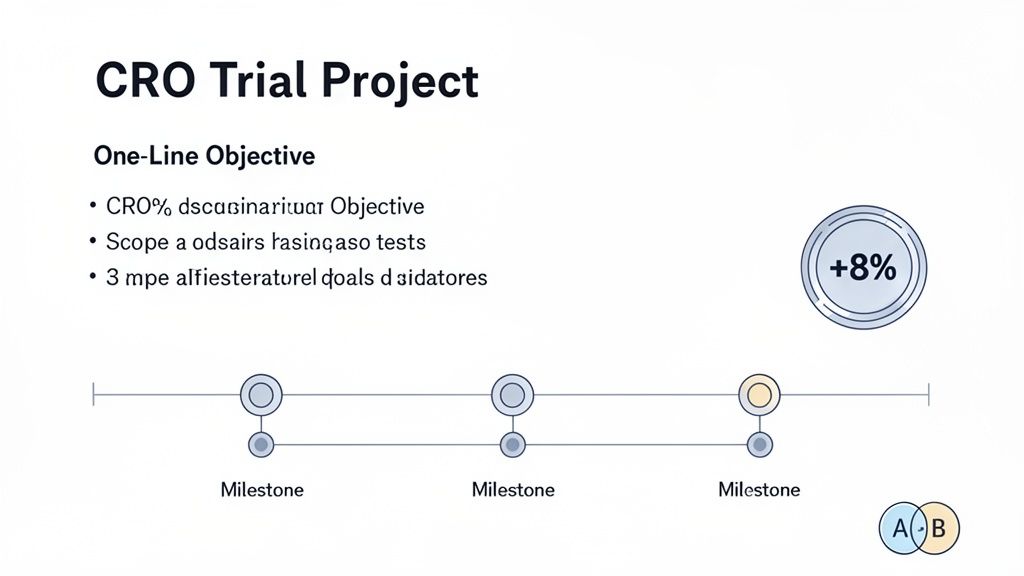
Your project brief is the North Star for the trial. It’s the one document that prevents scope creep and sets crystal-clear expectations from day one. It doesn't need to be a 20-page novel, but it absolutely must be precise.
A solid brief should always include these core components:
- A Clear Objective: Make it specific and measurable. Something like, "Increase the add-to-cart rate on our top 5 product pages by 8%."
- Defined Scope: Outline exactly what they will be working on. For example, "Conduct qualitative research (heatmaps, session recordings) and run one A/B test on the product page layout and CTA copy."
- Realistic Timeline: A typical trial project lasts between 4 to 6 weeks. This gives them enough runway for proper research, forming a hypothesis, design, development, and collecting meaningful data.
- Success Metrics: Beyond the main objective, what else are you watching? List any secondary KPIs, like scroll depth, time on page, or clicks on secondary elements.
This structure forces the project to stay focused on a high-impact area of your site, giving the agency a real chance to show you what they've got without getting lost in analysis paralysis.
Structuring the Trial Project Fee
How you pay for this initial work matters. There are a couple of common models, and the right one really depends on your budget and how much risk you're comfortable with.
A trial project is the ultimate audition. It should reveal not only an agency's technical skill but also their ability to integrate with your team, communicate clearly, and think strategically about your specific business challenges.
One of the most straightforward approaches is a one-time, fixed-fee project. This gives you cost certainty and a clear start and end date. It's perfect for testing the waters without any strings attached.
Alternatively, some agencies might structure the trial as the first month of a potential retainer. This can work well if you're already feeling confident about a particular partner but just want that final confirmation. If all goes well, it makes the transition into a long-term partnership seamless. Your choice here should align with your confidence level and financial planning.
Getting Your New CRO Partner Plugged In
You’ve found your ideal CRO partner. Great. Now the real work starts. A strong partnership is built on a rock-solid onboarding process, one that moves from handshakes to high-impact experiments as quickly as possible. This all comes down to granting the right access and setting up clear communication from day one.
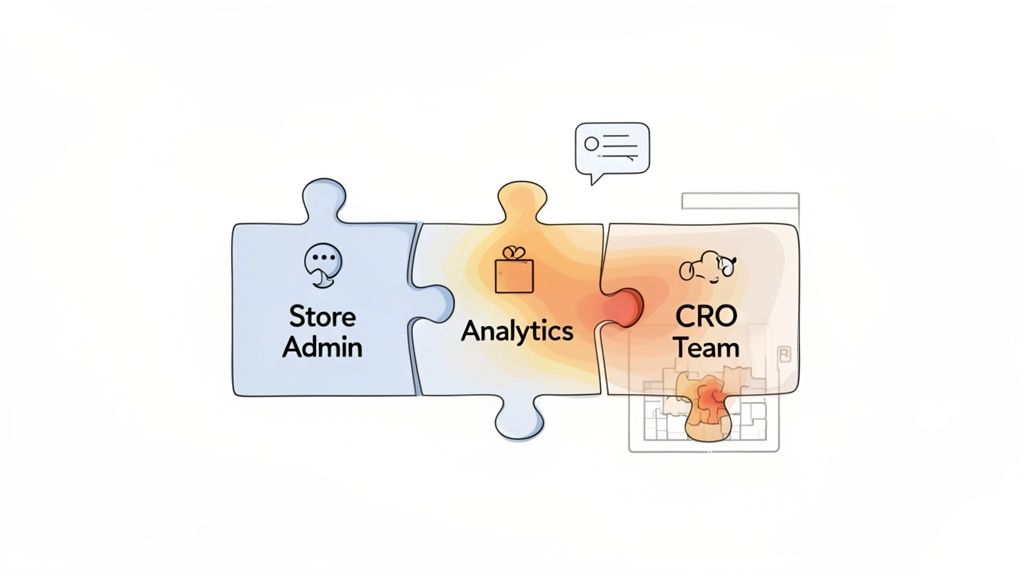
The first few days are all about arming your new team with the data they need to start building their first round of hypotheses. This is more than just sharing a few logins; it's about creating a transparent environment where they can see the whole picture. Your conversion rate optimisation experts need to understand your entire operation to connect the dots between how users behave and how you make money.
Setting Up Foundational Access
To hit the ground running, your new partner needs to get their hands on a few core tools. Getting this right is critical for both their quantitative and qualitative research, letting them dive straight into your customer journey.
Here’s the essential access checklist to knock out in the first week:
- Shopify Admin: Give them staff access with permissions for themes, apps, and analytics. They don’t need full financial access, but they absolutely must be able to see store performance and get into the theme code for testing.
- Google Analytics (GA4): Editor-level access is what you're aiming for. This lets them build custom segments, configure conversion events, and dig into user flow data without hitting any walls.
- Behavioral Analytics Tools: You’ll want to grant full access to platforms like Hotjar or Microsoft Clarity. These tools are where they find the "why" behind the numbers, through heatmaps, session recordings, and on-site surveys.
This trio of tools provides all the raw material needed for a killer CRO strategy. It lets the experts see what users do (GA4), where they struggle on the page (heatmaps), and how they actually experience your site (recordings).
Building a Communication Framework
Tool access is only half the story. How you communicate will make or break the partnership. A predictable rhythm keeps everyone aligned and stops small misunderstandings from turning into big problems. Don’t just wing it; build a simple framework.
The best CRO partnerships feel like a natural extension of your internal team. This requires more than just weekly reports; it demands a shared language, collaborative tools, and a consistent cadence for strategic discussions.
A simple but effective communication stack is all you really need.
First, set up a dedicated Slack channel. This is perfect for daily questions, quick updates, and sharing interesting findings on the fly. It keeps the conversation flowing in real-time and your email inbox clean.
Next, schedule a recurring weekly or bi-weekly check-in call. Make sure this meeting always has a clear, shared agenda covering these three points:
- Review of Live & Recent Tests: Talk through the key learnings and performance data. What worked? What didn't?
- Upcoming Experiment Roadmap: Agree on the next 2-3 tests in the pipeline.
- Roadblocks & Dependencies: Pinpoint anything the experts need from your team to keep things moving.
This structured approach makes sure everyone knows what they’re responsible for and the optimization program never loses steam. It shifts the relationship from a basic client-vendor dynamic to a true strategic partnership laser-focused on growth.
Measuring Real Success and Scaling Your Program
So, how do you actually know if dropping cash on a CRO expert is paying off? The real answer isn’t just about watching your main conversion rate go up. It’s about setting up the right Key Performance Indicators (KPIs) to see the full picture.
A great CRO program isn't about running a few one-off tests. It's about building a scalable, profitable engine for your store. The best conversion rate optimisation experts know this and will build a measurement framework that tells the whole story, looking way beyond the final sale to understand all the little steps a customer takes to get there.
Moving Beyond the Headline Conversion Rate
Fixating only on the overall conversion rate is like just checking the final score of a football game. You see who won, but you miss all the brilliant plays, fumbles, and turning points that decided the outcome.
To get a much clearer picture, your expert should be tracking a mix of primary and secondary metrics. This is what reveals the true impact of their work across the entire customer journey.
- Primary KPIs: These are your big-hitters, the metrics tied directly to your bank account. Think overall conversion rate, average order value (AOV), and revenue per visitor (RPV).
- Secondary KPIs (Micro-Conversions): These are the smaller, but super important, actions that lead up to a sale. We're talking about "add to cart" rates, how many people start the checkout, and email newsletter sign-ups.
Often, a jump in these micro-conversions is a flashing light indicating that future revenue growth is on its way. It shows the expert is successfully smoothing out the friction points on your site.
The real goal here is to create a continuous feedback loop. The insights you get from one experiment—even one that "fails"—should directly fuel the idea for the next one. This is how you build long-term, sustainable growth, not just temporary wins.
Interpreting Results and Creating a Feedback Loop
What really separates a seasoned pro from a rookie is the ability to interpret A/B test results with statistical confidence. They don't just call a winner and move on. They dig into the why—why one version performed better and what that teaches you about your customers.
Let's say an experiment boosts your "add to cart" rate but doesn't immediately lift overall sales. That's not a failure; it’s a massive insight. It tells you the changes on the product page worked, but now there's likely a new roadblock in the checkout process that needs attention. That's a data-driven feedback loop in action.
The CRO software market is exploding for a reason, jumping from $3.01 billion in 2019 to a projected $5.07 billion by 2026. This shows just how much eCommerce brands are waking up to the power of optimization. When you look at Google Ads benchmarks and see an average conversion rate of just 7.04%, you realize how many clicks are being wasted.
Experts use proven tactics to turn this around. For example, simply integrating user-generated content can boost engagement by a staggering 102% when shoppers interact with it.
Shopify CRO KPI Tracking Template
To measure the true impact of your CRO program, you need a clear way to track both the big-picture numbers and the smaller actions that lead to them. This template helps you organize your primary and secondary KPIs, set realistic targets, and maintain a consistent reporting schedule.
By tracking this mix of metrics, you can spot leading indicators of success and understand where your expert's efforts are having the most impact, long before it shows up in the final revenue numbers.
Scaling CRO Across Multiple Storefronts
If you're a Shopify Plus brand with stores in different countries or managing multiple sub-brands, scaling a CRO program gets a bit more complex. The big challenge is keeping a consistent brand experience while tweaking optimizations for totally different customer groups.
A true expert will create a global testing strategy that allows for local adaptations. They might test a new navigation menu across every storefront to keep the brand unified, but at the same time, run region-specific tests on things like local payment options or culturally relevant promotions.
This approach makes sure that what you learn in one market can be quickly and efficiently rolled out to others, speeding up growth across your entire portfolio.
Ultimately, you measure an expert's worth by their ability to significantly improve your marketing ROI. They need to prove their value with real results that hit your bottom line and build a program that grows right alongside your business.
Of course, even after you're sold on the value of conversion rate optimization, the practical side of hiring an expert can feel a bit murky. Let's walk through some of the most common questions Shopify store owners have when they're ready to bring in a pro.
This should clear things up and help you set the right expectations for budget, timelines, and what a real CRO program looks like day-to-day.
How Much Do CRO Experts Cost?
There's no single price tag here; the investment can vary quite a bit. A freelance consultant might bill anywhere from $100 to over $300 per hour. When you start looking at agencies, retainers usually kick off around $3,000 per month and can easily climb past $15,000 for more intensive, enterprise-level programs.
You'll also run into a few different pricing models, each designed for different needs:
- Single-Project Fees: This is a fixed price for a specific, one-off job, like a full product page audit followed by a single A/B test.
- Monthly Subscriptions: A more flexible model that often bundles services. Think of it as a bucket of hours for CRO, strategic consulting, and even development work.
- Performance-Based Models: These are pretty rare and almost always require a store with significant existing traffic and a high number of conversions. The agency essentially takes a cut of the revenue uplift they generate.
Before you sign anything, get crystal clear on what's included. Ask about tool licenses, the expected number of tests per month, and how deep the reporting goes. Those details matter.
How Long Until We See Results?
It's tempting to expect a magic bullet, but a proper CRO program is a long game, not a quick hack. You might see some small wins within the first month just by implementing proven best practices. A quick fix here, a tweak there.
But for a robust, data-backed A/B test, you need to be patient. It can easily take 30 to 90 days just to gather enough clean data, build a solid hypothesis, and run the first statistically significant experiment. Meaningful, bottom-line results that actually move the needle on revenue typically show up within three to six months of consistent, focused work. Rushing it with bad data just leads to bad decisions.
What Is the Difference Between CRO and SEO?
Think of them as two sides of the same coin. They have different jobs, but they share the same ultimate goal: growing your business.
SEO (Search Engine Optimization) is all about getting more qualified traffic to your website. It’s the art of opening the front door and inviting people in.
CRO (Conversion Rate Optimisation) is what you do once those people are inside. It’s about making sure they have a great experience and do what you want them to do, like click "Add to Cart" and complete a purchase.
In short, SEO brings you the visitors; CRO turns those visitors into customers.
You absolutely need both. World-class SEO is a waste of money if your site is confusing and users leave in frustration. On the flip side, a perfectly optimized website won't make a dime if no one can find it.
Do I Need a Certain Amount of Traffic to Start?
For true, statistically valid A/B testing, yes, you do. A good benchmark is having at least 1,000 conversions (like sales) per month on the specific page or funnel you want to test. You need that sample size to get reliable data that you can trust.
But what if your traffic is lower? A CRO expert can still be incredibly valuable. Instead of jumping straight to A/B tests, they'll focus on other high-impact activities:
- Heuristic Analysis: An expert review of your site based on established usability principles and their own experience.
- User Testing: Literally watching real people try to use your site to see where they get tripped up.
- Qualitative Data: Digging into heatmaps and session recordings to understand user behavior and identify friction points.
- Best Practices: Rolling out proven changes that are so universally effective they don't require testing for validation.
So while big traffic numbers are key for A/B testing, they are by no means a barrier to starting your optimization journey.
Ready to turn more of your Shopify traffic into revenue? The team of dedicated Shopify specialists at ECORN is here to build a data-driven CRO program that delivers real results. Explore our flexible subscription packages and see how we can help you grow.


Scale Shopify Store
10 Shopify App Ideas Worth Building in 2026
Conversion Rate Optimization for Landing Pages: The Playbook
Shopify Plus Automation: A Guide for 2026
10 Social Selling Platforms for Shopify Merchants

Shopify Website Design Examples: 7 Stores Worth Studying
7 Ecommerce Newsletter Examples for Shopify Brands
One Product Shopify Store: Build and Scale
Mobile Pop Up Strategy for Shopify Stores That Converts
Sitemap for Shopify: How to Find, Optimize, and Submit It
7 Single Product Websites Worth Emulating
Product Variants Shopify: The Complete 2026 Guide
Ecommerce Analytics Consulting for Growth
What Is AI Integration for eCommerce
How to Choose the Right eCommerce Website Development Firm
E Business Strategy Implementation
Conversion Tracking Setup for Shopify Stores
BigCommerce vs Shopify Plus Which Enterprise Wins in 2026
Shopify Theme Kit: Setup, Commands, and Migration Guide
Shopify Extension Development: A Practical 2026 Guide
Shopify Speed Score Explained and How to Improve It
Shopify Mobile Optimization: The 2026 Playbook
How to Add Subcategory in Shopify for Better UX
How to Implement Structured Data for Ecommerce in 2026
SEO App Mobile: Shopify Store Optimization Guide
Shopify Plus Support: What It Includes and How to Choose
Google Ads for Shopify: The Complete 2026 Playbook
Shopify New York: How to Find and Hire the Right Agency
Google Search Console for Shopify: The Complete Setup
First Party Data Collection for eCommerce Growth
FAQ Online Store Guide: Build and Measure It Right
Do FB Ads Work for eCommerce in 2026?
One Page Checkout for Shopify: Design and Implementation
Shopify GraphQL vs REST: The 2026 Developer Decision
Shopify Ecommerce Consulting: Strategy, Pricing &
Are Reddit Ads Worth It for eCommerce Brands
Shopify Title and Meta Description: A Practical 2026 Guide
Product Video Best Practices for Shopify Brands
Real-Time Inventory Management: A 2026 Guide
AI Chatbot Integration for Shopify Stores
Affiliate Program Management: A Shopify Guide
10 Best Performance Monitoring Tools for Shopify in 2026
Digital Asset Management for eCommerce Brands in 2026
Every Type of Facebook Ads Explained for eCommerce Growth
Product Information Management Explained for Shopify Brands
Support Ticket System: A Guide for Shopify Stores

10 Best Customer Service Tools for Shopify in 2026

Can I Start a Business with No Money? a 2026 Blueprint

What Sells Good on Etsy: Best Niches for 2026

Shopify Add to Cart Button: A Practical 2026 Guide

Customer Feedback Automation: A Practical eCommerce Guide
Critical Rendering Path: A Guide for Shopify Stores

How to Promote on TikTok for eCommerce in 2026

B2B eCommerce Consulting That Drives Real Revenue
10 Best Practices for Site Navigation in 2026
Return vs Refund for Shopify Stores: A Practical Guide
What Is Customer Lifetime Value and Why It Matters
What Is Voice of Customer Research for eCommerce

SMS Marketing for Ecommerce That Actually Converts

Master How to Improve Email Deliverability in 2026

Top 7 eCommerce Partners NYC for Shopify Brands in 2026
Machine Learning for Ecommerce: Boost Your Shopify Store

Beauty Market Research: Your 2026 Growth Guide
Shopify International Expansion: A 2026 Roadmap
What Does CRO Stand for in Business: Understanding CRO

Shopify Visual Merchandising: A Playbook for Higher Sales
Shopify Landing Page Design: Master Conversion in 2026
10 Best AI SEO Optimization Tools for Shopify in 2026

Agentic AI for Ecommerce: Boost Your Sales in 2026
Mastering Email Marketing Data for eCommerce Growth
Conversion Rate Optimisation Australia: Boost Your Sales
Conversion Rate Optimization AI: Your Shopify Store Guide

10 Product Bundling Strategies for Shopify in 2026
How to Increase Customer Lifetime Value: A Shopify Playbook
AI Customer Service Automation: Shopify Guide 2026
Clean Website Design: A Shopify Conversion Playbook

Omnichannel Retail Strategy: A Shopify Playbook
Product Data Enrichment: A Guide for Shopify Brands
Instagram Shopping Features a Guide for Shopify Stores
What Is Revenue Optimization: A Holistic RevOps Guide
Benefits of Conversion Rate Optimization: Boost Your
WordPress to Shopify Migration: Your 2026 Seamless Switch
Boost Sales: Ecommerce Payment Processing Guide 2026
Unified Commerce Platform: Benefits, KPIs & Shopify Guide

How to Reduce Bounce Rate eCommerce: Your 2026 Guide
Shopify API Integration: A Practical End-to-End Guide

How to Implement Data Governance: A 2026 Guide
Shopify Store Development Cost: A 2026 Breakdown
What Is Server Side Tracking: The Shopify Guide 2026
Marketing Automation Workflows: A Shopify Guide for 2026
Shopify: How to Reduce Technical Debt

Shopify UX Design Change: A Playbook for Growth
User Generated Content Strategy: Shopify Playbook
Shopify Pause and Build Plan Cost: A Complete 2026 Guide
Compare at Price on Shopify: A Complete Guide for 2026
Where Can I Sell My Prints? 10 Best Platforms for 2026
Shopify Order Management System: The Ultimate Guide 2026
What Is Marketing Attribution? an eCommerce Guide for 2026

10 Best Black Friday Sales Sheets for 2026

Discover the Top Social Media Marketing Agencies For


newsletter in your inbox