

Ecommerce conversion rate optimization services are all about turning more of your website visitors into paying customers. This isn't just about a few random design tweaks; it’s a disciplined, data-driven process designed to find and fix the friction points in your user journey, ultimately driving more revenue.
What Exactly Are Ecommerce CRO Services
Think of your Shopify store like a physical retail space. You pour a lot of your budget into marketing to get people through the door, but for some reason, a huge chunk of them leave without buying a thing. Ecommerce CRO services are like bringing in an expert retail designer to analyze your customer flow, store layout, and product displays to build an experience that sells.
Instead of a confusing, cluttered online store, a CRO specialist engineers a digital environment that guides shoppers effortlessly from the homepage all the way to checkout. It’s less of a one-time technical fix and more of a continuous cycle of improvement that turns your website into your most effective salesperson.
Moving Beyond Guesswork to Data-Driven Growth
At its core, professional CRO is the practice of using analytics, user feedback, and structured experiments—like A/B testing—to systematically improve your website's performance. It’s the difference between saying, "I have a feeling a blue button will work better," and proving that a blue button actually increases add-to-carts by 11%.
This whole process involves a deep dive into your store's data to uncover those hidden opportunities. Here’s what that typically looks like:
- Quantitative Analysis: This is about digging into analytics to see what users are doing. It’s how you find pages with high drop-off rates or pinpoint the exact step in the checkout process where customers are bailing.
- Qualitative Analysis: Using tools like heatmaps, session recordings, and surveys, you start to understand why users behave a certain way. Maybe you discover that customers are furiously clicking on an image that isn't a link, or they're getting stuck on a confusing form field.
- Hypothesis and Experimentation: Based on all that data, a CRO expert will form a testable hypothesis (e.g., "Simplifying our mobile checkout form will increase completed purchases") and then test it scientifically to see what works.
To give you a clearer picture, here's a breakdown of the essential services you should expect from any professional CRO program.
Core Components of a Professional CRO Program
Each of these components works together to create a complete picture of your store's performance, allowing for strategic, informed decisions that drive real growth.
The Real-World Impact of Professional CRO
The gap between an unoptimized and an optimized store is massive. According to recent benchmarks, the average Shopify merchant converts at just 1.4%. It's a tough number to swallow.
However, brands that invest in targeted optimizations—like improving mobile speed, streamlining the checkout flow, and adding smart recommendations—consistently hit 4-5% or even higher. With mobile traffic dominating over 60% of visits in major markets, even a tiny 100ms improvement in load speed can lift conversions by 1%. To really dig in, it helps to understand the full range of strategies to improve ecommerce conversion rates.
At ECORN, our https://www.ecorn.agency/services/shopify-cro are designed to bridge this performance gap. We blend deep platform expertise with a flexible, data-first approach to help emerging and enterprise brands unlock their full revenue potential.
Ultimately, ecommerce conversion rate optimization is about making the absolute most of the traffic you already have. Instead of constantly paying more for new visitors, you invest in building an experience that convinces more of them to become loyal customers.
Deconstructing the CRO Audit Process
A professional CRO audit isn't just a report card for your website; it's a strategic roadmap for growth. Think of it like hiring a team of detectives to meticulously examine every corner of your online store. They aren't just looking for the obvious problems—they're digging for the hidden friction points that quietly kill your sales and frustrate your customers.
This investigation is the foundation of any successful ecommerce CRO engagement. It’s the critical first step that separates random website tweaks from a structured, high-impact optimization program, replacing guesswork with a data-backed plan to increase revenue.
The whole point is to get real answers to fundamental questions. Where are customers getting confused? What stops them from clicking "Add to Cart"? Why are they bailing on the checkout at the very last second? A proper audit gives you those answers.
The flow below shows the journey an audit is designed to fix—moving from the traffic you attract to a smooth customer experience that actually drives revenue.
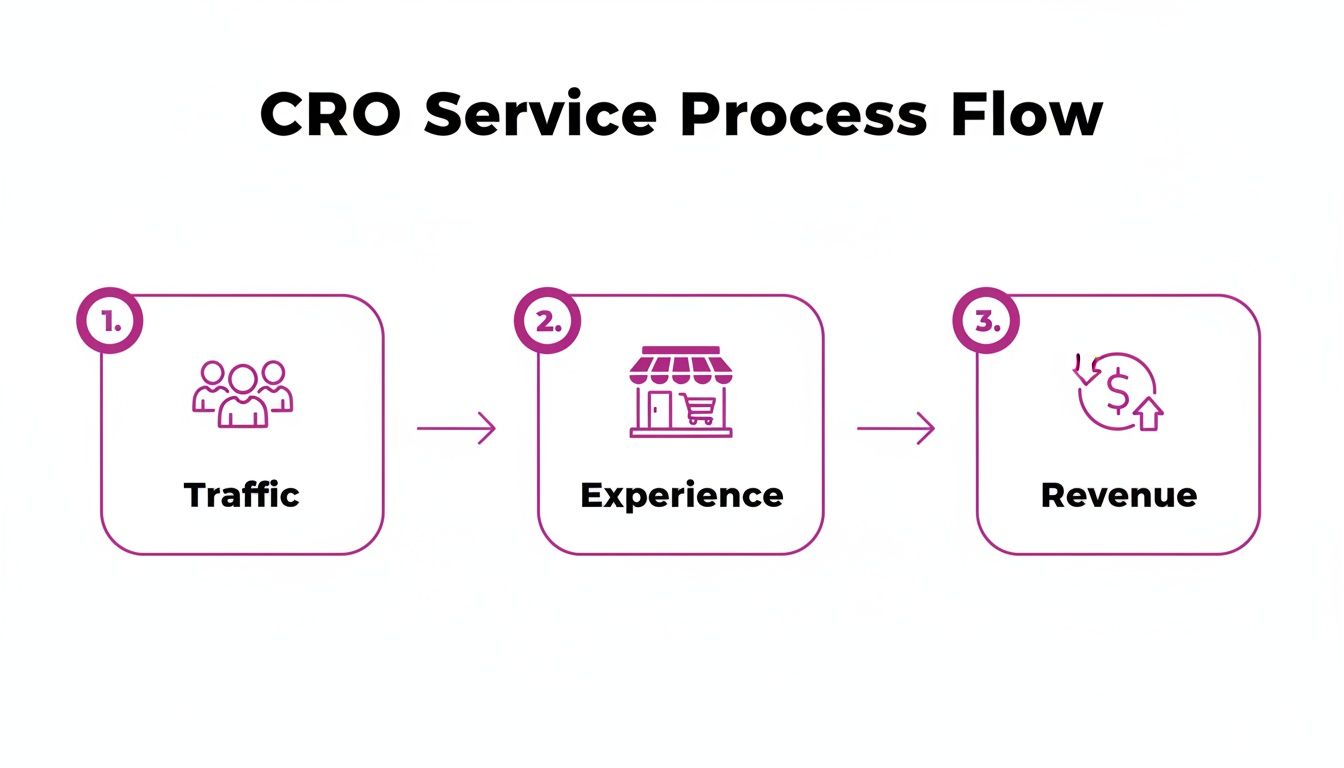
As you can see, a great user experience is the bridge between attracting visitors and turning them into customers. Strengthening that bridge is exactly what a CRO audit is all about.
Peeling Back the Layers of User Behavior
The audit process kicks off by looking at two very different types of data to build a complete picture of what's happening. It’s a bit like combining security camera footage with customer interviews to get the full story.
First up is quantitative analysis. This means a deep dive into your analytics platforms, like Google Analytics. Experts look for the hard numbers and patterns that reveal what is happening on your site.
- High Drop-Off Pages: We're looking for the exact pages where a huge chunk of visitors just give up and leave.
- Funnel Bottlenecks: This is about pinpointing the specific step in the checkout or sign-up process where users are abandoning their journey.
- Segment Performance: We analyze how different groups perform—for example, how well does traffic from social media convert compared to organic search? Or mobile versus desktop?
This data gives us the clues, but it doesn't tell us the motive. That's where the next part comes in.
Uncovering the "Why" Behind the Clicks
Next, we move on to qualitative analysis to understand why users are behaving in these ways. This is where tools that actually visualize the customer experience become incredibly valuable.
A CRO audit without qualitative data is like trying to solve a puzzle with half the pieces missing. The numbers tell you a problem exists, but session recordings and heatmaps show you exactly what that problem looks like through your customer's eyes.
For example, a heatmap might show that dozens of customers are clicking on a static banner image, thinking it’s a button. This is a simple insight you’d never find in standard analytics, but it points to a design flaw that’s causing widespread confusion and costing you sales.
Similarly, session recordings—anonymous videos of real user sessions—are like looking over your customer's shoulder. An auditor might watch a recording and see someone repeatedly trying to apply a discount code that doesn't work, getting frustrated, and eventually leaving. These are the "aha!" moments that turn raw data into actionable, revenue-generating insights.
From Insights to Actionable Experiments
The final, and most critical, step of the audit is turning all this information into a prioritized list of testable hypotheses. A great audit doesn't just hand you a laundry list of problems; it delivers a clear action plan.
For each issue we uncover, a CRO specialist will craft a hypothesis. For instance:
- Problem: Data shows 65% of mobile users abandon checkout at the payment step.
- Insight: Session recordings show users struggling to fill out complex credit card forms on small screens.
- Hypothesis: By adding express payment options like Apple Pay and Shop Pay, we can reduce friction and increase mobile checkout completions by 15%.
This structured approach ensures every change made to your website is based on evidence, not a hunch. At ECORN, our Shopify specialists use this exact audit process to build a customized testing roadmap for your brand, turning these data-driven insights into measurable increases in your store's revenue.
Fueling Growth with A/B Testing and Personalization
If a CRO audit is your strategic roadmap, think of A/B testing as the high-octane fuel that actually drives your growth. This is where all those juicy insights from analytics and user behavior studies get turned into real, revenue-generating improvements on your site. It’s the scientific method, but for your Shopify store, letting you systematically swap out guesswork for hard data.
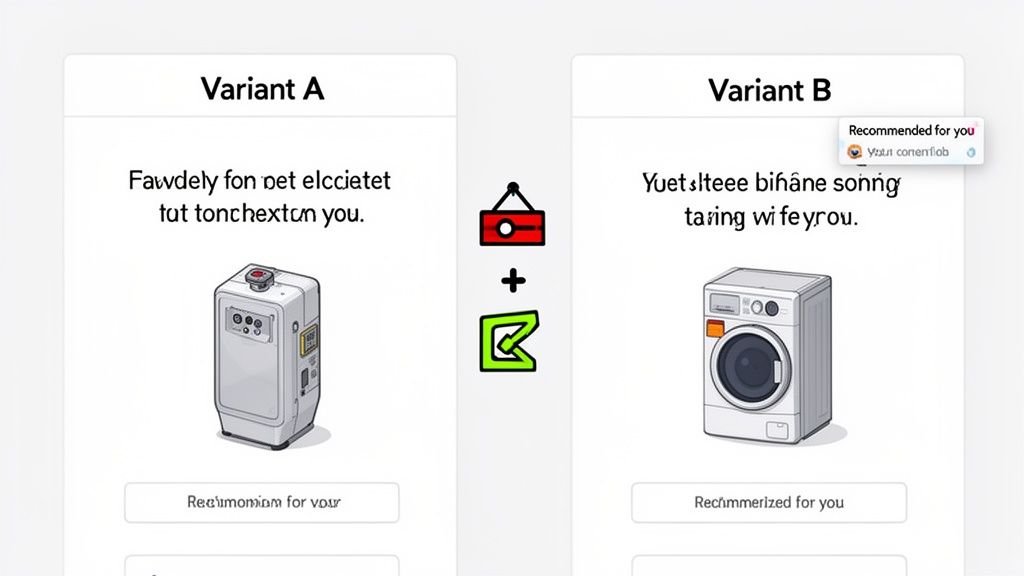
The process itself is refreshingly straightforward. It all kicks off with a clear, testable hypothesis that came out of your audit. Something like, "We believe moving the trust badges closer to the 'Add to Cart' button will cut down on last-second hesitation and lift conversions." Based on that, a CRO service will build a new version of the page (the "challenger") to go head-to-head with your original (the "control").
From there, your site traffic gets split evenly between the two versions. Your customers' behavior decides the winner. There’s absolutely no room for ego or opinion—just data. It’s this disciplined approach that leads to discoveries like rephrasing a button from "Submit Order" to "Get My Order" and seeing a 14% lift in checkouts.
Putting A/B Testing into Practice
For Shopify stores, the list of potential high-impact tests is practically endless. You don’t need to tear down your whole website to see major gains. More often than not, the most powerful experiments are small, focused changes on high-traffic pages where a minor improvement can have an outsized impact on your bottom line.
Here are a few classic examples of A/B tests that deliver results:
- Product Page Headlines: Testing a benefit-driven headline ("Achieve Flawless Skin in 30 Days") against a feature-focused one ("Advanced Hyaluronic Acid Serum").
- Call-to-Action Buttons: Fiddling with color, size, and microcopy to see what exact combination gets the most clicks.
- Product Descriptions: Pitting a scannable, bulleted list of features against a more descriptive, storytelling paragraph.
- Image Variations: Comparing professional studio shots against user-generated lifestyle photos to find out what builds more trust.
Every single test gives you a clear, actionable insight into what truly makes your audience tick. And to really smooth out the customer journey, think about weaving in tools like a slick ecommerce virtual try-on experience.
The Power of AI-Driven Personalization
While A/B testing is all about finding the best overall experience, personalization takes things a giant leap further. It’s built on the simple truth that not all visitors are the same. A first-time shopper has totally different needs than a loyal, returning customer. Personalization tech lets you create unique, one-to-one experiences for every segment of your audience.
Instead of showing everyone the same generic website, personalization creates that "just for you" feeling. It could be as simple as showing recently viewed items, offering a welcome discount to new visitors, or recommending products based on their purchase history.
This is where the top-tier ecommerce CRO services bring out the big guns. By analyzing visitor data in real time—things like their location, how they got to your site, and their browsing behavior—they can dynamically alter the content and offers each person sees. This kind of bespoke experience is a game-changer for boosting engagement and building real brand loyalty.
Ultimately, A/B testing and personalization are a powerful one-two punch for growth. Testing establishes a high-performing baseline that works for everyone, while personalization adds that targeted layer of relevance that makes each visitor feel seen and understood. You can learn more about the mechanics in our guide on how A/B testing for Shopify works. This combined strategy ensures you're not just improving your store, but building a smarter, more adaptive customer experience that prints money.
Choosing Your CRO Partnership Model
So, you're ready to bring in the experts for conversion rate optimization. Great move. The next big decision is how you'll work with them. This isn't just a minor detail—the partnership model you choose will dictate the pace, scope, and ultimate impact of your CRO efforts. It really boils down to two main paths: a one-off project or an ongoing subscription.
Think of it this way: a project-based model is like calling in a specialist surgeon for a specific operation. You have a clear, defined problem—maybe a leaky checkout or a landing page that just isn't converting—and you need a targeted fix. It's a precise strike designed for a measurable outcome.
A subscription-based model, on the other hand, is like having a team of performance coaches on retainer. This isn't about a single fix; it's about continuous, long-term improvement. It’s a commitment to a process of testing, learning, and optimizing every corner of your customer journey, month after month.
The Focused Power of Project-Based CRO
For brands just dipping their toes into CRO or those facing a single, glaring issue, a project-based engagement is a fantastic starting point. It gives you a crystal-clear scope, a set timeline, and a predictable budget. It's the perfect way to tackle a "hair-on-fire" problem or to simply test the waters with an agency without a long-term commitment.
A typical project might look like:
- A Deep-Dive CRO Audit: A full-site analysis to uncover every major conversion roadblock, leaving you with a prioritized roadmap of what to test next.
- A Checkout Flow Overhaul: A concentrated effort to rebuild your entire checkout experience to slash abandonment rates.
- Landing Page Optimization: A specific campaign to juice the performance of a critical landing page right before a big product launch.
The real beauty of a project is its clarity. You get a defined set of deliverables and a tangible result, which is perfect for building the internal business case you need to fund a bigger optimization program down the road.
The only real drawback? It ends. Once the project is wrapped up, the momentum stops unless you kick off another one. This can leave a ton of valuable insights from an audit sitting on the shelf if your team doesn't have the bandwidth to act on them.
The Compounding Growth of Subscription-Based CRO
A subscription model, often called a retainer, shifts CRO from a series of sprints to a marathon of continuous improvement. This is where you see the most significant, compounding growth. Through an ongoing partnership, an agency becomes an extension of your team, deeply understanding your business and constantly running experiments to refine the user experience.
This model is all about maintaining a consistent testing velocity, ensuring your optimization engine is always running. It allows the CRO team to seamlessly move from one opportunity to the next, using learnings from past experiments to inform future tests. This iterative cycle is what truly separates brands that see a few small wins from those that achieve transformative growth.
So, which model makes the most sense for you? Let's break it down.
Subscription vs Project-Based CRO: Which Is Right For You?
Choosing between a project and a subscription really comes down to your immediate needs and long-term goals. This table should help clarify which path is the best fit for your brand right now.
Ultimately, the right choice depends on where your brand is on its growth journey.
At ECORN, we get that every brand's situation is unique. That's why we're flexible. You can start with a single, high-impact project to prove the ROI and get a feel for how we work. Once you see the results, we can smoothly transition you to a subscription that scales with your business, making sure your Shopify store is always firing on all cylinders.
Measuring the Real-World Impact of CRO
So, you’ve put your money on ecommerce conversion rate optimization services. How do you actually know if it's paying off? The most obvious number to watch is your conversion rate, but that’s just the tip of the iceberg. True success is measured by a much richer set of key performance indicators (KPIs) that tell the complete story of your store’s health and, most importantly, its profitability.
Fixating only on the conversion rate is like a baseball team only tracking its number of hits. Hits are great, but they don’t tell you how many runs you scored or who actually won the game. To get the full picture, you need to look at the metrics that tie directly to your bottom line.
Key Metrics Beyond the Conversion Rate
A smart CRO strategy is about increasing the overall value of each visitor, not just pushing more of them to buy something. This is where we get into the KPIs that truly define growth and show the real-world impact of your investment.
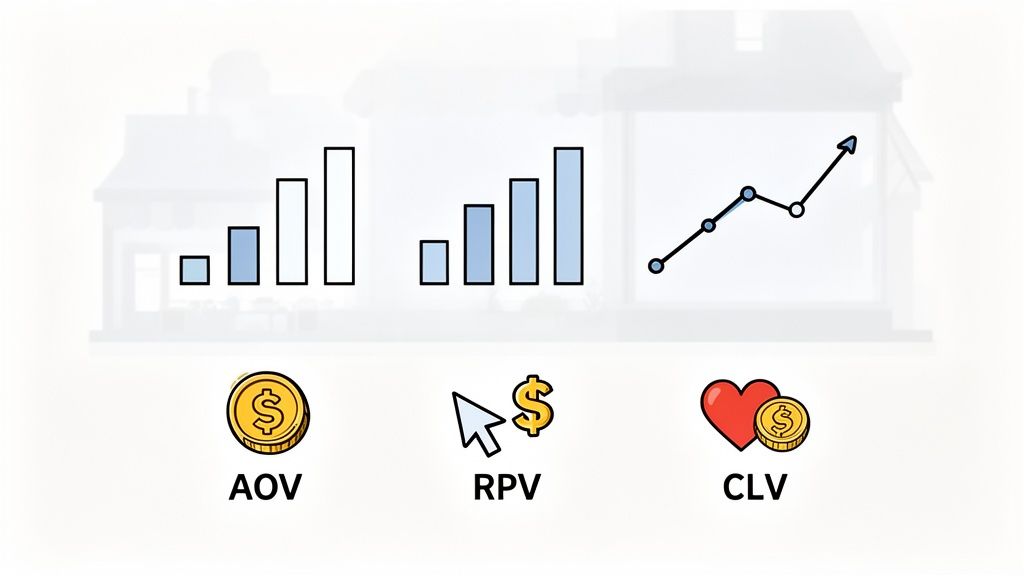
Here are the three most important metrics your CRO partner should be obsessing over:
- Average Order Value (AOV): This is the average amount a customer spends every time they place an order. A great CRO program will test strategies like product bundling, smart upsells, and cross-sells to push this number higher. Even a small 5% increase in AOV can have a massive impact on your total revenue.
- Revenue Per Visitor (RPV): You could argue this is the single most important CRO metric. It’s calculated by dividing your total revenue by your total number of visitors, giving you a clear picture of what each person landing on your site is worth. RPV beautifully balances your conversion rate and AOV into one powerful indicator of your site’s profitability.
- Customer Lifetime Value (CLV): This KPI measures the total revenue you can expect from a single customer over their entire relationship with your brand. CRO efforts that smooth out the user experience and build trust can turn one-time buyers into loyal, repeat customers, dramatically increasing your CLV.
These metrics work together, giving you a complete view of your store’s performance. A winning optimization program will show improvements across all three, proving a powerful and measurable return on investment.
Tangible CRO Wins in Action
To bring these ideas to life, let’s look at a couple of real-world scenarios inspired by our work with Shopify brands.
Mini Case Study 1: The Beauty Brand Checkout Fix
A fast-growing Shopify beauty store, "Brand A," noticed their mobile conversion rate was lagging behind desktop by nearly 50%. Our CRO audit revealed a clunky, multi-step checkout process that was frustrating users on smaller screens.The Fix: We implemented a streamlined, one-page checkout and added express payment options like Shop Pay and Apple Pay.
The Result: Within 60 days, "Brand A" saw a 35% boost in mobile conversions and a significant drop in cart abandonment, adding thousands to their monthly revenue.
This is a classic example of how removing friction directly leads to more sales. It's especially critical in high-performing sectors. Industry analysis shows the food and beverage sector leads in conversions at 6.2%, with health and beauty not far behind at 4%—key industries where a seamless mobile experience is non-negotiable. You can dive deeper into these conversion rate optimization statistics to see how your own vertical stacks up.
Driving Higher Value from Every Customer
Now, let's look at an example that goes beyond just the conversion rate and focuses on increasing the value of each transaction.
Mini Case Study 2: The Apparel Store's AOV Boost
An up-and-coming apparel brand, "Brand B," had a solid conversion rate but a stagnant AOV. Customers were buying, but they were almost always buying just one item.
- The Fix: We integrated an AI-driven product recommendation engine on their product and cart pages. This tool suggested complementary items, like a matching top for a pair of pants or popular accessories.
- The Result: "Brand B" increased their AOV by 20% in the first quarter. More importantly, their Revenue Per Visitor (RPV) shot up, as customers were now spending more during each session.
These examples show how strategic ecommerce conversion rate optimization services deliver tangible, measurable results that go far beyond a simple percentage point increase. It’s about building a smarter, more profitable business from the ground up.
So, What's the Next Move on Your CRO Journey?
You’ve got the framework now. You can see how a professional approach to conversion rate optimization can genuinely shift the trajectory of your business. This isn't about slapping on a few quick fixes and hoping for the best; it's about building a system for repeatable, data-driven growth. It’s a continuous loop of improvement, and the right partner makes navigating that loop a whole lot easier.
The main takeaway should be crystal clear. Every decision has to be backed by data, not a gut feeling. Every change needs to be tested and measured to prove its worth. That discipline is what separates the brands that hit a plateau from the ones that scale, year after year.
Charting Your Course Based on Your Size
What you should do next really depends on where your brand is right now. The path for a newer business is totally different from an established Shopify Plus merchant, and your game plan needs to reflect that.
For Emerging Brands: Your main goal is to get the ball rolling and prove ROI without a massive upfront investment. The best first step is usually a single, high-impact project. Think about a comprehensive CRO audit to find all the low-hanging fruit or a focused project to optimize your mobile checkout. This gets you tangible results, fast, and builds a rock-solid case for doing more.
For Established Shopify Plus Merchants: You've probably got more moving parts, more traffic, and much bigger growth targets. Your best starting point is a discovery call with a specialist team to map out a full-blown growth strategy. This isn't about single projects anymore; it’s about creating a long-term testing roadmap designed for continuous, compounding returns.
The real goal here is to shift from putting out fires to building a proactive growth engine. Whether you kick things off with a single project or a full strategy session, the objective is to build a smarter, more efficient path to sustainable revenue.
If you’re ready to stop guessing and start growing with a strategy that actually works, the next step is to chat with a specialist. At ECORN, we offer a free consultation to help you pinpoint the biggest opportunities for your store and lay out a clear plan forward. Let's build that smarter path together.
Frequently Asked Questions About CRO Services
Thinking about conversion rate optimization services? It's a big step, and you probably have a few questions. That's a good thing. It means you're serious about getting it right.
To help you out, we’ve put together some straight-up answers to the most common questions we hear from Shopify brands just like you. Let's clear the air so you can move forward with confidence.
How Long Does It Take to See Results?
This is usually the first question on everyone's mind, and the honest answer is: it depends. Some quick fixes we find during a technical audit—like a broken checkout button—can make a difference almost overnight. But the real, game-changing results from A/B testing take a little more patience.
To trust the data, each test needs to run for a few weeks. This makes sure the uplift we’re seeing is a real win, not just a lucky guess. For most brands, you’ll start seeing the first data-backed improvements within 60-90 days of kicking things off.
CRO is a long game, not a one-and-done fix. The power of a subscription service is that each win builds on the last, compounding your gains over time for real, sustainable growth.
Is CRO the Same as SEO?
Nope, but they’re two sides of the same coin. They work best when they work together.
Think of it this way:
- SEO (Search Engine Optimization) gets more people to your front door. It’s all about boosting traffic from search engines.
- CRO (Conversion Rate Optimization) makes sure the people who walk through that door actually buy something. It’s about turning visitors into customers.
You can't have a great ecommerce business without both. SEO fills the top of your funnel, and a solid CRO program makes sure you don't waste that hard-earned traffic.
What Should I Budget for CRO Services?
The cost really comes down to how you want to work together. A one-off project, like a deep-dive CRO audit with a full testing roadmap, will usually be a fixed cost, typically in the thousands.
On the other hand, an ongoing subscription is a monthly investment that covers continuous testing, analysis, and implementation. The best way to think about it isn't as a cost, but as an investment in your own revenue. A good CRO program should always pay for itself—and then some—by measurably lifting your sales.
At ECORN, we build data-driven CRO strategies that get real results for Shopify brands. Whether you’re looking for a single project to move the needle or a full-scale optimization program, our team is ready to unlock your store's true potential. Schedule a free consultation with us today and let's start building a smarter path to growth.


Mastering Multi Store Management on Shopify
Scale Shopify Store
10 Shopify App Ideas Worth Building in 2026
Conversion Rate Optimization for Landing Pages: The Playbook
Shopify Plus Automation: A Guide for 2026
10 Social Selling Platforms for Shopify Merchants
Shopify Website Design Examples: 7 Stores Worth Studying
7 Ecommerce Newsletter Examples for Shopify Brands
One Product Shopify Store: Build and Scale
Mobile Pop Up Strategy for Shopify Stores That Converts
Sitemap for Shopify: How to Find, Optimize, and Submit It
7 Single Product Websites Worth Emulating
Product Variants Shopify: The Complete 2026 Guide
Ecommerce Analytics Consulting for Growth
What Is AI Integration for eCommerce
How to Choose the Right eCommerce Website Development Firm
E Business Strategy Implementation
Conversion Tracking Setup for Shopify Stores
BigCommerce vs Shopify Plus Which Enterprise Wins in 2026
Shopify Theme Kit: Setup, Commands, and Migration Guide
Shopify Extension Development: A Practical 2026 Guide
Shopify Speed Score Explained and How to Improve It
Shopify Mobile Optimization: The 2026 Playbook
How to Add Subcategory in Shopify for Better UX
How to Implement Structured Data for Ecommerce in 2026
SEO App Mobile: Shopify Store Optimization Guide
Shopify Plus Support: What It Includes and How to Choose
Google Ads for Shopify: The Complete 2026 Playbook
Shopify New York: How to Find and Hire the Right Agency
Google Search Console for Shopify: The Complete Setup
First Party Data Collection for eCommerce Growth
FAQ Online Store Guide: Build and Measure It Right
Do FB Ads Work for eCommerce in 2026?
One Page Checkout for Shopify: Design and Implementation
Shopify GraphQL vs REST: The 2026 Developer Decision
Shopify Ecommerce Consulting: Strategy, Pricing &
Are Reddit Ads Worth It for eCommerce Brands
Shopify Title and Meta Description: A Practical 2026 Guide
Product Video Best Practices for Shopify Brands
Real-Time Inventory Management: A 2026 Guide
AI Chatbot Integration for Shopify Stores
Affiliate Program Management: A Shopify Guide
10 Best Performance Monitoring Tools for Shopify in 2026
Digital Asset Management for eCommerce Brands in 2026
Every Type of Facebook Ads Explained for eCommerce Growth
Product Information Management Explained for Shopify Brands
Support Ticket System: A Guide for Shopify Stores

10 Best Customer Service Tools for Shopify in 2026

Can I Start a Business with No Money? a 2026 Blueprint

What Sells Good on Etsy: Best Niches for 2026

Shopify Add to Cart Button: A Practical 2026 Guide

Customer Feedback Automation: A Practical eCommerce Guide
Critical Rendering Path: A Guide for Shopify Stores

How to Promote on TikTok for eCommerce in 2026

B2B eCommerce Consulting That Drives Real Revenue
10 Best Practices for Site Navigation in 2026
Return vs Refund for Shopify Stores: A Practical Guide
What Is Customer Lifetime Value and Why It Matters
What Is Voice of Customer Research for eCommerce

SMS Marketing for Ecommerce That Actually Converts

Master How to Improve Email Deliverability in 2026

Top 7 eCommerce Partners NYC for Shopify Brands in 2026
Machine Learning for Ecommerce: Boost Your Shopify Store

Beauty Market Research: Your 2026 Growth Guide
Shopify International Expansion: A 2026 Roadmap
What Does CRO Stand for in Business: Understanding CRO

Shopify Visual Merchandising: A Playbook for Higher Sales

Shopify Landing Page Design: Master Conversion in 2026
10 Best AI SEO Optimization Tools for Shopify in 2026

Agentic AI for Ecommerce: Boost Your Sales in 2026
Mastering Email Marketing Data for eCommerce Growth
Conversion Rate Optimisation Australia: Boost Your Sales
Conversion Rate Optimization AI: Your Shopify Store Guide

10 Product Bundling Strategies for Shopify in 2026
How to Increase Customer Lifetime Value: A Shopify Playbook
AI Customer Service Automation: Shopify Guide 2026
Clean Website Design: A Shopify Conversion Playbook

Omnichannel Retail Strategy: A Shopify Playbook
Product Data Enrichment: A Guide for Shopify Brands
Instagram Shopping Features a Guide for Shopify Stores
What Is Revenue Optimization: A Holistic RevOps Guide
Benefits of Conversion Rate Optimization: Boost Your
WordPress to Shopify Migration: Your 2026 Seamless Switch
Boost Sales: Ecommerce Payment Processing Guide 2026
Unified Commerce Platform: Benefits, KPIs & Shopify Guide
How to Reduce Bounce Rate eCommerce: Your 2026 Guide
Shopify API Integration: A Practical End-to-End Guide

How to Implement Data Governance: A 2026 Guide
Shopify Store Development Cost: A 2026 Breakdown
What Is Server Side Tracking: The Shopify Guide 2026
Marketing Automation Workflows: A Shopify Guide for 2026
Shopify: How to Reduce Technical Debt

Shopify UX Design Change: A Playbook for Growth
User Generated Content Strategy: Shopify Playbook

Shopify Pause and Build Plan Cost: A Complete 2026 Guide
Compare at Price on Shopify: A Complete Guide for 2026
Where Can I Sell My Prints? 10 Best Platforms for 2026
Shopify Order Management System: The Ultimate Guide 2026
What Is Marketing Attribution? an eCommerce Guide for 2026

10 Best Black Friday Sales Sheets for 2026


newsletter in your inbox