

So, what exactly are Shopify web design services? Put simply, they are professional services that design, build, and optimize custom online stores on the Shopify platform. Think of them as an expert architect and construction crew for your digital storefront.
These services go far beyond just picking a basic theme. They’re about creating a bespoke, high-performing sales engine that’s perfectly aligned with your brand, your products, and your customers.
Why Your Business Needs More Than a Basic Theme
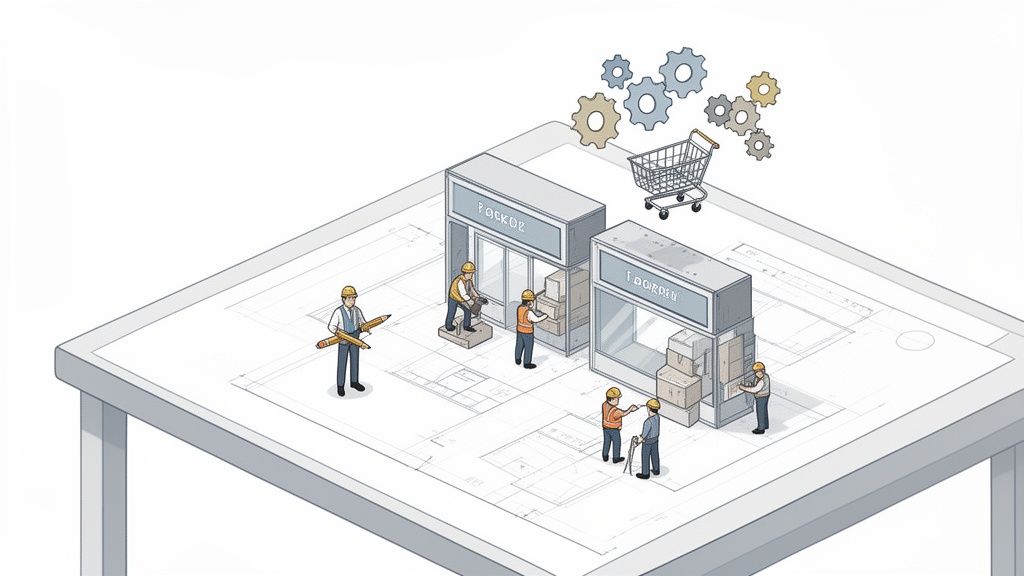
Anyone can get a store online with Shopify these days, but standing out from the crowd is a whole different ball game. A standard theme might get your doors open, but it often feels generic and just doesn't have the muscle to help you scale. This is precisely where professional Shopify web design services stop being an expense and become a critical investment in your growth.
A great agency solves the problem of an underperforming site by transforming it into a powerful tool for growth. This transformation rests on two core pillars that work hand-in-hand: strategic design and custom development.
To help clarify the role of each, here is a quick breakdown of what a comprehensive web design service includes.
Shopify Web Design Services At a Glance
Each element plays a crucial part in building an eCommerce machine that doesn't just look good but performs exceptionally well, driving sales and fostering customer loyalty.
The Two Sides of Expert Shopify Design
1. Strategic Design (The "Why")
This is all about the user experience (UX) and how your brand comes to life online. It’s about getting inside your customer's head so deeply that the store feels like it was built just for them. It involves crafting intuitive navigation, telling a compelling brand story, and creating a visual identity that builds trust and makes people want to buy. A skilled designer ensures every single click guides the user closer to making a purchase.
2. Custom Development (The "How")
This is the technical side of things, where the strategic design is brought to life with clean, efficient code. Development involves building out custom theme features that off-the-shelf templates can't offer, ensuring your pages load at lightning speed, and making sure all your third-party apps work together seamlessly. It’s what makes your store not just beautiful, but also functional, dependable, and ready to handle your business operations.
Think of it this way: Design is the architectural blueprint for your dream retail store, detailing the customer flow and brand aesthetic. Development is the engineering and construction, ensuring the foundation is solid, the lighting works perfectly, and the doors open smoothly.
The Scale of the Shopify Ecosystem
The need for specialized design and development is huge. Shopify powers over 4.82 million live eCommerce websites across the globe, with a mind-boggling 3 million in the US alone. This gives it a 10% share of the global eCommerce platform market and a commanding 30% of US-based sites. It's a dominant force, and knowing how to build effectively on this platform is a highly specialized skill.
If you’re feeling boxed in by your current site, investing in professional Shopify web design services is the most direct path to building a real competitive edge. It’s the move from a pre-made template to a custom-built machine engineered for conversions. Understanding the fundamentals of a dedicated Shopify Store Design is your first step toward an online presence that not only looks the part but actively drives sales and builds a loyal customer base.
What Goes Into a High-Converting Shopify Store?
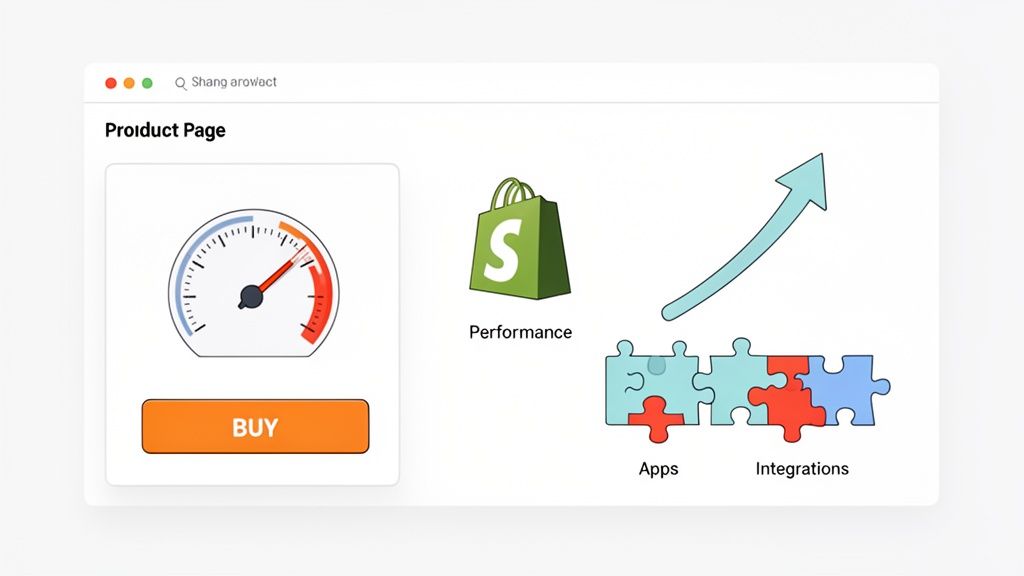
When you look past the basic setup, a truly great Shopify store isn’t just a pretty website—it's a well-oiled machine where every part works together. Professional Shopify web design services are all about fine-tuning these core elements to build a powerful sales engine. Each piece has a job to do, all aimed at turning casual visitors into loyal customers.
Let's unpack what an expert agency actually does to build a store that delivers results.
UI/UX and Brand-Centric Design
User Interface (UI) and User Experience (UX) design is where it all starts. Think of it as creating a smooth, intuitive path that guides shoppers from your homepage to the checkout, all without a hint of confusion or frustration. This is where art and science really come together; it’s so much more than picking colors and fonts.
A great agency will obsess over:
- Intuitive Navigation: Building menus and categories so well that customers find what they’re looking for in three clicks or less.
- Brand Storytelling: Weaving your brand’s personality into every page to build an emotional connection and earn trust.
- Visual Hierarchy: Using design to strategically pull the eye toward important things, like "Add to Cart" buttons and special offers.
The whole point is to make shopping feel natural and enjoyable. When customers have a good time browsing, they stick around, look at more products, and are far more likely to buy something.
Custom Shopify Development and Performance
If design is the blueprint, then custom development is what builds the high-performance structure. This is where you go beyond the limitations of a standard theme, opening the door to unique features made just for your business and your customers.
Key development work includes:
- Bespoke Theme Features: Building one-of-a-kind elements that competitors can't just copy. This could be a custom product configurator, a slick quick-add-to-cart function, or specialized lookbooks that bring your products to life.
- Site Speed Optimization: Lightning-fast load times are absolutely non-negotiable. With over 75% of Shopify traffic expected to come from mobile by 2026, a mobile-first mindset is essential. Top-tier developers will tune every part of your site to crush Google's Core Web Vitals, which directly boosts your SEO and stops customers from bouncing.
- Seamless App Integrations: Ensuring all your third-party apps—from your email platform to your loyalty program—play nicely together without dragging your site speed down.
This is the technical heavy lifting that makes your store not only unique but also fast, dependable, and ready for growth. If you want to dig deeper into the nuts and bolts, our guide on how to design a Shopify website has more insights.
Data-Driven Conversion Rate Optimization
Conversion Rate Optimization (CRO) is all about using data to make your store better, bit by bit. It's the art of figuring out why people aren't buying and then fixing those problems. This is easily one of the most valuable parts of professional Shopify web design services.
A skilled CRO expert doesn't guess what will work; they use A/B testing, heatmaps, and user session recordings to make data-backed decisions that measurably increase sales.
For instance, an agency might see from your analytics that product pages have a high drop-off rate. They might hypothesize that moving customer reviews higher on the page will build trust and get more people to click "Add to Cart." They'd test this theory on a slice of your traffic. If the data shows a clear win—even a 15% lift—they roll it out to everyone. To get a better handle on this, check out these helpful Shopify Conversion Rate Optimization tips.
Advanced System Integrations
As a business grows, its Shopify store becomes just one piece of a much larger operational puzzle. Advanced integrations are the glue that connects your store to other critical business systems, automating tedious workflows and saving hundreds of hours of manual effort.
This could mean connecting Shopify to:
- Enterprise Resource Planning (ERP) Systems: To keep inventory, orders, and customer data synced up in real-time.
- Customer Relationship Management (CRM) Platforms: To get a single, unified view of every customer interaction.
- Third-Party Logistics (3PL) Providers: To put order fulfillment and shipping on autopilot.
A custom integration might, for example, save your team 20 hours per week by automatically pushing order data into your accounting software. That kind of operational efficiency is a huge, often-overlooked advantage of working with an experienced Shopify agency.
Scaling Your Business with Shopify Plus
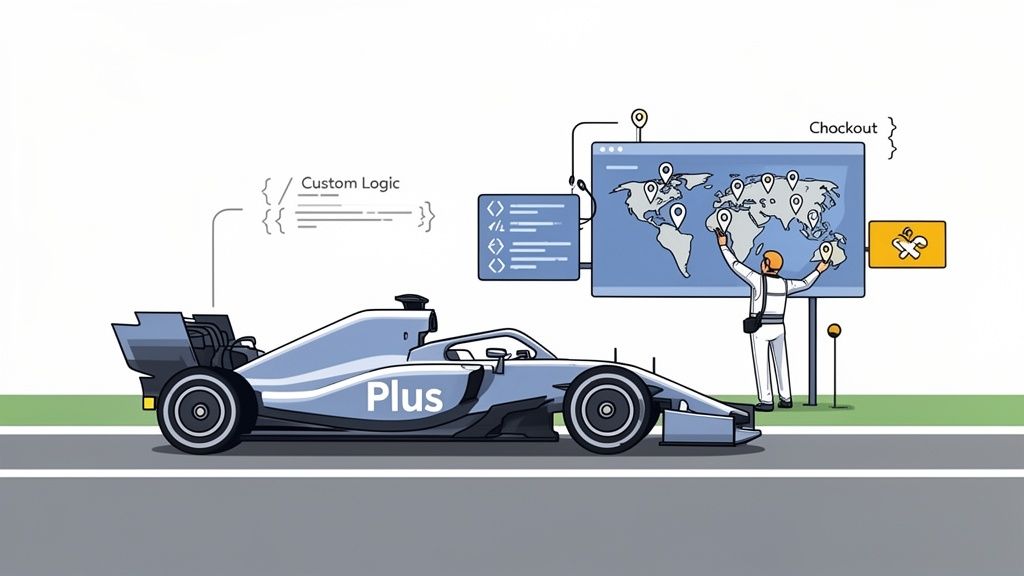
There comes a point when your brand simply outgrows the standard Shopify plans. When you're dealing with high volume and complex operations, you need an entirely new ecosystem built for scale. This is where Shopify Plus enters the picture. It’s not just a premium tier; it’s a fundamental shift in what's possible for your online store.
Let's put it this way: if a standard Shopify plan is a high-performance sports car, Shopify Plus is a Formula 1 machine. It's incredibly powerful, but you need a specialized pit crew to unlock its true speed and agility. That’s why expert Shopify web design services focused on the Plus platform are so essential.
Unlocking Exclusive Enterprise-Grade Tools
Shopify Plus isn't just about handling more traffic. It's a suite of exclusive tools designed to solve complex operational challenges and fuel aggressive growth. These aren’t simple add-ons; they are foundational capabilities that require an expert developer's touch to implement correctly.
A top-tier Shopify Plus agency will build custom solutions using features like:
- Shopify Functions: This powerful tool lets developers write custom server-side logic directly into Shopify’s backend. You can create unique discount structures, complex shipping rules, and custom payment options that are completely impossible on standard plans.
- Expanded API Access: Plus gives you significantly higher API call limits. This means you can build rock-solid connections to your ERP, CRM, and other business systems without hitting frustrating bottlenecks.
- Fully Customizable Checkout: For the first time, you gain total control over the
checkout.liquidfile. This is a game-changer, allowing for a completely branded and optimized checkout experience to slash cart abandonment at the most critical step of the journey.
These aren’t just features; they're the building blocks for a truly enterprise-level eCommerce operation.
Shopify Plus is for businesses that have moved beyond simply selling online. They're now focused on building a sophisticated, scalable, and highly automated digital commerce engine.
Advanced Solutions for High-Growth Brands
Working with a Shopify Plus agency goes far beyond just design; it’s about architectural strategy. These agencies are equipped to solve the unique headaches that come with rapid scaling and international expansion.
Specialized Shopify web design services for Plus merchants tackle the complex projects that drive massive business impact. This is critical for the rapidly growing number of enterprise brands on the platform. Shopify Plus now serves 47,240 enterprise stores, with high-revenue merchants seeing an average year-over-year growth of 126%—a rate that is 690% above typical industry norms. You can read more about these explosive Shopify growth statistics to grasp the full scale.
Tailored Development for Complex Needs
To support that kind of explosive growth, an agency's work has to be just as sophisticated.
- Multi-Store Architecture: For global brands, agencies can build and manage multiple storefronts for different regions or languages, all from a single Shopify Plus organization. This simplifies international operations and creates perfectly localized customer experiences.
- B2B and Wholesale Channels: Agencies can build dedicated, password-protected wholesale storefronts with custom pricing, net payment terms, and bulk ordering functions, opening up powerful new revenue streams.
- Flash Sale Engineering: Expecting a huge traffic spike from a product drop or a major sale? A Plus agency can architect your site to handle the load without crashing, ensuring you capture every single sale.
Ultimately, Shopify Plus is the definitive platform for ambitious brands ready to compete at the highest level. Partnering with an agency that has deep expertise in its unique capabilities ensures you have the technical and strategic support to turn its powerful features into measurable growth.
Choosing Your Agency Engagement Model
So, you've decided to bring in the pros for your Shopify web design services. Great move. The next big question is how you'll actually work with them. The structure of your relationship with an agency is a huge deal—it shapes your budget, day-to-day workflow, and what you can achieve in the long run.
Most agencies boil it down to two main ways of working together. Getting a handle on the difference between a one-time project and a monthly subscription is the key to picking the right path for your brand’s immediate needs and where you see it going in the future. Let’s break down what each one looks like in the real world.
The One-Time Project Model
Think of a one-time project like calling in a specialist contractor to build an extension on your house. It’s for a single, well-defined job with a clear beginning and end. This model is perfect when you have a specific, measurable goal in mind and need a concentrated blast of work to get it done.
Here are a few classic examples of one-time projects:
- A complete website redesign to nail your new branding and give the user experience a major upgrade.
- A deep-dive conversion rate optimization (CRO) audit to find and plug the holes where you're losing money.
- Migrating your store to Shopify from another platform like Magento or WooCommerce.
- Building a single, complex custom feature that your current theme just can't handle.
The biggest plus here is predictability. You lock in a fixed scope, a firm timeline, and a clear budget right from the start. No surprises. But that's also its main drawback—it isn't very flexible. Once the project is done, the work stops. If new ideas pop up or you need more help, you're looking at a brand-new contract.
The Monthly Subscription Model
A monthly subscription, often called a retainer, is a whole different ball game. You’re not just hiring someone for a job; you’re building a strategic partnership focused on continuous, never-ending improvement. This is the model for brands who see their website as a living, breathing sales engine, not a static brochure that just sits there.
This model is a fantastic fit for businesses that need:
- Ongoing design tweaks and fresh landing pages for new marketing campaigns.
- Consistent A/B testing and data-driven changes to steadily push conversion rates higher.
- Regular development support for squashing bugs, tuning performance, and rolling out small new features.
- Proactive strategic advice to keep you a step ahead of market shifts and what your competitors are doing.
With a subscription, you get a dedicated team that gets to know your brand, your customers, and your business goals inside and out. They're always in the background, working to drive your growth, month after month.
Here’s a simple way to think about it: a one-time project is like bringing in a consultant for a single workshop to fix a specific problem. A monthly subscription is like having that expert on your team, always hunting for new ways to boost performance.
Project vs. Subscription: Which Model Fits Your Business?
Still on the fence? This side-by-side comparison should help clarify which model makes the most sense for your current situation and goals.
In the end, there's no single "right" answer—it all comes down to you. If you need a massive overhaul with a clear finish line, a project is probably your best bet. But if you're ready to invest in steady, long-term growth with a partner who's in it for the long haul, a subscription provides the strategic firepower you need.
How to Hire the Right Shopify Agency
Picking a partner for your Shopify web design services is one of the most important decisions you'll make for your business. Let's be real—hiring the wrong agency is a nightmare. It means wasted budgets, blown deadlines, and an end product that does absolutely nothing for your growth. But get it right? You’ve just found a profitable partnership that will pay you back for years.
This isn't about falling for the flashiest website. It's about finding a team that has the chops, a transparent process, and thinks like a business owner, not just a designer. You need a solid playbook to vet potential partners, and this is it.
Look for a Shopify-Specific Portfolio
First thing's first: an agency's portfolio is their resume. Don't get distracted by a slick gallery of general web design projects. You need to see a portfolio stacked with successful Shopify stores.
Look for variety in their past work. Have they worked with brands in your industry? Have they tackled stores with the kind of complexity you're facing? A deep Shopify portfolio proves they know the platform's quirks and opportunities inside and out—from theme customization to the massive app ecosystem.
Scrutinize Case Studies for Real Results
A portfolio shows you what an agency can do. Case studies show you what they can achieve. This is where you separate the artists from the actual growth partners. Vague promises like "improved user experience" are a major red flag. You're looking for hard numbers and outcomes you can take to the bank.
A truly compelling case study will spell out the results in plain English, like:
- "Achieved a 25% increase in conversion rate through a targeted product page redesign."
- "Boosted average order value by 18% by implementing a custom upsell feature at checkout."
- "Reduced page load times by 40%, leading to a 10% decrease in bounce rate."
These specific metrics are proof that the agency gets it: great design is a business tool. It shows they track their impact and are accountable for results. To see what a specialized team can really do, check out what a top-tier Shopify development agency brings to the table.
Evaluate Their Process and Communication
You can't get a great final product without a great process. Period. In your first calls, the agency should be able to walk you through their entire workflow with confidence—from discovery and design all the way to development and launch.
Get specific with your questions about how they run projects:
- What project management tools do they use (like Asana, Trello, or Monday)?
- How often will you have check-in meetings?
- Who is my main point of contact?
A transparent, well-oiled process is the mark of an experienced and organized team. It cuts down on surprises and ensures you always know exactly where your project stands.
Get the Most Out of the Discovery Call
The discovery call is your single best chance to see how an agency thinks. This isn't just a sales pitch; it's a two-way interview. A great agency will actually ask you more questions than you ask them. They’ll want to dig into your business goals, who your customers are, and what's keeping you up at night.
Be wary of any agency that jumps straight into talking about solutions before they fully understand your problems. True partners diagnose before they prescribe.
Come to this call prepared. Have your key metrics, business goals, and biggest challenges ready to go. Use this conversation to feel out whether they’re just order-takers or genuine strategic partners who can challenge your thinking and bring fresh ideas. Making the right hire starts with asking the right questions and knowing the difference between a vendor and a partner.
Your Next Steps for Every Growth Stage
Knowing you need professional Shopify web design services is one thing. Figuring out what to do next is another. The right move for a brand just getting its legs is worlds apart from what an established enterprise needs.
Think of this as your roadmap. We’ve designed it to give you clear, practical advice that fits where your business is right now. Whether you're an emerging brand, a scaling business, or an enterprise retailer, your immediate focus should be on the actions that will deliver the biggest impact today.
The Emerging Brand (Under $500k/Year)
If your brand is in its early days, your one and only goal is to build a rock-solid foundation. This is not the time to chase shiny objects or complex custom features. Instead, every dollar is best spent creating a professional, trustworthy, and conversion-focused store that can grow with you.
Your main priorities should be:
- A Polished Design: Your store must look credible from the first click. First impressions are everything when you’re trying to win over new customers.
- Mobile-First Experience: The vast majority of your traffic will be on a phone. A clunky mobile site is a guaranteed way to lose sales, so a flawless smartphone experience is non-negotiable.
- Quick CRO Wins: Simple tweaks can make a huge difference at this stage. Things like improving your product page layout or simplifying your main menu can directly boost your sales.
Recommended First Step: Go for a one-time project to get your theme foundation right. A designer can take a premium theme, customize it to reflect your brand, and optimize it for conversions. This gives you a professional-grade store without the enterprise-level price tag and perfectly sets the stage for future growth.
The Scaling Business ($500k - $5M/Year)
You've found your groove and revenue is flowing consistently. Awesome. Your challenges now shift from just surviving to truly optimizing and standing out. The goal is to leapfrog the competition by creating a superior customer experience and making your back-end operations run like a well-oiled machine.
At this stage, your focus expands to:
- Custom Features: Start building unique functions that solve specific customer pain points or give you an edge no one else has.
- A/B Testing Program: It’s time to stop guessing and start knowing. A structured optimization program will steadily lift your conversion rate, average order value, and overall profitability.
- System Integrations: Begin connecting your store to key tools, like your email marketing platform or inventory management system, to automate workflows and save precious time.
Recommended First Step: Look into a monthly subscription with a Shopify agency. This model gives you the perfect mix of strategic guidance, ongoing development, and continuous optimization you need to keep up the momentum. A true partnership ensures your site gets better every single month.
The right agency partner does more than just build what you ask. They act as a strategic extension of your team, proactively identifying opportunities to improve performance and drive revenue.
The Enterprise Retailer (On or Moving to Shopify Plus)
You're a high-volume merchant operating at a serious scale. Your needs are complex, and your focus is on squeezing every last drop of power out of the Shopify Plus platform for global sales, operational excellence, and deep customization. Your store isn't just a website; it's a sophisticated commerce engine.
Key priorities for enterprise brands include:
- Leveraging Shopify Plus Features: Maximize tools like Shopify Functions for custom checkout logic and the expanded API access for heavy-duty integrations.
- Internationalization: Roll out multi-store architectures to handle different regions, languages, and currencies seamlessly.
- Complex Integrations: Connect your store to enterprise-level systems like an ERP or CRM for a unified flow of data across the entire business.
Recommended First Step: Find an agency with deep, proven Shopify Plus expertise for a major project or a high-touch retainer. Your challenges demand a partner who lives and breathes enterprise architecture and can engineer solutions to handle massive scale and complexity.
No matter your growth stage, this decision tree outlines the essential steps for vetting any potential agency partner.
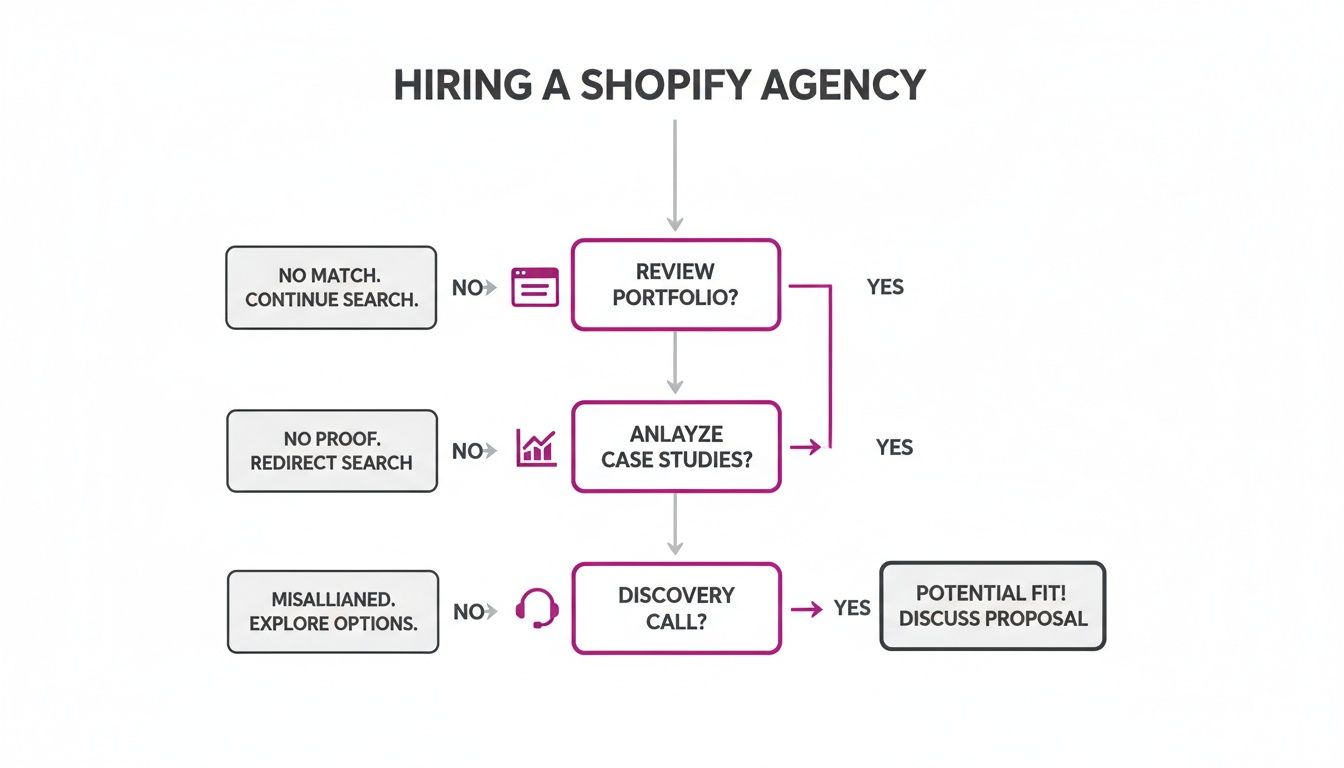
As you can see, a strong portfolio and real, measurable case studies are the price of entry. Only after you've confirmed they have the chops should you schedule a discovery call, which is your chance to assess strategic fit.
Frequently Asked Questions
Diving into the world of Shopify web design services usually brings up a handful of key questions. We get it. Here are some quick, straightforward answers to the most common ones we hear from merchants just like you.
How Much Do Shopify Web Design Services Cost in 2026?
Honestly, it varies a lot depending on what you need. For an emerging or growing brand looking for a full redesign, you can expect a project to land somewhere between $15,000 and $50,000. If you're an enterprise brand on Shopify Plus, those projects can easily climb past $100,000 due to the added complexity.
What about ongoing work? Monthly subscriptions, or what we call retainers, are perfect for continuous optimization and development. These typically start around $3,000 per month and can go up to $20,000+ for a really hands-on partnership. The final price tag always comes down to the agency's experience and exactly what you're getting each month.
How Long Does a Shopify Redesign Take?
A standard Shopify redesign usually takes about 12 to 16 weeks. This gives everyone enough time to move through strategy, design, development, testing, and getting all your content moved over without rushing. It’s a process, and you don’t want to cut corners.
For more involved projects, especially on Shopify Plus with custom apps or multiple storefronts, the timeline can stretch to 6 months or even longer. A good agency will always be transparent and give you a detailed project timeline right from the start.
A custom theme is like building a house from a unique architectural blueprint, perfectly suited to your needs. A premium theme is like buying a high-end model home—it's excellent, but you're still working within a pre-existing structure.
Is a Custom Shopify Theme Better Than a Premium Theme?
This really hinges on your business goals and, of course, your budget. A premium theme is an absolutely fantastic starting point for new and growing brands. It gives you a professional, reliable foundation that can be customized to your branding without a massive upfront investment.
However, a custom theme is where you get complete creative control and a real competitive edge. It lets you build unique user experiences, fine-tune customer journeys, and add special features that just aren't possible with a premium theme. For businesses looking to scale and for enterprise-level brands, a custom theme is often the missing piece to unlock that next stage of growth.
Ready to turn your Shopify store into a machine that drives sales? ECORN offers expert Shopify design, development, and CRO services built for your specific stage of growth. Book a free consultation with our team today and let's talk about how we can hit your eCommerce goals together.


Shopify Developer Hourly Rate: What to Pay in 2026
Ecommerce Conversion Tracking: The Complete How-To Guide
Shopify Design Agency: How to Pick the Right Partner
Mastering Multi Store Management on Shopify
Scale Shopify Store
10 Shopify App Ideas Worth Building in 2026
Conversion Rate Optimization for Landing Pages: The Playbook
Shopify Plus Automation: A Guide for 2026
10 Social Selling Platforms for Shopify Merchants

Shopify Website Design Examples: 7 Stores Worth Studying
7 Ecommerce Newsletter Examples for Shopify Brands
One Product Shopify Store: Build and Scale
Mobile Pop Up Strategy for Shopify Stores That Converts
Sitemap for Shopify: How to Find, Optimize, and Submit It
7 Single Product Websites Worth Emulating
Product Variants Shopify: The Complete 2026 Guide
Ecommerce Analytics Consulting for Growth
What Is AI Integration for eCommerce
How to Choose the Right eCommerce Website Development Firm
E Business Strategy Implementation
Conversion Tracking Setup for Shopify Stores
BigCommerce vs Shopify Plus Which Enterprise Wins in 2026
Shopify Theme Kit: Setup, Commands, and Migration Guide
Shopify Extension Development: A Practical 2026 Guide
Shopify Speed Score Explained and How to Improve It
Shopify Mobile Optimization: The 2026 Playbook
How to Add Subcategory in Shopify for Better UX
How to Implement Structured Data for Ecommerce in 2026
SEO App Mobile: Shopify Store Optimization Guide
Shopify Plus Support: What It Includes and How to Choose
Google Ads for Shopify: The Complete 2026 Playbook

Shopify New York: How to Find and Hire the Right Agency
Google Search Console for Shopify: The Complete Setup
First Party Data Collection for eCommerce Growth
FAQ Online Store Guide: Build and Measure It Right
Do FB Ads Work for eCommerce in 2026?
One Page Checkout for Shopify: Design and Implementation
Shopify GraphQL vs REST: The 2026 Developer Decision
Shopify Ecommerce Consulting: Strategy, Pricing &

Are Reddit Ads Worth It for eCommerce Brands
Shopify Title and Meta Description: A Practical 2026 Guide
Product Video Best Practices for Shopify Brands
Real-Time Inventory Management: A 2026 Guide
AI Chatbot Integration for Shopify Stores
Affiliate Program Management: A Shopify Guide
10 Best Performance Monitoring Tools for Shopify in 2026
Digital Asset Management for eCommerce Brands in 2026
Every Type of Facebook Ads Explained for eCommerce Growth
Product Information Management Explained for Shopify Brands
Support Ticket System: A Guide for Shopify Stores

10 Best Customer Service Tools for Shopify in 2026

Can I Start a Business with No Money? a 2026 Blueprint

What Sells Good on Etsy: Best Niches for 2026

Shopify Add to Cart Button: A Practical 2026 Guide

Customer Feedback Automation: A Practical eCommerce Guide
Critical Rendering Path: A Guide for Shopify Stores

How to Promote on TikTok for eCommerce in 2026

B2B eCommerce Consulting That Drives Real Revenue
10 Best Practices for Site Navigation in 2026
Return vs Refund for Shopify Stores: A Practical Guide
What Is Customer Lifetime Value and Why It Matters
What Is Voice of Customer Research for eCommerce

SMS Marketing for Ecommerce That Actually Converts

Master How to Improve Email Deliverability in 2026

Top 7 eCommerce Partners NYC for Shopify Brands in 2026
Machine Learning for Ecommerce: Boost Your Shopify Store

Beauty Market Research: Your 2026 Growth Guide
Shopify International Expansion: A 2026 Roadmap
What Does CRO Stand for in Business: Understanding CRO
Shopify Visual Merchandising: A Playbook for Higher Sales
Shopify Landing Page Design: Master Conversion in 2026
10 Best AI SEO Optimization Tools for Shopify in 2026

Agentic AI for Ecommerce: Boost Your Sales in 2026
Mastering Email Marketing Data for eCommerce Growth
Conversion Rate Optimisation Australia: Boost Your Sales
Conversion Rate Optimization AI: Your Shopify Store Guide

10 Product Bundling Strategies for Shopify in 2026
How to Increase Customer Lifetime Value: A Shopify Playbook
AI Customer Service Automation: Shopify Guide 2026
Clean Website Design: A Shopify Conversion Playbook

Omnichannel Retail Strategy: A Shopify Playbook
Product Data Enrichment: A Guide for Shopify Brands
Instagram Shopping Features a Guide for Shopify Stores
What Is Revenue Optimization: A Holistic RevOps Guide
Benefits of Conversion Rate Optimization: Boost Your
WordPress to Shopify Migration: Your 2026 Seamless Switch
Boost Sales: Ecommerce Payment Processing Guide 2026
Unified Commerce Platform: Benefits, KPIs & Shopify Guide
How to Reduce Bounce Rate eCommerce: Your 2026 Guide
Shopify API Integration: A Practical End-to-End Guide

How to Implement Data Governance: A 2026 Guide
Shopify Store Development Cost: A 2026 Breakdown
What Is Server Side Tracking: The Shopify Guide 2026
Marketing Automation Workflows: A Shopify Guide for 2026
Shopify: How to Reduce Technical Debt

Shopify UX Design Change: A Playbook for Growth
User Generated Content Strategy: Shopify Playbook
Shopify Pause and Build Plan Cost: A Complete 2026 Guide
Compare at Price on Shopify: A Complete Guide for 2026
Where Can I Sell My Prints? 10 Best Platforms for 2026


newsletter in your inbox