

So, what are Shopify optimization services? In short, they’re professional services that exist for one reason: to turn your Shopify store into a high-performance selling machine.
It's about making deliberate, data-backed improvements to your site's speed, user experience, and checkout flow. The goal is simple: convert more of the visitors you already have into paying customers and get more revenue out of your existing traffic.
What Exactly Are Shopify Optimization Services
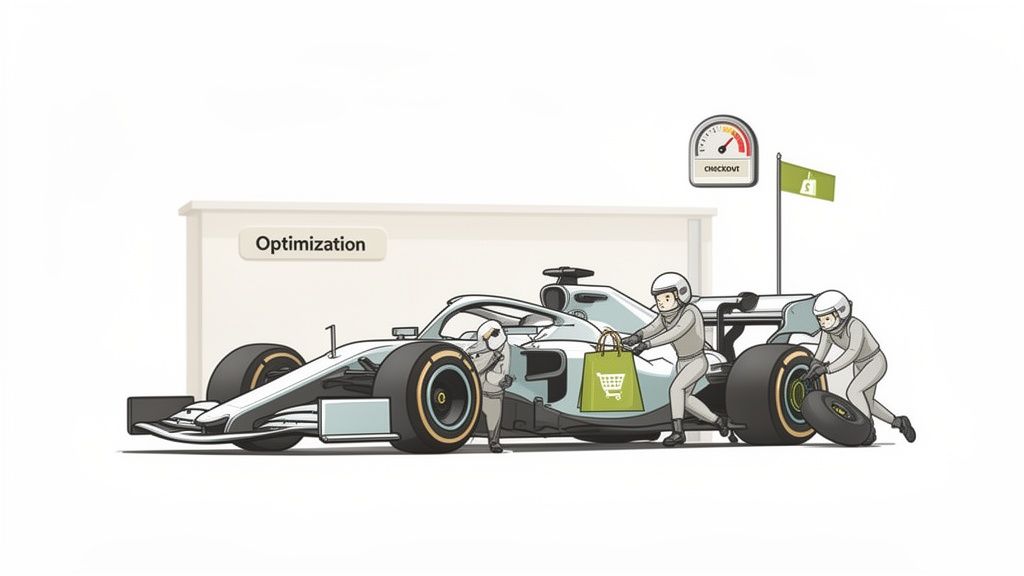
Think of your Shopify store as a Formula 1 race car. It might have a great design and a powerful engine (your products), but without a skilled pit crew, it's never going to win a race. That crew is there to fine-tune every single component—from the engine to the aerodynamics—for maximum performance. Shopify optimization services are that expert pit crew for your business.
This isn't a one-and-done fix. It's a continuous process of analysis and improvement, looking at every single step a customer takes, from the second they land on your homepage to the moment they see the final "thank you" message.
More Than Just a Tune-Up
Imagine walking into a physical retail store. If the aisles are messy and you can't find anything, you'll probably just leave. If there's a huge line at the checkout, you might dump your items and walk out. The same frustrations happen online, but they're amplified.
- Slow-loading pages are the digital version of a massive queue. A delay of just one second can cause shoppers to bounce.
- Confusing navigation is like a giant store with no signs. Customers get lost, frustrated, and give up looking.
- A clunky checkout process feels like a credit card terminal that keeps declining. It creates friction at the most critical moment.
Shopify optimization services are laser-focused on solving these exact problems. It’s all about creating a fast, smooth, and intuitive path that guides customers from discovery to purchase without any bumps in the road.
By looking at the entire customer journey, optimization services transform your store from a simple product catalog into a highly efficient sales engine. The aim is to eliminate every bit of friction that stands between a visitor and a completed order.
A Holistic Approach to Growth
A common mistake is thinking optimization is only about site speed. While speed is absolutely critical, it's just one piece of a much larger puzzle. True optimization is a holistic strategy that touches every part of your store to create a unified, powerful experience through constant testing, learning, and refining.
Here’s a quick breakdown of the core pillars that make up a comprehensive optimization strategy. Each one has a distinct role, but they all work together to drive growth.
Key Areas of Shopify Optimization
Ultimately, investing in professional Shopify optimization services is an investment in your store's future. You're building a more resilient business that doesn't just attract customers but actually delights them, giving them every reason to come back. This proactive work lays the foundation for long-term profitability and a brand that people trust.
The Core Components of Professional Shopify Optimization
To really get what professional Shopify optimization services bring to the table, you have to look under the hood. These services are built from several crucial parts, each one aimed at a different piece of the customer's journey. When they all work together, the result is a smooth, high-converting experience that grows your revenue and builds a loyal following.
Think of it this way: a successful store is like a finely-tuned race car. You need a powerful engine (development), responsive steering (UX), a stunning design (UI), and a lightweight frame (performance) to win. If you neglect any one of these, you’re not going to finish first. A great Shopify store depends on all its core components firing in perfect harmony.
Conversion Rate Optimization
At its core, Conversion Rate Optimization (CRO) is the art and science of getting more of your visitors to actually buy something. This isn't about throwing spaghetti at the wall to see what sticks; it's a disciplined process using data, psychology, and structured testing to find and fix the friction points that are costing you sales.
A CRO agency will dig into user behavior to figure out why people are leaving your store without making a purchase. They’ll use tools like heatmaps to see where users are clicking and session recordings to watch entire customer journeys, step by step.
Common CRO activities include:
- A/B Testing: Creating two versions of a page—maybe with different headlines or button colors—and running them against each other to see which one performs better.
- Checkout Flow Refinement: Making it as simple as possible to complete a purchase by cutting out unnecessary fields and distractions.
- Call-to-Action (CTA) Improvement: Testing the text, placement, and design of your buttons to get more people to click "Add to Cart" or "Buy Now."
This methodical approach means every change is backed by real data, leading to clear, measurable increases in your sales.
User Experience And User Interface Design
While people often say "UX/UI" like it's one thing, they are two distinct disciplines that are both absolutely critical for your store.
- User Experience (UX) Design is about the overall feeling a customer gets when they use your site. It’s the logic behind the layout. Good UX is all about making the journey intuitive and effortless. It answers the question: "Can a visitor find what they're looking for without getting frustrated?"
- User Interface (UI) Design is the visual part of that experience. It covers every visual element a user sees and interacts with—the buttons, the menus, the fonts, and the color palette. Good UI makes the site look fantastic and clearly communicates your brand’s personality.
A professional optimization service makes sure your store’s design is not just pretty, but also incredibly functional. The design should guide users smoothly from the homepage to a product page and straight through checkout, creating a positive experience that makes them want to come back.
Shopify Development And Performance Optimization
The technical health of your store is its backbone. This is where Shopify development and performance optimization come into play. A fast, bug-free site isn't a "nice-to-have" anymore—it's a must-have.
Consider that the average Shopify store's conversion rate hovers between 1.4% and 3.2%. The brands that consistently beat these numbers are obsessed with technical excellence. For example, the brand Sunday Citizen worked with experts to improve their image performance and simplify their site layout. The results were impressive: a 25% boost in Largest Contentful Paint (LCP), a key Google speed metric, a 61% improvement in Cumulative Layout Shift (CLS) to stop those annoying page jumps, and a 6% lift in their overall conversion rate.
Performance optimization involves a checklist of technical tasks:
- Compressing images so they load fast without looking blurry.
- Cleaning up and minimizing code (CSS and JavaScript).
- Optimizing how apps load so they don't drag down your site speed.
Beyond speed, you need people to actually find your store. This is where effective Shopify SEO services become vital, focusing on getting your store to rank higher in search engines and attract the right kind of traffic. You can also learn more about how speed directly impacts sales in our guide on Shopify page speed optimization.
App And AI Integration
The Shopify App Store has thousands of tools, but adding more apps doesn't automatically lead to better results. In fact, poorly chosen or badly configured apps are one of the main reasons for slow sites and a clunky user experience.
Professional Shopify optimization services are strategic about app integration. The goal isn't to add more apps; it's to select only the tools that deliver real value without hurting performance.
This means auditing the apps you already have and getting rid of anything redundant or inefficient. It also means finding smart ways to use modern tools, including Artificial Intelligence (AI), for things like:
- Personalized Product Recommendations: Showing customers the exact items they’re most likely to buy based on their browsing history.
- Automated Customer Service: Using AI chatbots to provide instant answers to common questions, 24/7.
- Dynamic Pricing: Automatically adjusting prices based on demand or specific customer groups.
By carefully curating your tech stack, you build a store that's both powerful and lightning-fast, giving you advanced features without sacrificing the core experience for your customers.
Measuring Success with the Right KPIs
So, you’ve invested in Shopify optimization services. How do you actually know if it's money well spent? The proof is in the data—specifically, the right Key Performance Indicators (KPIs). It’s time to look past surface-level numbers like website traffic and dig into the metrics that show how optimization is truly affecting your bottom line.
The entire point is to draw a straight line from every change we make on your store to a real, tangible business result. By zeroing in on the right KPIs, you get a clear before-and-after snapshot that proves the value of the work and helps steer the ship for what comes next. It’s about ditching the guesswork and making decisions backed by cold, hard data.
Primary KPIs That Drive Revenue
The metrics that matter most are the ones tied directly to your revenue. These are the numbers that get the C-suite and your marketing team to sit up and take notice because they’re a direct reflection of your store's financial health. Any optimization strategy worth its salt should be laser-focused on moving these needles.
Here are the big three:
- Conversion Rate (CR): This is the percentage of visitors who actually make a purchase. It's the ultimate report card on how well your store persuades browsers to become buyers.
- Average Order Value (AOV): This one’s simple: how much does the average customer spend in a single transaction? Pushing this number up means you're making more money from the same number of customers.
- Customer Lifetime Value (CLV): This KPI is a bit more forward-looking, predicting how much revenue a single customer will bring in over their entire relationship with your brand. A high CLV is a sure sign of killer customer loyalty.
And when you're running paid ads as part of your growth strategy, metrics like Return on Ad Spend (ROAS) become absolutely essential for measuring profitability.
This flowchart breaks down how all the pieces connect, flowing from technical tweaks to concrete business growth.
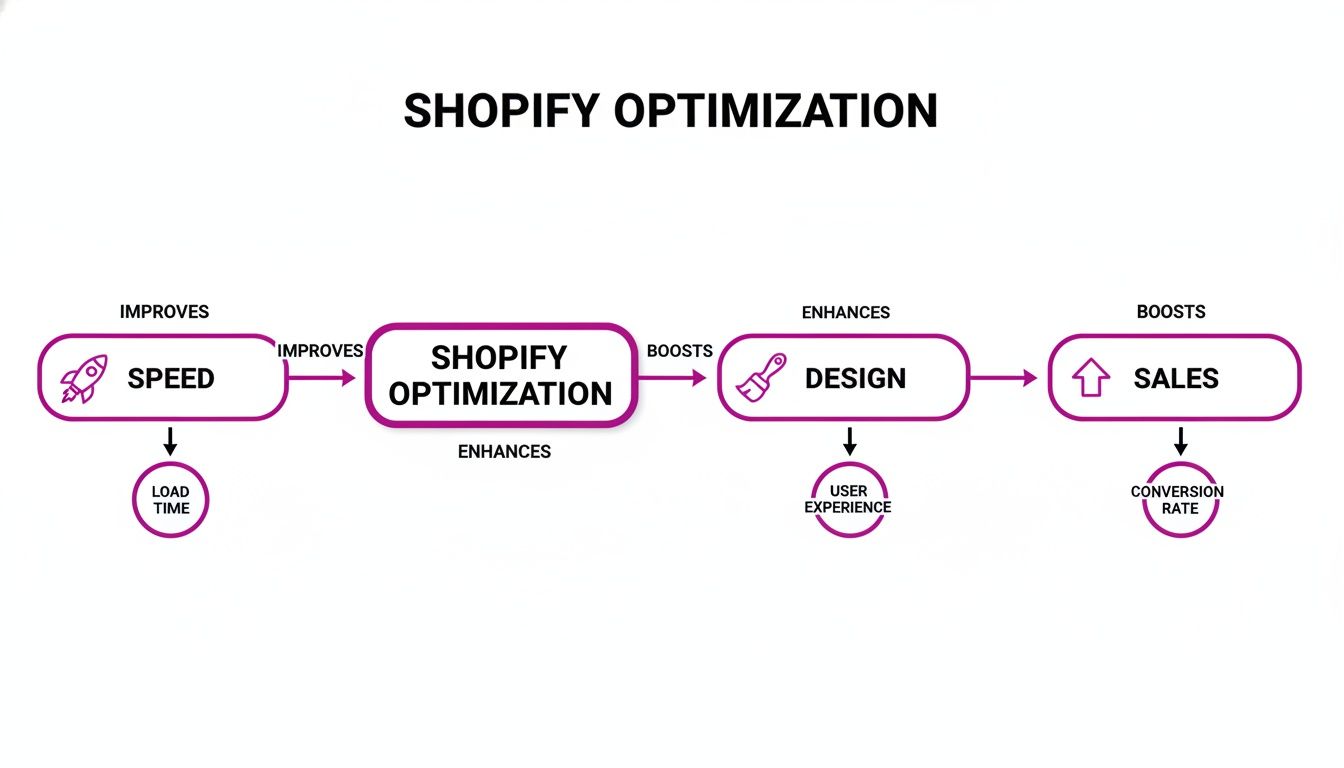
As you can see, it's not magic. Smart improvements to site speed and user experience are what directly fuel higher sales and stronger business metrics across the board.
Secondary KPIs That Reveal Why
If primary KPIs tell you what is happening, secondary KPIs tell you why. These are the diagnostic metrics that give you the context behind your main numbers. For example, if your bounce rate suddenly drops, it’s a strong signal that those site speed improvements are working and keeping people around longer.
Think of secondary KPIs as the diagnostic tools in your eCommerce toolbox. They don't always scream "revenue," but they shine a spotlight on the friction points and hidden opportunities in your customer's journey.
A good optimization partner lives in this data. They use these secondary metrics to figure out what's broken and where to focus their energy for the biggest wins.
A few key secondary metrics we always watch are:
- Bounce Rate: The percentage of people who land on a page and leave without clicking anything else. High bounce rates can scream "slow-loading page!" or "this isn't what I was looking for."
- Session Duration: The average length of time visitors stick around on your site. Longer sessions usually mean higher engagement and a stronger intent to buy.
- Add to Cart Rate: What percentage of visitors add an item to their cart? This is a great indicator of how appealing your products are and if your merchandising is hitting the mark.
- Checkout Abandonment Rate: The percentage of shoppers who start the checkout process but bail before paying. A focused checkout optimization project can often slash this rate by a massive 20-35%.
Of course, this is just scratching the surface. You can take a much deeper dive into a full list of important eCommerce website performance metrics to get the complete picture.
In the cutthroat world of eCommerce—where the global average conversion rate hovers around a meager 1.65%—data is what separates the winners from everyone else. For instance, a store that sees a big drop-off at the "add to cart" step could test an exit-intent popup with a small discount, often converting 20-30% of those would-be-lost visitors into customers. That's the power of data in action.
How Shopify Optimization Services Are Priced
Thinking about hiring a professional to optimize your Shopify store is a huge step. But before you jump in, it’s smart to get a handle on how agencies actually price their services. The price tag isn't just some random number; it’s a reflection of the team's experience, what they’ll be doing for you, and the kind of relationship you're building.
Getting clear on pricing helps you set a realistic budget and have much better conversations with potential partners.
Most agencies you’ll talk to will offer one of two pricing structures: a monthly retainer or a one-time project fee. Each one is built for different situations, and the best fit for you really boils down to where your store is at today and where you want it to be tomorrow.
The Monthly Retainer Model
The monthly retainer is the go-to model for brands that are serious about consistent, long-term growth. You can think of it as having a dedicated optimization team in your corner, without the hassle and cost of hiring full-time staff. You pay a set fee every month for a block of hours and ongoing expert support.
This setup is ideal for any brand that gets that optimization isn’t a one-and-done deal. Customer habits change, your competitors are always making moves, and new tools and tech pop up all the time. A retainer makes sure your store is constantly adapting and improving.
Here’s what a typical retainer might cover:
- Ongoing A/B Testing: Constantly running tests on things like your headlines, product page layouts, and special offers to see what really makes your customers click "buy."
- Performance Monitoring: Keeping a close watch on your site speed and overall technical health, jumping on any issues before they can hurt your sales.
- Strategic Planning: Regular check-in meetings to go over the results, dig into the data, and map out the next batch of improvements based on your goals.
This model builds a real partnership. The agency gets to know your brand inside and out, allowing them to make small, smart changes that add up to big results over time. It's the right choice for stores ready to get proactive about growth instead of just putting out fires.
The Single Project Model
On the flip side, a single-project fee is all about tackling a specific, clearly defined goal. The process is simple: you have a problem to solve, the agency gives you a fixed price to solve it, and the project is wrapped up once the work is done.
Maybe you need a complete theme overhaul, or you want to redesign your checkout from the ground up to cut down on abandoned carts. A single project is perfect for that kind of focused effort. It’s a surgical strike to fix a known issue.
The single project model gives you predictability. You know exactly what you’re paying and exactly what you’ll get in return. This makes it a great way to try out a new agency or tackle a big, one-off problem without blowing your budget.
The catch is that the scope is locked in. If new ideas or problems pop up midway through, you'll likely need a new quote or a change order to address them. This model is less about the journey of continuous improvement and more about reaching a specific destination.
Here’s a quick breakdown to help you see which model makes the most sense for your store.
Comparing Shopify Optimization Pricing Models
In the end, choosing between a retainer and a project really comes down to what you're trying to achieve. Are you looking for a long-term partner to help you grow month after month? Or do you have a specific, urgent problem that needs an expert solution right now? Answering that question is your first step toward making a great investment in your store's future.
How to Choose the Right Shopify Optimization Partner
Choosing an agency for your Shopify optimization services is just as critical as the optimization work itself. Think of it this way: the right partner is an extension of your own team, a dedicated force for growth that delivers a clear return on your investment. The wrong one? It's a fast track to a wasted budget, missed opportunities, and a whole lot of frustration.
This isn't a decision to take lightly. You're looking for a partner with proven skills, a transparent way of working, and a genuine stake in seeing your business win. It means looking past the flashy sales pitches and really digging into the substance of what an agency can do for you.
Your Vetting Checklist
To make a choice you can feel good about, you need a solid framework for evaluating potential partners. Don't just settle for an agency that claims they get results; find one that can prove it. A solid partner will have no problem opening up their portfolio and showing you a history of happy clients.
Start by building a checklist of your non-negotiables. This will help you compare different agencies on a level playing field.
Here’s what you absolutely need to look for:
- A Proven Track Record: Ask for case studies, especially ones from your own industry. You want to see real numbers—specific examples of how they boosted key metrics like conversion rates or average order value for businesses like yours.
- Deep Shopify Expertise: The agency should live and breathe Shopify. They need to understand the platform inside and out, from theme architecture and app performance to the specific nuances of Shopify Plus.
- Clear Communication and Reporting: How will they keep you in the loop? A great partner will set up a regular communication schedule and provide reports that are easy to understand, directly linking their efforts to your KPIs.
- Cultural Fit: This is so often overlooked, but it's crucial. You're going to be working closely with these people. You need a partner who communicates well, "gets" your brand, and feels like a true collaborator, not just a vendor.
Questions to Ask Potential Agencies
Once you have a shortlist, the discovery call is your moment to separate the real experts from the pretenders. This is where you get to probe deeper and see if their talk matches their walk. Come prepared with specific questions that demand more than a simple "yes" or "no."
A great agency won't just answer your questions; they'll ask you thoughtful questions in return. They should be just as interested in whether you're a good fit for them as you are for them.
Here are a few powerful questions to get the ball rolling:
- "Can you walk me through a case study for a store similar to ours? What was the initial problem, what was your process, and what were the specific results?" This tests their ability to show you the proof.
- "How do you prioritize optimization tasks? What’s your methodology for deciding what to work on first?" This gives you a window into their strategic thinking.
- "What does your reporting look like, and how often will we receive updates?" This sets clear expectations around transparency from the start.
- "Who would be our day-to-day point of contact, and what is their experience with Shopify?" This helps you understand who you’ll actually be working with, not just the sales team.
Red Flags to Watch Out For
Knowing what to look for is only half the battle; you also need to know what to avoid. Some agencies are all about making big promises they can't possibly keep.
Be wary of any provider that guarantees specific results, like "we'll double your conversion rate in 30 days." Real optimization is an iterative process of testing and learning—outcomes simply can't be guaranteed with that kind of certainty. You should also be cautious of agencies that are vague about their process or pricing. A partner you can trust will be an open book from day one.
What to Expect from the Optimization Process
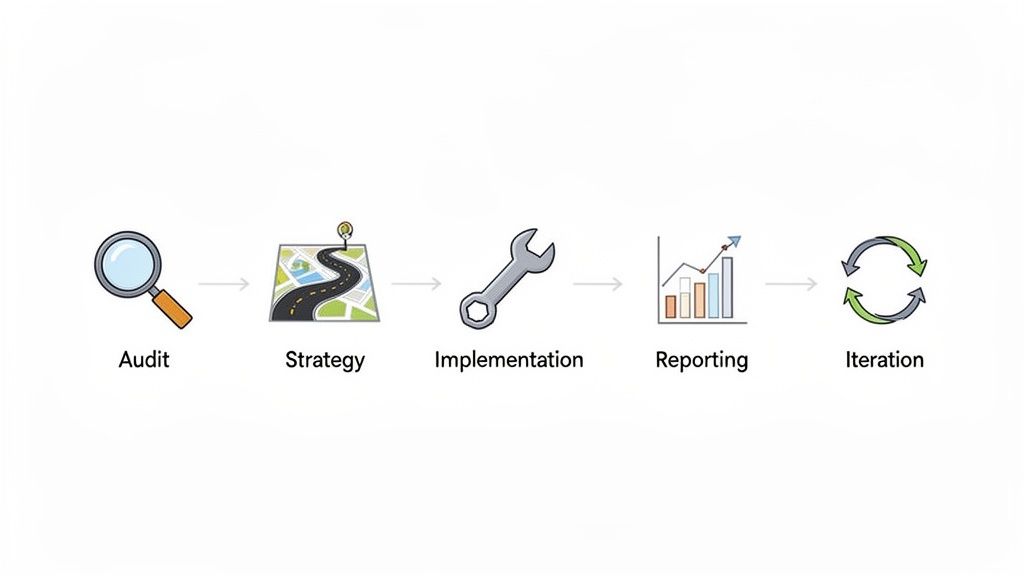
So you've picked an agency. Now the real work begins. It's important to know that partnering with a provider of Shopify optimization services isn't a "set it and forget it" deal—it's a collaboration. Knowing what the process looks like from the inside helps set the right expectations for timelines, communication, and your own involvement.
Think of it as a structured cycle of discovery, action, and learning, all designed to get you real, measurable results. Each step feeds into the next, building momentum that keeps your Shopify store getting better and better. Let's walk through what a typical engagement really looks like.
Stage 1: Discovery and Audit
First things first, your new partner needs to get under the hood of your store. They’ll act like a detective, digging into every nook and cranny to get a clear picture of where things stand today. This is far more than a quick look; it's a deep-dive technical and user experience audit.
The agency will need access to your analytics platforms, like Google Analytics 4, to see how users are actually behaving, where your traffic is coming from, and where they drop off. They’ll also use specialized tools to benchmark your site speed, hunt down code bloat, and find any technical SEO issues that are holding you back. Your main job here is to grant access and share insights about your business goals and what you’ve tried in the past.
Stage 2: Strategy and Roadmap
Once the audit is done, the agency translates all that raw data into a concrete plan of attack. They’ll put together a prioritized list of optimization opportunities, creating a strategic roadmap that spells out exactly what they'll do, why it's a priority, and the results they expect.
A great roadmap isn't just a to-do list; it's a strategic document that aligns the agency's work with your most important business objectives. It prioritizes low-effort, high-impact tasks first to secure quick wins while laying the groundwork for more complex projects.
This is where your collaboration is crucial. You’ll review the plan together, give your feedback, and sign off on the direction before any major work kicks off. This ensures everyone is on the same page and working toward the same goals.
Stage 3: Implementation and Testing
This is where the plan springs to life. The agency's team—developers, designers, and CRO specialists—rolls up their sleeves and gets to work. This might mean anything from compressing images and refactoring code to redesigning product page layouts and setting up A/B tests.
For instance, if the audit revealed a high cart abandonment rate, they might test a simplified one-page checkout against your current multi-step process. All changes are handled with care, usually on a separate development site first, so there’s no disruption to your live store.
Stage 4: Reporting and Analysis
As tests wrap up and changes go live, the focus swings back to the data. The agency will be closely tracking how their work is performing against the KPIs you agreed on at the start. This is the moment of truth where you see the tangible return on your investment.
You should expect regular, easy-to-understand reports that show you:
- Clear changes in your conversion rate, average order value, and other key metrics.
- The results from any A/B tests, explaining which version won and what the team learned.
- Improvements in technical metrics like site speed, bounce rate, and Core Web Vitals.
Stage 5: Iteration and Refinement
Finally, the process comes full circle. The insights from the reporting phase fuel the next round of improvements. Real optimization is never a one-and-done project; it’s a continuous loop of testing, learning, and refining.
What you learn from one A/B test will spark the idea for the next one. Performance data might shine a light on a new opportunity that wasn't obvious before. This iterative approach is what ensures your Shopify store is always evolving—getting faster, smarter, and more profitable over time.
Common Questions About Shopify Optimization Services
Even after seeing the potential, pulling the trigger on Shopify optimization services can feel like a leap of faith. It’s completely normal to have questions swirling around about the process, how long it all takes, and whether you could just handle it yourself. We get it. Let’s tackle some of those common questions head-on to give you the clarity you need.
A lot of merchants get stuck on whether to hire a professional or go the DIY route. It's a fair question, and the right answer really boils down to your specific goals, your budget, and how comfortable you are getting your hands dirty with the technical side of things.
Can I Do Shopify Optimization Myself?
Yes, you can definitely handle some optimization tasks on your own. Shopify gives you built-in analytics, and the App Store is packed with tools for SEO, page speed, and other quick fixes. If you're just starting out, simple things like compressing your images or sprucing up product descriptions are fantastic first steps.
But where professional services really shine is in the depth of expertise and sheer efficiency they bring to the table. An agency has seen what works—and what bombs—across hundreds of stores. They have access to specialized software for deep-dive analysis and A/B testing that simply isn’t cost-effective for one business to own. For brands that are serious about scaling, bringing in an expert partner is a massive advantage.
How Long Does It Take to See Results?
This is always the first question, and the honest answer is: it depends. The timeline for seeing a real impact is tied directly to what kind of optimization we’re talking about.
- Quick Wins: Technical fixes, like cleaning up code to improve site speed, can show results within weeks. Just a one-second improvement in load time can lift conversions by a reported 7%, so these tweaks often provide a fast and very measurable boost.
- Strategic Gains: Bigger-picture strategies, such as A/B testing different page layouts or completely rethinking the customer journey, need a bit more time to bake. You can generally expect to see the first wave of meaningful improvements within the first 60-90 days of a comprehensive partnership.
Real optimization isn’t a one-and-done sprint; it’s a marathon. The results start to compound as your agency gathers more data, runs more tests, and continually refines your store. Those initial wins are just the starting line.
Is Optimization a One-Time Project or Ongoing?
While a one-time project is great for a specific, isolated issue—like a full theme redesign—true, impactful optimization is always an ongoing process. The world of eCommerce never sits still. Customer expectations change, new tech emerges, and you can bet your competitors are constantly trying to get better.
A "set it and forget it" mindset is a recipe for getting left behind. Continuous optimization means your store is always adapting, testing new ideas, and staying one step ahead. That constant cycle of testing, learning, and refining is the single biggest thing that separates the top-performing brands from the rest of the pack.
Ready to stop guessing and start growing with a data-driven strategy? The team of Shopify specialists at ECORN is ready to build a custom optimization plan that drives real results for your business. Get in touch with us today to start the conversation.


How to Launch a Box Subscription Business in 2026

Luxury Skincare Branding Playbook That Converters
10 Best Podcast Ecommerce Shows for Store Growth in 2026
Shopify Developer Hourly Rate: What to Pay in 2026
Critical Shopify Setup Errors That Are Secretly Sabotaging Your Store
Ecommerce Conversion Tracking: The Complete How-To Guide
Shopify Design Agency: How to Pick the Right Partner
Mastering Multi Store Management on Shopify
Scale Shopify Store
10 Shopify App Ideas Worth Building in 2026
Conversion Rate Optimization for Landing Pages: The Playbook
Shopify Plus Automation: A Guide for 2026
10 Social Selling Platforms for Shopify Merchants

Shopify Website Design Examples: 7 Stores Worth Studying
7 Ecommerce Newsletter Examples for Shopify Brands
One Product Shopify Store: Build and Scale
Mobile Pop Up Strategy for Shopify Stores That Converts
Sitemap for Shopify: How to Find, Optimize, and Submit It
7 Single Product Websites Worth Emulating
Product Variants Shopify: The Complete 2026 Guide
Ecommerce Analytics Consulting for Growth
What Is AI Integration for eCommerce
How to Choose the Right eCommerce Website Development Firm
E Business Strategy Implementation
Conversion Tracking Setup for Shopify Stores
BigCommerce vs Shopify Plus Which Enterprise Wins in 2026
Shopify Theme Kit: Setup, Commands, and Migration Guide
Shopify Extension Development: A Practical 2026 Guide
Shopify Speed Score Explained and How to Improve It
Shopify Mobile Optimization: The 2026 Playbook
How to Add Subcategory in Shopify for Better UX
How to Implement Structured Data for Ecommerce in 2026
SEO App Mobile: Shopify Store Optimization Guide
Shopify Plus Support: What It Includes and How to Choose
Google Ads for Shopify: The Complete 2026 Playbook
Shopify New York: How to Find and Hire the Right Agency
Google Search Console for Shopify: The Complete Setup
First Party Data Collection for eCommerce Growth
FAQ Online Store Guide: Build and Measure It Right
Do FB Ads Work for eCommerce in 2026?
One Page Checkout for Shopify: Design and Implementation
Shopify GraphQL vs REST: The 2026 Developer Decision
Shopify Ecommerce Consulting: Strategy, Pricing &
Are Reddit Ads Worth It for eCommerce Brands
Shopify Title and Meta Description: A Practical 2026 Guide
Product Video Best Practices for Shopify Brands
Real-Time Inventory Management: A 2026 Guide
AI Chatbot Integration for Shopify Stores
Affiliate Program Management: A Shopify Guide
10 Best Performance Monitoring Tools for Shopify in 2026
Digital Asset Management for eCommerce Brands in 2026
Every Type of Facebook Ads Explained for eCommerce Growth
Product Information Management Explained for Shopify Brands
Support Ticket System: A Guide for Shopify Stores

10 Best Customer Service Tools for Shopify in 2026

Can I Start a Business with No Money? a 2026 Blueprint

What Sells Good on Etsy: Best Niches for 2026

Shopify Add to Cart Button: A Practical 2026 Guide

Customer Feedback Automation: A Practical eCommerce Guide
Critical Rendering Path: A Guide for Shopify Stores

How to Promote on TikTok for eCommerce in 2026

B2B eCommerce Consulting That Drives Real Revenue
10 Best Practices for Site Navigation in 2026
Return vs Refund for Shopify Stores: A Practical Guide
What Is Customer Lifetime Value and Why It Matters
What Is Voice of Customer Research for eCommerce

SMS Marketing for Ecommerce That Actually Converts

Master How to Improve Email Deliverability in 2026

Top 8 eCommerce Partners NYC for Shopify Brands in 2026
Machine Learning for Ecommerce: Boost Your Shopify Store

Beauty Market Research: Your 2026 Growth Guide
Shopify International Expansion: A 2026 Roadmap
What Does CRO Stand for in Business: Understanding CRO

Shopify Visual Merchandising: A Playbook for Higher Sales

Shopify Landing Page Design: Master Conversion in 2026
10 Best AI SEO Optimization Tools for Shopify in 2026

Agentic AI for Ecommerce: Boost Your Sales in 2026
Mastering Email Marketing Data for eCommerce Growth
Conversion Rate Optimisation Australia: Boost Your Sales
Conversion Rate Optimization AI: Your Shopify Store Guide

10 Product Bundling Strategies for Shopify in 2026
How to Increase Customer Lifetime Value: A Shopify Playbook
AI Customer Service Automation: Shopify Guide 2026
Clean Website Design: A Shopify Conversion Playbook

Omnichannel Retail Strategy: A Shopify Playbook
Product Data Enrichment: A Guide for Shopify Brands
Instagram Shopping Features a Guide for Shopify Stores
What Is Revenue Optimization: A Holistic RevOps Guide
Benefits of Conversion Rate Optimization: Boost Your
WordPress to Shopify Migration: Your 2026 Seamless Switch
Boost Sales: Ecommerce Payment Processing Guide 2026
Unified Commerce Platform: Benefits, KPIs & Shopify Guide
How to Reduce Bounce Rate eCommerce: Your 2026 Guide
Shopify API Integration: A Practical End-to-End Guide

How to Implement Data Governance: A 2026 Guide
Shopify Store Development Cost: A 2026 Breakdown
What Is Server Side Tracking: The Shopify Guide 2026
Marketing Automation Workflows: A Shopify Guide for 2026
Shopify: How to Reduce Technical Debt

Shopify UX Design Change: A Playbook for Growth


newsletter in your inbox