

If you're a Shopify merchant, you already know that Black Friday isn't just another sales event—it's the main event. And when it comes to driving sales during the BFCM frenzy, Meta's ad platform is, without a doubt, the most important channel in your arsenal. It consistently dominates ad spend and, more importantly, customer attention.
But let's be real. Success on Facebook during BFCM requires a lot more than just boosting a few posts and hoping for the best. It's a high-stakes game.
Why Facebook Ads Are Crucial for BFCM Success
Black Friday Cyber Monday is the ultimate stress test for any Shopify store, and your ad strategy is what determines whether you thrive or just survive. The reason Meta remains the top dog for eCommerce brands is simple: it’s where your customers are, ready to spend.
The platform's incredible reach and targeting capabilities are a massive advantage, but they also create an intensely competitive environment. Costs skyrocket, and only the smartest, most prepared advertisers come out on top. The first step to building a winning campaign isn't brainstorming creatives—it's looking at last year's data to understand the reality of the BFCM ad auction.
The Competitive BFCM Landscape
The numbers from last year tell a compelling story. During the 2025 BFCM period, Meta ads were the undisputed king, capturing a staggering 67.81% of all ad spend across the major platforms. That massive scale also delivered results, with an impressive average click-through rate (CTR) of 1.79%, a figure that jumped +13.29% from the previous year and left other channels in the dust. You can dig into the full BFCM ad performance dataset over at Triple Whale.
To give you a clearer picture, here’s a quick snapshot of the key performance indicators for Facebook ads during last year’s sale. This data highlights exactly why it's a channel you can't afford to get wrong.
BFCM 2025 Facebook Ads Performance Snapshot
| Metric | Value | Year-over-Year Change |
|---|---|---|
| Ad Spend Share | 67.81% | - |
| Click-Through Rate (CTR) | 1.79% | +13.29% |
| Average Order Value (AOV) | $100.17 | +0.16% |
| Cost Per Acquisition (CPA) | $31.38 | +6.70% |
| Cost Per Mille (CPM) | $20.33 | +17.79% |
These figures prove that Meta is still the place to be for driving high-value traffic, but they also reveal the challenges ahead for 2026.
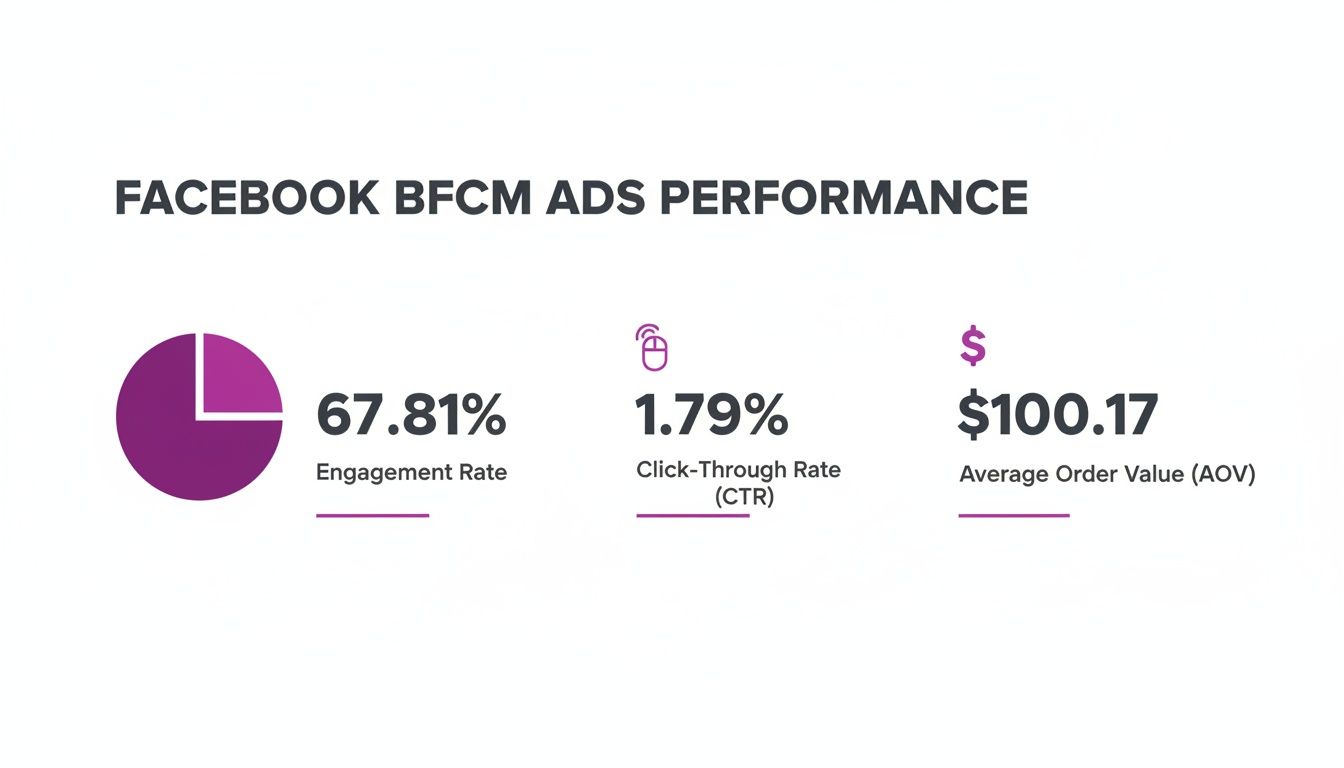
The numbers confirm Meta’s dominance in driving high-value traffic, with an average order value (AOV) of $100.17, the highest among all major platforms.
Key Takeaway: While Meta delivers unmatched reach and engagement for BFCM, the rising costs mean efficiency is everything. A high AOV is great, but you have to pair it with razor-sharp conversion rate optimization to protect your return on ad spend.
Now for the flip side. That intense competition drove the cost per acquisition (CPA) up to $31.38 and the cost per mille (CPM) to $20.33. Those are significant increases of +6.70% and +17.79%, respectively.
For growing Shopify stores, these rising costs mean you can't just throw money at the platform. You absolutely need a bulletproof strategy built on killer creatives, laser-focused audience targeting, and a frictionless on-site experience to stay profitable.
Laying the Groundwork: Your Pre-Sale Campaign Foundation

A killer Black Friday campaign isn't something you throw together at the last minute. The brands that truly crush it are the ones that meticulously lay the groundwork weeks, or even a month, before the sale frenzy even starts. This pre-launch phase is your golden opportunity to warm up your audiences, dial in your messaging, and make sure all your tech is running smoothly.
Your first move with Facebook Black Friday ads is to decide on your North Star. Are you trying to squeeze every last drop of profit from your loyal customers? Or is the goal to acquire as many new customers as you can, even if it means a lower return upfront? This single decision shapes your entire playbook, from who you target to what you offer.
Prime Your Audiences Before the Main Event
If you wait until Black Friday week to start running ads, you're setting yourself up for failure. The ad auction gets ridiculously crowded and expensive. You need to get in front of potential customers 3-4 weeks before the big weekend.
This "warm-up" period is all about two things:
- Building Your Retargeting Pools: Run campaigns focused on value, not direct sales. Think blog posts, how-to videos, or fun user-generated content (UGC) aimed at cold audiences. The goal here is cheap clicks and video views to build a massive pool of engaged people you can hit with offers later.
- Creating Buzz with a VIP List: This is a classic for a reason. Promote an "Early Access" or "VIP" list where people can sign up via email or SMS to get your Black Friday deals a day or two early. It builds urgency and hands you a ready-made list of highly motivated shoppers to target.
For instance, a skincare brand could run a video ad in early November showing a quick tutorial for a "holiday glow." Anyone who watches 50% or more of that video gets dropped into a custom audience. They're now primed and ready for a Black Friday offer on those very products. That's infinitely more powerful than ambushing a cold user with a "50% OFF!" ad out of the blue.
Segment Your Lists for Hyper-Personalized Ads
A one-size-fits-all ad strategy is a death sentence during BFCM. Your most valuable weapon is your own customer data, and you have to slice and dice it to create ads that feel personal and relevant.
Break down your customer and email lists into meaningful segments. A simple Recency, Frequency, and Monetary (RFM) analysis works wonders:
- Champions (High RFM): These are your ride-or-dies. Target them with loyalty rewards, exclusive bundles, or the very first look at the sale.
- Recent Customers (High R, Low F): They just bought from you. Welcome them back with a special offer to turn them into repeat buyers.
- High Spenders (High M, Low F/R): These customers have dropped serious cash but haven't been back in a while. Win them back with a really compelling discount or an offer tied to their past big-ticket purchases.
When you tailor your ad copy and offers this way, you're showing customers you actually know who they are. This personal touch will do more for your conversion rates—and long-term loyalty—than any generic ad ever could.
Pro Tip: Don't just rely on your email list. Use your Shopify customer data to create custom audiences directly in Meta Ads Manager. This ensures you're reaching your best customers with personalized messaging, even the ones who never open your marketing emails.
Conduct a Full Technical Audit
Finally, none of this matters if your tracking is broken. Before you spend a dime on your main BFCM campaigns, you have to be 100% certain your technical setup is perfect. A broken pixel or wonky server-side tracking means you're flying blind, and that's a recipe for burning cash.
Run a quick but thorough audit on these three pillars:
- Meta Pixel Health: Go into your Events Manager. Is the Pixel active? Is it correctly tracking key events like
ViewContent,AddToCart, andPurchase? Check for any deduplication errors that could be messing with your attribution. - Conversions API (CAPI): Confirm that CAPI is set up and firing server-side events. In a post-iOS 14 world, this is non-negotiable for getting accurate data and helping Meta's algorithm find you the right customers.
- UTM Parameters: Get your URL parameters standardized across all campaigns. Consistent UTM tagging is what allows you to trace every sale back to the specific campaign, ad set, and ad in tools like Google Analytics.
Nailing this foundation is the difference between guessing and knowing. It lets you track every dollar, see what’s working in real-time, and scale your winning Facebook Black Friday ads with total confidence when it counts.
Creating Ad Creatives That Actually Convert
Let's be honest, the BFCM newsfeed is a warzone. When every brand is screaming "SALE!", your ad creative is what stands between getting a scroll or getting a sale. Your Facebook Black Friday ads need to be thumb-stopping, plain and simple.
The secret? You don't need to reinvent the wheel. The smartest brands we work with take their top-performing evergreen creatives—the ads that have brought in results all year—and give them a BFCM makeover. A simple offer overlay or a punchier headline can instantly turn a proven winner into a holiday powerhouse, saving you from gambling on new concepts during the most expensive week of the year.
Choosing Your Creative Formats
Your ad creative mix needs to be diverse to grab attention wherever your customers are scrolling. For BFCM, authenticity, clarity, and speed are everything.
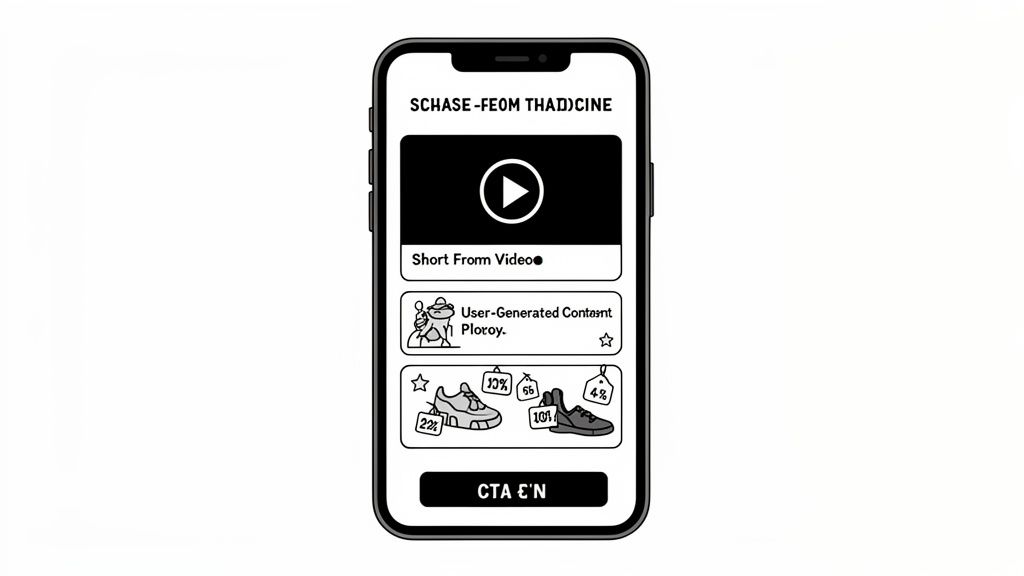
- User-Generated Content (UGC): This is your ace in the hole. Ads showing real customers with your products feel genuine and build immediate trust. A simple unboxing video or a photo of a customer loving their purchase will almost always outperform a slick studio shot during the BFCM chaos.
- Short-Form Video: Think Reels and Stories. These ads need to be fast, punchy, and deliver the offer within the first 3 seconds. Always use bold text overlays to shout out your deal, since most people watch with the sound off.
- Simple Static Images: Never underestimate the power of a clean, bold graphic. A great product photo with a can't-miss offer like "50% OFF - This Weekend Only" is incredibly effective, especially for retargeting warm audiences who already know who you are.
- Dynamic Product Ads (DPA): For your bottom-of-funnel audience, DPAs are a must. They automatically serve up the exact products people have looked at on your Shopify store. It's the perfect personalized nudge they need to finally click "buy."
This blend of formats gives you the right tool for the job at every stage of the compressed BFCM funnel, from grabbing new customers with authentic UGC to closing the deal with laser-focused DPAs.
Crafting Copy That Sells
BFCM ad copy needs to be direct, urgent, and focused on the value. Shoppers are scanning, not reading, so get straight to the point. Ditch the long brand story paragraphs and lead with the deal.
The data backs this up. Black Friday 2025 was a huge moment for social commerce, with platforms like Facebook driving 3.4% of all U.S. online sales—that's a massive 54.5% jump from the previous year. This proves that social media is no longer just a discovery tool; it's a primary revenue driver for Shopify stores. And with affiliates contributing 21.9% of Black Friday revenue, the opportunity for well-crafted ads to capture sales is bigger than ever.
Your copy should follow a simple, proven framework:
- The Hook: Lead with the offer. "Black Friday Starts Now: 40% Off Everything."
- The Benefit: Give them a quick reason why. "Get the perfect holiday gift before it's gone."
- The Call to Action: Tell them what to do. "Shop Now & Save."
My Personal Insight: Specificity creates urgency far better than hype. Instead of "Our Biggest Sale Ever!", try "Our Only 40% Off Sale of the Year." Being direct and honest builds more trust when everyone else is just making noise.
Pre-Sale Creative Testing
The absolute worst time to test new ad creatives is on Black Friday itself. You'll just be burning cash at premium CPMs to learn what you should have known weeks ago. Start testing your visuals, headlines, and ad copy 2-3 weeks before the big sale.
Set up a simple A/B test campaign with a small budget. Pit your best ideas against each other and see what gets the best click-through rate (CTR) and the lowest cost per add-to-cart.
For example, you could test:
- A raw UGC video vs. a polished product video.
- A headline focused on the discount ("40% Off Sitewide") vs. one focused on the benefit ("Your Coziest Winter Starts Here").
- A classic "Shop Now" CTA vs. a "Learn More" CTA.
By the time Black Friday week rolls around, you won't be guessing. You'll have data telling you exactly which creative combination resonates with your audience, so you can put your full budget behind a proven winner. If you need some inspiration, check out our breakdown of some of the best ads on Facebook for ideas you can adapt. A little prep work now is the key to a profitable and stress-free holiday season.
Structuring Your Campaigns and Budget for Peak Season
Even the most amazing Black Friday creative is useless without a solid campaign structure to back it up. This is the blueprint for your entire Facebook Black Friday ads operation. Forget those over-the-top, complex setups; experience has shown time and again that a simple, clear structure beats a convoluted one, especially when Meta's algorithm is working overtime during the sale.
The old-school marketing funnel—Top of Funnel (TOFU), Middle of Funnel (MOFU), and Bottom of Funnel (BOFU)—is still relevant, but we have to squeeze it for the high-speed, high-intent world of BFCM. The name of the game is guiding shoppers from "hello" to "buy now" as fast as possible, without burning through your ad spend.
Building Your BFCM Campaign Architecture
My go-to structure for BFCM is deceptively simple and revolves around Campaign Budget Optimization (CBO). This is key because it lets Meta's AI shift your budget to the best-performing ad set on the fly—an absolute must during the chaos of the sale weekend. Within a single CBO campaign, we'll only need two core ad sets.
Prospecting Ad Set (Broad TOFU): This is all about finding new customers. We target a broad audience, stripping away all interest and behavior layers. The only thing you'll do is exclude your existing customers (pulling from email/SMS lists and Pixel data). This lets Meta’s algorithm do the heavy lifting, hunting down new buyers who are most likely to jump on your offer.
Retargeting Ad Set (BOFU): Here, we're talking to your warmest audiences—people who have bought before, your email and SMS subscribers, and anyone who’s been on your site recently. This is where your highest ROAS will come from. To keep CBO from just dumping your whole budget here, set an Ad Set Spend Limit. This makes sure you're still investing in finding those crucial new customers.
This straightforward, two-ad-set approach lets you hit both new and existing customers effectively. It avoids creating too many moving parts that could bog down the algorithm's learning phase when you can least afford it.
Allocating Your Budget Across Sale Phases
Don't think of your BFCM budget as one big pot of money. It needs to be split strategically across three distinct phases. Your exact allocation will depend on your specific goals, but a balanced approach usually works best.
- Phase 1: Pre-Sale Warm-Up (Late October to mid-November): Put about 15-20% of your total budget here. The main goal is to run low-cost campaigns to grow your retargeting audiences with things like video views and landing page visits. You're also driving sign-ups for your VIP early access list.
- Phase 2: The Main Event (Black Friday Week): This is showtime. Unleash the majority of your budget—around 60-70%. Both your prospecting and retargeting campaigns go live with your main sale offers, aiming to drive maximum traffic and conversions.
- Phase 3: Cyber Monday & Extension (The final push): The last 10-20% of your budget is for grabbing those last-minute shoppers. This phase is heavy on retargeting anyone who didn't buy during the main event, hitting them with "Last Chance" or "Sale Ends Tonight" messaging.
A Personal Tip: Resist the urge to turn off your regular, non-sale campaigns during BFCM. I've seen many cases where these evergreen campaigns, already optimized and out of the learning phase, keep delivering profitable sales—sometimes even better than the flashy "SALE!" ads.
Choosing Your Bidding Strategy
For your Facebook Black Friday ads, your bidding strategy is how you'll control costs while trying to scale up. There are a few options, but two really shine during the hyper-competitive BFCM auction.
Advantage+ Shopping Campaigns (ASC): This is Meta's full-auto mode, and it can be an absolute beast for BFCM. I've found ASC works particularly well for consolidating your prospecting and retargeting into one powerful campaign. You can even set a cap on how much budget goes toward existing customers, giving you a great mix of acquisition and retention.
Cost Per Result Goal (Cost Cap): If you're the type who needs a bit more control, a Cost Cap bidding strategy is your best friend. You simply tell Meta the maximum average cost you're willing to pay for a purchase. This is perfect for keeping your cost per acquisition (CPA) from spiraling out of control when the auction gets heated, making it a great choice for brands with tighter margins.
If you are looking for a deeper dive into structuring these types of campaigns, our comprehensive guide on running a successful Facebook ad campaign for eCommerce provides more detailed examples.
Ultimately, the right structure is one that's easy for you to manage, gives Meta's algorithm clear instructions, and can withstand the pressure of the biggest shopping weekend of the year.
Optimizing Your Store and Scaling Ads in Real-Time
Getting that click is just the entry fee for Black Friday. The real money is made—or lost—the moment a shopper lands on your Shopify store. If your site isn't perfectly tuned to convert that expensive, high-intent traffic, you're essentially just burning ad budget for sport.
During the BFCM chaos, the path from ad to "thank you" page needs to be dead simple. This is where conversion rate optimization (CRO) comes in. Forget about a massive site overhaul; we're talking about small, surgical tweaks that build trust and push shoppers over the finish line.
Prepping Your Landing Pages for Conversion
Think of your product and landing pages as your digital sales floor. During Black Friday, they have one job: turn frantic deal-hunters into paying customers. Put yourself in their shoes—they’re bouncing between tabs, comparing offers, and looking for any reason to second-guess a purchase.
You need to hit them with the right signals, right away.
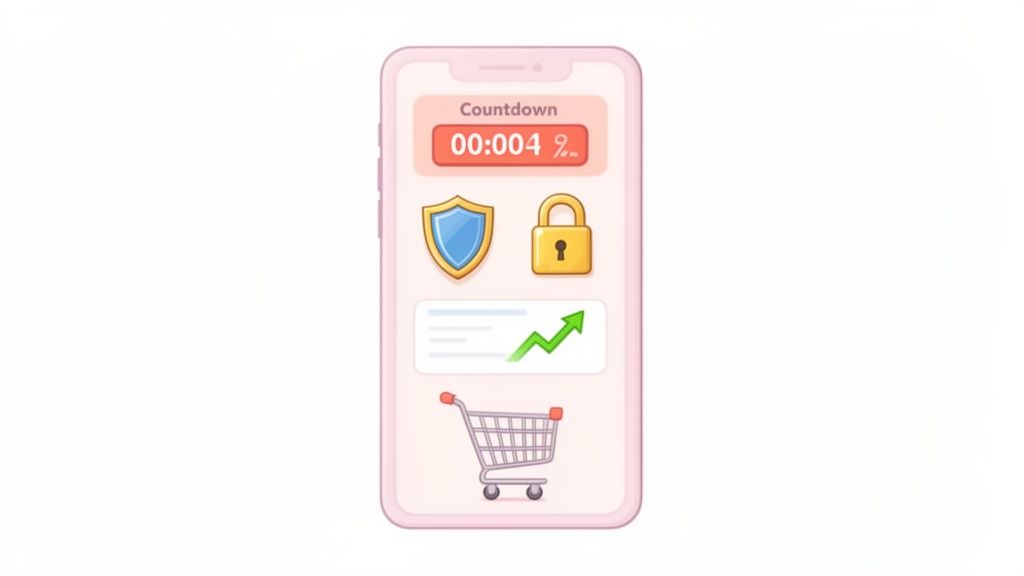
- Countdown Timers: A ticking clock is the oldest trick in the book for a reason. A bold banner screaming "Sale Ends In: 23:59:01" is brutally effective at killing hesitation.
- Trust Badges: Place those familiar Visa, Mastercard, and PayPal logos near your "Add to Cart" button. It’s a tiny visual that provides instant peace of mind.
- Clear Offer Messaging: Don't make them hunt for the deal. Use announcement bars and on-page banners to echo the exact offer they saw in the ad. Consistency is everything.
This trio of urgency, trust, and clarity is your secret weapon against on-page drop-offs.
Nailing the Mobile Checkout Experience
The vast majority of your BFCM traffic will come from a phone. A clunky, long-winded checkout on a small screen is where countless sales go to die. Every extra tap, every unnecessary form field, is another chance for them to bail.
It's time to be ruthless with your checkout flow.
- Activate Express Checkouts: Turn on Shop Pay, Apple Pay, and Google Pay. These one-click options are non-negotiable in 2026. They let customers skip the drudgery of filling out forms.
- Trim the Fat: Do you really need their phone number right now? Cut every single field that isn't absolutely essential for the transaction.
- Show the Finish Line: A simple progress bar—like "Cart > Info > Shipping > Payment"—reassures customers they’re almost done. It’s a small psychological nudge that keeps them moving forward.
I've seen brands boost their mobile conversion rate by over 15% just by adding express checkouts and gutting their forms. During BFCM, that lift can mean thousands in revenue you would have otherwise lost.
Monitoring and Scaling Your Ads Like a Pro
Once the sale kicks off, you're no longer a planner—you're a pilot. You need to be glued to Ads Manager, watching the data roll in and making quick, decisive moves. Agility is the name of the game.
Don't get bogged down in vanity metrics. Your focus should be on the numbers that actually move the needle.
- The Bottom Line: Return on Ad Spend (ROAS) or Cost Per Purchase. Is your spend actually making you money? This is your north star.
- Early Warnings: Click-Through Rate (CTR) and Cost Per Click (CPC). Are people actually clicking your ads, and is the traffic affordable?
- Mid-Funnel Check: Cost Per Add to Cart. This tells you if your ad creative is gelling with your landing page.
Set up a saved column view in Ads Manager with just these metrics so you can see what matters at a glance. Check in every couple of hours, not every five minutes. You need to give the algorithm room to breathe.
When to Scale and When to Cut
Making budget decisions on the fly is stressful, but it's much easier when you have pre-set rules.
When to Scale Up:
If an ad set is a clear winner—it has at least 5-10 purchases and is crushing your target ROAS—it's time to feed it more budget. But do it slowly. Increase the daily spend by 20-30% at a time, every 4-6 hours. Big, sudden jumps can throw the algorithm into a tailspin and reset its learning.
When to Pull the Plug:
If an ad set has spent at least 2x your target CPA and has zero purchases, it's a dud. Turn it off. Don't get sentimental; that budget has a better home with one of your winners.
As you get into the rhythm of optimizing, you'll see opportunities to layer in more advanced tactics. For example, remarketing with Facebook is an absolute must to bring back all those window shoppers who added to cart but didn't finish. Mastering this on-the-fly management is what separates a decent BFCM from a legendary one.
When the Black Friday Cyber Monday dust settles, it’s easy to breathe a sigh of relief. But the most crucial work is just getting started. All that sales data, customer feedback, and performance metrics you’ve collected are gold dust for building an even more profitable strategy next year. This is where you separate what felt like a win from what actually moved the needle.
The first thing on your to-do list should be a deep dive into your Meta Ads Manager and Shopify Analytics to pull a full performance report. Once the sale is over, it’s absolutely critical to understand the true impact of your ad spend by calculating social media ROI. This isn't just about looking at your final ROAS; it's about digging into the "why" behind both your wins and your flops.
Deconstructing Your Campaign Performance
To really get the full picture, you have to dissect your campaigns layer by layer. Don't just glance at the overall numbers. The real magic happens when you compare how different audiences, creatives, and offers performed against each other. The most valuable insights are always hiding in the details.
Start by asking yourself some pointed questions:
- Audience Winners: Which audience segment truly delivered? Was it your broad prospecting ad set, your loyal customer list, or a specific retargeting pool? You might find your "30-day website visitors" audience pulled a 5x ROAS, while your broad lookalike audience barely broke 2.5x. That tells you a story.
- Creative Resonance: What ad creative was the undisputed champion? Pit your UGC videos against those slick static offer graphics. Did a simple, unpolished "50% Off" image actually beat a high-production video? This is how you learn what visuals connect with your buyers when they're in a frenzy to find a deal.
- Offer Effectiveness: How did your "Buy One, Get One" deal stack up against a straight percentage discount? Analyzing your Average Order Value (AOV) and conversion rate for each offer will show you exactly what kind of incentive gets your customers to open their wallets wider.
A critical takeaway from this process is identifying your Cost Per Acquired Customer (CAC) for new buyers. Knowing this figure helps you budget more effectively for future growth campaigns and understand the true long-term value of your Facebook Black Friday ads.
Turning Insights into an Action Plan
Data without a plan is just a collection of numbers. The whole point of this analysis is to build a clear roadmap for your next big sale and your day-to-day marketing. Get all your findings down in a simple document.
Your action plan should lay out specific, testable ideas for the year ahead.
- For Next BFCM: "Our top-performing ad was a UGC unboxing video. Next year, we’ll produce three new UGC-style videos and test them in October so we have a proven winner locked and loaded for the sale."
- For Evergreen Campaigns: "Our ‘spend $100, get a $20 gift card’ offer seriously boosted AOV. We’re going to test a similar threshold-based offer in our evergreen campaigns in Q2."
This process turns your BFCM results from a one-time sugar rush into a strategic advantage you can use all year long.
Nurturing Your Newfound Customers
Finally, don’t neglect the treasure trove of new customers you just brought in. Let's be real—many of them were probably deal-hunters attracted by the sale. Your job now is to convince them to stick around and become loyal, full-price fans.
Build out a dedicated post-purchase email and SMS flow specifically for this BFCM cohort. Welcome them to the brand, share your story, and give them value that goes beyond just another discount code. This follow-up is absolutely essential for boosting your Customer Lifetime Value (CLV) and making sure every dollar you spent on Facebook Black Friday ads keeps paying you back long after the sale is over.
Your Top BFCM Ad Questions, Answered
Let's cut to the chase. Here are the quick-fire answers to the questions we get asked most often about running Facebook ads for Black Friday.
How Early Should I Really Start My Ads?
You should be warming up your cold audiences and testing creatives at least 3-4 weeks before Black Friday hits. Don't wait until the week of.
Your official "early access" or VIP pre-sale campaigns should launch about one week before the main event. This strategy is all about building a massive, warmed-up retargeting audience and getting that crucial early buzz going before the chaos truly begins.
What's a Good ROAS for BFCM?
This is the million-dollar question, and the honest answer is: it varies. A "good" Return on Ad Spend (ROAS) during the BFCM storm usually falls somewhere between 3x and 5x.
But here's a pro-tip: don't get tunnel vision on ROAS. Costs skyrocket during this period due to insane competition. It's often smarter to shift your focus to your net profit and the value of acquiring a new customer. A slightly lower ROAS can still be a massive win if you're bringing in a flood of new, profitable customers.


7 Ecommerce Newsletter Examples for Shopify Brands
One Product Shopify Store: Build and Scale
Mobile Pop Up Strategy for Shopify Stores That Converts
Sitemap for Shopify: How to Find, Optimize, and Submit It
7 Single Product Websites Worth Emulating
Product Variants Shopify: The Complete 2026 Guide
Ecommerce Analytics Consulting for Growth
What Is AI Integration for eCommerce
How to Choose the Right eCommerce Website Development Firm
E Business Strategy Implementation
Conversion Tracking Setup for Shopify Stores
BigCommerce vs Shopify Plus Which Enterprise Wins in 2026
Shopify Theme Kit: Setup, Commands, and Migration Guide
Shopify Extension Development: A Practical 2026 Guide
Shopify Speed Score Explained and How to Improve It
Shopify Mobile Optimization: The 2026 Playbook
How to Add Subcategory in Shopify for Better UX
How to Implement Structured Data for Ecommerce in 2026
SEO App Mobile: Shopify Store Optimization Guide
Shopify Plus Support: What It Includes and How to Choose
Google Ads for Shopify: The Complete 2026 Playbook
Shopify New York: How to Find and Hire the Right Agency
Google Search Console for Shopify: The Complete Setup
First Party Data Collection for eCommerce Growth
FAQ Online Store Guide: Build and Measure It Right
Do FB Ads Work for eCommerce in 2026?
One Page Checkout for Shopify: Design and Implementation
Shopify GraphQL vs REST: The 2026 Developer Decision
Shopify Ecommerce Consulting: Strategy, Pricing &
Are Reddit Ads Worth It for eCommerce Brands
Shopify Title and Meta Description: A Practical 2026 Guide
Product Video Best Practices for Shopify Brands
Real-Time Inventory Management: A 2026 Guide
AI Chatbot Integration for Shopify Stores
Affiliate Program Management: A Shopify Guide
10 Best Performance Monitoring Tools for Shopify in 2026
Digital Asset Management for eCommerce Brands in 2026
Every Type of Facebook Ads Explained for eCommerce Growth
Product Information Management Explained for Shopify Brands
Support Ticket System: A Guide for Shopify Stores

10 Best Customer Service Tools for Shopify in 2026

Can I Start a Business with No Money? a 2026 Blueprint
What Sells Good on Etsy: Best Niches for 2026

Shopify Add to Cart Button: A Practical 2026 Guide

Customer Feedback Automation: A Practical eCommerce Guide
Critical Rendering Path: A Guide for Shopify Stores

How to Promote on TikTok for eCommerce in 2026

B2B eCommerce Consulting That Drives Real Revenue
10 Best Practices for Site Navigation in 2026
Return vs Refund for Shopify Stores: A Practical Guide
What Is Customer Lifetime Value and Why It Matters
What Is Voice of Customer Research for eCommerce

SMS Marketing for Ecommerce That Actually Converts

Master How to Improve Email Deliverability in 2026
Top 7 eCommerce Partners NYC for Shopify Brands in 2026
Machine Learning for Ecommerce: Boost Your Shopify Store
Beauty Market Research: Your 2026 Growth Guide
Shopify International Expansion: A 2026 Roadmap
What Does CRO Stand for in Business: Understanding CRO
Shopify Visual Merchandising: A Playbook for Higher Sales
Shopify Landing Page Design: Master Conversion in 2026
10 Best AI SEO Optimization Tools for Shopify in 2026

Agentic AI for Ecommerce: Boost Your Sales in 2026
Mastering Email Marketing Data for eCommerce Growth
Conversion Rate Optimisation Australia: Boost Your Sales
Conversion Rate Optimization AI: Your Shopify Store Guide

10 Product Bundling Strategies for Shopify in 2026
How to Increase Customer Lifetime Value: A Shopify Playbook
AI Customer Service Automation: Shopify Guide 2026
Clean Website Design: A Shopify Conversion Playbook

Omnichannel Retail Strategy: A Shopify Playbook
Product Data Enrichment: A Guide for Shopify Brands
Instagram Shopping Features a Guide for Shopify Stores
What Is Revenue Optimization: A Holistic RevOps Guide
Benefits of Conversion Rate Optimization: Boost Your
WordPress to Shopify Migration: Your 2026 Seamless Switch
Boost Sales: Ecommerce Payment Processing Guide 2026
Unified Commerce Platform: Benefits, KPIs & Shopify Guide
How to Reduce Bounce Rate eCommerce: Your 2026 Guide
Shopify API Integration: A Practical End-to-End Guide
How to Implement Data Governance: A 2026 Guide
Shopify Store Development Cost: A 2026 Breakdown
What Is Server Side Tracking: The Shopify Guide 2026
Marketing Automation Workflows: A Shopify Guide for 2026
Shopify: How to Reduce Technical Debt
Shopify UX Design Change: A Playbook for Growth
User Generated Content Strategy: Shopify Playbook
Shopify Pause and Build Plan Cost: A Complete 2026 Guide
Compare at Price on Shopify: A Complete Guide for 2026
Where Can I Sell My Prints? 10 Best Platforms for 2026
Shopify Order Management System: The Ultimate Guide 2026
What Is Marketing Attribution? an eCommerce Guide for 2026
10 Best Black Friday Sales Sheets for 2026

Discover the Top Social Media Marketing Agencies For
Consumer Confidence Definition for eCommerce in 2026
What Is Social Commerce? Your 2026 Guide to Boosting Sales
A Social Ad Campaign Playbook for eCommerce Growth
7 Best FAQ Page Examples for SaaS & eCommerce

Market Research in Fashion Industry: A Guide for Shopify
Shopify Migration Services: Expert Guide for 2026


newsletter in your inbox