

Shopify apparel stores sit in the biggest category on the platform. As of 2025, apparel accounts for 28.2% of all Shopify stores, with over 540,000 live stores according to seo.ai’s breakdown of Shopify store counts. That sounds encouraging until you read it the way an operator should. It means demand is obvious, but so is competition.
That is why most apparel brands do not fail because they picked Shopify. They fail because they launch too early, price too loosely, merchandise too broadly, and treat conversion problems like design problems.
The brands that last usually do a few things well from the start. They validate demand before they buy deep inventory. They make sizing easy. They build product pages for decision-making, not just aesthetics. They choose a fulfillment model that fits their margin structure. Then, once the store has repeatability, they scale with tighter operations instead of louder marketing.
Laying the Groundwork for Your Apparel Brand
Apparel is Shopify’s largest category by store count, which creates a simple operating reality. Demand exists, but weak positioning gets exposed fast.
Buyers already understand the product type. They know what a hoodie, linen shirt, or oversized tee is. Early traction comes from answering a narrower question: why this product, for this customer, from this brand?
At ECORN, we see the same pattern across new apparel launches and later-stage replatforms. Brands that scale cleanly usually get the groundwork right before they invest in broad catalogs, heavy paid spend, or custom builds. The ones that stall often start with aesthetics, then try to solve margin, retention, and conversion after launch.
Start with a niche a customer can repeat back to you
A niche should be specific enough that a customer, investor, or creator partner can describe it in one sentence.
“Women’s fashion” is too broad. “Streetwear” is still too broad. Better starting points sound like this:
- Use-case driven: wrinkle-resistant workwear basics for women who travel often
- Fit driven: activewear cut for shorter torsos
- Identity driven: understated gender-neutral essentials
- Sensitivity driven: soft-fabric clothing for shoppers who avoid scratchy seams
Many new founders are drawn to chasing trends because trend-led products look easier to market. In practice, trend-first brands often run into the same problems: weak repeat purchase behavior, constant discount pressure, and creative that burns out quickly. The stronger approach is to build around a buying condition that large brands serve poorly. Fit, fabric feel, modesty, durability, climate, and lifestyle use case all tend to produce clearer demand than “fashionable” alone.
Validate demand before inventory arrives
Early validation should be cheap, fast, and specific.
Use Google Trends, search data tools, customer interviews, competitor reviews, and a simple pre-launch page. The goal is not perfect research. The goal is to reduce expensive guessing before you commit to stock, content production, and fulfillment workflows.
A useful pre-launch page usually includes:
- One clear promise: what the product is, who it serves, and why it is better
- One hero product or tight capsule: enough to test interest without hiding the offer in a catalog
- One conversion action: usually email capture, sometimes SMS if the audience already shows strong intent
- One reason to sign up: early access, first drop priority, limited launch color, or fit-specific messaging
If traffic lands and sign-ups stay weak, the issue is usually positioning, not page design. Either the problem is not painful enough, the promise sounds generic, or shoppers already have too many similar options.
A practical test is simple. If the value proposition falls apart the moment you remove the logo, the brand story is carrying a product that has not earned demand yet.
Audit competitors like an operator
Screenshot folders are not strategy.
Review competitor stores the same way you would review your own business six months after launch. Examine what they sell repeatedly, how they structure collections, where they hide friction, and what customer objections keep showing up in reviews. That tells you far more than a moodboard.
Focus on a few questions:
- How are bestsellers grouped and surfaced?
- What fit, fabric, or care details show up on every PDP?
- Where do shipping, returns, and delivery windows become harder to find?
- Which products appear to drive the brand, and which ones look like catalog filler?
- Do reviews mention inconsistent sizing, poor drape, transparency, shrinkage, or color mismatch?
This is also where practical AI can help before launch. Teams can test creative direction, product presentation, and campaign concepts without running a full shoot for every variant. Used well, AI fashion models can shorten concept testing cycles and reduce upfront content costs. They do not replace strong product photography or real customer proof, but they can help founders validate angles before spending heavily.
Build the margin model before the brand world
It is common for founders to spend weeks on naming, packaging, and references while avoiding the spreadsheet that determines whether the business can survive.
For apparel, that model needs to cover:
- Landed cost: unit cost, duties, packaging, inbound freight
- Gross margin: what remains before marketing, support, and overhead
- Allowable CAC: what you can pay to acquire a first order without creating a cash drain
- Return sensitivity: how refunds, exchanges, and reverse logistics change contribution margin
- Discount exposure: what happens to margin if launch demand requires promotions
- Cash timing: deposits, production lead times, and how long inventory ties up capital. At this point, trade-offs become clear. Dropshipping lowers inventory risk but usually gives up margin, quality control, and delivery consistency. Owned inventory improves merchandising control and customer experience, but it puts cash at risk early. Pre-orders can validate demand and protect cash flow, but only if lead times are clear and customers trust the brand. There is no perfect model. There is only the model your margin structure can support.
Before you spend on a polished theme build, work through the numbers. A well-designed storefront cannot rescue a line with weak margins, high return rates, and no room for acquisition costs. For brands that need help shaping that foundation, this guide on how to design a Shopify store that supports conversion and growth is a useful next step.
Launch narrow so you can learn faster
A narrow first drop usually outperforms a broad one because it produces cleaner data.
A focused launch makes it easier to identify what is working. You can see which fit sells, which message earns clicks, which colors convert, and where returns start. Wide catalogs blur those signals and create operational noise before the business has earned that complexity.
The better early setup is usually one hero product, a small supporting range, tight color logic, and messaging built around a single clear promise. That gives you a better path from launch to scale. It also sets up the systems you will need later if the brand grows into a larger catalog, more channels, or Shopify Plus.
Designing Your Store for Superior Product and Size UX
Apparel stores win or lose on confidence. Shoppers are not only asking whether they like the product. They are asking whether it will fit, flatter, arrive as expected, and feel worth the price.
That is why fashion UX is not mainly about visual style. It is about reducing hesitation.
Navigation should match how people shop for clothes
Many apparel teams overbuild their menus. They split collections too early, create too many top-level categories, and bury the actual bestsellers.
For most shopify apparel stores, cleaner navigation works better:
- Shop by product type: Tees, hoodies, dresses, outerwear
- Shop by concern: Petite, oversized, breathable, occasionwear
- Shop by edit: New arrivals, bestsellers, core collection
- Shop by audience only if it helps: Men, women, unisex, kids
Keep the top menu lean. In apparel, filtering and collection logic usually carry more weight than mega-menu complexity.
A strong collection page lets shoppers scan quickly. Use visible color swatches, fit labels, and product badges sparingly. Too many badges make everything feel equally important.
Your PDP should answer fit questions before support does
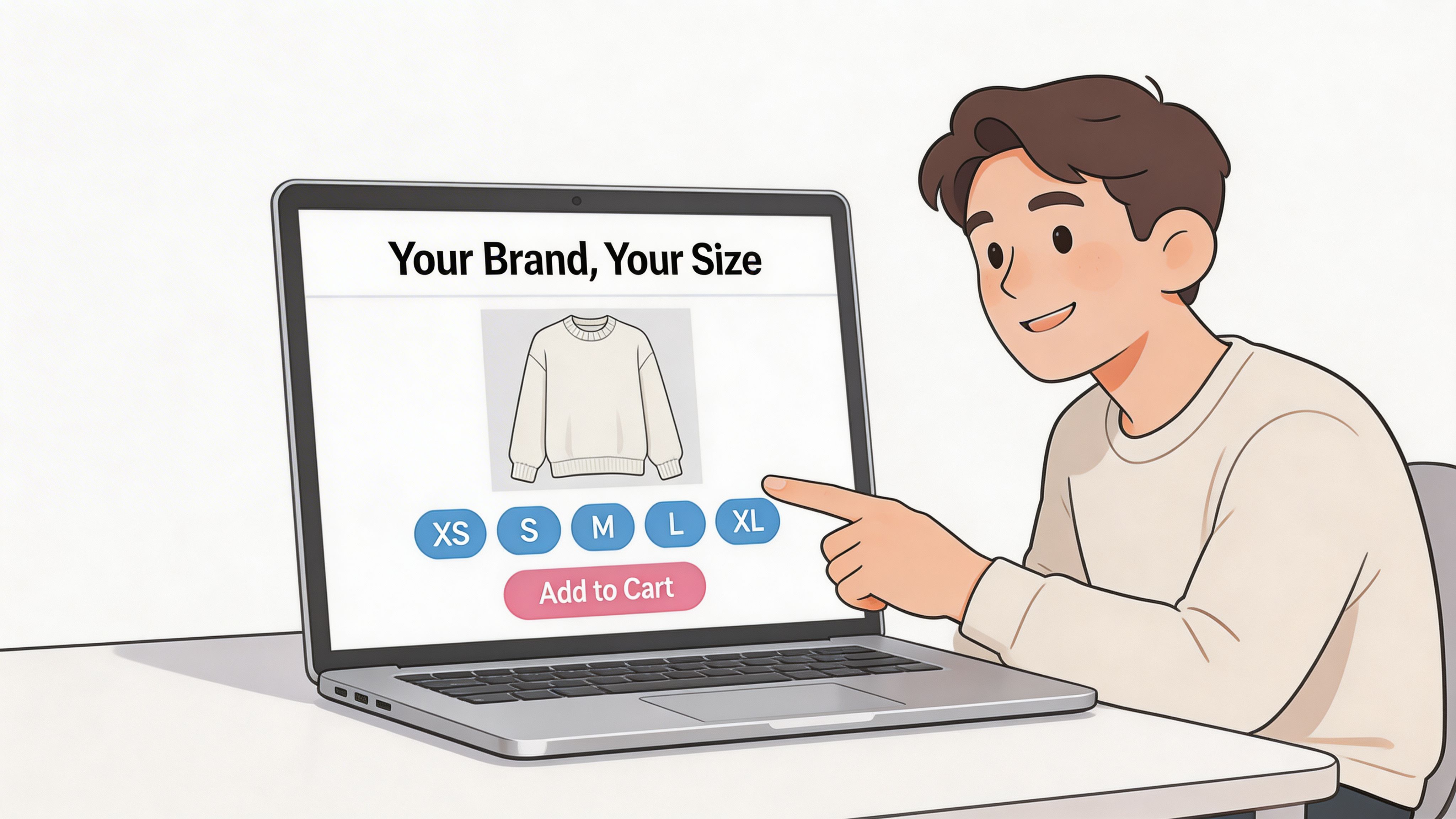
The biggest conversion drag in apparel is unresolved sizing anxiety. Most stores try to solve it with a generic chart hidden behind a tiny link.
That is not enough.
A useful apparel PDP usually includes:
- Size guide access near the selector
- Fit note in plain language, such as slim, relaxed, cropped, or true to size
- Model context, including what size is shown
- Fabric and stretch explanation
- Care instructions
- Shipping and returns clarity
If you sell multiple cuts, do not force one universal size chart across all products. Build size logic at the product level or at least by fit family.
Some brands also benefit from richer visual production. If your team needs more creative variation without running a new photoshoot every time, tools for AI fashion models can help produce broader merchandising assets for different audiences and style contexts. Used well, that supports catalog presentation. Used lazily, it creates a polished but untrustworthy store.
Accessibility is not a side task
A lot of fashion brands obsess over aesthetic references and ignore whether the store is usable. That is a miss.
An important but overlooked strategy is optimizing for digital accessibility. While top stores are praised for aesthetics, focusing on WCAG compliance and inclusive design for plus-size, disabled, or neurodivergent consumers can create immense brand loyalty in underserved markets, as noted in this analysis of Shopify store opportunities.
In practical terms, that means:
- Buttons should be obvious: Not hidden as tiny text links
- Color contrast should support readability: Especially on promo bars and sale labels
- Alt text should describe products meaningfully
- Keyboard navigation should work
- Motion should be limited or controllable
- Size and fit information should be easy to parse
Accessibility often improves conversion for everyone. Cleaner labels, clearer hierarchy, and fewer ambiguous interactions make stores easier to use on mobile, under time pressure, and across different shopping contexts.
Theme choice matters less than execution
Founders often ask which theme is best for apparel. The better question is whether the chosen theme can support your merchandising model without heavy compromise.
Check these before committing:
| Store need | What to look for |
|---|---|
| Dense catalogs | Strong filtering, clear collection layouts |
| Visual storytelling | Flexible image blocks, video support, editorial sections |
| Fit-heavy products | Easy insertion of size content, accordions, metafields |
| Mobile-first shopping | Fast tap targets, sticky add-to-cart, clean selectors |
If the base theme fights your product structure, you will end up patching around it with apps and custom code.
For a deeper look at practical storefront decisions, this guide on how to design a Shopify store is a useful reference point.
Good apparel UX feels obvious
When shoppers do not have to hunt for fit, compare colorways, or decode your product naming, they move faster.
That is the standard. Not “beautiful.” Not “premium.” Clear enough that a first-time visitor can make a buying decision without opening three tabs and emailing support.
Implementing Advanced Merchandising and CRO Tactics
Merchandising is where apparel brands usually win or waste the traffic they already paid for. On most stores we audit at ECORN, the gap is not design quality. It is decision quality. Shoppers arrive with intent, then hit collection pages and PDPs that force too much work.
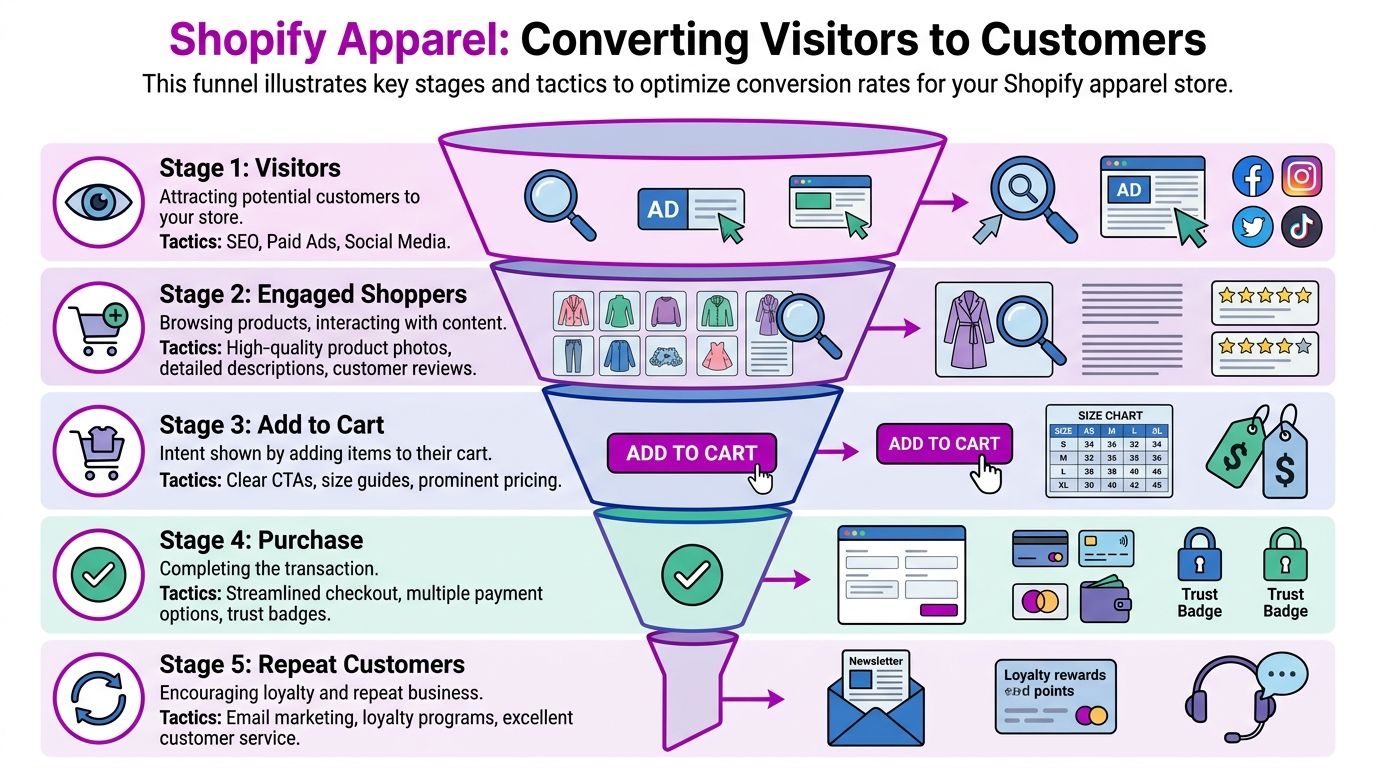
Good CRO for apparel is operational, not cosmetic. The goal is to reduce hesitation at each step, from product discovery to checkout completion, and to build a system that still works when the brand grows from a small catalog to Shopify Plus complexity.
This funnel illustrates key stages and tactics to optimize conversion rates for your Shopify apparel store.
Merchandising starts on collection pages
Collection pages shape product discovery, margin mix, and average order value. They are not just archives.
If every product tile gets equal weight, shoppers have to sort the assortment themselves. That usually hurts click-through and pushes high-intent visitors into comparison mode. Better-performing stores guide attention on purpose.
A few collection page decisions matter more than cosmetic tweaks:
- Lead with proven SKUs: Put your strongest products and best-selling colorways first
- Merchandise by outfit logic: Group matching sets, layering pieces, and capsule combinations
- Filter by how people shop: Size, fit, color, fabric, occasion, weather
- Add reassurance inside the grid: Review signals, fit callouts, shipping cues, restock context
For apparel, product-first merchandising is often weaker than outfit-first merchandising. Customers do not always want a single item. They want a wearable answer. This guide to ecommerce merchandising strategies is a solid reference if your collections still read like a stockroom instead of a selling surface.
Product pages should remove doubt in the right order
A lot of fashion PDPs are built for brand mood and not for purchase decisions. Beautiful campaign imagery helps with positioning, but it does not answer the key conversion questions. Will this fit me. How will it feel. What should I buy with it. When will it arrive.
High-converting PDPs usually follow a practical sequence:
Show the product clearly
Front, back, side, close-up, and on-body imagery. Video helps when movement, texture, or drape affects the sale.Answer fit and feel questions
Size guide, model measurements, fit description, fabric composition, stretch, and care.Introduce revenue-driving modules after intent is established
Complete-the-look, matching bottoms, recommended layers, or bundle prompts.Place operational details lower on the page
Delivery windows, returns, exchange process, and FAQs.
The sequence matters. Push cross-sells too early and the PDP gets noisy. Add them after the shopper trusts the core product and they feel useful.
In apparel, the best upsell reduces styling effort or sizing uncertainty. Anything else is usually clutter.
Use bundles where they simplify the purchase
Bundles work when they make the decision easier. They fail when they look like a margin tactic.
Good apparel bundle formats include:
- Tee plus short set
- Coordinated top and bottom
- Base layer plus outer layer
- Occasion-led edit with accessories
There is a trade-off here. Bundles can lift AOV, but they can also complicate inventory planning and returns if the setup is rigid. Brands with owned inventory usually have more control over this than brands using dropship suppliers or fragmented fulfillment partners. Build bundles around natural wardrobe logic, then test whether customers buy them as a set or still prefer separate line items.
Checkout is where friction shows up clearly
As noted earlier in the article, apparel stores usually operate within a narrow conversion range, so checkout efficiency matters more than small visual tweaks. Stores that perform well remove avoidable stops. They keep momentum high, especially on mobile.
Start with the basics:
- Guest checkout
- Fewer form fields
- Clear shipping visibility before the last step
- Express payment options
- Mobile-first input layout
- No surprise costs late in the flow
Checkout styling matters less than pace and trust. If customers pause to calculate delivery, second-guess fees, or switch devices to complete payment, conversion drops.
A short walkthrough helps show how these decisions connect in practice.
Track the funnel like an operator
While many founders monitor top-line sales, effective CRO requires deeper analysis.
For shopify apparel stores, review these metrics regularly:
| Funnel point | What to inspect |
|---|---|
| Collection engagement | Click-through into PDPs |
| PDP performance | Add-to-cart rate by product |
| Cart | Drop-off after shipping visibility |
| Checkout | Abandonment by device |
| Post-purchase | Repeat purchase patterns and refund reasons |
Patterns show up fast when you look at the funnel this way. A product with strong traffic but weak add-to-cart usually has a pricing, imagery, or fit-confidence problem. A product with healthy add-to-cart but poor checkout completion usually points to shipping friction, payment trust, or unexpected total cost.
This is also where scalable systems matter. Early-stage brands can review this manually each week. Larger catalogs need tighter tagging, cleaner product data, stronger merchandising rules, and often some AI support for search tuning, product recommendations, and customer service triage. That is the difference between launch-stage CRO and the operating model required to scale toward Shopify Plus.
Traffic quality still matters
CRO cannot compensate for misaligned traffic forever. If paid social, creators, or organic content set one expectation and the landing page delivers another, conversion falls no matter how polished the store looks.
That is why acquisition and storefront work need to stay connected. Brands that depend heavily on visual discovery often pair Shopify optimization with stronger creator and organic systems. If Instagram remains a primary channel for catalog discovery, this guide to an Instagram Growth Service for Ecommerce is a practical starting point for evaluating that side of the funnel.
The strongest apparel stores treat merchandising, CRO, and operations as one system. That approach scales better than isolated hacks, and it is usually what separates a decent launch from a brand that can grow cleanly into a larger Shopify stack.
Choosing Your Inventory and Fulfillment Model
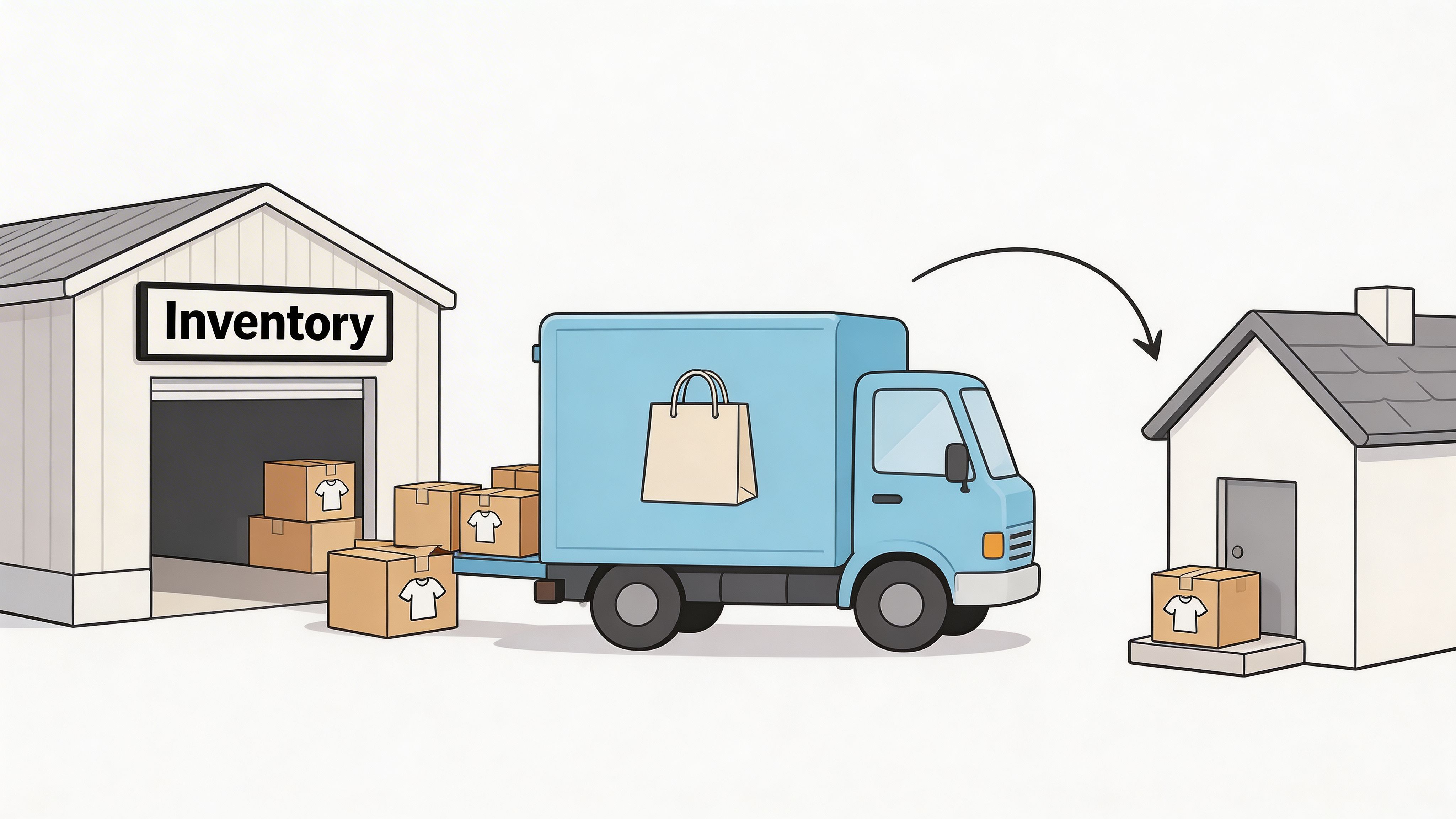
The inventory model shapes almost everything downstream. Margin. delivery speed. return handling. creative flexibility. even customer expectations.
A lot of founders pick a model based on convenience. That is understandable, but it usually creates problems later. Better to choose based on control, capital, and how quickly you need to test or scale.
A side-by-side view of the main models
| Model | Best fit | Main advantage | Main risk |
|---|---|---|---|
| POD | Early validation | Low upfront commitment | Limited control over quality and perceived brand value |
| Dropshipping | Fast catalog expansion | Broad assortment without stockholding | Thin margins, inconsistent shipping, weak differentiation |
| In-house inventory | Brands with strong product conviction | Full control over packaging, QC, and fulfillment | Capital tied up in stock and operations |
| 3PL | Growing brands with repeatable demand | Scalable fulfillment without running a warehouse | Less hands-on control and more process dependency |
POD is useful for testing, but weak for premium positioning
Print-on-demand can be a smart entry point when you need to validate concepts, artwork, or community demand without taking on inventory risk.
It becomes a problem when the brand promise depends on fabric, cut, finishing, or premium unboxing. In apparel, shoppers notice quality inconsistencies quickly. If the product feels generic, repeat purchase gets harder.
POD works best when:
- The design itself drives demand
- The audience buys into message or identity
- You are intentionally testing before a custom production run
Dropshipping solves stock risk, not trust risk
Dropshipping is attractive because it lowers the barrier to entry. It also makes it easy to build a store with too much product and too little control.
The biggest issue is not the business model itself. It is the mismatch between what the store promises and what the supply chain can reliably deliver.
Common trouble spots include:
- Unstable lead times
- Inconsistent sizing between suppliers
- Low control over packaging
- Complicated returns
- Thin room for paid acquisition
That does not mean nobody should use it. It means you should avoid building a premium apparel brand on top of a fulfillment experience you cannot shape.
In-house inventory creates control
Owning inventory gives you the tightest grip on quality, bundling, packing inserts, and same-day operational decisions.
For apparel brands with a clear hero product or repeatable bestsellers, that control can be worth the cash commitment. It also gives you more freedom to build better kits, pre-pack bundles, and respond quickly when one SKU starts outperforming.
The trade-off is obvious. You take on stock risk. If forecasting is poor, capital gets trapped in slow-moving sizes and colors.
If your catalog is still changing every few weeks, in-house stock can amplify mistakes. It works better once fit, demand, and reorder logic are becoming predictable.
A 3PL is often the right next step, not the first one
When brands start to grow, founders often wait too long to move fulfillment out of the office or studio. Orders pile up. packing quality slips. support tickets rise. the team spends launch week printing labels instead of managing the business.
A 3PL makes sense when:
- Order volume is consistent enough to justify process handoff
- The catalog is stable enough for clean warehouse logic
- Your team needs time back for merchandising, retention, and planning
The downside is that poor onboarding with a 3PL creates expensive friction. If SKU naming, barcodes, bundle logic, or return reasons are messy, the warehouse cannot fix that for you.
Choose for the next stage, not just the current pain
A simple decision rule works well:
- Use POD when you are validating demand
- Use dropshipping only when assortment breadth matters more than brand control
- Use in-house fulfillment when customer experience and quality control are part of the core offer
- Use a 3PL when operational scale is stealing focus from growth
The wrong model usually reveals itself in support tickets, refund reasons, and margin pressure long before it shows up in brand strategy decks.
Scaling Strategies with Shopify Plus and Multi-Store Setups
A growing apparel brand usually hits a plateau in one of two ways. Either the front end stops converting efficiently at higher traffic volumes, or the back end becomes too messy to support the next phase.
That is where scale decisions matter. Not because enterprise tooling looks impressive, but because complexity starts costing real money when the business is working.
Signs your brand is outgrowing a basic setup
You do not move to Shopify Plus just to say you are on Plus. You move because the current system is limiting merchandising, operations, or regional growth.
Typical signs include:
- Multiple markets need distinct storefront logic
- B2B and DTC need separate buying experiences
- Teams need cleaner permission structures
- Promotions and checkout behavior require deeper control
- Launches are operationally heavy and hard to repeat
For some brands, the primary trigger is organizational. More people touch the store, more workflows need governance, and the cost of manual work rises.
Multi-store can solve real business problems
Not every brand should run multiple storefronts. Many do it too early and create unnecessary maintenance.
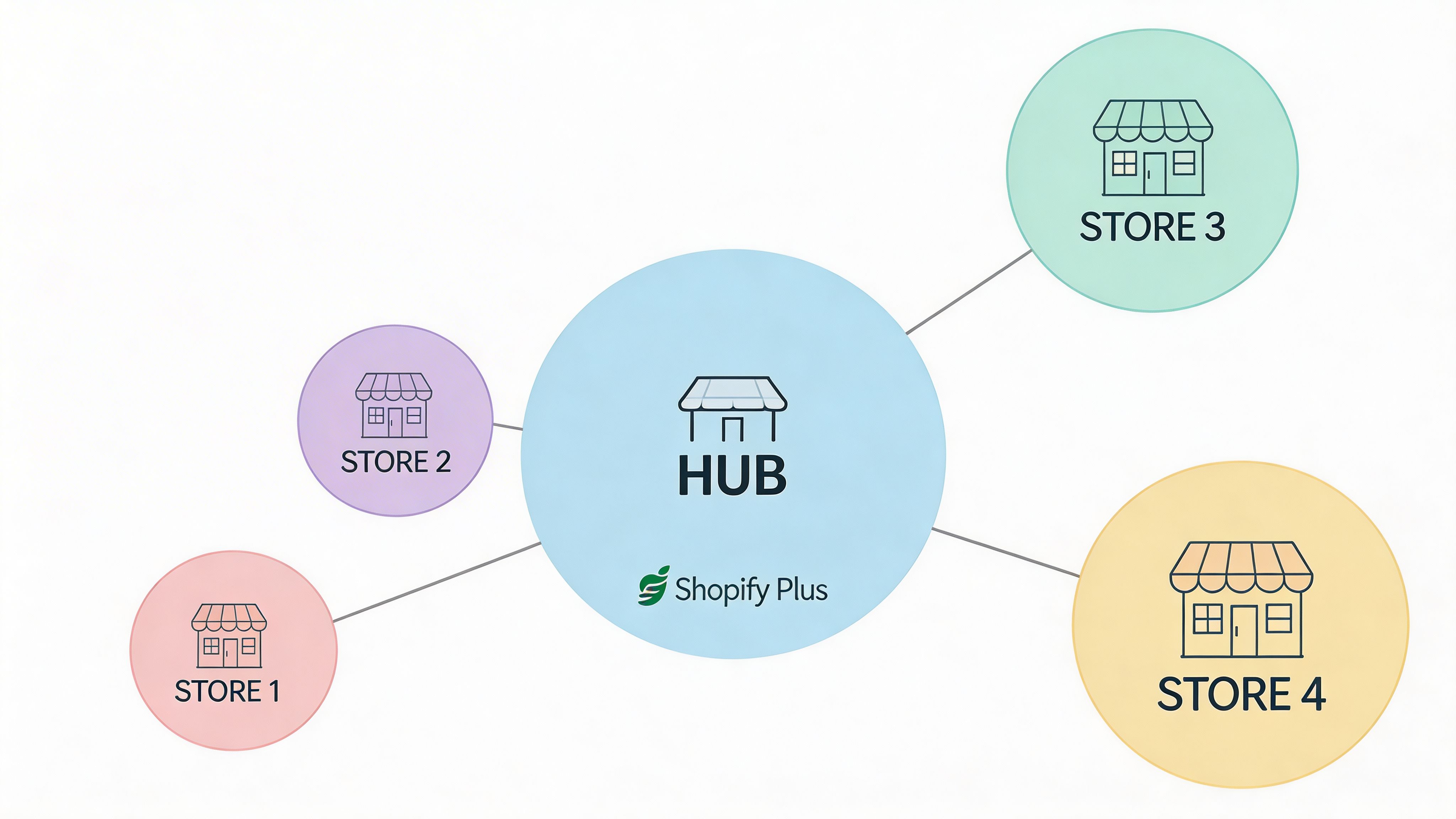
A multi-store structure is useful when the customer, catalog, pricing, language, or compliance needs are materially different.
That usually means one of these scenarios:
| Scenario | Why a separate store can help |
|---|---|
| International expansion | Local language, pricing, merchandising, and payment methods |
| Wholesale or B2B | Separate catalogs, account logic, and buying flows |
| Distinct brand architecture | Different positioning and creative systems |
| Region-specific inventory | Cleaner operational control and local campaigns |
The mistake is using separate stores to avoid cleaning up one messy store. Multi-store works when there is a strategic reason, not just a technical frustration.
Retention becomes more important as acquisition gets harder
As brands scale, paid acquisition usually gets less forgiving. That pushes stronger operators toward retention systems that feel exclusive, not generic.
One strong tactic in apparel is drop-based retention. For scaling brands, leveraging SMS waitlists for exclusive product drops can generate conversion rates of 20% to 30% from VIP customers. This strategy, combined with targeting sustainable or size-inclusive micro-niches, offers a powerful alternative to competing in saturated markets, according to Mapplinks.
That does not mean every store should spam SMS. It means the channel works best when access itself has value.
Good use cases include:
- Back-in-stock alerts for proven winners
- VIP early access to limited drops
- Collection launch reminders for repeat buyers
- Segmented messages by fit preference or category interest
A weak SMS strategy sends the same message to everyone. A strong one treats the list like a members-only channel.
VIP programs work when they reward attention, not just spending. Early access, reserved inventory, fit-specific alerts, and launch previews often create stronger loyalty than blanket discounts.
Plus matters when it unlocks execution speed
For apparel teams running larger release calendars, localized experiences, or more advanced promotions, Shopify Plus becomes useful because it reduces operational drag.
That can show up in areas like:
- Better control over promotional logic
- More flexible workflows for launches
- Cleaner management across multiple storefronts
- Stronger coordination between development, merchandising, and growth teams
This is also the point where implementation quality matters more than tool choice. A messy Plus setup is still messy, just more expensive.
Some brands also need support on customization, CRO, and scaling workflows across storefronts. ECORN offers Shopify development, design, CRO, and Shopify Plus work for brands that need that combination in one operating model.
Scale should make the business simpler for the customer
The customer should never feel your complexity. They should just feel that the store is fast, the launch is clear, the product is relevant, and the post-purchase experience is reliable.
That is the standard worth scaling toward.
Your Path Forward with a Modern Apparel Brand
The strongest shopify apparel stores are rarely the ones with the loudest launch. They are the ones that keep removing friction after launch.
That means staying disciplined on the basics. Watch product-level performance. Review support tickets for recurring fit and shipping issues. Rework weak PDPs before buying more traffic. Simplify merchandising when collections get bloated. Fix operational bottlenecks before they become brand problems.
Modern AI tools are useful here, but only when tied to real jobs. Use them to speed up copy drafting, generate campaign variations, tag product data, assist support teams with common pre-purchase questions, and help creative teams test more assets without slowing the release calendar. Do not use them to automate vague brand language or flood the store with low-trust content.
The return on AI in apparel usually comes from faster iteration and better consistency. A team that ships improved product copy, more relevant recommendations, cleaner support responses, and stronger campaign pages every week will usually outperform a team waiting for perfect quarterly redesigns.
The opportunity in apparel is still real. The stores that win tend to operate with more precision than ego. They validate before they scale. They make fit easier to understand. They build for repeat purchase. Then they invest in systems that let them grow without breaking the customer experience.
If you want help building or improving your apparel store, ECORN works with brands on Shopify design, development, CRO, and Shopify Plus execution. That can range from a focused project to ongoing support when your team needs faster rollout, tighter conversion work, or a clearer path to scale.


Conversion Rate Optimization for Landing Pages: The Playbook
Shopify Plus Automation: A Guide for 2026
10 Social Selling Platforms for Shopify Merchants

Shopify Website Design Examples: 7 Stores Worth Studying
7 Ecommerce Newsletter Examples for Shopify Brands
One Product Shopify Store: Build and Scale
Mobile Pop Up Strategy for Shopify Stores That Converts
Sitemap for Shopify: How to Find, Optimize, and Submit It
7 Single Product Websites Worth Emulating
Product Variants Shopify: The Complete 2026 Guide
Ecommerce Analytics Consulting for Growth
What Is AI Integration for eCommerce
How to Choose the Right eCommerce Website Development Firm
E Business Strategy Implementation
Conversion Tracking Setup for Shopify Stores
BigCommerce vs Shopify Plus Which Enterprise Wins in 2026
Shopify Theme Kit: Setup, Commands, and Migration Guide
Shopify Extension Development: A Practical 2026 Guide
Shopify Speed Score Explained and How to Improve It
Shopify Mobile Optimization: The 2026 Playbook
How to Add Subcategory in Shopify for Better UX
How to Implement Structured Data for Ecommerce in 2026
SEO App Mobile: Shopify Store Optimization Guide
Shopify Plus Support: What It Includes and How to Choose
Google Ads for Shopify: The Complete 2026 Playbook
Shopify New York: How to Find and Hire the Right Agency
Google Search Console for Shopify: The Complete Setup
First Party Data Collection for eCommerce Growth
FAQ Online Store Guide: Build and Measure It Right
Do FB Ads Work for eCommerce in 2026?
One Page Checkout for Shopify: Design and Implementation
Shopify GraphQL vs REST: The 2026 Developer Decision
Shopify Ecommerce Consulting: Strategy, Pricing &
Are Reddit Ads Worth It for eCommerce Brands
Shopify Title and Meta Description: A Practical 2026 Guide

Product Video Best Practices for Shopify Brands
Real-Time Inventory Management: A 2026 Guide
AI Chatbot Integration for Shopify Stores
Affiliate Program Management: A Shopify Guide
10 Best Performance Monitoring Tools for Shopify in 2026
Digital Asset Management for eCommerce Brands in 2026
Every Type of Facebook Ads Explained for eCommerce Growth
Product Information Management Explained for Shopify Brands
Support Ticket System: A Guide for Shopify Stores

10 Best Customer Service Tools for Shopify in 2026

Can I Start a Business with No Money? a 2026 Blueprint
What Sells Good on Etsy: Best Niches for 2026

Shopify Add to Cart Button: A Practical 2026 Guide

Customer Feedback Automation: A Practical eCommerce Guide
Critical Rendering Path: A Guide for Shopify Stores

How to Promote on TikTok for eCommerce in 2026

B2B eCommerce Consulting That Drives Real Revenue
10 Best Practices for Site Navigation in 2026
Return vs Refund for Shopify Stores: A Practical Guide
What Is Customer Lifetime Value and Why It Matters
What Is Voice of Customer Research for eCommerce

SMS Marketing for Ecommerce That Actually Converts

Master How to Improve Email Deliverability in 2026
Top 7 eCommerce Partners NYC for Shopify Brands in 2026
Machine Learning for Ecommerce: Boost Your Shopify Store

Beauty Market Research: Your 2026 Growth Guide

Shopify International Expansion: A 2026 Roadmap
What Does CRO Stand for in Business: Understanding CRO
Shopify Visual Merchandising: A Playbook for Higher Sales
Shopify Landing Page Design: Master Conversion in 2026
10 Best AI SEO Optimization Tools for Shopify in 2026

Agentic AI for Ecommerce: Boost Your Sales in 2026
Mastering Email Marketing Data for eCommerce Growth

Conversion Rate Optimisation Australia: Boost Your Sales
Conversion Rate Optimization AI: Your Shopify Store Guide

10 Product Bundling Strategies for Shopify in 2026
How to Increase Customer Lifetime Value: A Shopify Playbook
AI Customer Service Automation: Shopify Guide 2026

Clean Website Design: A Shopify Conversion Playbook

Omnichannel Retail Strategy: A Shopify Playbook
Product Data Enrichment: A Guide for Shopify Brands
Instagram Shopping Features a Guide for Shopify Stores
What Is Revenue Optimization: A Holistic RevOps Guide
Benefits of Conversion Rate Optimization: Boost Your
WordPress to Shopify Migration: Your 2026 Seamless Switch
Boost Sales: Ecommerce Payment Processing Guide 2026
Unified Commerce Platform: Benefits, KPIs & Shopify Guide
How to Reduce Bounce Rate eCommerce: Your 2026 Guide
Shopify API Integration: A Practical End-to-End Guide

How to Implement Data Governance: A 2026 Guide
Shopify Store Development Cost: A 2026 Breakdown
What Is Server Side Tracking: The Shopify Guide 2026
Marketing Automation Workflows: A Shopify Guide for 2026
Shopify: How to Reduce Technical Debt

Shopify UX Design Change: A Playbook for Growth
User Generated Content Strategy: Shopify Playbook
Shopify Pause and Build Plan Cost: A Complete 2026 Guide
Compare at Price on Shopify: A Complete Guide for 2026
Where Can I Sell My Prints? 10 Best Platforms for 2026
Shopify Order Management System: The Ultimate Guide 2026
What Is Marketing Attribution? an eCommerce Guide for 2026
10 Best Black Friday Sales Sheets for 2026

Discover the Top Social Media Marketing Agencies For
Consumer Confidence Definition for eCommerce in 2026
What Is Social Commerce? Your 2026 Guide to Boosting Sales


newsletter in your inbox