


If you're still chasing that #1 organic spot, you're playing yesterday's game. To truly win in modern eCommerce, you need to think bigger. The new goal is to own the entire search results page, from AI Overviews and Featured Snippets to those valuable 'People Also Ask' boxes.
Think of these SERP features as your new digital storefront—they capture attention and clicks long before a shopper ever scrolls down to the traditional blue links.
The New eCommerce Battleground Beyond Position One
For today’s eCommerce brands, the SEO game has completely changed. Simply ranking first is just one piece of a much larger puzzle. The real opportunity now is in dominating SERP real estate—all the different result types Google uses to give searchers direct answers and richer experiences.
When you win these features, your brand becomes the go-to answer for high-intent questions.
Picture a potential customer searching for "how to care for a leather jacket." If your store’s guide pops up in a Featured Snippet right at the top, you've not only solved their problem but also instantly established your brand as an expert. That makes your store the first, most logical click.
This is what a Featured Snippet, often called "position zero," looks like in action.
That single box immediately frames the featured site as the most authoritative source for the search, pushing all other organic results down the page. Securing that spot is a massive competitive advantage.
Why SERP Features Are Critical for eCommerce
The move toward a feature-packed SERP isn't just a passing trend. It's Google's direct answer to how user behavior is changing. People want answers, and they want them fast. This creates a huge opportunity for savvy eCommerce sites.
Before we dive into the "how-to," it's helpful to see which features pack the most punch for online stores.
Here's a quick reference table of some of the most valuable SERP features you should be targeting.
High-Value SERP Features for eCommerce
Targeting these features isn't just a "nice-to-have" anymore; it's a core part of a winning eCommerce SEO strategy.
Here's exactly why you need to start hunting for these SERP feature opportunities:
- Boosted Visibility: Features like Product Carousels, Image Packs, and Video Snippets make your products impossible to miss in a wall of text.
- Enhanced Authority: Owning a Featured Snippet or showing up in "People Also Ask" positions your brand as a trusted expert, building instant credibility.
- High-Quality Traffic: These features often show up for long-tail, high-intent keywords. That means the traffic you get is more qualified and much closer to making a purchase. A great starting point for finding these is a comprehensive eCommerce SEO audit.
The data backs up the urgency. Zero-click searches now make up over 50% of all Google queries. Users are finding their answers directly on the results page without ever clicking a traditional link.
Recent analysis shows how Google's focus on AI-powered results has completely reshaped the SEO landscape. AI Overviews, for example, are already appearing in 40% of informational searches. For eCommerce brands, especially those on platforms like Shopify Plus, finding and winning these spots is a matter of survival.
Featured Snippets alone show up in about 19% of searches and can increase click-through rates by up to 10%, even on a page crowded with other results.
Your Toolkit for Uncovering SERP Opportunities
Alright, so you get why SERP features are a big deal. But knowing how to actually find these opportunities is where the real work—and fun—begins. This isn't a job for a single tool. It's more of a layered workflow, kind of like using a metal detector, a map, and a magnifying glass all together to find buried treasure.
You don't need a massive, pricey software stack to get started, either. The best place to begin is a tool you already have for free: Google Search Console (GSC). This is ground zero for your easiest wins.
The whole process really boils down to three core stages: identifying what's out there, analyzing what it takes to win, and then creating or updating your content to match.
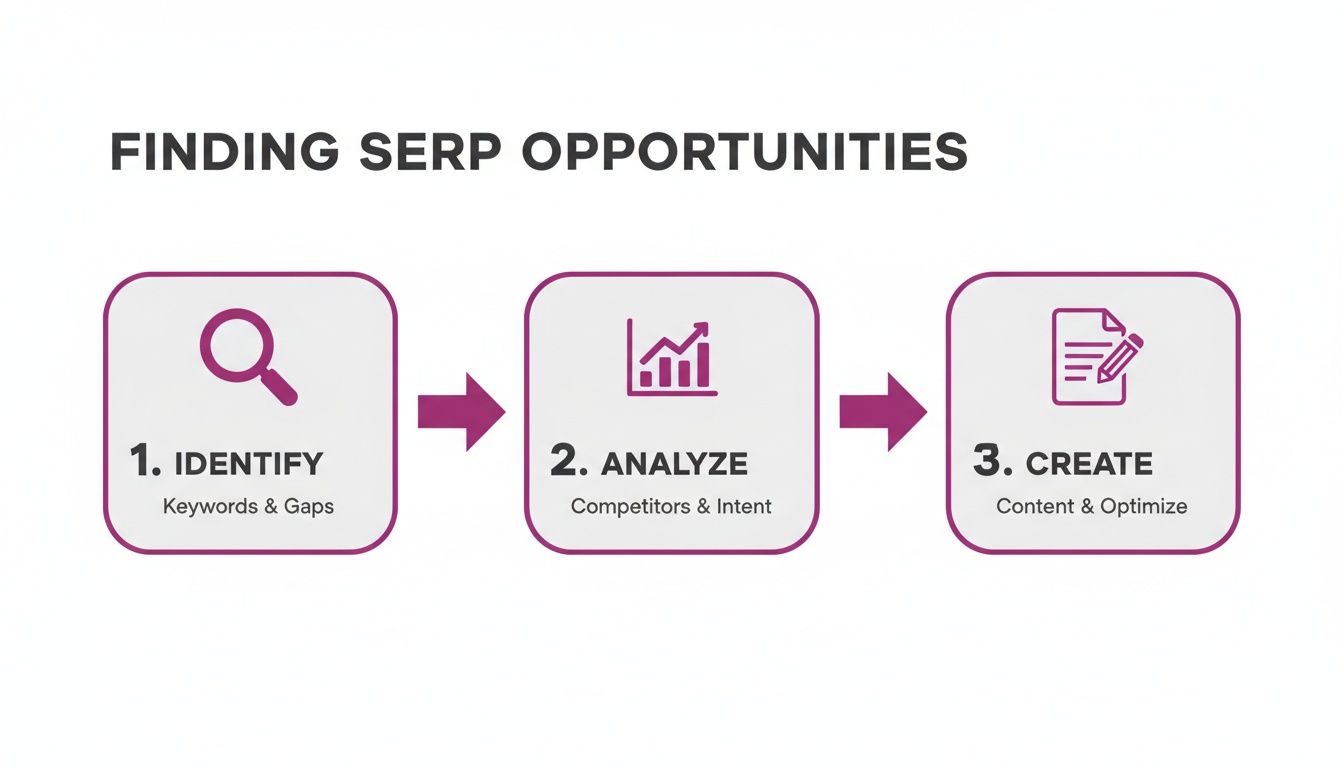
It’s a repeatable system, not just a one-and-done task.
Start With Your Low-Hanging Fruit in GSC
The first stop is GSC, where the goal is to find queries you’re already ranking for on page one but aren't winning any special features. These are your prime targets. Google already sees your page as relevant; it just needs a little nudge in the right direction.
Jump into the Performance report in GSC and get ready to filter.
First, I set a position filter for "smaller than 10.1." This immediately isolates all the keywords where you're already in the big leagues.
Next, I'll add a query filter for question-based keywords. Think terms like "how," "what," "why," "where," and "best." These are natural triggers for Featured Snippets and People Also Ask boxes.
With that list, it's time to do some manual searching in an incognito window. Are there Featured Snippets, PAA boxes, or video carousels that you don’t own? If you spot a query like "how to clean suede boots" where you rank #3 but a competitor has the snippet, you've struck gold. Your page has Google's trust; now you just need to tweak its structure to give a clearer, more direct answer.
Layer in Powerhouse SEO Tools
After you've picked all the low-hanging fruit in GSC, it’s time to bring out the heavy hitters like Ahrefs or Semrush. These tools are where you shift from optimizing what you have to finding entirely new opportunities by reverse-engineering your competition.
This is how we uncover how to find SERP feature opportunities that are currently beyond our site's reach.
My favorite tactic here is simple but incredibly effective. I plug a competitor's domain into Ahrefs' Site Explorer, head straight to the "Organic Keywords" report, and then filter by the SERP features they own. It gives you a direct, actionable list of keywords they're winning with.
For example, if you sell high-end blenders, you could analyze a site like Vitamix. By filtering their keywords to show only those that trigger a "Featured Snippet," you might find queries like "best blender for green smoothies" or "how to self-clean a blender."
This isn't just a keyword list. It’s a content roadmap handed to you by one of your top competitors.
When to Use SERP Scraping Tools
While GSC gives you quick wins and Ahrefs provides the competitive strategy, sometimes you need raw, real-time data at a massive scale. That’s where SERP scraping tools come in. They let you pull the search results for thousands of keywords at once, giving you an unfiltered snapshot of the SERP landscape.
I typically turn to a scraper for a few key jobs:
- Large-Scale Competitor Analysis: Seeing which SERP features a competitor owns across their entire keyword footprint.
- SERP Volatility Tracking: Monitoring whether we're gaining or losing features after a big Google algorithm update.
- "Share of SERP" Calculation: Measuring how much of the visible SERP real estate—organic links, snippets, images, etc.—our brand actually controls for a specific topic cluster.
Using this combination of tools—GSC for the easy wins, Ahrefs/Semrush for strategy, and scraping for deep-dive analysis—gives you everything you need to find and capture these valuable SERP features systematically. You start simple and layer on complexity, ensuring you’re always working on the highest-impact tasks.
Analyzing SERP Intent to Prioritize Your Efforts
Finding a dozen potential SERP feature opportunities is one thing. Actually deciding which one to go after first? That's where the real strategy comes in. This is the moment where you need to get inside the user's head and analyze the "why" behind every search query. It's your most powerful tool for prioritizing what to do next.
Forget just chasing basic keyword volume. To really make an impact, you have to dissect the core user intent. A deep understanding of search intent is the difference between blindly chasing features and strategically winning the ones that actually move the needle for your business.
When you know what a user is really trying to do, you can draw a straight line from their goal to the most valuable SERP features on the page.
Matching Intent to SERP Features
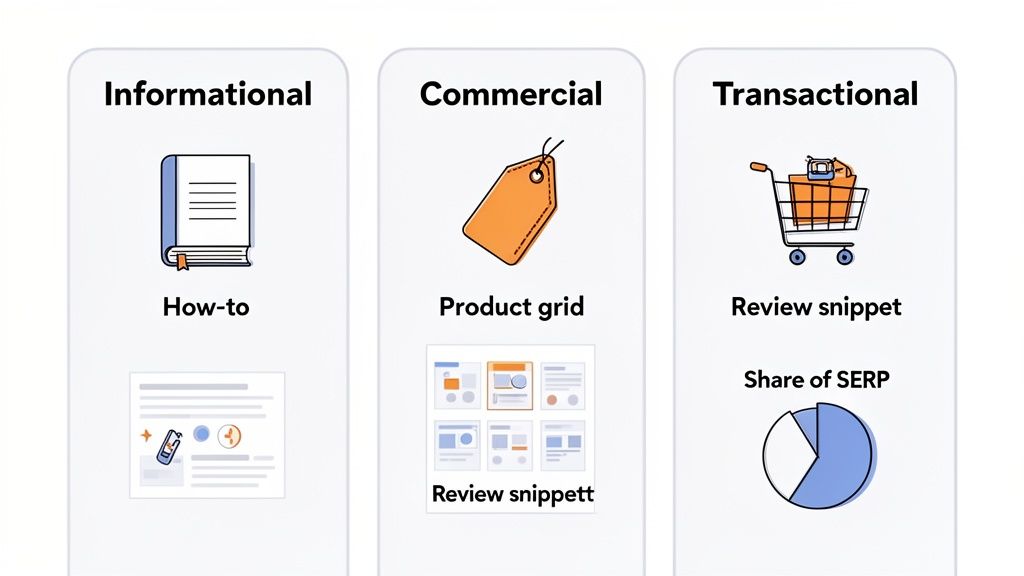
For eCommerce, search intent typically falls into three main buckets. Each one gives Google a different signal, which in turn dictates the kinds of SERP features it shows. This creates a clear roadmap for your content strategy.
- Informational Intent: The searcher needs answers. Think queries starting with "how to," "what is," or "why."
- Commercial Intent: The user is in research mode, comparing products, and hunting for reviews. These queries often include words like "best," "review," or "vs."
- Transactional Intent: The user has their wallet out and is ready to buy. These are your money-makers, including terms like "buy," "deal," or specific product SKUs.
Let's say you run an outdoor gear store. A query like "how to clean leather boots" is pure Informational. Google knows this and is looking to serve up a quick, direct answer. This is prime real estate for a How-to Snippet or a Video Carousel.
On the other hand, a search for "best winter running shoes" has clear Commercial intent. For these queries, Google is far more likely to feature Product Grids, Review Snippets, and in-depth comparison guides. Knowing this tells you to prioritize that detailed comparison article over a simple blog post.
Performing a Share of SERP Analysis
Once you’ve got a handle on the intent behind your target keywords, the next play is to figure out who's currently owning the most screen space. I call this a "Share of SERP" analysis. It’s not about who ranks #1 organically; it’s about who owns the most visual real estate on the page for a given topic.
Fire up an incognito browser and manually search for your top 5-10 most valuable keywords. Scan the entire page and start asking questions:
- Who owns the Featured Snippet?
- Whose products are in the Shopping Carousel?
- Which sites are popping up in the "People Also Ask" box?
- Is there an Image Pack or Video Carousel, and who's dominating it?
You can track this in a simple spreadsheet. For a keyword like "best waterproof hiking boots," you might find Competitor A has the Featured Snippet, but Competitor B owns the Image Pack and has two videos in the carousel. This immediately shows you exactly where the gaps—and your opportunities—lie.
Imagine dominating the SERP not with one ranking, but by claiming multiple real estate spots like AI Overviews, PAA, and video carousels. That's the "Share of SERP" revolution predicted for 2026, where position one is dead and diversification rules. To uncover opportunities, leverage advanced SERP analysis tools that track snippets, knowledge panels, and even forum mentions. You can find more details about these SEO predictions for 2026 and how to prepare for them.
Prioritizing Based on Impact and Effort
With your intent mapping and Share of SERP analysis done, you're ready to build a prioritized action plan. I'm a big fan of using a simple matrix that scores opportunities on just two things: potential business impact and the level of effort needed.
This framework forces you to focus on the highest-leverage tasks first. In our example, optimizing an existing blog post to win a Featured Snippet or creating a quick FAQ to grab a PAA spot offers a much better return on time than trying to muscle your way into a hyper-competitive Product Grid from a standing start.
This data-backed approach ensures you’re always working on the SERP feature opportunities that will make the biggest difference for your brand.
Crafting Content That Google Loves to Feature
Alright, you've done the hard work of finding and prioritizing your SERP feature targets. Now it's time to move from spreadsheets to the front lines and actually create or tweak your content to win those spots.
This isn't about gaming the system with old-school keyword stuffing. It's about structural intelligence. Think of it this way: if Google is looking for a perfectly diced onion for its recipe, you don't hand it the whole thing and hope for the best. You give it exactly what it wants.
The best part? Google isn't shy about showing you the winning recipe. By looking at what's already ranking, we can build repeatable templates that dramatically improve our chances. This is a foundational piece of any sharp eCommerce content strategy.
Build for the Featured Snippet
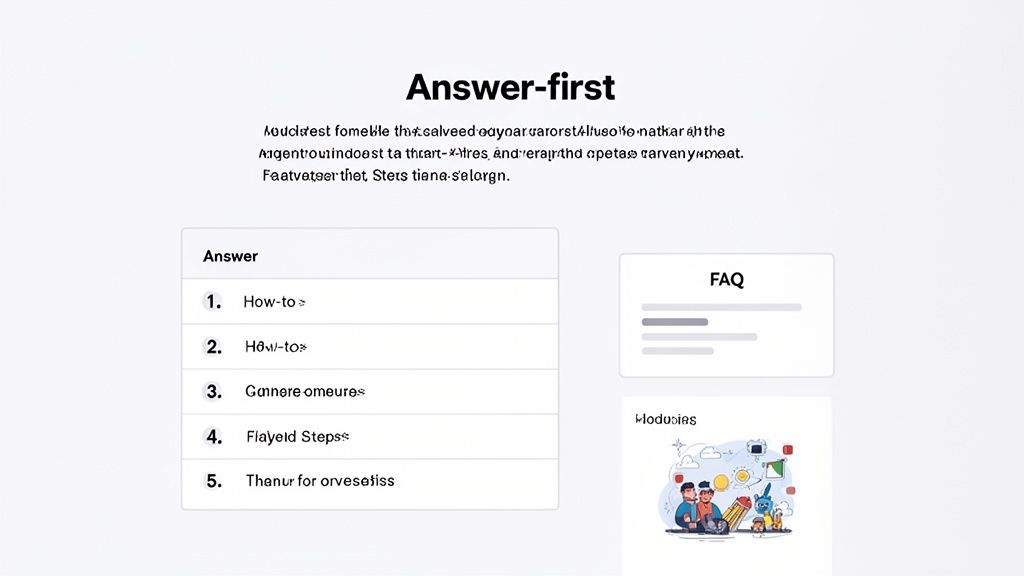
Featured Snippets are the holy grail for informational queries, and winning them usually boils down to one simple, powerful rule: answer the question first.
So many sites get this wrong. They bury the answer halfway down the page after a long, rambling intro. To win that coveted "position zero," you need to flip your structure. Put the answer right at the top, immediately under your main heading.
Keep this "answer-first" paragraph tight, factual, and around 40-60 words.
Let’s say you're targeting "how to waterproof canvas shoes." Your opening should get straight to the point.
To waterproof canvas shoes, start by cleaning them thoroughly and letting them dry. Apply a high-quality waterproofing spray evenly across the entire surface, holding the can about six inches away. Let the first coat dry completely for a few hours before applying a second coat for maximum protection.
This gives Google a perfectly sized, easy-to-grab chunk of text. It's a direct answer, served on a silver platter.
Beyond that initial answer, formatting is your best friend. Google loves clean, semantic HTML. Use these elements to signal what kind of content you have:
- Paragraph Snippets: Lead with that concise, definitional paragraph we just talked about.
- List Snippets: For any "how-to" or "best of" query, use ordered (
<ol>) or unordered (<ul>) lists. Make every list item a crystal-clear step or point. - Table Snippets: Comparing product specs or features? Use a proper HTML
<table>. Google can lift this directly into a SERP table, which is a massive win.
Dominate People Also Ask Boxes
That "People Also Ask" (PAA) box is another goldmine. The strategy here is to think like a topic cluster. Don't just create a page that answers one question; build an authoritative resource that answers a whole series of related questions.
Your earlier keyword research should have already handed you a list of these PAA questions. Now, it's time to put them to work.
Structure your content with H2 or H3 subheadings for each PAA question you want to target. Then, right under each heading, provide a clear, concise answer, just like you would for a Featured Snippet.
For a page on "best running shoes for flat feet," your page outline might look like this:
- H2: What Are the Best Running Shoes for Flat Feet?
- H2: Do People with Flat Feet Need Special Shoes?
- H2: How Can I Tell If I Have Flat Feet?
With this approach, a single blog post can become a magnet for PAA results, giving you a ton of chances to show up for all sorts of related searches.
Implement Essential Schema Markup
While content and structure get you most of the way there, Schema markup is the technical cheat sheet you hand directly to Google. It's code that lives on your page and explicitly tells search engines what your content is about, removing all the guesswork.
For any eCommerce site, a few Schema types are absolutely non-negotiable.
- FAQPage Schema: This is your ticket to getting those FAQ dropdowns directly in the search results. Use it on any page where you're answering several questions, wrapping each question-and-answer pair in the proper markup.
- HowTo Schema: If you've written a step-by-step guide, this Schema tells Google the exact sequence of instructions. It's a huge signal for winning How-to rich results and Featured Snippets.
- Product Schema: This is table stakes for eCommerce. It's how you feed Google structured data like your product's price, availability, and review ratings. This data powers the rich snippets that make your products pop in the SERPs.
You can add Schema directly into your site’s HTML, through Google Tag Manager, or with SEO plugins on platforms like Shopify. It’s that final layer of optimization that helps lock in your spot.
Measuring Success and Optimizing for Conversions
Landing a big SERP feature feels great. But let's be real—it’s just a vanity metric if that new visibility doesn't actually help your business. Nailing "position zero" is the starting pistol, not the finish line.
The real work starts now, connecting that prime SERP real estate to your bottom line. It's about moving past the "Featured Snippet Won" notification in your SEO tool and digging into what that win means for user behavior and, most importantly, sales.
Quantifying the Uplift in Google Search Console
Your first stop for measuring actual impact has to be Google Search Console. While tools like Ahrefs or Semrush are fantastic for tracking if you own a feature, GSC shows you how users are reacting to it. The metric we care about most here is click-through rate (CTR).
The process is simple but incredibly revealing. Jump into your GSC Performance report and find a page that just recently snagged a SERP feature. You're going to compare its performance for a specific query before and after you captured the feature.
Let's say you filtered for the query "how to descale a coffee machine" and set two date ranges:
- Before: The 30 days leading up to you winning the Featured Snippet.
- After: The 30 days since you won it.
If your CTR for that exact query shot up from 4% to 12%, that’s your proof. You have hard evidence that the feature is funneling more qualified traffic directly to your site. That's a concrete win you can share with your team.
Quick tip: SERP features are notoriously volatile. You might have a snippet one day and lose it the next. Keep a close eye on these key pages and their CTRs. A sudden drop is often the first sign you've lost the feature and need to get back in there to re-optimize.
Turning Visibility into Conversions
Getting a SERP feature is all about driving top-of-funnel traffic. But the job's not done until that traffic actually buys something. This is where Conversion Rate Optimization (CRO) becomes your best friend. A high CTR is nice, but a high conversion rate is what pays the bills.
Once you’ve found your top-performing pages—the ones winning snippets and pulling in clicks—it's time to put them under the microscope. Every single element on that page needs to be working hard to guide a visitor toward a purchase.
Think through the user's journey. Someone clicking your "how-to" snippet is actively looking for a solution. Once you've given them the answer, what's the next logical step? Your page needs to make that next step obvious and easy.
A/B Testing Your High-Traffic Pages
Don’t just guess what might work better—test it. A/B testing is the single most effective way to dial in your feature-winning pages for more conversions. By changing one element at a time, you can make decisions based on data, not hunches.
Here are a few high-impact elements to start testing right away:
- Headlines: Does a benefit-focused headline ("Get a Better-Tasting Brew in 5 Minutes") beat a question ("How to Descale Your Machine?")?
- Calls to Action (CTAs): Play with button text, color, and placement. Does "Shop Cleaning Kits" convert better than "Learn More"?
- Page Layout: For a guide, would placing a relevant product inside the step-by-step instructions work better than waiting until the end?
Once you've won the SERP features and the traffic is flowing, the mission shifts to making sure that traffic converts. There's a whole science to this, and for eCommerce brands, you can find a ton of actionable ideas on how to improve your ecommerce conversion rate and turn that hard-won visibility into real revenue.
When you pair a smart SERP feature strategy with a solid CRO program, you're not just getting eyeballs. You're getting customers.
Frequently Asked Questions About SERP Feature Opportunities
Even with a solid plan, jumping into SERP features always brings up a few questions. We see the same ones pop up all the time, so we've gathered them here to give you direct, no-fluff answers. Think of this as your go-to cheat sheet.
Which SERP Features Are Most Valuable For a Shopify Store?
For any eCommerce store, and especially for those on Shopify, the best features are the ones that get you closer to a sale. You'll want to pour your energy into winning Product Carousels, Featured Snippets, and People Also Ask (PAA) boxes.
Product Carousels are a straight shot to revenue. They show up for transactional searches and put your products, complete with images and pricing, directly in front of motivated buyers.
Featured Snippets are your ticket to capturing top-of-funnel traffic. When you own the snippet for a "how to use" or "what is" query related to what you sell, you instantly become the authority. PAA boxes work similarly, giving you multiple shots to answer a user's questions on one single results page.
And don't sleep on video. If you're creating product demos or tutorials, nabbing a spot in a Video Carousel is a huge win for engaging shoppers before they even click.
How Long Does It Take to Win a Featured Snippet?
That's the million-dollar question, isn't it? The honest answer is, it really depends. There's no set timeline.
If your page is already hanging out in the top five spots for a query, you could snag the snippet in just a few days or weeks after optimizing your content. Google already trusts your page; you just need to give it the perfect, bite-sized answer.
But if you're starting from scratch with a new page or trying to climb from the second page, you need to be patient. It's a longer game, likely taking a few months. Your content has to build authority and earn its way up the traditional rankings before Google will even consider it for that coveted "position zero."
The real key here is consistency, not speed. You can't just trick the algorithm. Winning a SERP feature is the reward for sustained effort—your page has to prove its worth in the regular rankings first.
Can I Lose a SERP Feature After I Win It?
Yes, absolutely. In fact, you should expect to lose it from time to time. SERP features are incredibly fluid and can change daily, sometimes even hourly. Google is always running tests and re-evaluating which result serves up the best answer.
You might lose a feature for a few common reasons:
- A competitor wrote a clearer, more direct answer.
- A Google algorithm update changed the rules of the game.
- You made a small tweak to your own page that accidentally knocked it out of contention.
This is exactly why you can't just set it and forget it. Ongoing monitoring is non-negotiable. If you see a valuable feature slip away, your first move is to analyze the new winner. What are they doing differently? Update your content, make it even better, and get back in the ring to reclaim your spot.
Should I Target AI Overviews or Featured Snippets?
You should be aiming for both. The great news is that the strategy is almost identical.
Both AI Overviews and Featured Snippets are fueled by the same thing: clear, concise, well-structured content that gets straight to the point of a user's question. Think of them as two sides of the same coin.
More often than not, the content that wins a Featured Snippet is also a primary source Google pulls from for its AI Overviews. So, your focus shouldn't be on one versus the other. Instead, focus on creating genuinely helpful, authoritative content that nails Experience, Expertise, Authoritativeness, and Trustworthiness (E-E-A-T).
When you build content that is fundamentally useful and well-organized, you put yourself in the best position to be featured in any answer-based format Google rolls out—now and in the future.
Ready to stop chasing rankings and start owning the SERP? The team at ECORN specializes in turning search visibility into real revenue for Shopify brands. We combine expert CRO, development, and strategic SEO to help you capture high-value SERP features and convert that traffic into loyal customers. Let's build your winning strategy together. Discover our flexible eCommerce solutions.



How to Choose a Shopify Plus Web Design Agency in 2026
Shopify Plus Ecommerce Agency: How to Pick the Right One
Shopify Themes Retina: How to Serve 2x Images

How to Cross Sell on Shopify Without Friction
Best Shopify Theme for Custom Products Compared
Multi Store Inventory Management: A Practical Guide

SEO Consulting for Ecommerce: A Practical Guide
Shopify Theme Updater App: A Safe Update Playbook
Shopify Git Integration: A Developer's Guide to 2026
Headless Ecommerce Development Services Explained

How to Build a Shopify Clothing Website That Converts
How to Launch a Box Subscription Business in 2026

Luxury Skincare Branding Playbook That Converters
10 Best Podcast Ecommerce Shows for Store Growth in 2026
Shopify Developer Hourly Rate: What to Pay in 2026
Critical Shopify Setup Errors That Are Secretly Sabotaging Your Store
Ecommerce Conversion Tracking: The Complete How-To Guide
Shopify Design Agency: How to Pick the Right Partner
Mastering Multi Store Management on Shopify
Scale Shopify Store
10 Shopify App Ideas Worth Building in 2026
Conversion Rate Optimization for Landing Pages: The Playbook
Shopify Plus Automation: A Guide for 2026
10 Social Selling Platforms for Shopify Merchants
Shopify Website Design Examples: 7 Stores Worth Studying
7 Ecommerce Newsletter Examples for Shopify Brands
One Product Shopify Store: Build and Scale
Mobile Pop Up Strategy for Shopify Stores That Converts
Sitemap for Shopify: How to Find, Optimize, and Submit It
7 Single Product Websites Worth Emulating
Product Variants Shopify: The Complete 2026 Guide
Ecommerce Analytics Consulting for Growth
What Is AI Integration for eCommerce
How to Choose the Right eCommerce Website Development Firm
E Business Strategy Implementation
Conversion Tracking Setup for Shopify Stores
BigCommerce vs Shopify Plus Which Enterprise Wins in 2026
Shopify Theme Kit: Setup, Commands, and Migration Guide
Shopify Extension Development: A Practical 2026 Guide
Shopify Speed Score Explained and How to Improve It
Shopify Mobile Optimization: The 2026 Playbook
How to Add Subcategory in Shopify for Better UX
How to Implement Structured Data for Ecommerce in 2026
SEO App Mobile: Shopify Store Optimization Guide
Shopify Plus Support: What It Includes and How to Choose
Google Ads for Shopify: The Complete 2026 Playbook
Shopify New York: How to Find and Hire the Right Agency
Google Search Console for Shopify: The Complete Setup
First Party Data Collection for eCommerce Growth
FAQ Online Store Guide: Build and Measure It Right
Do FB Ads Work for eCommerce in 2026?
One Page Checkout for Shopify: Design and Implementation
Shopify GraphQL vs REST: The 2026 Developer Decision
Shopify Ecommerce Consulting: Strategy, Pricing &
Are Reddit Ads Worth It for eCommerce Brands
Shopify Title and Meta Description: A Practical 2026 Guide
Product Video Best Practices for Shopify Brands
Real-Time Inventory Management: A 2026 Guide
AI Chatbot Integration for Shopify Stores
Affiliate Program Management: A Shopify Guide
10 Best Performance Monitoring Tools for Shopify in 2026
Digital Asset Management for eCommerce Brands in 2026
Every Type of Facebook Ads Explained for eCommerce Growth
Product Information Management Explained for Shopify Brands
Support Ticket System: A Guide for Shopify Stores

10 Best Customer Service Tools for Shopify in 2026

Can I Start a Business with No Money? a 2026 Blueprint
What Sells Good on Etsy: Best Niches for 2026

Shopify Add to Cart Button: A Practical 2026 Guide

Customer Feedback Automation: A Practical eCommerce Guide
Critical Rendering Path: A Guide for Shopify Stores

How to Promote on TikTok for eCommerce in 2026

B2B eCommerce Consulting That Drives Real Revenue
10 Best Practices for Site Navigation in 2026
Return vs Refund for Shopify Stores: A Practical Guide
What Is Customer Lifetime Value and Why It Matters
What Is Voice of Customer Research for eCommerce

SMS Marketing for Ecommerce That Actually Converts

Master How to Improve Email Deliverability in 2026

Top 8 eCommerce Partners NYC for Shopify Brands in 2026
Machine Learning for Ecommerce: Boost Your Shopify Store
Beauty Market Research: Your 2026 Growth Guide

Shopify International Expansion: A 2026 Roadmap
What Does CRO Stand for in Business: Understanding CRO

Shopify Visual Merchandising: A Playbook for Higher Sales
Shopify Landing Page Design: Master Conversion in 2026
10 Best AI SEO Optimization Tools for Shopify in 2026

Agentic AI for Ecommerce: Boost Your Sales in 2026
Mastering Email Marketing Data for eCommerce Growth
Conversion Rate Optimisation Australia: Boost Your Sales
Conversion Rate Optimization AI: Your Shopify Store Guide

10 Product Bundling Strategies for Shopify in 2026
How to Increase Customer Lifetime Value: A Shopify Playbook
AI Customer Service Automation: Shopify Guide 2026
Clean Website Design: A Shopify Conversion Playbook

Omnichannel Retail Strategy: A Shopify Playbook
Product Data Enrichment: A Guide for Shopify Brands
Instagram Shopping Features a Guide for Shopify Stores
What Is Revenue Optimization: A Holistic RevOps Guide
Benefits of Conversion Rate Optimization: Boost Your


newsletter in your inbox