

You launch campaigns every week. Meta ads are live. Klaviyo flows are firing. You post on Instagram, test a few creators, publish blogs, and tweak product pages between meetings. From the outside, your Shopify store looks active.
But the numbers don't feel stable.
Some weeks revenue spikes and you think you've found the answer. The next month performance drops, CAC creeps up, and nobody can clearly explain why one channel worked while another wasted budget. The team is busy, but the business isn't moving with the same clarity.
That's usually the point where founders start asking the right question. Not “which tactic should we add next?” but why strategic marketing is important in the first place.
The short answer is simple. Strategy stops marketing from becoming a collection of disconnected tasks. It gives your store a clear market position, a real customer focus, and a system for deciding what deserves budget, what needs fixing, and what should be cut. In eCommerce, that shows up in the numbers that matter: CAC, LTV, CVR, retention, and margin.
A lot of Shopify brands don't have a traffic problem. They have a decision problem. They're spending without a unifying logic. Strategic marketing fixes that.
Your Marketing Is Busy But Is It Working
A busy marketing function can hide a weak commercial model for a long time.
I see this constantly with eCommerce teams. They're doing “all the right things” in isolation. Paid social runs prospecting campaigns. Email sends promotions. SEO publishes category content. The site gets incremental design changes. None of those actions are wrong. The problem is that they often aren't connected to one another, and they aren't tied tightly enough to profit.
That creates a familiar pattern. You acquire traffic that doesn't convert well. You discount to force short-term sales. Your returning customer rate softens because the brand promise changes from channel to channel. Then the team responds by adding more activity instead of improving the system.
Practical rule: More channels won't fix weak positioning, a leaky funnel, or unclear messaging.
Founders usually feel this before they can articulate it. They know the business is producing motion, but not confidence. Reporting decks are full of platform metrics, yet basic questions stay unanswered. Which customer segment is profitable? Which message brings in stronger repeat buyers? Which landing pages deserve more investment? Which campaigns should stop today?
That's where strategic marketing matters. It forces trade-offs.
Instead of asking, “How do we do more?” strategy asks better questions:
- Who are we trying to win
- Why should they buy from us instead of the next store
- Which channels fit that buyer and that offer
- How will we measure success beyond vanity metrics
- What has to change on-site so acquisition turns into revenue
The difference between chaotic marketing and strategic marketing isn't effort. It's alignment. One creates activity. The other creates a repeatable growth model.
Strategic Marketing vs Tactical Marketing
Most confusion starts here. Teams talk about strategy when they really mean a campaign plan. They talk about marketing execution when they should be talking about customer fit, offer clarity, and market position.
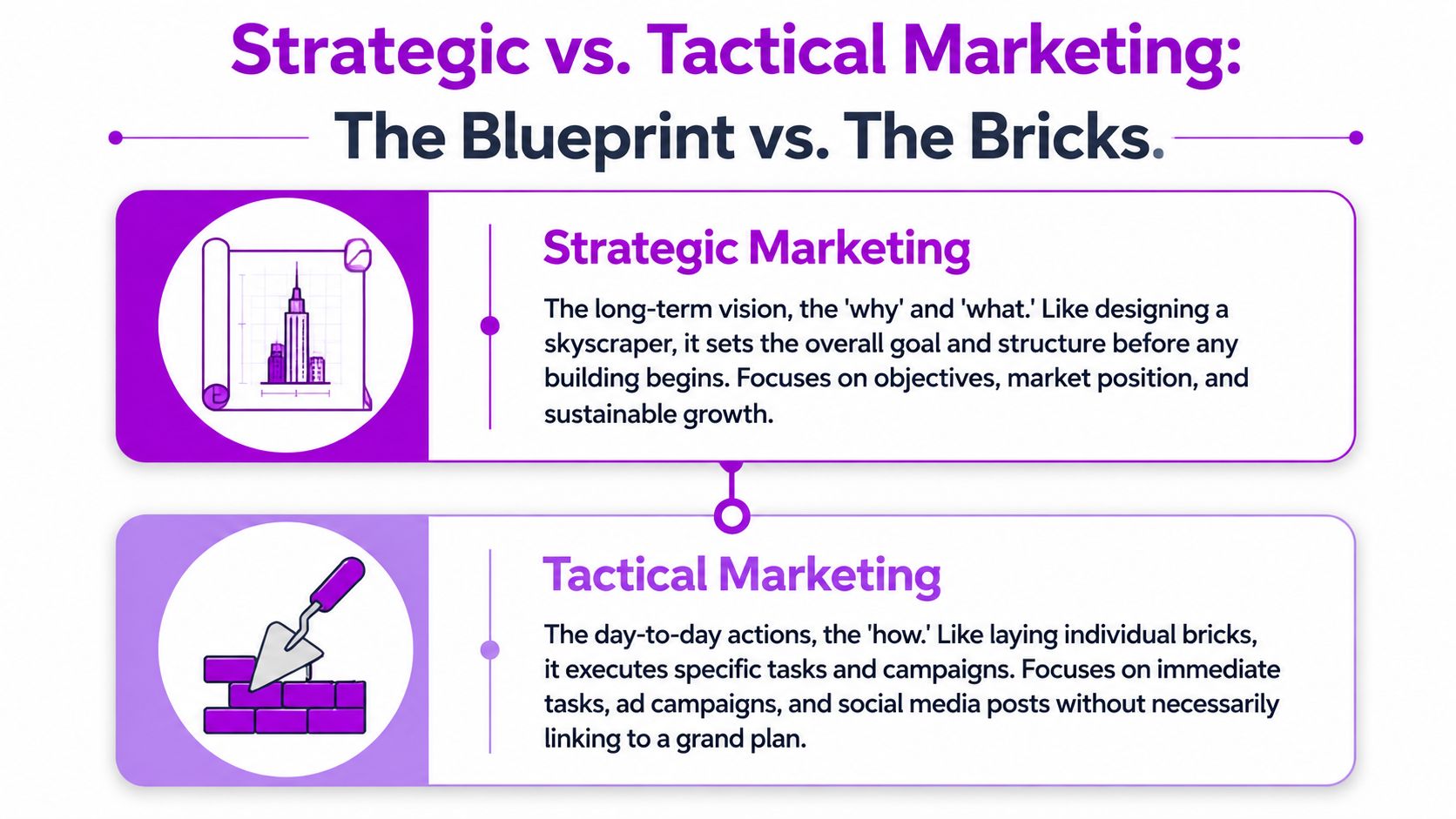
A simple way to think about it is this. Strategy is the blueprint. Tactics are the bricks.
What strategy actually does
Strategic marketing decides the fundamentals before money gets spent. It defines the audience, the commercial goal, the market angle, the value proposition, and the rules for channel selection.
If you run a premium skincare brand on Shopify, strategy answers questions like these:
- Audience fit. Are you targeting first-time problem solvers, routine upgraders, or high-intent loyalists switching from a competitor?
- Positioning. Are you winning on ingredient transparency, convenience, sustainability, or results?
- Offer design. Should the first purchase be driven by bundles, subscriptions, starter kits, or education-led content?
- Measurement. Are you optimizing for lower CAC, stronger first-order margin, or higher repeat purchase value?
Without those choices, every tactic becomes guesswork.
What tactics are supposed to do
Tactics are the execution layer. Meta creative tests, landing page layouts, lifecycle email flows, UGC briefs, technical SEO updates, and retention offers all sit here.
Tactics matter. They're where growth gets built day to day. But they only work when they're serving a clear strategic intent.
A founder might say, “We need more visibility in search.” That sounds strategic, but it's still too vague. A real strategy would define what kind of search visibility matters, for which product categories, and for which buyer stage. Then tactics can follow, including content architecture, collection page optimization, and newer AI search visibility tactics that matter as search behavior changes.
If strategy is missing, teams usually overvalue whatever platform is easiest to launch this week.
A useful test
Use this quick check with your current marketing plan.
| Question | If you have strategy | If you only have tactics |
|---|---|---|
| Why are we using this channel? | Because it matches buyer behavior and margin goals | Because competitors are there |
| What message leads? | One clear value proposition | Different claims in every campaign |
| What defines success? | Business KPIs tied to profit and retention | Clicks, reach, and platform-reported wins |
| What happens when results drop? | Diagnose segment, funnel, and offer issues | Launch more campaigns |
Good strategy doesn't replace tactical work. It tells your team which work is worth doing.
The Four Pillars of eCommerce Success Driven by Strategy
Strategic marketing matters because it changes how a store grows. It improves budget decisions, steadies demand generation, strengthens retention, and gives customers a clear reason to choose you.
For Shopify brands, those outcomes are not abstract. They show up in margin, repeat orders, and conversion performance.

Profit starts with better allocation
A strategy forces you to treat marketing as an investment portfolio, not a list of activities. That matters because 83% of marketing leaders now consider demonstrating ROI their top priority, according to Firework's marketing ROI statistics. The same source notes that email marketing delivers $42 for every $1 spent, while SEO yields $22.24 per dollar.
Those figures don't mean every store should dump budget into email and SEO overnight. They mean channel decisions should follow economics, not habit. If your team is overspending on acquisition while underfunding owned channels, strategy exposes that imbalance.
A practical example. If paid social acquires customers at acceptable volume but poor payback, the answer isn't always to cut paid. Sometimes the answer is to rebuild the post-click journey, improve lifecycle email, and increase first-to-second order conversion so the acquisition cost becomes sustainable.
Sustainable growth comes from consistency
Short-term spikes are easy to mistake for progress. Strategic growth looks different. It's built on repeatable demand.
That requires clear targeting, consistent messaging, and a site experience that doesn't break the promise made in ads, email, search, or social. When those elements align, your store can scale without constantly reinventing its message every month.
A founder often assumes growth means adding more channels. In practice, it often means tightening a few channels around one audience and one strong offer until the model is predictable.
Strong growth usually comes from narrowing the message before expanding the media mix.
Retention gets built before the second purchase
A lot of brands treat retention like a separate department. It isn't. Retention starts with the first promise a customer sees.
If your acquisition ads sell urgency, your product page sells craftsmanship, and your email flow sells discounting, you've trained the customer to expect inconsistency. That hurts trust. Strategic marketing fixes that by aligning message and experience across the full journey.
This video offers a useful lens on how integrated marketing thinking supports growth across the funnel.
Retention improves when the offer, creative, site UX, and post-purchase flow all reinforce the same reason to buy. That's especially important in categories where repeat purchasing is the business model, not a bonus.
Differentiation has to be operational
Founders often say they want to “stand out.” That usually turns into a visual rebrand or a new ad angle. Real differentiation goes deeper.
It shows up in decisions like these:
- Merchandising logic that makes product discovery easier
- Offer structure that matches how customers buy
- Content framing that answers objections before they block purchase
- Storefront UX that removes friction at the point of conversion
In other words, strategic marketing is not just what you say. It's how the business presents, sells, and reinforces value at every touchpoint.
That's why strategic marketing is important. It turns marketing from a cost center people debate into a commercial system people can measure.
Key Metrics to Measure Your Strategic Impact
If you can't connect strategy to store economics, it stays theoretical. The right metrics make strategy visible.
That starts by ignoring vanity metrics as your primary scorecard. Reach, likes, and raw sessions can be useful diagnostics, but they don't tell you if the business is getting healthier. For that, eCommerce operators need a tighter set of measures.

The metrics that matter most
| Metric | What it tells you | Why strategy affects it |
|---|---|---|
| CAC | What it costs to acquire a customer | Better targeting and clearer positioning reduce wasted spend |
| LTV | The value of a customer over time | Better retention, product fit, and lifecycle marketing raise it |
| CVR | How well traffic turns into orders | Messaging alignment and CRO improve it |
| ROAS | Revenue returned from ad spend | Offer quality and funnel efficiency shape it |
| Attribution by channel | Which sources assist or close revenue | Helps you stop overcrediting the last click |
You don't need a huge BI stack to start using these well. But you do need consistent definitions, clean tracking, and a habit of reviewing the numbers together instead of in channel silos.
CAC and LTV should be read together
Customer acquisition cost is one of the fastest ways to spot strategic weakness. When CAC rises, the issue may be media efficiency, but it may also be poor audience selection, weak creative-market fit, or an offer that doesn't justify the click.
Lifetime value gives that metric context. A higher CAC can be acceptable if retained customers become profitable fast enough. A low CAC can still be dangerous if first-time buyers never return.
According to Improvado's strategic marketing guide, modern eCommerce operators using Customer Data Platforms to segment audiences and personalize messaging can reduce CAC by 20-30% while improving LTV. That's the core strategic point. Better customer understanding improves both sides of the equation.
For teams focused on retention mechanics, this guide on improving Shopify customer lifetime value is a useful complement to your KPI reviews.
CVR tells you whether your strategy survives contact with the site
A campaign can generate strong click-through and still fail commercially if the product page, collection page, or checkout experience breaks the sales argument.
That's why conversion rate matters by channel, by landing page, and by customer segment. If branded search converts well but paid social traffic collapses, that's usually not just a media issue. It often means your cold-traffic promise is too broad, your landing page is too generic, or your merchandising doesn't help new visitors make a decision.
Good measurement asks where the buyer lost confidence, not just where the session ended.
If you want a practical KPI list for this level of review, these eCommerce performance metrics to track provide a useful operating baseline.
Common Pitfalls That Derail eCommerce Marketing
Most failing marketing systems don't collapse because the team is lazy. They collapse because the business keeps making unforced strategic errors.
One of the clearest warning signs is operating without a defined plan at all. Nearly 47% of businesses admit they don't have a defined digital marketing strategy, while organizations that do use data report benefits such as 35% better audience reach and 34% higher ROI, according to SLT Creative's 2025 marketing statistics roundup.
That gap shows up in a few predictable ways.
Chasing every new channel
A founder sees competitors on TikTok, hears about influencer seeding, reads about AI search, then asks the team to add all of it. Suddenly the calendar is full, but no channel gets the focus required to learn anything useful.
The corrective is simple. Pick channels based on audience behavior and operational fit, not novelty. If your merchandising, creative production, and attribution setup are already stretched, another channel usually adds noise before it adds revenue.
Letting the message fragment
This one is expensive because it often goes unnoticed. The ad promises one thing. The landing page stresses another. Email leans on discounting. Organic content tries to sound educational. Customers don't experience a brand. They experience a set of mixed signals.
A brand doesn't need to sound identical everywhere. But it does need one stable core promise. Without that, even strong traffic won't convert as well as it should.
Managing by gut feel
Founders are right to trust pattern recognition. They're wrong when instinct replaces measurement.
If budget decisions come from whoever argued most confidently in last week's meeting, the business can't learn. Teams need a simple review process that ties spend to CAC, LTV, CVR, and contribution by channel. Otherwise, weak campaigns survive too long and strong ones don't get scaled properly.
When teams say “nothing's working,” they often mean “we haven't defined success clearly enough to see what's working.”
Obsessing over acquisition and neglecting retention
A lot of stores have an acquisition engine and a retention afterthought. That's backwards in categories where repeat purchase, bundles, subscriptions, or replenishment drive real profitability.
Watch for these symptoms:
- Promo dependence that trains buyers to wait for discounts
- Thin post-purchase communication that fails to reinforce product value
- Weak segmentation that treats new buyers and loyal buyers the same
- No funnel ownership between first purchase and second purchase
Good strategy protects a brand from these mistakes by forcing discipline. It tells you what not to do as much as what to do.
A 5-Phase Strategic Roadmap for Shopify Brands
Strategy gets practical when it becomes a sequence of decisions. For a Shopify brand, that sequence should connect market insight to site performance, not stop at campaign planning.
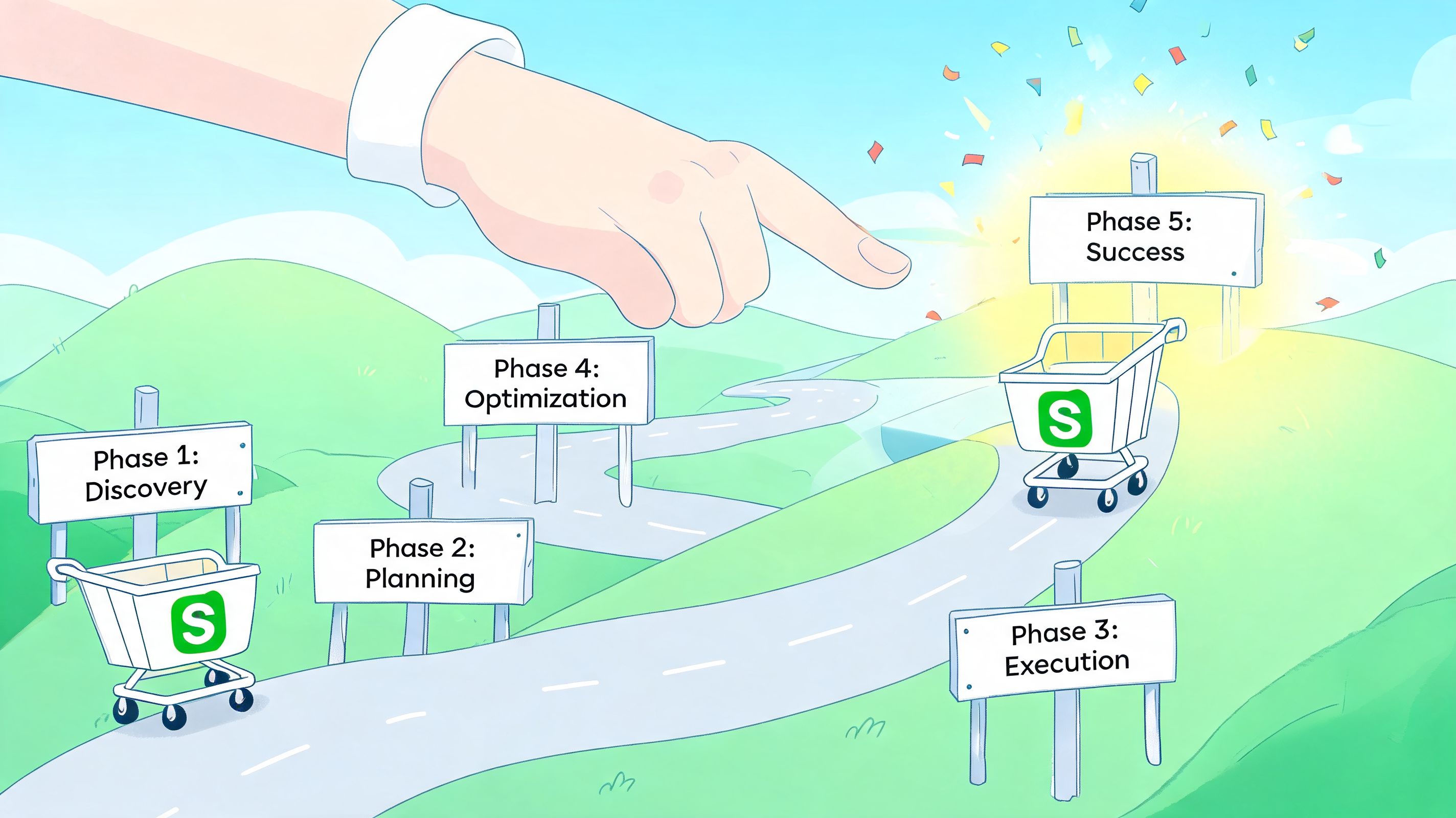
Phase 1 through 3
Audit the current reality
Start with a blunt review of channel performance, product mix, customer cohorts, repeat behavior, landing page conversion, and attribution quality. Pull data from Shopify, GA4, your ad platforms, Klaviyo, and support tickets. Look for patterns, not excuses.Define the customer and the promise
Your ideal customer profile can't be “women 25 to 44” or “people interested in wellness.” It needs to reflect buying triggers, objections, and repeat purchase logic. Then define a value proposition strong enough to guide copy, creative, and merchandising.Choose where to compete Teams usually overcomplicate things during this phase. You don't need to win every channel. You need a focused channel mix that matches customer intent and your team's ability to execute. For more examples of where brands place their bets, this collection of eCommerce growth strategies is useful context.
Phase 4 is where most brands leak money
Execution isn't just campaign launch. It includes product page structure, navigation clarity, bundle logic, mobile UX, speed, checkout friction, and email follow-up.
A real gap still exists between strategy and funnel execution. Research summarized by the American Marketing Association indicates that businesses integrating CRO into strategic marketing plans see a 15-30% improvement in conversion rates. For Shopify brands, that means strategy must shape product pages and checkout, not just media planning.
A few examples of Phase 4 work:
- A/B testing hero sections against different buyer objections
- Reworking PDP hierarchy so benefits, proof, and urgency appear in the right order
- Improving collection filters for high-SKU catalogs
- Aligning ad message to landing page copy so intent carries through the click
Phase 5 never ends
The final phase is iteration. In this phase, strategy becomes a management habit instead of a workshop document.
Review performance regularly around a few core questions:
| Review question | What to look for |
|---|---|
| Which audience segments are becoming profitable? | CAC trend, repeat behavior, and margin |
| Which offers convert first orders best? | CVR by landing page and campaign |
| Where is the funnel losing buyers? | Drop-off across PDP, cart, and checkout |
| What deserves more budget next? | Channels and experiences with strongest commercial efficiency |
The strongest Shopify teams don't treat strategy as a one-time exercise. They treat it as the operating logic behind every test, sprint, and budget decision.
How ECORN Accelerates Your Strategic Growth
Most brands don't fail because they lack ideas. They stall because they can't connect strategy, execution, and measurement tightly enough.
That gap usually appears in three places. First, the brand positioning is too vague to guide acquisition. Second, the storefront doesn't convert the traffic being bought. Third, the reporting stack doesn't make it easy to see which actions are improving commercial performance.
That's where implementation partners become useful. A team may know it needs sharper positioning, better CRO, cleaner Shopify execution, and stronger personalization, but those are different operational disciplines.
ECORN fits into that workflow as one option for Shopify brands that need strategic eCommerce consulting, CRO, development support, and AI-related implementation inside the same operating model. In practical terms, that means helping define the roadmap, improving the storefront experience, and supporting the measurement and testing cycle that turns strategy into revenue outcomes.
Strategy matters most when it changes what the customer sees, clicks, buys, and comes back for.
If you're running a store that feels active but unpredictable, the answer usually isn't another campaign added on top. It's a tighter system. Clearer customer selection. Better on-site conversion. Smarter use of data. Fewer disconnected decisions.
That is why strategic marketing is vital. It gives your business a way to grow on purpose instead of hoping the next tactic saves the month.
If your Shopify store is generating activity without enough clarity, ECORN can help you turn marketing into a measurable growth system through strategy, CRO, Shopify development, and AI-enabled optimization.


BigCommerce vs Shopify Plus Which Enterprise Wins in 2026
Shopify Theme Kit: Setup, Commands, and Migration Guide
Shopify Extension Development: A Practical 2026 Guide
Shopify Speed Score Explained and How to Improve It
Shopify Mobile Optimization: The 2026 Playbook
How to Add Subcategory in Shopify for Better UX
How to Implement Structured Data for Ecommerce in 2026

SEO App Mobile: Shopify Store Optimization Guide

Shopify Plus Support: What It Includes and How to Choose
Google Ads for Shopify: The Complete 2026 Playbook

Shopify New York: How to Find and Hire the Right Agency
Google Search Console for Shopify: The Complete Setup
First Party Data Collection for eCommerce Growth
FAQ Online Store Guide: Build and Measure It Right
Do FB Ads Work for eCommerce in 2026?
One Page Checkout for Shopify: Design and Implementation
Shopify GraphQL vs REST: The 2026 Developer Decision
Shopify Ecommerce Consulting: Strategy, Pricing &
Are Reddit Ads Worth It for eCommerce Brands
Shopify Title and Meta Description: A Practical 2026 Guide

Product Video Best Practices for Shopify Brands
Real-Time Inventory Management: A 2026 Guide

AI Chatbot Integration for Shopify Stores
Affiliate Program Management: A Shopify Guide
10 Best Performance Monitoring Tools for Shopify in 2026
Digital Asset Management for eCommerce Brands in 2026
Every Type of Facebook Ads Explained for eCommerce Growth
Product Information Management Explained for Shopify Brands
Support Ticket System: A Guide for Shopify Stores

10 Best Customer Service Tools for Shopify in 2026

Can I Start a Business with No Money? a 2026 Blueprint

What Sells Good on Etsy: Best Niches for 2026

Shopify Add to Cart Button: A Practical 2026 Guide

Customer Feedback Automation: A Practical eCommerce Guide
Critical Rendering Path: A Guide for Shopify Stores

How to Promote on TikTok for eCommerce in 2026

B2B eCommerce Consulting That Drives Real Revenue
10 Best Practices for Site Navigation in 2026
Return vs Refund for Shopify Stores: A Practical Guide
What Is Customer Lifetime Value and Why It Matters
What Is Voice of Customer Research for eCommerce

SMS Marketing for Ecommerce That Actually Converts

Master How to Improve Email Deliverability in 2026

Top 7 eCommerce Partners NYC for Shopify Brands in 2026

Machine Learning for Ecommerce: Boost Your Shopify Store

Beauty Market Research: Your 2026 Growth Guide

Shopify International Expansion: A 2026 Roadmap
What Does CRO Stand for in Business: Understanding CRO

Shopify Visual Merchandising: A Playbook for Higher Sales

Shopify Landing Page Design: Master Conversion in 2026
10 Best AI SEO Optimization Tools for Shopify in 2026

Agentic AI for Ecommerce: Boost Your Sales in 2026
Mastering Email Marketing Data for eCommerce Growth

Conversion Rate Optimisation Australia: Boost Your Sales
Conversion Rate Optimization AI: Your Shopify Store Guide

10 Product Bundling Strategies for Shopify in 2026

How to Increase Customer Lifetime Value: A Shopify Playbook
AI Customer Service Automation: Shopify Guide 2026

Clean Website Design: A Shopify Conversion Playbook

Omnichannel Retail Strategy: A Shopify Playbook
Product Data Enrichment: A Guide for Shopify Brands
Instagram Shopping Features a Guide for Shopify Stores
What Is Revenue Optimization: A Holistic RevOps Guide

Benefits of Conversion Rate Optimization: Boost Your
WordPress to Shopify Migration: Your 2026 Seamless Switch
Boost Sales: Ecommerce Payment Processing Guide 2026
Unified Commerce Platform: Benefits, KPIs & Shopify Guide
How to Reduce Bounce Rate eCommerce: Your 2026 Guide
Shopify API Integration: A Practical End-to-End Guide
How to Implement Data Governance: A 2026 Guide
Shopify Store Development Cost: A 2026 Breakdown
What Is Server Side Tracking: The Shopify Guide 2026
Marketing Automation Workflows: A Shopify Guide for 2026

Shopify: How to Reduce Technical Debt

Shopify UX Design Change: A Playbook for Growth
User Generated Content Strategy: Shopify Playbook
Shopify Pause and Build Plan Cost: A Complete 2026 Guide
Compare at Price on Shopify: A Complete Guide for 2026

Where Can I Sell My Prints? 10 Best Platforms for 2026
Shopify Order Management System: The Ultimate Guide 2026
What Is Marketing Attribution? an eCommerce Guide for 2026

10 Best Black Friday Sales Sheets for 2026

Discover the Top Social Media Marketing Agencies For
Consumer Confidence Definition for eCommerce in 2026
What Is Social Commerce? Your 2026 Guide to Boosting Sales
A Social Ad Campaign Playbook for eCommerce Growth

7 Best FAQ Page Examples for SaaS & eCommerce

Market Research in Fashion Industry: A Guide for Shopify
Shopify Migration Services: Expert Guide for 2026
Mastering FB Retargeting Ads for Shopify in 2026
What Is Omnichannel Ecommerce

Master Your Shopify Plus Migration: The 2026 Guide
Shopify Integration Services: A Merchant's 2026 Guide
Shopify Collection Description: A Guide to SEO & Sales

Shopify Plus Contact: Reach Sales & Support Effectively

Top Luxury Shopify Stores: Design & UX Strategies
How to Improve Customer Experience: A Shopify Roadmap

Creative Facebook Ads: 10 Examples for Shopify Brands

Remarketing with Facebook Ads: A Shopify Guide for 2026

SEO Linking Strategies for Shopify Stores


newsletter in your inbox