

Your Shopify store may still be growing, but the old playbook has started to break. Meta gets pricier. Google sends traffic that looks busy in analytics but weak in revenue. Your team keeps filling the top of funnel, yet the customers you want, the wholesale buyer, the retailer with repeat volume, the premium cohort with strong lifetime value, still feel out of reach.
That's where an account-based marketing agency becomes useful. Not as another lead-gen vendor. As a partner that helps you stop treating every click equally and start concentrating effort on the accounts most likely to move revenue.
For eCommerce brands, that shift matters more than most ABM content admits. ABM is usually framed for B2B SaaS. In practice, it also fits Shopify brands that sell wholesale, run B2B on Shopify Plus, court strategic retail partners, or want to retain and expand high-LTV customer groups with more precision than broad paid media allows.
Is Your Marketing Reaching the Right Customers
A familiar pattern shows up once a Shopify brand gets traction. Broad acquisition channels work early because almost any efficient traffic is helpful. Then scale kicks in. Costs rise, low-intent clicks pile up, and your team starts spending more time filtering noise than closing valuable business.
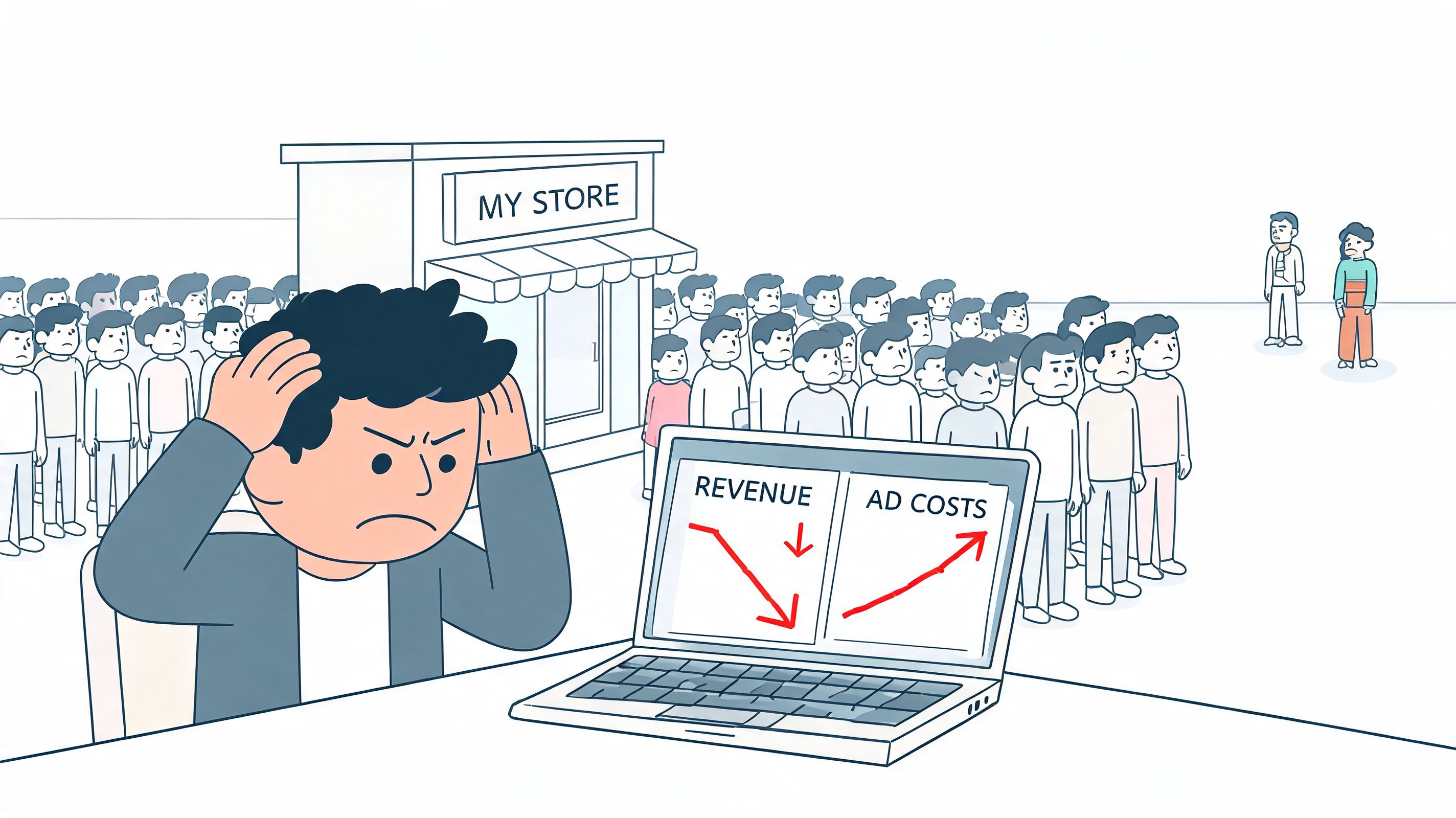
A founder usually notices it in a few places at once. Sales conversations feel repetitive. Wholesale outreach lands with the wrong companies. Paid traffic keeps growing, but the accounts that would materially change the business still aren't moving.
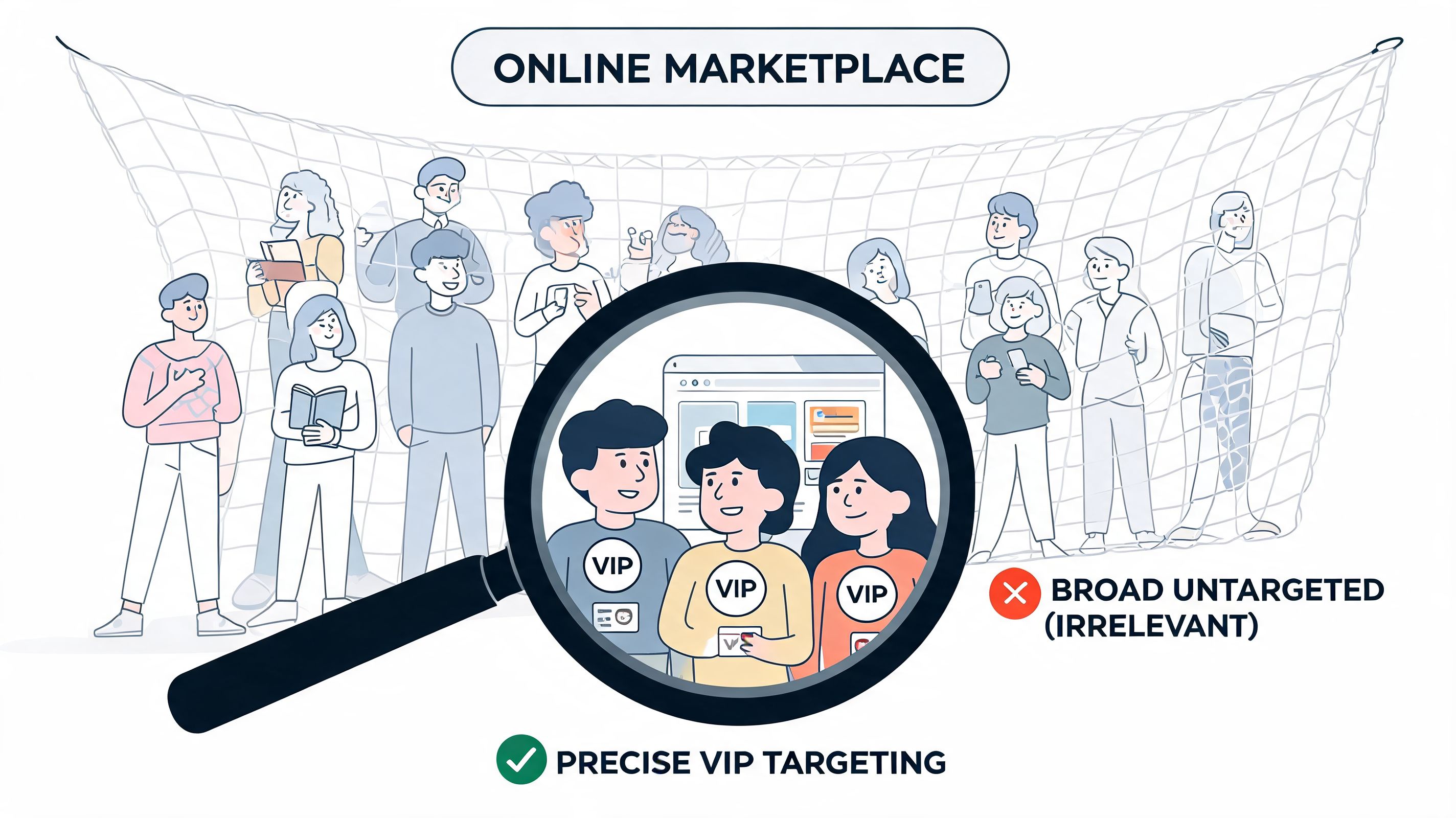
That's the moment to stop fishing with a net.
Broad reach stops working when your best buyers are specific
ABM is the discipline of deciding who matters most before you spend. Instead of asking, “How do we get more traffic?” you ask, “Which accounts would meaningfully grow revenue if we won them?”
For a Shopify brand, that account could be a retail chain, a distributor, a procurement team, or a premium customer segment worth nurturing with customized offers and content. The operating idea is simple. Fewer targets. Better fit. More relevant outreach.
Practical rule: If your team can name the companies or customer groups that would change next quarter's numbers, you're already thinking in ABM terms.
This isn't a niche tactic anymore. The global ABM market was valued at $1.07 billion in 2023 and is projected to reach $3,811.4 million by 2030, with a projected 17.9% CAGR from 2025 to 2030, according to G2's ABM statistics roundup.
Shopify founders need a better targeting layer
Founders often jump from weak broad targeting straight into expensive enterprise sales tactics. There's a middle path. Start with sharper segmentation, then build account-level plays around the groups with the highest upside. If you want a useful primer on new-customer acquisition before you narrow into ABM, Arlo Inc. guide for Shopify founders is a practical read.
The same logic applies inside your own database. Brands that already understand cohort behavior have a head start, which is why tighter audience planning matters before any agency starts buying media or building outreach. This is also where structured customer segmentation strategies for eCommerce growth become the bridge between classic performance marketing and true account-based execution.
What Account-Based Marketing Really Means
ABM sounds complicated because the category loves jargon. The core idea isn't complicated at all.
Traditional marketing behaves like net fishing. You cast wide, hope the right people swim in, then sort through what you catch. Account-based marketing is spearfishing. You decide which fish is worth catching first, then use the right gear, timing, and location to land it.
The unit of focus changes
In normal eCommerce acquisition, the unit is usually the click or the customer session. In ABM, the unit is the account.
That account might be:
- A wholesale buyer team at a regional retailer
- A set of procurement stakeholders inside a corporate gifting company
- A high-value customer cohort that buys repeatedly and responds to premium positioning
- A group of distributors that match your ideal expansion profile
This mindset changes how campaigns are built. You don't start with channels. You start with the account, the people involved, what they care about, and what would move them to buy.
For a clean explanation of how ABM creates more qualified business conversations, Grou's framework for qualified B2B conversations is worth reviewing.
The three ABM models
Most account-based marketing agency engagements fall into three models. They aren't better or worse than each other. They fit different goals.
One-to-one
This is the most customized version.
You select a small number of high-value accounts and build customized outreach around each one. For a Shopify brand, that could mean a bespoke landing page, custom assortment proposal, personalized email outreach, and paid social targeted to the buying team at one strategic retailer.
Use this when the upside per account is large and the buying process has multiple stakeholders.
One-to-few
This model groups similar accounts together.
Imagine you want to target premium spas, boutique hotels, or regional grocery chains that all fit the same purchase pattern. The messaging is still customized, but it's specific to a cluster rather than a single company.
This is usually the practical starting point for eCommerce brands because it balances personalization with scale.
One-to-many
This is the lightest-touch version.
You still define a strong ideal customer profile, but technology handles more of the targeting and personalization across a broader list. That can work for a Shopify brand entering B2B and testing whether a category of buyers is responsive before investing in deeper account treatment.
ABM isn't “fancy outbound.” It's coordinated marketing and sales effort aimed at a defined revenue target.
A good account-based marketing agency helps you choose the model your economics can support. If the expected account value is modest, deep one-to-one work won't make sense. If one retail partnership could materially affect revenue, broad generic outreach won't cut it.
Why Your eCommerce Brand Needs an ABM Strategy
The biggest mistake eCommerce operators make with ABM is assuming it's only for SaaS companies selling software contracts. That's too narrow. Shopify brands often have the same strategic problem. A small group of accounts or cohorts drives a disproportionate share of upside, but the marketing machine is still optimized for volume.
The retail angle is especially interesting because ABM already has evidence of impact there. Retail ABM is associated with a 208% increase in marketing-generated revenue over three years, while guidance on choosing agencies for Shopify-specific use cases remains limited, as noted in 42DM's review of ABM agency gaps and opportunities.
Four eCommerce use cases where ABM fits
Wholesale account acquisition
If you want larger retail partners, marketplaces, or resellers, broad paid media won't do much on its own. You need named-account targeting, better account research, and content that answers buyer concerns like margin, replenishment, assortment, and operational fit.
Shopify B2B channel launches
Brands moving into B2B on Shopify Plus often discover that having wholesale functionality isn't the same as having demand. ABM gives structure to the commercial side. Which buyers are a fit? Which industries should see custom outreach? Which accounts need category-specific offers?
High-LTV B2C cohort expansion
ABM thinking also works for premium consumer groups. You may not market to a company, but you can market to a tightly defined, high-value segment with account-like precision. VIP retention campaigns, private offers, premium bundles, and personalized lifecycle messaging all borrow from ABM logic.
Winning back strategic accounts
Many brands have dormant wholesale or enterprise buyers sitting in the CRM. They bought once, then went quiet. ABM is often the cleanest way to re-open those relationships because it forces focused outreach rather than another generic email blast.
Why this matters now
There's a gap in the market. Many agencies say they do ABM, but most of their examples come from software or generic B2B. That leaves Shopify brands translating the strategy themselves.
A practical overview can help before you commit budget, especially if your team is still figuring out where ABM fits in the funnel.
Brands don't need ABM because it sounds advanced. They need it when a handful of buyers matter more than a flood of anonymous traffic.
The primary advantage for eCommerce brands is focus. ABM pushes your team to treat key accounts like revenue projects, not list segments. That usually leads to better sales conversations, stronger retention planning, and less waste across media and outreach.
Core Services a Specialized ABM Agency Provides
A strong account-based marketing agency should give you more than targeting slides and a few ads. The work usually falls into four practical pillars.
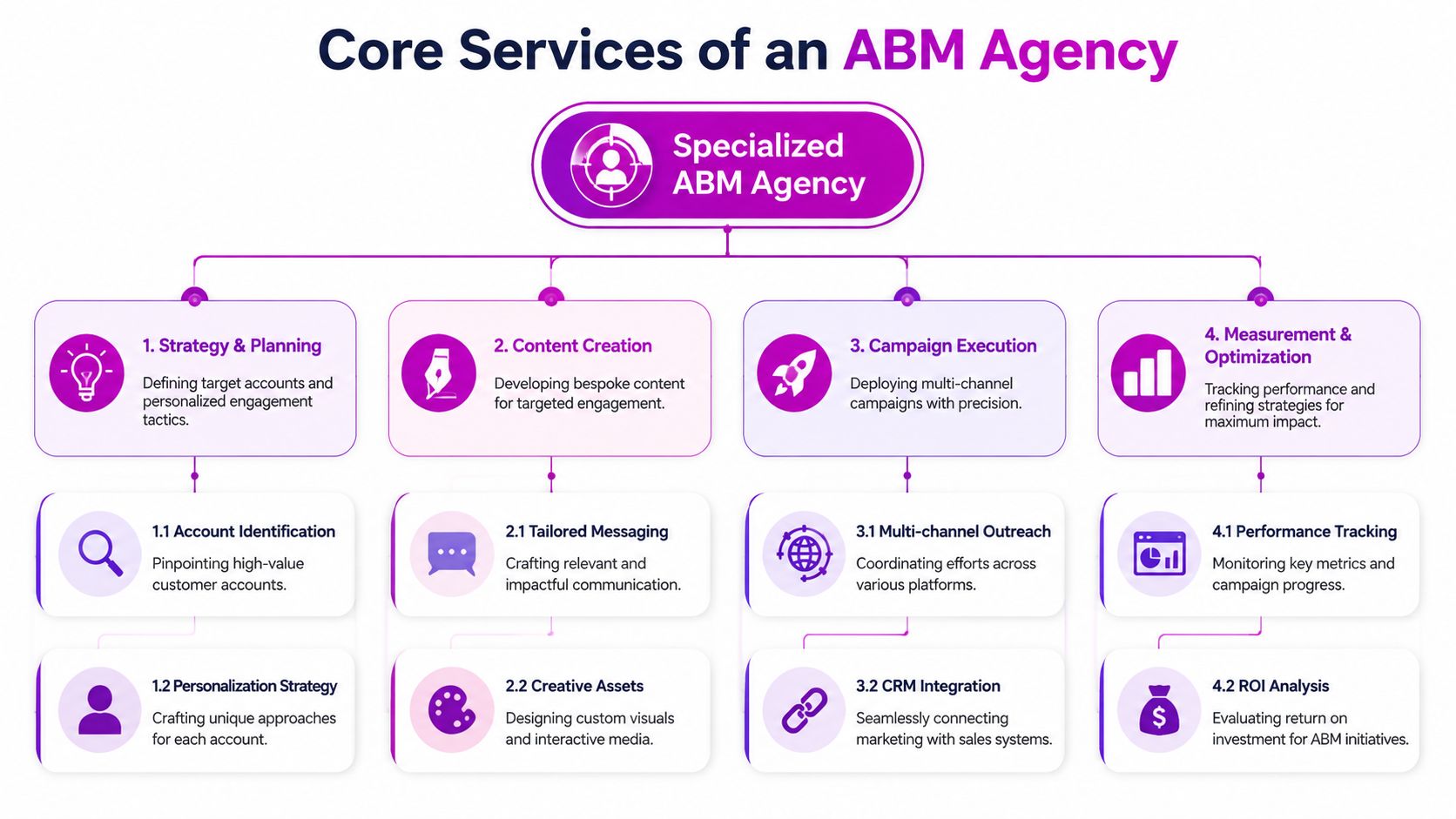
Leading agencies use platforms like Terminus and 6sense Revenue AI to coordinate campaigns across email, display, and social, and AI-generated personalization has been shown to lift reply rates by 29%, according to The ABM Agency's guide to 2025 execution.
Strategy and account selection
The agency proves whether it understands your business or not at this stage.
A useful partner should help define your ideal customer profile with actual commercial logic. For a Shopify brand, that often includes company type, product fit, order potential, geography, and operational match. If they can't explain why an account belongs on the list, the campaign will drift.
Typical deliverables include:
- ICP definition based on commercial fit, not loose persona language
- Tiered account lists for strategic, mid-priority, and scalable targets
- Buying group mapping so sales and marketing know who needs to be influenced
Campaign orchestration across channels
Good ABM doesn't rely on one channel. It coordinates touches so the same account sees a coherent story.
That can include LinkedIn, email, display, paid social, direct outreach, landing pages, and sometimes direct mail. For eCommerce, the mix often depends on who the buyer is. A retail buyer and a corporate gifting lead won't respond to the same pattern.
Common outputs look like this:
- Paid media plans targeted to named accounts or account clusters
- Outbound sequences aligned with campaign timing
- Sales enablement workflows so your team knows when and how to follow up
Field note: If paid ads, email, and sales outreach are all saying different things, you don't have ABM. You have channel clutter.
Personalized content and creative
Many generalist agencies fall short in this area. They reuse generic demand-gen assets and swap logos.
Specialized ABM work should produce content that helps an account say yes. That may include buyer-specific landing pages, custom pitch decks, assortment proposals, vertical messaging, or creative customized for one product line and one account type.
Examples:
- Vertical landing pages for hospitality, retail, or corporate gifting buyers
- Account-specific messaging that reflects known pain points and goals
- Decision-stage creative such as offer sheets, ROI framing, or procurement-ready materials
Technology and measurement
ABM creates complexity fast, so reporting has to move beyond clicks.
A capable agency should manage the stack, connect signals from platforms like 6sense or Demandbase where relevant, and give your team a view of account engagement, progression, and contribution to pipeline. If you only get a media report, you're missing the point.
Expect:
- Dashboard setup that tracks account engagement and progression
- Attribution logic connecting touchpoints to opportunity movement
- Optimization cycles based on account response, not channel vanity metrics
How to Evaluate and Choose the Right Agency
A polished pitch deck doesn't tell you whether an agency can run ABM for a Shopify brand. The useful test is whether they can connect targeting, execution, and measurement to the way your business makes money.
One signal matters immediately. Mature ABM programs achieve 200% larger deal sizes, and agencies that run them well track everything from email open rates in the 25% to 40% range to pipeline velocity, with models that can predict an account's buying stage with up to 85% accuracy, according to Digital Applied's ABM statistics analysis. If an agency talks only about impressions and leads, it's not thinking at the right level.
Questions worth asking on the first call
Use the first meeting to pressure-test depth, not chemistry alone.
- Show me an eCommerce example. Ask for work involving Shopify, wholesale, retail partnerships, or high-value customer cohorts. If everything is SaaS, translation risk is on you.
- How do you choose target accounts? You want a clear method, not “we'll test audiences.”
- What does personalization mean in your process? Good answers mention messaging, offers, creative, and sales alignment. Weak answers usually mean token customization.
- How do you measure success beyond lead volume? They should talk about account engagement, pipeline movement, deal quality, and revenue contribution.
- What happens when sales disagrees with the account list? Strong agencies already have a process for this.
- Who owns the tech stack and reporting? You need to know whether they can work inside your systems or require a heavy rebuild.
- What are the first signs a pilot is working? They should define early signals without hiding behind vanity metrics.
What to watch for in reporting
A real account-based marketing agency reports on commercial movement, not just media activity. For eCommerce brands, that means translating ABM metrics into familiar outcomes.
A few examples:
| ABM view | eCommerce translation |
|---|---|
| Account engagement | Are the right wholesale or strategic buyers interacting? |
| Pipeline velocity | Are target accounts moving faster toward conversation or deal stage? |
| Deal size | Are account-led opportunities larger than standard inbound business? |
| Opportunity quality | Do these accounts have better repeat purchase or expansion potential? |
That's why general agency selection advice only gets you part of the way. The harder question is whether they can map ABM work to your commercial model. If you want a broader framework for agency evaluation before narrowing to ABM specialists, this Shopify marketing agency guide for scaling success is a useful companion.
The wrong agency will send more reports. The right one will help your team make better account decisions.
Red flags that usually show up early
Some warning signs are easy to miss in a polished sales process:
- Too much channel talk before they've asked about your top accounts
- No view on sales collaboration, especially if wholesale or enterprise deals involve multiple people
- Case studies without business context, where you can't tell what was sold or why the account mattered
- Reporting built around CTR and traffic only, with no path to revenue accountability
If you see those, keep looking.
Understanding ABM Agency Engagement Models and Pricing
Pricing in ABM is murky because agencies package strategy, creative, tech, media, and sales coordination differently. That's frustrating for founders, but the pattern is still predictable enough to evaluate.
One verified benchmark is clear. Full-service ABM agencies often charge $10K to $50K per month for enterprise retainers, while flexible subscription-style models for mid-market eCommerce remain underdefined, according to Gripped's analysis of ABM agency pricing gaps.
What the common models look like
Some agencies start with a fixed pilot. Others push straight into a retainer. A few experiment with performance-based structures, although those can get messy when attribution is shared across sales and marketing.
Here's the practical comparison.
| Model | Typical Cost Range | Best For |
|---|---|---|
| Pilot | Qualitative only. Pricing varies by scope and there isn't enough verified benchmark data to cite a standard pilot range. | Brands testing ABM on a narrow account list before a larger commitment |
| Retainer | $10K to $50K per month for enterprise full-service engagements | Teams that need ongoing strategy, campaign execution, creative, and reporting |
| Performance-based | Qualitative only. Structures vary widely and dependable benchmark pricing isn't established in the verified data. | Brands that already have clear attribution rules and want incentives tied to commercial outcomes |
The trade-offs matter more than the label
A pilot sounds safer, but some pilots are too small to prove anything. If the agency only runs light outreach without real personalization or sales coordination, the result won't tell you whether ABM can work.
Retainers give the agency room to build the system properly, but they also increase the cost of a bad fit. That's why eCommerce brands should inspect deliverables line by line. Are you paying for strategy only? Media management too? Creative? Platform setup? Reporting? Sales enablement?
Performance pricing sounds attractive, but it often breaks when account influence is shared. If your internal team closes the relationship, the agency may still have shaped the opportunity. That's why many serious ABM engagements prefer a base fee with very clear scope.
What eCommerce brands should push for
Ask for:
- A defined account scope so you know how many targets are included
- Named deliverables for strategy, content, media, and reporting
- Clear measurement rules before anyone mentions performance bonuses
- Flexibility if your brand wants to blend in-house execution with external ABM support
For Shopify brands, hybrid setups often make the most sense. The internal team owns product truth and customer nuance. The agency brings process, orchestration, and targeting discipline.
Your Next Steps to Launching an ABM Pilot
You don't need a giant enterprise program to get started. Most Shopify brands should begin with a small, disciplined pilot that proves whether focused account work can outperform broad acquisition for a defined goal.
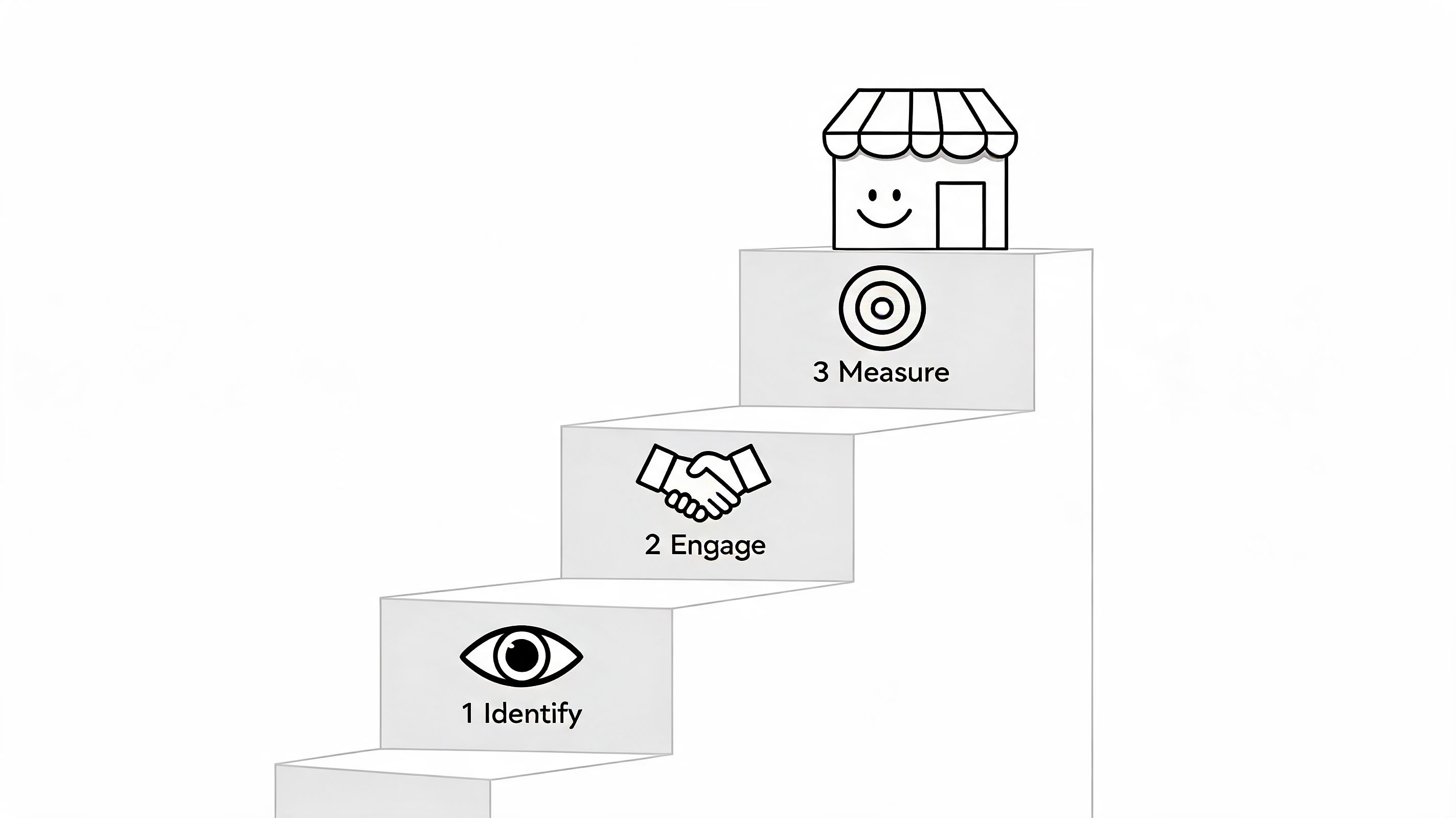
Step one: identify the accounts that would matter
Start with your internal short list. Not a giant spreadsheet. A manageable set of dream accounts or high-value cohorts your team already believes in.
That list might include target retailers, distributors, corporate buyers, dormant wholesale accounts, or premium customer groups with strong repeat economics. If your team can't explain why an account belongs on the list, cut it.
Step two: estimate the upside before you spend
ABM only works when the account value justifies focused effort. That doesn't require perfect forecasting. It requires sensible commercial math.
Ask:
- What could this account be worth over time?
- What would a repeat relationship look like?
- Would winning a few of these accounts change revenue quality, not just volume?
Founders should think beyond first order revenue. A strong account can improve retention, reorder behavior, average order quality, and channel stability.
Start with the accounts your sales team already wants, your ops team can support, and your margins can justify.
Step three: run informed agency conversations
Use the questions from earlier in this guide and keep the first brief focused. The goal isn't to buy a huge engagement. It's to learn whether the agency can translate ABM into your eCommerce context.
Bring a short account list, a clear commercial objective, and a simple success definition. For example, better engagement with wholesale buyers, movement in dormant strategic accounts, or stronger penetration of a premium customer segment.
A good first pilot is narrow enough to manage and meaningful enough to judge. If it works, you scale. If it doesn't, you'll know why.
If your Shopify brand is ready to test a sharper growth strategy instead of spending more on broad acquisition, ECORN can help you connect targeting, site experience, and conversion work into a more focused revenue plan. That's especially useful when your best growth opportunities come from a small number of high-value accounts, not another batch of low-intent traffic.


Ecommerce Analytics Consulting for Growth
What Is AI Integration for eCommerce
How to Choose the Right eCommerce Website Development Firm
E Business Strategy Implementation
Conversion Tracking Setup for Shopify Stores
BigCommerce vs Shopify Plus Which Enterprise Wins in 2026
Shopify Theme Kit: Setup, Commands, and Migration Guide
Shopify Extension Development: A Practical 2026 Guide
Shopify Speed Score Explained and How to Improve It
Shopify Mobile Optimization: The 2026 Playbook
How to Add Subcategory in Shopify for Better UX
How to Implement Structured Data for Ecommerce in 2026
SEO App Mobile: Shopify Store Optimization Guide
Shopify Plus Support: What It Includes and How to Choose
Google Ads for Shopify: The Complete 2026 Playbook
Shopify New York: How to Find and Hire the Right Agency
Google Search Console for Shopify: The Complete Setup
First Party Data Collection for eCommerce Growth
FAQ Online Store Guide: Build and Measure It Right
Do FB Ads Work for eCommerce in 2026?
One Page Checkout for Shopify: Design and Implementation
Shopify GraphQL vs REST: The 2026 Developer Decision
Shopify Ecommerce Consulting: Strategy, Pricing &
Are Reddit Ads Worth It for eCommerce Brands
Shopify Title and Meta Description: A Practical 2026 Guide

Product Video Best Practices for Shopify Brands
Real-Time Inventory Management: A 2026 Guide
AI Chatbot Integration for Shopify Stores
Affiliate Program Management: A Shopify Guide
10 Best Performance Monitoring Tools for Shopify in 2026
Digital Asset Management for eCommerce Brands in 2026
Every Type of Facebook Ads Explained for eCommerce Growth
Product Information Management Explained for Shopify Brands
Support Ticket System: A Guide for Shopify Stores

10 Best Customer Service Tools for Shopify in 2026

Can I Start a Business with No Money? a 2026 Blueprint
What Sells Good on Etsy: Best Niches for 2026

Shopify Add to Cart Button: A Practical 2026 Guide

Customer Feedback Automation: A Practical eCommerce Guide
Critical Rendering Path: A Guide for Shopify Stores

How to Promote on TikTok for eCommerce in 2026

B2B eCommerce Consulting That Drives Real Revenue
10 Best Practices for Site Navigation in 2026
Return vs Refund for Shopify Stores: A Practical Guide
What Is Customer Lifetime Value and Why It Matters
What Is Voice of Customer Research for eCommerce

SMS Marketing for Ecommerce That Actually Converts

Master How to Improve Email Deliverability in 2026

Top 7 eCommerce Partners NYC for Shopify Brands in 2026
Machine Learning for Ecommerce: Boost Your Shopify Store

Beauty Market Research: Your 2026 Growth Guide

Shopify International Expansion: A 2026 Roadmap
What Does CRO Stand for in Business: Understanding CRO
Shopify Visual Merchandising: A Playbook for Higher Sales
Shopify Landing Page Design: Master Conversion in 2026
10 Best AI SEO Optimization Tools for Shopify in 2026

Agentic AI for Ecommerce: Boost Your Sales in 2026
Mastering Email Marketing Data for eCommerce Growth

Conversion Rate Optimisation Australia: Boost Your Sales
Conversion Rate Optimization AI: Your Shopify Store Guide

10 Product Bundling Strategies for Shopify in 2026
How to Increase Customer Lifetime Value: A Shopify Playbook
AI Customer Service Automation: Shopify Guide 2026
Clean Website Design: A Shopify Conversion Playbook

Omnichannel Retail Strategy: A Shopify Playbook
Product Data Enrichment: A Guide for Shopify Brands
Instagram Shopping Features a Guide for Shopify Stores
What Is Revenue Optimization: A Holistic RevOps Guide

Benefits of Conversion Rate Optimization: Boost Your
WordPress to Shopify Migration: Your 2026 Seamless Switch
Boost Sales: Ecommerce Payment Processing Guide 2026
Unified Commerce Platform: Benefits, KPIs & Shopify Guide
How to Reduce Bounce Rate eCommerce: Your 2026 Guide
Shopify API Integration: A Practical End-to-End Guide
How to Implement Data Governance: A 2026 Guide
Shopify Store Development Cost: A 2026 Breakdown
What Is Server Side Tracking: The Shopify Guide 2026
Marketing Automation Workflows: A Shopify Guide for 2026
Shopify: How to Reduce Technical Debt

Shopify UX Design Change: A Playbook for Growth
User Generated Content Strategy: Shopify Playbook
Shopify Pause and Build Plan Cost: A Complete 2026 Guide
Compare at Price on Shopify: A Complete Guide for 2026
Where Can I Sell My Prints? 10 Best Platforms for 2026
Shopify Order Management System: The Ultimate Guide 2026
What Is Marketing Attribution? an eCommerce Guide for 2026
10 Best Black Friday Sales Sheets for 2026

Discover the Top Social Media Marketing Agencies For
Consumer Confidence Definition for eCommerce in 2026
What Is Social Commerce? Your 2026 Guide to Boosting Sales
A Social Ad Campaign Playbook for eCommerce Growth
7 Best FAQ Page Examples for SaaS & eCommerce

Market Research in Fashion Industry: A Guide for Shopify
Shopify Migration Services: Expert Guide for 2026
Mastering FB Retargeting Ads for Shopify in 2026
What Is Omnichannel Ecommerce
Master Your Shopify Plus Migration: The 2026 Guide
Shopify Integration Services: A Merchant's 2026 Guide
Shopify Collection Description: A Guide to SEO & Sales
Shopify Plus Contact: Reach Sales & Support Effectively


newsletter in your inbox