

Trying to pin down an ecommerce website development cost can feel like guesswork. You see numbers all over the place, from a few thousand dollars to figures that look more like a down payment on a house. The truth is, a new ecommerce site can run you anywhere from $3,000 to over $250,000.
That massive range comes down to one key decision: your development path. A straightforward Shopify store built from a theme is on the lower end, while a completely custom-coded site with unique features will be at the very top of that scale.
Your Quick Guide To Ecommerce Website Costs in 2026
So, what's a realistic budget for your brand? Let's cut through the noise and give you some solid numbers to work with. The platform and approach you select will be the single biggest driver of your final cost.
The path you take depends entirely on your business's current stage and future goals. For instance, a basic Shopify setup might cost between $3,000 and $15,000. On the other hand, a fully custom build from the ground up can easily go from $50,000 to $250,000 or more. You can dive deeper into how these costs add up in this detailed ecommerce cost breakdown.
Ecommerce Development Cost Comparison At A Glance
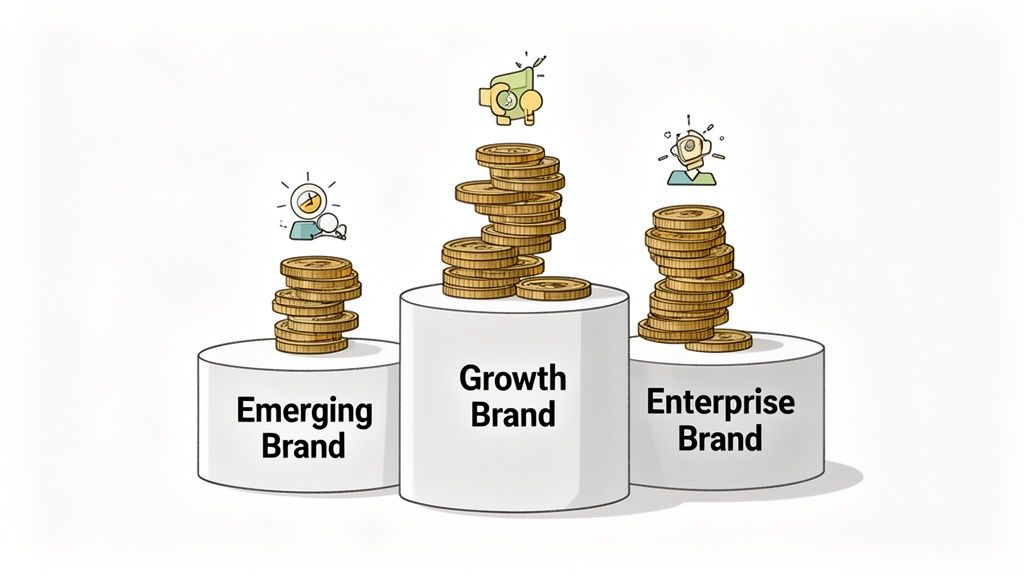
To put it simply, think of it in three tiers. Each one is designed for a different kind of business, from a startup just getting its feet wet to a major enterprise that needs a powerhouse solution.
The table below breaks down these three main approaches. It gives you a quick look at the estimated initial investment and the type of brand each one is best suited for.
This gives you a clear framework for figuring out where your budget should land based on your immediate needs and long-term ambitions.
Comparing Development Paths
This chart offers a visual way to understand the starting costs for the most common ecommerce development routes.
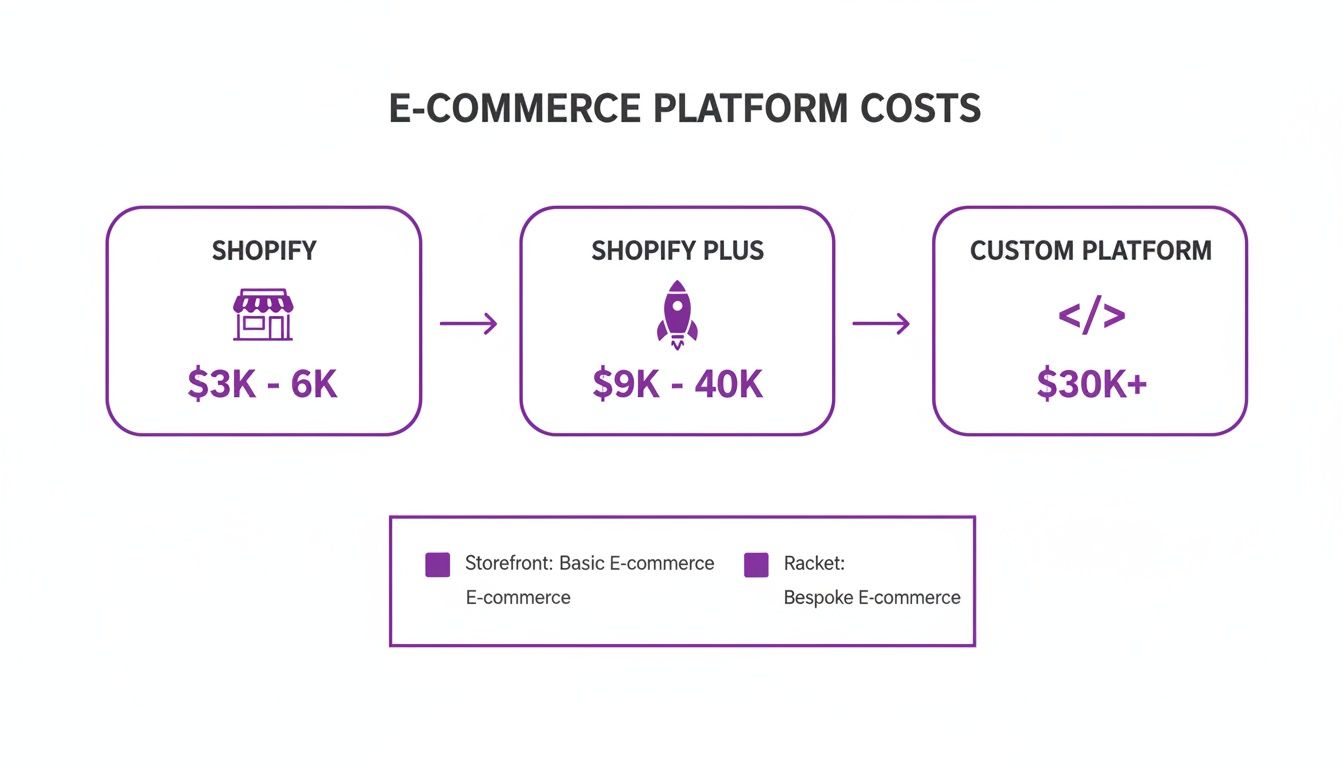
As you can see, there's a clear step up in cost and complexity as you move from a standard platform to a fully custom solution.
Key Takeaway: The "best" choice isn't about spending the most money; it's about finding the right fit. A small, emerging brand simply doesn't need a $100,000 custom site, and a large enterprise will hit the limits of a basic setup almost immediately.
Understanding Your Core Investment Decisions
Before you even think about a single line of code, your final ecommerce development cost really comes down to two big, foundational choices. These aren't just about where you spend your money; they're strategic moves that will shape your brand's growth, how your team operates day-to-day, and your ability to scale down the road.
First up is the classic "build vs. rent" question. This is all about deciding who’s actually going to construct and look after your digital storefront. You can go with an agency, build your own in-house team, or piece it together with freelancers.
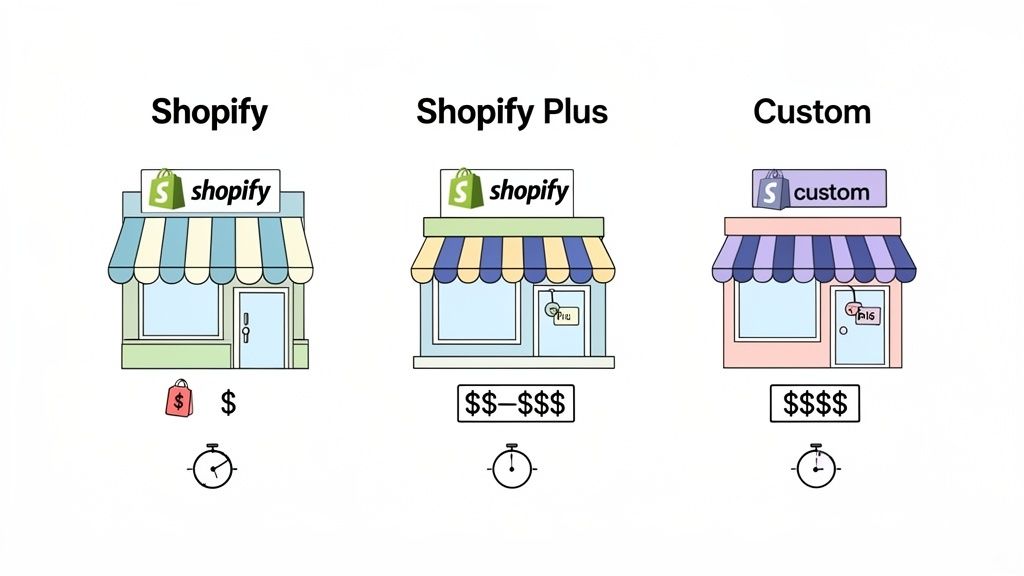
Agency vs In-House Team vs Freelancer
Hiring an ecommerce agency is like bringing in a professional F1 pit crew. They show up with a complete team of specialists—designers, developers, strategists, and project managers—who’ve done this dozens of times before. You get instant expertise, speed, and a smooth process, but that turnkey service comes at a premium.
Building an in-house team is more like designing and building your own professional-grade kitchen from the ground up. You get total control over every single detail, and the team is woven directly into your company culture. The catch? Recruiting, hiring, and training top-tier talent is a slow, expensive, and never-ending commitment. The annual cost for salaries and benefits for even a small ecommerce team can easily blow past $300,000.
Working with freelancers is the middle-of-the-road option. You can pull in specialized talent for specific jobs, which gives you a ton of flexibility and control over costs. The real challenge is in managing the project and making sure all the different pieces from different people fit together perfectly.
An agency gives you a ready-to-go solution with immediate, specialized expertise. An in-house team offers deep company integration and long-term control. Freelancers deliver on-demand skills with maximum flexibility. Your choice here doesn't just set your initial budget; it dictates your speed to market and how agile you can be later on.
Platform vs Custom Development
Your second major decision is about the technical foundation—the "chassis" your entire store is built on. You can either use an established ecommerce platform like Shopify or go all-in and build a completely custom solution from scratch.
Ecommerce Platforms (e.g., Shopify, Shopify Plus)
Think of a platform like Shopify as buying a high-performance, customizable race car straight from a top manufacturer. It’s engineered on a proven, secure, and ridiculously fast frame. You get to customize the paint job (your theme), upgrade the engine (apps), and fine-tune the suspension (settings), but the core mechanics are already handled for you. This approach slashes your initial development time and costs.Custom-Built Solutions (e.g., Headless Commerce)
A custom build is like designing and engineering a one-of-a-kind vehicle from the ground up. You have absolute freedom to create any wild feature or user experience you can dream of. This is often the path for enterprise-level businesses with incredibly specific operational needs, but the ecommerce website development cost and complexity are on another level, often taking many months to even get to a starting line.
For the vast majority of brands, a platform gives you the best mix of power, flexibility, and cost. A solid platform provides a strong foundation that you can easily extend with apps and integrations. This lets you focus your budget on what really moves the needle—your customer experience and growth.
If you're still weighing the options, our guide on how to choose the right ecommerce platform can help you find the perfect fit.
Ultimately, these two decisions—how you build and what you build on—are the biggest drivers of your total investment. Making the right call here from the start ensures your budget is working for you, not against you.
That big, scary number on a project proposal can feel like a black box. But just like building a house, you’re not just paying for “a house.” You're paying for the foundation, the framing, the plumbing, and the finishing touches that make it your home.
Let's pull back the curtain on what goes into an ecommerce development project. When you understand what you're actually paying for, you can make smarter decisions and get the most out of your budget.
UX and UI Design: The Blueprint For Your Store
Before a single line of code gets written, you need a plan. That’s where User Experience (UX) and User Interface (UI) design come in. Think of it as the difference between picking a stock floor plan and hiring an architect to design a custom home.
- Theme Customization ($1,500 – $5,000): This is the fastest way to get a professional-looking site. We take a high-quality, pre-built Shopify theme and tailor it to fit your brand's colors, fonts, and style. It's a fantastic starting point for new and emerging brands.
- Bespoke UX/UI Design ($5,000 – $20,000+): This is the custom-built route. Our designers start from scratch, mapping every customer journey, creating wireframes, and building a completely unique storefront designed to meet your specific business goals and wow your customers.
This isn't just about looking pretty. A well-designed site has a direct impact on your bottom line. Studies have shown a great UI can boost conversion rates by up to 200%, and a thoughtfully crafted UX can push that number up to 400%. That initial design investment pays for itself over and over by turning more visitors into loyal customers.
Development: The Engine and Bodywork
With the design blueprint signed off, our developers fire up their keyboards. This is where the designs come to life. The work is usually split into two parts that work hand-in-hand.
Frontend Development ($5,000 – $25,000+): This is everything your customers see and click on—the "bodywork" of your car. Developers use languages like HTML, CSS, and JavaScript to translate static designs into a live, responsive website that looks great on any device. The cost here is tied to the complexity of the design and any custom animations.
Backend Development ($7,000 – $40,000+): This is the "engine" powering your store. It’s all the heavy lifting that happens behind the scenes: processing orders, managing your product catalog, handling customer accounts, and connecting to payment gateways. On a platform like Shopify, a lot of this is already built, but custom features or logic will add to the scope and cost.
The development phase is where your vision truly becomes a reality. The price reflects the highly skilled work needed to build a fast, secure, and reliable online store that can handle your business's day-to-day operations without breaking a sweat.
Integrations and Apps: Connecting Your Ecosystem
An ecommerce store rarely stands alone. It needs to talk to all the other tools you use to run your business, acting as the central hub of your entire operation. Think of these integrations as the nervous system that keeps data flowing smoothly.
Some of the most common integrations include:
- ERP (Enterprise Resource Planning): For syncing inventory, order, and supply chain data.
- CRM (Customer Relationship Management): To keep customer data aligned for marketing and support teams.
- Payment Gateways: To process transactions securely and reliably.
- 3PL (Third-Party Logistics): To automate order fulfillment and shipping.
The cost for integrations can run from $2,000 to $15,000+ for each system. A simple app install is on the low end, but building a custom API connection to a legacy ERP system will be a more significant investment.
On top of that, you have monthly app subscriptions. Must-have Shopify apps for things like customer reviews, loyalty programs, or advanced search can add $100 to $500+ per month to your recurring costs. While it's an ongoing expense, these apps are critical for extending your store's functionality and driving conversions. This part of the ecommerce website development cost ensures your website is a powerful, interconnected business tool.
Beyond The Build Uncovering Hidden And Ongoing Costs
Thinking your new ecommerce website is a one-and-done deal is a classic mistake. Launching your site isn't the finish line; it's the starting line for your ongoing investment. The initial build is a major expense, sure, but it's the recurring costs that truly define your long-term total cost of ownership. Getting this part wrong can put your entire business in a tough spot financially.
It's a lot like buying a high-performance car. The sticker price is just where the spending begins. You still have to budget for gas, insurance, and regular service to keep it humming on the road. Your website is no different—it demands consistent investment to maintain its performance, keep it secure, and, most importantly, keep it profitable.
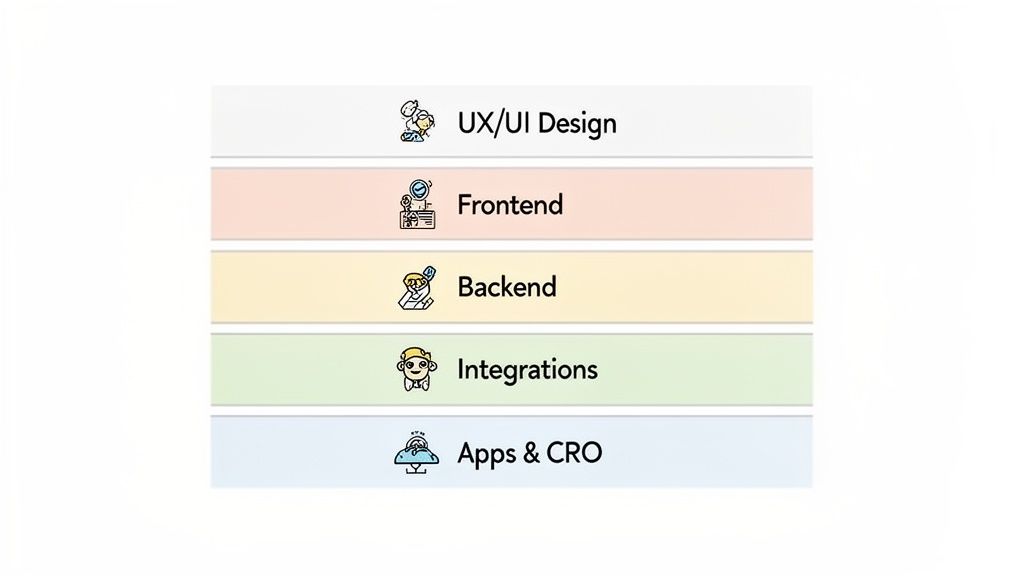
Core Recurring Costs Every Brand Faces
Every online store, regardless of size, has a few non-negotiable running costs. Think of these as the foundational expenses you have to plan for every year just to keep your digital doors open and your customer data safe.
- Hosting and Domain Fees: While platforms like Shopify bundle hosting into their plans, custom-built sites require you to foot this bill separately. Expect to pay anywhere from $30 to $500+ per month, depending on your traffic and performance needs. Your domain name also needs an annual renewal, which is typically $15 to $60 per year.
- SSL Certificate: This is an absolute must-have for encrypting data and earning customer trust. Many hosts include a basic one, but a premium Extended Validation (EV) certificate can set you back $100 to $500 annually.
- Platform Subscription Fees: If you're on a platform like Shopify Plus, this will be a significant line item, starting at $2,000 per month. Standard Shopify plans are much more accessible, ranging from $39 to $399 per month.
- App and Plugin Subscriptions: Those handy apps that power key features like product reviews, loyalty programs, and advanced search aren't always free. For a growing store, these monthly fees can easily add up to $200 to $1,000+ per month.
Proactive maintenance is your premium service plan. It prevents costly breakdowns like site crashes during a major sale, security breaches that destroy customer trust, and slow performance that sends shoppers to your competitors.
Budgeting For Maintenance Security And Growth
Beyond the fixed monthly subscriptions, you absolutely need a dedicated budget for proactive maintenance and strategic improvements. This isn't just about fixing things when they break; it's about optimizing for growth and protecting your initial investment.
Your maintenance budget should be roughly 15-20% of your initial development cost, annually. This covers critical tasks like installing security patches, updating apps to prevent conflicts, squashing bugs as they pop up, and running regular backups. For this kind of work, an agency retainer often falls between $1,000 to $5,000+ per month.
On top of that, your ongoing costs aren't purely technical. A huge chunk of your recurring budget needs to be earmarked for customer acquisition. Understanding effective advertising in e-commerce is critical, as this is the investment that directly drives the traffic that makes your shiny new website profitable in the first place.
The total cost of ownership in the first year often catches merchants by surprise. A growing ecommerce business, for instance, typically invests $8,000 to $25,000 in Year 1 alone. This covers professional design, better hosting, premium apps, and initial SEO work. For scaling or enterprise-level brands, first-year ownership costs can easily hit $30,000 to $100,000+, factoring in custom development, advanced features, and dedicated support. These numbers really drive home why you need to plan your budget with long-term ownership in mind from day one.
Sample Budgets For Every Stage Of Business Growth
Theoretical cost ranges are one thing, but seeing real-world examples is where it all starts to click. To help you connect the dots, we've put together three sample budget scenarios. Each one is a blueprint for a different stage of business, showing you how your spending priorities will change as your brand grows.
Think of this as turning those big, abstract numbers into an actual game plan. Find the scenario that feels closest to your current situation, and you'll get a much clearer picture of what it really takes to build and scale a successful store.
The Emerging Brand Focused On A Lean Launch
This is for the startup or small business just getting their feet wet. The number one goal here is a quick, professional, and affordable launch to get the ball rolling, test the market, and start bringing in revenue. The budget is tight, which means every dollar needs to work as hard as possible.
A theme-based Shopify store is the perfect play here. You keep upfront development costs low while still getting a secure, powerful, and scalable foundation. The focus is on a great-looking site, must-have features, and a small, targeted push to get your first customers.
The Growth Brand Ready To Scale
This brand is already in the game and likely pulling in over $25k/month. The goal isn't just about being online anymore—it's about optimizing every single detail to scale aggressively. The budget here is bigger, allowing for more advanced customization, serious conversion rate optimization (CRO), and smarter integrations to make everything run smoother.
For a growth-stage brand, the investment shifts from simply launching to building a conversion machine. This means spending more on custom design elements, advanced analytics, and tools that enhance the customer experience to maximize lifetime value.
The table below gives you an idea of a typical budget for a brand at this stage, likely investing in a more tailored Shopify or Shopify Plus experience.
Sample Budget For A Growth Brand (Scaling From $50k/month)
This breakdown shows how a growing brand might allocate its budget to go from steady sales to explosive growth. The focus shifts from basic setup to investing in a platform that can handle higher traffic, more complex operations, and a superior customer experience.
This level of investment is all about building a robust engine for growth that will pay for itself many times over.
The Enterprise Brand Needing Custom Solutions
When you get to the enterprise level, standard solutions just don't cut it. These brands operate at a scale where off-the-shelf software starts to buckle under the pressure. They need complex, custom-built platforms, deep integrations with internal systems like an ERP, and often a headless architecture for total control and flexibility.
The total ecommerce website development cost for an enterprise project usually starts at $75,000 and can easily sail past $250,000. This budget covers a dedicated team of developers, in-depth strategy and discovery work, custom API development, and ongoing retainers for support and continuous improvement. These aren't just website projects; they're long-term strategic investments built for massive scale.
As you map out your own budget, it’s also a good idea to forecast your potential return on that investment. Our ecommerce profit calculator can be a really helpful tool for running those numbers.
Smart Strategies To Maximize Your Ecommerce ROI
Shelling out for a new ecommerce website is a major step for any brand. But here’s the thing: a big price tag doesn’t automatically lead to a big return. The smartest brands I’ve worked with know that maximizing ROI isn't about throwing more money at the problem—it’s about spending that money strategically. You can absolutely control your ecommerce website development cost and still build a powerhouse, profitable store. It just takes deliberate choices that put impact ahead of excess.
What this really means is shifting away from the idea of a single, massive, all-or-nothing launch. The real goal is to get to market quickly, start bringing in revenue, and then use that cash flow to bankroll your future growth.
Launch Lean With A Phased Development Approach
Instead of getting bogged down trying to build your ultimate "dream store" right out of the gate, your focus should be on launching a Minimum Viable Product (MVP). An MVP isn't a cheap or half-baked site. It’s a strategically streamlined version that has all the essential features you need to go live, serve your first customers, and start making sales.
This approach has some huge upsides:
- Faster Time-to-Market: You begin generating revenue and getting real-world customer feedback weeks, or even months, sooner.
- Reduced Upfront Risk: You get to prove your business concept works without having to bet the farm on a massive initial investment.
- Data-Driven Decisions: You can use actual sales data and user behavior to guide what you build next, making sure you only spend money on what your customers actually want.
Once your MVP is live and turning a profit, you can start reinvesting a piece of that revenue back into the site. You add new features and make improvements in phases, creating a self-funding cycle of growth paid for directly by your customers.
Leverage Premium Themes As A Powerful Foundation
Starting with a high-quality premium theme is easily one of the smartest, most effective cost-saving moves you can make. These aren't just simple templates. They are robust foundations, built by expert developers who have already baked in the best practices for design, performance, and user experience.
By customizing a premium theme, you get 80% of the way to a custom-designed site for 20% of the cost. This frees up a huge chunk of your budget for things that actually drive traffic and sales, like branding, top-notch product photography, and marketing.
In the hands of a skilled development team, a premium theme can be customized so heavily that it’s completely unrecognizable from its original state. You end up with a unique, professional storefront without the eye-watering expense of building every single component from scratch.
Prioritize Features Based On Direct Impact
When you're planning your budget, it's so easy to get carried away with a long list of "nice-to-have" features. To get the best ROI, you have to be ruthless. Prioritize every feature based on its direct impact on your revenue and your customer's experience.
Before you greenlight any new feature, ask these questions:
- Will this directly help us sell more products? (Think improved product filtering or a one-click checkout).
- Will this tangibly improve the customer journey? (Like faster page loads or a super-clear returns policy).
- Will this solve a major headache in our daily operations? (For example, an integration that automates shipping).
Putting your money into conversion rate optimization (CRO) is a perfect example of this in action. A tiny tweak that lifts your conversion rate by just 0.5% can translate into thousands in new revenue, which then pays for the next round of site improvements.
And finally, never forget that a beautiful website is completely useless if nobody can find it. Optimizing your store for search engines is absolutely fundamental to getting traffic and making sales. To make sure your investment pays off for the long haul, learn how to implement effective Ecommerce SEO Best Practices to Boost Sales.
Frequently Asked Questions
When you're trying to pin down the cost of building an online store, a lot of questions pop up. We get it. Here are some quick, straight-to-the-point answers to the most common questions we hear from brands just like yours.
How Much Does A Basic Ecommerce Website Cost?
For a startup or small business dipping its toes into ecommerce, a professionally built site using a premium Shopify theme usually lands somewhere between $3,000 and $15,000. That budget typically covers the professional setup, customizing the theme to fit your brand’s look and feel, and getting essential apps configured for features like customer reviews or email marketing.
This route gives you a solid, scalable foundation to build on without the hefty price tag of a completely custom project. It’s the perfect way to get your products to market quickly and start generating revenue.
Is Shopify More Expensive Than A Custom Website?
Not even close—at least not upfront. A custom-built website often kicks off at $50,000 and can easily sail past $250,000, requiring months of dedicated design, development, and testing. In contrast, you can launch a powerful Shopify or Shopify Plus store for just a fraction of that initial spend.
It's true that a custom site has a huge initial cost, while Shopify comes with recurring monthly fees. But when you factor everything in, the total cost of ownership for a Shopify store is almost always far lower than managing the hosting, security, and constant maintenance a custom solution demands.
What Hidden Costs Should I Budget For?
Thinking beyond the initial build is crucial. A lot of brands get tripped up by the ongoing costs, so make sure you budget for these from day one:
- Monthly Platform Fees: Your Shopify plan can be as low as $39/month or go up to $2,000+/month for Shopify Plus, depending on your needs.
- App Subscriptions: Key apps for things like marketing automation, loyalty programs, and subscriptions can add another $100 to $500+ to your monthly bill.
- Payment Processing Fees: Expect to pay around 2.9% + 30¢ for every transaction, though this rate can vary based on your Shopify plan.
- Ongoing Maintenance: It’s wise to set aside a retainer ($1,000-$5,000+/month) for bug fixes, performance updates, and small feature improvements to keep your store running smoothly.
Can I Build An Ecommerce Website For Free?
You can start a free trial on platforms like Shopify to play around with the features, but you can't run a real, money-making business for free. As soon as you want to accept payments, use your own domain name, and get rid of the platform's branding, you'll have to upgrade to a paid plan.
Think of the "free" options as a test drive, not the actual car. A professional store that earns customer trust and securely handles sales will always require a real investment in a paid plan and a quality setup.
Ready to build an ecommerce store that drives growth without breaking the bank? At ECORN, we specialize in creating scalable Shopify and Shopify Plus experiences. Book a consultation today to get a clear, actionable plan for your project.


SEO Consulting for Ecommerce: A Practical Guide
Shopify Theme Updater App: A Safe Update Playbook
Shopify Git Integration: A Developer's Guide to 2026
Headless Ecommerce Development Services Explained

How to Build a Shopify Clothing Website That Converts
How to Launch a Box Subscription Business in 2026

Luxury Skincare Branding Playbook That Converters
10 Best Podcast Ecommerce Shows for Store Growth in 2026
Shopify Developer Hourly Rate: What to Pay in 2026
Critical Shopify Setup Errors That Are Secretly Sabotaging Your Store
Ecommerce Conversion Tracking: The Complete How-To Guide
Shopify Design Agency: How to Pick the Right Partner
Mastering Multi Store Management on Shopify
Scale Shopify Store
10 Shopify App Ideas Worth Building in 2026
Conversion Rate Optimization for Landing Pages: The Playbook
Shopify Plus Automation: A Guide for 2026
10 Social Selling Platforms for Shopify Merchants
Shopify Website Design Examples: 7 Stores Worth Studying
7 Ecommerce Newsletter Examples for Shopify Brands
One Product Shopify Store: Build and Scale
Mobile Pop Up Strategy for Shopify Stores That Converts
Sitemap for Shopify: How to Find, Optimize, and Submit It
7 Single Product Websites Worth Emulating
Product Variants Shopify: The Complete 2026 Guide
Ecommerce Analytics Consulting for Growth
What Is AI Integration for eCommerce
How to Choose the Right eCommerce Website Development Firm
E Business Strategy Implementation
Conversion Tracking Setup for Shopify Stores
BigCommerce vs Shopify Plus Which Enterprise Wins in 2026
Shopify Theme Kit: Setup, Commands, and Migration Guide
Shopify Extension Development: A Practical 2026 Guide
Shopify Speed Score Explained and How to Improve It
Shopify Mobile Optimization: The 2026 Playbook
How to Add Subcategory in Shopify for Better UX
How to Implement Structured Data for Ecommerce in 2026
SEO App Mobile: Shopify Store Optimization Guide
Shopify Plus Support: What It Includes and How to Choose
Google Ads for Shopify: The Complete 2026 Playbook

Shopify New York: How to Find and Hire the Right Agency
Google Search Console for Shopify: The Complete Setup
First Party Data Collection for eCommerce Growth
FAQ Online Store Guide: Build and Measure It Right
Do FB Ads Work for eCommerce in 2026?
One Page Checkout for Shopify: Design and Implementation
Shopify GraphQL vs REST: The 2026 Developer Decision
Shopify Ecommerce Consulting: Strategy, Pricing &
Are Reddit Ads Worth It for eCommerce Brands

Shopify Title and Meta Description: A Practical 2026 Guide

Product Video Best Practices for Shopify Brands
Real-Time Inventory Management: A 2026 Guide
AI Chatbot Integration for Shopify Stores
Affiliate Program Management: A Shopify Guide
10 Best Performance Monitoring Tools for Shopify in 2026
Digital Asset Management for eCommerce Brands in 2026
Every Type of Facebook Ads Explained for eCommerce Growth
Product Information Management Explained for Shopify Brands
Support Ticket System: A Guide for Shopify Stores

10 Best Customer Service Tools for Shopify in 2026

Can I Start a Business with No Money? a 2026 Blueprint

What Sells Good on Etsy: Best Niches for 2026

Shopify Add to Cart Button: A Practical 2026 Guide

Customer Feedback Automation: A Practical eCommerce Guide
Critical Rendering Path: A Guide for Shopify Stores

How to Promote on TikTok for eCommerce in 2026

B2B eCommerce Consulting That Drives Real Revenue
10 Best Practices for Site Navigation in 2026
Return vs Refund for Shopify Stores: A Practical Guide
What Is Customer Lifetime Value and Why It Matters
What Is Voice of Customer Research for eCommerce

SMS Marketing for Ecommerce That Actually Converts

Master How to Improve Email Deliverability in 2026

Top 8 eCommerce Partners NYC for Shopify Brands in 2026
Machine Learning for Ecommerce: Boost Your Shopify Store

Beauty Market Research: Your 2026 Growth Guide
Shopify International Expansion: A 2026 Roadmap
What Does CRO Stand for in Business: Understanding CRO
Shopify Visual Merchandising: A Playbook for Higher Sales
Shopify Landing Page Design: Master Conversion in 2026
10 Best AI SEO Optimization Tools for Shopify in 2026

Agentic AI for Ecommerce: Boost Your Sales in 2026
Mastering Email Marketing Data for eCommerce Growth
Conversion Rate Optimisation Australia: Boost Your Sales
Conversion Rate Optimization AI: Your Shopify Store Guide

10 Product Bundling Strategies for Shopify in 2026
How to Increase Customer Lifetime Value: A Shopify Playbook
AI Customer Service Automation: Shopify Guide 2026
Clean Website Design: A Shopify Conversion Playbook

Omnichannel Retail Strategy: A Shopify Playbook
Product Data Enrichment: A Guide for Shopify Brands
Instagram Shopping Features a Guide for Shopify Stores
What Is Revenue Optimization: A Holistic RevOps Guide
Benefits of Conversion Rate Optimization: Boost Your
WordPress to Shopify Migration: Your 2026 Seamless Switch
Boost Sales: Ecommerce Payment Processing Guide 2026
Unified Commerce Platform: Benefits, KPIs & Shopify Guide
How to Reduce Bounce Rate eCommerce: Your 2026 Guide
Shopify API Integration: A Practical End-to-End Guide

How to Implement Data Governance: A 2026 Guide


newsletter in your inbox