

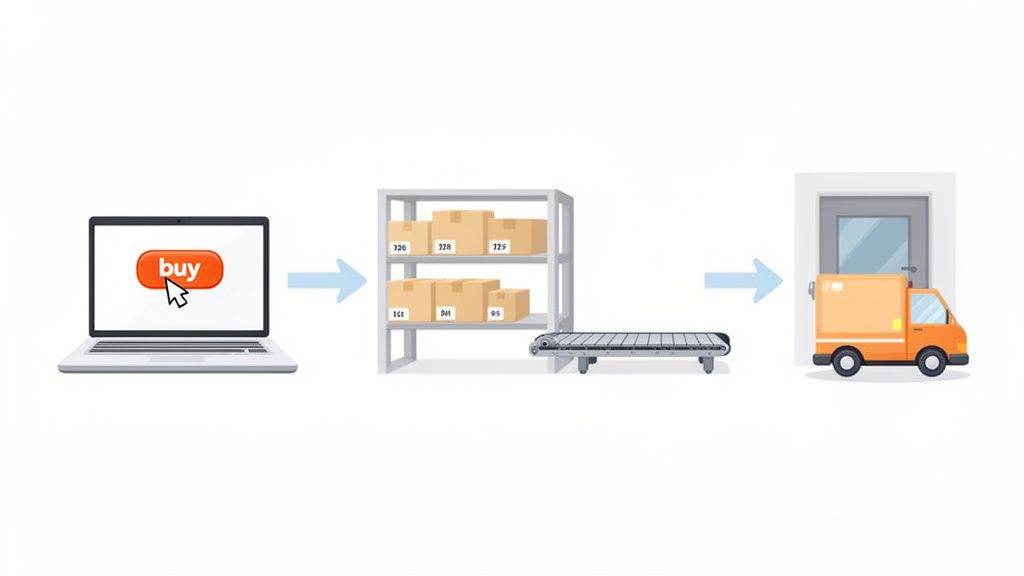
At its core, a Shopify fulfillment service is the behind-the-scenes engine that gets your products from your warehouse to your customer's doorstep. It handles everything that happens after a customer clicks "buy"—storing your inventory, picking and packing orders, and shipping them out.
Think of it like this: when you first start out, you're the head chef, waiter, and dishwasher all rolled into one. But as your restaurant gets popular, you can't keep doing it all. You hire a professional kitchen staff so you can focus on creating amazing new dishes and greeting your guests. That's what a fulfillment service does for your brand.
How Shopify Fulfillment Services Transform Your Operations
If you're like most Shopify store owners, your business probably started with you packing boxes in a garage, spare room, or office. This hands-on approach is perfect when you're managing just a few orders a day. But as your brand takes off, that manual process quickly becomes a major bottleneck, eating up precious time you could be spending on marketing and growth.
This is exactly where fulfillment services for Shopify come in to change the game. By teaming up with a third-party logistics (3PL) provider, you’re essentially outsourcing the entire physical side of your operation. Your inventory moves from your personal space into a professional warehouse built for one thing: getting orders out the door fast.
When a customer makes a purchase, the entire process kicks off automatically.
- Order Reception: The 3PL's system instantly pulls the new order directly from your Shopify store. No manual entry needed.
- Picking: A warehouse team member, guided by an efficient inventory system, finds the items for that order.
- Packing: Your products are securely packed in the right-sized box or mailer, often with options for your own custom-branded materials.
- Shipping: The 3PL prints the shipping label, hands the package off to the carrier (like UPS or FedEx), and pushes the tracking information back to Shopify, which automatically notifies your customer.
The Shift From Manual Labor to Strategic Management
This move marks a huge shift in your role as a founder. You stop being an order packer and start being a logistics manager. Your day-to-day focus moves from taping up boxes to strategically overseeing your supply chain—monitoring inventory levels, analyzing shipping data, and working with your 3PL to fine-tune the customer experience.
The explosive growth of Shopify’s ecosystem shows why this is so critical. The platform powered 2,846,464 live stores as of Q1 2026, a mind-boggling 278% total growth since Q1 2019. In a competitive field chasing a piece of the projected $6.9 trillion in global retail ecommerce sales, you can't afford to be bogged down. Especially when shipping can make up roughly 90% of your fulfillment costs.
A truly transformative Shopify fulfillment service often begins with an optimized physical space. Understanding the principles behind an efficient E-commerce Fulfillment Center Design Built For Speed Accuracy is crucial for ensuring rapid and accurate order processing.
A Snapshot of Daily Operations
To really see the difference, let’s compare a typical day for a brand managing its own fulfillment versus one using a 3PL partner.
| Operational Area | In-House Fulfillment (Manual) | Outsourced Fulfillment (3PL Service) |
|---|---|---|
| Inventory Management | Manually counting stock in your garage or storage unit; risk of stockouts or overstocking. | Real-time inventory levels synced with Shopify; automated low-stock alerts. |
| Order Processing | Printing packing slips, picking items, packing boxes, and printing labels one-by-one. | Orders are automatically received, picked, and packed by a professional team. |
| Shipping & Handling | Daily trips to the post office; manually entering tracking numbers. | Carrier pickups scheduled daily from the warehouse; tracking info auto-updates in Shopify. |
| Your Daily Focus | Packing and shipping orders, managing warehouse space, and dealing with carrier issues. | Marketing, product development, customer service strategy, and analyzing performance data. |
| Scalability | A sudden spike in orders (like from a sale) creates a huge backlog and late nights of packing. | The 3PL's staff and infrastructure easily absorb order spikes without delays. |
The contrast is pretty stark. Partnering with a 3PL isn't a luxury for a growing brand; it's a strategic move that frees up your time, capital, and energy. It allows you to focus on building a brand people love, confident that your partner is ensuring every customer gets their order on time, every time.
Choosing the Right Shopify Fulfillment Partner
Picking a fulfillment partner is easily one of the biggest calls you'll make for your Shopify brand. This isn't just a vendor; they become a true extension of your team, holding your customer satisfaction and your very ability to grow in their hands.
Get it right, and you've got a powerhouse for growth. Get it wrong, and you're staring down the barrel of logistical nightmares and a damaged reputation.
Think of it like choosing a co-pilot for your business jet. You need someone who is skilled, dependable, and whose fees align with your flight plan. Let's walk through the critical factors you need to weigh so you can pick the right partner with total confidence.
Demystifying Fulfillment Pricing Models
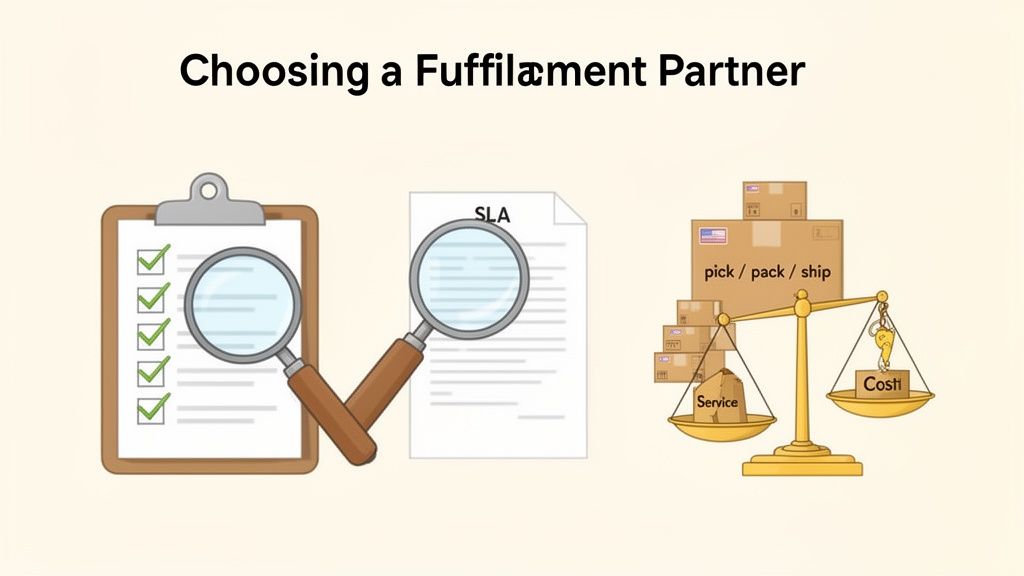
The first hurdle for most brands is just figuring out the cost. Fulfillment pricing is never a single line item. It’s a whole collection of different fees for different services, and getting a clear picture is vital to protect your profit margins from surprise charges.
Most fulfillment services for Shopify build their pricing around a few core activities:
- Receiving & Onboarding: This is a one-time fee to take in your initial inventory, count it all, and get it logged into their warehouse system.
- Storage: You'll pay a recurring fee, usually monthly, for the physical space your products take up. This might be calculated per pallet, per bin, or by the cubic foot.
- Pick & Pack: This is the fee you're charged for every single order they fulfill. It could be a flat rate, a per-item fee, or some mix of the two.
- Shipping: This is the actual postage cost from carriers like USPS, FedEx, or DHL. Your 3PL passes this on to you, often with a nice volume discount baked in.
- Account Management: Some partners will charge a recurring fee for having a dedicated support person on your account.
Don't just compare the pick-and-pack fee. A low per-order cost can be a smokescreen for sky-high storage fees or a long list of add-on charges for things like boxes or special handling. Always, always request a detailed, all-in quote based on your actual order volume and inventory.
Analyzing Service Level Agreements and Capabilities
Beyond what you pay, a partner's performance promises—their Service Level Agreements (SLAs)—are what really show their value. An SLA is their formal promise to hit specific service targets. If they don't, they typically owe you a service credit.
Here are the key SLAs and capabilities you need to dig into:
- Order Accuracy: What's their guaranteed percentage of orders shipped without a single mistake? The industry benchmark to look for is 99.5% or higher.
- Dock-to-Stock Time: How fast will new inventory be processed and ready to sell once it hits their warehouse? You should be looking for a 24-72 hour turnaround.
- Order Cutoff Time: What’s the absolute latest in the day an order can come in and still ship out same-day? A later cutoff time, like 2 PM or even later, is a massive competitive edge.
- Shipping Speed: Can they actually deliver on a 2-day shipping promise in the regions you serve? This is where their network of warehouse locations really comes into play.
Essential Services for Modern Ecommerce
Your vetting process shouldn't stop with the basics. The best fulfillment services for Shopify offer a whole range of features that a modern, customer-first brand needs.
Returns Management (Reverse Logistics): A clunky returns process is a surefire way to lose customers for good. A quality partner will have a smooth system for receiving, inspecting, and processing returns, with clear rules for restocking, quarantining, or disposing of items. Some even have integrations that can power your customer-facing returns portal.
Value-Added Services (VAS): Does your brand need a little something extra?
- Kitting: This is where they assemble multiple SKUs into one package, which is perfect for creating bundles or subscription boxes.
- Custom Packaging: Using your own branded boxes, tissue paper, or marketing inserts to craft that memorable unboxing experience.
- Quality Control: Performing inspections on your incoming inventory to catch manufacturing defects before they ever get to a customer.
International Fulfillment: If you're selling globally (or want to), your partner's international skills are non-negotiable. This means they need expertise in customs paperwork, calculating duties and taxes (DDP vs. DDU), and using global carrier networks to get you affordable and timely shipping around the world. A partner with a real global footprint is a huge asset.
Integrating Fulfillment Services with Your Shopify Store
Getting your new fulfillment partner connected to your Shopify store is the last big technical step before you can truly hand off your physical logistics. While this might sound intimidating, modern tools have made the whole process much more straightforward than you'd think. The main goal is to get your store and their warehouse talking to each other automatically.
There are really two main ways to make this connection. Figuring out which one is right for you is key, and it mostly comes down to your business needs and how comfortable you are with the tech side of things.
Shopify Apps vs Direct API Integrations
The most common, and by far the most user-friendly, route is using a dedicated app from the Shopify App Store. Most fulfillment partners build their own app that you just need to install and set up. This is the plug-and-play option, perfect for merchants who want a solution that just works, no custom code required.
A direct API (Application Programming Interface) integration is the more custom-built path. You can think of an API as a special language that lets two different software systems communicate directly. This approach is usually reserved for larger, more complex businesses that have unique workflows or their own in-house development team.
For the overwhelming majority of Shopify brands, the partner’s dedicated app is the way to go. It makes setup a breeze, ensures everything is compatible, and means you get ongoing support and updates straight from the provider.
To give you an idea of what this looks like, here’s a peek at Shopify's own fulfillment solution. It shows just how clean and integrated the experience should feel.
A properly integrated system like this gives you a single dashboard to manage inventory, keep an eye on orders, and see your entire fulfillment operation, all without ever leaving your Shopify admin.
The Core Integration Workflow
Whether you use an app or a direct API, the setup process follows a pretty logical path. Your aim is to make sure information flows correctly in both directions: orders go from Shopify to the warehouse, and inventory levels and tracking numbers come from the warehouse back to Shopify.
1. Authorize the Connection
First things first, you have to give your fulfillment partner permission to access your Shopify store’s data. If you’re using an app, this is as easy as clicking "Install" and approving the request. This initial handshake lets the two systems start talking.
2. Map Your Product SKUs
Pay close attention here—this is a critical step. You have to make sure the SKUs (Stock Keeping Units) in your Shopify catalog are a perfect match for the SKUs your fulfillment partner uses in their warehouse. Any mix-up will cause immediate shipping errors.
- Existing SKUs: You'll need to "map," or link, your current Shopify SKUs to the corresponding ones in the 3PL's system.
- New Products: Figure out a solid process for adding new products to both systems at the same time so they always stay in sync.
3. Configure Shipping Rates
Your fulfillment partner's app should help you set up shipping rates in Shopify that mirror the actual services they provide (like Standard, 2-Day, or Overnight). This is how you make sure you're charging customers the right amount and not losing money on shipping. For even more control, you can check out our guide on the best Shopify shipping apps to find tools with extra flexibility.
4. Run Test Orders
Before you flip the switch, you absolutely must run several test orders. Go to your live store and place a few orders just like a customer would. Then, log into your 3PL's portal and double-check everything:
- Did the orders show up automatically and correctly?
- Were the right products and customer address pulled in?
- After the 3PL "fulfills" the order, did the tracking number and "Fulfilled" status sync back to the order inside your Shopify admin?
This end-to-end testing is what saves you from launch-day headaches and guarantees your customers get a smooth experience from the very first order. This seamless integration is what makes fulfillment services for Shopify so effective, automating the entire post-purchase process and keeping your customers in the loop.
How Top Brands Use Fulfillment to Fuel Growth
The theory is one thing, but seeing how the best Shopify brands actually put fulfillment services for Shopify to work is where the real lessons are. For them, fulfillment isn't just a line item on a budget; it's a strategic weapon they use to grab market share, build rock-solid customer loyalty, and scale way faster than their competition.
Let's walk through a few real-world scenarios. These examples show just how the right fulfillment partner can solve some of the most pressing business challenges and open up new avenues for growth.
This visual breaks down the simple, three-step flow for getting a fulfillment partner plugged into your Shopify store.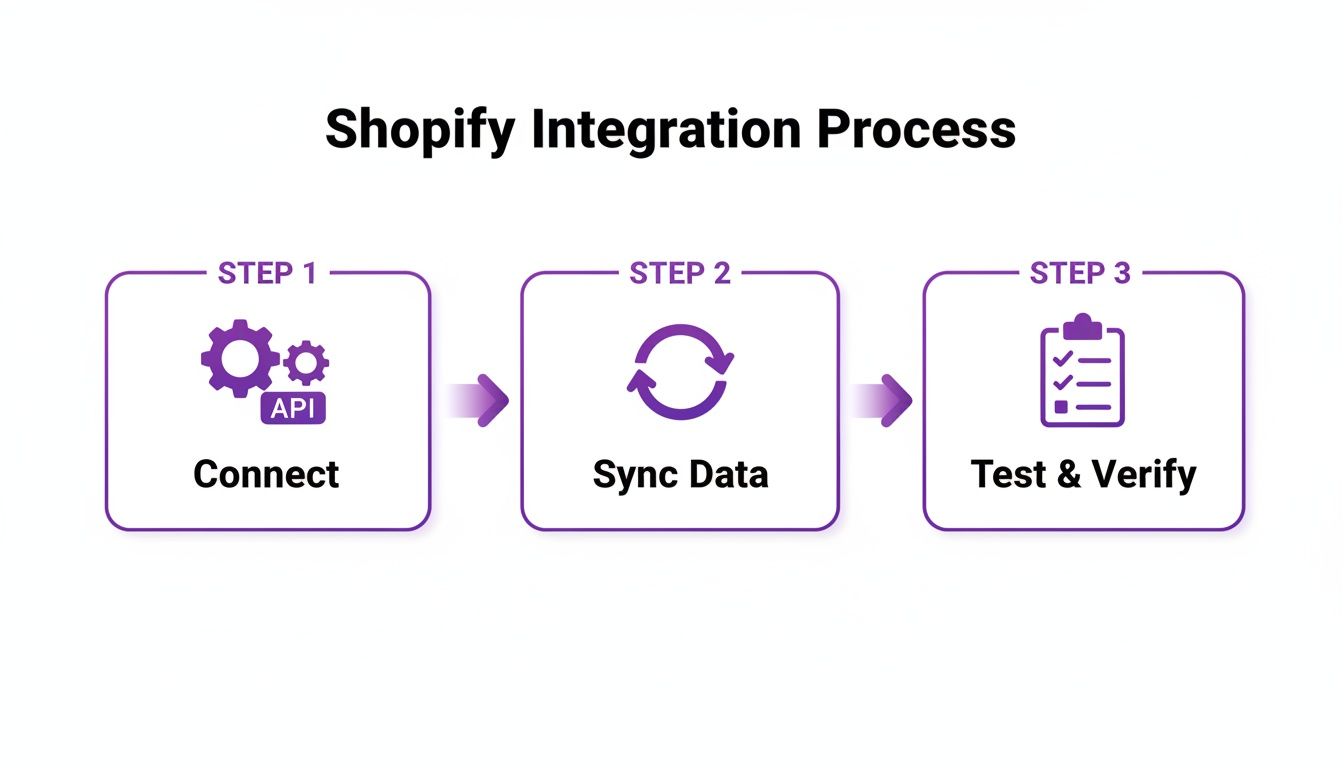
As you can see, modern integrations are built to eliminate technical headaches. Brands can connect their systems, sync all the critical data, and run tests on the entire workflow before a single live order goes through.
Scenario 1: The DTC Brand Overwhelmed by Success
Picture a DTC apparel brand that suddenly goes viral on TikTok. Their daily order volume shoots from 50 to 500 overnight. While that’s every founder's dream, it created an operational nightmare. Their small in-house team was completely buried, leading to 4-5 day processing delays, a constant stream of "Where's my order?" emails, and a wave of negative comments on social media.
The Challenge: Their manual, in-house fulfillment simply couldn't keep up. They ran out of physical space, people, and the systems needed to handle the volume, putting the very brand reputation they just built at risk.
The Solution: They found a 3PL with a dead-simple Shopify app integration. In less than a week, they moved their inventory to the 3PL’s warehouse. The very next day, orders started flowing out automatically, meeting a same-day shipping SLA.
The Outcome: Processing times plummeted from several days to under 24 hours. Customer satisfaction went through the roof, and the founders were finally free from packing boxes. They could get back to what they do best—marketing and riding their viral momentum.
Scenario 2: The Enterprise Expanding Internationally
Now, consider a Shopify Plus brand selling high-end skincare. They have a solid base in the US but see massive potential in the UK and EU. Their first attempt at international shipping was a mess. Packages got stuck in customs, customers were blindsided by unexpected import fees, and the shipping costs were just too high to be sustainable.
The Challenge: They didn't have the expertise or infrastructure for smooth global logistics. This resulted in a terrible international customer experience and depressingly low conversion rates overseas.
The Solution: They switched to a fulfillment partner with a global network, including a warehouse in the Netherlands. This let them ship inventory to the EU in bulk, storing it much closer to their customers. The partner handled all the customs paperwork and offered Delivery Duty Paid (DDP) shipping, which means customers pay all duties and taxes upfront.
The Outcome: Shipping times to the EU dropped from 2-3 weeks to just 2-4 days. The transparent DDP pricing got rid of surprise fees, which dramatically improved the customer experience and fueled a 40% increase in international sales within six months. For the best brands, a great customer experience often boils down to mastering final mile delivery, a critical fulfillment step that has a direct line to growth.
By strategically placing inventory in key international markets, brands can offer a "local" shipping experience to a global audience. This is a powerful competitive advantage that is nearly impossible to achieve without a sophisticated fulfillment partner.
Scenario 3: The Complex Subscription Box
Finally, let’s look at a subscription box company that provides a highly curated experience. Each month, they have to assemble five to seven different products from various suppliers into a custom-branded box. Their old 3PL just couldn't handle this complexity, resulting in constant packing errors and the wrong items being shipped out.
The Challenge: Standard pick-and-pack services weren't cut out for their specialized assembly needs, also known as "kitting." The high error rate was causing subscribers to cancel and was seriously damaging their brand’s premium reputation.
The Solution: They moved to a fulfillment service that specializes in these kinds of value-added services. The new partner had a dedicated team just for kitting and assembly. They set up a clear quality control process to make sure every single box was packed perfectly according to a detailed bill of materials.
The Outcome: Order accuracy shot up to over 99.8%. The brand could now confidently create even more complex and customized boxes, knowing their fulfillment partner could execute flawlessly. That reliability gave them the freedom to focus on sourcing unique products and making the subscriber experience even better.
Your Go-Live Checklist for a Smooth Fulfillment Transition
Switching to a new fulfillment partner is a massive move for any brand. A smooth transition is never an accident—it's the direct result of meticulous planning and crystal-clear communication. We've put together this go-live checklist to walk you through it, making sure the handover is seamless whether you're graduating from an in-house operation or switching from another 3PL.
Think of it like moving into a new, professionally managed apartment. You wouldn't just show up with your stuff. You’d clean out the old place, label every box, and triple-check the new address with the building manager. A little prep work prevents a world of chaos on moving day.
The Pre-Launch Preparation Phase
This is all about laying the groundwork before a single box arrives at the new warehouse. Getting these details right from the start prevents costly mistakes and frustrating delays down the line. It's where you lay the foundation for a successful partnership.
Your entire focus here should be on two things: data and inventory.
Clean Up Your SKU Data: This is absolutely non-negotiable. Go through your Shopify catalog and ensure every single product variant has a unique, correct SKU. Any duplicates or mistakes here will cause immediate picking errors and throw your inventory counts into chaos.
Prepare Your First Inventory Shipment: Get in touch with your 3PL’s receiving team and work with them closely. They'll have very specific rules for how your inventory needs to be packed, labeled, and documented in an Advanced Shipping Notice (ASN). Following their process to the letter is the secret to a fast dock-to-stock time.
Set Customer Expectations: If you think there might be a brief pause in shipping during the cutover, get ahead of it. A simple site banner or a heads-up email explaining potential short delays shows transparency and builds trust with your customers.
The Go-Live and Testing Phase
Once your first shipment of inventory is on-site at the warehouse, it’s time to flip the switch and test the pipes. This phase is all about making sure the digital commands from Shopify translate perfectly to physical actions on the warehouse floor. You want to squash any tiny bugs before they can impact a real customer order.
The mission here is to run thorough, end-to-end tests of the entire order lifecycle. From the moment a customer clicks "buy" to the final delivery tracking notification, every piece of the puzzle needs to work flawlessly.
The single most critical step during go-live is placing multiple test orders through your live Shopify store. Use different products, ship to different addresses, and try out various shipping methods. This is the only way to confirm orders are flowing through correctly and getting fulfilled without a hitch.
Make sure you have a direct line of communication, like a shared Slack channel or a dedicated support email, with your partner’s team. When you're in the critical first few days, having quick access to help is invaluable for troubleshooting any issues that pop up.
Post-Launch Monitoring and Optimization
You’re live! The heavy lifting is done, but the job isn't over. The first few weeks are all about monitoring performance, digging into the data, and fine-tuning the partnership. This is where you really confirm that the fulfillment services for Shopify you chose are delivering on their promises.
A huge part of this is understanding the complete flow of information, not just packages. You can get a deeper look at the data side of this process in our guide on what an order management system is and how it plugs into your new operational setup.
- Establish a KPI Dashboard: Track the metrics that actually matter. Your 3PL’s portal should give you easy access to data on order accuracy, on-time shipping, and receiving turnaround times.
- Schedule Regular Business Reviews: Get a quarterly meeting on the calendar with your account manager. Use that time to review performance against SLAs, talk about upcoming sales or promotions, and plan for future growth.
- Gather Customer Feedback: Keep a close watch on customer service tickets and product reviews, specifically looking for any mentions of shipping. This direct feedback is the ultimate scorecard for your fulfillment success.
Diving into the world of Shopify fulfillment can feel like a maze. As you start looking at different options, it’s easy to get overwhelmed. You're not just picking a vendor; you're choosing a partner for a critical piece of your business. Let's cut through the noise and tackle the most common questions we hear from brand owners.
We’ll break down the real costs, compare big players like the Shopify Fulfillment Network (SFN) against independent 3PLs, and lay out a realistic timeline for getting started. Each answer is designed to give you the clarity you need to move forward with confidence.
What Is the True Cost of Fulfillment?
Understanding the actual cost of outsourcing is the biggest hurdle for most brands. It’s never just a single number; it's a collection of different fees that make up the total. A typical quote for fulfillment services for Shopify will usually have these line items:
- Receiving: A fee for the labor involved in accepting, counting, and stowing your inventory when it arrives at the warehouse.
- Storage: Monthly costs based on how much space your products take up. This is usually billed per pallet, per bin, or by the cubic foot.
- Pick & Pack: This is a per-order fee that can be a flat rate or based on how many items are in an order.
- Shipping: The direct postage cost from the carrier (like UPS or FedEx), which is passed through to you.
- Account Fees: Some providers might charge a monthly fee for software access or to have a dedicated account manager.
The trick is to get a detailed, all-in quote based on your actual order volume and inventory. A super low per-order fee might be hiding high storage costs, so you have to look at the complete picture. This is the only way to avoid nasty surprises that chip away at your profit margins.
SFN vs. a 3PL: What Is the Difference?
This is the million-dollar question for most Shopify merchants. The Shopify Fulfillment Network (SFN) is Shopify’s own, in-house solution, built to integrate perfectly with the platform. An independent third-party logistics (3PL) provider, on the other hand, is a separate company that specializes in fulfillment services.
Shopify Fulfillment Network (SFN): The biggest selling point here is the seamless integration. It’s built by Shopify, for Shopify, which can make the initial setup much simpler. The trade-off? It often has stricter eligibility requirements for order volume and can be less flexible when it comes to things like custom packaging or complicated kitting projects.
Independent 3PL: A 3PL is all about flexibility and specialized services. If you need custom-branded boxes, subscription box assembly (kitting), or have products with unique handling requirements, a 3PL is almost always the better choice. They also tend to have larger, more strategically placed warehouse networks, which is a huge advantage for hitting fast, nationwide shipping targets.
The decision really boils down to simplicity versus customization. SFN is fantastic for a straightforward, deeply integrated experience. A 3PL shines when you need a tailored solution for more specific operational demands. Even Amazon is getting in on the action by expanding its multi-channel fulfillment to service Shopify orders, which shows just how competitive this space is.
How Long Does Integration and Onboarding Take?
Getting up and running with a new fulfillment partner is a step-by-step process, but it’s usually quicker than most brands think. A realistic timeline really depends on your partner’s process and how prepared you are.
Here’s a general breakdown of what to expect:
- Contract & Setup (1-2 weeks): This is where you finalize the agreement, get access to the 3PL’s software, and do some initial data cleanup (like making sure all your SKUs are in order).
- First Inventory Shipment (1 week): This covers the time it takes to prep your products according to the 3PL's receiving rules and ship them off to the warehouse.
- Receiving & Go-Live (3-5 business days): Once your inventory lands, the warehouse team needs to receive it, count it, and get it on the shelves. After that's done, you can run a few test orders and then officially go live.
All in, a well-run onboarding can take anywhere from 2 to 4 weeks from the day you sign the contract to shipping your first live order. The biggest thing you can control to speed things up is your own readiness—especially having clean product data. Consistent communication with your new partner during this time is absolutely critical for a smooth launch.
If you're looking to optimize your Shopify operations and scale your brand with expert guidance, ECORN is here to help. Our team of specialists provides everything from CRO and development to strategic consulting, ensuring your store is built for growth. Explore our flexible packages and see how we can help your brand thrive.


Shopify Mobile Optimization: The 2026 Playbook
How to Add Subcategory in Shopify for Better UX
How to Implement Structured Data for Ecommerce in 2026
SEO App Mobile: Shopify Store Optimization Guide
Shopify Plus Support: What It Includes and How to Choose
Google Ads for Shopify: The Complete 2026 Playbook

Shopify New York: How to Find and Hire the Right Agency
Google Search Console for Shopify: The Complete Setup
First Party Data Collection for eCommerce Growth
FAQ Online Store Guide: Build and Measure It Right
Do FB Ads Work for eCommerce in 2026?
One Page Checkout for Shopify: Design and Implementation
Shopify GraphQL vs REST: The 2026 Developer Decision
Shopify Ecommerce Consulting: Strategy, Pricing &
Are Reddit Ads Worth It for eCommerce Brands
Shopify Title and Meta Description: A Practical 2026 Guide

Product Video Best Practices for Shopify Brands
Real-Time Inventory Management: A 2026 Guide
AI Chatbot Integration for Shopify Stores
Affiliate Program Management: A Shopify Guide
10 Best Performance Monitoring Tools for Shopify in 2026
Digital Asset Management for eCommerce Brands in 2026
Every Type of Facebook Ads Explained for eCommerce Growth
Product Information Management Explained for Shopify Brands
Support Ticket System: A Guide for Shopify Stores

10 Best Customer Service Tools for Shopify in 2026

Can I Start a Business with No Money? a 2026 Blueprint

What Sells Good on Etsy: Best Niches for 2026

Shopify Add to Cart Button: A Practical 2026 Guide

Customer Feedback Automation: A Practical eCommerce Guide
Critical Rendering Path: A Guide for Shopify Stores

How to Promote on TikTok for eCommerce in 2026

B2B eCommerce Consulting That Drives Real Revenue
10 Best Practices for Site Navigation in 2026
Return vs Refund for Shopify Stores: A Practical Guide
What Is Customer Lifetime Value and Why It Matters
What Is Voice of Customer Research for eCommerce

SMS Marketing for Ecommerce That Actually Converts

Master How to Improve Email Deliverability in 2026

Top 7 eCommerce Partners NYC for Shopify Brands in 2026
Machine Learning for Ecommerce: Boost Your Shopify Store

Beauty Market Research: Your 2026 Growth Guide
Shopify International Expansion: A 2026 Roadmap

What Does CRO Stand for in Business: Understanding CRO

Shopify Visual Merchandising: A Playbook for Higher Sales

Shopify Landing Page Design: Master Conversion in 2026
10 Best AI SEO Optimization Tools for Shopify in 2026

Agentic AI for Ecommerce: Boost Your Sales in 2026
Mastering Email Marketing Data for eCommerce Growth

Conversion Rate Optimisation Australia: Boost Your Sales
Conversion Rate Optimization AI: Your Shopify Store Guide

10 Product Bundling Strategies for Shopify in 2026
How to Increase Customer Lifetime Value: A Shopify Playbook
AI Customer Service Automation: Shopify Guide 2026
Clean Website Design: A Shopify Conversion Playbook

Omnichannel Retail Strategy: A Shopify Playbook
Product Data Enrichment: A Guide for Shopify Brands
Instagram Shopping Features a Guide for Shopify Stores
What Is Revenue Optimization: A Holistic RevOps Guide
Benefits of Conversion Rate Optimization: Boost Your
WordPress to Shopify Migration: Your 2026 Seamless Switch
Boost Sales: Ecommerce Payment Processing Guide 2026
Unified Commerce Platform: Benefits, KPIs & Shopify Guide
How to Reduce Bounce Rate eCommerce: Your 2026 Guide
Shopify API Integration: A Practical End-to-End Guide

How to Implement Data Governance: A 2026 Guide
Shopify Store Development Cost: A 2026 Breakdown
What Is Server Side Tracking: The Shopify Guide 2026
Marketing Automation Workflows: A Shopify Guide for 2026
Shopify: How to Reduce Technical Debt

Shopify UX Design Change: A Playbook for Growth
User Generated Content Strategy: Shopify Playbook
Shopify Pause and Build Plan Cost: A Complete 2026 Guide
Compare at Price on Shopify: A Complete Guide for 2026

Where Can I Sell My Prints? 10 Best Platforms for 2026
Shopify Order Management System: The Ultimate Guide 2026
What Is Marketing Attribution? an eCommerce Guide for 2026

10 Best Black Friday Sales Sheets for 2026

Discover the Top Social Media Marketing Agencies For
Consumer Confidence Definition for eCommerce in 2026
What Is Social Commerce? Your 2026 Guide to Boosting Sales
A Social Ad Campaign Playbook for eCommerce Growth

7 Best FAQ Page Examples for SaaS & eCommerce

Market Research in Fashion Industry: A Guide for Shopify
Shopify Migration Services: Expert Guide for 2026
Mastering FB Retargeting Ads for Shopify in 2026
What Is Omnichannel Ecommerce
Master Your Shopify Plus Migration: The 2026 Guide
Shopify Integration Services: A Merchant's 2026 Guide
Shopify Collection Description: A Guide to SEO & Sales
Shopify Plus Contact: Reach Sales & Support Effectively

Top Luxury Shopify Stores: Design & UX Strategies
How to Improve Customer Experience: A Shopify Roadmap

Creative Facebook Ads: 10 Examples for Shopify Brands

Remarketing with Facebook Ads: A Shopify Guide for 2026

SEO Linking Strategies for Shopify Stores
Top 7 Statistics YouTube Channels for eCommerce in 2026

Hiring Shopify Plus Designers: A Founder's Guide
Shopify Product Variation: Master Your Variants for 2026

Leverage Ai Solutions Brands: Your 2026 Shopify Growth Guide


newsletter in your inbox