


A lot of merchants reach the same point the hard way. Online orders are running through one system. Pop-up sales, events, or a small storefront run through another. Inventory gets updated late. Reporting lives in spreadsheets. Staff start asking which number is accurate.
That is usually when the Shopify and Square question stops being theoretical.
Both platforms are good. They are not good at the same thing, and that distinction matters more in practice than most comparison pages admit. One stack tends to make growth cleaner if your business is led by eCommerce. The other tends to make setup easier if your business starts at the counter, at the market stall, or inside an appointment-driven operation.
The problem is not choosing a prettier dashboard. The problem is choosing the operating model your team can run without daily reconciliation work.
The Modern Merchant's Dilemma Shopify and Square
Founders often arrive here with a familiar setup. They launched fast with Square because taking payments in person was simple. Later, they added an online store. Or they started on Shopify, then added retail, events, and wholesale pickups and discovered that in-person operations need more than a card reader.
That is where operational friction shows up.
A product sells at a weekend market but the online store still shows it as available. A staff member changes pricing in one system and forgets the other. Finance exports one report for store sales, another for online sales, then tries to reconcile refunds, taxes, and customer history after the fact.
Shopify and Square solve different core problems. Shopify grew into a global eCommerce platform powering over 4.8 million live stores worldwide as of 2026 and holding 10.32% of the global eCommerce market share, according to these Shopify statistics. Square built its reputation around simple, accessible in-person commerce.
If your business sells in more than one channel, this is not just a software choice. It affects:
- Inventory control: whether stock stays accurate across channels
- Staff workload: whether teams update one system or two
- Reporting quality: whether you can trust channel and margin data
- Growth options: whether adding locations, products, and channels creates advantage or chaos
The best choice is usually the platform that matches your primary sales motion, not the one with the longest feature list.
For a brand that is becoming more digital every quarter, the wrong stack becomes expensive long before the monthly software bill looks expensive.
Understanding the Core Philosophies of Each Platform
Shopify started online first
The simplest way to understand the difference is this.
Shopify built the online store first, then extended that system into physical retail. Square did the reverse. It built a strong in-person payments and POS experience, then added online selling around that base.
That difference shapes almost every trade-off downstream.
If your business is eCommerce-led, Shopify feels like a central commerce system. Products, customer records, online orders, content, discounts, and marketing tools all sit close to the core platform. POS exists inside that broader logic.
If your business is counter-led, Square feels natural. You can get hardware in place quickly, start taking payments, and operate a physical location without much setup friction.
Square started at the counter
Square launched in 2009 and is strongest in point-of-sale. It powers over 290,000 online merchants via Square Online, but its primary strength remains its POS software and hardware for brick-and-mortar businesses, as outlined in this Shopify vs Square comparison from Merchant Maverick.
That matters because “online support” and “online-first architecture” are not the same thing.
Square Online is enough for many early-stage sellers, local businesses, and service operators. But when merchants need deeper merchandising control, more flexible storefront design, more mature multichannel workflows, or a larger ecosystem of commerce apps, Square’s origin starts to show.
Why philosophy becomes an operational issue
The architecture question sounds abstract until a brand starts scaling.
A physical-first system tends to work well when the center of gravity is:
- A shop floor
- Appointments or services
- Menus or local fulfillment
- A simple catalog
- A team that needs fast POS onboarding
An eCommerce-first system tends to work better when the center of gravity is:
- A growing online catalog
- Paid traffic and conversion optimization
- Multiple sales channels
- Cross-border selling
- Frequent merchandising and promotional changes
This is why generic feature grids often mislead merchants. They compare buttons, not operating models.
If online growth is your main strategy, choose the platform that treats eCommerce as the core system. If in-person selling is the business itself, choose the platform that treats POS as the center.
The practical takeaway is simple. Shopify and Square are not interchangeable. They overlap, but they are built from different assumptions about how your business runs each day.
A Detailed Breakdown of Features Fees and Functionality
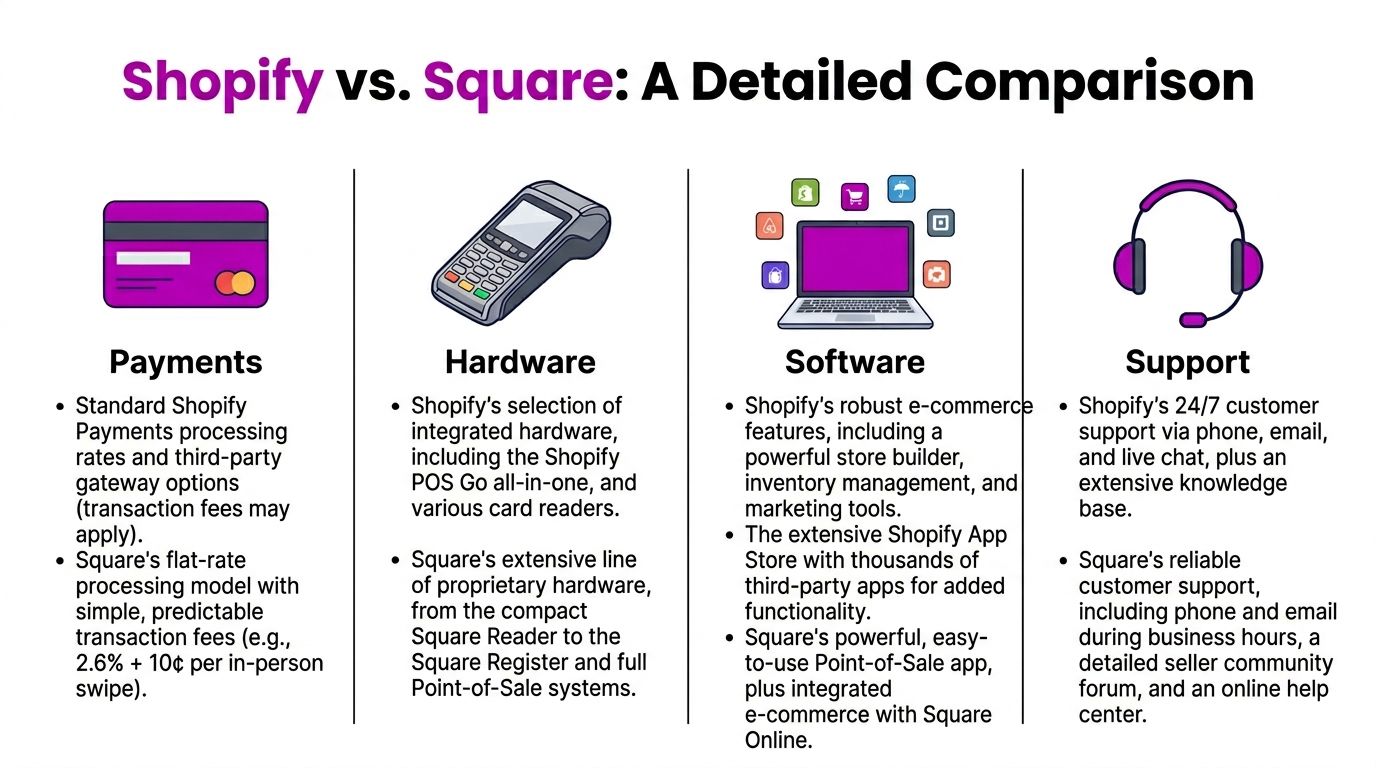
Payments and transaction flow
Payments are usually where merchants start comparing platforms, but the key question is not just rates. It is control.
Square makes payments easy to start. For many small operators, that low-friction setup is the reason it wins early. You can get hardware quickly, accept cards in person, and avoid a complex implementation cycle.
Shopify’s payment advantage shows up more clearly when online and offline sales need to work together under one commerce system. In the background, that changes how orders, customer profiles, reporting, and inventory behave.
For merchants trying to understand platform economics beyond sticker price, it helps to review how transaction costs stack up in practice across channels and plans: Shopify fees per sale.
POS software and hardware reality
Square is strong when POS is the main event. Retailers, cafes, food operators, and appointment-based businesses often find the interface simple and practical. Staff training tends to be easier because the workflows were designed around in-person transactions first.
Shopify POS becomes more compelling when the store is one channel inside a broader commerce operation. That is especially true if the same catalog, customers, and promotions need to flow between retail and online without patchwork tools.
A useful way to frame it is this:
| Area | Shopify | Square |
|---|---|
| Core strength | eCommerce-first commerce system | POS-first in-person selling |
| Best fit | Brands scaling online and omnichannel | Local and physical-first businesses |
| Operational model | Unified commerce environment | Strong POS with add-on online tools |
| Scaling challenge | More setup upfront for simple local sellers | More fragmentation as eCommerce complexity grows |
eCommerce capability and ecosystem depth
For online selling, Shopify is the stronger platform.
Its advantage is not one flashy feature. It is the depth of the ecosystem and the way core commerce work fits together. Shopify’s POS architecture gives merchants 22% lower total cost of ownership on average and 37% lower implementation and integration costs compared with fragmented solutions like Square, according to this comparison of Shopify and Square architecture.
That number matters because the hidden cost in commerce stacks is often not subscription fees. It is the ongoing work required to make disconnected systems behave like one system.
In practice, Shopify is usually the better fit when merchants need:
- A stronger storefront experience
- More flexibility in merchandising
- Broader app and integration options
- A cleaner path to omnichannel reporting
- Fewer workarounds as complexity increases
Square can absolutely support online sales. The question is whether it supports the kind of online operation you plan to run a year from now.
Fee structure and hidden cost patterns
Merchants often focus on monthly plan prices and overlook labor cost, implementation cost, and maintenance cost.
That is where many “cheaper” setups stop being cheaper.
A stack can look efficient on paper and still create avoidable cost through:
- Manual catalog updates
- Duplicate discount configuration
- Reconciliation between channels
- Connector apps
- Support work when sync breaks
- Staff confusion over the source of truth
This is why the lowest entry cost and the lowest long-term operating cost are rarely the same thing.
The right fee analysis includes software, transaction flow, integration overhead, staff time, and the cost of fixing errors created by disconnected systems.
If you run a single location with a simple product mix, Square may stay efficient for a long time. If you are managing online growth, multiple channels, richer merchandising, or more advanced retention work, Shopify’s cost profile often becomes easier to justify because it reduces operational drag.
How to Integrate Shopify and Square The Messy Middle
A lot of merchants do not want to choose. They want Shopify for online growth and Square for the store, event circuit, service desk, or restaurant counter.
That setup is possible. It is just rarely clean.
There is no deep native Shopify and Square integration that gives most merchants a true single source of truth out of the box. To make both systems coexist, merchants typically rely on connectors, middleware, or automation tools. Before doing that, it helps to understand the broader trade-offs involved in a payment gateway integration guide.
What usually breaks first
Inventory is the first pain point.
One system records the sale immediately. The other catches up later, or only after a sync job runs. If the catalog is small and sales volume is modest, you can often live with that. Once volume rises, delays turn into customer-facing problems.
The common failure patterns look like this:
- Overselling: an item sells in person and remains available online
- Catalog drift: variants, bundles, or pricing differ across systems
- Return confusion: staff cannot easily see original channel context
- Reporting mismatch: sales totals align, but inventory movement does not
- Multi-location headaches: stock adjustments happen in one place but not the other
Shopify’s inventory tools natively integrate with major sales channels and support over 2,000 apps for automation, while Square Online struggles with inventory management beyond a few hundred items and has around 250 integrations, based on this Shopify vs Square Online analysis.
Workarounds that can work
The hybrid route can work if you constrain complexity.
In practice, the merchants who manage this best usually do three things well:
Choose a system of record
One platform owns the master catalog, canonical stock levels, and pricing rules. The other receives synced data.Keep the catalog clean
If SKUs, variants, naming conventions, and tax logic are messy before integration, middleware will amplify the mess.Limit edge cases
Bundles, pre-orders, custom products, timed promotions, and location-specific stock rules create failure points fast.
If you plan to run Shopify and Square together, decide first which system owns products, inventory, and customer records. Do not let teams make that decision ad hoc.
A hybrid setup is usually most survivable for merchants with simple catalogs, clear process discipline, and a genuine operational reason to keep both platforms.
Here is a useful walkthrough of the broader challenge and what merchants often underestimate in mixed-stack setups:
When the messy middle stops making sense
At some point, using both systems becomes a tax on the business.
That moment often arrives when a merchant adds more locations, expands the product range, launches new channels, or starts relying on cleaner customer data for retention and forecasting.
When that happens, the question changes from “Can we integrate Shopify and Square?” to “Which platform should be the foundation?”
For many scaling brands, that is the right question to ask much earlier.
Action Plans for Your Brand Stage
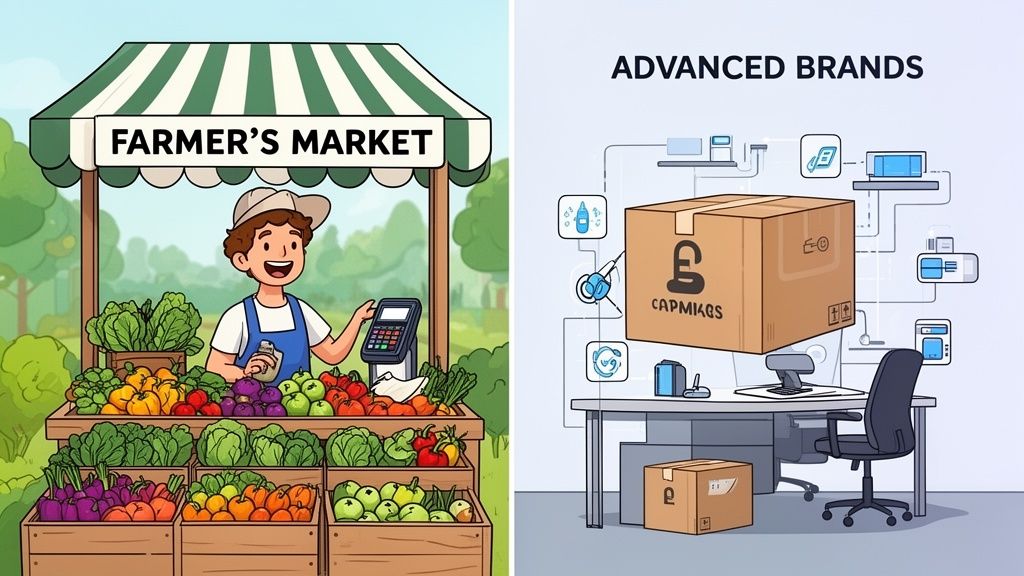
Not every business should make the same choice. The cleanest recommendation depends on your current sales motion, catalog complexity, and where management attention is going each week.
Emerging brands and local operators
Square is often the practical starting point for businesses that are still proving demand in person.
That includes sellers at markets, single-location retailers, early food concepts, and service businesses that need payments and scheduling to work without much technical overhead. If your online store is a support channel rather than the engine of growth, Square keeps the setup lighter.
Choose Square first if most of these are true:
- You sell mainly in person
- Your catalog is simple
- Your staff needs POS simplicity more than merchandising depth
- Your online store is basic and local
- You are still validating the business model
This is especially true when the owner is still operating the counter, handling purchasing, and doing admin personally. In that stage, fewer moving parts usually matters more than platform sophistication.
Scaling eCommerce and omnichannel brands
Shopify becomes the stronger choice when online sales are no longer secondary.
If your business is investing in paid acquisition, lifecycle marketing, subscriptions, merchandising, content, or cross-channel retention, you need a platform that treats commerce as more than checkout plus inventory.
Choose Shopify when the business starts to show these traits:
- Online sales are becoming the main revenue driver
- The catalog is growing in size or complexity
- You need stronger merchandising control
- You sell across more than one digital channel
- Your team needs cleaner customer and order data
- Retail is part of the brand, not the entire business
The key trigger is not just growth. It is operational complexity.
A platform migration should happen before the business outgrows process discipline. Once staff create manual workarounds, migrating becomes harder because you are replacing habits, not just software.
A simple decision filter
If you need a quick internal rule, use this one:
| Situation | Better default |
|---|---|
| Physical-first, local, simple operations | Square |
| eCommerce-first, multichannel, growth-focused operations | Shopify |
| Hybrid but small and process-light | Either can work, with constraints |
| Hybrid and growing complexity | Standardize on one system quickly |
A lot of merchants spend too long trying to preserve optionality. In practice, optionality often means duplicate systems, duplicate process, and diluted accountability.
The right move at each stage is the one your team can run consistently, not the one that promises every feature under the sun.
Advanced CRO and Operational Strategy for Shopify Merchants
Once a brand commits to Shopify, the conversation should move beyond “store setup” and into operational advantage.
That is where many merchants leave value on the table. They install apps, launch campaigns, and tweak themes, but they do not build a system that connects conversion rate optimization, merchandising, customer data, and retail operations.
Use customer data across channels
The biggest strategic upside in Shopify is not that it has POS. It is that in-person and online behavior can support one broader commerce strategy.
That opens up stronger workflows for:
- Segmented retention campaigns
- Location-aware promotions
- Post-purchase upsells
- Clienteling and repeat purchase follow-up
- Merchandising based on channel demand
If a customer shops online, then visits a store, the goal is not just to record both transactions. The goal is to use that history to improve what they see next, what support receives, and how the team plans stock.
Tighten operational loops, not just front-end conversion
CRO is often treated as a landing page exercise. For serious merchants, conversion is downstream from operational quality.
Stock accuracy affects conversion. Fulfillment clarity affects conversion. Faster merchandising cycles affect conversion. Cleaner customer segmentation affects conversion.
That is why Shopify tends to become more valuable as the business matures. The store is not just a storefront. It becomes the commercial center of the operation.
A strong Shopify operating model usually includes:
Clear merchandising ownership
Someone owns collection logic, product storytelling, and promotional hierarchy.App discipline
Apps should solve identified workflow or revenue problems. They should not accumulate because each team wants another shortcut.POS-aware retention planning
In-store purchases should inform email, SMS, loyalty, and replenishment logic where relevant.Inventory confidence
Merchants should trust stock data enough to promote aggressively without fear of avoidable fulfillment issues.
AI and non-traditional retail use cases
Here, old assumptions about Shopify break down.
Recent 2026 trends indicate that 25% of Shopify Plus users are in service-based industries, using the app ecosystem for bookings and appointments, and new Shopify AI tools have been shown to boost CRO by up to 37% for non-traditional retail businesses, according to this Square vs Shopify comparison at NerdWallet.
That matters because many merchants still frame Shopify as a pure product-retail platform and Square as the more flexible option for hybrid service models. In practice, Shopify has become much more adaptable for brands that blend products, bookings, events, education, memberships, or consultation-led sales.
Where merchants usually get it wrong
The most common mistakes are not technical. They are strategic.
Treating POS as separate from CRO
Store transactions should inform customer segmentation and lifecycle marketing.Over-installing apps
A bloated stack creates slower stores, messier data, and support issues.Ignoring search and collection logic
Merchants focus on homepage polish while product discovery remains weak.Running disconnected promotions
Teams launch in-store and online offers that do not align operationally.
The highest-performing Shopify setups are usually boring in the best sense. Data is clean. Ownership is clear. Promotions are mapped before launch. The team knows which system controls what.
What good looks like
A mature Shopify setup usually has one clear source of truth, predictable promotion workflows, disciplined app usage, and reporting that supports action rather than post-mortem explanation.
When that is in place, growth work gets sharper.
Merchants can test bundles, improve collection structure, personalize retention flows, support retail events, launch service add-ons, and push harder on acquisition because the backend can support the promise made on the front end.
That is the difference between using Shopify and operating well on Shopify.
Making the Final Call for Your Business
The decision between Shopify and Square gets easier once you stop treating them as equal substitutes.
They are not.
Square is usually the better fit for physical-first businesses that need accessible POS, straightforward operations, and a quick path to taking payments in person. It works well when the counter is the center of the business and online selling plays a supporting role.
Shopify is usually the better fit for eCommerce-first and growth-focused brands that need stronger merchandising, a broader app ecosystem, cleaner omnichannel operations, and a more scalable foundation for online revenue.
If you are trying to use Shopify and Square together, be honest about the operational cost of preserving both. Mixed setups can work, but they demand process discipline and create friction that many teams underestimate.
The strongest choice is usually the one that aligns with the business you are becoming, not the business you were when you first accepted a card payment or launched a basic website.
For brands serious about scaling their online operation while keeping retail connected, Shopify is the stronger long-term foundation.
If you want expert help choosing the right Shopify architecture, improving conversion, or planning a migration from a fragmented setup, ECORN can help you design a cleaner path to scale.


10 Social Selling Platforms for Shopify Merchants

Shopify Website Design Examples: 7 Stores Worth Studying

7 Ecommerce Newsletter Examples for Shopify Brands
One Product Shopify Store: Build and Scale

Mobile Pop Up Strategy for Shopify Stores That Converts

Sitemap for Shopify: How to Find, Optimize, and Submit It

7 Single Product Websites Worth Emulating

Product Variants Shopify: The Complete 2026 Guide
Ecommerce Analytics Consulting for Growth
What Is AI Integration for eCommerce
How to Choose the Right eCommerce Website Development Firm
E Business Strategy Implementation
Conversion Tracking Setup for Shopify Stores
BigCommerce vs Shopify Plus Which Enterprise Wins in 2026
Shopify Theme Kit: Setup, Commands, and Migration Guide

Shopify Extension Development: A Practical 2026 Guide

Shopify Speed Score Explained and How to Improve It

Shopify Mobile Optimization: The 2026 Playbook

How to Add Subcategory in Shopify for Better UX
How to Implement Structured Data for Ecommerce in 2026

SEO App Mobile: Shopify Store Optimization Guide

Shopify Plus Support: What It Includes and How to Choose

Google Ads for Shopify: The Complete 2026 Playbook

Shopify New York: How to Find and Hire the Right Agency

Google Search Console for Shopify: The Complete Setup
First Party Data Collection for eCommerce Growth
FAQ Online Store Guide: Build and Measure It Right
Do FB Ads Work for eCommerce in 2026?

One Page Checkout for Shopify: Design and Implementation
Shopify GraphQL vs REST: The 2026 Developer Decision
Shopify Ecommerce Consulting: Strategy, Pricing &

Are Reddit Ads Worth It for eCommerce Brands

Shopify Title and Meta Description: A Practical 2026 Guide

Product Video Best Practices for Shopify Brands

Real-Time Inventory Management: A 2026 Guide

AI Chatbot Integration for Shopify Stores

Affiliate Program Management: A Shopify Guide
10 Best Performance Monitoring Tools for Shopify in 2026

Digital Asset Management for eCommerce Brands in 2026

Every Type of Facebook Ads Explained for eCommerce Growth
Product Information Management Explained for Shopify Brands
Support Ticket System: A Guide for Shopify Stores

10 Best Customer Service Tools for Shopify in 2026

Can I Start a Business with No Money? a 2026 Blueprint

What Sells Good on Etsy: Best Niches for 2026

Shopify Add to Cart Button: A Practical 2026 Guide

Customer Feedback Automation: A Practical eCommerce Guide
Critical Rendering Path: A Guide for Shopify Stores

How to Promote on TikTok for eCommerce in 2026

B2B eCommerce Consulting That Drives Real Revenue

10 Best Practices for Site Navigation in 2026
Return vs Refund for Shopify Stores: A Practical Guide

What Is Customer Lifetime Value and Why It Matters
What Is Voice of Customer Research for eCommerce

SMS Marketing for Ecommerce That Actually Converts

Master How to Improve Email Deliverability in 2026

Top 7 eCommerce Partners NYC for Shopify Brands in 2026

Machine Learning for Ecommerce: Boost Your Shopify Store

Beauty Market Research: Your 2026 Growth Guide

Shopify International Expansion: A 2026 Roadmap

What Does CRO Stand for in Business: Understanding CRO

Shopify Visual Merchandising: A Playbook for Higher Sales

Shopify Landing Page Design: Master Conversion in 2026

10 Best AI SEO Optimization Tools for Shopify in 2026

Agentic AI for Ecommerce: Boost Your Sales in 2026
Mastering Email Marketing Data for eCommerce Growth

Conversion Rate Optimisation Australia: Boost Your Sales
Conversion Rate Optimization AI: Your Shopify Store Guide

10 Product Bundling Strategies for Shopify in 2026

How to Increase Customer Lifetime Value: A Shopify Playbook
AI Customer Service Automation: Shopify Guide 2026

Clean Website Design: A Shopify Conversion Playbook

Omnichannel Retail Strategy: A Shopify Playbook

Product Data Enrichment: A Guide for Shopify Brands

Instagram Shopping Features a Guide for Shopify Stores

What Is Revenue Optimization: A Holistic RevOps Guide

Benefits of Conversion Rate Optimization: Boost Your
WordPress to Shopify Migration: Your 2026 Seamless Switch
Boost Sales: Ecommerce Payment Processing Guide 2026
Unified Commerce Platform: Benefits, KPIs & Shopify Guide

How to Reduce Bounce Rate eCommerce: Your 2026 Guide
Shopify API Integration: A Practical End-to-End Guide

How to Implement Data Governance: A 2026 Guide

Shopify Store Development Cost: A 2026 Breakdown
What Is Server Side Tracking: The Shopify Guide 2026
Marketing Automation Workflows: A Shopify Guide for 2026

Shopify: How to Reduce Technical Debt

Shopify UX Design Change: A Playbook for Growth

User Generated Content Strategy: Shopify Playbook

Shopify Pause and Build Plan Cost: A Complete 2026 Guide

Compare at Price on Shopify: A Complete Guide for 2026

Where Can I Sell My Prints? 10 Best Platforms for 2026
Shopify Order Management System: The Ultimate Guide 2026
What Is Marketing Attribution? an eCommerce Guide for 2026

10 Best Black Friday Sales Sheets for 2026

Discover the Top Social Media Marketing Agencies For
Consumer Confidence Definition for eCommerce in 2026

What Is Social Commerce? Your 2026 Guide to Boosting Sales

A Social Ad Campaign Playbook for eCommerce Growth

7 Best FAQ Page Examples for SaaS & eCommerce


newsletter in your inbox