

If you're wondering how to reduce returns, it really boils down to three core areas: nailing your product presentation, smoothing out the post-purchase experience, and building a return policy that actually protects your bottom line. Get these right, and you can transform returns from a massive headache into a goldmine of business intelligence.
We've found that the most effective strategies fall into one of three buckets. Thinking about it this way helps organize your efforts and ensures you're covering all your bases.
Three Pillars for Reducing eCommerce Returns
| Pillar | Key Action | Expected Impact |
|---|---|---|
| Product Presentation | Set crystal-clear expectations with better photos, videos, descriptions, and sizing guides. | Fewer returns due to "not as expected," "wrong size," or "wrong color." |
| Post-Purchase Experience | Improve packaging, provide proactive shipping updates, and offer stellar customer support. | Reduced returns from damaged items, shipping anxiety, and poor service interactions. |
| Smart Policies & Logistics | Design a return policy that balances customer satisfaction with profitability, and streamline reverse logistics. | Lowered operational costs, increased customer loyalty, and valuable data on return reasons. |
By focusing your efforts on these three pillars, you can start making a measurable dent in your return rate almost immediately.
The Hidden Costs of Returns and Why They Matter
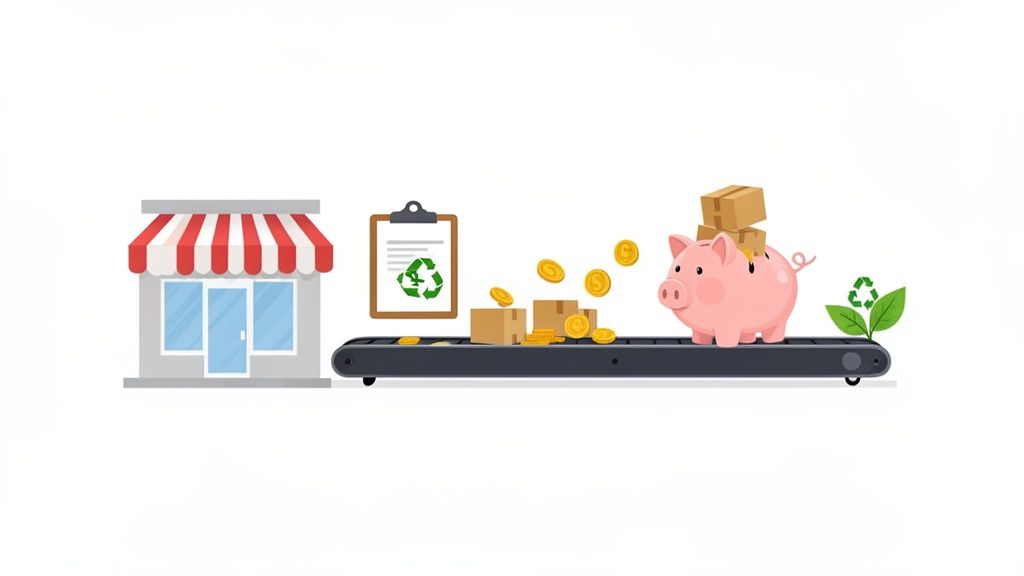
Returns are so much more than a logistical problem—they're a silent killer of profits, customer trust, and operational bandwidth. For most eCommerce brands, the cost of a return label is just the tip of the iceberg. The real damage lies just beneath the surface, in a tangled web of expenses that can quietly sink your margins.
When an item is sent back, it kicks off a whole chain of expensive activities we call reverse logistics. This isn’t just about the shipping cost. It’s the labor for receiving the package, inspecting the item, processing the refund, and—if you’re lucky—restocking it. Every minute your team spends on a return is a minute they aren't spending picking and packing new orders.
The True Financial Impact
The financial bleed from returns goes way beyond just labor and shipping. A high return rate is a blaring alarm bell, signaling that something is broken somewhere in your customer journey—whether it's a misleading product photo or a totally confusing size chart.
The fallout is huge:
- Damaged Inventory: A shocking amount of returned merchandise, especially in fashion or fragile goods, can’t be resold as new. These products get marked down for a quick sale or written off as a total loss.
- Increased Customer Service Load: Every single return creates a support ticket, an email, or a phone call. This buries your support team, which means you either need to hire more people or watch your service quality drop.
- Environmental Toll: Let's be honest, shipping products back and forth isn't great for the planet. The carbon footprint, plus the waste from extra packaging and trashed goods, is something more and more customers are paying attention to.
A high return rate is more than a statistic; it's a direct reflection of a gap between customer expectation and reality. Closing this gap is the foundation of any effective strategy for how to reduce returns.
Shifting from Cost Center to Data Source
Instead of just accepting returns as a cost of doing business, the smartest brands have reframed them as a powerful source of data. Every return is telling you a story. Was the color different in person? Did it show up broken? Was the fit completely off from the chart?
This feedback is pure gold. It gives you unfiltered insights into your product quality, marketing accuracy, and fulfillment process. By treating your return reasons like a treasure trove of data, you can spot patterns and fix the root cause of the problem.
This isn't just about lowering your return rate. It’s about building a better overall customer experience, one that creates loyal fans and drives real, sustainable growth. This guide will give you the practical framework to make that happen.
Building Product Pages That Prevent Returns
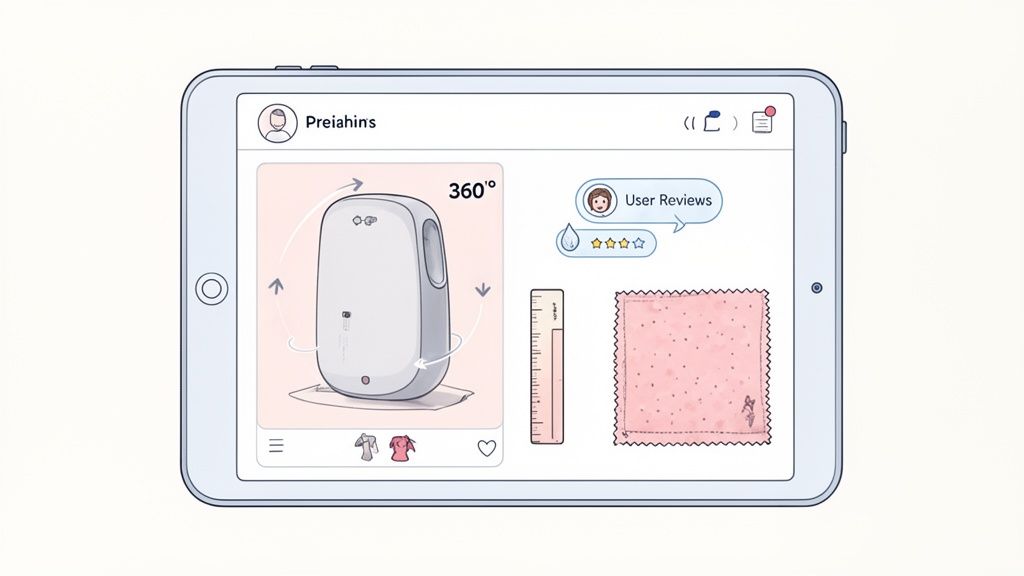
Your product page is the absolute frontline in the battle against returns. It’s where a shopper’s expectations are forged, and it’s your single biggest chance to prevent the disappointment that sends a product right back to your warehouse.
Let's be honest: a return almost always starts with a small gap between what a customer imagined and what actually landed on their doorstep.
Closing this “expectation gap” isn’t just a good idea; it's the core of a smart return prevention strategy. This means transforming your product detail pages (PDPs) from simple sales tools into deep, educational resources that build unshakable buyer confidence.
Go Beyond Basic Product Descriptions
A great product description does more than just list features—it anticipates and answers a customer's questions before they even have a chance to ask them. Think about the last time you sent something back. What information was missing from the product page that could have changed your mind? That’s exactly what your copy needs to solve.
Don't just write "100% Cotton." Explain what that actually feels like. Is it a soft, brushed cotton or a crisp, structured poplin? Does it wrinkle easily? This level of detail helps a shopper truly visualize the item in their life, not just on a screen.
- Tell a Story: Frame your product in a real-world scenario. Instead of a generic "water-resistant jacket," try something like, "Our jacket keeps you dry during those unexpected downpours on your morning commute."
- Focus on Benefits: Always connect a feature to a tangible benefit for the customer. "Triple-stitched seams" becomes "Built with triple-stitched seams for extra durability, so you can wear it for years to come."
- Use Bullet Points: Break out key details like dimensions, materials, and care instructions into scannable lists. This makes the most critical information incredibly easy to digest at a glance.
For a deeper dive into what separates a good product page from a great one, check out our complete guide on eCommerce product page design.
Create a Near-Tangible Experience with Rich Media
Words are powerful, but visuals are what truly bridge the gap between the digital browser and the physical world. High-quality imagery isn't a luxury; it's an essential weapon against high return rates.
High-quality product imagery and detailed descriptions are the unsung heroes in battling sky-high eCommerce returns, which climbed to 18% globally in 2025 volumes per recent reports. With fashion at 25%, electronics 10-15%, and averages hitting 19.3-24.5%, poor visuals drive 38% of repackaging headaches. Brands leveraging 360-degree views, zoomable HD photos, and video demos on Shopify see returns plunge 30-35%.
Investing in a robust media strategy is one of the most effective ways to show customers exactly what they're buying.
- 360-Degree Photos: Let shoppers spin the product and inspect it from every conceivable angle. This eliminates surprises.
- High-Resolution Zoom: Allow customers to get up close and personal with textures, stitching, and hardware to verify the quality for themselves.
- Product-in-Use Videos: Show the item in action. A video of a model walking in a dress demonstrates how the fabric moves, while a video of a blender crushing ice proves its power far better than words ever could.
- User-Generated Content (UGC): Featuring photos from real, happy customers adds a layer of authenticity and social proof. It also shows your product on different body types and in various real-life settings.
Be Radically Transparent with Product Details
Nothing erodes trust faster than a customer discovering that their "solid wood" table is actually just veneer. Being brutally honest about your product's specifics isn't just good ethics; it's a non-negotiable tactic for reducing returns.
Clearly communicate material composition, precise dimensions, and any specific maintenance requirements. For electronics, list every included accessory and all compatibility details. For furniture, provide assembly instructions or at least an estimated assembly time right on the page.
To really get to the bottom of what might be causing returns, conducting a profit-driven Amazon listing audit can reveal critical issues on your product pages you may have overlooked. Applying this same auditing mindset to your Shopify store is invaluable.
Ultimately, your goal is to arm shoppers with so much clear, accurate information that they can make a purchase decision with total confidence. When a customer knows exactly what to expect, the chances of post-purchase regret—and a costly return—drop significantly.
Solving Sizing Issues to Reduce Bracketing
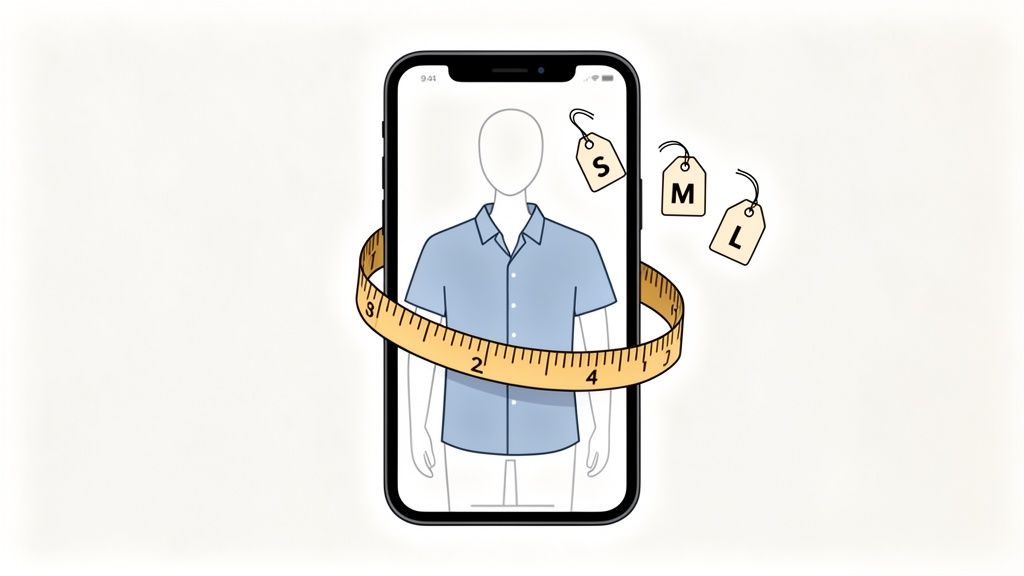
If you're in the apparel or footwear game, you know the drill. Sizing and fit are almost always the top reasons for returns. This is where you run headfirst into a profit-draining customer habit called bracketing.
Bracketing is when a shopper buys the same item in multiple sizes, fully intending to send back the ones that don't fit. It's not that they're trying to cause problems—it's just a logical workaround for online shopping's biggest flaw: uncertainty. If they can't trust that your "Large" fits like another brand's "Large," they'll buy a Medium, Large, and XL to be safe.
The only real way to curb bracketing is to build rock-solid confidence that the first size they choose will be the perfect fit.
Evolving from Static Size Charts to Dynamic Fit Guides
Let’s be honest, the old-school static size chart just isn't cutting it anymore. While having those basic chest, waist, and hip measurements is a decent starting point, it doesn't tell the whole story. It fails to account for different body shapes or how a specific garment is designed to fit.
Your job is to give customers the context they need to choose correctly the first time. It's time to build a dynamic fit guide that goes way beyond a simple table of numbers. This is a direct-fire way to tackle fit-related returns.
- Model Specifications: For every single product, tell your customers the model's height, key measurements, and what size they're wearing. A simple line like, "Model is 5'9" and is wearing a size Small," is pure gold.
- Fit Notes: Use plain language to describe the fit. Is it an oversized cut or true to size? Is the denim rigid or does it have stretch? Think simple, descriptive phrases like, "Features a snug fit; consider sizing up for a more relaxed feel."
- Video Demonstrations: Nothing beats seeing a product in motion. A quick video clip of a model walking or moving in the item shows how the fabric hangs and stretches in a way a static photo never can.
According to a 2022 survey, an eye-watering 63% of online shoppers in the U.S. admitted to 'bracketing'. This habit is a huge contributor to the $890 billion in returns projected for 2025. We've seen Shopify brands get dramatic results by implementing better size guides and AR tools. In fashion, where returns can hit 25-30%, some brands using AI-powered virtual fitting rooms have cut their return rates by up to 40%. One study on AR adoption found clothing returns dropped from 28% to 17% in just six months. You can dig deeper into these eCommerce return trends to see the full picture.
Leveraging AI for Personalized Fit Recommendations
While a better size chart is a huge step forward, the real game-changer is using technology to offer personalized recommendations. AI-powered tools are giving Shopify merchants the ability to create a tailored fitting experience that, until recently, was only possible in a physical store.
These tools plug right into your product pages and use various methods to nail down the perfect size for each individual shopper.
Types of AI Fit Tools:
- Virtual Try-On (VTO): Using augmented reality, VTO tools let shoppers use their phone's camera to see a digital version of an item on their own body. It’s incredibly effective for eyewear and jewelry, and the technology for apparel is getting better every day.
- Fit Recommenders: These are often simpler to implement. The tool asks for a few data points—like height, weight, and the size they wear in a popular brand—and its algorithm suggests the right size for your product.
The image below shows how Shopify Plus is designed to help brands integrate these advanced technologies.
This highlights how the platform is built to handle the complex integrations needed for sophisticated AI fit tools, which are becoming crucial for reducing returns.
The Power of Customer Feedback in Sizing
Never underestimate the best source of sizing information you have: your own customers. Weaving user-generated content and reviews into your sizing strategy provides powerful social proof that many shoppers desperately need.
A review that says, "I'm 5'6" with a 36-inch bust and the Medium fits perfectly," is worth more than a dozen generic five-star ratings.
Here's how to put this into action:
- Update Review Prompts: Tweak your post-purchase review requests. Specifically ask customers to include their height, general body type, and what size they bought.
- Incentivize Detailed Reviews: Offer a little something—a small discount on a future purchase or some loyalty points—for customers who provide these extra details.
- Showcase Fit-Focused Reviews: Use your Shopify review app to filter and feature the most helpful reviews right on the product page. Pin the ones that talk about fit, size, and measurements.
When you combine detailed fit guides with smart technology and real customer feedback, you create a sizing experience that gives shoppers complete confidence. This isn't just about trimming your return rate; it's about building trust and creating customers who come back again and again.
Crafting a Return Policy That Builds Trust and Protects Profits
A great return policy has to walk a fine line. It needs to be generous enough to build shopper trust and get them over the "buy button" anxiety, but also structured enough to prevent abuse and protect your bottom line. I see too many brands treat their policy as a reactive measure, but it's really a proactive tool that can directly help reduce your return rate.
Many stores just slap up a generic, one-size-fits-all policy without realizing how much revenue they're leaving on the table. When done right, your policy can do more than just manage returns—it can actually guide customer behavior, keep sales in-house through exchanges, and even filter out potentially problematic shoppers before they ever click "buy."
Setting Your Return Window and Refund Types
The length of your return window sends a powerful message. A super short window, like 14 days, might create urgency, but I've seen it backfire and increase returns as customers rush to make a decision. On the flip side, a longer window of 30-45 days can reduce this pressure. Counterintuitively, studies show this doesn't always lead to more returns; customers sometimes just forget or grow to like the item.
What’s even more impactful is the type of refund you offer. This is where you can get really strategic.
- Cash Refunds: This is the gold standard for customer satisfaction. Offering a full refund is a massive trust signal, especially for first-time buyers who are still on the fence about your brand.
- Store Credit: A fantastic way to retain revenue. You can easily nudge customers toward this option by sweetening the deal, like offering "a full refund in store credit, plus an extra $10 for your next purchase."
- Exchanges: This is the best possible outcome. Making exchanges the easiest, most appealing option is the key to turning a potential return into a retained sale. If you can make it a one-click process, do it.
The industry-wide eCommerce return rate is projected to hover around 20% in 2026, with online returns being 2-3 times higher than in-store purchases. However, brands that implement clear, time-bound return windows and use automation see significant improvements. For Shopify Plus stores, tools like Loop or ReturnLogic can process refunds 50% faster and recover 15% more merchandise for resale.
A transparent and fair return policy is crucial for building trust. Ensure your customers have access to detailed delivery and returns information so they know exactly what to expect.
Automating and Incentivizing the Right Behaviors
Processing returns manually is a huge drain on your team's time and energy. For any Shopify store that's scaling, modern return management apps are non-negotiable. These platforms do way more than just print labels; they create a customer-facing portal that guides shoppers toward better outcomes for your business.
For instance, a good automated portal can:
- Prioritize Exchanges: It can showcase exchange options for a different size, color, or even a completely different product before ever showing the "refund" button.
- Offer "Bonus Credit": Like I mentioned, it can automatically offer an incentive for choosing store credit over a cash refund. This is a powerful tactic for keeping money within your business.
- Collect Rich Data: It forces customers to select a specific reason for their return, giving you incredibly granular data on why your products are coming back.
This automated approach doesn't just streamline your operations; it actively works to slash the number of cash refunds you issue. It turns a point of friction into a brand-building, revenue-saving experience.
Communicating Your Policy with Absolute Clarity
Your policy is worthless if customers can't find it or don't understand it. Ambiguity is your enemy here—it just leads to support tickets, customer frustration, and a poor brand experience.
Your policy needs to be written in simple, plain language. Ditch the legal jargon and complex sentences. Use formatting like bullet points and bold text to make key terms—like the return window, item conditions, and refund types—impossible to miss.
Where should you display your return policy?
- Footer: A link in your site-wide footer is standard practice. Everyone expects it there.
- Product Pages: A small link or pop-up right next to the "Add to Cart" button can answer a critical pre-purchase question and boost conversions.
- FAQ Page: Have a comprehensive section dedicated entirely to returns and exchanges.
- Order Confirmation Emails: Reinforce the policy right after the purchase is made to set clear expectations.
A well-crafted policy, paired with smart automation and crystal-clear communication, is a cornerstone of any effective return reduction strategy. It aligns what your customers expect with your operational reality, protecting your profits while still delivering an experience that builds loyalty.
For more tips on optimizing the final stages of the customer journey, you might be interested in our guide on scalable eCommerce shipping strategies.
Using Post-Purchase Communication and Packaging to Your Advantage
Your job isn’t over the moment a customer hits “buy.” The space between checkout and delivery is a critical, and often totally overlooked, chance to lock in the sale and head off a potential return.
Smart post-purchase communication and considered packaging are two of the best tools you have for making a customer feel great about their decision and setting the right expectations.
Too many brands treat this phase as pure logistics—just a tracking number and a box. But if you start thinking of it as an extension of the customer experience, you can seriously cut down on returns driven by buyer’s remorse, shipping anxiety, or items damaged in transit. This is your moment to build some real excitement and show them what your brand is all about.
Transform Your Transactional Emails
Your order and shipping confirmation emails have some of the highest open rates you'll ever see. Instead of treating them like a boring receipt, you should be turning them into valuable touchpoints that stamp out buyer's remorse before it even has a chance to set in. The mission is simple: make the customer feel even better about their purchase after they've paid.
This is your opportunity to offer more than just an order summary. You can provide real value and build anticipation.
- Share Product Tips: Did they buy a leather handbag? Send a link to a care guide. A new piece of tech? Link them to a quick-start video.
- Reinforce Value: Gently remind them why they chose your brand. A simple line like, "You're going to love the hand-stitched details on your new jacket," reinforces the quality and backs up their decision.
- Build Excitement: Frame the delivery like an event. Phrasing like, "Get Ready! Your order is on its way," feels way more personal and exciting than a cold "Your order has shipped."
By adding this layer of value, you shift the customer's mindset from anxious waiting to eager anticipation. It’s a simple psychological tweak, but it’s incredibly powerful for stopping returns caused by post-purchase jitters.
The Unboxing Experience Is Your Final Sales Pitch
The second that customer opens their package is a massive moment of truth. The unboxing experience is your last chance to make a killer impression and communicate the real quality of your product and your brand.
A flimsy mailer with a product just tossed inside screams "disposable." It makes a return feel like a casual, no-big-deal decision. On the other hand, thoughtful packaging not only protects the item but also communicates a premium quality that makes someone think twice before sending it back. It’s the physical proof of your brand promise. A well-packaged product feels valuable and cared for.
A thoughtful unboxing experience does more than just look good on Instagram. It’s a direct line of communication with your customer, reinforcing that they made a high-quality choice worth keeping. It is your last, best defense against "not as described" or "quality not as expected" returns.
Designing Packaging That Protects and Impresses
Your packaging really has two main jobs: stop "damaged in transit" returns and reinforce your brand's quality. Picking the right materials is make-or-break for both.
Here’s what we’ve found works best:
- Select the Right-Sized Box: Too much empty space is a recipe for disaster, letting the item get thrown around and damaged. Use filler like crinkle paper or air pillows to keep the product snug and secure.
- Use High-Quality Materials: A sturdy, well-made box just feels more durable and premium. For anything fragile, double-boxing or using custom inserts is a smart investment to prevent expensive damage-related returns.
- Include Branded Inserts: Never underestimate the power of a simple, well-designed postcard. Use it to thank the customer, tell a bit of your brand story, or even offer a small discount on their next purchase. That personal touch makes the whole experience feel less transactional.
At the end of the day, your post-purchase strategy is all about continuing the conversation you started on your product page. By using smart communication to manage expectations and quality packaging to deliver on your promises, you create a seamless and reassuring journey for your customer. This kind of attention to detail doesn’t just slash your return rate—it builds the kind of brand loyalty that brings people back again and again.
Measuring Your Success and Continuously Improving
As the old saying goes, you can't fix what you don't measure. The final, and arguably most critical, piece of your return reduction strategy is building a data-driven system for ongoing improvement.
Just keeping an eye on your store’s overall return rate is a start, but that top-level number rarely tells you the full story. The real breakthroughs happen when you dig into the details. To find solutions that actually work, you need to look past the main metric and get familiar with the "who, what, and why" behind every single package that comes back.
Setting Up Your Key Return Metrics
This is where you move from reacting to returns to proactively preventing them. By tracking your return rate from a few different angles, you'll start to see patterns emerge that point you directly to the source of the problem. Is one marketing campaign attracting the wrong customers? Is a particular SKU a constant headache?
Here are the essential metrics we always tell our clients to monitor:
- Return Rate by Product/SKU: This is your fastest way to flag problem products. If you see a consistently high return rate on one specific item, it's a massive red flag for a quality control issue, a misleading description, or a sizing disconnect.
- Return Rate by Category: This gives you a bird's-eye view. If your "Outerwear" category has a return rate that's double your "T-shirts," you immediately know where to focus your energy and resources.
- Return Rate by Reason Code: This is the goldmine. Capturing specific, honest reasons from customers—like "wrong size," "item not as described," or "damaged in transit"—provides a direct roadmap for what needs to be fixed.
We can't stress this enough: analyzing return reasons is your fastest path to actionable insights. If 40% of your returns are for "wrong size," you don’t have a returns problem—you have a sizing communication problem. Fixing that root cause is infinitely more effective than just processing the returns as they come in.
The journey doesn't end at checkout. Thoughtful post-purchase actions play a huge role in reinforcing a customer's decision and setting the right expectations from the get-go.
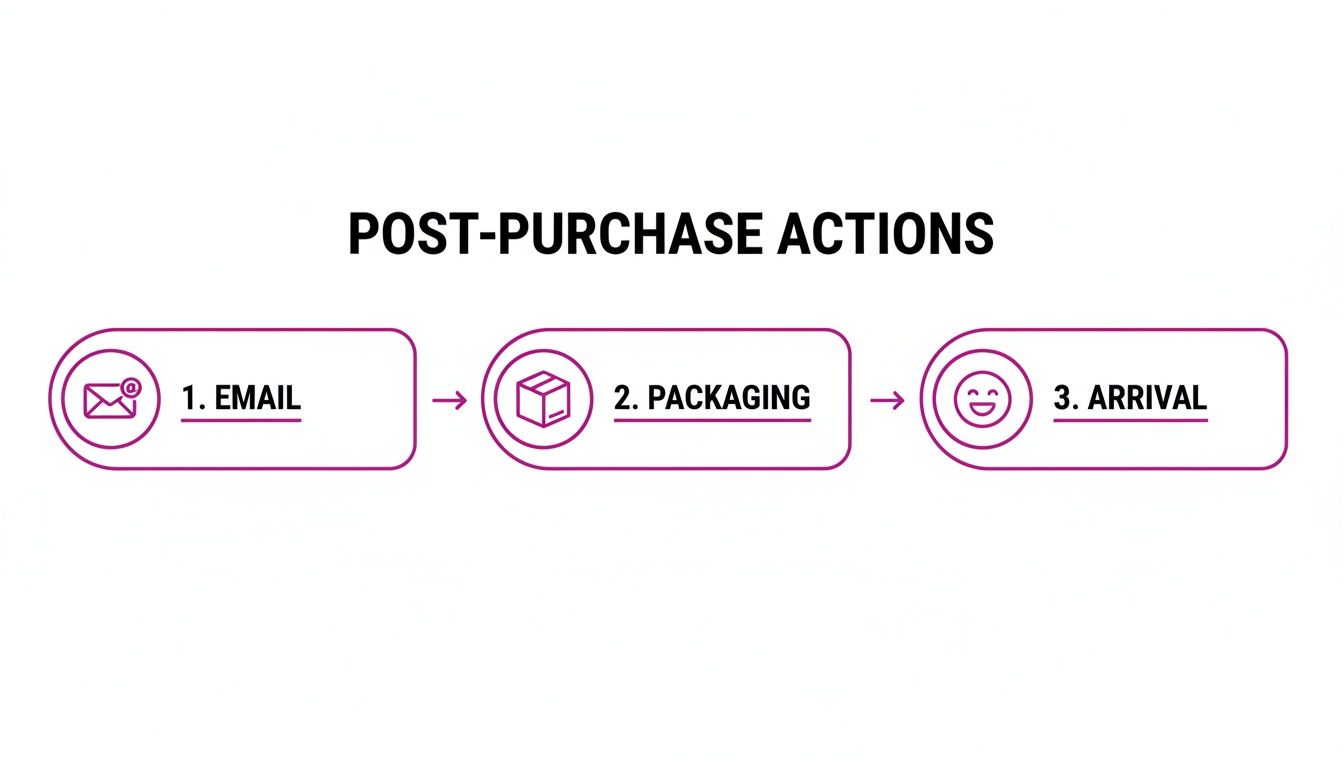
This process, from a clear confirmation email to a delightful unboxing, creates a positive customer experience that builds trust and reduces the likelihood of a return.
Experimenting and Iterating Based on Data
With these insights in hand, you can finally stop guessing and start testing. This is where real progress is made.
Let’s say your data shows that a particular dress has a sky-high return rate, and the top reason is "wrong size." Now you have a clear hypothesis to test. It's time to set up a simple A/B test.
On version A (the control), you'd keep your current size chart and product details. For version B (the test), you could add detailed fit notes like "runs small, consider sizing up," include the model's height and the size she's wearing, and even embed a short video of someone moving in the dress.
Let the test run for a few weeks, then compare the return rates for each version. This systematic approach is how you prove which changes actually move the needle. You can then apply those learnings to other products, continuously refining your pages, policies, and messaging to drive down returns across your entire store.
Frequently Asked Questions About Reducing Returns
As you start digging into your returns strategy, a few common questions always seem to pop up. Let's tackle some of the big ones we hear from eCommerce merchants all the time.
What Is a Realistic Return Rate to Aim For?
This is the million-dollar question, and honestly, there's no single "good" number. Return rates vary dramatically across industries. A fashion brand might see rates of 25% or even higher, while an electronics store could hover around 10-15%.
Instead of getting fixated on an industry benchmark, look at your own data. If you're currently at 22%, a great starting goal could be trimming that down to 18% in the next quarter. The real win is continuous improvement, not hitting some magic number.
A much better goal is to target the reasons for returns. If "wrong size" accounts for half of your returns, focus all your energy there. Success means cutting that specific driver down, which will naturally improve your overall rate.
What Technology Gives the Best ROI for Reducing Returns?
The best return on your investment will always come from tech that solves your biggest, most expensive problem. Before you spend a dime, you need to diagnose your main return drivers from your own data.
Once you know the 'why', you can pick the right tool for the job.
- Sizing Issues: If sizing is the main culprit, AI-powered fit recommenders or virtual try-on (VTO) tools can offer a fantastic ROI. They give shoppers the confidence to choose the right size the first time.
- "Not as Described" Returns: For these types of returns, your best bet is to invest in better product page media. Think about platforms that help you manage user-generated content (UGC) or implement 360-degree product viewers so customers know exactly what they’re getting.
- Operational Headaches: Is your team just drowning in manual returns processing? A returns management app like Loop or ReturnLogic delivers an immediate ROI by automating the entire flow and making it easy to steer customers toward exchanges instead of refunds.
Start with the pain point, then find the technology that offers the most direct solution.
Ready to turn your return data into actionable insights and build a better customer experience? The team of Shopify specialists at ECORN can help you diagnose return drivers and implement strategies that protect your bottom line. Book a call with ECORN today.


BigCommerce vs Shopify Plus Which Enterprise Wins in 2026
Shopify Theme Kit: Setup, Commands, and Migration Guide
Shopify Extension Development: A Practical 2026 Guide
Shopify Speed Score Explained and How to Improve It
Shopify Mobile Optimization: The 2026 Playbook
How to Add Subcategory in Shopify for Better UX
How to Implement Structured Data for Ecommerce in 2026

SEO App Mobile: Shopify Store Optimization Guide
Shopify Plus Support: What It Includes and How to Choose

Google Ads for Shopify: The Complete 2026 Playbook
Shopify New York: How to Find and Hire the Right Agency
Google Search Console for Shopify: The Complete Setup
First Party Data Collection for eCommerce Growth
FAQ Online Store Guide: Build and Measure It Right
Do FB Ads Work for eCommerce in 2026?
One Page Checkout for Shopify: Design and Implementation
Shopify GraphQL vs REST: The 2026 Developer Decision
Shopify Ecommerce Consulting: Strategy, Pricing &

Are Reddit Ads Worth It for eCommerce Brands
Shopify Title and Meta Description: A Practical 2026 Guide

Product Video Best Practices for Shopify Brands
Real-Time Inventory Management: A 2026 Guide

AI Chatbot Integration for Shopify Stores
Affiliate Program Management: A Shopify Guide
10 Best Performance Monitoring Tools for Shopify in 2026
Digital Asset Management for eCommerce Brands in 2026
Every Type of Facebook Ads Explained for eCommerce Growth
Product Information Management Explained for Shopify Brands
Support Ticket System: A Guide for Shopify Stores

10 Best Customer Service Tools for Shopify in 2026

Can I Start a Business with No Money? a 2026 Blueprint

What Sells Good on Etsy: Best Niches for 2026

Shopify Add to Cart Button: A Practical 2026 Guide

Customer Feedback Automation: A Practical eCommerce Guide
Critical Rendering Path: A Guide for Shopify Stores

How to Promote on TikTok for eCommerce in 2026

B2B eCommerce Consulting That Drives Real Revenue
10 Best Practices for Site Navigation in 2026
Return vs Refund for Shopify Stores: A Practical Guide
What Is Customer Lifetime Value and Why It Matters
What Is Voice of Customer Research for eCommerce

SMS Marketing for Ecommerce That Actually Converts

Master How to Improve Email Deliverability in 2026

Top 7 eCommerce Partners NYC for Shopify Brands in 2026
Machine Learning for Ecommerce: Boost Your Shopify Store

Beauty Market Research: Your 2026 Growth Guide

Shopify International Expansion: A 2026 Roadmap
What Does CRO Stand for in Business: Understanding CRO

Shopify Visual Merchandising: A Playbook for Higher Sales

Shopify Landing Page Design: Master Conversion in 2026

10 Best AI SEO Optimization Tools for Shopify in 2026

Agentic AI for Ecommerce: Boost Your Sales in 2026
Mastering Email Marketing Data for eCommerce Growth

Conversion Rate Optimisation Australia: Boost Your Sales
Conversion Rate Optimization AI: Your Shopify Store Guide

10 Product Bundling Strategies for Shopify in 2026
How to Increase Customer Lifetime Value: A Shopify Playbook
AI Customer Service Automation: Shopify Guide 2026

Clean Website Design: A Shopify Conversion Playbook

Omnichannel Retail Strategy: A Shopify Playbook
Product Data Enrichment: A Guide for Shopify Brands
Instagram Shopping Features a Guide for Shopify Stores
What Is Revenue Optimization: A Holistic RevOps Guide

Benefits of Conversion Rate Optimization: Boost Your
WordPress to Shopify Migration: Your 2026 Seamless Switch
Boost Sales: Ecommerce Payment Processing Guide 2026
Unified Commerce Platform: Benefits, KPIs & Shopify Guide
How to Reduce Bounce Rate eCommerce: Your 2026 Guide
Shopify API Integration: A Practical End-to-End Guide

How to Implement Data Governance: A 2026 Guide
Shopify Store Development Cost: A 2026 Breakdown
What Is Server Side Tracking: The Shopify Guide 2026
Marketing Automation Workflows: A Shopify Guide for 2026
Shopify: How to Reduce Technical Debt

Shopify UX Design Change: A Playbook for Growth
User Generated Content Strategy: Shopify Playbook

Shopify Pause and Build Plan Cost: A Complete 2026 Guide
Compare at Price on Shopify: A Complete Guide for 2026
Where Can I Sell My Prints? 10 Best Platforms for 2026
Shopify Order Management System: The Ultimate Guide 2026
What Is Marketing Attribution? an eCommerce Guide for 2026
10 Best Black Friday Sales Sheets for 2026

Discover the Top Social Media Marketing Agencies For
Consumer Confidence Definition for eCommerce in 2026
What Is Social Commerce? Your 2026 Guide to Boosting Sales
A Social Ad Campaign Playbook for eCommerce Growth

7 Best FAQ Page Examples for SaaS & eCommerce

Market Research in Fashion Industry: A Guide for Shopify
Shopify Migration Services: Expert Guide for 2026
Mastering FB Retargeting Ads for Shopify in 2026
What Is Omnichannel Ecommerce

Master Your Shopify Plus Migration: The 2026 Guide
Shopify Integration Services: A Merchant's 2026 Guide
Shopify Collection Description: A Guide to SEO & Sales
Shopify Plus Contact: Reach Sales & Support Effectively

Top Luxury Shopify Stores: Design & UX Strategies
How to Improve Customer Experience: A Shopify Roadmap

Creative Facebook Ads: 10 Examples for Shopify Brands

Remarketing with Facebook Ads: A Shopify Guide for 2026

SEO Linking Strategies for Shopify Stores


newsletter in your inbox